International Journal of Emerging Technology and Advanced Engineering
Website: www.ijetae.com (ISSN 2250-2459,ISO 9001:2008 Certified Journal, Volume 4, Issue 12, December 2014)
542
Trust Based Secure Data Communication in MANET
Priyanka Takalkar
1,
Aaradhana Deshmukh
2University of Pune,India
Abstract— A "mobile ad hoc network" (MANET) is an autonomous system of collection of mobile routers and associated hosts which are connected by wireless links. The routers are free to move randomly and organize themselves arbitrarily, thus the network's topology may change rapidly and unpredictably. For quick data communication, we need a routing protocol that adapts to topology changes. In the MANET environment, any node can maliciously or selfishly disrupt and deny communication of other nodes. In MANET secure data communication is one of the vital issue. For secure data communication route finding and data communication are the two main phases. This work introduces model to enhance security in both phases. We are doing enhancement in the secure data communication in MANET using trust based multiroute routing protocols which ensures secure and undisrupted delivery of transmitted data. A Secure and efficient route to the destination is calculated as a weighted average of the trust value of the nodes in the route. We proposed method here with respect to End to end packet delay, Throughput.
Keywords— Decryption, Encryption, Mobile Adhoc Network, Misbehaving nodes, Route Trust, Secure Data Transmission, Security Algorithms.
I. INTRODUCTION
Mobile ad-hoc network (MANET) is of high research value and wide application prospects. Due to its mobility, dynamic topology, equivalence, self-organizing and other unique features, it has great advantages in emergency communications and military mobile communications. Routing is one of the core issues in mobile ad-hoc network. An effective routing mechanism will be helpful to extend the successful deployment of mobile adhoc network. There are various techniques available for secure data communication from source to destination in manet. In single route routing only single route is available in between source and destination by using that route we can send data from source to destination, but if that route is not available or if connection is failed then we cannot send data from one node to another. There are various routing protocols present in single routing. Multiroute routing protocols are proposed based on the principle that higher performance can be achieved by recording more than one feasible route.
Multiroute routing has been explored in several different contexts. By implementing multiroute routing, data forwarding can continue uninterrupted on other available routes without waiting for finding a new route even if the primary route fails data. In MANET, Multiroute routing protocols are used to provide reliable communication as well as improve quality of service of ad hoc and mobile Network. Multiroute routing allows the establishment of multiple routes between a pair of source and destination node in mobile ad hoc network. It is typically proposed in order to increase the reliability of data communication or to provide load balancing and has received more and more attentions.
II. RELATED WORK
This section analyzes all the existing methods to MANET environment. This method focuses on data security. The SMT (Secure Message Transmission)is well known protocol for data transmission[1]. It is used to safeguard the data transmission against arbitrary malicious behavior of network nodes. SMT for secured data communication provides end to end secure and strong feedback mechanism. SMT uses an active path set comprising node disjoint paths, determined and deemed operational at the source for communication with a specific destination’s disperses each outgoing message, adding limited redundancy to the data and dividing the resultant information into N pieces, which are transmitted across routes one piece per route. Even if the message pieces are lost or corrupted, successful reception of M out of N pieces allows the reconstruction of messages at the destination. The ratio r=N/M is termed the redundancy factor and we denote a dispersed message with redundancy r as an (M, N)
message. There is no link encryption is needed. SMR (Split Multi-path Routing) is discovered maximally
International Journal of Emerging Technology and Advanced Engineering
Website: www.ijetae.com (ISSN 2250-2459,ISO 9001:2008 Certified Journal, Volume 4, Issue 12, December 2014)
543 This protocol focuses on finding secure end to end route. In route discovery phase RREQ packet the trust field is additionally added with other field, when this packet is received at intermediate node then intermediate node rebroadcast the RREQ packet by adding trust value of itself & then finally it send towards destination. Source selects the path with the highest value of the trust level field.
In Multipath DSR Protocol, this protocol uses multipath forwarding approach [11][6].In this each node sends RREQ to other node if it is received from a different path, using this method we are able to identify or avoid misbehaving nodes. When node received RREQ packet it first checked whether it is processed previously if yes then it simply drop the packet. Using this procedure source find the routes to the destination using weighted average of no of nodes and their trust values.
In TDSR, Trust is calculated on combination of direct trust and indirect trust[7]. In this if trust value of node is fall out of a tolerable threshold range that nodes are added to the blacklist. In this when node A send RREQ packet to neighboring node i.e.B then B checks its blacklist whether node A is in it or not, if not then B forwards the packet towards other node.
III. PROPOSED SYSTEM
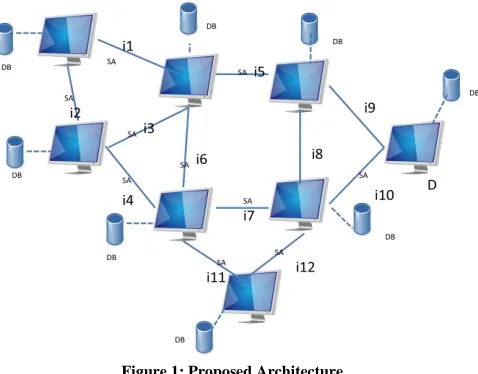
Communications in mobile ad hoc network has two phases i.e. route finding and secure data communication .These both phases focuses on data security. The below
[image:2.612.52.291.467.654.2]diagram shows overall system architecture.
Figure 1: Proposed Architecture
A. Multiple Secure Route Discovery
Multiroute routing consists of finding multiple routes between a source and destination node.
1] Trust Assignment
Trust is an important aspect in mobile adhoc networks (MANET).
T
XYFigure 2: Trust between nodes
TXY is the trust in a node y by node x as Txy and is
given by the following equation,
Txy= W (PA) * PA + W (PP)* PP (1)
Where PA represents the category packet
acknowledgements that maintain a count of the number of
packets that have been forwarded by a node. PP represents
the category packet precision, which preserves a count of the number of packets forwarded correctly. W reflects the weight assigned to that category.
2] Route Discovery at Source Node
By Broadcasting RREQ packet, source initiates route discovery process. RREQ packet contains trust value field.
RREQ: {IPd, IPs, seq num}|| p_trust (2) after broadcasting the RREQ, source is equal to
propagation delay which is generated using formula,
T = 2* TR/ S + C (3)
3] RREQ processing at intermediate nodes
Intermediate node forward the RREQ packet if it received from different node and it adds its trust value to RREQ packet for avoid route loop. For e.g. suppose two nodes A and B in the network. When B broadcasts RREQ packet to node A it updates p_trust field as,
p_trust = p_trust + TAB (4)
4] RREP processing at intermediate nodes
Intermediate node receives the RREP packet if it received from different node and it adds its trust value to RREP packet for avoid route loop. It updates n_trust field as,
n_trust = n_trust + TAB (5)
5] RREP at destination node
International Journal of Emerging Technology and Advanced Engineering
Website: www.ijetae.com (ISSN 2250-2459,ISO 9001:2008 Certified Journal, Volume 4, Issue 12, December 2014)
544 6] Path decision at source node
After finding multiple routes between source and destination, we have to find best route which is trustworthy. When RREP packet reaches to the source node, it calculates route_trust which is the trust value associated with path
route_trust i = ((p_trust + n_trust) / 2) * w i (7)
(route_trust) s-d = max (route_trust i) (8)
Where i is trust value of ith path.
[image:3.612.332.549.180.531.2]Consider the following network,
Figure 3: Ad hoc network
Consider S as a source node and D as destination node. Here source does not have the direct route towards destination. So first S initiates route discovery by sending RREQ to its neighbours. Let us consider RREQ packet reach at D by using route S-A-C-D.Each intermediate node modifies p_trust by adding trust value of the node from which it received the packet. p_trust value is,
p_trust= TAS + TCA + TDC (9)
Now RREP is sent from D to S from the path D-C-A-S. Now n_trust will also updated by intermediate nodes. n_trust will be,
n_trust= TCD + TAC + TSA (10)
Route_trust i = ((p_trust + n_trust) / 2) * w i (11)
Route_trust S-D= ((TAS + TCA + TDC + TCD +TAC +TSA)/ 2) *
w i (12)
B. End to End data security
1] Encryption Process
Encryption is the process of encoding information in such a way that other cannot read it, but only authorized parties can. Message is divided, encrypted and forwarded through secure multiple route. The proposed algorithm is an symmetric algorithm.
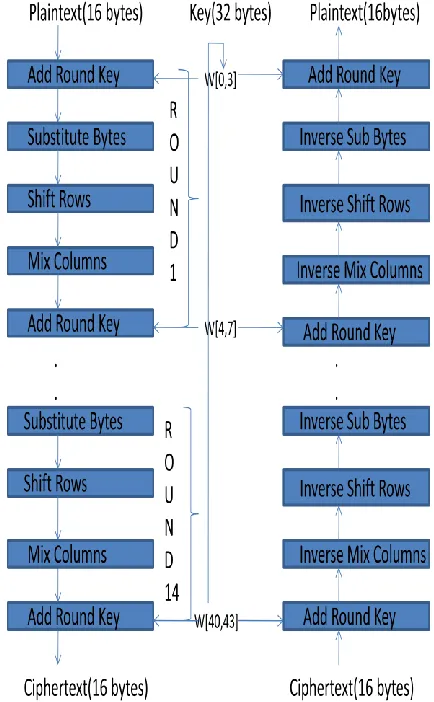
[image:3.612.52.266.219.403.2]Based on the length of the cipher key 10, 12, 14, round keys are generated. The input for this algorithm is 128bit.Then key size is 32byte.Steps in encryption and decryption process is as follows,
Figure 4: Encryption & Decryption Process
2]Substitute Byte Transformation
AES defines a 16*16 matrix of byte values called S box that contains a permutation of all possible 256 bit values.The leftmost 4 bits of the byte are used as a row value and rightmost 4 bits are used as a column value.These row and column values serve as indexes into the S-box to select a unique 8 bit output value.
3] ShiftRows Transformation
International Journal of Emerging Technology and Advanced Engineering
Website: www.ijetae.com (ISSN 2250-2459,ISO 9001:2008 Certified Journal, Volume 4, Issue 12, December 2014)
545 4] Mix Columns Transformation
[image:4.612.53.282.166.256.2]Each byte of a column is mapped into a new value that is a function of all four bytes in that column.
Figure 5:Mix Columns Transformation
5] AddRoundKey Transformation
This is the last step in algorithm. In AddRoundKey transformation,128 bits of states are bitwise XORed with the 128 bits of the round key.
Decryption Process
Decryption is the reverse procedure of encryption.
IV. RESULTS AND DISCUSSIONS
1] Metrics
To estimate the performance of the proposed method, we use the following metrics:
End to End Delay: time taken by the data packets to reach their respective destination.
Throughput: is the rate of successful packet delivery over a communication route.
2] Performance Analysis
We will compare the performance of standard DSR, Trust based DSR and our proposed system.
[image:4.612.324.576.192.374.2]The end to end delay for all algorithms is presented in figure.
Figure 6: End to end delay
Our proposed method takes less time to reach packets from source to destination than DSR.Because it uses multi route simultaneously and if one of the route is failed the data transmitted to next available routes. Graph shows our proposed method is more trustworthy.
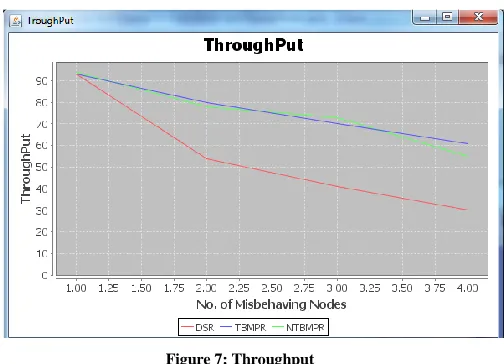
Figure shows throughput for all algorithms.
Figure 7: Throughput
When the system is free from malicious nodes, the throughput is more. Throughput degrades with increase in the number of misbehaving nodes in the network. Our proposed system have high throughput because of multipath feature.
V. CONCLUSION
In this proposed method, we can perform fast and secure routing with the help of trust value of route, also we can provide security using security algorithm. We have shown that our proposed method is much more secure. It is the only method which is able to withstand against attacks in route discovery and communication phases.
REFERENCES
[1] Panagiotis Papadimitratos and Zygmunt J. Haas” Secure Data Transmission in Mobile Ad Hoc Networks” ACM Workshop on Wireless Security September 19, 2003.
[2] Poonam Gera, Kumkum Garg, Manoj Misra, “Trust Based Multi-path Routing for end to end secure data delivery in MANETS”, SIN 10 Proceedings of the 3rd international conference on Security of information and networks, Pages 81-89,ACM, 2010
[3] Jiazi YI, Asmaa ADNANE, Sylvain DAVID, Benoıt PARREIN, “Multipath Optimized Link State Routing for Mobile ad hoc Networks”, published in Ad Hoc Networks 9, 1 (2011).
[4] Rohan Rayarikar,Ajinkya Bokil,”An Encryption Algorithm for End-to-End Secure Data Transmission in MANET ”,IJCA, Volume 56– No.16, October 2012 .
[image:4.612.49.303.549.695.2]International Journal of Emerging Technology and Advanced Engineering
Website: www.ijetae.com (ISSN 2250-2459,ISO 9001:2008 Certified Journal, Volume 4, Issue 12, December 2014)
546
[6] Pissinou, N., Ghosh, T. and Makki, K. 2004. Collaborative trust-based secure routing in multihop ad hoc networks. Networking (Athens, Greece 2004). Lecture Notes in Computer Science, vol. 3042, 1446-1451
[7] Wang, C., Yang, X. and Gao, Y. 2005. A Routing Protocol Based on Trust for MANETs. In Proceeding of Sixth Annual International Conference on Grid and Cooperative Computing (Beijing, China).
Lecture notes in computer science, vol. 3795, 959-964.
[8] B. Pranisa,B.Thanikaivel,, “Fast and Secure Data Transmission in MANET”, International Conference on Computer Communication and Informatics (ICCCI)Jan. 10 – 12, 2012.
[9] Asad Amir, Pirzada, Amitava Datta, Chris McDonald“Trust-Based Routing For Ad-Hoc Wireless Networks”, 12th IEEE international
conference on network,pp 326-330,2004.
[10] Poonam Gera, Kumkum Garg, Manoj Misra, “trust-based Multi-Path Routing for Enhancing Data Security in MANETs”,International Journal of Network Security, Vol.16, No.2, PP.102-111, Mar. 2014 [11] Johnson, D.B Maltz,Jetcheva, J.G 2003, “The dynamic source