comm
en
t
re
v
ie
w
s
re
ports
de
p
o
si
te
d r
e
sea
rch
refer
e
e
d
re
sear
ch
interacti
o
ns
inf
ormation
A first-draft human protein-interaction map
Ben Lehner and Andrew G Fraser
Address: The Wellcome Trust Sanger Institute, Hinxton, Cambridge CB10 1SA, UK.
Correspondence: Andrew G Fraser. E-mail: [email protected]
© 2004 Lehner and Fraser; licensee BioMed Central Ltd. This is an Open Access article distributed under the terms of the Creative Commons Attribution License (http://creativecommons.org/licenses/by/2.0), which permits unrestricted use, distribution, and reproduction in any medium, provided the original work is properly cited.
A first-draft human protein-interaction map
<p>Protein-interaction maps are powerful tools for suggesting the cellular functions of genes. Although large-scale protein-interaction maps have been generated for several invertebrate species, projects of a similar scale have not yet been described for any mammal. Because many physical interactions are conserved between species, it should be possible to infer information about human protein interactions (and hence protein function) using model organism protein-interaction datasets. </p>
Abstract
Background: Protein-interaction maps are powerful tools for suggesting the cellular functions of genes. Although large-scale protein-interaction maps have been generated for several invertebrate species, projects of a similar scale have not yet been described for any mammal. Because many physical interactions are conserved between species, it should be possible to infer information about human protein interactions (and hence protein function) using model organism protein-interaction datasets.
Results: Here we describe a network of over 70,000 predicted physical interactions between around 6,200 human proteins generated using the data from lower eukaryotic protein-interaction maps. The physiological relevance of this network is supported by its ability to preferentially connect human proteins that share the same functional annotations, and we show how the network can be used to successfully predict the functions of human proteins. We find that combining interaction datasets from a single organism (but generated using independent assays) and combining interaction datasets from two organisms (but generated using the same assay) are both very effective ways of further improving the accuracy of protein-interaction maps.
Conclusions: The complete network predicts interactions for a third of human genes, including 448 human disease genes and 1,482 genes of unknown function, and so provides a rich framework for biomedical research.
Background
Physical interactions between proteins underpin most biolog-ical processes. For this reason, large-scale protein-interaction mapping projects have been initiated in several model organ-isms [1-6]. Unfortunately, projects of a similar scale have not yet been described for mammalian systems, with the result that our global understanding of protein function remains less advanced in mammals than in lower eukaryotes. How-ever, many physical interactions are conserved between spe-cies, so it should be possible to infer information about
human protein interactions and protein function using data from model organism protein-interaction datasets [7,8].
To transfer information on gene function between two genomes requires the identification of orthologous genes in the two genomes (that is, genes that are descended from a common ancestor and share biological functions). However, the identification of gene orthologs is often not a trivial prob-lem; gene duplications can result in a single gene having mul-tiple potential orthologs in a second species. In addition, it is
Published: 13 August 2004 Genome Biology 2004, 5:R63
Received: 7 May 2004 Revised: 23 June 2004 Accepted: 20 July 2004 The electronic version of this article is the complete one and can be
necessary to distinguish true gene orthologs from 'out-para-logs' (that is, genes that arose from a gene-duplication event before the divergence of two species, and so are unlikely to share functions) [9]. One method that addresses both these problems is the InParanoid algorithm, which first identifies potential orthologs by best pairwise similarity searches, and then clusters these orthologs into groups of likely co-orthologs, with each ortholog assigned a score representing the confidence that it is the main ortholog [9]. We have used the orthology relationships identified by the InParanoid algo-rithm to construct a putative human protein-interaction map based solely on high-throughput interaction datasets from model organisms. We show that this approach successfully identifies functionally related human proteins, and so can be used to assign putative functions to many novel human genes. The resulting network provides a framework for human biol-ogy and acts as a guide for a future experimental human pro-tein-interaction mapping project.
Results
Generation of a human protein-interaction map
Protein interactions are often evolutionarily conserved between orthologous proteins from different species [7]. Hence we reasoned that a human protein-interaction map could be constructed using data from model organism pro-tein-interaction mapping projects. We obtained the data from seven experimental and four computationally predicted pro-tein-interaction maps from Saccharomyces cerevisiae [1-4,10,11], Drosophila melanogaster [5] and Caenorhabditis
elegans [6]. For each interacting protein, we identified
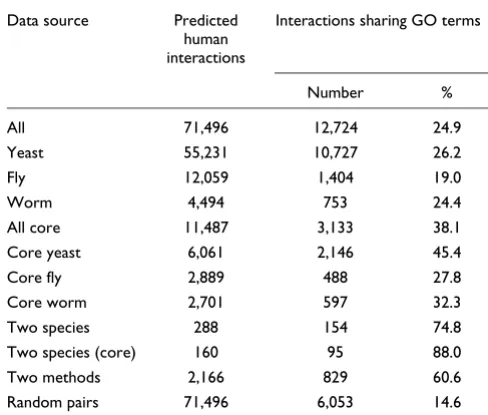
poten-tial human orthologs using the InParanoid algorithm [9]. A human protein interaction is predicted if both interaction partners from a model organism have one or more human orthologs. Using this strategy, we were able to generate a human interaction network comprising 71,496 interactions between 6,231 human proteins. The sources of these pre-dicted interactions are summarized in Table 1 and Figure 1a, and all the interactions are available in Additional data file 1 available online with this article and can also be searched or downloaded from our website [12].
Assessment of the accuracy of the interaction datasets
In the absence of a comprehensive set of verified human pro-tein interactions, we required another method to assess the accuracy of the interaction network. Proteins that interact physiologically are expected to have related functions. There-fore high-quality interaction datasets should predict a greater proportion of interactions between functionally related teins than low quality datasets. The functions of human pro-teins can be systematically described using the Gene Ontology (GO) annotations [13] available from Ensembl [14-17]. GO annotations provide a hierarchical description of gene functions with general functions described by GO annota-tions at the top levels of the hierarchy and very precise func-tions described by terms deeper in the hierarchy. Because
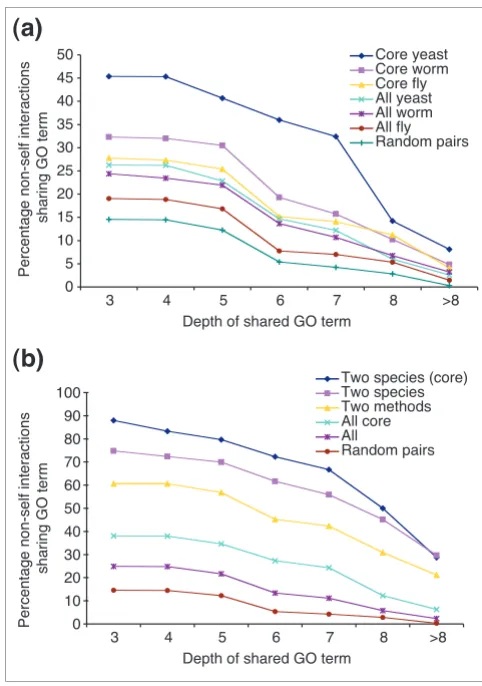
[image:2.612.313.557.131.339.2]physiologically interacting proteins are expected to have related, but non-identical functions, they are expected to share some, but not all GO annotations. Therefore, one method to evaluate an interaction dataset is to count the pro-portion of interactions that connect proteins that share com-mon GO terms [5]. For the complete predicted human interaction network, 25% of interaction partners share at least one GO term, which is many more than observed with a randomly generated network of the same size (15% of interac-tions). To confirm that this result did not just apply to quite general GO annotations, we calculated the proportion of interaction partners that share GO annotations at depths 3 to 8 and greater than 8 in the GO hierarchy. We found that the predicted interaction network preferentially connects pro-teins that share GO annotations at any level of the GO hierar-chy (see Figure 2). This suggests that the interaction network indeed preferentially connects functionally related human proteins.
Table 1
The number and accuracy of human protein interactions pre-dicted by different model organism protein-interaction datasets
Data source Predicted human interactions
Interactions sharing GO terms
comm
en
t
re
v
ie
w
s
re
ports
refer
e
e
d
re
sear
ch
de
p
o
si
te
d r
e
sea
rch
interacti
o
ns
inf
ormation
We then used the same strategy to compare the accuracy of human interactions predicted by data from the three different model organisms. If the interactions from a particular model organism dataset predict fewer interactions between func-tionally related human proteins than the other datasets, then this dataset should be considered less reliable as a source of
[image:3.612.311.552.84.427.2]Sources of predicted human protein interactions Figure 1
Sources of predicted human protein interactions. (a) The number of human protein interactions predicted by the interaction maps from each model organism. (b) The number of human protein interactions predicted by the core higher-confidence interactions from each organism. As explained in the text, core interactions are those that reconfirmed when retested (worm), or had an interaction score of greater than 0.5 (fly) or were identified more than once in a single assay (yeast, worm).
5,990
2,582
2,755
41
89
26
4
Yeast (6,061)
Worm (2,701)
Fly (2,889)
55,064
4,321
11,824
115
100
53
20
Yeast (55,252)
Worm (4,494)
Fly (12,059)
(a)
Complete network (71,496 interactions)
(b)
Core network (11,487 interactions)
Filtering interaction datasets to improve their accuracy Figure 2
Filtering interaction datasets to improve their accuracy.(a) The percentages of interactions sharing GO terms at various depths in the GO hierarchy are compared for interactions predicted by the high-confidence interactions from each model organism (core yeast, core worm and core fly), as well as for the complete datasets from each organism (all yeast, all worm, all fly). For comparison, the percentage of shared GO terms is shown for a randomly generated network of the same size as the complete human network (random pairs). The x-axis indicates the depth in the GO hierarchy being considered, and the y-value the percentage of interaction partners (with known GO annotations) that share GO annotations at this depth or deeper. (b) The percentages of interactions sharing GO terms at different levels in the GO hierarchy are compared for interactions predicted by core interactions in two or more species (two species (core)), by interactions in the complete datasets of two or more species (two species), for interactions predicted by more than one experimental method in yeast (two methods), by any core interaction (all core), by any interaction (all), or by a randomly generated interaction network of the same size as the complete human interaction network (random pairs). All values shown are the percentage of non-self interactions between pairs of proteins that both have at least one associated GO term at the indicated depth in the GO hierarchy.
3 4 5 6 7 8 >8
Percentage non-self interactions
sharing GO term
Core yeast Core worm Core fly All yeast All worm All fly Random pairs
3 4 5 6 7 8 >8
Percentage non-self interactions
sharing GO term
Two species (core) Two species Two methods All core All
Random pairs 0
5 10 15 20 25 30 35 40 45 50
0 10 20 30 40 50 60 70 80 90 100
Depth of shared GO term
Depth of shared GO term
(a)
[image:3.612.57.312.88.650.2]candidate human protein interactions. As shown in Table 1 and Figure 2a, interactions predicted by the complete yeast and worm datasets are slightly better at connecting function-ally related human proteins than those predicted by the fly dataset, suggesting that these interactions can be considered with higher confidence. This result is especially interesting given that the yeast interaction map is an order of magnitude larger than the fly or worm maps, confirming that the fly and worm interaction maps currently have a relatively low coverage.
Next we asked how the confidence in the assignment of gene orthologs affects the accuracy of an interaction. For each pre-dicted interaction, an orthology confidence score was calcu-lated by summing the InParanoid orthology confidence scores for the two human and two model organism proteins (see Materials and methods). Of the predicted interactions, 24,897 have the maximum possible confidence score of 4. Of these interactions, 28%, 24% and 13% connect proteins that share GO terms at depths of 3, 5 or 7 in the GO hierarchy (excluding proteins without GO annotation). In contrast, for interactions with an orthology confidence score less than 4, these figures are 24%, 20% and 10%. Hence we conclude that the predicted human interactions with high-confidence orthology assignments can be considered more reliable than those interactions with less confidence in their orthology assignments. This confirms that the confidence scores assigned using InParanoid are indeed likely to be useful pre-dictors of functional conservation.
A core dataset of high-confidence protein interactions
The worm and fly interaction mapping projects both defined a subset of high-confidence 'core' interactions that have the greatest experimental support (Figure 1b). For the worm interaction map these were defined as interactions identified more than once, or that reconfirmed when retested in the two-hybrid assay [6]. In the fly interaction map each interac-tion has an associated confidence score, and interacinterac-tions with a score greater than 0.5 are considered core interactions (the interaction score mainly depends upon the number of times each interaction was detected, the total number of interactions made by each protein and the local network clus-tering; see [5]). To generate a similar subset of yeast protein interactions, we defined core yeast protein interactions as those identified more than once by any single assay, consist-ent with previous analyses of the individual datasets [1-3,11]. As shown in Figure 2a and Table 1, for all three species these core interactions predict a greater proportion of human inter-actions that share GO terms than the total datasets. Indeed all three core interaction maps are of similar accuracy, so we combine their predicted interactions into a core network of 11,487 higher-confidence human protein interactions (sum-marized in Table 2 and available as Additional data file 2). Of these core interactions, 38%, 35% and 24% connect proteins that share GO terms at depths of 3, 5 or 7 in the GO hierarchy (excluding proteins with no GO annotations).
Combining interaction datasets to generate high-confidence networks
It has been shown previously that protein interactions detected by more than one high-throughput interaction assay are more accurate [11]. We find that this is also true for human protein interactions predicted by yeast protein inter-actions detected by more than one method (see Figure 2b and Table 1). It has also been suggested that protein interactions are more likely to represent physiologically important inter-actions if they have been detected between orthologous pro-tein pairs from two or more species [7,18]. To test this hypothesis we identified 288 human protein interactions pre-dicted by interactions in two or more model organisms (Fig-ure 1, Table 1). Remarkably, 75%, 70% and 56% of these interactions share GO terms at depths of 3, 5 or 7 in the GO hierarchy, respectively (Figure 2b). Indeed, for interactions derived from core interaction datasets, these figures rise to 88%, 80% and 67% of interactions. Hence, protein interac-tions predicted by data from multiple species can be consid-ered with very high confidence.
Using the interaction network to predict human gene function
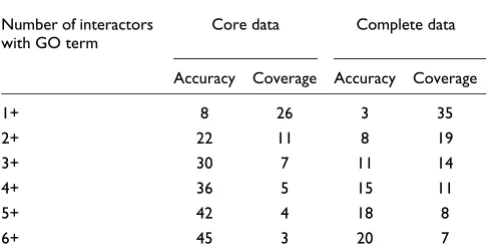
[image:4.612.313.558.133.179.2]Because physiologically interacting proteins often have simi-lar functions (Figure 2), it should be possible to predict the functions of a novel human protein if it interacts with pro-teins of known function. To address how well our interaction map could be used for this purpose, we asked whether the known GO terms of a protein could be predicted using only the GO terms of its interaction partners. As shown in Table 3, GO terms associated with at least one of a gene's core interac-tion partners predict GO terms associated with that gene with an accuracy of around 8%. However, GO terms associated with at least two, three, four or five of a gene's interaction partners have 22%, 30%, 37%, 42% and 45% probabilities, respectively, of also being associated with that gene (Table 3). Although these values may vary for different GO terms, as shown in Additional data file 3, the accuracy and coverage of these GO term predictions are very similar for GO terms at
Table 2
The number of interactions, genes, novel genes and disease genes in the complete and core human interaction networks
comm
en
t
re
v
ie
w
s
re
ports
refer
e
e
d
re
sear
ch
de
p
o
si
te
d r
e
sea
rch
interacti
o
ns
inf
ormation
different levels in the GO hierarchy, and so can be used as an approximate indication of the confidence in a prediction of gene function. Hence the network can be used to predict GO terms for a human gene of unknown function, with the approximate confidence in the GO prediction determined by the number of interaction partners that share the GO term.
The ability to provide a reasonably accurate prediction of a gene's GO terms means that we can use the interaction net-work to provide probabilistic gene function predictions for novel human proteins and also to predict additional functions for proteins with some known functions. The core interaction map contains 864 proteins with no functional annotations. About 10% of these proteins interact with two or more pro-teins that share GO terms. The probabilistic predictions of the functions of these novel proteins are listed in Additional data file 4. Often these predicted functions are also supported by the known functions of the protein domains predicted to be encoded by these novel genes (see Additional data file 4). For example, ENSG00000028310 encodes a bromodomain and interacts with six proteins annotated as 'GO:0006355 regula-tion of transcripregula-tion, DNA-dependent', ENSG00000080608 encodes an RNA-binding domain and interacts with five pro-teins annotated as 'GO:0006364 rRNA processing', and ENSG00000104863 encodes a PDZ domain and interacts with three proteins with the annotations 'GO:0005887 inte-gral to plasma membrane, GO:0007242 intracellular signal-ing cascade' (Additional data file 4). The complete and core interaction maps also predict interactions for 448 and 292
human disease genes (listed in Additional data file 5), of which 55 interact with two or more proteins in the core inter-action network that share a GO annotation. The functional predictions for these 55 genes are listed in Additional data file 6.
Discussion
A framework for human biology
We report here the use of data from model organism protein-interaction mapping projects to predict a network of human protein interactions. This network consists of over 70,000 interactions that connect over one-third of all the predicted human proteins, including 1,482 proteins of unknown func-tion and 448 proteins encoded by human disease genes. The physiological relevance of this network is supported by its ability to preferentially connect human proteins that share biological functions (Figure 2). Indeed the network can be successfully used to predict the functions of a gene using the known functions of its interaction partners (Table 3). As such, the network should provide a rich source of functional hypotheses for researchers interested in the functions of one or many human proteins.
The accuracy and coverage of the interactions predicted in this network depend primarily on two parameters: the quality of the original model organism interaction datasets; and the ability to identify the human orthologs of a model organism protein. Our analysis suggests that the raw yeast and worm protein-interaction datasets are currently slightly more accu-rate than the raw fly interaction dataset, but that when fil-tered for high-confidence interactions the three interaction maps are of very similar accuracy (see Table 1 and Figure 2). The fly and worm interaction maps both have a much lower coverage than the yeast interaction network, most probably because they both only represent the results of a single inter-action-mapping project. The continuation of these model organism protein-interaction mapping projects to generate higher coverage interaction maps will greatly enhance our ability to predict human protein interactions.
[image:5.612.54.299.129.255.2]For the identification of gene orthologs, we used the InPara-noid algorithm. InParaInPara-noid offers several important benefits compared to simple 'reciprocal best hit' sequence-similarity searches [9]. First, many genes from lower eukaryotes have multiple co-orthologs in humans, which can be identified using InParanoid, but not by simple one-to-one sequence-similarity searches. Second, InParanoid can successfully dis-tinguish these true co-orthologs from paralogs that arose before a speciation event (which are unlikely to retain similar functions). Finally, each potential ortholog in a group of co-orthologs identified by InParanoid has an associated score that represents the likelihood that it is the main ortholog of a gene. We have summed these confidence scores to provide an orthology confidence score for each predicted human protein interaction in our network. These high-confidence ortholog
Table 3
The approximate accuracy and coverage of GO terms predicted by the core and complete interaction networks
Number of interactors with GO term
Core data Complete data
Accuracy Coverage Accuracy Coverage
1+ 8 26 3 35
2+ 22 11 8 19
3+ 30 7 11 14
4+ 36 5 15 11
5+ 42 4 18 8
6+ 45 3 20 7
interactions connect a greater proportion of functionally related human proteins, suggesting that the InParanoid con-fidence score is indeed a useful tool for predicting the likely physiological relevance of a predicted protein interaction.
The ability to successfully predict human protein functions using the results of model organism protein-interaction map-ping projects highlights both the relevance of model organism protein-interaction mapping projects to understanding human biology and also the benefits that would result from an experimental human protein-interaction mapping project. Although the interaction network can currently accurately predict only a subset of the known functions of a gene, this should improve as more protein-interaction data becomes available. For this reason, we strongly encourage the continu-ation of model organism protein-interaction mapping projects.
Methods of verifying protein-interaction datasets
We also assessed the relative merits of three different meth-ods to improve the accuracy of protein-interaction maps. The first strategy is to define a subset of interactions detected more than once with a single assay [1-3,6]. We found that this approach leads to an approximately 1.5- to 2.7-fold increase in the proportion of predicted human interactions that share GO terms (Figure 2b). The second strategy is to define a sub-set of interactions that have been identified by more than one interaction assay. This results in around a 2.3- to 8-fold improvement in the prediction of associations between pro-teins that share GO terms (Figure 2b). The final strategy is to define a subset of interactions that are predicted by interac-tions from more than one model organism, which results in around a 3- to 12-fold improvement in the proportion of interactions between proteins sharing GO terms (Figure 2b).
With all these filtering methods, the greatest improvements are seen when considering the proportion of interactions that share GO terms deep within the GO hierarchy; that is, the fil-tering steps dramatically improve the proportion of interac-tions between proteins with very closely related funcinterac-tions. We conclude that using interaction data derived from a second interaction assay or from a second species both represent excellent methods to improve the accuracy of tion maps. Because of the small number of protein-interac-tion assays that have been adapted to a high-throughput format, we suggest that constructing a second interaction map in a related organism using the same assay may be an efficient way to produce a high-confidence interaction map. This strategy is somewhat similar to using phylogenetic foot-printing to identify functional noncoding DNA, so we suggest it should be named 'interaction footprinting'. Using the rela-tively low-coverage model organism interaction datasets currently available, only a small proportion of interactions can be verified by interaction footprinting. The continuation of these model organism interaction mapping projects will not only provide a much richer framework of predicted
human protein interactions, but will also allow many more interactions to be verified using the interaction footprinting strategy. However, such an approach will be limited to pro-viding information on those proteins and interactions that are conserved between vertebrates and invertebrates.
Strategies for completing the human interaction map
The interactions described here provide a first-draft human protein-interaction map that can be used to predict interac-tions and funcinterac-tions for genes of interest to a particular researcher. However, the map also provides a framework from which a complete human protein-interaction map could be generated. Firstly, the map could be used to identify sub-sets of high-confidence, evolutionarily conserved interactions from the results of large- or medium-scale human interac-tion-mapping projects. For example the map verifies 51 of 296 yeast two-hybrid interactions detected for human pro-teins involved in mRNA decay [19]. Alternatively, the interactions predicted here could be directly experimentally validated using an assay that allows rapid testing of binary interactions (such as the yeast or mammalian two-hybrid assays [20] or protein fragment complementation assays [21]). This would represent a cost-effective strategy to pro-duce a high-confidence human protein-interaction map because it massively reduces the number of candidate inter-actions that need to be tested. Finally, the map identifies 17,300 (23,531 - 6,231) human genes for which no protein interactions are predicted from model organism interaction datasets. Many of these proteins are likely to be vertebrate- or mammalian-specific, and are the most logical choices for bait proteins for the discovery phase of an experimental human protein-interaction mapping project.
Materials and methods
Model organism protein-interaction datasets
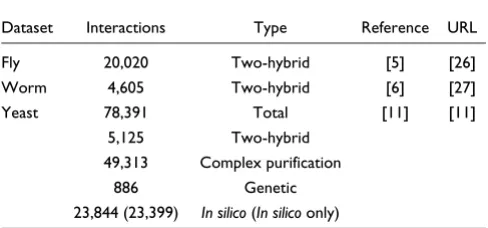
The interaction datasets used to generate the draft human protein-interaction network were two-hybrid-based interac-tion maps for D. melanogaster [5] and C. elegans [6] and a list of S. cerevisiae protein-interactions compiled by Von Mering et al. [11] from two two-hybrid [1,2], two complex purification [3,4], one genetic [10], and four in silico -pre-dicted interaction datasets (which used correlated mRNA expressions, conserved gene neighbourhood, gene co-occur-rence or gene fusion events to predict protein interactions [11]). Table 4 shows the number of unique interactions in each dataset, the methods used to generate each dataset, and the URLs from which the datasets were obtained.
Identification of gene orthologs and construction of the interaction network
comm
en
t
re
v
ie
w
s
re
ports
refer
e
e
d
re
sear
ch
de
p
o
si
te
d r
e
se
a
rch
interacti
o
ns
inf
o
rmation
by best pairwise similarity searches, and then clusters these orthologs into groups of probable co-orthologs, with each ortholog assigned a score representing the confidence that it is the main ortholog. For each interaction data source, we obtained SWISS-PROT/TrEMBL accessions for each inter-acting protein using the Ensmart data-mining tool [16,17] (for worm and fly genes) or both SWISS-PROT [22] and a TrEMBL conversion file kindly provided by Paul Kersey, EBI, Hinxton, UK (for yeast genes). Potential human orthologs of these genes were then identified using the pre-computed InParanoid results (version 2.3, available from [23]), and the results converted to nonredundant Ensembl (v19.34a.1, genome assembly NCBI34) gene IDs using Ensmart (v19.1) 1 [16,17]. In total, InParanoid identifies 9,500 human genes with at least one ortholog in at least one of worm, fly or yeast. For each potential ortholog in a group of co-orthologs, the InParanoid algorithm calculates a score that represents the confidence that it is the main ortholog. In this scoring system, the main ortholog always receives a score of 1, with the other co-orthologs receiving scores ranging between 0 and 1, calcu-lated according to their similarity to the main ortholog [9]. As an indication of the confidence we have in the orthology rela-tionships between a pair of interacting proteins from a model organism and a predicted pair of interacting human proteins, we calculate a confidence score by summing the InParanoid confidence scores for each of the four proteins. Hence, each interaction has an associated score ranging from 0 to 4 that represents the confidence that both human proteins repre-sent the main orthologs of the model organism proteins, and vice versa.
Core interactions were defined as those predicted by worm interactions identified more than once or that reconfirmed when retested in the two-hybrid assay [6], by fly interactions with an interaction score greater than 0.5 [5], or by yeast interactions detected two or more times by a single assay [1-3,11].
Assessment of the interaction data
Human GOs (at levels 3 or deeper in the GO hierarchy) were obtained from Ensembl (v19.34a.1) [14,15] using Ensmart (v19.1) [16,17]. The GO terms 'unknown molecular function/ biological process/cellular compartment' were discarded in all subsequent analyses. To validate the accuracy of the inter-action data, we calculated the percentage of interinter-actions that shared at least one GO term. To confirm that the results did not just apply to very general GO annotations, we calculated the proportion of interacting proteins that shared a GO anno-tation at levels 3 to 8 and greater than 8 in the GO hierarchy. For all of these analyses we ignored proteins with no associ-ated GO annotations. Moreover, self-interactions were excluded because they will always share GO terms and so bias the results.
Prediction of gene functions
To predict the GO terms of a protein, we identified all the GO terms associated with x or more of its interaction partners (where x varied from 1 to 6). To validate the accuracy and cov-erage of this approach we predicted GO terms for genes that already have associated GO terms. The accuracy was calcu-lated as the total number of correct GO term predictions divided by the total number of GO term predictions. The cov-erage was calculated as the total number of correct GO term predictions divided by the total number of known GO terms. This analysis was repeated, but only considering individually GO terms at depths of 3 to 8 and greater than 8 in the GO hier-archy (see Additional data file 3). To avoid biasing the results we again ignored self-interactions. For the same reason, we also only counted once GO terms associated with more than one interaction partner predicted by the same source interac-tion from a model organism. The InterPro protein domains [24] encoded by each human gene were obtained from Ensembl using Ensmart. Genes of unknown function were defined as those having no associated GO terms, and disease genes were as defined by Ensembl using the Online Mende-lian Inheritance in Man (OMIM) database as a reference [25].
Additional data files
The following additional data files are available with the online version of this article: Additional data file 1 contains a complete list of predicted human protein interactions; this dataset contains every human protein interaction that is pre-dicted by a protein interaction from any of seven experimen-tal and four computationally-predicted protein interaction maps from Saccharomyces cerevisiae [1-4,10,11], Drosophila
[image:7.612.54.298.118.232.2]melanogaster [5] and Caenorhabditis elegans [6].
Table 4
Sources of model organism protein-interaction data
Dataset Interactions Type Reference URL Fly 20,020 Two-hybrid [5] [26] Worm 4,605 Two-hybrid [6] [27] Yeast 78,391 Total [11] [11]
5,125 Two-hybrid 49,313 Complex purification
886 Genetic 23,844 (23,399) In silico (In silico only)
The table lists the total number of interactions contained in each model organism dataset, together with the method used to identify
Additional data file 2 contains a list of all core human protein interactions. This represents a subset of high-confidence human protein interactions that is predicted by model organ-ism protein interactions with greater experimental support. In the worm interaction map, these are defined as interac-tions that reconfirmed when retested in the Y2H assay [6]. In the fly interaction map, each interaction has an associated confidence score, and interactions with a score greater than 0.5 are considered core interactions (the interaction score mainly depends upon the number of times each interaction was detected, the total number of interactions made by each protein and the local network clustering [5]). To generate a similar subset of yeast protein interactions, we defined core yeast protein interactions as those identified more than once by any single assay. Each entry in the core and complete inter-action networks contains the following tab delimited infor-mation: Gene 1 Id, Ensembl gene ID for human interaction partner 1; Gene 1 description, alternative names for human Gene 1 (from Ensembl); Gene 2 Id, Ensembl gene ID for human interaction partner 2; Gene 2 description, alternative names for human Gene 2 (from Ensembl); Source Organism, the model organism protein interaction dataset that predicts this human protein interaction; Ortholog 1, model organism interaction partner 1 from the model organism protein inter-action that predicts the human protein interinter-action; Ortholog 2, model organism interaction partner 2 from the model organism protein interaction that predicts the human protein interaction; and Ortholog score, a confidence score for the human protein interaction based on the likelihood that the two human proteins are the functional orthologs of the two model organism proteins. The score ranges from 0 (no confi-dence) to 4 (high conficonfi-dence). The score is calculated as the sum of the Inparanoid confidence scores for each gene orthology assignment. A score of 4 means that both of the human genes and both of the model organism genes are all the main orthologs in their groups of co-orthologs according to Inparanoid. These represent higher confidence human protein interactions. Description, this field contains the orig-inal annotation for the model organism protein interaction; for worm interactions this indicates whether the interaction is in the core dataset of interactions found more than once (CORE_1), or interactions that reconfirmed when retested (CORE_2), or non-core interactions that did not reconfirm (NON_CORE) [6]. For fly interactions this indicates the interaction score. This score mainly depends upon the number of times each interaction was detected, the total number of interactions made by each protein and the local network clustering, see [5] for details. A score >0.5 is consid-ered high confidence. For yeast protein interactions, these are the annotations of von Mering et al. [11] and contain the fol-lowing information: experimental/computation method (and the number of times the interaction was detected); Von
Mer-ing et al.'s confidence assignment; and whether the
interac-tion was previously known in the literature. For more information, please see [11].
Additional data file 3 lists the accuracy and coverage of GO term predictions at different levels in the GO hierarchy; Addi-tional data file 4 lists gene function predictions for 85 human genes of unknown function; Additional data file 5 lists human disease genes with predicted protein interactions; and Additional data file 6 lists gene function predictions for 55 human disease genes.
Additional data file 1
A complete list of predicted human protein interactions A complete list of predicted human protein interactions Click here for additional data file
Additional data file 2
A list of all core human protein interactions A list of all core human protein interactions Click here for additional data file
Additional data file 3
The accuracy and coverage of GO term predictions at different lev-els in the GO hierarchy
The accuracy and coverage of GO term predictions at different lev-els in the GO hierarchy
Click here for additional data file Additional data file 4
Gene function predictions for 85 human genes of unknown function
Gene function predictions for 85 human genes of unknown function
Click here for additional data file Additional data file 5
Human disease genes with predicted protein interactions Human disease genes with predicted protein interactions Click here for additional data file
Additional data file 6
Gene function predictions for 55 human disease genes Gene function predictions for 55 human disease genes Click here for additional data file
Acknowledgements
We thank the Sanger Institute Web Team for construction of the web interface and Paul Kersey for providing a list of TrEMBL accessions for yeast proteins. B.L. is supported by a Sanger Institute Postdoctoral Fellowship and A.G.F is supported by the Wellcome Trust.
References
1. Uetz P, Giot L, Cagney G, Mansfield TA, Judson RS, Knight JR, Lock-shon D, Narayan V, Srinivasan M, Pochart P, et al.: A comprehen-sive analysis of protein-protein interactions in Saccharomyces cerevisiae.Nature 2000, 403:623-627.
2. Ito T, Chiba T, Ozawa R, Yoshida M, Hattori M, Sakaki Y: A compre-hensive two-hybrid analysis to explore the yeast protein interactome.Proc Natl Acad Sci USA 2001, 98:4569-4574. 3. Gavin AC, Bosche M, Krause R, Grandi P, Marzioch M, Bauer A,
Schultz J, Rick JM, Michon AM, Cruciat CM, et al.: Functional organ-ization of the yeast proteome by systematic analysis of pro-tein complexes.Nature 2002, 415:141-147.
4. Ho Y, Gruhler A, Heilbut A, Bader GD, Moore L, Adams SL, Millar A, Taylor P, Bennett K, Boutilier K, et al.: Systematic identification of protein complexes in Saccharomyces cerevisiae by mass spectrometry.Nature 2002, 415:180-183.
5. Giot L, Bader JS, Brouwer C, Chaudhuri A, Kuang B, Li Y, Hao YL, Ooi CE, Godwin B, Vitols E, et al.: A protein interaction map of Drosophila melanogaster.Science 2003, 302:1727-1736.
6. Li S, Armstrong CM, Bertin N, Ge H, Milstein S, Boxem M, Vidalain PO, Han JD, Chesneau A, Hao T, et al.: A map of the interactome network of the metazoan C. elegans.Science 2004, 303:540-543. 7. Matthews LR, Vaglio P, Reboul J, Ge H, Davis BP, Garrels J, Vincent S, Vidal M: Identification of potential interaction networks using sequence-based searches for conserved protein-protein interactions or "interologs".Genome Res 2001, 11:2120-2126. 8. Wojcik J, Boneca IG, Legrain P: Prediction, assessment and
vali-dation of protein interaction maps in bacteria.J Mol Biol 2002, 323:763-770.
9. Remm M, Storm CE, Sonnhammer EL: Automatic clustering of orthologs and in-paralogs from pairwise species comparisons.J Mol Biol 2001, 314:1041-1052.
10. Tong AH, Evangelista M, Parsons AB, Xu H, Bader GD, Page N, Rob-inson M, Raghibizadeh S, Hogue CW, Bussey H, et al.: Systematic genetic analysis with ordered arrays of yeast deletion mutants.Science 2001, 294:2364-2368.
11. von Mering C, Krause R, Snel B, Cornell M, Oliver SG, Fields S, Bork P: Comparative assessment of large-scale data sets of pro-tein-protein interactions.Nature 2002, 417:399-403.
12. The Sanger Institute: Interaction Map [http:// www.sanger.ac.uk/interactionmap]
13. Ashburner M, Ball CA, Blake JA, Botstein D, Butler H, Cherry JM, Davis AP, Dolinski K, Dwight SS, Eppig JT, et al.: Gene ontology: tool for the unification of biology. The Gene Ontology Consortium.Nat Genet 2000, 25:25-29.
14. Birney E, Andrews D, Bevan P, Caccamo M, Cameron G, Chen Y, Clarke L, Coates G, Cox T, Cuff J, et al.: Ensembl 2004.Nucleic Acids Res 2004, 32 Database issue:D468-D470.
15. Ensembl genome browser [http://www.ensembl.org]
16. Ensembl EnsMart genome browser (Martview) [http:// www.ensembl.org/Multi/martview]
17. Kasprzyk A, Keefe D, Smedley D, London D, Spooner W, Melsopp C, Hammond M, Rocca-Serra P, Cox T, Birney E: EnsMart: a generic system for fast and flexible access to biological data.Genome Res 2004, 14:160-169.
comm
en
t
re
v
ie
w
s
re
ports
refer
e
e
d
re
sear
ch
de
p
o
si
te
d r
e
se
a
rch
interacti
o
ns
inf
o
rmation
using proteins involved in vulval development.Science 2000, 287:116-122.
19. Lehner B, Sanderson CM: A protein interaction framework for human RNA degradation.Genome Res 2004, 14:1315-1323. 20. Suzuki H, Fukunishi Y, Kagawa I, Saito R, Oda H, Endo T, Kondo S,
Bono H, Okazaki Y, Hayashizaki Y: Protein-protein interaction panel using mouse full-length cDNAs. Genome Res 2001, 11:1758-1765.
21. Remy I, Galarneau A, Michnick SW: Detection and visualization of protein interactions with protein fragment complementa-tion assays.Methods Mol Biol 2002, 185:447-459.
22. Boeckmann B, Bairoch A, Apweiler R, Blatter MC, Estreicher A, Gasteiger E, Martin MJ, Michoud K, O'Donovan C, Phan I, et al.: The SWISS-PROT protein knowledgebase and its supplement TrEMBL in 2003.Nucleic Acids Res 2003, 31:365-370.
23. InParanoid: database of pairwise orthologs [http://inpara noid.cgb.ki.se]
24. Mulder NJ, Apweiler R, Attwood TK, Bairoch A, Barrell D, Bateman A, Binns D, Biswas M, Bradley P, Bork P, et al.: The InterPro Data-base, 2003 brings increased coverage and new features. Nucleic Acids Res 2003, 31:315-318.
25. Online Mendelian Inheritance in Man [http:// www.ncbi.nlm.nih.gov/entrez/query.fcgi?db=OMIM]