A Comparative Evaluation of Term Recognition Algorithms
Ziqi Zhang, JoséIria, Christopher Brewster and Fabio Ciravegna
Department of Computer Science,
University of Sheffield, Sheffield, S1 4DP
[email protected]
Abstract
Automatic Term recognition (ATR) is a fundamental processing step preceding more complex tasks such as semantic search and ontology learning. From a large number of methodologies available i n the literature only a few are able to handle both single and multi-word terms. In this paper we present a comparison of five such algorithms and propose a combined approach using a voting mechanism. We evaluated the six approaches using two different corpora and show how the voting algorithm performs best on one corpus (a collection of texts from Wikipedia) and less well using the Genia corpus (a standard life science corpus). This indicates that choice and design of corpus has a major impact on the evaluation of term recognition algorithms. Our experiments also showed that single-word terms can be equally important and occupy a fairly large proportion in certain domains. As a result, algorithms that ignore single-word terms may cause problems to tasks built on top of ATR. Effective ATR systems also need to take into account both the unstructured text and the structured aspects and this means information extraction techniques need to be integrated into the term recognition process.
1. Introduction
Automatic Term Recognition (ATR) is an important research area that deals with the extraction of technical terms from domain-specific language corpora. ATR is often a processing step preceding more complex tasks, such as semantic search (Bhagdev et a l . 2007) and especially ontology engineering (Park, Byrd, & Boguraev 2003; Brewsteret al . 2007).
There have been many studies into ATR. In the majority of these studies (Ananiadou 1994; Bourigault 1992; Fahmi, Bouma, & van der Plas 2007; Frantzi & Ananiadou 1999; Wermter & Hahn 2005) linguistic processors (e.g. POS tagger, phrase chunker) are used to filter out stop words and restrict candidate terms to nouns or noun phrases, while in others any n-gram sequences are selected as candidate terms (Deane 2005). Statistical measures are then used to rank the candidate terms. These measures can be categorised into two kinds: measures of ‘unithood’indicating the collocation strength of units that comprise a single term; and measures of ‘termhood’indicating the association strength of a term to domain concepts. For measuring ‘unithood’measures such as mutual information (Daille 1996), log likelihood (Cohen 1995), t-test (Fahmi, Bouma, & van der Plas 2007; Wermter & Hahn 2005), and the notion of ‘modifiability’ and its variants (Caraballo & Charniak 1999; Deane 2005; Wermter & Hahn 2005) are employed. In contrast, measures for ‘termhood’are circumscribed to frequency-based approaches and the use of reference corpora: the classic TFIDF used in (Evans & Lefferts 1995; Medelyan & Witten 2006); the notion of ‘weirdness’as introduced in
(Ahmad, Gillam, & Tostevin 1999), which compares the term frequency in the corpus with its frequency in a reference corpus from a different domain; and measures such as ‘domain pertinence’in (Sclano & Velardi 2007) and ‘domain specificity’in (Kozakovet a l . 2004; Park, Byrd, & Boguraev 2002), which extend and revise ‘weirdness.’ The trend in recent research is to use hybrid approaches, in which ‘unithood’and ‘termhood’are combined to produce an unified indicator, such as ‘C-value’(Frantzi & Ananiadou 1999), and many others (Fahmi, Bouma, & van der Plas 2007; Kozakov et a l . 2004; Park, Byrd, & Boguraev 2002; Sclano & Velardi 2007).
Total number of terms evaluated = 100
Judge TF-IDF Weirdness C-value Glossex Termex Voted
1 0.67 0.8 0.59 0.81 0.93 0.97
2 0.79 0.85 0.69 0.83 0.95 0.97
3 0.77 0.77 0.68 0.83 0.95 0.97
Total number of terms evaluated = 300
Judge TF-IDF Weirdness C-value Glossex Termex Voted
1 0.57 0.81 0.55 0.86 0.9 0.95
2 0.59 0.8 0.56 0.88 0.86 0.96
3 0.64 0.77 0.61 0.88 0.9 0.97
Table 1: Precision of each algorithm evaluated by each judge - Wikipedia corpus
in those domains are more clearly characteristic and specific to that domain. For that reason, we chose two domains for our experiment, i.e., biological domain and a domain ‘closer’ to common knowledge in order to compare the methods.
We firstly selected the GENIA corpus3(Kimet al. 2003) which contains 2000 abstracts totaling 420,000 words selected from National Library of Medicine’s MEDLINE database for the biological domain; for the other domain we manually created a corpus of roughly 1.3 million words consisting of Wikipedia articles describing 1,052 different animals. This was created by extracting only the main textual content from the HTML pages and ignoring any formatting or navigational elements. These corpora were then POS tagged and the linguistic filters described in (Frantzi & Ananiadou 1999) were applied to extract nouns and noun phrases as candidate terms. The candidate list is then filtered by removing stop words. However we do not apply a frequency filter but rather submit the full list of candidates to each algorithm for ranking.
2.4 Evaluation Methodology
The way methods are evaluated in the ATR literature is diverse, ranging from human judges manually assessing a selected section of the output (Frantzi & Ananiadou 1999; Park, Byrd, & Boguraev 2002; Sclano & Velardi 2007), to unsupervised matching of parts of the output against dictionary resources (Deane 2005; Fahmi, Bouma, & van der Plas 2007; Wermter & Hahn 2005). Nevertheless, evaluations have two things in common: first, the majority only measure precision but not recall; second, they evaluate only a subset of the output. Accordingly, our experiments compared precision (and other precision-related metrics) of the top terms returned by the algorithms. For the Wikipedia corpus these are calculated from the judgment of native language speakers. We instructed three judges to manually inspect the top 300 candidate terms produced by each algorithm and mark those they believed to be terms one would expect to encounter when reading texts about animals; for GENIA corpus we extracted the annotations
3
Available at http://www-tsujii.is.s.u-tokyo.ac.jp/~genia/topics/Corpus/
from the corpus as the gold standard terminologies for evaluation. Next we applied two evaluation metrics: ‘classic’ precision measuring the proportion of correct terms to all terms considered; and the Un-interpolated Average Precision (UAP) (Schone & Jurafsky 2001) which averages precision at theithcorrect term out of the total K correct terms in the ranked output considered (cf. Eq. 3).
In Eq. 3,Kis the set of Kcorrect terms in the output, and Pi =i/Hiis precision at ranki, whereHi is the number of
hypothesized terms required to find theithcorrect term.
3. Results
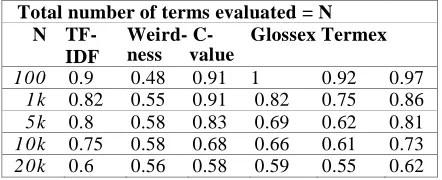
Table 1 and 2 illustrate the precision of each algorithm on each corpus. Table 3 illustrates precision obtained from the experiment on the Wikipedia corpus depending on how strictly inter-annotator agreement was required. We calculated precision of each algorithm under both a strict mode, in which a candidate is counted a correct term only i f all judges agreed, and a lenient mode, in which any candidates marked as correct terms by any judges are counted.
Figure 1 and Figure 2 show the UAP results for each corpus.
Total number of terms evaluated = N N
TF-IDF
Weird- C- Glossex Termex ness value
100 0.9 0.48 0.91 1 0.92 0.97 1 k 0.82 0.55 0.91 0.82 0.75 0.86 5 k 0.8 0.58 0.83 0.69 0.62 0.81 1 0k 0.75 0.58 0.68 0.66 0.61 0.73 2 0k 0.6 0.56 0.58 0.59 0.55 0.62
Table 2: Precision of each algorithm –Genia corpus
k
i i
P
k
11
Strict Leni ent
TF-IDF 0.52 0.66
Weirdness 0.64 0.93
C-Value 0.49 0.66
Glossex 0.82 0.93
Termex 0.83 0.93
Voted 0.93 0.98
Table 3: Precision with respect to inter-annotator agreement Wikipedia corpus, top 300 terms
4. Discussion
In terms of overall precision, our experiments do not produce consistent results from two testing corpus, indicating that domains and quality of corpus do have an impact on the performance of ATR algorithms. Experiment on the Wikipedia corpus shows that Termex performs best among the five algorithms; however the algorithm does not perform so well on the GENIA corpus. Likewise, the C-value algorithm, which has been tested extensively and proved to be effective in biological and medical domains, outperforms the rest on the GENIA corpus but fails on the Wikipedia corpus. This is also due to its specificity to multi-word term recognition, although i t
is an algorithm applicable to single-word units. Manual inspection showed that for the Wikipedia corpus i f considering only the multi-word units (46 out of 100) from the C-value output, the precision is 0.67 under strict mode, and 0.82 under lenient mode.
Using the UAP metric, Termex again outperforms the rest on the Wikipedia corpus, whereas on the GENIA corpus C-value is again the winning algorithm. A high value of UAP indicates that the algorithm produces an even distribution of precision at every correct term on the list, and that i t manages to bring correct terms to the top.
Surprisingly we noticed that TF-IDF produces the second best output from the GENIA corpus. We believe this is due to the high quality of the corpus, as manual inspection shows that the 35% of noun phrases extracted from the corpus are annotated as correct terms.
Experiments also show that using a weighted voting sys-tem does not necessarily improve performance of an ATR algorithm. Test on the GENIA corpus indicates that the per-formance of the voting system does not outperform C-value. However, this may be again caused by the quality of corpus as well as of C-value’s specificity to multi-word terms.
We also manually counted the proportions of single-word terms in the outputs from two testing corpus. For the GENIA corpus, only 11% of gold standard terms are single-word terms. For the Wikipedia corpus, the numbers of single-word terms in the top 100 candidates from each algorithm are 100, 59, 54, 78 and 99 for TFIDF, Weirdness, C-value, Glossex and Termex respectively. Clearly, ignoring single-word terms wil l reduce system recall significantly, while algorithms favouring multi-word terms also suffer from low precision when single-word terms are counted (C-value).
Careful examination of the Wikipedia corpus and the se-lected terms showed that a number of errors were due to fact that the original pages had a certain structure (for example details of the classification of a species in a table on the right hand side of the web page). The elimination of this structure meant that structured data was lost, and some errors of collocation were created largely due to errors of the subsequent POS tagging and noun phrase chunking.
5. Conclusion
In this paper we have compared the performance of five ATR algorithms capable of recognising both single- and multi-word terms on a corpus of animal domain and a corpus of Figure 2: UAP metric for the Genia corpus
compound noun for term extraction. In Proceedings of the First Workshop on Comutational Terminol-ogy(COMPUTERM’98),64–70.
Park, Y.; Byrd, R. J.; and Boguraev, B. 2002. Automatic glossary extraction: Beyond terminology identification. In 19th International Conference on Computational Linguistics - COLING 02. Taipei, Taiwan: Howard International House and Academia Sinica.
Park, Y.; Byrd, R. J.; and Boguraev, B. K. 2003. Towards ontologies on demand. In Ashish, N., and Goble, C., eds., Proceedings of the Workshop on Semantic Web Technolo-gies for Searching and Retrieving Scientific Data. Colo-cated with the Second International Semantic Web Conference (ISWC-03).
Schone, P., and Jurafsky, D. 2001. Is knowledge-free in-duction of multiword unit dictionary headwords a solved problem? In Proceedings of Empirical Methods in Natural Language Processing.
Sclano, F., and Velardi, P. 2007. Termextractor: a web ap-plication to learn the shared terminology of emergent web communities. In Proceedings of the 3rd International Conference on Interoperability for Enterprise Software andApplications (I-ESA 2007). Sinha, R., and Mihalcea, R. 2007. Unsupervised
graph-basedword sense disambiguation using measures of word semantic similarity. In ICSC ’07: Proceedings of the Inter-national Conference on Semantic Computing (ICSC 2007),363–369. Washington, DC, USA: IEEE Computer Society.
Su´arez, A., and Palomar, M. 2002. A maximum entropy-based word sense disambiguation system. In Proceedings of the 19th international conference on Computational linguistics (COLING 02), 1–7. Taipei, Taiwan: Association for Computational Linguistics.