I n t elli g e n t c o n di tio n al
c oll a b o r a tiv e p r iv a t e d a t a s h a r i n g
Bi a n c hi, G, D a r g a h i, T, C a p o ni, A a n d C o n ti, M
h t t p :// dx. d oi.o r g / 1 0 . 1 0 1 6 /j.f u t u r e . 2 0 1 9 . 0 1 . 0 0 1
T i t l e
I n t elli g e n t c o n d i tio n al c oll a b o r a tiv e p r iv a t e d a t a s h a r i n g
A u t h o r s
Bi a n c h i, G, D a r g a h i, T, C a p o ni, A a n d C o n ti, M
Typ e
Ar ticl e
U RL
T hi s v e r si o n is a v ail a bl e a t :
h t t p :// u sir. s alfo r d . a c . u k /i d/ e p ri n t/ 4 9 7 8 6 /
P u b l i s h e d D a t e
2 0 1 9
U S IR is a d i gi t al c oll e c ti o n of t h e r e s e a r c h o u t p u t of t h e U n iv e r si ty of S alfo r d .
W h e r e c o p y ri g h t p e r m i t s , f ull t e x t m a t e r i al h el d i n t h e r e p o si t o r y is m a d e
f r e ely a v ail a bl e o nli n e a n d c a n b e r e a d , d o w nl o a d e d a n d c o pi e d fo r n o
n-c o m m e r n-ci al p r iv a t e s t u d y o r r e s e a r n-c h p u r p o s e s . Pl e a s e n-c h e n-c k t h e m a n u s n-c ri p t
fo r a n y f u r t h e r c o p y ri g h t r e s t r i c ti o n s .
Intelligent Conditional Collaborative
Private Data Sharing
Giuseppe Bianchi, Tooska Dargahi, Alberto Caponi, and Mauro Conti
Abstract With the advent of distributed systems, secure and privacy-preserving data sharing between different entities (individuals or organiza-tions) becomes a challenging issue. There are several real-world scenarios in which different entities are willing to share their private dataonlyunder cer-tain circumstances, such as sharing the system logs when there is indications of cyber attack in order to provide cyber threat intelligence. Therefore, over the past few years, several researchers proposed solutions for collaborative
data sharing, mostly based on existing cryptographic algorithms. However,
the existing approaches are not appropriate forconditionaldata sharing, i.e., sharing the dataif and only if a pre-defined condition is satisfied due to the occurrence of an event. Moreover, in case the existing solutions are used in
conditional data sharing scenarios, the shared secret will be revealed to all
parties and re-keying process is necessary. In this work, in order to address the aforementioned challenges, we propose, a “conditional collaborative
pri-vate data sharing”protocol based onIdentity-Based Encryptionand
Thresh-old Secret Sharing schemes. In our proposed approach, the condition based
on which the encrypted data will be revealed to the collaborating parties (or a central entity) could be of two types: (i) threshold, or (ii) pre-defined policy. Supported by thorough analytical and experimental analysis, we show the effectiveness and performance of our proposal.
Giuseppe Bianchi
CNIT - University of Rome Tor Vergata, Italy, e-mail:[email protected]
Tooska Dargahi
University of Salford, UK, and CNIT - University of Rome Tor Vergata, Italy, e-mail: [email protected]
Alberto Caponi
CNIT - University of Rome Tor Vergata, Italy, e-mail:[email protected]
Mauro Conti
University of Padua, Italy e-mail:[email protected]
1
1 Introduction
New generation networking paradigms, such as Cloud, have made data shar-ing between individuals or organizations easier and simpler than ever before. However, preserving confidentiality and privacy of the shared data (which could be privacy sensitive) is an important and challenging issue in such net-works. This issue becomes more significant with regards to distributed sys-tems, in which different systems might have their own access control policies for the shared data. Therefore, providing an intelligent private data sharing method that allows the involved parties to decide when, to whom, and to what extent they should share their private data is important [9, 13].
Over the past few years, collaborative data sharing has attracted atten-tion of governments, academia, and industry, due to a multitude of real-world applications of such a data sharing need. For example, consider the promo-tion of cyber threat informapromo-tion sharing announced by the US government in 2015 [16]: “In order to address cyber threats to public health and safety, national security, and economic security of the United States, private compa-nies, nonprofit organizations, executive departments and agencies, and other entities must be able to share information related to cybersecurity risks and
incidents and collaborate to respond in as close to real time as possible”. As
another example, consider large-scale disaster recovery scenarios, such as the
WannaCry worldwide ransomware attack in May 2017. In such a scenario,
several crisis information systems belonged to different organizations need to share their private data in order to provide Cyber Threat Intelligence (CTI) to take timely actions [8]. It should be noted that, though in these (and other similar) scenarios, collaborative data sharing is necessary, at the same time, preserving privacy of individuals, and confidentiality of the business data is also important [16]. Therefore, an intelligent and secure privacy-preserving conditional data sharing method should be in place in order to ensure the confidentiality and accuracy of the shared data.
Motivation and Related Work
Recently, researchers have paid more attention to the secure data sharing issue, and proposed various cryptographical or non-cryptographical solutions for private data sharing. This ranges from (just to mention a few) cyberse-curity [13], smart metering [10], cloud computing [25], cross project defect prediction [29] and statistical data analysis [24], to online social networks [17]. Most of them basically preserve privacy of shared data by applying different methods such as data aggregation [24], anonymization [11], obfuscation [29], multi-party computation [10, 13], or proxy re-encryption [18, 22, 27]. We be-lieve that the existing data sharing methods have two limitations: (1)
Scala-bility:they are not scalable in terms of number of datasets, i.e., if the data
encrypted data, he should perform several key agreement procedures withall
the other entities for each dataset. (2)Conditionality: they do not support
conditional data disclosure, i.e., the scenarios in which the collaborating
en-tities are willing to discloseonly a specificset of encrypted dataif and only if
a certain condition holds (e.g., entities identify indications of a global cyber attack).
Moreover, recently some researchers proposed game–theoretic approaches [19, 20]. They consider a game between the attackers and the defenders, based on which they decide the collaboration strategy between different parties. The difference between our solution and game-theoric methods is that we consider a scenario in which the collaborating entities “must” share a specific piece of data due to a previous agreement. However, all the collaborating entities might not be available at the same time. In such a scenario, our solution will help other entities to access that piece of data, while we preserve confiden-tiality of other parts of the dataset. Therefore, the data owner has granular control on the amount of data that is shared in emergency situation.
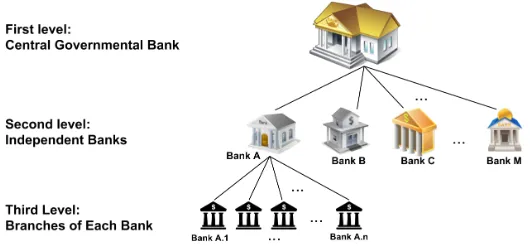
Running example:In order to elaborate more on the problem definition and the importance of scalability and conditionality issues, let us make a small example of a cyber attack scenario. Consider a hierarchical banking system (see Figure 1): in the first (highest) level, there is the country’scentral
governmental bank, whose main role is to provide financial, statistical, and
advisory services to all banks in the country. In the second level (Bank Ato
Bank M in Figure 1), the central offices of all different independent banks
that exist in a country. In the third (lowest) level (Bank A.1 toBank A.nin Figure 1), each bank has a large number of branches in all cities (though we could consider another fourth level for classifying the branches based on the cities, for simplicity we ignore this level). It is normal to imagine that all the branches of one bank share their private data (possibly encrypted) with the central office of the corresponding bank (i.e., entities of the third level share the encrypted data with their parent entity in the second level). This data could be, monetary or non-monetary (e.g., system logs of the users accessing the PCs in each branch). Moreover, due to some reasons (e.g., country-wide cyber attack to banking system) central office of each bank (e.g., Bank A) might need to share its own private data with other banks (Bank BtoBank M
situations. Moreover, considering the fact that each bank might have several different datasets (e.g., security logs, financial reports, software update logs, etc.), for each dataset it requires to consider a secret key and perform a key sharing procedure with all the other entities. Otherwise, in case of considering just one secret key for all the datasets, other entities will have access to other datasets thatBank Ais not actually willing to share.
Fig. 1: Simple overview of the system model
In such scenarios, a scalable, and easy to deploy secret sharing method is required, such that it is independent from the number of involved entities and number of released datasets. A possible solution for the scalability chal-lenge could be utilization of the Attribute-Based Encryption (ABE) [15], or Identity-Based Encryption (IBE) [6] that allow the data owner to specify the data decryptors based on their specific attributes or identities, respectively. However, the conditionality challenge is still unsolved, and to the best of our knowledge there is no solution in the literature (except our preliminary work [3, 4] that are solutions for specific networking use cases and we extend them in the current work).
Contribution
process (which we call themcollaborating entities) construct their ownshare
of a master secrets. We use a distributed key generation scheme proposed by
Pedersen [28], to construct the unique shared master secret s(which is not disclosed to any entity) out of the entities’ shares. The only required coordi-nation between the collaborating entities should take place just once during the global setup phase, in which the entities decide on the dataset name that they are going to generate (we do not consider any limitation on the number of datasets that could be produced).
In order to cope with the “conditionality” challenge, we provide crypto-graphically conditioning by permitting the collaborating entities to decrypt a specific dataset onlyif they satisfy the pre-defined policy and recover the relevant secret key. We apply a fully distributed process by adopting a com-bination of Identity-Based Encryption(IBE) [6], and Linear Secret Sharing
(LSS) [2] (in particular,Threshold Secret Sharing[31]). Our approach permits the reconstruction of the secret key for each dataset (i.e., for each identity)
order to perform analysis of the attack entry point, and in some cases it might be possible to prevent malware spreading on network shares by investigating the vulnerable points extracted from the security logs.
2 Models and Priliminaries
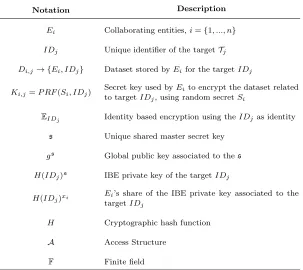
[image:7.612.151.454.307.577.2]In this section we describe our considered system model (Section 2.1), and attack model (Section 2.2), and we explain the assumptions that will be used in the remainder of the paper. Moreover, we provide relevant background information (Section 2.3) about the cryptographical tools that we utilize in the proposed approach. Table 1 reports the notations that we use in this paper.
Table 1: Notation table.
Notation Description
Ei Collaborating entities,i={1, ..., n}
IDj Unique identifier of the targetTj
Di,j→ {Ei, IDj} Dataset stored byEifor the targetIDj
Ki,j=P RF(Si, IDj) Secret key used byEito encrypt the dataset related
to targetIDj, using random secretSi
EIDj Identity based encryption using theIDjas identity
s Unique shared master secret key
gs Global public key associated to thes
H(IDj)s IBE private key of the targetIDj
H(IDj)xi Ei’s share of the IBE private key associated to the
targetIDj
H Cryptographic hash function
A Access Structure
2.1 System Model
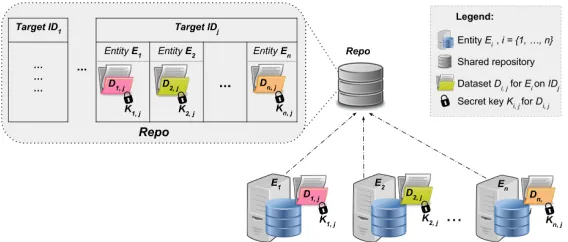
Figure 2 shows a simple overview of the considered system model. We con-sider a set of n independent entities E ={E1, ..., En}, each of which being
recognizable by a unique name or identity. We assume that each entity Ei
dynamically logs information about each possible target Tj from a set of
targets. Note that we do not consider any limit on the number of tracked targets and so no limit for j. Targets are identifiable by a unique identifier
IDj, and choice of the targets is application-dependent, e.g., in the “running
example” in Section 1, a target could be a daily Security Log of a system. The discussion about how a target could be specified is out of the scope of the paper. The target identifier could be any pre-defined string, such as
Se-curity.evtx in our running example. We also assume that each Ei stores at
most one unique dataset Di,j for each target identifier IDj (i.e., each Di,j
is identifiable by a pair {Ei, IDj}). In our model, we do not assume any a
priori agreement between the entities on the targets that they are going to track (i.e., the datasets that they are going to generate), but we assume that datasets/targets are identifiable through their (global) unique identifierIDj
known by all the entities.
Fig. 2: Simple overview of the system model
Data Sharing Model:
As it can be seen in Figure 2, we assume that entities store their“encrypted”
IDj, as primary index, and ii) Entity name (or identifier),Ei, as secondary
index (see top left part of Figure 2).
Moreover, we assume that symmetric (e.g., AES [1]) and asymmetric (e.g., IBE [6]) encryption algorithms, as well as Threshold Secret Sharing [31], and Pedersen key generation [28] schemes are available in the system to be used by the entities. Therefore, we consider each entityEito encrypt the content of
each datasetDi,j, for target identityIDj, using a fast symmetric encryption
method (e.g., AES). To do so, Ei uses a distinct keyKi,j per dataset that
is only known by the entity Ei itself, and is computed using the following
function:
Ki,j =P RF(Si, IDj), (1)
where Si is a random secret chosen by Ei, and P RF is a secure
pseudo-random function. We consider such a key derivation method in order to enable entities to compute per target keys on-the-fly without the need for complex stateful key management methods. Then, each entity sends an IBE-encrypted version of the target-specific key, i.e.,EIDj(Ki,j), to the shared repository.
Furthermore, we assume the Pedersen key generation scheme [28] will be used in the system in order to construct a unique shared master secret s
(which is not disclosed to any entity). And each target Tj with identityIDj
will be associated with an IBE private key H(IDj)s, where H is a
crypto-graphic hash function mapping the IDj into a point of a cyclic group Gp.
Each entityEi is able to compute its ownshare of the master secrets, the
global public keygs, as well as its share of the IBE private key associated to
each target, i.e., H(IDj)xi, where xi is the local per party share (for more
details onxirefer to Section 3.1). All the details regarding the key generation
and sharing is explained in Section 3.
Data Disclosure Model:
Every entity in our model is in charge of evaluating its own status and corre-spondingly deciding when to share the credentials related to one (or more) of its targets, by triggering a“disclosure signal”. In particular, when an entity
Ei decides to disclose its dataset Di,j on the target identity IDj, it sends
its own share, H(IDj)xi, of the IBE private key associated to target IDj.
When the Repo receives required number of private key shares for targetIDj
which satisfy the pre-defined access policy onTj, it will be able to reconstruct
theH(IDj)sand access all the datasetes related to targetIDj generated by
To elaborate more on this matter consider our running example (see Fig-ure 1). Each bank in the third level (e.g., Bank Ai where i ∈ {1..n}) is in
charge of assessing its local security status and storing systemSecurity Log. EachAi upon recognizing an attack indicator, triggers a“disclosure signal”
and sends its own share of the secret related to its encrypted Security Log
(which is identified by Security.evtx identifier) to a high level correspond-ing authority or repository (e.g., Bank A, or even the central bank). Upon reception of sufficient number of key shares on the Security.evtxby the col-laborating entities, the Repo will be able to recover the IBE private key associated to theSecurity.evtxand access theSecurity Logof all the collab-orating banks. Obviously, if an entity Ek (for any reason) does not gather
information about a target Tj, will neither send corresponding dataset Dk,j
to the Repo, nor participate in the disclosure policy ofTj dataset.
2.2 Attack Model
In our attack model, we consider two types of attackers:externalandinternal
attackers. (i)External attackersare the external entities that do not collabo-rate in our protocol. We consider this adversary as aweak attacker, since the only capability of the attacker is eavesdropping the communication between the collaborating entities, and between the entities and the shared repository. A secure protocol against external attacker should not leak any information to the eavesdropper. (ii) In contrary, we consider theinternal attackersto be
strong attackersand our main focus in this work is to strengthen the security
of the proposed scheme against these attackers.
We consider theinternal attackerto be of four types, as we explain in the following.
(1)Untrusted shared repository:We consider the shared repository to be
un-trusted. Therefore, it attempts to gain information about the encrypted datasets that it receives from the entities. A desirable secure protocol should be resistance against this adversary, i.e., a security requirement is that the shared repository “must not” be able to decrypt any of the datasets unless the disclosure condition (the pre-defined policy) is met by the entities.
(2) Honest-but-curious collaborating entities: We assume the collaborating
entities to be honest-but-curious adversaries, meaning that they honestly follow the protocol (as we will explain in Section 3) in generating their own shares of a secret and distributing the required public parameters. How-ever, they are curious to obtain information about other entities’ dataset on the same or different targets. To elaborate more on this attacker consider Figure 2. Assume thatE1 has two datasetsD1,1 and D1,2 on the targets
that E1 is “curious” to access the data stored in D2,1 and D2,3. In this
example,E1andE2both track the targetID1. So, a possible attack from E1 onD2,1is to use its own secret onID1to have unauthorized access to
the D2,1. Another possible attack fromE1 to D2,3, is as follows: assume
that the entities agreed to reveal the dataset related toID1. Now,E1tries
to use the revealed share of theE2’s secret to gain information about the D2,3.
Therefore, two security requirements regarding this attacker are: (a) two entities who track the same target “must not” be able to access each other’s dataset unless the disclosure condition is met; (b) the disclosure of one dataset “must not” reveal any information about another dataset.
(3)Colluding entities:As the third attack, we consider a set of entities where
each of them does not satisfy a dataset disclosure’s condition per se. Hence, they collude with each other to satisfy the disclosure policy (e.g., by send-ing a false “disclosure signal”) in order to have unauthorized access to other entities’ datatset. Now, we have two scenarios: (a) the colluding entitiesdo notsatisfy the disclosure policy, and (b) the colluding entitiessatisfy the disclosure policy. Therefore, security requirement related to this attacker is: a set of colluding entities “must not” be able to access information about the dataset and the master secrets.
(4)Cheating entity on the secret: The last attacker that we consider is an
internal entity that sends a fake/altered shares of the secret secret as its share to the Repo (or other entities) to avoid letting disclosure of its dataset. Therefore, the security requirement is that “no” collaborating entity can submit an incorrect share of a secret.
2.3 Background on the Cryptographic Algorithms
In the proposed scheme, we take advantage of Identity-Based Encryption (IBE), and Linear Secret Sharing (LSS) schemes. In the following we provide required background knowledge on these two schemes.
2.3.1 Identity-Based Encryption
Identity-Based Encryption proposed by Boneh and Franklin [6, 7] is a public key encryption that allows the data owner to encrypt the data using an arbitrary string,ID, (as the public key). This way, any pair of users are able to securely communicate without exchanging any key materials (i.e., public and private keys), and without the need to involve any trusted third party for the key management purpose.
• Setup:takes as input a security parameter; and outputs a set of system
publicparameters,P, and a privatemaster key,M K, that is known only
by the key generator. The system public parameters include a description of a finite message spaceM, and a description of a finite ciphertext space
C.
• Extract:takes as inputP, the master keyM K, and an arbitrary string
ID ∈ {0,1}∗; and outputs a private key SK. In particular, this function
takes the ID as a public key, and extracts the corresponding private key
SK.
• Encrypt:takes as inputP, an ID, and a message m∈ M; and outputs a ciphertext CT ∈ C.
• Decrypt:takes as inputP, a ciphertextCT, and a private key SK; and outputs the messagem.
In an IBE scheme, if SK is a private key that is generated by the Ex-tract algorithm for the stringID as the public key, then the corresponding encryption and decryption functions must satisfy the following consistency constraint:
∀m∈ M:Decrypt(P, CT, SK) =m where CT=Encrypt(P, ID, m)
2.3.2 Linear Secret Sharing
Secret sharing scheme, first introduced by Shamir [31] as threshold secret
sharing, is a building block for several cryptographic methods and secure
protocols, such as attribute-based encryption, and multiparty computation. In a (t, n) “threshold” secret sharing scheme [31], a dealer who has a secret
s, divides the secret into n pieces and distributes shares of his secret to n
parties. Any subset of parties whose cardinality is greater or equal to a pre-defined threshold,t(where 1≤t≤n), can reconstruct thesfrom its shares. However, knowledge of anyt−1 or less shares of the secret reveals“no” in-formation about thes. A generalization of the threshold secret sharing would be distributing the shares ofsbased on an access structureA(i.e., a subset of parties). Such a secret sharing scheme satisfies the following conditions [2]: i) Correctness: any subset of A(authorized parties) can reconstruct the se-cret from its shares; and ii) Perfect privacy: any subset of parties that is not in A (unauthorized parties) cannot gain any information about the secret. A “linear” secret sharing scheme (LSSS) is defined over a finite fieldF. The
dealer chooses a secret which is an element of the F, and the shares of the
secret are vectors overF. The shares are computed using some independent
3 Proposed Approach
Our proposal for conditional collaborative data sharing composed of two phases: 1) offline setup phase, and 2) online credential and dataset man-agement. The main difference between our proposal and the state-of-the-art LSSS [2] thatmight beconsidered by a layman reader as a similar approach for collaborative data sharing is the “conditionality”requirement. This require-ment, as we explained in Section 1 and Section 2 (second attacker model), is that disclosure of a dataset related to target identifierIDj must not reveal
any information related to any other target identifier IDk. Therefore, our
proposal is different from the state-of-the-art in that, in our approach we consideruniquedynamic keys for each target (adopting IBE [6, 7]), that can be defined at runtime. Further, such keys will be mixed with exiting secret sharing schemes in order to provide distributed collaborative data sharing. We explain the details in the following.
3.1 Offline Setup
In the setup phase, the participating entities, Ei where i ∈ {1..n}, share a
secret according to the considered access structure A. The entities agree on the following public parameters:
• Two large primes pandqsuch thatq dividesp−1;
• Anm×`access matrix1Aon the participating entities, representing the specified policy to access the secret;
• A cyclic groupGpof prime orderp, and a generatorg∈Gpfor the group.
The groupGp is specifically chosen as the domain of a non degenerative
bilinear mape:Gp×Gp→GT.
Then, each partyEi performs the following steps:
1. Chooses a random secret σi ∈Zq over the ring of integers modulo prime q;
2. Chooses a random vectorvi∈Zq`withσi as first entry;
3. For each access matrix rowj, computes the sharewi,j=Aj·vi, and sends
(through a secure unicast) it to party associated to the rowj; 4. Computesgσi ∈G
p, and broadcasts it to all entities.
After all, none of the entities knows the shared master secret s, where
s=Pn
i=1σi. Rather, each entity is able to compute the following important
quantities:
1 In general, depending on the access structure, m can be greater than the number of
• Theglobal public keygs=Qn i=1g
σi ∈G
p;
• Thelocal per entity sharexj=P
n
i=1wi,j∈Zq.
The system is secure as long as the master secretsremains unknown to all the involved parties. In essence, the master secret will never be reconstructed, and we will reconstruct quantities of type H(IDj)s, namely identity based
private keys associated to target identityH(IDj).
3.2 Online Credential and Dataset Management
Monitoring a new target:We recall that an entityEiencrypts its dataset
associated to a targetIDj , using a pseudo-random keyKi,j on-the-fly
gen-erated according to (1). Each entity upon deciding to generate a dataset regarding a targetTj, with identityIDj, must deliver suitable cryptographic
information to the shared repository for decrypting the dataset. In order to do so,Ei transmits once-for-all to the Repo (or once everytime it changes its
own secret Si used in Equation (1) an IBE-encrypted version EIDj(Ki,j) of
the keyKi,j. TheEIDj(Ki,j) is constructed using the IBE method [6], where
the identity (IBE public key) is the stringIDj, and the PKG’s public key is
thegsthat is computed in the offline setup phase (Section 3.1). The adopted
IBE equation is as follows:
EIDj(Ki,j) = (g
r, K
i,k⊕H2(e(H(IDj)r, gs))) (2)
where r ∈ Zq is a random value, e: Gp×Gp →GT is the agreed bilinear
map, H :{0,1}∗→G
p is a cryptographic hash mapping a target nameIDj
into a point of the groupGp, andH2:GT → {0,1}his a cryptographic hash
mapping a point of the groupGT into a string of same size as Ki,j.
Dataset disclosure:Whenever an entityEi, desires to share its dataset
related to the target identity IDj with the other entities, it generates a
disclosure signalas follows:
Signali,j=H(IDj)xi ∈Gp (3)
Upon reception of a sufficient number of shares (satisfying the access pol-icy) delivered inside the signals Signali,j for IDj, the repo computes the
coefficientci such that
X
i∈Q
ci·Ai= (1,0, ...,0) (4)
where Q is the set of secret shares for the target IDj received from the
entities, andAiis the row of the access matrix associated to the secret share
their corresponding coefficients, the Repo can reconstruct the IBE private key associated to the targetIDj , i.e.,H(IDj)sas follows:
H(IDj)s= Y
i∈Q
signalci
i,k= Y
i∈Q
H(IDj)cixi=H(IDj)
P
i∈Qcixi (5)
Finally,allthe IBE-encrypted keysK∗,j, used to encrypt each entities dataset,
can be decrypted by computing
H2(e(H(IDj)s, gr)) (6)
Due the properties of bilinear pairings, we have
H2(e(H(IDj)s, gr)) =H2(e(H(IDj)r, gs)), (7)
Considering the Equation (2), we can now recover all the keys (i.e.,K∗,j):
Ki,j⊕H2(e(H(IDj)r, gs))⊕H2(e(H(IDj)s, gr)) =Ki,j (8)
The keysK∗,j now can be used to decrypt all the datasets associated to the
targetIDj. Hence, even the dataset of the entities that have not decided to
share their dataset and have not sent the relevant Signal can be decrypted (due to satisfying the pre-defined access policy during the offline setup phase).
3.3 Security Discussion
In this section, we provide a security analysis of our proposed approach against the considered attack model in Section 2.2. First, considering an
external attacker, eavesdropping could be easily eliminated by assuming a
secure communication channel between each pair of entities, and between an entity and the shared repository. Therefore, our proposed approach is safe against such an attacker.
Regarding aninternal attackerand considered four types of attacks (refer to Section 2.2), we discuss the resilience of our proposed approach against each of these attacks in the following.
3.3.1 Untrusted shared repository
Due to the usage of IBE for encrypting the datasets based on their target identifier (i.e., perIDj), for each dataset we have a unique IBE private key, H(IDj)s. The shared repository (Repo) would only be able to decrypt the
datasets if either thesis disclosed, orH(IDj)shas been reconstructed as a
whole. On the one hand, as we explained earlier, the master secretswillnever
hand, if the shares of the IBE private key,H(IDj)xi, that the Repo receives
do not satisfy the access policy, the Repo would not be able to recover the
H(IDj)s. This feature is due to the usage of LSSS for sharing the master
secret sbetween the collaborating parties. Therefore, the shared repository is not able to decrypt the datasetsunlessa sufficient number of entities send their shares of the IBE private key; hence the proposed approach meets the security requirements related to an “untrusted shared repository” attack.
3.3.2 Honest-but-curious collaborating entities
In Section 2.2 we defined two security requirements. (a) considering any sub-set Ω0 of the entities (unauthorized parties) that are not involved in the dataset disclosure access policy, should not be able to gain any information about the secret [2]. This requirement is satisfied due to the usage of LSSS. Therefore, a malicious entity cannot access other entity’s share and datasets unless the disclosure condition is met.
(b) Based on the features of IBE [6], it follows that the disclosure of the IBE private key H(IDj)s associated to a target IDj does not reveal any
information about the remaining targets.
3.3.3 Colluding entities
In Section 2.2 we considered two different scenarios. First case is a setΩ0 of colluding entities that do not satisfy the disclosure policy. In this case, the outcome of their collusion will be a keys0=P
i∈Ω0c0ix0i, which would bes0=
s+εand could not be used to decrypt the dataset. In the second case, in which the colluding entities “satisfy” the disclosure policy on a dataset, they will obviously be able to reconstruct theH(IDj)sand decrypt the corresponding
dataset.
3.3.4 Cheating entity on the secret
In this section, we focus on cheating parties who aim to break the protocol by delivering fake/altered shares during the crucial offline setup operation2
(described in Section 3.1). We show that how our proposed system could be further improved to cope with this kind of attack. Note that such an attacker
2 Note that fake shares are critical only during the offline setup operation. Indeed, a
party wishing to cheat during theonlineoperation, i.e., sending a fake signalH(IDj)xi
may play havoc with the proposed protocol. Undetected injection of fake shares wi,j -with reference to the notation introduced in Section 3.1- by a
partyi would affectall of the local per-entity shares xj that are built upon
such fake shares. In this case, it will be impossible to reconstruct the key for any target dataset as detailed in Section 3.2.
A possible solution against such an attacker would be extending the pro-tocol by permitting each party participating in the setup phase to explicitly verify each (fraction of the) share received during the setup. Then, each party could follow up with its own local share computation only when the correctness of the received information is guaranteed. This goal can be ac-complished by adapting a non-interactive verifiable secret sharing scheme to our proposed offline setup protocol. To this purpose, in the remainder of this section we show how a basic solution based on Feldman’s commitments [12] can be designed. Our proposed approach is simple and perfectly compatible with the Pedersen Distributed Key Generation scheme [28], but it is more general than previous proposals restricted to threshold-based secret sharing. Our proposed solution does not require any special structure or restriction in the access matrix. We here focus on such a baseline approach and leave exten-sions to more elaborated zero-knowledge approaches for further work. In fact, despite some known limitations [14] a Feldman-based commitment within a distributed Pedersen-type protocol is considered reasonable and, for instance, it has been employed also for distributing the Private Key Generator in IBE schemes [7].
Let us first recall, from Section 3.1, that each participating entity Ei
chooses a random secret σi ∈ Zq and a random vector in Zq`, with σi as
the first entry. Let us denote such a vector as
vi= [σi, r2,i,· · ·, rl,i].
With such a notation, the computation of the sharewi,jfor each access matrix
rowj can be rewritten as
wi,j=a1,jσi+ l X
k=2
ak,j·rk,i
The offline setup phase, described in Section 3.1, now requires each partici-pating entityEito compute and broadcastc1,i=gσi ∈Gp. To permit
verifia-bility of the shareswi,j, each partyEihave tofurthercompute and broadcast
the additionall−1 commitments ck,i=grk,i ∈Gp, for allk= 2,· · ·l.
The participating entityEi is now given the possibility to verify that the
above computed sharewi,j associated to rowj of the access matrix is indeed
a valid share, by checking whether the following equality holds:
l Y
k=1 cak,j
k ?
In fact, if the protocol is correctly executed and no shares are altered, it readily follows that:
l Y
k=1 cak,j
k = (g
σi)a1,j·
l Y
k=2
(grk,i)ak,j =g(a1,jσi+Plk=2ak,j·rk,i) =gwi,i. (9)
Otherwise, if the Equation 9 does not hold, it means that one (or more) of the collaborating entities has shared a fake/altered share of the secret.
4 Use Case Example
In this section we explain two use case scenarios for which we adopt our proposed conditional collaborative data sharing approach. As we discuss in Section 4.1, during a global or large scale cyber attack scenario, intelligently sharing the threat feeds provides security analysts with threat intelligence. Cyber Threat Intelligence (CTI) helps security analysts, victims, and defend-ers to gain knowledge about advdefend-ersaries, their intentions and methods [21]. This knowledge is achieved by processing the shared information regarding the Indicators of Compromise (IoCs), e.g., through sharing system logs, secu-rity alerts, network traffic information, and so on [30]. An important challenge in the area of CTI is legal issues regarding the sharing of CTI-related infor-mation, specially the information within the government’s possession and within the possession of the private sector [26]. As an example, assume a sce-nario in which Federal Bureau of Investigation (FBI) provides the privately owned banks with the IP addresses that are known to deliver ransomware to financial sector [26], or an infected bank provides such information to other banks.
The second use case (in Section 4.2) is borrowed from our previous work [3], in which we show how the proposed approach helps in mitigating a distributed denial of service attack through whitelisting legitimate traffic.
4.1 Ransomware Threat Intelligence
E2 En
E1
...
Dn,jD2,j D1,j
Legend:
D1,j
K1,j
D2,j
K2,j
Dn,j
Kn,j
Secret key Ki,j for Di,j Entity Ei , i = {1, …, n}
Shared repository
Dataset Di,jfor Ei on IDj
[image:19.612.159.426.84.216.2]Admin Repo
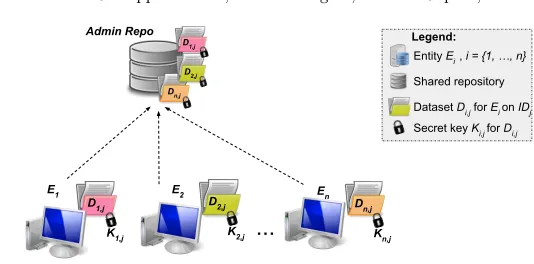
Fig. 3: System log (i.e., IoCs regarding a ransomware attack) sharing
In this use case, we consider two scenarios: 1)a fine-grained data sharing
scenario, in which each individual device in an organization, e.g., personal
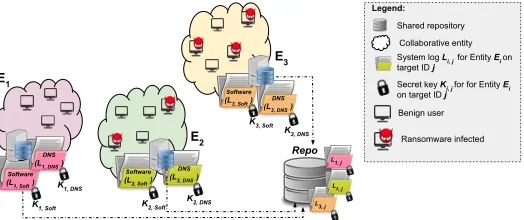
computers in wards of a hospital, in each office of a department in a uni-versity, or in each branch of a bank, is considered as a collaborating entity (e.g., Figure 3). In this scenario, each device stores logs (e.g., network traf-fic, or application information) based on a specific index (which should be agreed a priori). For example, each device logs the requested DNS resolution, or contacted websites, or list of software updates. Moreover, there is usually a central logging database that stores an encrypted version of the logs of each device (though it can be saved locally on the user’s system in a shared folder). Upon receiving an indication of a cyber attack, the security analyst of an organization should have access to all the encrypted logs in order to perform analysis of the attack entry point. For example, having access to the contacted IP addresses by each device in an organization, the analyst might be able to detect the Command and Control (C2) server which the malware connects to, and blacklist the IP address. However, considering a university example, all the staff and professors may not wish to share their private information on their activities, e.g., contacted web sites. In the WannaCry attack scenario, this havoc happened for those computers that were using outdated/unpatched Windows. While, if at the first point of recognizing the indicators of compromise, the first victim (or a number of initial victims) had shared the vulnerability and attack information within their organization, or with other organizations, it could be possible to search for those vulnera-bilities and mitigate it before being distributed through the organization’s network.
2)A coarse-grained data sharing scenario: in which each private hospital,
Software
(L1, Soft )
K1, Soft E1
E2
E3
DNS
(L 1, DNS )
K1, DNS
DNS
(L 2, DNS )
K2, DNS
Legend:
Secret key Ki, j forfor Entity Ei
ontarget ID j System log Li, j for Entity Ei on
target ID j Collaborative entity
Ransomware infected Benign user
K2, Soft Software
(L2, Soft )
L3, j L 2, j L 1, j Repo Shared repository DNS
(L3, DNS )
K3, DNS K3, Soft Software
[image:20.612.171.433.96.206.2](L3, Soft )
Fig. 4: Ransomware threat data sharing in large scale scenario
condition is that at least two hospitals trigger theSignalalert. Upon recogni-tion of an attack,E2andE3in Figure 4 trigger the data disclosureSignal. As
soon as receiving sufficient number ofSignals, the admin of the shared repos-itory is able to recover the encryption key and access the logged information by all the entities. In fact, Equation 8 which leads to disclosure of all theK∗,j
keys regarding a targetIDj (recalling that a target could be any of these logs
which is identifiable through a unique public index) provides an important feature for emergency scenarios. This is useful in situations where the log of all the hospitals should be investigated (for vulnerability analysis against the ransomware attack), while some of the hospitals have not detected an attack (e.g., E1 in Figure 4), or their IT manager (or whoever responsible) is not
available to share their credentials, or for any reason (which could be privacy issues) they are not able/willing to share their logged information. In such a scenario, in order to mitigate a large scale cyber attack, and due to the fact that the disclosure policy has been agreed by all the participating entities (i.e., hospitals) during the initial setup, the unavailability or unwillingness of some entities does not matter, since the shared repository will be able to access those information for further investigation.
4.2 Distributed Denial of Service Attack Mitigation
num-E1
E2
E3
Target3
(L 2, T3 )
K2, T3
Legend:
Secret key Ki, j forfor Entity Ei
ontarget ID j Whitelist Li, j for Entity Ei on
target ID j Sub domain
Attacker Benign user
K2, T1 Target1
(L2, T1 )
L3, j L 2, j L 1, j Repo Shared repository Target j Target2
(L3, T2 )
K3, T2 K3, T1 Target1
(L3, T1 )
Blocked user
Target1: www.uniroma2.it
Target1
(L1, T1 )
[image:21.612.168.434.96.206.2]K1, T1
Fig. 5: DDoS mitigation via whitelist example
ber of fine-grained organized whitelists and selectively disclose them under precisely specified attack conditions.
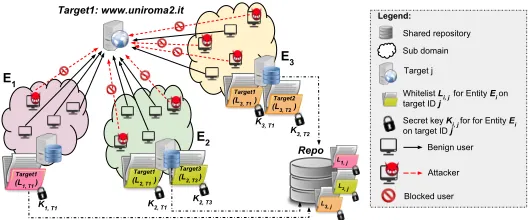
Whenever a domainEi, based on its internal monitoring of a targetIDj,
detects that the target is under DDoS attack, it triggers thedisclosure signal
and shares its own share of the private key associated to the target IDj .
When “sufficient” number of Signals which satisfy the access policy (e.g.,
hE1∧E3i ∨E2) is received,all the domains involved in the system operation
will be able to retrieve (i.e., decrypt) all the whitelists associated to the target
IDj, and will be able to instruct their
firewalls accordingly (e.g., block all traffic except the whitelisted IP ad-dresses).
5 Performance Evaluation
In this section, we present the performance evaluation of our approach bor-rowed from our previous work [3]. As our proposal is mostly a cryptographic approach and its performance assessment highly relates to specific applica-tion scenario, in this secapplica-tion we present the computaapplica-tional time required to perform each cryptographic primitive. The performance evaluation is per-formed on an Intel Xeon X5650 (2.67 GHz, 6 cores) equipped with 16 GB RAM and an Ubuntu Server operating system. We implemented the system using C++ programming language. We adopted XML to structure and trans-port extrans-ported data between different entities. For cryptographic operations (e.g., hashing with SHA-256, symmetric encryption/decryption with AES-128 ) we used the OpenSSL library. For pairings, elliptic curve generation, elliptic curve arithmetic, and hash functions required by IBE, we adopted Pairing Based Cryptography (PBC) library [23].
re-Function Computation Time (ms)
IBE encryption, Equation (2) 2.2051
IBE decryption, Equation (6) 2.3070
Symmetric key derivation, Equation (1) 0.0086 Key share computation, Equation (3) 0.3101
AES-cbc-256 encryption 0.00927
AES-cbc-256 decryption 0.01334
[image:22.612.163.439.94.205.2]Key Reconstruction, Equation (5) (1 share) 0.35697 Key Reconstruction, Equation (5) (2 shares) 0.98011 Key Reconstruction, Equation (5) (3 shares) 1.18959
Table 2: Cryptographic operation performance analysis
sults are obtained by averaging 1M executions of a same primitive. As it can be seen, IBE-related operations impose the highest computation overhead, especially those involving pairings. While, Symmetric encryption of datasets is the least expensive operation. However, as encryption of datasets should be performed in real time, it may become a bottleneck. The IBE-related opera-tions are actually computed only once for every newly considered targetIDj
(we assume there is not a periodic rekeying process per target). Similarly, key reconstruction functions per target should be performed once, only if there is an ongoing attack. Therefore, the fact that complexity grows with the number of shares is not an issue. It should be noted that complexity of the proposal does not rely on the number of entities involved in the system, this will only affect the initial offline setup phase. While, the number of shares that are required to satisfy the access policy affects performance of the system. It is evident that if we consider thethreshold-based secret sharing, the increase in the threshold value (and consequently number of required shares) will lead to the increase in the complexity of Equation (5) which reconstructs the IBE private key associated to a target. While, if we consider the policy-based
se-cret sharing, the complexity of Equation (5) depends on the complexity of
the access policy. For example, if we consider a policy∪i∈NEi, the number of
required shares for key reconstruction would be one; however, if we consider the following access policy (E1∨E2)∧E3∧E4∧E5, the number of required
shares to reconstruct the key would be four. The performance of our system also relies on the rate of considering new targets (IDj), since each entity
requires to perform Equation (1) and the IBE encryption (Equation (2)) and deliver the decryption key to the Repo. However, these operations can be offloaded and scaled to gbps speed [5].
6 Conclusion
The conditional collaborative private data sharing method proposed in this
privacy-preserving collaborative data sharing scenarios. In such scenarios, a priori known entities would only like to share their encrypted data conditionally on special occasions, defining uniform access structures. In particular, our proposed method adopts a combination ofIdentity-Based Encryption (IBE)
andLinear Secret Sharing(LSS) schemes in order to provide scalability, and
efficiency. Our proposal is scalable in the sense that there is no limit on the number of distinct datasets that each entity is willing to share, since the datasets are independently encrypted using IBE, and their unique identi
er is the public key. The proposed approach is efficient in the sense that there is no need for any interaction between different entities on deciding encryption/decrytion keys for each dataset, as long as they consider aunique
public identifierfor each dataset that is publicly available to all the
collabora-tive entities. The important distinguishing feature of the proposed approach compared to the existing collaborative data sharing methods is that, the mas-ter secret will never be revealed/reconstructed by any entity or central shared storage; rather, some quantities of the identity-based private keys associated to each dataset will be shared and reconstructed by the collaborative enti-ties. Therefore, disclosure of one datasetDj , will not reveal any information
about the other datasets with different identifiers (i.e.,ID), eliminating the need for perform re-keying process for other undisclosed datasets.
References
1. AES– advanced encryption standard. URLhttp://www.nist.gov/aes
2. Beimel, A.: Secret-sharing schemes: a survey. In: Coding and Cryptology, pp. 11–46 (2011)
3. Bianchi, G., Rajabi, H., Caponi, A., Picierro, G.: Conditional disclosure of encrypted whitelists for ddos attack mitigation. In: Proc. of the 2013 GLOBECOM Workshops (GC Wkshps), pp. 200–206. IEEE (2013)
4. Bianchi, G., Rajabi, H., Sgorlon, M.: Enabling conditional cross-domain data sharing via a cryptographic approach. In: Proc. of the 5th International Conference on Internet Multimedia Systems Architecture and Application, IMSAA’11, pp. 1–6. IEEE (2011) 5. Bianchi, G., Wolkerstorfer, J., Teofili, S., Gojmerac, I., Jung, O.: Feasibility of wire-speed hardware-based conditional per-flow encryption for on-the-fly protection of mon-itored traffic. In: Future Network and Mobile Summit, 2010, pp. 1–9. IEEE (2010) 6. Boneh, D., Franklin, M.: Identity-based encryption from the weil pairing. In: Advances
in Cryptology CRYPTO 2001, pp. 213–229 (2001)
7. Boneh, D., Franklin, M.: Identity-based encryption from the weil pairing. SIAM journal on computing32(3), 586–615 (2003)
8. Cinque, M., Cotroneo, D., Esposito, C., Fiorentino, M., Russo, S.: A reliable crisis information system to share data after the event of a large-scale disaster. In: Com-puter and Information Technology; Ubiquitous Computing and Communications; De-pendable, Autonomic and Secure Computing; Pervasive Intelligence and Computing (CIT/IUCC/DASC/PICOM), 2015 IEEE International Conference on, pp. 941–946. IEEE (2015)
ACM SIGMOD workshop on Research issues in data mining and knowledge discovery, pp. 19–26. ACM (2004)
10. Danezis, G., Fournet, C., Kohlweiss, M., Zanella-B´eguelin, S.: Smart meter aggregation via secret-sharing. In: Proc. of the first ACM workshop on Smart energy grid security, pp. 75–80. ACM (2013)
11. Dunning, L.A., Kresman, R.: Privacy preserving data sharing with anonymous id as-signment. IEEE Transactions on Information Forensics and Security 8(2), 402–413 (2013)
12. Feldman, P.: A practical scheme for non-interactive verifiable secret sharing. In: Foun-dations of Computer Science, 1987., 28th Annual Symposium on, pp. 427–438. IEEE (1987)
13. Freudiger, J., De Cristofaro, E., Brito, A.E.: Controlled data sharing for collaborative predictive blacklisting. In: International Conference on Detection of Intrusions and Malware, and Vulnerability Assessment, pp. 327–349. Springer (2015)
14. Gennaro, R., Jarecki, S., Krawczyk, H., Rabin, T.: Secure distributed key generation for discrete-log based cryptosystems. In: International Conference on the Theory and Applications of Cryptographic Techniques, pp. 295–310. Springer (1999)
15. Goyal, V., Pandey, O., Sahai, A., Waters, B.: Attribute-based encryption for fine-grained access control of encrypted data. In: Proceedings of the 13th ACM conference on Computer and communications security, pp. 89–98. Acm (2006)
16. House, T.W.: Executive order – promoting private sector cybersecurity information sharing (2015). URLhttps://www.whitehouse.gov/the-press-office/2015/02/13/ executive-order-promoting-private-sector-cybersecurity-information-shari 17. Huang, Q., Yang, Y., Fu, J.: Precise: Identity-based private data sharing with
con-ditional proxy re-encryption in online social networks. Future Generation Computer Systems86, 1523–1533 (2018)
18. Jiang, L., Guo, D.: Dynamic encrypted data sharing scheme based on conditional proxy broadcast re-encryption for cloud storage. IEEE Access5, 13,336–13,345 (2017) 19. Jin, R., He, X., Dai, H.: On the tradeoff between privacy and utility in collaborative
intrusion detection systems-a game theoretical approach. In: Proceedings of the Hot Topics in Science of Security: Symposium and Bootcamp, pp. 45–51. ACM (2017) 20. Jin, R., He, X., Dai, H., Dutta, R., Ning, P.: Towards privacy-aware collaborative
security: A game-theoretic approach. In: Privacy-Aware Computing (PAC), 2017 IEEE Symposium on, pp. 72–83. IEEE (2017)
21. Jon Friedman, M.B.: Definitive guide to cyber threat intelligence. Tech. rep., Cy-berEdge Group, LLC (2015)
22. Liang, K., Susilo, W., Liu, J.K.: Privacy-preserving ciphertext multi-sharing control for big data storage. IEEE transactions on information forensics and security10(8), 1578–1589 (2015)
23. Lynn., B.: Pbc library. URLhttps://crypto.stanford.edu/pbc/
24. Melis, L., Danezis, G., De Cristofaro, E.: Efficient private statistics with succinct sketches. In: Proc. of the 23nd Annual Network and Distributed System Security Symposium, NDSS’16 (2016)
25. Nabeel, M., Shang, N., Bertino, E.: Privacy preserving policy-based content sharing in public clouds. IEEE Transactions on Knowledge and Data Engineering 25(11), 2602–2614 (2013)
26. Nolan, A.: Cybersecurity and information sharing: Legal challenges and solutions. Tech. rep., Congressional Research Service - Informing the legislative debate since 1914 (2015)
27. Nuez, D., Agudo, I., Lopez, J.: Proxy re-encryption. Journal of Network and Computer Applications87(C), 193–209 (2017)
29. Peters, F., Menzies, T., Layman, L.: Lace2: better privacy-preserving data sharing for cross project defect prediction. In: Proc. of the 37th International Conference on Software Engineering,ICSE’15, vol. 1, pp. 801–811. IEEE Press (2015)
30. Shackleford, D.: Who’s using cyberthreat intelligence and how? SANS Institute InfoSec Reading Room (2015)