Built asset management climate change
adaptation model
Jones, K, Desai, A, Brosnan, N, Cooper, JC and Ali, F
http://dx.doi.org/10.1108/IJDRBE0720160032
Title
Built asset management climate change adaptation model
Authors
Jones, K, Desai, A, Brosnan, N, Cooper, JC and Ali, F
Type
Article
URL
This version is available at: http://usir.salford.ac.uk/44390/
Published Date
2017
USIR is a digital collection of the research output of the University of Salford. Where copyright
permits, full text material held in the repository is made freely available online and can be read,
downloaded and copied for noncommercial private study or research purposes. Please check the
manuscript for any further copyright restrictions.
1
Built Asset Management Climate Change Adaptation
Model
Keith Jones, Anglia Ruskin University (email: [email protected])
Api Desai, Anglia Ruskin University (email: [email protected])
Noel Brosnan Octavia Housing
(email: [email protected]) Justine Cooper
(email: [email protected]) Fuad Ali
(email: [email protected])
Abstract
Climate change continues to pose major challenges to those responsible for the management of built assets. Whilst mitigation is largely being driven by legislation and corporate social responsibility, adaptation has to compete alongside general built asset management needs. As such, adaptations to address longer-term building performance issues (such as those posed by climate change) rarely get prioritised above more immediate, short-term needs. However, failure to adapt a built asset to climate change could result in significant premature obsolescence if work is not programmed in a timely fashion. This paper will present the results of a case study of climate change adaptation of UK social housing.
The project reports the results of an in-depth participatory action research project with a London based social landlord to develop and test a 6 stage climate change adaptation framework and risk based model as part of its built asset management strategy. The project developed metrics to analyse the performance of the housing stock against climate change scenarios for current time and 2050. The project also examined the potential (options appraisals and cost/benefit analyses) for a range of adaptation solutions to close the performance gap and developed performance thresholds to prioritise adaptations into long term built asset management plans. These plans were developed against a range of futures scenarios through interviews and workshops with senior decision making stakeholders within the social landlord’s organisation. This paper will present the practical results from this study along with a new theoretical model that integrates resilience theory, risk framing and performance management into built asset management (maintenance and refurbishment) planning. The paper will conclude with a 10 step asset management framework that was developed as an aide memoir to guide other social landlords through the climate change adaptation planning process.
2
1. Introduction
The world’s climate is changing in ways that will have a significant impact on both human society and the built environment (IPCC, 2014a). These changes affect not only average temperature but also results in changed temperature patterns and in particular the severity and frequency of extreme weather events (ibid). Whilst the impact of climate change is different across the world it is urban centres that are likely to be at greatest risk and where action needs to be taken to improve resilience to climate change threats (IPCC, 2014b). To this end actions that accelerate adaptation of the built environment are required (ibid). In particular actions are needed that reduce the vulnerability and improve the resilience of urban systems (e.g. housing, buildings and infrastructure etc.) and provide the governance, policies and incentives to realise adaptive capacity (ibid). This paper reports the development of a built asset climate change adaptation model for social housing in London. The paper supplements a previous publication by Jones et al (2013) where the climate risks to London were discussed and the theoretical base to the risk framework model was presented. This paper provides details of a participatory action research project that integrated the risk framework model with built asset management theory and tested the resulting model against approximately 4000 housing units in London. The paper concludes with a 10 step approach to adaptation planning that should allow Facilities Manager’s to develop built asset management plans to reduce the vulnerability and improve the resilience of their built assets.
2. Background
Whilst in the UK the impact of a changing climate on new buildings can be accommodated through new design standards and planning guidance (CLG, 2007; CLG, 2009; Environment Agency, 2009), the same instruments are not universally applied to existing buildings. As such many existing buildings could be vulnerable to the impacts of climate change, and particularly extreme weather events (EWEs), requiring adaptation if they are to remain viable (Saunders & Phillipson, 2003). Further, in the UK adaptation to climate change is not generally considered part of routine maintenance/refurbishment and it is unclear whether the approaches used by the climate change community (UK climate projections, risk frameworks) can be effectively integrated into built asset management models. These issues are particularly acute in London where it is already apparent that the changing climate could have a significant impact on the ability of existing social housing to provide the quality environment expected by residents (Jones et al, 2013). This poses a problem for many landlords; how do they prioritise adaptation for an uncertain future climate over solutions that improve the immediate quality of their housing stock today?
3
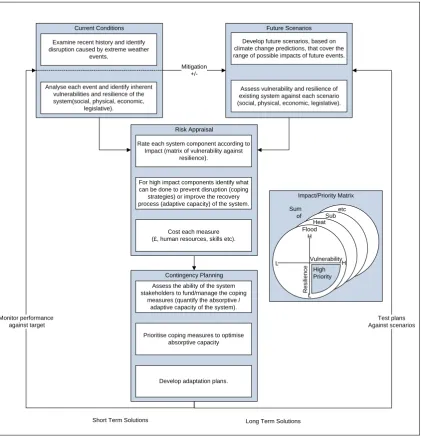
[image:4.595.86.508.228.668.2]to housing of overheating and flooding and to identify adaptation solutions that could reduce vulnerability and improve resilience. One of the key outputs from the CREW project was a risk based adaptation framework (Fig. 1) that sought to guide facilities managers through the climate change adaptation assessment process. In this framework future scenarios are used to predict the degree of change over current conditions that could occur to a building(s) as a consequence of climate change. For each potential impact a risk assessment is then performed to identify impacts and cost adaptations. These adaptations are then prioritised and integrated into contingency plans (Jones et al, 2013). The application of the adaptation framework forms the background to this project.
Figure 1: Adaptation Framework (Hallett, 2013)
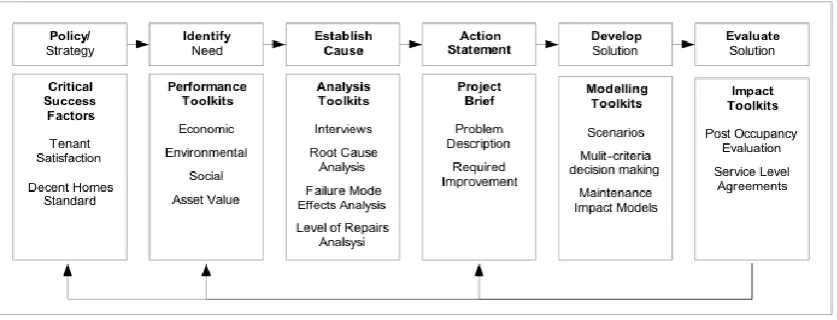
In order to test the applicability of the adaptation framework to inform maintenance and refurbishment plans it needs to be integrated into a performance based built asset management model (Jones and Sharp, 2007) (Fig. 2). The performance model involves: identifying the critical success factors (CSF’s) against which maintenance and refurbishment (including climate change
Impact/Priority Matrix
Contingency Planning Risk Appraisal
Future Scenarios Current Conditions
Examine recent history and identify disruption caused by extreme weather
events.
Develop future scenarios, based on climate change predictions, that cover the range of possible impacts of future events.
Assess the ability of the system stakeholders to fund/manage the coping
measures (quantify the absorptive / adaptive capacity of the system).
Cost each measure (£, human resources, skills etc). For high impact components identify what can be done to prevent disruption (coping
strategies) or improve the recovery process (adaptive capacity) of the system. Rate each system component according to Impact (matrix of vulnerability against
resilience).
Assess vulnerability and resilience of existing system against each scenario (social, physical, economic, legislative). Analyse each event and identify inherent
vulnerabilities and resilience of the system(social, physical, economic,
legislative).
Develop adaptation plans. Prioritise coping measures to optimise
absorptive capacity Monitor performance
against target
Mitigation
+/-Short Term Solutions Long Term Solutions
4
[image:5.595.92.511.222.382.2]adaptation) will be judged; establishing a series of performance toolkits that measure the performance-in-use of each property; establishing the underlying cause of any underperformance; developing action statements that describe the required improvements in performance; developing and evaluating adaptation solutions against the organisations CSF’s; and evaluating the success of the adaptations and provide feedback to the organisation’s climate change adaptation policy and strategies. This project developed the tools necessary to achieve this integration. This paper builds on work previously published (Jones et al, 2013) where the background to, and further details of, the factors that affect the vulnerability, resilience and adaptive capacity of UK social housing to climate change can be found.
Figure 2: Performance Based Built Asset Management Model (Jones and Sharp, 2007)
3. Methodology
The focus of the project was a UK Registered Social Landlord (RSL) that owns and manages approximately 4000 homes, located mainly in inner London. The RSLs property portfolio was extremely diverse, ranging from large modern purpose built blocks, to Victorian street properties. Whilst he RSL owned few whole houses, more than 86% of its stock was made up of maisonettes and flats (the majority the result of the conversion of houses rather than purpose built blocks). Forty six percent of the stock were bedsits or one bedroom properties, 33% were two bedroom properties; 18% were three bedroom properties; and the remaining 3% were 4 and 5 bedroom properties. Forty nine percent of the stock was built before 1919; 8% between 1919 and 1944; 22% between 1945 and 1980; and 21% post 1980. A number of the RSLs properties were Listed Buildings and others were in Conservation Areas. At the time of the project the majority of the stock was in a reasonable state of repair, with the RSL spending approximately £11m per year on maintenance/refurbishment and a further £25m on new build. The RSL had a comprehensive asset management database, including an up to date condition survey of their stock, and had maintenance/refurbishment plans in place for general improvements over a 5, 10 and 30 year period. The RSL also had detailed contingency plans to deal with flooding events. For logistical reasons the fieldwork was limited to a sample of the RSL’s housing, of 1255 properties or 31.46% of their total stock, located in a single London Borough.
5
simulation models and life cycle costing analyses were used to develop and test a range of practical adaptation planning tools that could be used to integrate climate change adaptation into the built asset management process. The field work for this project took place in 2012/13. Although the project examined both flooding and overheating for the sake of brevity only the flooding results are presented here.
4. Results
The following section describes the process that the participatory action research team went through to integrate the adaptation framework (Fig 1) into the performance based built asset management model (Fig 2).
Step 1 - Identify Policy/Strategy Drivers: The first task was to establish the Critical Success Factors (CSFs) against which current and future performance would be judged. This was done through discussion with senior managers and by reference to the RSLs strategic plan and operational documents. The RSLs approach to the quality of their housing was governed by their ‘Performance Standard’ that described expectations for the quality of the stock. Although the Standard didn’t explicitly address the impact that climate change could have on a house it did establish the general principle that:
“Your home should be in good working order and fit for purpose - it should meet a certain set of standards, both inside and outside and in shared and private areas to
make it a safe and healthy environment to live in.”
The Standard also implied that the RSL would adopt a proactive approach to ensuring that its homes meet the Standard. To this end the ‘Standard’ provided the basis from which CSF’s were derived and against which the success of adaptation solutions would be measured. For flooding these were:
1) Reduce disruption to tenants from flooding events. Performance thresholds to relate to the degree of disruption that a flood event would cause to tenants. 2) To continue to maintain tenant confidence and trust in the RSLs ability to deal
with climate change issues. Performance thresholds to be measured through the tenant satisfaction survey.
Once the CSFs had been established a set of performance toolkits were developed to help identify adaptation needs.
6
m flood in the street immediately adjacent to the property. A combination of the potential flood risk and likelihood of water ingress into the property was used to determine the property’s level of vulnerability (Fig. 3)
Toolkit 2 sought to quantify the impact that exposure to a flood would have on the performance-in-use of those properties at risk of such an event. Assessments of the potential impact of flooding events on a sample of those properties identified as highly vulnerable to such an event was used to identify their coping capacity. A combination of the potential damage that a flood event would cause and the recovery time it would take to return the property to its pre-flood performance level was used to categorise the properties coping capacity threshold as Low Medium or High.
Likelihood of a flood event
No likelihood Low Medium High
Likelihood of
water ingress to the property /
damage to critical
infrastructure
No likelihood Not vulnerable Not vulnerable Not vulnerable Not vulnerable
Low Not vulnerable Low
vulnerability
Low
vulnerability
Low
vulnerability Medium Not vulnerable Low
vulnerability
Medium vulnerability
Medium vulnerability High Not vulnerable Low
vulnerability
Medium
vulnerability
High
vulnerability
Figure 3: Typical vulnerability threshold matrix for flooding
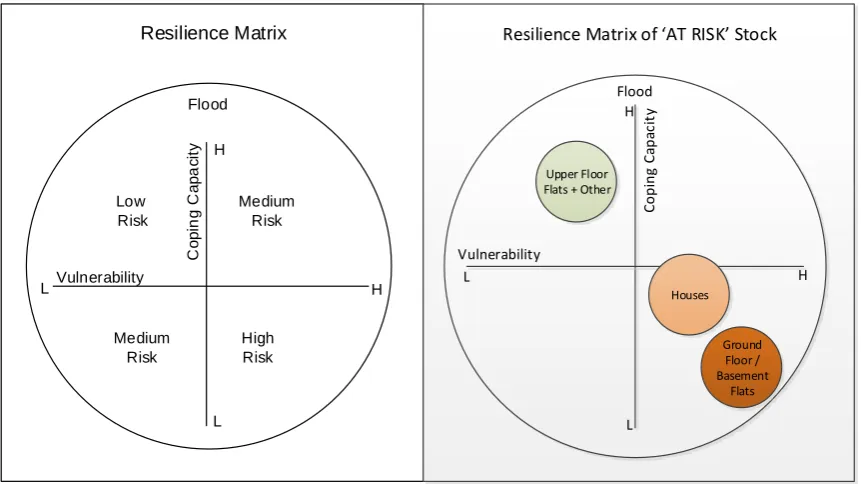
The vulnerability and coping capacity for each property identified as ‘at risk’ of flooding was plotted onto a Resilience Matrix (Fig. 4). From this figure a number of properties were identified as highly vulnerable with a low coping capacity and these would be prioritized for early action in the asset management plan. Those properties that were highly vulnerable but had a Medium/Low coping capacity would be prioritized as short-medium term action in the asset management plan. Those properties that had a low vulnerability and high coping capacity would be reviewed at regular intervals as more climate change data became available.
Step 3 - Establish Cause: Internal surveys of 26 typical properties were undertaken to establish the root cause of flooding damage and to identify potential adaptation solutions. In all cases these solutions were affected by legacy design decisions made when the buildings were newly constructed or underwent major refurbishments.
7
[image:8.595.85.516.153.395.2]fixtures & fittings to shorten the time it would take to return the property to a habitable condition. Similar analyses were undertaken for ground floor flats, houses and communal areas and a set adaptation principles (Fig 5) were developed in the form of an Action Statement (Step 4).
Figure 4: Generic resilience matrix and specific resilience matrix for flood risk properties
Figure 5: Adaptation principles
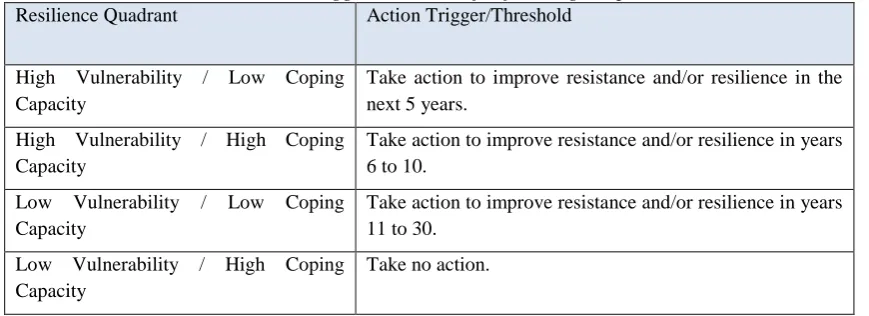
Step 5- Develop Solutions: The potential (technical and cost/benefit) for a wide range of flood resistance and resilience measures were assessed for each archetype property. A set of triggers and thresholds were developed to allow potential adaptations to be prioritised for inclusion into the built asset management plan. At the strategic level these triggers and thresholds tended to be statements of intent or desire, rather than quantified metrics to instigate an action. These statements of intent were related directly to the RSLs ‘Performance Standard’ and were expressed as commitments for each quadrant of the Impact/Priority Matrix shown in Fig. 4 and summarized in Table 1.
In addition to the generic triggers and thresholds outlined above, specific action should be taken in Year 1 of the adaptation plan to address known, current problems. Where the problems are
Adaptation Guiding Principles
If it is economically feasible to prevent flood water entering a property then this should be adopted.
Water resilient components, fixtures and fittings should be installed when flood ingress is likely.
Ensure all essential services are resistant to a flooding event.
Work with residents to prepare personal flood action plans.
H L V2 V1 Flood Vulnerability C o p in g C a p a ci ty H L High Risk Low Risk Medium Risk Medium Risk Resilience Matrix H L Flood Vulnerability C o p in g C ap ac it y H L
Resilience Matrix of ‘AT RISK’ Stock
H L Ground Floor / Basement Flats Houses Upper Floor
8
[image:9.595.83.518.174.332.2]known, but the scale is unknown, action should be taken in the first 5 years of the adaptation plan to quantify the scale of the problem. Where there is uncertainty about the potential problem or a solution the situation should be regularly monitored. These thresholds and triggers are summarized in Table 2.
Table 1: Action trigger/thresholds for flooding adaptations
Resilience Quadrant Action Trigger/Threshold
High Vulnerability / Low Coping Capacity
Take action to improve resistance and/or resilience in the next 5 years.
High Vulnerability / High Coping Capacity
Take action to improve resistance and/or resilience in years 6 to 10.
Low Vulnerability / Low Coping Capacity
Take action to improve resistance and/or resilience in years 11 to 30.
Low Vulnerability / High Coping Capacity
Take no action.
[image:9.595.84.511.407.475.2]Step 7 - Adaptation Strategy: Once all the previous described steps had been completed an adaptation strategy was developed to address the potential impact of flooding both today, and in the future. A typical part of the adaptation plan is shown in Table 3.
Table 2: Thresholds and triggers for action in an adaptation plan.
Year to Action Threshold Trigger
1 Know scale of problem and solution Known level of risk is high
2-5 Know problem exists but don’t know scale or solution
Establish level of risk
[image:9.595.85.517.486.731.2]6-30 Unsure if problem exists. Don’t have a solution Continue to monitor risk
Table 3: Example extracted from the adaptation strategy
Property Type Vulnerability - FLOODING Timescale for Action Vulnerable
Street Houses
Where ever possible floodwater should be prevented from entering
the house. Depending on the depth of any water entering the house (will depend on floor level above the street, existence of a basement
etc.) resilient fixtures and fittings should be used to ensure that the house can be returned to a habitable condition in the shortest period
of time.
Undertake detailed surveys of the vulnerable properties identified
in this report to identify the flood resistant actions required to prevent water entering the property (including the sealing of air
bricks, appropriateness of door dams, non-return valves on drainage and foul water systems etc.). Identify the impact that any floodwater
entering the property would have on the post-flood recovery period. These plans should include a detailed assessment of post-flood
9
building works and an estimate of the time to return the house to a
habitable (or part habitable) condition.
Assess the potential of resilience measures to reduce the estimated time to return the house to a habitable (or part habitable) condition.
In particular examine measures that improve the resilience of essential services, kitchen and bathroom areas. Undertake a more
detailed cost/benefit analysis of these measures and implement those that are appropriate when next refurbishment is planned.
Year 2-5
Ensure that the RSL is signed up to the environment agency early warning service and develop a communications strategy that
informs its residents of an impending flood events and keeps them informed of progress through the clean-up and repair phase.
Year 1
Engage with the residents living in these houses to ensure that they
are as prepared as possible for potential flooding events. Consider providing labour to assist residents in the removal of personal and
treasured items to the upper floors of the houses.
Year 1
Ensure that arrangements are in place with alternative landlords to
provide temporary accommodation for those residents displaced by a flood.
Year 1
5. Discussion
[image:10.595.88.513.82.376.2]This project sought to test the theoretical adaption framework developed through the CREW project by developing a set of tools that could be used to integrate it into a performance based built asset management planning model. Through this process a new 10 step model for adaption planning for future climate change was developed. This model is summarised in Table 4.
Table 4: Ten step adaptation planning model
Step Actions
1 Identify current climate related threats to your stock
Examine local histories for details of climate related impacts. This could involve reviewing national and local climate risk assessments (e.g. flood maps) and identifying previous extreme weather events that have affected the region where properties are based.
2 Develop future climate impacts scenarios that are relevant to your circumstances
10 3 Map current and future
climate threats to your property portfolio
Examine known vulnerabilities of your stock to the key weather impacts. This would include geo-mapping the location of each of your properties onto current and future climate change risk maps (e.g. flooding, overheating etc.) and identify the numbers of properties at risk and the level of the risk (e.g. flood type, flood depth, flood duration etc.) for each property. Review the ability of existing disaster planning to cope with any increased incidence of extreme weather events.
4 Identify the coping capacity of your properties to current and future climate threats
Assess the impact that a climate related event would have on your
property portfolio. This would involve identifying typical property
archetypes for a range of climate change events (flood impact
assessments, overheating etc.) ensuring that the organisation have the
data (either in their asset management system or through housing
surveys) to assess the vulnerability and coping capacity of the property
to each event. Develop organisation specific vulnerability and coping
capacity thresholds for each property archetype against each climate
change impact. Plot vulnerability and coping capacity onto a Resilience
Matrix.
5 Identify possible adaptation solutions
Identify appropriate resistant and resilience measures. This will include modelling the effect of a range of adaptation options against each archetype for each climate change impact and assessing the technical feasibility of retrofitting adaptation measures.
6 Articulate required improvements to the performance of your properties
Identify performance expectations for your properties against each climate change impact. For example,
Let properties flood and ensure rapid recovery; or
Prevent water ingress where ever possible; or
Ensure at least one room in every property does not over heat; etc.
7 Identify priorities Develop priority thresholds based on the performance expectations identified in step 6. Identify what types of adaptation should occur in years 1-5; 6-10; and years 11-30?
8 Develop adaptation strategy
Identify the actions to be taken for each vulnerable property archetype.
This could include identifying known problems for immediate action in
year 1; gathering missing data (surveys) for high risk properties in years
1-5; and monitor performance of medium risk properties in years 6-30.
All other missing data should be collected as a part of the normal
re-survey cycle.
11
10 Implement and test plan Monitor effectiveness of interventions and close the feedback loop. If you experience a climate related event how well did your plans work? If you don’t experience an event then test your plans against a simulation. Review the effectiveness of your Disaster Management and Contingency Plans
Whilst the theories supporting the adaptation framework and the performance based built asset management complemented each other, and at the theoretical level integration was fairly easy to achieve, a number of issues were identified that limited its practical application.
Whist access to public data on past extreme weather events and potential impact of none climate change future events was generally available and suitable to inform step 1 of the adaptation planning model the data required for steps 2 and 3 wasn’t. Whilst UKCP09 climate change projections provided a means of generating future weather patterns the lack of future risk assessments (e.g. future flood risk maps, local heat islands etc.) made it difficult to assess the future vulnerability and resilience of the housing stock. As such the project scenarios were based on possible relative changes to weather impacts rather than absolute risk projections. Whilst these scenarios worked well when introducing the problem and examining the generic vulnerability and resilience of the housing stock (see Jones et al, 2013 for further details), the lack of probability risk factors associated with the different scenarios limited their credibility when trying to prioritise adaptation actions. The lack of projected climate risk data must be addressed if real advances in adaptation planning are to be made.
Whilst the toolkits developed to assess the impact of flooding (and overheating) on a range of archetypal properties worked well, allowing ‘potentially at risk’ properties to be clearly identified and generic adaptation solutions to be evaluated, the level of data required by the toolkits was significantly greater than that which existed within the RSLs built asset management database (step 4). As such re-survey work (internal and external) had to be undertaken to identify the potential impacts that flooding (and overheating) would have on the performance of a range of property archetypes before indicative adaptation solutions could be identified and evaluated (step 5). Going forward the additional data needed for adaptation to climate change should be gathered as part of the routine stock condition survey process.
12
working with tenants to help them develop personal flood plans; providing support to allow tenants to protect valuable items; and having robust relocation plans in place.
The other problem with setting meaningful priority thresholds (step 7) and developing adaptation plans (steps 8 and 9) was the lack of quantifiable (probabilistic) projected weather impact data and the numerous gaps in building data meant that only the most obvious adaptations were prioritised for action with the vast majority of adaptations being put ‘on hold’ until better information is available or until the future risk became obvious. As such, the adaptation strategy can best be described as cautious and reactionary. This approach is at odds with the need to accelerate adaptation of the existing built environment (IPCC, 2014b).
6. Conclusions
This project sought to integrate a theoretical adaptation framework with a performance based built asset management model to provide an approach by which Facilities Managers could develop short, medium and long term climate change adaptation plans. The project has described how a series of performance toolkits can be used to identify potential impacts of climate change on the performance of a house and how triggers and thresholds based on an organisation’s CSFs can be used to prioritise interventions as part of routine maintenance and refurbishment planning. Although developed for housing the 10 step model should be applicable to most property types. Whilst the underlying theory and the assessment tools developed in the project worked well, some of the underlying data required to support the tools was lacking or incomplete. As such, working assumptions had to be made that reduced the level of detail and confidence that Facilities Managers had in the final adaptation plans. At the time of this project there was no consistent UK wide data on the future impact that climate change could have on physical performance of the building stock. Most flood maps that were available didn’t accommodate climate change scenarios and, in the case of pluvial flooding, didn’t map future rainfall predictions onto local drainage topology. As such the future flooding scenarios lack the currency associated with existing fluvial flood assessment. Where there are accepted climate change models, organisations asset management databases don’t generally contain the level of building detail required to develop adaptation solutions. Whilst these issues do not undermine the development of the adaptation strategy, they will influence attitudes towards adaptation planning, resulting in a wait and see approach which is at odds with the needs to plan for the implications of climate change. Better national and organisational data sets are needed to address this shortcoming.
13
7. Acknowledgements
The authors would like to acknowledge the support of the Engineering and Physical Sciences Research Council who funded the initial study (Grant Number EP/F035861/1) that developed the theoretical model on which this work was based and the Technology Strategy Board (Project Number 13839-86229) who funded the development of the adaptation strategy.
References
CLG (2007) Improving the Flood Performance of New Buildings, RIBA Publishing, ISBN 978 1 85946 287 4, (available online
http://www.planningportal.gov.uk/uploads/br/flood_performance.pdf [accessed on 30 November 2015]).
CLG (2009) PPS25 Practice Guide, (available online
https://www.gov.uk/government/uploads/system/uploads/attachment_data/file/7772/pps25guide update.pdf [accessed on 30 November 2015]).
Environment Agency (2009) The Flood Risk Regulations 2009, (available online
http://www.legislation.gov.uk/uksi/2009/3042/contents/made accessed on 04/02/2013 [accessed on 30 November 2015]).
Hallett, S. (2013) Community Resilience to Extreme Weather- the CREW Project: Final Report, (available online www.exytreme-weather-impacts.net. [accessed on 20 February 2016]). IPCC. (2014a) Synthesis Report Summary for Policy makers, (available online
http://www.ipcc.ch/pdf/assessment-report/ar5/syr/AR5_SYR_FINAL_SPM.pdf [accessed on 30 Nov 2015]).
IPCC. (2014b) Climate change 2014, impacts, adaptation and vulnerability, (available online http://ipcc-wg2.gov/AR5/images/uploads/WG2AR5_SPM_FINAL.pdf [accessed on 30 Nov 2015]).
Jones, K. G., Brydson, H., Ali, F. & Cooper, J. (2013) “Assessing vulnerability, resilience and adaptive capacity of a UK Social Landlord”, International Journal of Disaster Resilience in the Built Environment, Vol 4, No 3, pp287-296.
Jones, K. and Sharp, M. “A new performance-based process model for built asset maintenance”,
Facilities, Vol 25, No 13/14, 2007, pp 525-535.