Understanding Trust & Confidence
in Web Behaviour
Jiten Maka n
Understanding Trust & Confidence in
Web Behaviour
Jiten Makan
Salfo rd Bus in ess Scho ol ,
Co lleg e o f B usiness and Law,
Un iversit y of S alfo rd ,
Salfo rd, UK
“If you want a guarantee, buy a toaster”
ACKN OWL EDGME NTS
Rather than taking this opportunity to write the most impressive paragraph the literary world has ever wit-nessed, I’ll just stop messing about and get to the point. Main person that needs a dose of gratitude is Maria Kutar; it’s literally not possible to owe somebody so much without having a CCJ against your name. To be fair it was largely her fault that I ended up doing a Ph.D. in the first place, but irrespective of that she has stuck by, listened to my tedious woes and generally put up with a whole manner of ridiculous nonsense throughout. I owe you so much and I will gladly sponsor a cat shelter, donkey sanctuary, goat or something else like that in your name.
Then there are the obligatory parents, sister, crazy cousin Steven in Texas, Helen in Oklahoma and the fol-lowing folks (in no particular order) who tirelessly ask “haven’t you finished yet; the hells’ wrong with you; get a normal job like normal people!?”
- Charlie Breslin (CDG)
- Lee Smith (Flobased)
- Keabetswe Masalilia (KB)
- Lee Davies (is a Scary Person)
- Marie Griffiths (Maaaaaaaaaarie!)
- Jean Goldsmith (Jewstein)
- Liam Silcock (Tech)
- Michael Sheehan (Sheen)
ABST RA CT
Trust is recognised as the construct that makes societies function; not only this but it is understood to be the element that makes them successful, wealthier, healthier and wiser. A problem of the trust construct is that, despite its perceived importance on facilitating modern life, it remains a subject that lacks consensus on its definition.
Within literature, when the construct of trust is applied to the Web context, there is further confusion as the construct being referred to as trust in actual fact referring to the construct of confidence. This confusion led to the research in understanding trust and confidence in Web behaviour. In addition to researching the lit-erature, the diary-study interview method was used to investigate into how the constructs of trust and con-fidence function on the Web. The diary study was designed to act as an observational research method, and in doing so would identify the what and how participants used the Web, with the follow-up interviews ex-tracting the why.
When taking the core-concept understanding of trust (as developed within this thesis), it shows there to be a disparity between trust and its applicability to the Web. The study further supports this view, and from this emerges the key finding that Web interactions are facilitated and driven by confidence – not trust.
PAGE OF C O NTE NTS
Acknowledgments ... i
Abstract ... ii
Page of Contents ... iii
List of Tables ...viii
List of Figures... ix
Glossary of Terms ... xii
1 Trust, Confidence and Web Behaviour ... 1
1.1 Background ... 1
1.2 Setting the Boundaries ... 2
1.2.1 World Wide Web ... 2
1.2.2 Trust ... 2
1.3 Web Trust ... 3
1.3.1 The Importance of the WeB... 3
1.3.2 The Importance of Trust ... 4
1.3.3 The Importance of Trust on the Web ... 5
1.4 PhD Journey ... 6
1.5 Research Aims ... 7
1.6 Methodology ... 8
1.7 Contribution ... 9
1.8 The Thesis Overall ... 9
2 Internet Development ... 11
2.1 Internet and World Wide Web ...11
2.2 Three Decades of Internet Development ...12
2.3 The Nineties ...13
2.3.1 World Wide Web ...14
2.3.2 Removal of Restrictions ...15
2.3.3 Domestication of IT ...15
2.3.4 eCommerce ...15
2.4 The Millenium Onwards ...16
2.4.1 Dot-Com Bubble ...17
2.4.2 High-Speed & Mobile Access ...18
2.4.5 Social Networking ...21
2.4.6 Summary of Web Development ...23
2.5 Web Uses ...23
2.5.1 Systematic Literature Review (SLR) ...24
2.5.2 Taxonomy of Web Use ...28
2.6 Status of Current Web Use ...30
2.6.1 UK Web Use (Oxford Internet Surveys (OxIS)) ...30
2.6.2 US Web Use (PEW Internet & American Life Project) ...32
2.6.3 Web Use in the Western Developed World ...33
2.7 Summary ...36
3 Trust ... 38
3.1 Issues in Defining Trust ...38
3.1.1 Interdisciplinary Nature of Trust ...39
3.1.2 Trust as a Social Construct ...39
3.1.3 Reification ...40
3.1.4 Summary ...40
3.2 Understanding Trust ...41
3.2.1 Researching Trust ...42
3.2.2 Elements Related to Trust ...46
3.2.3 Forms of Trust ...56
3.2.4 Summary ...61
3.3 The Process of Trust ...62
3.3.1 Stage 1: Disposition to Trust ...63
3.3.2 Stage 2: Perceived Trustworthiness ...68
3.3.3 Stage 3: Judgement ...72
3.4 Summarising Trust ...74
3.5 Defining Trust ...76
3.5.1 Castaldo et al. (2010) ...76
3.5.2 Adams (2005) ...77
3.6 Trust Definition ...78
4 Defining The Constructs ... 79
4.1 Constructs Defined ...80
4.2 Trust & Confidence ...80
4.2.1 The Differences ...80
4.2.2 Summarising the Differences ...82
4.3 Trust and Confidence Process ...83
4.3.2 Process of Confidence ...84
4.4 Research Purpose ...85
5 Research Methods ... 87
5.1 Research Defined ...87
5.2 Research Structure ...89
5.3 Adopted Framework ...90
5.3.1 Epistemology...91
5.3.2 Theoretical Perspectives ...93
5.3.3 Methodology ...97
5.3.4 Method ... 100
5.4 Adopted Research Structure ... 102
5.5 Diary Study ... 102
5.5.1 Background... 104
5.5.2 Approaches ... 105
5.5.3 Analysis of Method ... 110
5.5.4 Adopted Approach ... 116
5.5.5 Pilot Study ... 121
5.5.6 Post-Pilot Analysis ... 123
5.6 Implemented Diary Study ... 126
5.6.1 Commercially Available Diary ... 126
5.6.2 Research Specific Diary ... 127
5.7 Interview ... 130
5.7.1 Introduction ... 130
5.7.2 Stages of Questions ... 131
5.8 Summary of Method ... 138
5.8.1 Research Method ... 138
5.8.2 Diary Study ... 139
5.8.3 Follow-Up Interview ... 140
5.8.4 Ethical Considerations ... 141
5.8.5 Sampling and Participant Profiles ... 141
5.8.6 Research Specifics ... 143
6 Data Analysis ... 144
6.1 Core Approaches to Analysis ... 145
6.1.1 Quantitative Data Analysis... 145
6.1.2 Qualitative Data Analysis ... 146
6.2.1 Oates Approach ... 149
6.2.2 Data Preparation ... 149
6.2.3 Diary Document ... 149
6.2.4 Voice Recorded Interview... 150
6.2.5 Diary and Interview Documents ... 150
6.2.6 Computer Aided Analysis ... 151
6.2.7 Analysis Process / Coding ... 152
6.3 Analysing the Data ... 153
6.3.1 Adopted Approach ... 154
6.3.2 Implemented Process... 155
6.4 Post-Analysis Research Data ... 156
6.4.1 Samples of Gathered Data ... 156
6.4.2 Vignettes of User Type and Web Use ... 159
6.4.3 Emergent Categories ... 164
6.5 Emergent Themes ... 178
7 Discussion ... 180
7.1 Research Approach ... 180
7.2 Trust, Confidence & Web ... 180
7.3 Research Findings ... 181
7.3.1 Preference for Usability ... 182
7.3.2 Experience and Optimism ... 183
7.3.3 Pessimism & Negative Expectations ... 184
7.3.4 Confidence / Assurances ... 184
7.3.5 Anxieties / Concerns ... 185
7.3.6 Conscious Trade-Off ... 186
7.3.7 Summary of Findings ... 187
7.4 The Relationship of Findings & Confidence ... 188
7.5 Findings & Literature ... 191
7.5.1 User Types ... 191
7.5.2 Confidence Facilitates the Web ... 192
7.5.3 The ‘Six’ Research Findings ... 199
7.6 Summary ... 202
8 Conclusion ... 203
8.1 Summary of the Research ... 203
8.2 Evaluation of the Research ... 204
8.3 Critique of the Research Methodology ... 207
8.4.1 Understanding Trust ... 208
8.4.2 Understanding Confidence ... 209
8.4.3 Web Behaviour ... 211
8.5 Future Research ... 212
8.6 Contribution to Research... 212
9 References ... 217
Appendix A ... 243
Diary Study Documents ... 243
Appendix B ... 244
LIST O F TABLE S
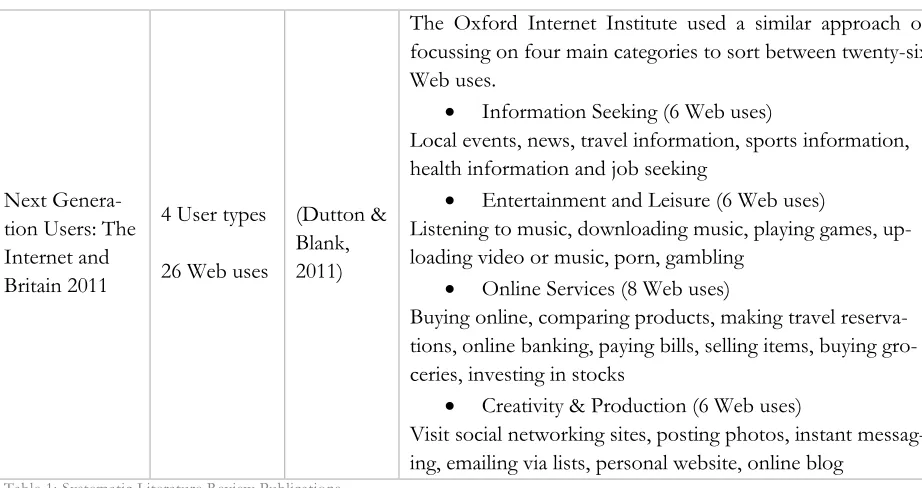
Table 1: Systematic Literature Review Publications ...28
Table 2: Taxonomy of Web Uses ...30
Table 3: User Types (OxIS 2011 Study) ...31
Table 4: Cultures of Web User (OxIS 2013 Study) ...32
Table 5: Understanding Trust...62
Table 6: Disposition to Trust ...67
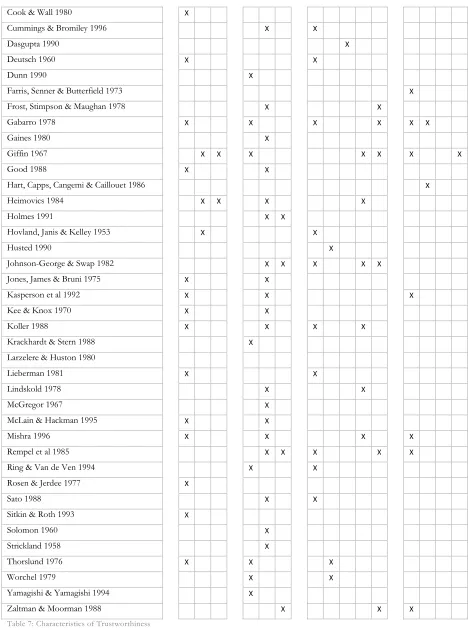
Table 7: Characteristics of Trustworthiness ...69
Table 8: Stages of the Trust Process ...75
Table 9: Trust & Confidence Characteristics ...83
Table 10: Trust & Confidence Characteristics ... 134
Table 11: Participant Profiles ... 142
Table 12: First-Generation User (FGU Vignettes) ... 162
Table 13: Next-Generation User (NGU Vignettes) ... 163
Table 14: Findings from Study ... 188
Table 15: Relating Findings to Confidence ... 190
Table 16: Trust & Confidence Characteristics ... 197
Table 17: Study Findings and Contributions to the Field ... 201
Table 18: Evaluation of Research Goals ... 206
LIST O F FIG UR ES
Figure 1: Systematic Literature Review Process ...26
Figure 2: Disposition to Trust (Stage 1) ...67
Figure 3: Perceived Trustworthiness (Stage 2) ...71
Figure 4: Model of Trust Process ...74
Figure 5: Model of Trust Process (with explanations) ...75
Figure 6: Model of Trust (with explanation) ...83
Figure 7: Model of Confidence (with explanations) ...84
Figure 8: Research Methods Chapter Sections ...87
Figure 9: Alternative Research Structures ...89
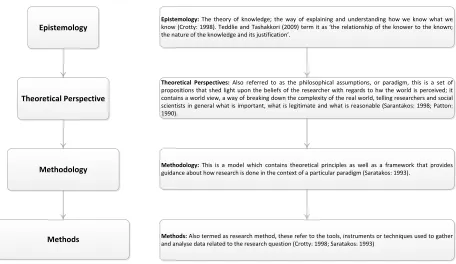
Figure 10: Adopted Research Structure (Crotty, 1998) ...91
Figure 11: Typical Information Systems Methodological Approaches ...98
Figure 12: Research Process Questions (Crotty, 1998) ...99
Figure 13: Analysis of Research Method ... 100
Figure 14: Adopted Research Structure (applied to the study) ... 102
Figure 15: Intended Approach to Formulating Research Method ... 103
Figure 16: Actual Approach to Formulating Research Method ... 103
Figure 17: Types of Diary Study ... 105
Figure 18: Diary Study Terminology ... 106
Figure 19: Advantages to Diary Study (Lazar, Feng and Hochheiser, 2010) ... 110
Figure 20: Diary Study Design Considerations (Generic) ... 115
Figure 21: Diary Study Analysis (applied to the research) ... 118
Figure 22: Summary of Diary Design Considerations (adopted approach) ... 120
Figure 23: Diary Study Process Diagram ... 120
Figure 24: Intended Pilot Study Path ... 121
Figure 25: Actual Pilot Study Path ... 122
Figure 26: Pilot Diary Study Document (physical version) ... 122
Figure 27: Pilot Diary Study (electronic version) ... 123
Figure 28: Diary Study Redesign Considerations (Post-Pilot Analysis) ... 125
Figure 29: Diary Study Redesign Process ... 126
Figure 30: Commercially Available Diary Document ... 127
Figure 31: Bespoke Diary Documents (implemented) ... 128
Figure 32: Bespoke Diary Document(s) Contents ... 129
Figure 33: Follow-Up Interview Design Approach ... 130
Figure 35: Follow-Up Interview Questions (Phase 1) ... 132
Figure 36: Follow-Up Interview Questions (Phase 2) ... 133
Figure 37: Phase 2 - Question Justifications and Analysis ... 136
Figure 38: Research Approach Diagram ... 139
Figure 39: Diary Study Analysis (implemented) ... 140
Figure 40: Follow-Up Interview Analysis (implemented) ... 141
Figure 41: Data Analysis Approach ... 144
Figure 42: Interview Document (Before Analysis) ... 150
Figure 43: Interview Document (Post Analysis ... 150
Figure 44: Data Analysis Chapter Sections ... 153
Figure 45: Diary Study Example ... 154
Figure 46: Follow-Up Interview Process ... 154
Figure 47: Codes-To-Theory Analysis (Saldaña, 2009) ... 155
Figure 48: Thematic Analysis Process (implemented) ... 155
Figure 49: Participant 1 - Transcript Page 1 of 14 ... 157
Figure 50: Participant 6 - Interview Transcript Page 1 of 24 ... 158
Figure 51: Participant 16 - Interview Transcript Page 1 of 20 ... 159
Figure 52: Web User Types (OxIS 2011 Study) ... 160
Figure 53: Closed Questioning (Diary Study Example) ... 164
Figure 54: Emergent Categories ... 164
Figure 55: Web Related Categories ... 165
Figure 56: Nature of Use / Routine (Coding Category) ... 165
Figure 57: Mobile Device Use (Coding Category) ... 166
Figure 58: Traditional Device Use (Coding Category) ... 167
Figure 59: Web Use Related Categories (Summary) ... 169
Figure 60: Trust, Confidence and Risk Related Categories ... 170
Figure 61: Anxiety / Concern (Coding Category) ... 170
Figure 62: Assurance / Confidence (Coding Category) ... 171
Figure 63: Conscious Trade-Off (Coding Category) ... 172
Figure 64: Trust, Confidence and Risk Related Categories (Summary) ... 173
Figure 65: Overlapping Categories ... 174
Figure 66: eCommerce (Coding Category) ... 175
Figure 67: Online Banking (Coding Category) ... 176
Figure 68: Overlapping Category (Summary) ... 177
Figure 69: Emergent Themes ... 178
Figure 70: Web User Types (OxIS 2011 Study) ... 191
Figure 72: Model of Confidence ... 194
Figure 73: (Stage 2) Trust Model ... 195
Figure 74: (Stage 2) Confidence Model... 195
Figure 75: Model of Confidence ... 198
Figure 76: Model of Trust ... 209
Figure 77: Model of Trust ... 214
GLOS SA RY OF T ERM S
1
T R U S T, C O N F I D E N C E A N D W E B
B E H AV I O U R
1.1 BACKG RO UND
This work is centred upon the social constructs of trust and confidence and how they influence an individu-al’s Web behaviour. It is not a manual on how to achieve or create trust on the Web; it is focussed more on what trust actually is and how – if at all – it impacts upon people’s Web behaviour. The thesis works to clar-ify the cloudy understanding of the trust construct and the understanding of trust on the Web. This work can be used by those wanting to ‘create trust’ or merely ‘understand trust’ as it works to provide a thorough and comprehensive insight into the concept, how it is developed and how it functions.
This research is concerned with understanding whether it is actually the construct of trust that exists and operates on the Web, or whether it is a comparable construct commonly misconstrued as representing trust, i.e. confidence, familiarity, or indeed cooperation. Whilst this may initially present itself as little more than a semantic argument, it does carry significant weight when we consider that ‘nothing in society works without trust. It is the foundation of communities, commerce, democracy – everything’ (Schneier 2012). The rapid and continued growth of the Web has enabled communities (Valenzuela et al. 2009), commerce (Hernández et al. 2010; Grandón et al. 2011) and democracy (Latimer 2009) to exist online as well as offline. So, to un-derstand how, or even if, these elements of trust and the Web interact, helps us better unun-derstand whether trust impacts Web use, and if so, to what extent.
One of the principal drivers behind this research is the lack of consensus and understanding within the lit-erature of how trust works on the Web (Taddeo 2009). Trust, as is explained within this study, is an incredi-bly complex and influential construct, yet remains one that is often misdirected, taken for granted, taken on face value and commonly misunderstood (Connolly 2007); in other words, the meaning of trust is usually sold short. Taking this approach toward understanding trust and then applying it to the Web context illus-trates why there is a lack of consensus within much of the Web trust literature, as well as explaining why it often attempts to offer unrealistic solutions to harnessing trust on the Web.
Trust involves risk, and the idea is often taken that by taking steps to reduce or even eliminating risk within the online environment would, theoretically at least, lead to trust. However, this again is underselling what trust is about. Nissenbaum (2001) challenges this idea of achieving trust online through the use of security measures and techniques. The premise existed – and possibly still does – that trust is about uncertainty (Fu-kuyama 1995) and removing this uncertainty on the Web through the use of security features will in turn create trust (Toufaily et al. 2013; Gefen 2000). She argues that, although aspects of this are true, there are many more peculiarities to the trust construct beyond uncertainty and risk that require consideration. In other words, by taking a slither of what trust is and meeting its need does not automatically create trust.
The remainder of this chapter will develop on the above, will set the boundaries for the study, will outline the aims and objectives and will guide the reader though the remainder of the thesis.
1.2 SETTI NG THE B OU NDARI ES
There are two core topics within this work, the concept of trust and the subject of the World Wide Web, these are briefly outlined in the below subsections.
1.2.1 WO RLD WID E W EB
The World Wide Web is the focus of the study, not the Internet within which the Web resides. As it can be a challenge to describe the Web without discussing the Internet, there are sections in this thesis that work to explain the history of both, and in doing so, outline the difference between the two (see Chapter 2). Rather than looking at the entire Internet arena – the hardware, network infrastructures, systems, etc. – it is fo-cussed on the aspects that ‘regular users’ use on a daily basis. The Web is the part of the Internet that is used to stay in contact with others, to make purchases, to pay bills, to check accounts, to email, to collabo-rate, to find information, play games, make connections and transact with public and private organisations. Throughout the IS literature, not only are the terms of the Internet and World Wide Web used interchange-ably, but numerous labels are applied to it, for instance www, Web, ‘net, cyberspace, information super-highway, the virtual world and the online world. Throughout this thesis the Internet will be phrased correct-ly as the ‘Internet’ and the World Wide Web will be referred to within the thesis as the ‘Web’.
1.2.2 TRUST
can trust in institutions (Grönlund & Setälä 2011), organisations (Kramer 1999), governments (Bélanger & Carter 2008), abstract systems (Giddens 1990), information (Warren 1999), objects and much more besides. Conversely, other authors (Offe 1999; Seligman 1997; Putnam 1993) agree that trust is something that can only legitimately exist between people, due not only to the nature of trust itself, but due to some of these peculiarities and characteristics that are known to exist within trust, e.g. reciprocity and benevolence. Nissenbaum (2001) explains that ‘in a reciprocal relationship, we trust others not because we have common ends, but because each of us holds the fate of others in our hands in a manner of tit-for-tat. This may occur, for example, when people are taking turns. The agent whose turn it is first deals fairly, reliably, or responsi-bly with the other because soon the tables will be turned’.
Within this thesis, as opposed to discussing trust from a system, government, organisational, context the author will be researching the core concept of trust from the ground up. Understanding what trust is in its purest sense should, in theory promote an understanding of what it is in other contexts and whether it re-mains valid, in addition to allowing the possibility to compare applications from other disciplines.
1.3 WEB TRUST
This section provides a brief overview of the importance of the Web as well as the significance of trust to a modern society.
1.3.1 THE IMP ORTA NCE O F THE W EB
The crucial aspect that makes the Web environment so important today is its ubiquity. Looking into the history of the Internet and the Web over the last thirty years shows that it has emerged from a series of un-anticipated development ideas and accidents (Ryan 2010) and was in large part fuelled by the ‘classic nerd trait of deep impatience of things that don’t work as well as they should’ (Segallar 1998).
1.3.2 THE IMP ORTA NCE O F TRUST
Some of the reasons why trust is considered important have been touched upon in the earlier section; trust is understood to affect everything in society. Not only this, but it is put forward that it is a crucial compo-nent to creating successful societies (Fukuyama 1995; Putnam 1993), those that are wealthier (Knack & Keefer 1997), better educated (Triandis et al. 1988), and even healthier (Cohen et al. 1997). It contributes positively to our lives (Uslaner 1999), this is what trust does.
How does it manage to achieve this? One of the central aspects of trust is that it is understood to be a tool for decision-making (Luhmann 1990). More specifically, trust works to reduce uncertainty and complexity in a situation of risk (Seligman 1997). Rather than considering and analysing every conceivable outcome associated to a particular decision, we may choose to trust. Trust is a tentative and intrinsically fragile re-sponse to our ignorance, a way of coping with ‘the limits of our foresight’ (Shklar 1984). As Fukuyama (1995) points out, ‘it is not rational for people to be “rational” about every single choice they make in life. If this were true, our lives would be consumed in decisions over the smallest matters.
‘Trust facilitates cooperation and success within civil and political society; it enriches individuals’ lives by encouraging activity, boldness, adventure, and creativity, and by enriching the scope of the individuals’ rela-tionships with others’ (Nissenbaum 2001). Although this sounds incredibly utopian and idealistic, deeper investigation into trust shows that the outcomes of a trusting society can produce such things, and greater things beyond.
This research takes the idea that trust is a tool for decision-making in a situation of risk (Seligman 1997), and working from this, further elements are unpacked in order to get to a core concept and understanding of how it operates. Trust is a judgement made upon two key elements – propensity to trust and perceived trustwor-thiness – and one that is made in a situation containing an array of peculiarities. This thesis proposes that trust can be perceived as a process of:
- i) Disposition to Trust: This can be understood as ‘attitude to risk’ (Hofstede 1980). In effect, this is recognised as the general willingness of an individual to trust. Propensity to trust is recog-nised as being developed, shaped and influenced by culture, society, experiences as well as factors such as temperament in the form of optimism and pessimism (Fukuyama 1995; Uslaner 1999; Luhmann 1990).
be given the specific context. There is a debate that trust can only exist between people, not organi-sations or objects; this is explained more comprehensively in Chapter 3.
- iii) Peculiarities of Trust: For a decision to be deemed driven by trust, inherent to it, is a specific set of peculiarities that distinguish a trust decision from one founded on a similar construct such as cooperation or confidence. As well as involving the above two aspects, within trust, there must also for example, be a possibility for exit, betrayal or defection (Gambetta 1990) or that there are no guaranteed outcome or measures of protection (Adams 2005).
Put together, the process (i) considers how trusting an individual is, (ii) how trustworthy they perceive an-other person to be within a given context, and lastly, for this decision to be characterised by trust it (iii) re-quires the presence of various peculiarities, most of which are focussed around risk and vulnerability.
1.3.3 THE IMP ORTA NCE O F T RUST ON T HE WEB
The literature into trust on the Web is predominantly focussed on B2C eCommerce trust (Shneiderman 2000; Corbitt 2003; Connolly 2007; Becerra & Korgaonkar 2011) with little concern for how trust influ-ences other Web exchange relationships such as social networking, online gambling, email, etc. Within the literature the onus is not on understanding or defining trust, as the idea of trust is largely taken for granted. A factor that adds further confusion to an already misunderstood concept.
With communication, commerce and many aspects of our social lives from friendships to relationships now taking place on the Web, the aspect of trust should be just as dominant, and just as crucial to the success of it. If it is trust that makes society function (Fukuyama 1995), makes people cooperate and encourages activi-ty and risk taking (Nissenbaum 2001) then the Web, must surely operate on the same rules?
Some authors have argued that the success of the Web has been built on the basis of trust, and more cru-cially that it wouldn’t continue to grow without its presence (Gefen et al. 2008; Blanchard et al. 2011). The more trust there is online, the more people – akin to the offline comparison to societies and communities (Putnam 1993) – will get involved and take part.
interaction (Gefen et al. 2008; Uslaner 2002; Fukuyama 1995). If people don’t trust the Web, then a great resource will be wasted (Nissenbaum 2001); this issue is discussed in greater detail in Chapter 3.
Although the connection between trust and Web use seems on the surface at least to be indisputable and logical, the literature into trust as a ‘stand-alone’ construct can be seen to challenge this idea.
Elements of the research point to the idea that it is the similar decision-making construct of confidence that supports Web use, not trust itself. Two ideas that support this view and challenge the concept that trust exists online, are:
a) ‘Confidence is the expectation of competence, and trust is the expectation of goodwill and benign
intent’ (Yamagishi & Yamagishi 1994).
b) There can be no guarantees within trust; it is a leap of faith where there risks involved cannot be countered or mitigated from. Trust requires person-to-person interaction whereas confidence can be held in persons, systems, objects, governments, etc.
It is for these reasons – and others besides – that the author was motivated to carry out research to not only understand how trust influences Web behaviour, but before that, to understand what this elusive construct of trust actually is, what it does, how it is developed and how it is used.
1.4 PHD J OU RN EY
As with many research endeavours, this PhD journey has been subject to change and alteration as the time has marched on. At the outset, the original premise was to investigate the development of eCommerce trust with the intention of creating a set of heuristics used to engender trust. The contribution to research, as well as to commerce of such a tool would – from the authors’ point of view at least – be deemed valuable and have demonstrable impact.
Once the research started to take shape the direction began to alter as more current, valid, and arguably, interesting areas became apparent. The research remained firmly on the arena of trust, but as opposed to being confined to eCommerce, the decision was made to take a broader approach and look at trust across the wider field and how it works to influence Web behaviour. Although eCommerce remains a central pillar in the Web context, the massive shifts in personal and social online activities are areas that cannot be ig-nored. Despite this, trust in relation to general Web use is under-researched, and it still remains that most focus is dedicated to trust and eCommerce activities.
A conscious decision was made to restrict the research to social, domestic and pleasure uses of the Web only, to not only narrow the scope and create a more manageable strategy, but principally as it removed el-ements of potential bias from the study. Social, domestic and pleasure uses of the Web are considered as those that are open to the users’ personal preference, rather than being guided by a workplace or study re-quirement. This approach has the potential to create a more robust piece of research as it relies solely on the choices of the individuals involved.
If the notion is carried forward that much of Web relies on and is influenced by the trust construct, then a greater understanding of what trust actually is and how it functions on the Web is imperative. As opposed to taking the construct at face value (Connolly 2007), effort should be put toward understanding the core concepts of trust, working toward clearing through any misconceptions to arrive at a firm understanding. This understanding of the construct can then be applied to the Web context to see the influence – if any – it has upon user behaviour.
1.5 RE SE ARCH AIM S
There is one central question that the research aims to address. In addition to this there are four aims and three objectives that emerge from the overall investigation.
The research question is to understand trust and confidence and how they work on the Web
There are two initial aims of the research, these are:
- To gain an understanding of risk, confidence and trust
- To understand how these constructs work in the Web environment
A third and fourth aim that was developed during the course of the research,
The objectives of the research are:
- To identify key aspects of Web use for social, domestic and pleasure
- To identify the relationship between risk, confidence and trust and how they relate to one another - To investigate the significance of risk, confidence and trust with regards to Web use.
1.6 METHOD OL OGY
The methodology was selected using the techniques of Crotty (1998), in effectively outlining four key ele-ments that, if followed, facilitate a solid foundation for the research, ensuring that the research answers the questions demanded of it.
The author supports the view that the accuracy and validity of an IS research project are directly related to the research approach and design that has been adopted. Within this instance, the process involves four stages of identifying the epistemology, theoretical perspective, methodology and then finally the specific method that will be used to shape and guide the data gathering and analysis phase.
Epistemology: Of the three core epistemological perspectives – objectivism, constructionism and subjec-tivism – the author is adhering to the perspective of constructionism. The premise behind this effectively means that we subscribe to the belief that our knowledge of the truth emerges from out engagement with the realities in our world (Burr 1995)
Theoretical Perspective: Of the three central IS perspectives – positivism, interpretivism and critical re-search – the author aligns to the ethos of interpretivism, rather than the rigid scientific views of positivism, whereby ‘individuals and groups construct their own version of reality’ (Gilbert 2001). As explained by Bryman (2005), the interpretivist approach to social sciences is about understanding human behaviour, as op-posed to the positivist approach which is about explaining human behaviour.
Method: The idea of the method is to take the plan of action from the methodology and implement it. In short, it is the specific technical procedure used to gather and analyse the data in order to answer the re-search question. The method chosen was a naturalistic diary study, and akin to the works of Zimmerman and Wieder (1977) a follow-up interview was attached to each diary post analysis. The specifics of the ap-proach – naturalistic diary and follow-up interview – were decided upon following a pilot study that highlighted several flaws with the quality and efficacy of the data captured. Careful consideration was applied to the planning, design and implementation of this method as, although it is a legitimate means of capturing ob-servation data, poor planning and consideration can render the data gathered largely useless and incredibly weak.
The advantages to this approach are not only centred on geography and resources, but its ability to – pro-vided that sufficient freedom is given to the participant – capture natural and sensitive observational data. This was the fundamental rationale behind the choice of the approach.
1.7 CONT RIBUTIO N
The thesis develops an understanding of trust, confidence and a process model of both these constructs.
Upon taking account of these models and definitions it combines to demonstrate that the use of the Web is shaped by the construct of confidence, not trust. The literature into Web use and in particular eCommerce works on this idea that trust influences Web use and therefore understanding what trust is enables practi-tioners a better understanding of how the Web develops and how to take better advantage of its capabilities.
In addition the above, the author feels that the core contribution of this thesis is the work that has been put into understanding and modelling the process of the trust construct. The literature explains and demon-strates why trust is considered a critical construct to the functioning of a successful society, and therefore clarifying the misunderstandings and better understanding how it develops, how it functions and what makes trust trust is of equal importance.
1.8 THE THE SIS OVE RALL
Chapter 2: Internet Development
This is the initial chapter of three that covers the literature section of the research. This chapter is focussed on the development history of the Internet and World Wide Web, leading up to the present day period and providing an overview of the Web usage and trends in the UK and US.
Chapter 3: Trust
This chapter examines the construct of trust. The current research is presented along with the inherent chal-lenges within. From this and further research into trust within society, within exchange relationships etc., a definition of trust is given. In addition the constructs of risk and confidence are also analysed and defini-tions brought forward based upon the surrounding research.
Chapter 4: Defining the Constructs
In addition to providing clear definitions and process models of the work into trust, confidence and risk (Chapter 3), this chapter also takes the literature understanding of trust from Chapter 3 and applies it to the Web context.
Chapter 5: Research Methods
This is effectively a summarisation of the issues discovered within the literature section and aligning it to-wards the research question, aims and objectives. Within this section, it will be cover the overall nature of the research and the intentions of the study and the justification and design process of the chosen approach – the diary study–interview method.
Chapter 6: Data Analysis
The work discusses the approaches available to this type of research and then centres its focus on justifying the use of thematic analysis using the hand-coded techniques. The latter part of this chapter (6.4 onwards) covers the preparation of the research data, its subsequent analysis and finishes with an analysis of the themes that emerged.
Chapter 7: Discussion
The discussion chapter is framed around the findings of the study. It is broken down into three stages, i) discussing the findings from the study, ii) discussing the study findings in relation to the literature, iii) dis-cussing what the findings contribute to the literature.
Chapter 8: Conclusions
2
I N T E R N E T D E V E L O P M E N T
In the developed parts of the world, the Internet impacts most individuals life on a daily basis (Morse et al. 2011), and although it has a short history, it is one that remains incredibly colourful. The impact and influ-ence it has had, and continues to have on the world is unprecedented by the standards of practically all oth-er technological feats that have preceded it. The Intoth-ernet is a technology so unusual and so profoundly un-likely to have been created that its existence would be a constant marvel were it not a fact of daily life (Ryan 2010).
Firstly, a brief outline of the historical developments of the Internet and World Wide Web is presented. The chapter then moves towards the central focus of identifying the current Web usage trends within the devel-oped parts of the world – namely UK and US – the ways in which the technology has develdevel-oped and how it is being utilised within society. There is wide debate on technological determinism (Wyatt 2013) – this idea of whether technology shapes society or society shapes technology – that although important and requires acknowledging, it doesn’t form a key piece of this research.
2.1 INTE RN ET A ND WO RL D WIDE WEB
There is a common misconception that the Internet and the World Wide Web (WWW) are one and the same with the terms often being used interchangeably. ‘The Internet is like a network of electronic roads criss-crossing the planet – the much-hyped information superhighway. The WWW is just one of many ser-vices using that network’ (Gillies and Cailliau: 2000).
The roots of the Internet are grounded within US military technology of the 1960’s. The ‘Web’ however is a different entity, created at the CERN laboratories in Europe by physicist Tim Berners-Lee in 1989. The Web is an ever-expanding collection of documents and pages that are linked together and accessed through the Internet with the use of a Web browser (Fischetti: 1999). However, more recently there has been a shift toward mobile access, with 57% of the US population accessing the Web through a cell phone (Duggan, 2013) (51% in the UK ( Dutton, Blank, & Groselj, 2013)).
much the recognition of a paradox, but the fact that it was prominent enough to be recognised in 1985 when computing was still arguably in its infancy. Although this period was infamous in the history of com-puting and information technology (IT) in general, with the development, launch and considerable growth of the first personal computers (PC’s), it still remained a technology that was only accessible and useful to a narrow set within society. Similar to most ‘new technologies’, applicability and usefulness were limited, be-fore even addressing the issue of the prohibitive costs involved.
Since these early days, advancements in the realm of computing and IT have continually pushed forward, thus not only domesticating IT (Cummings & Kraut 2002) but making it pervasive throughout modern so-ciety (Satyanarayanan 2001). It is due to the Web that this paradox still exists today more than ever before. Although there are numerous, typically overlapping and totally unanticipated reasons supporting the adop-tion of IT, one of the central – if not the central – drivers has been the Web. Segallar (1998) made the ob-servation that as a communications medium, the Web ‘rivals the telephone system or television in its scope and reach’ however, this scope and reach has been long since surpassed in a much shorter space of time. Most African countries now have much higher cell phone penetration rates than fixed-line penetration (Gray et al. 2006), and WiFi technologies allowing for the Web be easily accessed in some of its most rural parts. The ‘evolution of networks in the developing world is taking quite an alternative route from the tradi-tional types of networks we observe in the industrialised world’ (Subramanian et al. 2010). Most of the earli-er technologies, such as fixed line connectivity has been simply bypassed, with developing countries using Web (accessed via WiFi) instead of fixed line telephone calls as a means of staying in touch with one anoth-er (Pentland et al. 2004).
2.2 THRE E DEC ADE S OF I NTE RN ET DEV EL OPM ENT
Using a decade-by-decade analysis, leading to the development of the Internet as it is recognised today, this subsection identifies some of the key milestones that have occurred. Leading from this will be a deeper analysis into the Web and, more crucially, its impact on society and the economy at large.
- 1970’s: The seventies presented a different era for the development of the Internet, which was then still known as ARPAnet and remained largely a government run project in the early part of the dec-ade. Continuous effort was required with software and protocols to ensure compatibility between different types of machines as the network continued to expand. One of the biggest accidental and surprisingly easily development applications of the ARPAnet was the creation of electronic mail, known more commonly as e-mail (Denning 1989; O’Neill 1995). This was developed as a ‘hack’ in the space of a day, and was reportedly done almost accidentally, rather than a feature which was planned and designed from the outset. Although ‘ARPA would never have funded a computer network to facilitate e-mail’ (Segallar 1998), it had tremendous benefits and became the main use of the network incredibly quickly (Denning 1989). Taking into account the some of the recent works of online use within the developed world, e-mail still represents the primary use of the Internet (Dutton, Blank, & Groselj, 2013; Kathryn Zickuhr, 2010).
- 1980’s: The 1980s was when networking became professional; this was the era that experienced immense networking expansion due to the launch of the personal computer (PC) in the late seven-ties. After it was introduced to the broader market (by Apple and IBM), it was not long before people began bringing these computers home to connect to national networks…primarily for work related purposes (Vitalari et al. 1985).‘It was the PC as a business machine, whose utility was multi-plied when the prospect of networking and connecting data became real’ (Segallar 1998). Tom For-ester in 1989 claimed that ‘the microchip has put cheap computing power on the desks of mil-lions…computers are proliferating as never before…computers have entered into society’s blood-stream – and they are becoming ubiquitous because they are cheap’. However, it would be naïve to suggest that price has been the only driver to IT proliferation; as will be explained in the next sec-tion, it was the combination of elements such as price, functionality, usefulness and usability.
2.3 THE NI NETI ES
Of those covered so far, the nineties are probably the most widely discussed decade of the Internet’s histo-ry. This was the period when the Web was developed, and the technology became truly accessible, afforda-ble useful and actually desiraafforda-ble to the masses as opposed to a small subset of people. The events in the ear-ly part of the decade proved pivotal in facilitating the growth, accessibility and appeal of the Internet and IT.
The section has been divided into four major developments from the decade;
i) World Wide Web (WWW),
iii) Electronic Commerce (eCommerce),
iv) Domestication of IT
However, due to the overlapping relationships between some of the events, they do not present events in a strict chronological order.
2.3.1 WO RLD WID E W EB
Of the four milestones, the first event is probably the most central – the development of the World Wide Web. The Web as it became known was created by the individual brilliance of one information technology consultant, an Englishman named Tim Berners-Lee, in a nuclear research laboratory in Europe’ (Segallar 1998).
The idea was for this Web to be a pool of human knowledge that would allow collaborators in remote sites to share their ideas and all aspects of a common project (Berners-Lee & Cailliau 1994). The aim was to en-able incompatible machines to communicate and share information. ‘Irrespective of the type of data, its format or computing platform, any data on the Web such as a text, image or movie file could be called up from a web server by a simple URI (universal resource identifier)’ (Ryan 2010).
‘The Web was designed so that if it was used independently for two projects and later relationships were found between the projects, then no major or centralised changes would have to be made, but the infor-mation could smoothly reshape to represent the new state of knowledge’ (Berners-Lee & Cailliau 1994). In order to support this idea, Berners-Lee developed a hypertext language called HTML, a browser and editor that allowed users to create and view these files. Interestingly, although ‘the WWW, one of the most im-portant advances in human communications history had been invented, surprisingly, in retrospect, almost nobody cared’ (Ryan 2010).
2.3.2 REM OVAL OF R EST RIC TION S
One of the lesser-known events of this decade occurred in 1992 when the Internet was freed by the US government of its non-commercial restrictions, and in doing so, it quickly became a medium not just for information, but for commerce…as a result in the 1990s, the Internet became a mass, ubiquitous phenome-non’ (Segallar 1998). Although it had been around for some time, the nineties brought it to mass attention as not only did the ‘WWW put a friendly face on the network’ (Ryan 2010) by supporting the use of differ-ent contdiffer-ent and formats – rather than the mere text capabilities of the Internet – but by improving usability through graphical user interfaces. This change in restrictions paved the way for the Web to become a medi-um for commerce as well as information. This quickly created a new market place, ideal for everything from marketing to transacting business, and so the process of eCommerce was born.
2.3.3 DOME STICATI O N O F I T
The ‘domestication of IT’ refers to this shift from PC’s in a typical, income-producing, working environ-ment to a domestic setting for household, personal purposes (Habib & Cornford 2002). The mid to late 1990’s represented – in the UK and US – the period when IT proliferation increased massively within the home environment. In addition to the reducing cost factor of home PC’s, this widespread domestication of IT can be attributed to the development, and more importantly, the appeal of the WWW (Cummings & Kraut 2002).
The author believes that this domestication wasn’t driven by a single development or event within the field of computing and information technology – more a culmination of factors coming together at the right time. Through this period, the domain underwent immense improvements in usability (Bevan 1995) sup-ported by graphical user interface design (Benini et al. 2005), greater functionality, applicability (Dewan & Riggins 2005) in a market of continually reducing hardware costs; the next major shift bringing all this to-gether and pushing further for IT adoption was the WWW. It had a practical purpose in that it was not only a truly useful tool for accessing information, but it had entertainment value too. Web operators were – and still are today – continually developing and perfecting new uses for the technology, improving on existing processes and making new things possible. The content and the technology have always had a dual relation-ship as a shift in one area provides or pushes for new developments in the other.
2.3.4 ECOMM ERC E
and selling using the Web…but it involves much more than electronically mediated financial transactions between organisations and customers. Many commentators refer to eCommerce as all electronically mediat-ed transactions – payments, purchases, information, marketing, etc. – between an organisation and any third party it deals with’ (Chaffey 2011). When considered outside of the ‘buying and selling’ box, it becomes ap-parent that eCommerce accounts for an impressive amount of Internet traffic. Ninety-three per cent of American Internet users have engaged in eCommerce-related activities, including researching information about a product they are thinking of buying; more than a quarter of them report to do this on a daily basis (Flanagin et al. 2011).
Recent UK statistics for online spending go some way to illustrating how important and influential this marketplace has become to the economy. For instance:
– In November 2013, over £10.1bn was spent online by UK consumers (Guardian 2013)
– UK consumers are now the biggest online shoppers in the developed world – with almost two thirds of adults purchasing goods or services through the Web (60%). This is followed by Denmark (54%) and Norway (53%) and is almost double that of the US at 34%. (Telegraph 2012).
– The British Retail Consortium identified that close to one-in-five non-food items were purchased
online in December 2013 (representing 18.6% of total UK non-food sales). (BBC News 2013) – Overall online spending increased by 19.2% in 2013, something that clearly shows that not only
does eCommerce account for a huge proportion of the UK economy, but an increasing one at that (BBC News 2013).
The author views the nineties as the first ‘phase’ of the Web story; this period when it first marked out its territory by becoming commercially popular through efficiency benefits – such as eCommerce and replicat-ing existreplicat-ing offline processes, and in doreplicat-ing so makreplicat-ing them available twenty-four hours a day. It became socially popular through useful, interesting, novel content, and new capabilities such as the ability to com-municate with anyone connected in real-time through messenger services or email, often at no cost.
2.4 THE MILLE NIUM O NWARD S
In the developed parts of the world, the Web established itself as a part of daily life, and five key constructs of importance to this are examined below:
i) Dot-Com Bubble
ii) High-speed and Mobile Access
iii) Digital Divide
iv) Web 2.0
There is a duality of relationship between the technological advancements and the shifts in society with ref-erence to the use of the Web. The author carries the belief that this most recent period of the Web’s history has seen the most influential shifts on culture, society and the economy. This duality has taken the founda-tion that was established in the nineties into a whole new, almost unimaginable realm of Web possibilities as the infrastructure has continued to develop.
2.4.1 DOT-COM BUBBL E
The proliferation of IT and continuous growth of Web use in the nineties brought with it a colossal stock market boom that became known as the “dot-com bubble”. This was a period of massive growth in the stock valuations of practically all Web and Web-related technology companies.
The availability of capital, with the willingness to invest into this largely unknown territory of the Web result-ed in numerous investments into companies that not only lackresult-ed sales, cash flow, profit, or even a potential for profit, but in many instances, relied entirely on a business model that made no practical business sense whatsoever. At the time, the very real view was believed that ‘companies that are not Internet companies won’t be companies at all’ (Naughton 2006). ‘Creating an impression of extremely rapid Internet develop-ment may have worked to propel the rush to invest into every dot-com that came along…and so no price is too high to be the first to stake a claim in another ‘California gold rush’’ (Odlyzko 2000). Many online busi-nesses pursued a ‘get big fast’ (GBF) strategy, pricing low and marketing heavily to build their user base, in the belief that there were significant sources of increasing returns favouring early entrants and large players (Oliva et al. 2003).
This trend continued, in September 1999 the IPO of VA Linux Systems launched into a 698 per cent share price rise on its first day of trading from $30 to $239.25 (Ritter 2008). There are numerous examples that encapsulate the levels of excitement in the markets at the time, for instance:
- Webvan.com (over $1bn invested to create the first online grocery store)
- Kozmo.com ($250m invested for hand delivered DVD service),
- ThirdVoice.com ($15m raised for a plug-in that allowed the user to attach virtual sticky notes to a website), which failed in spectacular fashion.
the archetypal dot-com failure. It was a company born in a flurry of hype, raising a large influx of start-up capital based on a promising concept’ (Geist 2002)
‘More venture capital was given out during the few years these companies were founded, than in the entire history of America. Business and consumers were spending record amounts and Internet usage surpassed almost all predictions’ (Kaplan 2007). The dot-com bubble ran from the late nineties and ended spectacular-ly in earspectacular-ly March 2000 (DeLong & Magin 2006).
The fact that the Web survived the ‘dot-stock bubble’ relatively unscathed and continued to expand shows that it is more than merely a tool for marketing, selling products, generating capital and taking offline pro-cess online. The way that it has continued to grow toward more collaborative and social spheres is an indi-cation that the Web isn’t something that can be easily pigeonholed into a neat category. More recently, there is an emerging belief that current tech-stock is overvalued, with the likes of Twitter, Facebook, and LinkedIn being evidence that the period of overpriced IPO’s for online companies is repeating the previous pattern – a period where stock prices initially defied logic, then began to level (New Yorker 2014).
2.4.2 HIGH-S PE ED & M OBIL E ACC ES S
Domestication of IT continued, as ‘by 2000, the Internet became an information and communication medi-um that was integrated into our everyday lives’ (Buente & Robbin 2008). A ‘major change since 2003 was the move from narrowband dial-up to broadband always-on Internet connections’ (Dutton & Blank 2011). Not only did this significantly expand end-user connection speeds (Labovitz et al., 2010) and reduced costs, but being ‘always-on’ allowed for fast, uninterrupted access.
Arguably more important and influential than launch of broadband, was the development of ‘third genera-tion’ (3G) mobile connectivity, which was quickly followed by ‘wireless fidelity’ (WiFi); both these technol-ogies allowed for fast and truly mobile access to the Web. ‘Mobile and wireless have known a success that is beyond the most optimistic initial expectation’ (Correia 2006). WiFi has now become the preferred means of connecting to the Internet (Lemstra et al 2011). The most recent studies show that within the UK, wire-less connectivity within households is at 96% (Dutton et al., 2013), and in the US, some 59% of the popula-tion go online wirelessly via smartphones or WiFi (Zickuhr, 2010). This is why it becomes understandable that Brodkin (2008) reports the expectation that the mobile phone will be the primary device used to access the Internet by 2020.
of mobile devices and limited bandwidth (Karlson et al. 2010) – has led to a shift in how users not only ac-cess the Web, but how they use the Web.
The most recent UK office of National Statistics (2013) survey shows that ‘access to the Internet using a mobile phone more than doubled between 2010 and 2013, from 24% to 53%’ (Britain 2013). As the capa-bilities of the technology – both the devices in terms of smartphones and tablets, and the capacities of the networks in terms of WiFi, 3G and 4G – are continually improving, the very real likelihood exists that with-in a very short period of time, access to the Internet will be led by mobile devices. Any disparities that with- ini-tially existed between website capabilities and speed of mobile access versus traditional broadband and com-puter access have quickly eroded to a point that it has become almost seamless. The author believes that the shift will continue with mobile access taking the lead due – primarily, but not only – to the convenience benefits it delivers in terms of immediate access, but also how it supports the behaviour of the users to al-low for fast, immediate, secure access through mobile browsers and increasingly through the mobile ‘app’. From the diary study, the use of mobile devices to access the Web was a prominent activity, however, and more significantly the preference for access through mobile apps emerged as a key theme from the research (see Chapter 6.5). Several participants made the point that once a process could be completed via a mobile device using an app (as opposed to a traditional desktop using a Web browser) then this became their pre-ferred and most frequently used point of access.
More recently there is a convergence happening between other technologies and integrated within is the Web in a varying capacity, for instance streaming Web TV services, Web accessible gaming consoles to smartphone operated central heating systems are instances of how existing technologies are making the fur-ther leap across boundaries. Within this thesis, the understanding of Web use encapsulates all of these types of functions, irrespective of whether it is a process that is conducted through the Internet (such as email) or through the Web itself.
2.4.3 DIGITAL DIVID E
Since 2000 a further shift has been identified and termed as the ‘secondary digital divide’, however in this instance, this ‘refers to the gap with intensity and nature of IT use rather than to the gap with access to it’ (Jackson et al. 2008). The secondary digital divide is concerned with the inequality from skill and usage dif-ferentials; how the use of IT rather than access to IT has led to inequalities (Dewan & Riggins 2005; Wei 2012).
However, we argue that, regardless whether it is a second divide, or a continuation of the original divide, a gap is still apparent and still occurring between different groups within society. The problem remains that those that use it [the Web] more, use it in more different ways, and so gain significantly more benefit from it, be it educational (Latimer 2009), socio-economic (McLaren & Zappalà 2002), or even simply for enter-tainment (Livingstone & Helsper 2007). Whether this is still likely to be the case with more current and fu-ture studies is something that is yet to be seen. The growth in mobile capabilities in terms of access and de-vices, not to mention the more palatable rather than prohibitive costs mean that accessing the Web is no longer the hurdle it once represented. As The Conversation (2014) article points out the digital divide ‘gap’ in Australia is narrowing rapidly but only from the perspective of the mobile users; ‘beyond the use of smartphones, the gap is closing slowly’. Further studies would be required to confirm any difference in na-ture of use but the author believes that although ‘access’ in itself is no longer as contentious or as definitive as it once was, different socioeconomic groups would differ in terms of the nature of their Web use. De-spite ubiquitous access, how different socioeconomic groups would use it, what they’d use it for, and ulti-mately whether they’d use it at all are all elements that are likely to divide the population.
‘There is an on-going consensus that the actual use of the Internet is a more prevalent source of inequality than the plain access to the Internet’ (Wei 2012). The summary within this section (2.6) discusses this idea in greater details and does so using some of the most prominent and detailed Web use research available.
2.4.4 WEB 2.0
Labovitz et al (2010) illustrates three key shifts of the Web since 1995:
i) The WWW and Internet adoption
ii) Broadband technologies and enhanced connection speeds
iii) Applications like social networking and video content are again reshaping consumer Web
us-age.
Dale Dougherty coined the term “Web 2.0” in during a conference brainstorming session in 2004 (O’Reilly 2007). The significant aspect of this term is not just the nod to the use of technical nerd-speak, but it sig-nalled that the Web had entered a new phase.
- Release 1.0 was revolutionary but limited (Ryan 2010). The first iteration of the WWW was
essen-tially a broadcast mechanism for information to reach users
- Web 2.0 was the mechanism whereby the users could not only interact with other users significantly
more, but the ability for them to provide their own content.
This term represented the change in the nature of the Web that enabled users to provide their own content, irrespective of format to share with other users. This mechanism spawned everything from Wikipedia, YouTube, Flickr, to blogs, forums and MySpace, etc, all of which are driven by Web 2.0 functionality. Web 2.0 differs in that it is understood to always be in ‘perpetual beta’, as information and content are now plas-tic and mutable, open-ended and infinitely adaptable by users (Constantinides & Fountain 2008). The appeal is understandable, and this adaptability enables Web 2.0 to continually evolve, providing new, intriguing and – on occasion – truly useful, innovative functionality. The Web becomes a less functional space, a more entertaining and engaging space. ‘This new focus creates a riper breeding ground for social networking and collaboration. In an abstract sense, social networking is about everyone…the model has changed from a top down, to a bottom-up creation of information and interaction…that give power to the users’ (Weaver & Morrison 2008). It is the characteristics of Web 2.0 – the capability, the simplicity and popularity – that fa-cilitated what some might perceive to be the most important shift in Web usage; social networking.
The current Web is a much different entity than the Web of a decade ago’ (Weaver & Morrison 2008). Even though the developments in the supporting technologies – broadband, WiFi, 3G and 4G – have a part to play in this shift of heavier WWW use, the author feels that a greater influence has come from Web 2.0 ap-plications, and namely social networking. It has led to an arguable shift in attitude and behaviour of the us-ers, all aspects from ‘what’ they use the Web for, to ‘how’ they access it has begun to change as the Web has become even more immersed into the lives of many users.
2.4.5 SOCI AL NET WO RKI NG
World of Warcraft, Second Life, and the Sims; video sites such as YouTube; and blogs (O’Keeffe & Clarke-Pearson 2011). It is emerging into all forms, through inclusion into traditional media, newspapers, TV, etc.
The social networking movement has been immense and has not only acted as a driver to non-Internet us-ers, but, more interestingly, increased the time spent online of existing Web users (Valenzuela et al. 2009). ‘Most sites support the maintenance of pre-existing social networks, but others help strangers connect based on shared interests, political views, or activities…catering to diverse audiences, attracting people based on common language or shared racial, sexual, religious, or nationality- based identities’ (boyd & Ellison 2007). This in turn has become one of the ‘future issues’, as social networking needs to maintain development of new means, methods and tools to keep users ‘engaged’, not simply for the process (Solis 2011), but because providers such as Facebook, Twitter, YouTube, etc, have become businesses in their own right, business that are open to the usual economic forces of competition, shareholders, market share, etc.
One of the central reasons behind the continual appeal, growth and diversity of social networking is down to how it aligns to users on a pure, basic level. ‘The mass adoption of social networking websites points to an evolution in human social interaction’ (Weaver & Morrison 2008) humans are social beings and social networking facilitates this ‘human trait’ in a manner far superior than any previous technology (Valenzuela et al. 2009; Ryan 2010). Providing a platform for adaptable, interactive, and engaging content through blog-ging, photo, video sharing etc (boyd & Ellison 2007) means that it supports this a natural human character-istic of being ‘social’.
With the Web becoming more socially engaging, it does lead the author to draw a link between online world and the concept of social capital in the offline world. Social capital is understood to be ‘the ability of people to work together for a common purpose in groups and organisations’ (Coleman 1988). It is ‘a capability that arises from the prevalence of trust in a society’ (Fukuyama 1995), it supports interaction, engagement and cooperation with others. The idea of the Web becoming more of a social place – for cooperating, engaging and interacting – means the role of trust with regards to it becomes something that requires a greater under-standing than currently exists within the literature.
This social networking movement is the ‘phase’ that the Web is currently at, whether this will change mark-edly or whether it will continue to immerse itself into other aspects of offline life is something that is it yet to be seen. The author believes that – due to the prominence, dominance, mass appeal and shifting trends – the Web will continue to remain a social space for some considerable time to come. It is becoming increas-ingly intertwined with both the online and offline world of users. It is becoming an extension of one’s life rather than a separate entity altogether. Social capital, trust and cooperation are factors which are discussed in greater detail within the following chapter 3 (3.2.2)
2.4.6 SUMM A RY OF WE B DE VELO PME NT
The author perceives there to be a common theme that runs through the history of Internet technology, and that is its relentless development. Whether it is from the early era of the Internet to the early nineties period of the Web, or the more recent shifts in wireless mobile accessibility and social networking, there has always been an expanding field of usefulness. The history shows an increasing applicability to users and non-users, as well as easier, faster and cheaper access, and in doing so has jointly become a commercially and socially important space that has – more so than ever – immersed itself within the daily lives of those within the developed parts of the world. Arguably it can be put forward that the online world and offline world are converging where each side can function to supplement the other.
2.5 WEB US ES
2.5.1 S Y ST EMATIC LIT ER AT UR E R EVI EW ( SLR)
Taking into consideration the work from Armitage & Keeble-Allen (2008) and Tranfield et al. (2003), the approach was followed that a systematic literature review encompasses the following four key stages:
i) Formulate a review for the following research objective of identifying the key aspects of Web use for social, domestic and pleasure
ii) Locate and generate a comprehensive list of relevant research studies using online journal and aca-demic databases, specialist bibliographies, unpublished research, etc.
iii) Select and evaluate relevant research studies using predetermined inclusion and exclusion criteria to assess their relevance to the research aim (criteria will be based on initial pilot searches).
a. Screen initially using title and abstract
b. Those included are further assessed (being included or excluded) based upon their content
iv) Analysis and synthesis of the included works by effectively breaking down the paper, explore and
integrate the studies to align with the research objective and finally reporting the results by extract-ing what is known and not known in relation to the research objective. In this case, this would be data related to Web and Internet use.
Each aspect was considered knowing that the intended outcome was to compile an up-to-date taxonomy of Web uses and Web users, which satisfies the objective of identifying the key aspects of Web use for social, domestic and pleasure. The systematic review procedure works as a guideline to ensure that the literature is structured appropriately, is approached systematically and is free from researcher bias. Although this under-taking is on a smaller scale than what would typically be expected, the respective objective has a respectively narrow focus and therefore the author supports the belief that a comprehensive outcome can be achieved with this approach.
2.5.1.1 SLR AD OPTED A P PROA CH
This subsection is goes into detail of the five-stage SLR process as delineated above and in doing so, ex-plains how the process was handled.
The initial phase was already established as it represented one of the research objectives of identifying the key aspects of Internet use for social, domestic and pleasure. The search terms of ‘Internet use’ and ‘Web use’ was applied to keep it relatively open and therefore extract the maximum number of articles with these keywords in the title, abstract, keywords or body.
various other databases such as namely ACM, Computers in Human Behaviour, and Internet Computing. Due to the span of matching documents – everything from new media, paediatrics, psychology, adolescent health and advertising – the route was taken to adhere to results from Google Scholar.
The third stage can be viewed as a filter, in that by establishing criteria for the extracted results from stage 2, the works can be legitimately included or excluded before being reviewed in greater depth. Based on an ini-tial pilot searches, the criteria was set down to filter databases from 1996 to present day. This start year was selected as 1996 was the point that much of the research relevant to categories of Internet use began to emerge. The significant majority of literature prior to this point were not only massively outdated, but more crucially they were concerned with the actual use of the Internet, as opposed to activities partaken in by us-ers themselves. The earliest and most highly cited paper on Web uses was in published in 1996, and so this presented itself as a rational start point for the research to begin.
Inclusion criteria: articles that related to - Web use (specific activities)
- Taxonomies of Web Use
- Web activities
- Internet use
- Taxonomies of Internet Use
- Internet activities
Exclusion criteria:
- Articles published before 1996
- Articles not related to search topic, for instance those concerned with categories of use, types of use or user types