Latent dirichlet markov allocation for
sentiment analysis
Bagheri, A, Saraee, MH and de Jong, F
Title
Latent dirichlet markov allocation for sentiment analysis
Authors
Bagheri, A, Saraee, MH and de Jong, F
Type
Conference or Workshop Item
URL
This version is available at: http://usir.salford.ac.uk/29460/
Published Date
2013
USIR is a digital collection of the research output of the University of Salford. Where copyright
permits, full text material held in the repository is made freely available online and can be read,
downloaded and copied for noncommercial private study or research purposes. Please check the
manuscript for any further copyright restrictions.
Latent Dirichlet Markov Allocation for Sentiment Analysis
Ayoub Bagheri Mohamad Saraee
Isfahan University of Technology, Isfahan, Iran University of Salford, Manchester, UK
Intelligent Database, Data Mining and Bioinformatics Lab, Electrical and Computer Engineering Department
School of Computing, Science and Engineering
[email protected] [email protected]
Franciska de Jong
University of Twente, Enschede, Netherlands Human Media Interaction, P.O. Box 217, 7500 AE
Abstract. In recent years probabilistic topic models have gained tremendous attention in data mining and natural language processing research areas. In the field of information retrieval for text mining, a variety of probabilistic topic models have been used to ana-lyse content of documents. A topic model is a generative model for documents, it speci-fies a probabilistic procedure by which documents can be generated. All topic models share the idea that documents are mixture of topics, where a topic is a probability distri-bution over words. In this paper we describe Latent Dirichlet Markov Allocation Model (LDMA), a new generative probabilistic topic model, based on Latent Dirichlet Alloca-tion (LDA) and Hidden Markov Model (HMM), which emphasizes on extracting multi-word topics from text data. LDMA is a four-level hierarchical Bayesian model where topics are associated with documents, words are associated with topics and topics in the model can be presented with single- or multi-word terms. To evaluate performance of LDMA, we report results in the field of aspect detection in sentiment analysis, comparing to the basic LDA model.
Keywords: topic model, latent Dirichlet allocation (LDA), hidden markov model (HMM), Latent Dirichlet Markov Allocation (LDMA), sentiment analysis.
1 INTRODUCTION
With the explosion of web 2.0, user generated content in online reviews present a wealth of infor-mation that can be very helpful for manufactories, companies and other customers. Mining these online reviews to extract and summarize users’ opinions is a challenging task in the field of data min-ing and natural language processmin-ing. One main task in sentiment review analysis is to find aspects that users evaluate in their reviews. Aspects are topics on which opinion are expressed about. In the field of sentiment analysis, other names for aspect are: features, product features or opinion targets [1-10]. Aspects are important because without knowing them, the opinions expressed in a sentence or a re-view are of limited use. For example, in the rere-view sentence “after using iPhone, I found the size to be perfect for carrying in a pocket”, “size” is the aspect for which an opinion is expressed. Likewise as-pect detection is critical to sentiment analysis, because its effectiveness dramatically affects the per-formance of opinion word detection and sentiment orientation identification. Therefore, in this study we concentrate on aspect detection for sentiment analysis.
practical due to the fact that building sufficient labeled data is often expensive and needs much human labor. In contrast, the effectiveness of unsupervised topic modeling approaches has been shown in identifying aspect words. Probabilistic topic models are a suite of algorithms whose aim is to extract latent structure from large collection of documents. These models all share the idea that documents are mixtures of topics and each topic is a distribution over words [11-15]. We follow this promising line of research to extend existing topic models for aspect detection in sentiment analysis. Current topic modeling approaches are computationally efficient and also seem to capture correlations be-tween words and topics but they have two main limitations: the first limitation is that they assume that words are generated independently to each other, i.e. the bag of words assumption. In other words, topic models only extract unigrams for topics in a corpus. We believe that a topic model considering unigrams and phrases is more realistic and would be more useful in applications. The second limit for current topic modeling approaches is that of the assumption that the order of words can be ignored is an unrealistic oversimplification. Topic models assume the subsequent words in a document or a sen-tence have different topics, which is not a true assumption. In our model, in addition to extracting unigrams and phrases for topics we assume that the topics of words in a sentence form a Markov chain and that subsequent words are more likely to have the same topic. Therefore, in this paper we propose a new topic modeling approach that can automatically extract topics or aspects in sentiment reviews. We call the proposed model: Latent Dirichlet Markov Allocation Model (LDMA), which is a generative probabilistic topic model based on Latent Dirichlet Allocation (LDA) and Hidden Markov Model (HMM), which emphasizes on extracting multi-word topics from text data. In addition LDMA relaxes the “bag of words” assumption from topic modeling approaches to yield to a better model in terms of extracting latent topics from text.
We proceed by reviewing the formalism of LDA. We then propose the LDMA model and its infer-ence procedure to estimate parameters. We demonstrate the effectiveness of our model in our experi-ments by comparing to basic LDA model for aspect detection. Finally, we conclude our work and outline future directions.
2
LDA
LDA, introduced by David Blei et al. [12], is a probabilistic generative topic model based on the assumption that each document is a mixture of various topics and each topic is a probability distribu-tion over different words.
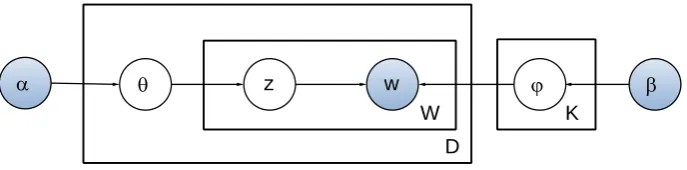
A graphical model of LDA is shown in Figure 1, wherein nodes are random variables and edges in-dicate the dependence between nodes [12, 13]. As a directed graph, shaded and unshaded variables indicate observed and latent (i.e., unobserved) variables respectively, and arrows indicate conditional dependencies between variables while plates (the boxes in the figure) refer to repetitions of sampling steps with the variable in the lower right corner referring to the number of samples.
Given a corpus with a collection of D documents, each document in the corpus is a sequence of W words, each word in the document is an item from a vocabulary index with V distinct terms, and T is the total number of topics. The procedure for generating a word in a document by LDA is as follows:
1. for each topic z = 1…K, Draw z ~ Dirichlet();
2. for each document d = 1…D,
(a) Draw topic distribution d ~ Dirichlet(); (b) for each word wi in document d,
i. Draw a topic ~ d; ii. Draw a word ~ ;
Figure 1LDA Topic Model
3
LDMA
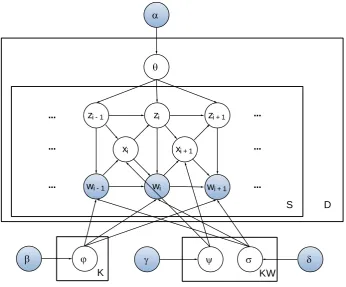
LDA model makes an assumption that words are generated independently to each other in a docu-ment. Also LDA ignores the order or positions of words or simplicity. Here we propose LDMA, a generative probabilistic topic model based on Latent Dirichlet Allocation (LDA) and Hidden Markov Model (HMM), to relax the “bag of words” assumption from LDA to yield to a better model in terms of extracting latent topics from text. Figure 2 shows the graphical model corresponding to the LDMA generative model.
LDMA, in addition to the two sets of random variables z and w, introduces a new set of variables x to detect an n-gram phrase from the text. LDMA assumes that the topics in a sentence form a Markov chain with a transition probability that depends on , a distribution zw, a random variable xi and the
topic of previous word zi-1. Random variable x denotes whether a bigram can be formed with previous
term or not. Therefore LDMA has the power to decide whether to generate a unigram, a bigram, a trigram or etc. Here we only consider generating unigrams and bigrams from LDMA. If the model sets xi equal to one, it means that wi-1 and wi form a bigram and if it is equal to zero they do not.
The generative process of the LDMA model can be described as follows: 3. for z = 1…K,
Draw multinomial z ~ Dirichlet();
4. for z = 1…K, for w = 1…W,
(a) Draw binomial zw ~ Dirichlet();
(b) Draw multinomial zw ~ Beta();
5. for d = 1…D,
(c) Draw multinomial d ~ Dirichlet(); (d) for s = 1…S in document d,
for each word wi in sentence s,
i. Draw from binomial ; ii. if( = 0) Draw from multinomial d; else ;
iii. if( = 1) Draw from multinomial ; else draw from multinomial ;
D z
W
Figure 2A graphical view of LDMA Topic Model
LDMA model is sensitive to the order of the words, which it is not assumes that a document is a bag of words, i.e. successive words in LDMA tend to have the same topics. Therefore unlike LDA ap-proach, LDMA will not give the same topic to all appearances of the same word within a sentence, a document or corpus.
4
INFERENCEThe exact inference of learning parameters in LDMA is intractable due to the large number of param-eters in the model [13, 15]. Therefore approximate techniques are needed. We use Gibbs sampling to approximate the latent variables in the model. At each transition of Markov chain, the aspect (topic) of ith sentence, zi, and the n-gram variable xi are drawn from the following conditional probability:
If then:
( | )
∑ ( )( ) (
∑ ( ))
If then:
( | )
∑ ( )( ) (
∑ ( ))
Where denotes the bigram status for all words except , represents the topic (aspect) assign-ments for all words except , represents how many times word w is assigned to aspect z as a unigram, represents how many times word v is assigned to aspect z as a second term of a bi-gram word given the previous word w, denotes how many times the status variable x is set to k given the previous word w and the previous word’s aspect z, and represents how many times a word is assigned to aspect z in sentence s of document d.
zi - 1 zi ...
zi + 1
wi - 1 wi wi + 1
...
S
K
...
...
xi xi + 1
D
... ...
KW
5
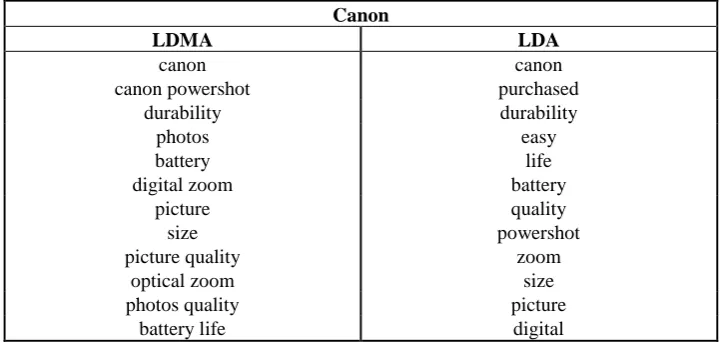
EXPERIMENTSIn this section, we apply the proposed LDMA model to customer review datasets of digital cameras and compare the results with the original LDA model. These datasets of customer reviews [1] contain two different products: Canon G3 and Nikon Coolpix 4300. Table 1 shows the number of review sen-tences and the number of manually tagged product aspects for each product in the dataset.
Table 1
Summary of customer review datasets.
Dataset Number of review sentences Number of
manual aspects
Canon 597 100
Nikon 346 74
[image:6.595.117.478.350.521.2]We first start by preprocessing review document from the datasets. We extract the sentences accord-ing to the delimiters ‘.’, ‘,’, ‘!’, ‘?’, ‘;’. And then by removaccord-ing Stopwords and words with frequency less than three we extract a feature vector to represent review documents. By applying LDMA and the original LDA models examples of most probable aspects (topics) extracted are shown in Tables 2 and Table 3.
Table 2
Exampled aspects discovered by LDMA and LDA form Canon reviews Canon
LDMA LDA
canon canon powershot
canon purchased durability durability
photos battery digital zoom
easy life battery picture
size picture quality
optical zoom
quality powershot
zoom size photos quality picture
[image:6.595.120.478.559.694.2]battery life digital
Table 3
Exampled aspects discovered by LDMA and LDA form Nikon reviews Nikon
LDMA LDA
easy use auto mode
Battery perfect
camera transfer
pictures camera
nikon nikon
transfer cable Manual
battery manual mode
print quality
macro small mode
6
CONCLUSIONSManaging the explosion of digital content on the internet requires new tools for automatically mining, searching, indexing and browsing large collections of text data. Recent research in data mining and statistics has developed a new brand of techniques call probabilistic topic modeling for text. In this paper, we proposed LDMA model, a model which extends the original topic modeling approach, LDA, by considering the underlying structure of a document and order of words in document. LDMA ignores the bag of words assumption of LDA to extract multi-word and n-gram aspects and topics from text data. We find that ignoring this basic assumption allows the model to learn more coherent and informatics topics.
REFERENCES
[1] Hu, M., Liu, B. (2004). Mining opinion features in customer reviews. In: Proceedings of 19th Na-tional Conference on Artificial Intelligence AAAI.
[2] B. Liu, L. Zhang, (2012). A survey of opinion mining and sentiment analysis, Mining Text Data, 415-463.
[3] C. Lin, Y. He, R. Everson, S. Ruger, (2012). Weakly supervised joint sentiment-topic detection from text, IEEE Trans. Knowl. Data Eng. 24, no. 6, 1134-1145.
[4] G. Qiu, B. Liu, J. Bu, C. Chen. (2011). Opinion word expansion and target extraction through double propagation, Computational linguistics, 37(1), 9-27.
[5] I. Titov, R. McDonald, (2008). A joint model of text and aspect ratings for sentiment summarization, in: Proceedings of the Annual Meeting on Association for Computational Linguistics and the Human Language Technology Conference (ACL-HLT). pp. 308–316. [6] S. Brody, N. Elhadad, (2010). An unsupervised aspect-sentiment model for online reviews, in: Proceedings of Annual Conference of
the North American Chapter of the Association for Computational Linguistics. Publishing, Association for Computational Linguistics, pp. 804-812.
[7] S. Moghaddam, M. Ester, (2011). ILDA: interdependent LDA model for learning latent aspects and their ratings from online product reviews, in: Proceedings of the 34th international ACM SIGIR conference on Research and development in Information Retrieval. Publishing, ACM, pp. 665-674.
[8] X. Fu, G. Liu, Y. Guo, Z. Wang, (2013). Multi-aspect sentiment analysis for Chinese online social reviews based on topic modeling and HowNet lexicon, Knowledge-Based Systems, 37, 186-195.
[9] Z. Zhai, B. Liu, H. Xu, P. Jia, (2011). Constrained LDA for grouping product features in opinion mining, in: Proceedings of 15th Pacific-Asia Conference, Advances in Knowledge Discovery and Data Mining, pp 448-459.
[10] Jo, Y., & Oh, A. H. (2011). Aspect and sentiment unification model for online review analysis. In Proceedings of the fourth ACM international conference on Web search and data mining (pp. 815-824). ACM.
[11] C. Zhai, J. Lafferty, (2001). Model-based feedback in the language modeling approach to information retrieval, in: Proceedings of 10th International Conference on Information and knowledge management. Publishing, pp. 403-410.
[12] David M. Blei, Andrew Y. Ng, and Michael I. Jordan. (2003). Latent Dirichlet allocation. Journal of Machine Learning Research, 3:993–1022.
[13] Thomas L. Griffiths, Mark Steyvers, David M. Blei, and Joshua B. Tenenbaum. (2005). Integrating topics and syntax. In Lawrence K. Saul, Yair Weiss, and L´eon Bottou, editors, Advances in Neural Information Processing Systems 17, pages 537–544. MIT Press, Cambridge, MA.
[14] Hanna M. Wallach. (2006). Topic modeling: Beyond bag-of-words. In ICML ’06: 23rd International Conference on Machine Learn-ing, Pittsburgh, Pennsylvania, USA.