Journal of Inequalities and Applications Volume 2010, Article ID 805178,9pages doi:10.1155/2010/805178
Research Article
Weight Identification of a Weighted
Bipartite Graph Complex Dynamical Network with
Coupling Delay
Zhen Jia and Guangming Deng
College of Science, Guilin University of Technology, Guilin 541004, China
Correspondence should be addressed to Zhen Jia,[email protected]
Received 25 March 2010; Accepted 16 July 2010
Academic Editor: Alexander I. Domoshnitsky
Copyrightq2010 Z. Jia and G. Deng. This is an open access article distributed under the Creative Commons Attribution License, which permits unrestricted use, distribution, and reproduction in any medium, provided the original work is properly cited.
We propose a network model, a weighted bipartite complex dynamical network with coupling delay, and present a scheme for identifying the weights of the network. Based on adaptive synchronization technique, weight trackers are designed for identifying the edge weights between nodes of the network by monitoring the dynamical evolution of the synchronous networks with drive-response structure. The conclusion is proved theoretically by Lyapunovs stability theory and LaSalle’s invariance principle. Compared with the similar works, taking into consideration the structural characteristics of the network, the tracking devices designed in our paper are more effective and more easy to implement. Finally, numerical simulations show the effectiveness of the proposed method.
1. Introduction
suggested a method for estimating the adjacency matrix of networks with various oscillators. In12,13, the authors have provided methods to identify the topology for general networks and delay coupled networks, respectively. The study in14has further investigated the key factor, the independent condition, for guaranteeing successful topology identification, and it pointed out that the earlier results in11–13were incomplete or incorrect. The topology identification process based on11–13may fail due to the lack of “independent condition”. Now, for a special network, such as a bipartite graph network proposed below, it is worth of further study how to design more suitable and more effective controllers to guarantee the topology or weight identification utilizing the structural feature of the network.
Bipartite graph networks widely exist in biological, social, physical, and technological fields. The so-called bipartite graph refers to a graph which has two types of nodes and edges running only between nodes of unlike types15. Many social and biological networks are bipartite. For example, in the research of human disease genomics, if it regards various human diseases as a type of nodes and pathogenic genes as another, human diseases and pathogenic genes make up a bipartite graph network16. Obviously, it is very important to identify the relation of the two classes of nodes for helping people to treat diseases. So, the research of the edge weight between nodes in a bipartite graph network has the widespread practical significance and the application value.
Motivated by the above discussions, in this paper, we provide a weighted bipartite complex dynamical network model and focus on the weight identifying problem. Based on adaptive synchronization technique, we design trackers to identify the edge weights of the network. The conclusion is proved rigorously by LaSalle’s invariance principle, and a numerical example with the chaotic Lorenz system and the Chen system is provided to demonstrate the effectiveness of the proposed method.
In the whole paper, · represents 2-norm of vector,·T denotes the transposition of
·,⊗represents the Kronecker product,Imis anm-order identity matrix, andNs1denotes the
set{1,2, . . . , s}.
2. Model Description and Preliminaries
Consider a weighted bipartite graph complex dynamical network with delay linear coupling, which consists by two different types of nodes, as described below:
˙
xit ft, xit r
j1
pijA
yjt−τ−xit−τ
, i∈Ns1,
˙
yjt g
t, yjt
s
i1
pijA
xit−τ−yjt−τ
, j∈N1r,
2.1
wherexit, yjt ∈Rnare the state vectors of nodes,f, g : R×Rn → Rnare continuously
differentiable vector functions. The two sets of node equation are described by ˙xt ft, xt and ˙yt gt, yt, and s, r represent the number of two types of nodes, respectively.τ > 0 is a constant for the coupling delay.A∈ Rn×nis a constant matrix called
inner-coupling matrix. P pijs×r represents an unknown or uncertain coupling weight
matrix, in whichpij/0 if there is a coupling from nodeito nodej, andpijrepresents the edge
is determined by the weight matrixP. The external-coupling matrix of network2.1is given by
Ccij
D1 P
PT D
2
∈Rsr×sr, 2.2
whereD1 diag−
r
j1p1j, . . . ,− r
j1psj ∈ Rs×sandD2 diag−
s
i1pi1, . . . ,−
s
i1pir ∈ Rr×r.
Obviously, matrixCis a diffusive coupling matrix which has zero-row sums; that is,
cii− sr
k1cik, i∈N1sr.
Our objective is to design weight trackers to identify the weights of the network2.1, that is, to estimate the elements of the unknown or uncertain weight matrixP pijs×r. For
this purpose, here we introduce a useful assumption and lemma.
Assumption 1A1. Suppose that there exist positive constantsδf andδgsuch that
ft, xt−ft, yt≤δfxt−yt, gt, xt−gt, yt≤δgxt−yt,
2.3
wherext, ytare time-varying vectors.
Lemma 2.1. For any vectorsx, y∈Rn, one has2xTy≤xTxyTy.
3. Main Result
Taking the network2.1as the drive network, a controlled response network can be designed as
˙
xit ft,xit r
j1
pijA
yjt−τ−xit−τ
ui, i∈N1s,
˙
yjt gt,yjt
s
i1
pijA
xit−τ−yjt−τ
usj, j ∈Nr1,
3.1
wherexit,yjt∈Rnare the response state vectors,uiandusj are the control inputs to be
designed, andpijis the estimation of the weightpij. The synchronous error between systems
Denote thatet eT1t, . . . , eT
st, eTs1t, . . . , eTsrtT, andpij pij −pij. Then the
error system can be written as follows:
˙
eit ft,xit−ft, xit r
j1
pijA
yjt−τ−xit−τ
r
j1
pijA
esjt−τ−eit−τ
ui, i∈N1s,
˙
esjt g
t,yjt
−gt, yjt
s
i1
pijA
xit−τ−yjt−τ
s
i1
pijA
eit−τ−esjt−τ
usj, j ∈N1r,
3.2
or
˙
eit ft,xit−ft, xit r
j1
pijA
yjt−τ−xit−τ
r
j1
pijA
esjt−τ−eit−τ
ui, i∈N1s,
˙
esjt g
t,yjt
−gt, yjt
s
i1
pijA
xit−τi−yjt−τ
s
i1
pijA
eit−τ−esjt−τ
usj, j ∈N1r,
3.3
where3.2and3.3are equivalent.
Theorem 3.1. Suppose that A1 holds. Take the controller and adaptive laws as follows
ui−kieit, k˙ieTiteit, i∈N1sr, 3.4
˙
pijt esjt−eit T
Ayjt−τ−xit−τ
, i∈N1s, j ∈N1r, 3.5
Then one haset → 0t → ∞; that is, the systems2.1and 3.1achieve synchronization.
Furthermore, if vectorsy1t−xit, y2t−xit, . . . ,andyrt−xit i∈N1sor vectorsx1t−
yjt, x2t−yjt, . . . ,andxst−yjt j ∈N1rare linear independence, then one haspij → 0,
that is,pij → pijast → ∞.
Proof. Choose the Lyapunov candidate as
Vt 1
2
sr
i1
eTiteit
1 2
s
i1
r
j1
pij2 1
2
sr
i1
ki−k2
1 2
t
t−τ sr
i1
eiTζeiζdζ, 3.6
The derivative ofVtalong the trajectories of3.3,3.4, and3.5is given by
˙
Vt s
i1
eTite˙it r
j1
eTsjte˙sjt s
i1
r
j1
pijp˙ij
sr
i1
ki−kk˙i
1
2
sr
i1
eT
iteit−
1 2
sr
i1
eT
it−τeit−τ
s
i1
eTitft,xit−ft, xit
s
i1
r
j1
eTitpijA
yjt−τ−xit−τ
s
i1
r
j1
eTitpijA
esjt−τ−eit−τ
s
i1
eiTui r
j1
esTjtgt,yjt
−gt, yjt
s
i1
r
j1
eTsjtpijA
xit−τ−yjt−τ
s
i1
r
j1
eTsjtpijA
eit−τ−esjt−τ
r
j1
esTjtusj s
i1
r
j1
pijp˙ij
sr
i1
ki−kk˙i
1 2
sr
i1
eTiteit−
1 2
sr
i1
eTit−τeit−τ
≤δf s
i1
ei2 s
i1
r
j1
pij
eTitAesjt−τ−eit−τ
eTsjtAeit−τ−esjt−τ
δg r
j1
esj2 s
i1
r
j1
pij
eTitAyjt−τ−xit−τ
esTjtAxit−τ−yjt−τ
p˙
ij
sr
i1
eiTtui sr
i1
ki−keiTteit 1
2e
Ttet−1
2e
Tt−τet−τ
δf s
i1
eTiteit δg r
j1
eTsjtesjt
s
i1
r
j1
pij
eTitAesjt−τ−eit−τ
eTsjtAeit−τ−esjt−τ
−keTtet 1
2e
Ttet− 1
2e
Tt−τet−τ.
3.7
because
s
i1
r
j1
pij
eiTtAesjt−τ−eit−τ
eTsjtAeit−τ−esjt−τ
s
i1
r
j1
eTitpijAesjt−τ s
i1
r
j1
eTsrtpijAeit−τ
s
i1
eTitciiAeit−τ r
j1
esTjtcsj,sjAesjt−τ
eTtC ⊗ Aet−τeTtGet−τ,
whereGC⊗A. ByLemma 2.1, one has
eTtGet−τ≤ 1
2e
TtGGTet 1
2e
Tt−τet−τ. 3.9
Therefore,
˙
Vt≤δf s
i1
eTiteit δg r
j1
eTsjtesjt−keTtet 1
2e
TtGGTet 1
2e
Ttet
≤λmax
Q1
2GG
T
1
2−k
eTtet
3.10
in whichQdiag{δfIsn, δgIrn}. Takingk λmaxQ 1/2GGT 3/2, then one has ˙Vt≤ −eTtet.
It is obvious that ˙V 0 if and only ifet 0. LetS be the set of all points where ˙
V 0, that is,S {V˙ 0} {et 0}. From3.2, the largest invariant set ofS isM {et 0,rj1pijAyjt−xit 0,si1pijAxit−yjt 0}. According to LaSalle’s
invariance principle17, starting with any initial values, the trajectories of systems 3.2–
3.5will converge toMasymptotically, which implies thatet → 0t → ∞. By the linear independence condition inTheorem 3.1,rj1pijAyjt−xit 0,and si1pijAxit− yjt 0}, we can getpij0. Therefore, one haspij → 0; that is,pij → pijast → ∞. Now
the proof is completed.
Remark 3.2. Bypij → pij, it is show that ˙pij esjt−eitTAyjt−τ−xit−τis just
the tracker ofpij; that is, we can get the weight of the network by monitoring the dynamical
evolution of the nodes. Here, the number of trackers iss×rwhich is much smaller than that ofsr2in12,13, so our method is more simple and easier to achieve.
Remark 3.3. It is noteworthy that the “linear independence condition” is very important in the
identification method14; otherwise it may lead to identification failure. For the successful identifying, there cannot occur any synchronization between the two types of nodes in the bipartite graph network. Fortunately, the two types of nodes in a bipartite graph network generally have different dynamics; they are generally not synchronized under natural state.
4. A Numerical Example
0 5 10 15 20 25 30
t
0 5 10
e1
0 5 10 15 20 25 30
t
0 5 10
e2
0 5 10 15 20 25 30
t
0 5 10
e3
0 5 10 15 20 25 30
t
0 5 10
e4
0 5 10 15 20 25 30
t
0 5 10
e5
[image:7.600.186.413.94.373.2]
Figure 1:The evolution of the synchronous error.
The chaotic Lorenz system18and Chen system19are, respectively, described by
˙
xifxi ⎡ ⎢ ⎢ ⎢ ⎢ ⎣
10xi2−xi1
28xi1−xi1xi3−xi2
xi1xi2−
8 3xi3
⎤ ⎥ ⎥ ⎥ ⎥
⎦, y˙jg
yj
⎡ ⎢ ⎢ ⎢ ⎣
35yj2−yj1
−7yj1−yj1yj328yj2
yj1yj2−3yj3
⎤ ⎥ ⎥ ⎥
⎦. 4.1
Choose the coupling delayτ1 and the weight matrix
P
3 0 −1
−2 2 4
. 4.2
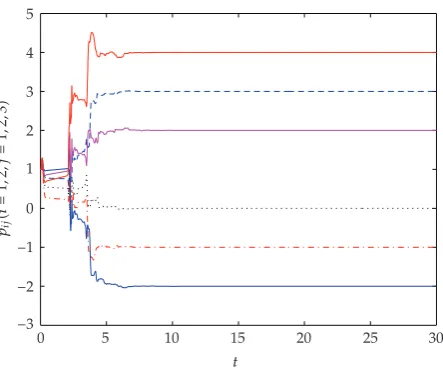
The controllers and trackers are taken as3.4and3.5inTheorem 3.1; then one can obtain the edge weights of the network:p113, p120, p13 −1, p21−2, p22 2, andp234.
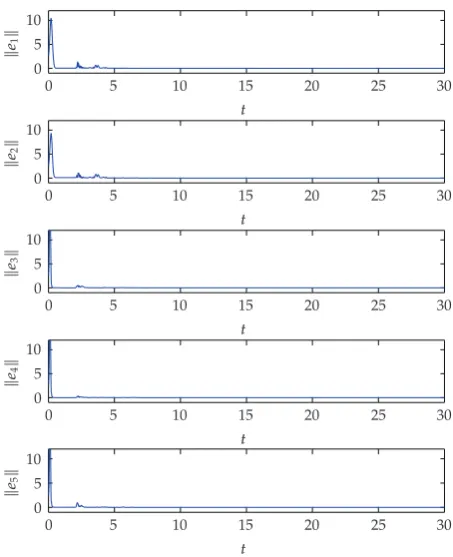
Figures1and2are the numerical simulation results.Figure 1shows the synchronous errors that converge to zeros; that is, the response network3.1synchronized to the drive network2.1. Figure 2 displays that pij → pij; that is, we have obtained the exact edge
weights of network2.1.
In the numerical simulations, the initial values are taken as follows:xi0 1.50.5i,2
0 5 10 15 20 25 30
t −3
−2 −1 0 1 2 3 4 5
pij
i
1
,
2
,j
1
,
2
,
3
[image:8.600.190.412.94.279.2]
Figure 2:The evolution of the weight trackerspij.
5. Conclusion
In this paper, we have presented a model of weighted bipartite graph complex dynamical network with coupling delay and designed trackers for identifying the weights of the network. By monitoring the dynamical evolutions of the drive-response synchronous network, we can obtain the exact weights of the network. This approach is expected to be widely used in the study of many real bipartite graph networks, especially in the research of the relationship between two types of things.
Acknowledgments
This work was supported by the National Natural Science Foundation of China no. 60574045, the Natural Science Foundation of Guangxi no. 0991244 and the Science Foundation of Education Commission of Guangxinos. 61004101, 11061012.
References
1 D. J. Watts and S. H. Strogatz, “Collective dynamics of ‘small-world’ networks,”Nature, vol. 393, no. 6684, pp. 440–442, 1998.
2 A.-L. Barab´asi and R. Albert, “Emergence of scaling in random networks,”Science, vol. 286, no. 5439, pp. 509–512, 1999.
3 G. R. Chen, “Introduction to complex networks and their recent advances,”Advances in Mechanics, vol. 38, no. 6, pp. 653–662, 2008.
4 A. Arenas, A. D´ıaz-Guilera, J. Kurths, Y. Moreno, and C. Zhou, “Synchronization in complex networks,”Physics Reports, vol. 469, no. 3, pp. 93–153, 2008.
5 J. L ¨u, X. Yu, and G. Chen, “Chaos synchronization of general complex dynamical networks,”Physica A, vol. 334, no. 1-2, pp. 281–302, 2004.
6 J. L ¨u and G. Chen, “A time-varying complex dynamical network model and its controlled synchronization criteria,”IEEE Transactions on Automatic Control, vol. 50, no. 6, pp. 841–846, 2005.
8 X. F. Wang and G. Chen, “Pinning control of scale-free dynamical networks,”Physica A, vol. 310, no. 3-4, pp. 521–531, 2002.
9 X.-P. Han and J.-A. Lu, “The changes on synchronizing ability of coupled networks from ring networks to chain networks,”Science in China Series F, vol. 50, no. 4, pp. 615–624, 2007.
10 I. Belykh, M. Hasler, M. Lauret, and H. Nijmeijer, “Synchronization and graph topology,”International Journal of Bifurcation and Chaos, vol. 15, no. 11, pp. 3423–3433, 2005.
11 D. Yu, M. Righero, and L. Kocarev, “Estimating topology of networks,”Physical Review Letters, vol. 97, no. 18, Article ID 188701, 2006.
12 J. Zhou and J.-A. Lu, “Topology identification of weighted complex dynamical networks,”Physica A, vol. 386, no. 1, pp. 481–491, 2007.
13 X. Wu, “Synchronization-based topology identification of weighted general complex dynamical networks with time-varying coupling delay,”Physica A, vol. 387, no. 4, pp. 997–1008, 2008.
14 L. Chen, J.-A. Lu, and C. K. Tse, “Synchronization: an obstacle to identification of network topology,”
IEEE Transactions on Circuits and Systems II, vol. 56, no. 4, pp. 310–314, 2009.
15 M. E. J. Newman, “The structure and function of complex networks,”SIAM Review, vol. 45, no. 2, pp. 167–256, 2003.
16 K.-I. Goh, M. E. Cusick, D. Valle, B. Childs, M. Vidal, and A.-L. Barab´asi, “The human disease network,”Proceedings of the National Academy of Sciences of the United States of America, vol. 104, no. 21, pp. 8685–8690, 2007.
17 H. K. Khalil,Nonlinear Systems, Prentice Hall, Upper Saddle River, NY, USA, 3rd edition, 2002.
18 E. N. Lorenz, “Deterministic non-periodic flows,”Journal of Atmospheric Science, vol. 20, no. 2, pp. 130–141, 1963.