HYBRID-DOUBLE MULTIPLIER ARCHITECTURE FOR ELLIPTIC
CURVE CRYPTOGRAPHY
DHANALAKSHMI.S
1, POOVIZHI.P
2, AGALYA.E
3, UHASHINI.R
41
Assistant professor, ECE, Idhaya Engineering College for Women, Tamil Nadu, India
2Assistant professor, ECE, Idhaya Engineering College for Women, Tamil Nadu, India
3Assistant professor, ECE, Idhaya Engineering College for Women, Tamil Nadu, India
4
P.G Student, ECE, Idhaya Engineering College for Women, Tamil Nadu, India
---***---
Abstract - High-performance and fast implementation of point multiplication is crucial for elliptic curve cryptographic systems. Recently, considerable research has investigated the implementation of point multiplication on different curves over binary extension fields. In this paper, we propose efficient and high speed architecture implement point multiplication on binary Edwards and generalized Hessian curves. We perform a dataflow analysis and investigate maximum number of parallel multipliers to be employed to reduce the latency of point multiplication on these curves. Then, we modify the addition and doubling formulations and employ a newly proposed digit level hybrid double Gaussian normal basis multiplier to remove the data dependencies and hence reduce the latency of point multiplication. To the best of our knowledge, this is the first time that one employs hybrid double multiplication technique to reduce the computation time of point multiplication. Moreover, we have implemented our proposed architecture for point multiplication on FPGA and obtained the results of timing and area. Our results indicate that the proposed scheme is one step forward to improve the performance of point multiplication on binary Edward and generalized Hessian curves.
Key Words: Elliptic curve cryptography, double hybrid multiplier, Binary Edwards curves, generalized Hessian curves, Gaussian normal basis.
1 INTRODUCTION
It has been shown by Miller [1] and koblitz [2] independently that a group of points on an elliptic curve over finite fields can be used for elliptic curve cryptography (ECC) as a public key cryptography
method. In comparison to RSA, ECC offers the same level of security employing smaller key size [3]. Therefore, efficient implementation of ECC in terms of time-area trade-offs is crucial. For server applications, high speed implementations are required while for small and embedded devices area usage is the main concern that needs to be considered.
There are several implementations are available in the literature; see for example, [4], [5], [6], [7], [8], [9], [10], [11], [12], [13], [14], [15], [16], and [17]. In all these implementations, various hardware platforms such as field programmable gate array (FPGAs) and application specific integrated circuit have been utilized. Binary Edward and Generalized Hessian curves have recently been introduced in [18] and [19]. It has been shown that all generic elliptic curves over binary fields can be written in Edwards and generalized Hessian form to obtain complete and unified addition formulas which work for all pairs of input [18]. However, few works in the literature have considered the implementation of point multiplication on these curves [20], and [17]. In [20], an ASIC implementation of point multiplication on binary Edwards curves (BECs) is presented for resource constrained applications. In [17], lower level parallelization in finite field arithmetic as well as parallelization in higher level of curve formulations have been investigated to evaluate the time – area trade – offs. Curve level parallelization results indicate that although point multiplication on these curves is unified and complete, but they are slow in comparison to the point multiplication results on binary generic curves proposed in [21] and [4]. This is due to the data dependency in computing combined point addition (PA) and doubling which require three levelsofmultiplicationemploying
four parallel finite field multipliers. Note that
twolevelsofmultiplication incorporating three or more parallel multiplier aspointedoutin[4]and[22].
Highly parallel and fast computations of the widely used cryptographic algorithm ECC is required for high
performanceapplicationssuch secure web server and
systems using big data.However,a challengetocope with
is that most applications for which parallelism is essential, have significantly large scale that is not commonly suppoted by today’s crtptographic algorithms. Therefore, new techniques and architectures are required to investigate parallelization and scalability in all levels of computations of ECC. The main pupose of this paper is to provide new architecture to reduce the latency of the computation of cryptographic primitives specifically point multiplication of ECC targeting high performance applications. In this paper, we propose a new scheme to
reducethelatency of point multiplication on binary
Edwards, generalized Hessian curves using a hybrid
double multiplication techniqueproposedin[23]. The
digit level hybrid double multiplier of [23] computes two consecutive multiplications using the same latency as required for a single traditional digit level multiplier. Using this scheme reduces the latency of point multiplication on these curves and hence increases the speed of point multiplication on binary Edwards and generalized hessian curves. It should be noted that the scheme proposed in this paper is actually more than just merging the previous works presented in [23] and [17]. We first perform data flow analysis for ECC com- putations to understand how data has to move between the different logic and computational elements such as field
multipliers, adders, and squarers over binary fields .
Then, we perform alatency analysis to determine
wheretherearedoublefieldmultiplications and hence
wecanemploythehybrid double multiplier. The results
indicate that the speed of point multiplication on these curves are competitive with binary generic curves as well as providing completeness. To evaluate the practical performance of the proposed scheme, we design two cryptoprocessors using the hybrid double multiplier and code it using VHDL and implement it on Xilinx Virtex-4 and Virtex-7 FPGAs.
In preliminaries, Gaussian normal basis (GNB) and hybrid double multiplication are presented. Also, binary Edwards and generalized Hessn curves are briefly explained in this section.In Section 3, a latency reduction scheme for point multiplication is presented. In Section 4 the proposed ECC crypto processors are explained.In Section 5, we implement the crypto
processors on two FPGAs and their time and area
results are presented. Finally concluded the paper in section 6.
2 PRELIMINARIES
2.1Gaussian Normal Basis
The finite fields of characteristic two, can be
constructed by a normal basis N= { , , ... }where
GF( )is called a normal element of ). Then,
any element of ), say, A=( , can be
represented asA= . In Normal basis squaring can be ach-ieved by simple right cyclic shift of A, i.e.,
= =( ….. [3].Note that
thisoperation is fast without any costifit is implemented
in hardware.Gaussian normal basisisa special classof
normal basis whichis included in the IEEE
1363 [25] and NIST [3] standards for elliptic
curve digitalsignature algorithmandexist for every m >1
that is not divisible by 8. The complexities of type T,
GNB multiplierin terms of time and area
dependonT> 1.For thefive binary fields recommended
by NIST,i.e., m=163; 233; 283; 409; and 571, the
values of Tare even, and are 4; 2; 6; 4; and
10,respectively.
2.2Single Multiplication
Single multiplication is the computations C =A* B in and several research in the literature has been conducted on its efficient computation and Implemetation [28], [27], and[26].
[image:2.595.313.519.468.604.2]
Fig – 1:Thearchitectureofdigit-levelhybrid
Double multiplier
GNB multiplication is basedona multiplicationmatrix
[26]. Let A and Bbe two fields elements
represented by GNB over . Then their product in
TABLE - 1
Comparison of the Upper Bound of the Space and Time Complexities of Different Digit – Level Type T GNB Multipliers over
C=(A⊙(B<<1))⊕ (1)
where
S(i,B) = (B<<R(i,1))⊕(B<<R(i,2))⊕………... …..⊕(B<<R(i,T)), 1 ≤ i ≤ m-1, (2) and (X<<i) istheifoldleftcyclicshiftof andT is the type
of GNB over . Also, X⊙Y=( …
and X⊕Y = ( + denote bitwise
AND(⊙) and XOR(⊕) operations between
coordinates of X and Y, respectively. R(i,j), 1 ≤ j ≤ T
denotestheentries of column i and j of multiplication
matrix equation(1)canbe implemented in
bit-level, digit-level, and bit - parallel, depending on the available resources.Inthispaper,wechoosedigit-level parallel -inparallel-out(DL-PIPO) architecture to
perform field level multiplications of ECC.
2.3 Hybrid-Double Multiplication
Let A, B,and C bethreefield elements of GF
represented by GNB.Double multiplication is the
computation of D = A* B *C, D . In [29], the
idea hybrid double multiplication which requires
same number of clock cycles as the one for one
multiplicationis initially proposed. Then, in [23],a
digit level multiplier architecture using GNB has
been proposed which computes D with latency as
the one required forone multiplication.The structure
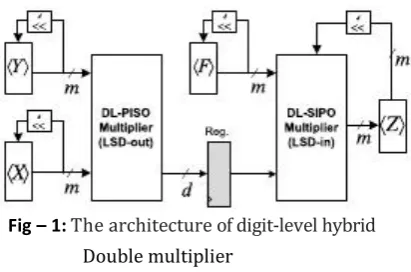
of the hybrid-double multiplier isdepicted in Fig. 1. As onecan see,itis composed of a digit level
parallel-in serial-out (DL-PISO) GNB multiplier
and a digit-level serial-in parallel- out GNB
multiplier. For the operation of the hybrid double
multiplier, the registers <X>, <Y>, and <F> should
bepreloaded with the coordinates of operands A,
of operands A, B, and C, respectively, and
the register Z> should be cleared to0 .The
entire hybrid-double multiplier performs two
multiplications simultaneously, where the result are available in parallel after M = ]+1 clock cycles, where d is the digit – size and one clock cycle is used for storing and loading from the middle d-bit register. The
critical-path delay of the hybrid double multiplier is equal
to the maximum of the delays for the DL-PISO ( and
DL-SIPO (( multipliers i.e., ( = max{( }. Then,
one can obtain the time of multiplication as T=(
In table 1, we compare the time and space
complexities ofdifferent single digit-level multiplier
(including DL-PIPO,DL-PISO,andDL-SIPO)with the
digit size d and2dwith the hybrid-doublemultiplier
with the digit dover GNB. As one can see, he
presented hybrid double multiplierhas smaller
spacecomplexities in comparison to the
DL-SIPO and DL-PISO multipliers and is comparable
tothe DL-PIPO multiplier employing 2d digitsize.
Also,itstime complexities is equaltotheDL-PISO
multiplier and is almost similar tothe
DL-PIPO and DL-SIPOmultipliers depending to the digit
size.We note that for practical implementations,
increasing the digit size drastically reduces the
maximum operating clock frequencies, hence employing hybrid double multipliers seems to be better choice to
point multiplication on elliptic curves.
Therefore, in the next sections we employ the
presented hybrid-double multiplier to reduce the
(a) (b)
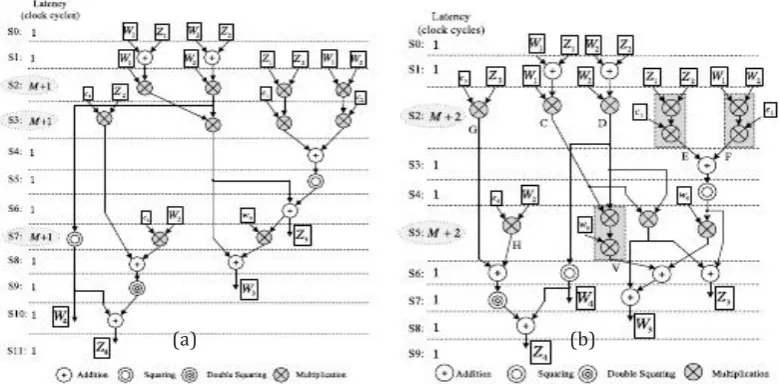
Fig – 2: Data dependency graph for fast computation of combined PA and PD for binary Edwards Curves (a): employing four DL-PIPO multipliers. (b): employing three DL-PIPO and two hybrid – double multipliers. Note that
2.4Trace and Quadratic Equation Solution
ThetracefunctionTr: =GF(2) isa linear map
and foranelement A=(
isdefinedasTr(A)=
For normal basis, the trace of element A can be
computed as Tr(A) = , which is bit-wise XOR
operationofallbitsofvectorA.
The quadratic equation for X=
( has a solution if
and onlyif Tr(A)=0,and hence ifXis a solution, then X+1isasolution. Innormal basisthe solution
canbefoundbit-wise.However, in polynomial basis it
iscomplicatedandneedshalf-trace computatio-ns
which requires m-1 squarings and m-1/2
additions[30].The costofsolving quadratic equation using normal basisis only m-2 additions.
2.5 Arithmetic over Binary Edwards and Generalized Hessian Curves
It is well known that a non-super singular binary
generic(short Weierstraß) elliptic curve canbedefined
by a set of points (x, y) and a specialpointat infininity
O(groupidentity)
That satisfythe following equation
(3)
where a,b and b [30]. Binary edwards curve
belong to a special class of generic elliptic curves defined
over binary field when m≥3 [18]. The merit of binary
Edwardscurvesovergenericcurvesisthat their point
addition formulas are complete and
their implementationsare comparable with the
traditional ones of[21].
Definition 1 ([18]). Let K be a finite field of
characteristic two i.e., char(K) = 2 and be
the elements of K with The
binary Edwards curve with coefficient the
affine curve
, (4)
where .
Given a point P=(x,y), its negation, - P , is obtained as (y,x) which has no cost [18]. The point (0,0) is the neutral lement and (1,1) has order 2[18].
The binary Edwards curvesarecompleteif Tr( )=1
i.e.,d2 cannot as +eforany e in K,
whereTr is theabsolutetrace of over GF(2)
[18].
Definition 2 ([19]). Let c and d be elements of K such
that c and The generalized hessian
[image:4.595.127.517.123.315.2](5)
where c =1 results in a Hessian curve, i.e., Note that the GHCs are complete if and only if c is not a cube in K.
The standardformulason generic curves in [21] and
[31]failincomputingaddition of two points on
curvesifoneof thepoints or their addition is at
infinity.Thesepossibilities should be tested before
designing anelliptic curve crypto system.Note that
point addition and doublingformulason binary
Edwards and generalized Hessian curves work for all
input pairs,thischaracteristiciscalled completeness.
3 NEW TECHNIQUE FOR LATENCY REDUCTION IN P OINT MULTIPLICATION
The efficiency of point multiplication, i.e.,Q=k . P,
dependsonfindingtheminimum number of steps
toreach kP from a given point P. Point
multiplication on binary Edwards andgeneralized
Hessi-ancurves is efficient when one uses
w-coordinate differential addition and doubling
formulas,Montgomery’sladder.Inthis case,forevery
bit of scalar K,oneneedstoperform combined point
addition and doubling. In [17], the maximum
parallelization over those curves is not
considered forthe purpose of high speed
implementations. This idea can be explored
deeply to investigate the area-time trade-off for
differentapplications.Anotherideaistooptimize the
size of the finite field multipliers in terms of different digit sizes. In this effect, one can employ different digit sizes(some multipliers with smaller digit size and some with larger digit sizes) and futher reduce the occupied area. We note that in theory one may keep the latency unchanged and reduce the required area but in practice the multipliers with the larger digit sizes dominate the critical path and reduce the maximum operating clock frequencies.
In this section, We first study the maximum number ofmultipliers to achieve high speed computations of point multiplication. Then, We employ a new hybrid-double multiplier presented in section 2.3. This reduces the overall latency of point multiplication on BECs and GHCs.
3.1 Binary Edwards Curves
In binary Edwards curves, mixed w-coordinate
has been in corporatedtocompute mixed differential
pointadditionandpoint doubling(PD) for
Montgomery point multiplica
tion [18]. Differential addition [32] is the
com-putation of Q+ P,givenpointsofQ,P ,and Q-P. Let
us assumewtobealinearand symmetric function in
termsofthecoordinatesx andy of the point P and
is definedas ,where w(P)= w(-P).
Bernstein et al. have defined w – coordinate
differential addition for computing w(Q + P) given
w(Q), w(P), and w(Q-P). Similarly, thew coordinates
differential doubling is the computation of w(2P)
given w(P). Therefore,using w-coordinates of
differential additiondoublingformulas,
w((2n+1)P), and w(2nP) can be computed given
w(nP) and W((n+1)P),recursively[18]. The combined
point addition and doublingformulawith
is as
(6)
where
Also, , , , ,
, and Asseenfromthe
aboveformulations,the costofthe combined PA and
PD operations is10M,where M is the cost of a
multiplication. For achieving highest degreeof
parallelization,weemploymaximumnumberof parallel multipliers. The data dependency graph is
depicted in Fig. 2a employing four DL-PIPO
multipliers. In steps S2 and S3 of Fig. 2a,
fourDL-PIPO multipliers operateinparallel and inS7,
onlytwomultipliers per-form the operation.
Therefore, the multiplier utilizationis 83.33%;.
As one can see, the smallest latency for the combined PA and PD is achieved by employing four multipliers as 3M+12. Note that employing more than four multipliers does not reduce the latency due to data dependencies.
For binary Edward curves, we modify the combined PA and PD formulations in (6) in such a way
toincorporatethe proposed hybrid double
multiplier and remove the data
dependenciestofurther reduce the number of
multipliersin the data path. The Modified
formulations are as follows:
, (6)
(7)
,
(a) (b)
Fig – 3: Data dependency graph for generalized Hessian curves with and (a) employing three
single DL-PIPO multipliers and (b) employing two single DL-PIPO multipliers and one hybrid-double multiplier.
The corresponding data dependency graph for three
modified formulations for combined PA and PD is
illustrated in Fig.2b for binary Edwards curves. As
shown in this figure, we employ the proposed
Hybrid double multiplier in Steps S2 and S5. In
step S2, we combined computation of field
multiplications by constants (c1 and c2)
and performed the m in one step with
the latency of M+2 using 2 hybrid
double multipliers.Three traditional digit-level
PIPO multipliers are also operating in this step. In step S5, we modified formulation of the PA operation in computing (w3 and z3) to take the advantage of the hybrid double multiplier as much as possible. As one can see, in this step the computation of V=C.D.w0 is done using one hybrid double multiplier with the latency of M+2. As a result, the latency of the overall point multiplication over binary Edwards curves is reduced to 2M + 12. Therefore, applying the proposed technique reduces the latency of computation of combined PA and PD by about 33 percent. We further note that the proposed approach is new method to reduce the latency of point multiplication while parallelization fails due to data dependency. Therefore, one can achieve higher speed in computing of point multiplication for high speed applications.
3.2 Generalized Hessian Curves
SimilartoBECs,mixedw- coordinate has been
incorporated tocomputemixed differential PA
andPDforMontgomery point multiplication as
follows [19]:
(8)
Where and As one can figure out the
cost of combined PA and PD is 7M. In Fig. 3a, the data dependency graph for combined PA and PD is depicted employing three parallel multipliers. As illustrated in this figure, the latency is 3M+9 and employing more than three multipliers will not reduce the latency. This is the maximum possible number of parallel multipliers that can be used to accelerate the computation of combined PA and PD. In Fig. 3b, we employ a hybrid-double multiplier to reduce the latency.
First, as one can see in step S5 one should compute A.B. and employing a hybrid multiplier can compute it in M + 2 clock cycles. Moreover, in this step we need two parallel multipliers as well. In step S2, we employ a hybrid multiplier having one of its inputs to be 1 to compute a single multiplication. This increases the latency 1 clock cycle but result in reducing the area. Therefore,the utilizationfactorforsingle and
hybrid-double multiplier is100 percent. Futher, we reduce
the latency to 2M+11 clock cycles as showninFig.3b.
Hence, the architectureof point multiplication on
generalized Hessian curves requires two single
multiplier and a hybrid-double multiplier. In
Table2, we summarize the cost of combined
TABLE - 2
Comparison of the cost of Combined Point Addition and Doubling on BEC and GHC with and without Employing Hybrid Multipliers, where M is the Number Single Digit -level Multipliers and H is the Number of Hybrid – Double Multipliers
As onecansee, the costs are givenin terms of
numberofsingledigit level and multiplier. The
cost (latency intermsofnumberof multiplier
inthecritical-path) reduction for both binary
Edwards and generalized Hessiancurves is about 33
percent.
It should be noted that the values of
depend to the digit-size and should be chosen carefully. For smaller ds, the hybrid-double multiplier is not efficient (as shown in [23], Table 4). On the other hand, for larger ds the latency reduction for the computation of PA and PD in the main loop of point multiplication is not significant. Therefore, one needs to do a trade-off between the latency reduction for multiplier and the whole architecture of ECC choosing larger digit sizes. It is worth mentioning that the occupied area and maximum operating clock frequency should be considered when one chooses the digit – size.
(a)
4 PROPOSED CRYPTOPROCESSORs
FOR POINTMULTIPLICATION
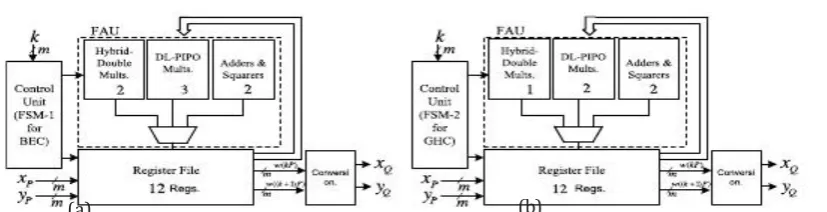
The crypto processors for point multiplicati –onare
composed of fourmain units including
finite fieldarithmeticunit(FAU), control unit,
registerfile, andconversionunit. In FAU
of BEC, we employ three singledigit-level
parallel-in parallel - out GNB multipliers and two
hybrid-to perform double multiplica
-tions asexplainedinSection3. In FAU of GHC,
twosingleDL-PIPOmultipliersanda
hybrid-doublemultiplier (M=2 and H=1) are employed.
The architectures of the proposed crypto-processors
are depicted in Fig. 4.In
FAU, squaring is simply rewiring without
anytime and area cost in normal basis. Addition is
bit-wise XORingof the coordinates of the two
operands. Thisrequires only one clock cycle to store
the results in theregisters.In a digit-level parallel
in parallel-out GNBmultiplierboth input operands, A
and B should be present through multiplication
process and the results will be available in parallel after
M=q+1, ], 1 ≤ d ≤ m, clock cycles.
[image:7.595.106.520.619.725.2](b)
TABLE - 3
Implementation Results of Point Multiplication on BECs (with M = 3 and H = 2) and GHCs (with M = 2 and H = 1) over
and in Xilinx Virtex – 4 XC4VLX160 FPGA
Where one clock cycles is due to
pipeliningthemultiplier.Forthegiven field size
m=163, digit-sizedis chosenin suchaway to
reduce thelatency while increasing d . Therefore
we choose the digit sizes fromtheset
for m = 163.As explained in
Section 2, the hybrid double multiplier computes
a double multiplication with the number of clock
cycles astheone requires for a single
multiplication. The single and hybrid double multipliers are efficiency pipelined (one level) to achieve maximum operating clock frequencies.
The architectures of proposed crypto processors
for different curves are different mainly in terms
of number of employed single and hybrid double
multipliers, registerfile,andthecontrolunit.
4.1 Control Unit
The control units are designed with finite state
machine (FSM) to perform the point
multiplication with other units.Scheduling the
computation tasks is doneby generating the
signals and switchingthe operands for FAU.The
intermediate results are stored in the
regisster file.This eliminates the over head of
communication between memory and FAU.
Several multiplexers are employed to choose
appropriate registers and connect to the
FAU.Also,forbinary Edwards and generalized
Hessian curves weobtained theaffinecoordinates
employing linear half-traceand Itoh-Tsujii’s
scheme[33] which itsimplementationisvery
efficient.
4.2 REGISTER FILE
Theregisterfileincludes12m-bitregisters to store
inputs,outputs, curve parameters, and intermediate
results for binary Edwards and generalized
Hessian curves, respectively. For instanceforbinary
Edwards curves,we have five
intermediateresults thatneed to bestored in the registersfile, four registers to store internal input
parameters (i.e., tworegisters to stor
ecoordinates of affine inp-utpoint (i.e., x and
y),andashift register to storescalar k.Thecurve
parametersare stored inaseparateregistersas to be
fixed including d1;d2;c1;c2;c3 and c4. Our
proposed data dependency graphs are efficiently
hand optimizedto ensure we occupy optimal
number of registers. We employed flip-flops
availablein eachsliceto construct register files
astheyare available asa decentralized
resources. These flip flops areputcloseto their
usage and hencewe reduced the routing
constraints.For instance the employed DL-PIPO and hybrid double multipliersrequiresequential
computations (with shift and and accumulate
operations) and hencewe we are abletoplace the registers closetotheseoperator. We note that these
flip-flops are available without additional area
requirements.Theregister fileiscomposed of
several multiplexers to chose appropriate
5. FPGA IMPLEMENTATIONS RESULTS AND COMPARISONS
Theproposedarchitectureforpointmultiplication
onBECsandGHCs are implemented on FPGA.
To be abletomake fair comparisons
[image:9.595.73.527.196.410.2] [image:9.595.69.530.199.409.2]with the previous work available in the
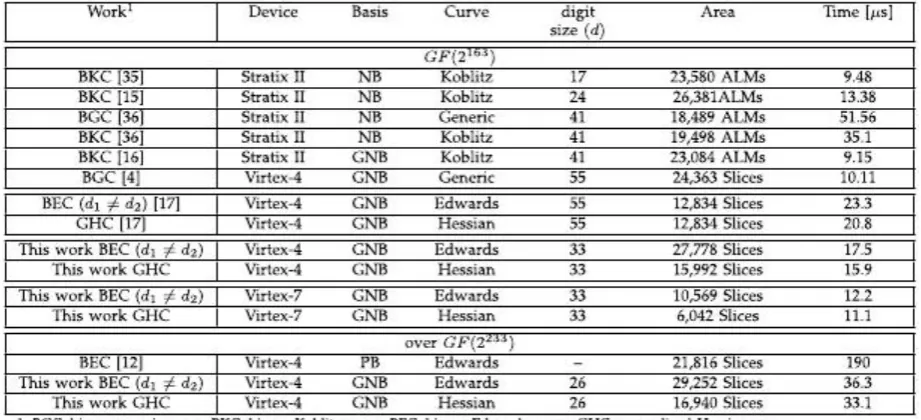
TABLE - 4 Comparison of ECC Implementations on FPGA over
literature, we have chosen same platform for our
implementations.
Fig-5 comparison of time-area results for the point multiplication on binary Edwards and generalized Hessian curves over on Xilinx Virtex-4 FPGA.
The proposed architectures for BECs andGHCs
(in Figs. 4a and4b) are modeled in VHDL[34]and
are synthesized usingXST of Xilinx ISEversion12.1
design software and are implementedon Xilinx
virtex-4 XC4VLX160 FPGA.
In terms of available resources it contains 67,584
Slices (135,168 LUTs and 135,168FFs). The
implementation results for different digit
sizes d, d an d are reported
in Table 3 after place androute(PAR) for the
proposed architecturesover and
As one can see, for m = 163 the fastestpoint
multiplicationstake 17.5ms and15.9 msand equire
27,778 Slicesand 15,992 Slices for BEC and GHC,
respectively.Form=233 the fastest point
multiplication is computed in 36.3
computedin 36.3and 33.1msoccupying 29,252
slices and 16,940Slices, respectively. In
Table3, we also provide the resultsofarea
timeproducts as a parameter tomeasurethe
efficiencyoftheproposed a rchitecturesfor
practicalapplications. Further as illustrated in
Fig. 5 we plot the area-timefordifferentdigit sizes
andcompareittotheprevious work presented
in[17].
Itshouldbenotedthatfor particular applications
the digit-sizeshouldbechosenin such away to
achieve highest performance considering the time-area trade-offs.
As explained in the above sections, the novelty of the
[image:9.595.27.233.474.635.2]this paper is based on employing a new hybrid double multiplier architecture proposed in
[23].This scheme reducesthelatencyofpoint
multiplicationon preliminaryworkwhich
parallelizationfails due to data dependencies.
5.1 Discussion and Comparison
In this section, the implementation results
of the proposed crypto-processors for point
multiplication in this paper are compared to the
counterparts in the literatureas illustrated in
Table 4. As explained in the previous sections,the
novelty of the proposed architetures for point
multiplication in this paper is based on employing
a new hybrid-double multiplier architecture
proposed in [23]. This scheme reduces the
latencyof point multiplication on previous work
which parallelization fails due to
data dependencies.
The work presented in [17] and [12], are the only
available works in theopen literature on BECs and
GHCs and hence we mainly compare our results
to them on the same platform and field sizes.
Comparisons to the other works which have not
employed unified and complete formulae
i.e.,implementationsonBGCs and BKCs)
is presentedonly interms of performance result.
The point multiplication architecture presened
in [17], employs two finite field multipliers and
investigates the time-areatrade-offsandmultiplier
utilization. As reported in [17], the point
multiplication takes 23.3 and 20.8 ms employing
two parallel finite field multipliers for binary
Edwards and generalized Hessian curves,
respectively.
In[36],Jarvinenandskytta haveemployed four
parallel normalbasismultipliers for point
multiplication binary generic and Koblitz
curves.The point multiplication requires
51.56 and 35.1 ms for binary genericand koblitz
curves, respectively.Also,in[35],a new scheme
hasbeen proposed employing interleaving which
reduces the time of point multiplication on
Koblitz curves to 9.48 ms on AlteraStratixII.
However,inourproposed architecturesfor
point multiplication on Koblitz curves
requires 8.6 ms onthe same platform. We note that
one can reach higher speedsbycombining our
scheme with the one proposedin[35]utilizingdata
inter leaving. In [13],Royetal.proposed aparallel
architecture for scalarmultiplicationonKoblitz
curves. They have employed a hybrid Karatsuba
multiplier for field multiplications andhave
implemented their parallel architecture on
Xilinx Virtex-5 FPGA.
The point multiplication requires 12.1ms and
occupies 2,430Slicesover .In[14], Rebeiro
et al. proposedahigh speed architecture based on
pipelined hybrid Karatsuba multiplier(using
polynomialbasis) forcomputing point
multiplication on binary generic curves. Similar to
[17], they employed a LUT-based pipelining
technique to achieve maximum operating clock
frequency.Their architecture is coming with a
carefuldata scheduling for computingdifferential
point additionand doubling in themainloop of
point multiplication. They have implemented their
proposed architecture ondifferent FPGA
platforms.
For instance, their architecture requires 9.7 ms
and occupies 8,070Slices on Xilinx
Virtex-over .In [11], Chatterjee andSengupta,
proposed a similar architecture forcomputingpoint
multiplication on binaryHuffcurves which have
beenrecently propo-sedby Devigne andJoye[37].
Their proposed architecture is efficiently
implemented over which is unified and
complete. They have also investigated side
channel resistivity of point multiplication
architecture on binary Edwards curves
implemented on Xilinx Virtex-4 over galois
field . in[12]. Their architecture requiers
21,816 slices and computes a single point
multiplication in 190ms.Thisarchitectureoperates
in 47.3 MHz clock frequencywhichisfairly low
due to the usage ofKaratsuba multiplierand
requires about 9.006 clock cycles in total,
In addition, one should note that binaryEdwards
curves requires 10multiplication operations and it
seems that parallelization is more efficient as
we have employed in our proposedscheme. We
note that their proposed method is one step
forward in investigating theside channel analysis
of proposed architecturesfor point
multiplicationon binaryEdwardscurves which
motivatesmore research in this direction forother
curves such as generalized Hessian curves.Thepoint
multiplication scheme proposedin[4]has been
performed on binarygenericcurves over
The employingthreedigit-serial GNB
multipliers. The computationof point multiplication
takes 10.11 ms on Xilinx Virtex-4 platform[4].
As summarized in Table 3, we have
employed smaller digit sizesandreduced the
latency of point multiplication basedonthe newly proposedcrypto processors.As a result, we have increased the speed of point multiplication
computationonbinaryEdwards and generalized
Hessaiancurves about 25 percent in
comparison to the ones presented in[17]. As one
work onthesameplatforms andaremore efficient intermsoftime areaproducts for GHCs.Note that
theideaofemploying hybrid double multiplier
tospeeduppointmultiplication on binary curves
canalso be employed for the case when field elements
are represented by polynomial basis.Therefore,
similar improvements will be achieved for
increasing the speed of point multiplication using
any basis. The point multiplication onBECs and
GHCs arecompleteand work for all pairsofinputs.
However, for the othercurves one needs to check
points at infinity and avoid them for practical
applications.
Therefore, it is not fair to compare our
implementation results to the counterparts using
generic and Koblitz curves quantitatively. In
addition, if security against side channel attacks
plays the main role, uniform formulas
certainlydohave an advantagewhichwe
have investigated in this work.Further,in this paper
our targetishigh performance applicationsas
wespeedupthe time of point multiplication at the cost of increasing the area. We stress that one could have use Karatsuba method for multiplication over
for computing point multiplication but as indicated in [38], for smaller field sizes digit serial normal/polynomial basis multipliers can operate in higher clock frequencies occup-ying similar area in comparison to the Karatsuba multiplier.
6 CONCLUSIONS
In thispaper,wehave proposed a newscheme to
speed up the point multiplication onbinary
Edwards and generalized Hessiancurves
employinga digit level hybrid-double
multiplierofwhich performs two multiplications
withthe latencyastheone requires for
onemultiplication.Wehave performed adata flow
analysis for pointmultiplication to understand how
data has to move between the different logicand
computational elements such asfield multipliers ,
adders andsquarers. Then ,we have investigated
how the hybrid double multiplier can be employed
to reduce the latency of point multiplication. We
have obtained that employing the hybrid double
multipliercan reduce the latency of point
multiplicationon binaryEdwards andgeneralized
Hessian curves and speed up the computation
time.We have evaluated the performance of the
proposed cryptoprocessors for different digit
sizes with implementing on FPGA and
have reported the area and the timing
results. Our proposed architecture performs point
multiplication on binary Edwardsand
generalizedHessiancurves25percent faster than
the previousfastestresults appearing in [17].
R EFERENCES
[1] V.S.Miller, Use of elliptic curves in cryptography inProc.Adv.Cryptol.,1986, pp.417–426. [2] N.Koblitz, Elliptic curve cryptosystems,Math.
Comput., vol.48,pp.203–209,1987.
[3] U.S. Department of Commerce/NIST,Nationa
lInstitute ofStandards and technology, Digital
signature Standard,FIPSPublications1862.
[4] C.H. Kim,S. Kwon,andC.P.Hong,FPGA
implementation of high performance elliptic curve cryptographic processor over
J. Syst. Arch.,vol.54,no.10, pp.,893–900,2008.
[5] Y. K. Lee,K. Sakiyama,L. Batina,andI.Verbau
whede, Elliptic curve based security processor for RFID, IEEE Trans. Comput.,vol.57,no.11,
pp.,1514– 1527,Nov.2008.
[6] J.Adikari,V.S.Dimitrov,andL. Imbert, Hybrid binary-ternary number system for elliptic
curve cryptosystems, IEEE Trans.Comput.,
vol.60, no.2,pp.254–65,Feb.2011.
[7] W.CheltonandM.Benaissa,Fast elliptic curve cryptography onFPGA, IEEE Trans. Very Large Scale Integr. Syst., vol. 16, no.2,pp.198– 205,Feb.2008.
[8] J.Adikari,V.Dimitrov,andK. Jarvinen,A fast
Hardware architecture for integer to
NAF conversion for koblitz curves, IEEE
Trans.Comput.,vol.61,no.5, pp. 732 – 737,
May2011.
[9] M.Keller,A.Byrne,andW.P.Marnane, Elliptic
curve cryptography on FPGA for low-power
applications,ACMTrans. ReconfigurableTechnol.
Syst., vol. 2, no. 1,pp.1–20,2009.
[10] G.SutterandJ.DeschampsandJ.Imana,
Efficientelliptic curvepoint multiplicationusing digit serial binary field operations, IEEETrans. Ind.Electron.,vol.60, no.1, pp.,217–225,
Jan.2013.
[11] A. Chatterjee and I. Sengupta, Design ofa hig
hperformance binary Edwards curve based
processor Secured against side channel analysis, Integr.,VLSIJ.,vol.45,no.3,pp.331–340,2012.
[12] S.Roy, C.Rebeiro,andD.Mukhopadhyay,A
parallel architecture for Koblitz curve scalar
multiplications on FPGA platforms,inProc.15
thEuromicroConf.Digit. Syst.
Des,2012,pp.553–559.
[13] C.Rebeiro,S.S.Roy,andD.Mukhopadhyay,
Pushing limits of high-speed GF( )elliptic
curve scalar multiplication on FPGAs, in proc.
Cryptographic hardwareEmbeddedSyst.2012