© 2016, IRJET | Impact Factor value: 4.45 | ISO 9001:2008 Certified Journal
| Page 1130
SEISMIC ANALYSIS OF BUILDING STRUCTURE WITH BUCKLING RESTRAINED
BRACE
TINTO GEORGE
1, JEBIN JAMES
21
Faculty ,United Cadd Solutions, Ernakulam, Kerala
2
Head of Department ,United Cadd Solutions, Ernakulam, Kerala
---***---ABSTRACT-
Conventional braces have limited deformation ductility capacity, and exhibit unsymmetrical hysteretic cycles, with marked strength deterioration when loaded in compression. To overcome the above mentioned problems, a new type of brace was developed in Japan called as buckling restrained braces, designated as BRB’s. These braces are designed such that buckling is inhibited to occur, exhibiting adequate behavior and symmetrical hysteretic curves under the action of both tensile and compressive cycles, produced by the action of seismic and wind forces. Nonlinear time history analysis, response spectrum method and pushover analysis of 10-story 2D frame is carried using software, ETAB. The response parameters used to evaluate structural performance are natural time period, story displacement, inter story drift, story shear and axial forces.Key Words:
Seismic Analysis,Building structure,
Buckling, Restrained brace,Time HistoryINTRODUCTION
As the population of our country is increasing and land area remains constant, engineers have no option other than going for vertical growth of buildings. As these vertical structures become slender and slender, the effect of earthquake on these structure became atmost important. These structures are susceptible to collapse or large lateral displacements due to earthquake ground motions and require special attention to limit this displacement. This ductile behavior can be achieved by the stable plastic deformation of structural members. To control this lateral displacement, different engineers have used different-different techniques. Lateral displacements on structural buildings have been of great concerns for engineers. In order to minimize the effect of earthquake and wind forces, special diagonal members, called braces, have been used successfully. However, these members when subjected to compressive forces exhibit buckling deformation and show unsymmetrical hysteretic behavior in tension and
compression. If buckling of steel brace is restrained and the same strength is ensured both in tension and compression.
The energy
absorption of the brace will be markedly increased and the hysteretic property will be simplified. These requirements motivate researchers and engineers to develop a new type of brace, the buckling-restrained brace (BRB). The concept of the BRB is simple, restraining the buckling of the brace so that the brace exhibits the same behavior in both tension and compression.
SCOPE AND OBJECTIVE
SCOPE
© 2016, IRJET | Impact Factor value: 4.45 | ISO 9001:2008 Certified Journal
| Page 1131
OBJECTIVE
To conduct time history analysis of building
structure with buckling restrained braces.
To conduct pushover analysis of building
structure with buckling restrained braces
To analyse the seismic performance of
structure with buckling restrained brace.
METHODOLOGY
Literature review.
ETABS software is used.
The grid of the plan is prepared.
IS456-2000 is defined to models.
ISMB450 section is used
Material properties are assigned
Define the static load cases and apply
them to slab and beams
Assign the support condition as a
fixed support to the bottom
Time history analysis is performed.
ANALYSIS DATA
This study is concerns about comparative study between two similar buildings with BRB and conventional bracing systems. Building is located in seismic zone IV soil type is considered as of type II. Detailed description about the building and its components is as follows:
Plan area = 20x20 m Beam size = 0.3x0.45m
Column size = 0.45x0.45m Slab thickness =0.15m
Live load = 2kN/m Floor Finish = 1.5kN/m
Seismic zone IV Steel brace ISMB450
Buckling restrained brace BRB.5 Grades: Fe415, M30, Fe250
ANALYSIS AND RESULT
© 2016, IRJET | Impact Factor value: 4.45 | ISO 9001:2008 Certified Journal
| Page 1132
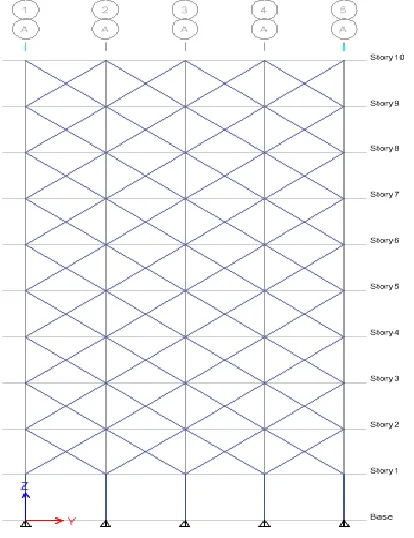
Fig. BRB in X direction
TIME HISTORY
Story Response - Maximum Story Displacement
Time Base FX
Sec Kn
0 0
1 -6369.63
2 -7282.81
3 -7844.04
4 -8156.36
5 -8240.58
6 -8232.4
7 -8149.97
8 -8067.9
9 -8038.99
© 2016, IRJET | Impact Factor value: 4.45 | ISO 9001:2008 Certified Journal
| Page 1133
Story Response ValuesStory Elevation Location X-Dir Y-Dir
m mm mm
Story10 30 Top 16.5 1.6
Story9 27 Top 15.5 1.6
Story8 24 Top 15.1 1.7
Story7 21 Top 14 1.7
Story6 18 Top 14.2 1.7
Story5 15 Top 13.4 1.8
Story4 12 Top 13.3 1.8
Story3 9 Top 13.5 1.9
Story2 6 Top 12.7 1.9
Story1 3 Top 12 2
Base 0 Top 0 0
Response Spectrum from Time History
Response Spectrum Values
Perio
d Damping 0 Damping 0.02 Damping 0.03 Damping 0.05 Damping 0.07 Damping 0.1
PSA PSA PSA PSA PSA PSA
Sec mm/sec² mm/sec² mm/sec² mm/sec² mm/sec² mm/sec²
1 33874.40 24287.17 21653.24 17923.65 15313.65 12640.25
2 7299.79 7153.51 7067.41 6926.96 6764.58 6546.06
3 5312.57 5234.78 5183.89 5150.58 5134.34 5112.71
4 7575.47 7309.15 7174.68 6914.72 6664.03 6349.76
6 7476.57 7033.15 6817.95 6405.09 6049.14 5567.24
8 4146.84 4320.1 4375.16 4468.48 4530.06 4525.68
12 4763.64 4533.03 4477.79 4385.15 4348.59 4309.57
14 4955.2 4705.84 4582.91 4411.97 4296.18 4169.92
18 4339.59 4482.19 4528 4553.71 4558.35 4520.79
22 4632.99 4481.55 4448.51 4423.63 4415.39 4411.91
28 4380.17 4539.92 4513.04 4530.98 4515.0 4477.44
© 2016, IRJET | Impact Factor value: 4.45 | ISO 9001:2008 Certified Journal
| Page 1134
CONCLUSION
From the comparative study between both the buildings and from the analysis of results of various parameters, it is concluded that in the seismic events, the buckling restrained brace building shows better performance over the building with conventional bracing. BRB reduces the story forces in the building which provides the stability of the building. Hence the use of BRB is considered safer than the conventional bracing in the building.
REFERENCES
[1] Sevak Demirdjian, stability of castellated beam webs, March 1999
[2] D.A. Nethercot, D. Kerdal , “Lateral–torsional buckling of castellated beams”, Structural Eng, Lond, 60B (3), 53–61,1982.
[3] Amir Hossein Gandomi, Seyed Morteza Tabatabaei, Mohammad Hossein, Moradia,Ata Radfar Amir Hossein Alavi Journal of Constructional Steel Research 67 (2011) 1096– 1105.
[4] Husain MU, Speirs WG. Failure of castellated beams due to rupture of welded joints. Acier-Stahl-Steel 1971;1.
[5] Husain MU, Speirs WG. Experiments on castellated
steel beams. J Am Weld Soc, Weld Res
Suppl1973;52(8):329–3423.
[6] Galambos AR, Husain MU, Spin WG. Optimum expansion ratio of castellated steel beams. Eng Optim 1975;1:213-25 [London, Great Britain].
[7] Kerdal D, Nethercot DA. Lateral torsional buckling of castellated steel beams. Design of test beams. Research Report No: 4043/43/02, Constrado; April 1980.