IIIIIIIIIIIIIIII~~I]I~I~IIII
UT11111111111111
Cfr~1~vl
SESI PENGAJIAN: 2005/2006
Saya WARSUZARINA BINTI MAT JUBADI
(HURUF BESAR)
menga1:u membenarkan tesis (llSM/Smjana.lPektor FaIsafah)* ini di simpan di Perpustakaan Universiti Teknologi Malaysia dengan syarat-syarat kegunaan seperti berikut:
1. Tesis adalah hak milik Universiti Teknologi Malaysia.
2. Perpustakaan Universiti Teknologi Malaysia dibenarkan membuat salinan untuk tujuan pengajian sahaja.
3. Perpustakaan dibenarkan membuat salinan tesis ini sebagai bahan pertukaran antara institusi pengajian tinggi.
4. **Sila tandakan (..J )
D
SULITTERHAD
(Mengandungi maklumat yang berdmjah keselamatan atau kepentingan Malaysia seperti yang termaktub di dalam AKT A RAHSIA RASMI 1972)
(Mengandungi maklumat TERHAD yang telah ditentukan oleh organisasilbadan di mana penyelidikkan dijalankan)
TIDAK TERHAD
(TANDATANG PENULIS) Alamat Tetap:
LOT 2694, KG. TELUK RI-IV, PROF. DR NORSHEILA BT FISAL
(Nama Penyelia)
45200 SABAK BERNAM SELANGOR DARUL EHSAN
Tarikll
CATATAN: * **
+
29 NOVEMBER 2005 Tarikll : 29 NOVEMBER 2005
Potong yang tidak bcrkcnaan.
Jika tcsis ini SULIT at au TERHAD, sila lampirkan surat daripada pihak bcrkuasa/organisasi bcrkcnaan dcngan mcnyatakan sckali scbab dan tcmpoh tesis ini pcrlu dikclaskan scbagai SULIT atau TERHAD_
"I hereby, declare that 1 have read this thesis and in my opinion this thesis is
sufficient in terms of scope and quality for the award of degree of
Master of Engineering (Electrical-Electronic & Telecommunication)"
Signature
Name of Supervisor : PROF DR. NORSHEILA BINTI FISAL
W ARSUZARINA BINTI MAT JUBADI
A project report submitted in partial fulfilment of the requirements for the award of the degree of
Master of Engineering (Electrical-Electronics & Telecommunications)
Faculty of Electrical Engineering Universiti Teknologi Malaysia
ii
I declare that this thesis entitled "Embedded TCP/IP in Sensor Nodes (sensornets)" is the result of my own research except as cited in the references. The report has not been accepted for any degree and is not concurrently submitted in candidature of any
other degree.
Signature
Name : WARSUZARINA BINTI MAT JUBADI
To my beloved hlisbandJor lzis Slip port and lInderstanding To my 'little baby' Jar not giving any problem
IV
ACKNOWLEDGEMENT
First of all, I am greatly indebted to ALLAH SWT on His blessing to make this project successful.
I would like to express my gratitude to honourable Professor Dr. Norsheila Bt. Fisal, my supervisor of Master's project. During the research, she inspired me with motivations, guidance, encouragement and assistance which finally led me to the completion of this project.
A very big appreciation goes to Mr. David Annstrong; an active members in A VR-GCC mailing list, and also to Mr. Dennis Kuschel, the developer of my-CPU who guide and assist me without any doubt through the emails. They have guided me a lot through the compiling of the embedded TCP/IP stack, the biggest part of this project.
ABSTRACT
A sensor network is a group of sensor nodes (sensor) which are connected and communicate each other. Sensor node has the ability to sense environmental
data such as humidity, light, weight, and temperature, and has been ported with embedded TCP/IP protocol to perform the networking. A sensor node is equipped
with a small micro controller, a radio transceiver, and an energy source. Sensors are constrained in terms of memory and processing power because of their limited physical size and cost. These constraints have been considered too limiting for physical size sensor to be able to use the TCP/IP protocols. This project was carried out to develop two sensor nodes that able to sense the temperature value, to embed
the TCP/IP stack into the sensor nodes, and to apply the SLIP protocol into the
TCP/IP stack. One will be the transmitter node while the other is the receiver node.
vi
ABSTRAK
Rangkaian pengesan ialah sekumpulan nod-nod pengesan (pengesan) yang saling berhubungan dan berkomunikasi antara satu sama lain. Nod pengesan mempunyai kebolehan untuk menges an data datipada persekitaran seperti kelembapan, cahaya, berat dan suhu, dan ia juga dilengkapi dengan protokol TCPIIP terbenam untuk perangkaian. Setiap nod pengesan dilengkapi dengan mikro-pengawal yang kecil, gabungan pemancar dan penerima, dan satu sumber tenaga. Nod-nod pengesan ini terikat dari segi ingatan dan kuasa pemprosesan disebabkan oleh kos dan saiz fizikal yang terhad. Ciri-ciri ini telah dipertimbangkan amat terhad bagi saiz fizikal nod pengesan untuk berupaya menggunakan protokol TCPIIP. Projek ini telah untuk dijalankan untuk membangunkan dua modul nod pengesan yang berupaya untuk menges an nilai suhu, untuk memprogramkan tindanan TCPIIP ke dalam nod pengesan dan mengaplikasikan protokol SLIP kedalam tindanan
TABLE OF CONTENTS SUBJECT TITLE DECLARATION DEDICATION ACKNOWLEDGEMENT ABSTRACT ABSTRAK
TABLE OF CONTENTS LIST OF TABLES LIST OF FIGURES
LIST OF ABBREVIATIONS LIST OF APPENDICES
CHAPTER 1 INTRODUCTION
1.1 Overview
1.2 Introduction to Sensor Network
1.3 Problem Statement
1.4 Objectives
1.5 Scope of Project
1.6 Thesis Outline
VI11
CHAPTER 2 SENSOR NODES ARCHITECTURE 7
2.1 Introduction 7
2.2 Sensor Node (Sensomets) 8
2.3 Sensor Network Developments and Limitations 9
2.4 Application Example 11
2.5 Communication Method in Sensor Network 12
2.6 Sensor Developments 13
2.7 Embedded Operating Systems 14
2.8 TCP/IP Overview 16
2.9 The structure ofTCP/IP Protocol in an 19 Operating System
2.10 Small TCP/IP Protocol Stack 20 2.11 IP Address and Hostname 25
2.12 Service Port and Socket Addressing 26 2.13 Drivers, Layers and Stacks 27
2.14 Physical Layer 28
2.15 Link Layers - SLIP & PPP 28
2.16 Choosing a Protocol 29
CHAPTER 3
SENSOR NODES DEVELOPMENT
30
3.1 Overview 30
3.2 Hardware Development 31
3.2.1 Processor 35
3.2.2 Temperature Sensor 37
3.2.3 RF Communication 39
3.3 ISP Connector 41
3.4 Software Development 42
CHAPTER 4 SENSOR NODES VERIFICATION 52
4.1 Overview 52
4.2 Embedded Design Application 53
4.3 Sensor Nodes 54
4.4 ISP Connector 56
4.5 Code Verification 58
4.6 Serial Device Programmer 61 4.7 Converting Data from Analog to Digital Form 63
4.8 Temperature Derivation 64
4.9 Measured Voltage 65
4.9.1 Reset Voltage 66
4.9.2 Temperature Voltage 67 4.10 Data Transmission between Sensor Nodes 70
CHAPTER 5 CONCLUSION & SUGGESTION 75
5.1 5.1 REFERENCES APPENDIX A APPENDIXB APPENDIXC APPENDIXD Conclusion
Suggestion For Future Work
LIST OF TABLES
NO TITLE
2.1 The Conceptual Organization ofTCP/IP Protocol 2.2 Code size for uIP (A VR) and (x86)
4.1 Functions of ISP Connector Pin Header
4.2 Comparing Fuses in AT90S8535 and Atmega8535
x
PAGE
17
20
56
LIST OF FIGURES
FIGURE NUMBER TITLE PAGE
1.1 Sensor Network Structure 2
2.1 Structure of Sensor Node 9
2.2 Broadcast Mechanism 12
2.3 Structure of Node Application 18
2.4 Example ofuIP code size 21
2.5 Interfacing uIP 22
2.6 Sensor Network with Proxy 23
2.7 Sensor Network with DTN-Gateway 24
2.8 Sensor Network with TCP/IP 25
2.9 Communications between Microcontrollers 29
3.1 Sensor Node Proposed Design 31
3.2 Block Diagram for Transmitter and Receiver Node 32 3.3 Schematic Circuit of Transmitter Node 33 3.4 Schematic Circuit of Receiver Node 34
3.5 ATmega8535 Block Diagram 36
3.6 LM335 Pin Configurations 37
3.7 Schematic Circuit for Temperature sensor, LM335 39 3.8 RF transmitter and Receiver Circuit 40
3.9 ISP Connector 41
3.10 Flow of Software Development 43
xii
3.12 Flowchart for Temperature Sensing 46
3.13 Flowchart of Transmitting Character String 48
3.14 Flowchart of Receiving Character 49
3.15 A VR-GCC Environment Window 50
3.16 Programmer Notepad in WinA VR 51
4.1 COlmnunications between Microcontrollers 53
4.2 Communications between Microcontroller and PC 53
4.3 Transmitter Node Prototype 54
4.4 Receiver Node Prototype 55
4.5 RF Transmitter and Receiver Module 55
4.4 ISP Cable Downloader 55
4.5 Compiling Code using A VRGCC 56
4.6 Error Status when Failure Occur 57
4.7 ISP Cable Downloader 57
4.8 Compiling Code using A VRGCC 58
4.9 Compile and Link Code using WinA VR 59
4.10 Memory Size Displayed After Code Compiled 61
4.11 Porting Hex Code using PonyProg2000 63
4.12 Measured Supply Voltages 65
4.13 Measured Reset Voltage 66
4.14 Voltage at Temperature 30°C 67
4.15 Voltage Level at Temperature 26°C 68
4.16 Voltage Level at Temperature 230C 69
4.17 Observed Data during Transmission 71
4.18 Digital Data at Temperature 230C 72
4.19 Data During Transmission Process (wired) 73
4.20 Data Transmitted from TxD pin 73
ADC AM ARP AVR-GCC AVRRISC DHCP DNS DTN EEPROM FTP GPRS HTTP ICMP ISP KB LWIP LSB MHz MSB OS PPP RAM RF Rx
LIST OF ABBREVIATIONS
Analog to Digital Conversion
Amplitude Modulation
Address Resolution Protocol
AVR- GNU Compiler Collection
A VR Reduced Instruction Set Computer
Dynamic Host Configuration Protocol
Domain Name System
Delay Tolerant Network
Electrically Erasable Programmable Read Only Memory
File Transfer Protocol
Global Packet Radio Service
HyperText Transfer Proto co
Internet Control Message Protocol
In-Circuit Serial Programmable
Kilo Byte
Light Weight Internet Protocol
Least Significant Bit
Megahertz
Most Significant Bit Operating System
Point-to-Point Protocol
Random Access Memory
Radio Frequency
SLIP SMTP SN SRAM TCP/IP
Tx
UDP USART
Serial Line Interface Protocol Simple Mail Transport Protocol Sensor Network
Static Random Access Memory
Transmisson Control Protocol/ Internet Protocol Transmitter
User Datagram Protocol
LIST OF APPENDICES
APPENDIX A : Transmitter and Receiver Node Source Codes 82
APPENDIX B : uIP Modified Codes 85
APPENDIX C: A VRGCC Makefile for uIP Stack 108
CHAPTER I
INTRODUCTION
1.1 Overview
Today, most network infrastructures use the Internet Protocol (IP) as its base
technology. It is of particular interest to look how sensor networks can be connected to IP network infrastructures (TCP/IP) and methods to interconnect and embed TCP/IP
protocol into the sensor device. By directly employ the TCP/IP suite as the
communication protocol in the sensor network enable the integration of the sensor
network and TCP/IP network. There have been a number of research and development
effOlis at all levels of development and usage of sensor networks, including applications,
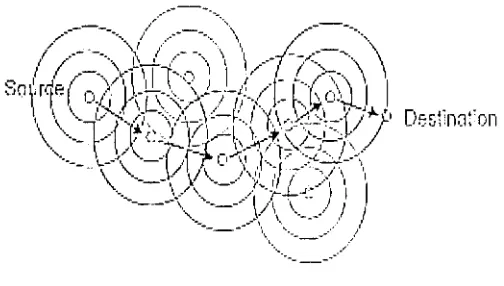
operating systems, architectures, middleware, integrated circuit, and system. Sensor network based on TCP/IP has the advantage of being able to directly communicate with
an infrastructure consisting either of a wired IP network or of IP-based wireless
temperature changes or pollutant levels. Sensor networks enable infonnation gathering,
information processing, and reliable monitoring of a variety of environments for both
civil and military applications. These sensor nodes can be spread out in hard accessible
areas depends on the application fields. A sensor node combines the abilities to
[image:21.597.161.413.378.521.2]compute, communicate and sense [l.Bluementhal et
at.,
2002].Figure 1.1 Sensor Network Structure
Applications of sensor networks can be found in such diverse areas as wild-life
habitat monitoring, forest fire detection, alarm systems, medicine, and monitoring of
volcanic eruptions. Communication can be perfonned using medium such as wircle~s,
optic or acoustic. For nodes with a far distance range from the source node to tht.:
3
The development of sensor nodes was influenced by the increasing of the device
complexity, high perfonnance of wireless networking teclmologies, combination of
digital signal processing and sensor data acquisition, the advances in the development of
micro-electromechanical systems (MEMS) and the availability of high perfonnance
development tools. [J.Blumenthal et al., 2002]:
1.3 Problem Statement
This project was developed because of:
i) Limited resources such as size of memory and processing power is said to be the
limiting criteria for a sensor node to run the TCP/IP protocol. This project was
run in an 8-bit processor with 8KB flash memory, 512 Bytes of SRAM to proof
that porting TCPIIP stack is not a problem into the device itself.
ii) uIP is a small TCP/IP stack developed for small size microcontroller. Because of
this, we tried to embed the uIP into the A VR ATmega8535 which has the limited
size of memory.
iii) Data need to be transmitted and received at a specific time. We also need to
work on specific device driver that used in the project. The project was carried
out to see the perfonnance of data transmission according to the time/period
specified in the uIP codes and device driver.
(4) Nonnally IP works with Ethernet interface. In this project, the uIP code has been
modified to be used with SLIP protocol. We try to observe the transmission of
Temperature data from a specific area is collected by one sensor node (defined as
transmitter node) before it is transmitted to the other sensor node (defined as
receiver node).
ii) To embed the uIP, a TCPIIP stack protocol into sensor nodes. This is done as to
make sure the data can be transmitted and received at specific time. The IP
address for each node and the periodic transmission of data is determined in thc
uIP stack.
iii) To develop sensor networking (between sensor nodes) using SLIP protocol. By
using SLIP protocol, data can be transmitted more flexibly with wired or through
the wireless link such as RF.
1.5 Scope of Proj ect
The scopes of work for this project arc:
• Developing the sensor nodes which implemented TCP/IP protocol using:
o Processor: A VR microcontroller
o Sensor t)1)e: Temperature sensor
•
•
5
o Frequency involved: 433 MHz
o TCP/IP Protocol: uIP stack
Programming the micro controller using CIC++, and then compile the source
codes using GNU tools, WinA VR (A VR-GCC).
Convert the data collected by the analog temperature sensor into digital
representation (AID Conversion).
• Build the A VRISP connector to program the INTEL hex code into the A VR
micro controller.
• Write a device driver for target's network device in uIP (serial), and configure
the uIP codes to be used in the sensor device.
• Embed uIP, a TCP/IP functions into the sensor nodes. This is done to perform a
networking between both sensor nodes.
1.6 Thesis Outline
This thesis comprises of five chapters. The first chapter briefly overviews the
background of sensor network and sensor nodes, objectives and scope of this proj ect.
Chapter 2 deals with the previous research and development of sensor nodes