© 2015, IRJET ISO 9001:2008 Certified Journal
Page 154
EXPERIMENTAL ANALYSIS OF DIESEL ENGINE USING WASTE
TRANSFORMER OIL WITH IPA IGNITION IMPROVER
G.Venkateswarlu
1,
J.Jhansi Rani
2, M.Sreenivasa Reddy
31
PG Scholar, Dept. of Mechanical Engineering, Aditya Engineering College, AP, India
2
Assistant Prof, Dept. of Mechanical Engineering, Aditya Engineering College, AP, India
3
Professor, Dept. of Mechanical Engineering, Aditya Engineering College, AP, India
---***---Abstract
- Bio diesel it is a name of clean burningalternative fuel produced from domestic and renewable sources. Biodiesel contains no petroleum but it can be blended at any level with diesel. It is a biodegradable, Non toxic, and essentially free from sulphur. This is reliable, and renewable. Therefore in the present investigation the oil taken is the waste transformer oil .The transformer oil is produced from wax-free naphthenic oils. Entire experimental investigation is carried out on 4 strokes – twin cylinder water cooled diesel engine. For this purpose preparing blends of transformer oil with diesel like T10, T20, T30, and T40 and comparing its performance parameters with conventional diesel. Among these blends selecting optimum blend and adding ignition improver in a different proportions and finding optimum blend. By comparing performance parameters of the optimum blend with conventional diesel fuel. Here use Isopropyl alcohol is as ignition improver for optimum blend. Based on the earlier finding the current experimental investigation investigated the possibility of using waste transformer oil is a diesel substitute.
Key Words
: Waste transformer oil, fuel properties, CIengine, alternative fuel, Ignition improver.
1 INTRODUCTION
The internal combustion engine is an engine in which the combustion of a fuel occurs with an oxidizer (usually air) in a combustion chamber. In an internal combustion engine the expansion of the high temperature and pressure gases, which are produced by the combustion, directly applies force to a movable component of the engine such as the pistons or turbine blades and by moving it over a distance, generate useful mechanical energy. The term internal combustion engine usually refers to an engine in which combustion is intermittent, such as the more familiar four stroke and two stroke piston engines along with variants, such as the winkle rotary engine. The Diesel internal combustion engine differs from the gasoline powered Otto cycle by using highly compressed hot air to ignite the fuel rather than using a spark plug. In the Diesel Engine only air is initially introduced into the combustion chamber .the air
is then compressed with a compression ratio typically between 15 and 22 resulting into a 40 bar pressure compared to 8 to 14 bar in the petrol engine. This high compression heats the air to 5500c. At about this moment
© 2015, IRJET ISO 9001:2008 Certified Journal
Page 155
with minor or no modifications at all. Bio-diesel workswell with new technologies such as catalyst (which can reduce soluble fraction of diesel but not the solid carbon fraction), particulate traps an exhaust gas circulation. It can be produced from any kind of oil both vegetable and animal source. Used frying oil can also be used and, therefore, be very promising alternative for waste treatment. It can strengthen economy by creating more jobs and create independence from the imported depleting commodity, petroleum. It can also be used as a way of stimulating and supporting agriculture.
1.1 PREPERATION OF BLENDS WITH DIESEL
The obtained Bio- Diesel is blended for conducting the performance test, the Transformer oil seed Bio- Diesel is mixed in proper proportions.
3.8.1 Procedure for Preparation of Blends with
Diesel
The Bio- Diesel is first filtered form impurities. Required amount of fuel and Bio- Diesel is taken
into the measuring jar and mixed thoroughly the amount of proportions shown in table 3.1.
Obtained TOME fuel properties are find out and these values are tabulated
Notation
Fuel
Quantity
Bio-Diesel
Quantity
Diesel
Quantity
RWTO 10
1000 ml
fuel
100ml
900 ml
RWTO 20
1000ml
fuel
200 ml 800 ml
RWTO 30
1000ml
fuel
300 ml 700ml
RWTO 40
1000ml
fuel
400 ml 600 ml
D100
1000ml
fuel
0 ml
1000ml
Table: 3.1 Blending Percentage of Fuel
Fig 3.3 Process of separation
Fig: 3.4 Transformer Oil Methyl Esters Blends T10 T20 T30 T40
The blends of transformer oil with diesel in a particular proportion are shown in figure 3.4 after that conducting performance test and selecting the best blend.
4.3.3 Determination of Flash and Fire Point
Apparatus required
All’s closed cup flash and fire point set up
ThermometerFlash and fire point are obtained by using pen sky test. The apparatus consists of a brass cup and cover fitted with shutter mechanism without shutter mechanism (open cup), test flame arrangement, hand stirrer (closed cup), thermometer socket, etc., heated with energy regulator, a thermometer socket made of copper.
4.3.4 Experimental Procedure
© 2015, IRJET ISO 9001:2008 Certified Journal
Page 156
second. Once the heating is started, the test flame isapplied with the help of small sticks after reach 5OC rise of
temperature up to temperature of 40OC. Now the rheostat
is adjusted some that heating rate maintained at 1-2OC per
minute and the test flame is applied after each 5OC rise of
temperature. Operating the shutter makes the application of the test flame. The temperature at which flame application cause a flash in the interior of the cup is recorded as flash point. The heating further continued and the temperature at which the vapours will burn for at least 5 seconds is heated as fire points.
Fig: 4.1 Pensky martin flashpoint apparatus 4.4 SPECIFIC GRAVITY
Specific gravity is the relative measure of the density of a substance. It is defined as the ratio of the density of the substance, ρ, to a reference density. With the help of digital balance to find out specific gravity it is shown in fig 4.2. The specific gravity of conventional diesel fuel is t 0.835 .It is dimensional less quantity
.
Fig: 4.2 Digital Balance
Take weight of empty vessel weight after take 100 ml quantity of transformer oil in it and again measure its weight.
Then after subtract the empty vessel weight from it. Then we got weight of 100ml oil. The process is same for all blends .the specific gravity of all blends and diesel is tabulated in table 4.2
Specific gravity of water is unity. For this purpose we use digital balance.
4.4.1 Specific Gravity- Results for Transformer Methyl Ester Blends with Diesel T10, T20, T30, T40
S.no
Oil
Percentage
Specific
Gravity
1
Diesel
D100
0.835
2.
Transformer
Waste
Oil
T100
0.82
3
Blends of
Transformer
Oil
With Diesel
T10
0.83
T20
0.838
T30
0.84
T40
0.8414
Table: 4.1Results of Specific Gravity for TOME and Diesel
4.5 CALORIFIC VALUE
© 2015, IRJET ISO 9001:2008 Certified Journal
Page 157
back to the initial temperature of the combustible mixture.It measures the energy content in a fuel. This is an important property of biodiesel that determines the suitability of the material as alternative to diesel fuels. Calorific value of each of the transformer oil blends is taken as follows.
Calorific value of transformer oil methyl ester blends = (Percentage of (%) transformer oil blend) x (calorific value of refined transformer oil) + (percentage of (%) Diesel)X (calorific value of Diesel value)
.
4.6 VISCOSITY
The resistance to flow, exhibited by fuel blends, is expressed in various units of viscosity. It is a major factor of consequence in exhibiting their suitability for mass transfer and metering requirements of engine operation. High value of viscosity reduces volatility and gives poor atomization of oil during injection of the CI engine. This results in incomplete combustion and ultimately carbon deposits on the injector nozzle as well as in the combustion chamber.
1 stokes = 100 centistokes = 1 cm2.s-1 = 0.0001 m2.s-1.
4.5.1 Experimental Results of Calorific Value in
kj/kg for Transformer methyl esters blends and
Diesel
OIL
T10
T20
T30
T40
Blends of
Transformer
oil
With Diesel
44431
.3
44362
.6
44293
.9
44225
.2
Diesel
44500 44500 44500 44500
Table: 4.2 Results of Calorific value for TOME and Diesel
4.6.1 Determination of Viscosity
Viscosity is measured by using Engler’s viscometer. By using stop watch Take time for collecting every 200 ml quantity of fuel at different temperature intervals. The process is same for water. Time taken by oil to the time taken by water gives Engler’s degree. Then we get viscosity in centistokes.
Figure 4.3 Engler’s Viscometer and Oil collecting flask
4.6.2
Procedure for finding viscosity© 2015, IRJET ISO 9001:2008 Certified Journal
Page 158
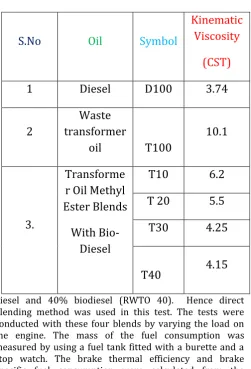
Table: 4.3 Results of Viscosity in centistokes for TOMEblends and Diesel at 400C
4.6.3 Fuel Properties of Waste Transformer Oil,
Refined Transformer Oil and Diesel fuel
[image:5.595.29.285.251.477.2]Table shows that fuel properties of waste transformer oil and refined transformer oil along with diesel for different properties such as density, kinetic viscosity, flash point, fire points and gross calorific values, cetane numbers ec
Table 4.4 Properties of WTO and RWTO with Diesel
4.6.4 EXPERIMENTAL OBSERVATIONS
The engine was first operated on diesel fuel with no load for few minutes at rated speed of 1500 rpm until the cooling water and lubricating oil temperatures comes to certain temperature. The same temperatures were maintained throughout the experiments with all the fuel modes. The base line parameters were obtained at the rated speed by varying 0 to 100% of load on the engine. The diesel fuel was replaced with the transformer oil biodiesel (RWTO 10) and test was conducted with the blend of 90% diesel and 10% biodiesel by varying 0 to 100% of load on the engine with an increment of 25%. After the transformer oil biodiesel, the test was conducted with the blend of 80% diesel and 20% biodiesel (RWTO 20). After the transformer oil biodiesel, the test was conducted with the blend of 70% diesel and 30% biodiesel (RWTO30). The directly blended fuel does not require any modifications to diesel engines. After the transformer oil biodiesel, the test was conducted with the blend of 60%
diesel and 40% biodiesel (RWTO 40). Hence direct blending method was used in this test. The tests were conducted with these four blends by varying the load on the engine. The mass of the fuel consumption was measured by using a fuel tank fitted with a burette and a stop watch. The brake thermal efficiency and brake specific fuel consumption were calculated from the observed values.
The results from the engine with a blend of diesel and biodiesel and compared with the base line parameters obtained during engine fuelled with diesel fuel at rated speed of 1500 rpm. Out of these four blends best blend is obtained on the basis of performance parameters. In this experiment RWTO 40 shows the best results. Then RWTO 40 is added with 5ml, 10ml of IPA (Ignition improver) and evaluates performance parameters. The results from the engine with a blend of RWTO 40 and IPA biodiesel and compared with the base line parameters obtained during engine fuelled with diesel fuel at rated speed of 1500 rpm .Experiments were conducted on the specified diesel engine at constant speed using diesel and note down the observation at zero load, voltmeter reading, and ammeter reading speed, time taken for 20cc of fuel consumption and the manometer readings and tabulated in the form of tables. By varying loads steps 1/4, 1/2, 3/4 and full loads note down all the readings for the diesel engine. Taking all the readings at constant engine speed of 1500 rpm. While doing experiments fill the fuel into the tank mounted on panel frame, on engine check the lubricating
S.No
Oil
Symbol
Kinematic
Viscosity
(CST)
1
Diesel
D100
3.74
2
Waste
transformer
oil
T100
10.1
3.
Transforme
r Oil Methyl
Ester Blends
With Bio-
Diesel
T10
6.2
T 20
5.5
T30
4.25
T40
4.15
Properties
WTO
RWTO
DF
Density[ kg/m
3]
895
874
830
Kinematic
viscosity[cSt]
10.1
6.2
3.08
Flash point [
OC]
140
125
60
Fire point [
OC]
145
132
65
Gross calorific
value[kJ/kg]
41775
43813
44500
© 2015, IRJET ISO 9001:2008 Certified Journal
Page 159
oil in the engine sump with help of dip stick and setoptimum flow rate of water in Rota meter.
Fig.6.6 Variation of Brake Thermal Efficiency
with Load using optimum blends
0 25 50 75 100
0 5 10 15 20 25 30 35 40 45 50 B R A K E T H E R M A L E F F IC IE N C Y ( % ) LOAD (%) D 100 T 40
T 40% + D 59.5 % + 5ml IPA T 40% + D 59 % + 10ml IPA
Fig.6.6 Variation of Brake Thermal Efficiency with Load using optimum blend T40 with ignition improver Isopropyle alcohol.
0 25 50 75 100
0 10 20 30 40 50 60 70 80 90 100 M E C H A N IC A L E F F IC IE N C Y ( % ) LOAD (%) D 100 T 40
T 40% + D 59.5 % + 5ml IPA T 40% + D 59 % + 10ml IPA
Fig 6.7 Variation of Mechanical Efficiency with Load using optimum blend T40 with ignition improver Isopropyle alcohol
0 25 50 75 100
0.0 0.1 0.2 0.3 0.4 0.5 0.6 0.7 0.8 0.9 1.0 B R A K E S P E C IF IC F U E L C O N S U M P T IO N ( k g/ k w -h r) LOAD (%) D 100 T 40
T 40% + D 59.5 % + 5ml IPA T 40% + D 59 % + 10ml IPA
Fig.6.8 Variation of Brakespecific fuel consumption with Load using optimum blend T40 with ignition improver Isopropyle alcohol
0 25 50 75 100
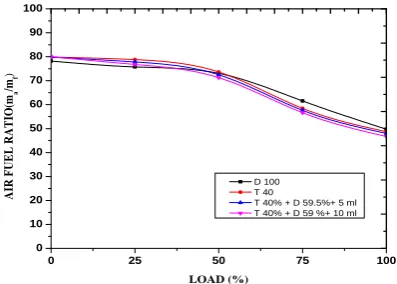
0 10 20 30 40 50 60 70 80 90 100 A IR F U E L R A T IO (m a /m f ) LOAD (%) D 100 T 40
T 40% + D 59.5%+ 5 ml T 40% + D 59 %+ 10 ml
Fig 6.10 Variation of Air fuel ratio with Load using optimum blend T40 with ignition improver Isopropyle alcohol
0 25 50 75 100
0 10 20 30 40 50 60 70 80 90 100 A IR F U E L R A T IO (m a /m f ) LOAD (%) D 100 T 40
T 40% + D 59.5%+ 5 ml T 40% + D 59 %+ 10 ml
[image:6.595.55.252.177.351.2] [image:6.595.326.526.332.478.2] [image:6.595.54.239.433.561.2] [image:6.595.327.526.549.691.2]© 2015, IRJET ISO 9001:2008 Certified Journal
Page 160
CONCLUSIONS
The main objective of this experiment is to use waste transformer oil as an alternative fuel for compression ignition engine. The pure diesel was used as base fuel for comparing properties and performance parameters. The entire experimental investigation is conducted on a 4 stroke twin cylinder water-cooled diesel engine at a constant speed of 1500rpm and comparing its performance parameters with conventional diesel. The results of the current investigation may be summarized as follows.
7.1 PERFORMANCE ANALYSIS USING DIESEL AND
TOME BLENDS
1.The flash and fire points of transformer oil were 140o c,
and 145o c while for diesel flash and fire points were 90oc
and 95oc respectively. This shows transformer oil is safer
for
stroge. The cetane number was 42.
2. The viscosity of transformer oil is 10.1 centistokes. Mean while viscosity of diesel is 3.08 centistokes. The high viscosity gives poor atomization when at the time of fuel is injecting in the engine cylinder. For this purpose transformer oil is transesterified by transesterification process. The calorific value of diesel was higher than transformer oil.
3. The brake thermal efficiency increases with increase bio diesel percentage. The brake thermal efficiency for each blend was found to be high because of proper combustion
.
4. The
brake thermal efficiency for T10, T20, T30, T40 were found to be 35.87%, 39.1726%, 39.374%, 41.6%. Out of all the blends T40 shows best performance parameters when compared to diesel. The maximum brake thermal efficiency obtained is 41.63% with T40 blend.4.The brake specific fuel consumption for T10, T20, T30, T40 were found to be0.2354 hr,0.21490 kg/kw-hr,.0.21315 kg/kw-hr, 0.2003 kg/kw-hr .out of all the blends T40 having low specific fuel consumption when compared to diesel fuel
.
5.
Since T40 blend reduces the environmental pollution, high in thermal efficiency when compared with diesel it will be a promising renewable energy source for sustaining the energy.7.2
PERFORMANCE ANALYSIS USING DIESEL AND
OPTIMUM BLEND WITH IGNITION IMPROVER
In further stage the investigations were carried out on the 4 stroke twin cylinder water cooled Diesel engine with addition of Isopropyl Alcohol (ignition improver) 5%, 10% volume ratios to optimum blend T40 (T40D59.5IPA5, T40D59IPA10) find out performance parameters and compared with optimum blend and Diesel base line data. Out of this 10% volume addition of ignition improver (T40D59IPA10) shows best and give high brake thermal efficiency and low specific fuel consumption at full load conditions. The conclusions of this investigation are compared with optimum blend T40 and Diesel base line data at full load as follows:
1 .The brake thermal efficiency increases with increase ignition improver by volume percentages in blends 2. The brake thermal efficiency at full load condition for Diesel it is 40.12% while for blend T40D59.5IPA5ml it is 41.739% and for blend T40D59IPA10ml it is 43.776%. 3. Mechanical efficiency for Diesel fuel is 72.54% and for T40D59.5IPA5ml it is 73.1% and for T40D59IPA10ml it is 73.649%.The maximum brake thermal efficiency is obtained by T40D59IPA10ml
4.Brake specific fuel consumption for Diesel is 0.201 kg/kw-hr mean while for blend T40D59.5IPA5ml it is 0.1950 kg/kw-hr & blend T40D59.5IPA10ml it is 0.1911 kg/kwhr
5. The value of volumetric efficiency is at full load condition for T40 is 83.82% for diesel is 83.81%mean while volumetric efficiency for blend T40D59.5IPA5ml is 83.83%. Mean while the Blend T40D59IPA10ml it is 83.89%.
6. The value of air fuel ratio is at full load condition for T40 is 48.72 for diesel it is 49.75. Mean while air fuel ratio for blend T40D59.5IPA5ml is 48.7 and blend T40D59IPA10ml it is 48.67.
© 2015, IRJET ISO 9001:2008 Certified Journal
Page 161
Based on this investigation, it is observed thata time will be reached in the future when demand for non-polluting and efficient energy sources will be met by other sources than fossil fuel globally. It is concluded that in order to overcome the energy crisis in future, mega cultivation of this species may be carried out for Bio Diesel production at large-scale. Based on the findings, WTO, and RWTO are suggested to be alternative fuel for compression ignition engine
.
7.3 SCOPE OF FUTURE WORK
In the present investigation the performance parameters are evaluated with constant speed, constant pressure, compression ratio and injection timing. In the future work the experiment can be carried out by varying the operating parameters like injection pressure, compression ratio and crank angle by using waste transformer oil.
7.4 REFERENCES
[1] Ashtosh Kumar.D.F.Melvin “Performance, emission and combustion characteristics of a DI diesel engine using waste plastic oil” Applied Thermal Engineering 29 (2009) 2738–2744
[2] R. PAWAR HARSHAL carried out experiment on diesel Engine. He conducted experimental investigation on compression ignition engine using WASTE PLASTIC OIL is an alternative for diesel engine. Pyrolysis is a chemical decomposition of organic substances Engineering 56 ( 2013 ) ,pp583 – 590
[3]. AVINISH KUMAR carried out experiment on diesel engine .He conducted experimental investigation on compression ignition engine using KARANJA OIL is an alternative for diesel engine Applied Thermal Engineering 31 (2011) 1682e1688.
[4]. S.SAVARIRAJ carried out experiment on diesel engine. He conducted experimental investigation on compression ignition engine using MANGO SEED OIL is an alternative for diesel engine Transportation Research Part A 46 (2012) ,pp1707–1715
[5] SHARANAPPA GODIGANUR carried out experiment on diesel engine. He conducted experimental investigation on compression ignition engine using high viscosity FISH OIL is an alternative for diesel engine. Journal of Sustainable Energy & Environment 2 (2011)
[6]. M.MARTI carried out experiment on diesel Engine. He conducted experimental investigation on compression ignition engine using pre heated COTTONSEED OIL is an alternative for diesel engine. Applied Thermal Engineering 30 (2010) ,pp245–249
[7].F.AKSOY carried out experiment on diesel engine. He conducted experimental investigation on compression ignition engine using OPIUM POPPY OIL is an alternative for diesel engine Renewable Energy 19 (2000) ,pp219-221 [8]. AMEYA VILAS MALVADE carried out experiment on diesel engine. He conducted experimental investigation on compression ignition engine using PALM OIL is an alternative for diesel engine. Renewable Energy 29 (2004) ,pp727–742
[9]. RAJ AND KANDASAMY carried out experiment on diesel engine. He conducted experimental investigation on compression ignition engine using TAMANU OIL is an alternative for diesel engine Applied Thermal Engineering 28 (2008) ,pp2136–2143
[10]. G.VENKATA SUBBAIAH et al carried out experiment on diesel Engine. He conducted experimental investigation on compression ignition engine using RICE BRAN OIL is an alternative for diesel engine. Applied Thermal Engineering 29 (2009) 2738–2744.
[11]. MOHAMMED EL-KASABY et al carried out experiment on diesel engine. He conducted experimental investigation on compression ignition engine using PONGAMIA, JATROPHA; NEEM OIL Applied Energy xxx (2013) xxx–xxx
[12 P.SRINIVAS et al carried out experiment on diesel engine. He conducted experimental investigation on compression ignition engine using CASTOR OIL for diesel engine, Applied Energy 107 (2013) ,pp183–190
[13]. MD. HASAN ALI et al carried out experiment on diesel engine. He conducted experimental investigation on compression ignition engine using NEEM OIL for diesel engine Procedia Engineering 56 (2013) ,pp583 – 590 [14 K.SRINIVAS et al carried out experiment on diesel engine. He conducted experimental investigation on compression ignition engine using TOBACCO SEED OIL BLENDS for diesel engine Applied Thermal Engineering 31 (2011) 1682e1688.
[15]. K.HARSHAVARDHAN REDDY carried out experiment on diesel engine. He conducted experimental investigation on compression ignition engine using ORANGE OIL BLENDS for diesel engine Transportation Research Part A 46 (2012) ,pp1707–1715
[16]. ADEILTON FERNANDES et al carried out experiment on diesel Engine. Type of oil used VEGETABLE oil. Renewable Energy 28 (2003) 239–248.
© 2015, IRJET ISO 9001:2008 Certified Journal
Page 162
METHYL ESTER A Review” Universal Journal ofEnvironmental Research and technology, Volume1, 2011, Issue 2: 124-134
[18] İLKERSUGOZA AND et al Conducted experiments on diesel engine using CANOLA OIL ETHYL ESTER evaluate engine performance and exhaust emissions were investigated on twin cylinder diesel engine. Journal of Sustainable development, Vol. 2, No.2, July 2009, pp no : 84-89.
[19] PRANIL J. SINGH et al in this investigation COCONUT OIL based hybrid fuels (coconut oil, aqueous ethanol and a surfactant (butan-1-ol) were used. 20th International
congress of Mechanical Engineering, Gramado, RS, Brazil November 15-20, 2009 ,
[20]S. Jindal. “Effect of engine parameters on NOx emissions with Jatropha biodiesel as fuel”, International Journal of energy and environment, Volume 1, Issue 2, 2010 pp.343-350..
[21] N.LAKSHMI NARAYANARAO AND et al They were conducted experiments on diesel engine by different vegetable oils. International journal of Advanced Scientific and Technical Research, Issue 1, Vol 1 October 2011 ISSN 2249-9954
[22] A. GOPINATHAND et al The objective of this work is to investigate the influence of FATTY ACID METHYL ester composition on cetane number of biodiesel fuels Int.Jornal of .Engineering Research Development, Vol.2, No.1, January 2010.
[23] GVNSR RATNAKARARAO et al they were carried out on a twin cylinder variable compression ratio C.I engine using neat MAHUA OIL as the fuel. Renewable Energy an international journal.vol.35 (2009), page no.2065-2070. .[24] Md.NurunNabi and S.M. NajmulHoque,”Biodiesel Production From Linseed oil and Performance study of a Diesel Engine with Diesel Bio-Diesel”,journal of Mechanical Engineering ,vol. ME39,NO1,June 2008,pp:40-43