© 2015, IRJET ISO 9001:2008 Certified Journal
Page 1077
PRE-PATH DETECTION IN MANET FOR BETTER RESOURCE
UTILIZATION
Er. Manasvi Mannan
1, Er. Alka Rani
2,
1
Er. Manasvi Mannan,Asst. Professor Dept. of Electronics & Communication Engg. PCET, Punjab, India
2
Er. Alka Rani Student,Dept. of Electronics & Communication Engg. PCET, Punjab, India
---***---Abstract-
A network that is created of random nodesand within each node is capable to speak with different nodes. A mobile node works as a individual router in such a network wherever nothing like fastened infrastructure or excess points are out there. However these networks usually deal with several limitations like information measure issue, node movements, node in inaccessibility, battery consumption and amp; restricted battery of remote nodes. & because of node movement the can’t be fastened at one purpose in order they would like some batteries put in with them and conjointly leads to consumption of battery power. Therefore it’s going to be the case once a specific packet is shipped from supply node to destination node with many intermediate nodes and one in every of the intermediate node is down simply because of no back-up power at that node or the facility out there is below the desired threshold. Therefore at that point node can’t be delivered from supply to destination and it’s going to lead to packet loss. Conjointly it leads to wastage of time and resources at different nodes. As a result of it leads to power consumption at intermediate nodes even if they are not the particular sender or receiver of the info. And any them out their power at remote nodes decides the period of time of node and of the root selected yet. Therefore to avoid recourse consumption at remote nodes its will be higher to pre-estimate the trail 1st for rising routing performance.
During this study the planned associate in nursing algorithmic program supported that ways is calculable from supply to destination supported the remaining power at the nodes
Key Words:
MANET, Pre-Path Estimation, Resource
allocation.
1. INTRODUCTION
© 2015, IRJET ISO 9001:2008 Certified Journal
Page 1078
2. RELATED WORK
A lot of research has been done by many researchers within the field of Edouard MANET conjointly within the field of path detection for the in delivery of packets. From last a few years several protocols has been projected by humorous authors simply to trot out the matter of route detection for economical resources utilization. Route choice is random & it changes dynamically from supply to destination [1]. One in every of the most reasons for route failure is thanks to the backup drawback visage by the mobile devices. The algorithms projected square major Dynamic Link Failure & Power Aware Reliable Routing. For this, to notations square major used for locating reliable routes; Normalized Link Failure & Normalized Node Failure. Herein projected work we have targeted on the only path rather than operating with multiple routes. Solely the route that is shortest and reliable is taken into accounts [3]. Liableness in terms of accessibility of the nodes in discovered path. Rather than operating with multiple ways solely one path is taken into account, that reduces the general overhead of path maintenance. The aim of this work is to enhance the network failure by rising the node info to utilization the facility of node by exploitation routing mechanism in MANETs. Link stability is a signed in keeping with the transmission power required to achieve that estimation node, at the side of battery standing of the causing & intermediate nodes. Objective of this work is that selecting routes with most battery backup can result in higher utilization of the facility sources of the act devices.
3.
PROBLEM DEFINITION
The main objective is to alter the matter of route failure which might be caused by restricted battery with mobile devices. Some threshold values are often assumed for every mobile node out there within the network. If the out there power with mobile devices is below the edge price then that specific route is discarded. Here link stability of a node is decided consistent with the transmission power required to transfer knowledge packet from supply node to destination node. Target is in selecting nodes with most battery backup or the node have battery backup bigger than the minimum threshold price. The link quality is largely obtained from the notice of signal strength and of the lost rate the signal strength reveals the channel state a lot of exactly its stability. There are numerous answers wont to take away the matter of link failure in the Mobile circumstantial Network that we’ve got the mentioned in Literature review [5]. However there are issues arise in those ways so we have tendency to propose new protocol to get rid of the issue of link failure attributable to power supply between supply and destination. Suppose a node a wish to send a packet to different node at destination D
then supply doesn’t fathom the remaining power out there at the mobile nodes. Therefore it’s a decent plan to predict the out there path between the nodes and if they are crossing a minimum threshold or not. Therefore we have a tendency to be proposing an influence aware routing protocol that gives the correct power data of current path utilized by supply of communication.
4. PROPOSED WORK
Many different strategies had been projected to touch open the matter of link/node/route failure. They were supported the energy saving mechanism on the idea of however energy are often saved at the remote nodes? However here we have projected associate formula for pre-path estimation to get the nodes that are offered on top of the minimum power demand for causation packet from supply to destination. It will end in improvement and to touch upon the matter of link failure. This formula works well for raising the standard of services and for higher utilization of resources. It’s supported AODV. During this routing protocol, some vital parameters are used like TTL, supply address, destination address, power needed etc. route request and route reply mechanism is employed. Route request packet is often send to the neighbor node supported the utmost needed power. This protocol is used to boost the packet delivery quantitative relation from supply to destination as a result of it offer the best & shortest path in terms of power, that improve the standard of service of this protocol. This formula uses AODV protocol to search out routes from supply to destination with minimum offered power. During this formula following terms are used for calculation & in packet header format.
4.1 Broadcast Id
It is just a number which is used in packet header and gets incremented every time when a new request comes.
4.2 Source Address
It maintains the address of the sources node used to send packets from that node acting as a source node to destination node.
4.3 Destination Address
Address of the last node in the route detected is stored in the destination address.
4.4 Available Power List
© 2015, IRJET ISO 9001:2008 Certified Journal
Page 1079
5. PHASES OF ALGORITHM
There are three phases used for algorithm which are Route Discovery, Route Reply and Route Maintenance
5.1 Route Discovery
Let’s assume that S is that the supply node accustomed send packet to the destination node D with the assistance of zero or a lot of intermediate nodes. Supply node S initiates the RREQ request that packet contain the knowledge like TTL, Min_Power, broadcast id, supply address & destination address. Before possession the info packets from supply node to destination node all the knowledge Hawkeye State obtainable at the supply node like TTL broadcast id & everyone alternative parameters mentioned higher than. Then RREQ is employed by the supply node to its neighbor. Once neighbor node receive RREQ then 1st of all destination address of packets is
checked. Once supply node neighbor receive the RREQ packet then 1st of all it check the destination address of
RREQ, if destination address if that the address of anybody of the neighbor node and check it lies at intervals the very of the network then it consume the packet and send RREP packet to the supply node. Each destination address isn’t adequate the neighbor node address then it check the worth of TTL, if TTL is a smaller amount than or adequate zero the node discard the RREQ, else the node calculate the minimum power from the supply node. Then it checks that node power is large than or adequate the minimum power need for communication of supply node or not. If node power is larger than or adequate minimum power then attach its own address to the list of visited node and forward RREQ packet to its neighbor node. If the route can’t realize the minimum power, then node discards the RREQ packet. This method is follows by each node that receive the RREQ packet till the RREQ receive the by destination node. Higher than figure is associate in nursing example of route discovery method of ILFRP that realize the trail between supply want S and destination node D.
5.2 Route Reply
For this section of knowledge transfer between supply and destination node, 1st at the receiving node packet header
destination address is checked. If destination address is that the address of node then it checks the facility of the node. If power is bigger than or adequate to the minimum power the destination consume the RREQ packet and sent RREP packet to supply node via same path that path is used to receive RREQ packet from supply to destination. Otherwise discard RREQ packet. In the route reply section reply is shipped back from destination to supply node.
Step 1
If Time to live value is greater than the zero then move to the 2nd step.
Step 2
Compare the Node_Id with Destination_Id, IF the Node_Id is equal to Destination_Id then move to 3rd step otherwise
4th step.
Step 3
(a) Consume the Route Request (RREQ) packet. (b) Calculate the minimum power for all nodes. (c) Choose the node of minimum power.
(d) Send the Route Reply (RREP) packet to the source node.
Step 4
(a) Enter remaining power into power list (PL). (b) Enter Node_Id into visited Node List. (c) Flood the Route Request (RREQ).
Step 5
Drop the other packets.
5.3 Route Maintenance
In Ad-hoc network there is high quality of nodes, links between nodes are seemingly to interrupt. Thus, routing path should be taken care. Once the nodes move outside to the reach of its neighbor then route from supply to destination is break i.e. RERR is occurred. During this case route maintenance method is used to take care of the route from supply to destination. During this section a node doesn’t receive a RREP packet it’ll break the trail. During this case, the node sends a route error (RERR) packet to the supply node. Once the supply node receives the packet, it’ll reconstruct a replacement path to the destination node.
6. SIMULATION
© 2015, IRJET ISO 9001:2008 Certified Journal
Page 1080
6.1 Steps for Victimization the MATLAB
[image:4.595.305.559.131.443.2]Step 1:
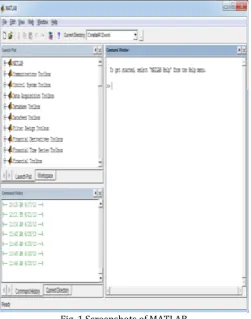
Fig. 1 shows the snapshot after opening the MATLAB. In this snapshot there are three windows: Launch pad, Command History and Command Window. Launch pad provides the description about the all tool box that is used in the MATLAB. The command history widow displays log of statement that run in current and previous MATLAB secessions. The time and date for each session appear at the top of statements listed for that secession, in our operating systems short date format. All entries remains until it get deleted, or until the command history file exceeds its maximum size of 200,300 bytes. When the file exceeds its maximum size, MATLAB automatically deletes the oldest entries. The command window displays the result of the statement that run in MATLAB secession.Fig. 1 Screenshots of MATLAB
Step 2:
Fig. 2 shows the snapshot for creating the new file in MATLAB software. To create a new file in the MATALB software first click to the File – New – M-File. After the click on the M-File a new blank page is open in which program can be written forgetting better the result shown in 3rd step Fig. 3. This Fig. shown that click on file optionthen list is open for open the file with option Open and save the file with saves as and close the window with close command window. Also there are various option like added the file with copy, cut and paste. If click on the
[image:4.595.37.289.302.622.2]File-New-GUI then the new window is opened that display the graphical window to draw the graph in the MATLAB.
Fig 2 snapshot for open the new file
Step 3:
Fig 4.3 shows the snapshot for blank new file in which new program got implemented. Write the program then save it in the folder work of MATLAB that is placed in Local Disc(C) – MATLAB R1 - WORK [image:4.595.306.558.521.762.2]© 2015, IRJET ISO 9001:2008 Certified Journal
Page 1081
7. RESULTS
Evaluation of the Simulation
During simulation let’s assume total 15 numbers of nodes in the network. In Fig 4 assumed node 5 as the source node and node 9 as the destination node. To find the path between two nodes in which used the distance formula that calculates the distance between nodes. The distance between two nodes is calculated as
dist=sqrt((X(i)-X(j))2+(Y(i)-Y(j))2)
[image:5.595.307.559.89.343.2]If the calculated distance lies within the range between the nodes then path is found & data is transmitted otherwise the path is not found. This Fig shows the data flow from node file
Fig 4 snapshot for path not found
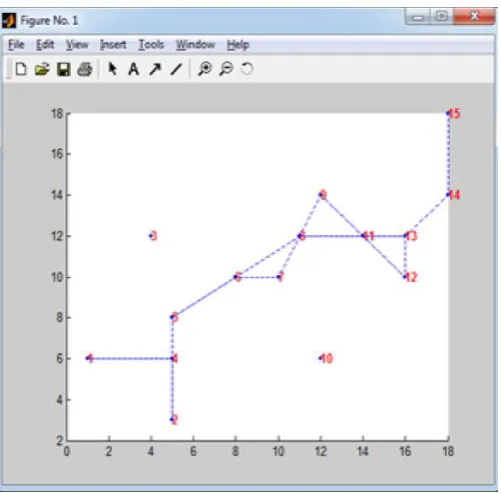
To node 9 in which the path is not found between sources to destination so the packet is drop. From the nodes 5 to node 9 the nodes 6-7-8 are the intermediate nodes. In the second scenario when the number of nodes is 10 and where there is path found between the source and destination. In the Fig 5 node 1 is source node and node 5 is destination node and the path is found between the source and destination with the minimum power value 0.1100. From the node 1 to node 5 the node 4 is intermediate node. The path is found in this Figure because the calculated distance between the two nodes is lies within the range of the network so the path is shown in this figure from node 1 to node 5 with the red line.
Fig 5 snapshots for path found between node 1 and node 5
[image:5.595.37.288.287.534.2]In the third scenario when the number of nodes is increasing the packet delivery ratios and average number of path is also increase. In Fig 6 the number of nodes is 15 and source node is for and destination node is 11 then the path is found from the node 4 to 11 with the intermediate nodes 5,6,7,8,9. So the data can be transmitted from 4-5-6-7-8-9-11 with the min. power values 0.1200 as shown in Fig 6 that will provide the detail of the route from the source to destination. When the no. of nodes increases or decreases the power values also varies.
[image:5.595.307.559.495.738.2]© 2015, IRJET ISO 9001:2008 Certified Journal
Page 1082
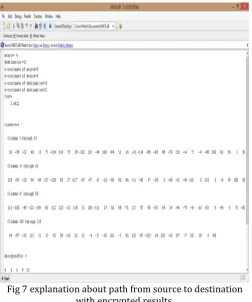
The Fig. 7 shows the detail about the source node, [image:6.595.36.289.261.564.2]destination node with encryption and decryption of nodes in the path from source to destination. The power values of the node and it gave the result means provide the path from source to destination and minimum power value for communication. Its main hypothesis is to find the path from source to destination with the help of reactive routing protocol. This routing protocol determines the minimum available power between sources to destination. Then source node decided the path which has maximum available power between source node to destination node. By using ILFRP protocol, improve the link failure problem due to power in between source to destination.
Fig 7 explanation about path from source to destination with encrypted results.
7. CONCLUSION
The main outline of this paper is to discuss with the characteristics of the Ad-hoc mobile networks and the algorithm discussed above deals with the problem of link failure by pre-estimation of the routing path. It saves in routing overhead. It saves resource consumption. It ensures successful packet delivery of data. So by proper estimation conclude that packet delivery can be assured if it is known in advance that the route is working or not and thereby resources can be saved.
Future Perspective
The work in this Thesis gives a betterment to improve successful packet delivery by detecting link failure in advance based on power availability. So in future proposed protocol can be reconstruct to generate new protocol in terms of transmission range and movement of nodes that will improve problem of link failure in Mobile Ad Hoc Network.
ACKNOWLEDGEMENT
The author gives acknowledgement to PCET
administration for their support and motivation during this research and also likes to give thanks to Miss. Manasvi Mannan for discussion regarding the Improve Link Failure Routing Protocol and for producing the approach adopted for this paper.
REFRENCES
[1] C.K. Toh, “Maximum Battery Loife Routing to Support Ubiquitous Mobile Computing in Wireless Ad Hoc Networks”, Georgia Institute of Technology, IEEE, vol. 39, issue 6, pp. 138-147, june 2001.
[2] Sang-Hee Han and Sang-Ha Kim, “ The Dynamic Link failure and Power Aware Relaible Routing in mobile Ad Hoc Networks”, IEEE, vol. 2, pp. 950-954, 2004. [3] Marco Conti and Enrico Gregori, “Improving the
performability of data transfer in Mobile Ad Hoc Networks”, IEEE, vol. 3, pp. 153-163, 2005.
[4] Binod Vaidya “Secure Multipath Routing Scheme for Mobile Ad Hoc Network”, IEEE, pp. 163-171, 2007. [5] S Radha and Niranjay Ravindran, “A New Solution to
Improve The Link Failure Tolerance in Mobile Ad Hoc Networks”, IEEE, pp. 539-542, 2007.
[6] Hyun Yu, Sanghyun Ahn, “Node Movement Detection to Overcome False Route Failure in Mobile Ad Hoc Networks”, Information Science and Security IEEE, pp. 137-140, 2008.
[7] David Tipper, prashant Krishnamurthy, “Improving the Topological Resilience of Mobile Ad Hoc Networks”, design in relable communication network IEEE, pp. 191-197, 2009.
[8] Guido Oddi, Donato Macone, “A Proactive Link-Failure Resilient Routing Protocol for MANETs based on Reinforcement Learning”, Control and Automation (MED) IEEE, pp. 1259-1264, 2012.
[9] Utkarsh1, Mukesh Mishra, Suchismita Chinara, “An Energy Saving Ad Hoc Routing Algorithm for MANET”, Advanced Computing (ICoAC) IEEE, pp. 01-05, 2012.