The Effect of Treffinger Learning Model
On Critical Thinking Ability And Student
Learning Outcomes
Sumiara,S.Pd
Prof. Dr. Yatim Riyanto, M.Pd Dr. Suhanadji, M.Si
Postgraduate, State University of Surabaya
e-mail: [email protected], [email protected], [email protected]
DOI: 10.29322/IJSRP.9.06.2019.p90106
http://dx.doi.org/10.29322/IJSRP.9.06.2019.p90106
ABSTRACT
This study aims to determine the effect of Treffinger learning models on the ability to think critically and student learning outcomes. This research is an experimental research, the research design used is Quasi Experimental Research. The experimental class that uses treatment using the Treffinger learning model, one class only uses conventional learning models. Data from research results obtained from the results of students' critical thinking skills at the pretest in the experimental class are the same as the control class, this is indicated by the value 𝒕𝒕𝒉𝒉𝒉𝒉𝒕𝒕𝒉𝒉𝒉𝒉𝒉𝒉(0.891)˃ (1.7138) whereas for the critical thinking skills in the posttest there were differences in the experimental class and the control class with values 𝒕𝒕𝒉𝒉𝒉𝒉𝒕𝒕𝒉𝒉𝒉𝒉𝒉𝒉(0,852) ) ˃ 𝒕𝒕𝒕𝒕𝒕𝒕𝒕𝒕𝒕𝒕𝒕𝒕(1.7138), and the research data obtained by student learning
outcomes at the pretest in the experimental class is the same as the control class, this is indicated by the value 𝒕𝒕𝒉𝒉𝒉𝒉𝒕𝒕𝒉𝒉𝒉𝒉𝒉𝒉(0.891)˃ (1.7138) while for the learning outcomes in the posttest there were differences in the experimental class and the control class with values 𝒕𝒕𝒉𝒉𝒉𝒉𝒕𝒕𝒉𝒉𝒉𝒉𝒉𝒉(0,852) ) ˃ 𝒕𝒕𝒕𝒕𝒕𝒕𝒕𝒕𝒕𝒕𝒕𝒕(1.7138)) So there is the influence of the Treffinger learning model
on critical thinking skills and fourth grade learning outcomes in the sub-themes of my national culture diversity in Muhammadiyah 24 Ketintang Elementary School Surabaya.
Keywords: Critical thinking ability, learning outcomes, learning model, treffinger.
.
I. INTRODUCTION
The learning curriculum in Indonesia in recent years, especially in the 2013 curriculum introduces thematic learning models, namely learning models that emphasize student involvement in the learning process actively. Thematic learning is based on the 2013 curriculum which was first used starting in the 2013/2014 school year (Poerwati and Amri: 2013, 282).
Learning that can achieve the expected goals has a number of things that are emphasized such as learning must be qualified, learning methods must be in accordance with the theme, learning must be able to improve critical thinking and learning must improve student learning outcomes. However, in reality there are still some obstacles, namely, learning is still teacher-centered, learning cannot be centered on critical thinking, learning still cannot be centered on improving student learning outcomes, and learning is still monotonous and boring, besides the learning model used by some teachers still use the direct learning model. The role of the learning model is very important to make it easier for students to understand the material to be taught if the model used is appropriate and appropriate.
To achieve learning success, the role of the teacher in the learning process is very supportive and the application of the learning model that is used and can be oriented towards improving student learning outcomes both in terms of students' critical thinking abilities and able to make students excited and not bored in receiving learning. The application of the right learning model basically aims to create learning conditions for students more active and have creative thinking, in this study the suitable learning model is the Treffinger learning model, especially if it is associated with the ability of critical thinking students.
The Treffinger learning model is a learning model that was first recognized by Donald J. Treffinger in 1980, and a figure as president at the Center of Creative Learning, IncSarasota, Florida, and developed this learning model as a form to develop the creativity of Ifana and Dwi (2015: .31).
The Treffinger learning model also has the definition that a learning strategy developed from a creative learning model that has the nature of mental development and prioritizes aspects of the Sunata process, 2008.15 (Shoimin, 2014, p.219). And most importantly, according to Treffinger (1985), the basis for developing this model is that viewed from the development of the era which is increasingly changing, so to overcome these problems, we need a way that can provide the right solution by paying attention to the facts in the environment. around then provide solutions or ideas that can provide solutions to these problems Huda (2013, p.318).
In addition to the learning model, it is also associated with students' critical thinking skills. Critical thinking according to Mustaji (2012) is anything that has a related reason by giving emphasis in making decisions about what to believe or not.
Above is a series of critical thinking for students so that they will have many benefits and advantages that students get by being trained early on related to critical thinking skills. The ability to think critically will encourage an attitude of self-confidence that arises in students, because they have been trained to express their arguments in the classroom so that when interacting outside the classroom it will be easier for them to get along with their surroundings. Whereas for learning outcomes proposed by Sudjana (2011, p.22) that all abilities possessed by students after being given some learning experience either in the form of tests in writing or in an unwritten form
thinking skills or commonly called HOTS (Nasution, 2011, p.23). The accuracy in choosing the learning model used determines students in critical thinking and learning outcomes. Of the many existing learning models, the Treffinger learning model will be very suitable to be used to train students in critical thinking so that they can improve their learning outcomes in the given sub-themes.
Like the learning model that was studied by Venorica in 2015, which states why the learning model is important especially the Treffinger learning model, because the inaccuracy of giving the learning model by the teacher will have a fatal impact from the learning because it will cause students to fail in achieving learning goals due to mental conditions children become depressed especially for social studies subjects, especially for the theme of cultural diversity. In this sub-theme students are required to be able to identify various kinds of social, economic, and various ethnic cultures in the provinces throughout Indonesia. For that, students need to understand and think critically to get to know more about the various tribes in Indonesia. One way to deal with it right according to researchers is to apply the Treffinger learning model to be able to encourage students to be able to think more critically and creatively.
According to Anderson and Karthwohl (2015, p. 50), cognitive results are divided into six, namely: remembering, understanding, applying, analyzing, evaluating, and creating. This is an achievement that must be met in assessing student learning outcomes.
The characteristics of the Treffinger learning model are touching or taking part when used and when it will end. The touch in question is explained in the components contained in the treefinger learning model which includes three aspects, namely: 1) understanding the response, in this case students are given the opportunity to first identify the existing problems and their solutions. 2) generating ideas, teachers guide students to come up with ideas and ideas to solve problems. 3) preparing the action, the teacher helps students collect the appropriate information and checks the solutions students have obtained. So that in essence this learning model can be used to foster student creativity directly, this learning strategy developed from a creative learning model that is developmental and prioritizes processes, helps master the process and is finally able to solve problems.
Thus the Treffinger learning model is expected to be suitable for use in this study with its characteristics that this learning model is more directed at critical thinking skills characterized by the level of the basic elements of learning that are more complex and emphasize the use of meaningful ways in the learning process, so can improve student learning outcomes. In addition, the Treffinger learning model is developmental (development) which prioritizes the process and most importantly is given a problem and then guided in discussions and finally can provide a solution to the problems they get or observe.
Based on this background, the formulation of the problem in this study is whether there is an influence of the Treffinger learning model on the critical thinking skills of fourth grade students of Muhammadiyah 24 Ketintang Elementary School Surabaya.
II. METHODS
The type of research used in this study is a type of experimental research. The type of quantitative research that will be applied aims to measure the influence of independent variables namely treffinger learning model and the dependent variable is the ability to think critically. The form of design in this study uses Quasi Experimental Research ...
Quasi Experimental Research Design. It can be described as follows.
Category Pre-test Variable
Treatment
Post-test
Experiment O1 X O2
Control O3 - O4
Source: ( Sugiyono, 2016:76) Information:
O1 :Pretest results in the control group O2 :Posttest results in the experimental group O3 :Pretest results in the control group O4 :Posttest results in the experimental group X : Treatment
In the experimental group the learning was done using the Treffinger learning model while the control group used a conventional learning model.
In this study the research subjects were fourth grade students of SD 24 Muhammadiyah and fourth grade students of Muhammadiyah 24 Ketintang Elementary School. The research sample used was 20 students for the control class and 20 for the experimental class. The timing of the research is carried out approximately between January and February 2019 in the odd semester 2018/2019 academic year.
The research instruments to be carried out in this study are two: 1. Test sheets, in this test sheet containing questions about mastery of the material and critical thinking skills and student learning outcomes, the test sheet in this test is in the form of essays with 5 questions. Questions were given to the experimental class which received treatment and control classes that were not treated. 2. This observation sheet aims to determine the extent of the influence of the Treffinger learning model on critical abilities and student learning outcomes. The observations that will be carried out are the researcher acting as a beginner teacher in class IV, then the class teacher or peer researcher observes the implementation of the Treffinger learning model when used when the learning model takes place.
The techniques used to collect data by researchers are two: 1. Observation techniques, aiming to observe the teacher in carrying out the use of digital literacy when learning takes place in the experimental class and 2. The test technique aims to measure or know the progress of students during learning, there are two implementations in this test technique, namely the implementation of the pre-test and post-test.
Furthermore, after data collection techniques, data analysis techniques will be carried out using a quantitative approach to data presented in the form of numbers. The analytical technique of data used in relation to the quantitative approach is the calculation of answers to problem formulation and hypothesis presentation, which are held in two stages: 1 Data analysis is divided into first, validity and reliability tests. 2. Analysis of the results data are normality test and hypothesis test.
III. RESULTS AND DISCUSSION
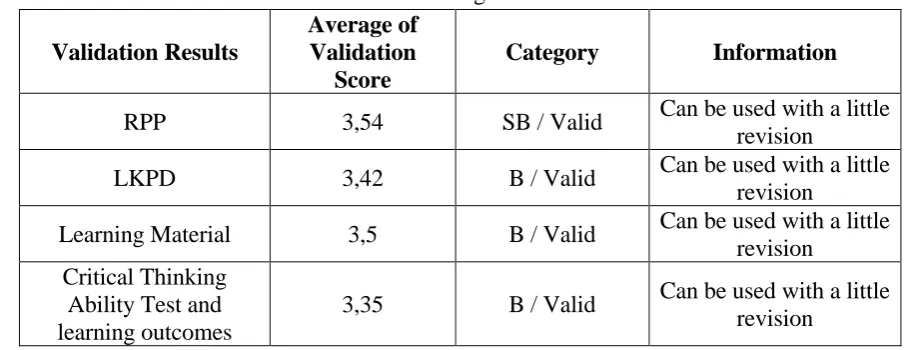
learning device validation and research instruments used in this study, which have been validated by experts, the following are the results of validated data.
Table 1. Results of Validation of Learning Devices and Research Instruments
Validation Results
Average of Validation
Score
Category Information
RPP 3,54 SB / Valid Can be used with a little revision
LKPD 3,42 B / Valid Can be used with a little revision
Learning Material 3,5 B / Valid Can be used with a little revision
Critical Thinking Ability Test and learning outcomes
3,35 B / Valid Can be used with a little revision
Validation results related to RPP syllabus, LKPD, learning material, and critical thinking ability tests in the table show the average feasibility validation of the four learning devices and research instruments from the validator to get a good category, so it can be concluded that the learning device is feasible to use with a slight revision.
Next below is the percentage of the comparison of Pre-test and Post-test scores
Value Results of Pre-test and Post-test on students' critical thinking skills
Score 1380 2295
Score Average 55,2 80
Source: processed data
For the results of the observation analysis students' critical thinking skills of experimental class students showed that for the pretest results the average presentation was 55.2% with the category of moderate critical thinking ability and for the posttest results the presentation average was 80% with the category of critical thinking ability very high. For the results of observational analysis of students the experimental class student learning outcomes showed that for the pretest results the average presentation was 55.2% with the category of moderate critical thinking ability and for the posttest results the average presentation of 80% with the category of critical thinking ability was very high. Based on the results of the analysis of observing the critical thinking skills of the control class students for pretest and posttest in the control class and the experimental class there was an influence on the use of the Treffinger learning model because there were very significant differences.
Value Results of Pre-test and Post-test on learning outcomes
Total 1380 2295
Score Average 55,2 80
Source: processed data
The results of student learning outcomes in the control class showed that for the pretest results the average presentation was 55.2% with the less active category and for the posttest results the average presentation was 80% with the moderately active category. Based on the results of the analysis of learning outcomes for the control class for pretest and posttest only at the stage of being less active and quite active. In this case it has not shown good results.
Furthermore, the translation related to the normality test of data acquisition of creative thinking skills and collaboration of students, researchers used the SPSS 21.00 program with the kolmogorov-smirnov technique at a significant level of 0.05. The selection of the Kolmogorov-Smirnov test because this technique can test in large or small quantities, besides that, the data in this study are interval scale or ratio.
The results of the normality test that has been processed are in table 4.13
Table 4.13
Normality Test Results
Variant Class Sig-
Critical Thinking Ability (Pretest)
Experiment 0,083
Critical Thinking Ability (Postest) 0,170
Critical Thinking Ability (Pretest) Control 0,083
Critical Thinking Ability (Postest) 0,200
Learning outcome (Pretest) Experiment 0,083
Learning outcome (Posttest) 0,170
Learning outcome (Pretest) Control 0,083
Learning outcome (Posttest) 0,200
Source: processed data
Normality test data based on table 4.13 above obtained that, the results of the significance level of the ability to think critically and the learning outcomes of students in the experimental class and control class more than 5% or 0.05. So based on the acquisition, it can be concluded that the analysis requirements test has been determined because all data that has been obtained is normally distributed.
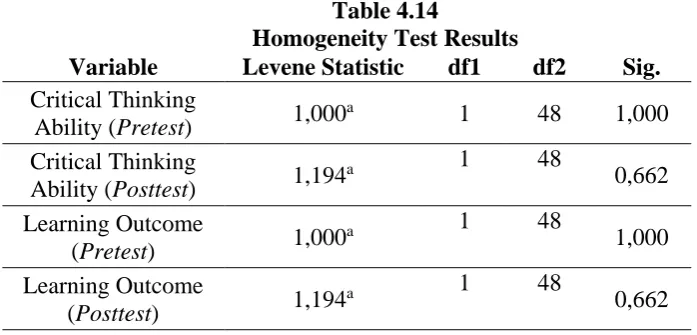
The homogeneity test carried out in this study aims to determine the similarity of the sample section. In the homogeneity test, researchers used the SPSS 21.00 program with a one way ANOVA test technique at a significant level of 0.05. The homogeneity test results can be seen below.
Table 4.14
Homogeneity Test Results
Variable Levene Statistic df1 df2 Sig.
Critical Thinking
Ability (Pretest) 1,000
a 1 48 1,000
Critical Thinking
Ability (Posttest) 1,194
a 1 48 0,662
Learning Outcome
(Pretest) 1,000
a 1 48 1,000
Learning Outcome
(Posttest) 1,194
a 1 48 0,662
[image:6.595.120.469.566.733.2]IV. DISCUSSION
Based on the acquisition of homogeneity test data each variable gets more than 5%. Then it was concluded that the samples of the two homogeneous variants (HO were rejected) and the test requirements analysis were fulfilled. Interpretation of the results of hypothesis testing data, the hypothesis of this study is "there is a significant effect of Treffinger learning model on critical thinking skills and learning outcomes of fourth grade students of Muhammadiyah 24 Ketintang Elementary School Surabaya". The results of these hypotheses are tested from the results of the research data that has been conducted. This can be seen from the average score of the experiment class and control posttest.
The results of the research in class IV T were greater than the average score in class IV K. The average of the IV T grade students was 85.4 and the average of the K class students was 80. The Independent Sample T-Test test results about the influence Treffinger learning model of students' critical thinking skills, data on critical thinking skills and student learning outcomes for the test (pretest) of 0.851 in the control class and in the experimental class of 0.891 while, when the student learning outcomes (pretest) amounted to 0.851 in the control class and in experimental class of 0.891. Because the two classes that have been tested have a significance value of 5 0.05 with df.38 at the 0.05 significance level. Because the significance level is 5 0.05 then 𝐻𝐻𝑂𝑂 is rejected and 𝐻𝐻𝑎𝑎 is accepted it can be concluded that the data on students' critical thinking abilities are stated to be normally distributed in each group.
This shows that there are differences in critical thinking skills and student learning outcomes in the experimental class and in the control class at the time (posttest) because in the experimental class there is treatment that is using the Treffinger model during learning and in the control class there is no treatment ( treatment) given. Based on the results obtained, it can be concluded that the thinking ability of students who use the terffinger learning model is significantly higher than the students' thinking ability using conventional learning.
V. CONCLUSSION
Based on the results of the discussion described above, it can be concluded that there is an influence of the use of the Treffinger learning model on students 'critical thinking abilities. The results of students' critical thinking skills after being given treatment are obtained posttest with the results 𝑡𝑡ℎ𝑖𝑖𝑖𝑖𝑖𝑖𝑖𝑖𝑖𝑖 (0,891) > 𝑡𝑡𝑖𝑖𝑎𝑎𝑡𝑡𝑡𝑡𝑡𝑡(1.7138) with df. 23 at the 0.05 significance level. The results of student learning outcomes after the treatment, obtained posttest with results 𝑡𝑡ℎ𝑖𝑖𝑖𝑖𝑖𝑖𝑖𝑖𝑖𝑖 (0,891) >𝑡𝑡𝑖𝑖𝑎𝑎𝑡𝑡𝑡𝑡𝑡𝑡(1.7138) with df. 23 at a significance level of 0.05, it can be concluded that the use of the Treffinger learning model influences critical thinking skills and learning outcomes of fourth grade students in the sub-theme of cultural diversity of my nation in elementary school.
I. REFERENCES
Emzir,2011.Metodologi Penelitian Pendidikan Kuantitatif. Jakarta : Raja Grafindo Aksara.
Ifana Yuli dan Dwi Fauzia (2015) . Pengaruh Model Pembelajaran Treefinger terhadap kemampuan Kritis dan kreatif mahasiswa Universitas kanjuruhan Malang . Th 20.no.2 diakses tanggal 2 september 2018 pukul 11.00
Mustaji (2012).Pengembangan kemampuan berpikir kritis dan kreatif dalam pembelajaran . diakses pada tanggal 10 september 2018 pukul 11.45
Nasution, (2011). Kajian pembelajaran IPS di sekolah. Surabaya: Unesa University Press
Poerwati endah Loeloek dan Amri sofan,2013.Panduan Memahami Kurikulum 2013. Jakarta.PT.Prestasi Pustaka
Siswono, T.Y.E .2009. Meningkatkan Kemampuan Berpikir Kreatif siswa. (online). Tersedia di http://suaraguru.wordpress.com
Siswono, Tatag Y.E. 2008. Model Pembelajaran Matematika Berbasis Pengajuan dan Pemecahan Masalah untuk Meningkatkan Kemampuan Berpikir Kreatif. Unesa University Press: Surabaya.
Shoimin, Aris . (2014 ) .68 Model pembelajaran inovatif dalam kurikulum 2013 .Yogyakarta : AR-Ruzz Media
Sofan Amri. 2013. Pengembangan dan Model Pembelajaran dalam Kurikulum 2013. Jakarta: Prestasi Pustaka.
Sugiyono. 2016. Metode Penelitian Kuantitatif & Kualitatif &R & D. Bandung: Alfabeta.
Suhanadji dan Roesminingsih (2018). Pendidikan IPS berbasis kontekstual. Surabaya : Universitas Negeri Surabaya Pascasarjana Prodi Pendidikan Dasar.
Suharningsih & Harmanto. 2015. Strategi Belajar Mengajar. Surabaya: Unesa University Press.
Supriyono. 2015. Peningkatan Kinerja Guru Dalam Pembelajaran Melalui Metode Kolaborasi. Vol 1 Nomor 9.
Susanto, Ahmad. 2012. Teori belajar dan pembelajaran. Jakarta: Kencana Prenada media grop.