An Exploratory Study of the Relationship between
Innovation and Change Management
Kenneth Chukwujioke Agbim, Godday Orziemgbe Oriarewo & Abu Emmanuel Omattah
Business Administration Department, College of Management Sciences, University of Agriculture, Makurdi, Nigeria
Abstract- An organization that innovates its products, services
and/or processes has introduced change in the organization and this change needs to be managed right from the beginning of the innovation process. To be effective and efficient in managing this change, organizations and their managers need to develop effective and efficient change management strategy for the extreme ends stages in the innovation process – idea generation and implementation. Thus, the study was designed to explore the relationship among the various images of managing, the innovation process and change outcomes. The study adopted a survey research method, while simple random sampling technique was employed to select the employees that completed the questionnaire. The generated data were analysed using linear regression. It was found that coaching, interpreting and nurturing images of managing are significantly related to idea generation, while directing, navigating and caretaking images are related to idea implementation. Also, the directing, navigating and caretaking images are significantly related to intended, partially intended and unintended change outcomes respectively. The study recommends the employment of coaching, interpreting and nurturing images in idea generation, while directing, navigating and caretaking images should be employed by change managers in the management of idea implementation. However, this must be done with recourse to the managerial capabilities of the change manager and the nature of the prevailing business environment.
Index Terms- Change management, change outcome,
innovation, turbulent environment
I. INTRODUCTION
nvironmental trends such as globalization of markets, technological revolution, government policy somersault and deregulation are rapidly changing the competitive structure of markets in such away that the competitive advantage of organizations is often attenuated (Andreu et al., 2003; Oghojafor et al., 2011). Consequently, organizations are under great pressure so much so that the turbulent environmental condition is constantly impinging on their capacity to be innovative in the eyes of their demanding customers (Karami, 2008; Andreu et al., 2003; Duygulu and Ozeren, 2009).
However, according to Kanter (1995, as cited in Rollinson, 2008), organizations need to change by moving from rigid, bureaucratic structure, which are best suited to coping with stable, relatively unchanging conditions towards organizational forms that are better able to adapt to rapid environmental change. But, organizations according to Jones and George (2008) cannot
change or adapt in response to changing environment unless they have effective control over their activities. This implies that there is a need for organizations and their managers to develop effective and efficient change management strategy for the extreme ends stages in the innovation process (idea generation and implementation).
Change management with respect to innovation appears a simple enough term. However, in reality, this is rarely so owing to the varying nature of “managing” (coaching, interpreting, nurturing, directing, navigating and caretaking) (Palmer and Dunford, 2002; Palmer et al., 2006) and “change” (Palmer and Dunford, 2008) and the stages in the innovation process. The study therefore seeks to explore the relationship among the nature of managing, change outcomes (intended, partially intended and unintended) and the innovation process.
II. LITERATUREREVIEW
The Nature of Organizational Change
Change is an effort that consists of actual physical alterations to operations and different emotional stimulation (Berneth, 2004). Applied to organizations, the word “change” has been defined by Ford and Ford (1995, as cited in Rollison, 2008) as a firm’s shift from one state to another. Similarly, organizational change is the movement of an organization away from its prevent state and toward some descried future state to increase its efficiency and effectiveness (Jones and George, 2008). More so, in the past, organizational change was usually a matter of making small and gradual adaptations. These days, however, the way that matters were handled in the past is no longer a faithful guide to what is required in the present. Indeed, for organizations to equip themselves for the future, they will not only need to completely transform themselves into something radically different, but they must also understand that their survival (Rollinson, 2008) and desired change outcome depends on their vision (i.e., the picture of the organization’s future) and their ability to understand the innovation process.
Change outcomes could take the form of intended change outcomes, partially intended change outcomes and unintended change outcomes. Intended change outcomes refers to situations where it is believed that proposed change outcomes are achievable. Change is treated as the realization of prior intent, achieved through the actions of change managers (Chin and Benne, 1976). Partially intended change outcomes refers to situations where some, but not all change intentions are achievable. Power, procession, interests and different skill levels of managers affect the ability to produce proposed change outcomes. Classic works such as Mintzberg and Waters (1985)
argued that not all features of change outcomes are intended (Harrison and Shirom, 1985). Unintended change outcomes suggests that managers often have great difficulty in achieving proposed change outcomes because a variety of forces lead to unplanned charge outcomes. These forces are more powerful than the influence of individual change managers, thereby swamping change managers and their proposed changes. Occasionally, outcomes and intentions may collide, but this is the result of serendipity rather than the direct influence of change managers. Outcomes are therefore emergent (Mintzberg, 1978; Pascale, et al., 2000).
The Nature of Change Management
Management as control has been dominant throughout the history of management thought. It underlies the classic Fayol (1949) characterization of management as planning, organizing, commanding, coordinating and controlling. In addition, management as control is associated with top-down, hierarchical view of managing. The organization is concerned mechanistically with the manager’s role to drive the machine in specific directions. People are allocated resources (in-puts) so that the machine can perform efficiently and produce the expected products or services (out-puts). In comparison, management as shaping sees managing as influencing rather than determining outcomes by edict. The emphasis on shaping anthropomorphizes the organization, giving it the qualities of an organism rather than a machine. The responsibility of management is to produce strong corporate capabilities that provide the organization with a firm platform to respond to and shape or manage external changes (Beer and Nohria, 2000; Palmer and Dunford, 2008).
Change management is the process of directing, navigating, caretaking, coaching, interpreting and nurturing organizational change so as to achieve a desired change outcome, maintain the status quo or adapt to the emergent outcomes. According to French and bell (1995), in coaching, change managers are able to intentionally shape (through influence) an organization’s capabilities in particular ways. But rather than dictating the exact direction of change, coaching relies on building the right set of values, skills and drills that are deemed necessary for organizational members to achieve desired organizational outcomes. The essence of coaching therefore is to help members of the organization to develop a better future picture of their units/department and by extension skills that will enhance their ability to generate innovative ideas that will bring about improved product/service quality and efficiency/effectiveness in production/service processes. More so, in interpreting, the change manager creates meaning for other organizational members, helping them to make sense of the various proposed organizational events and actions. Managers as interpreters need to explain to members of the organization why new ideas need to be generated and why the innovations should be introduced. The change managers should interprete why the changes are important by providing meaning and making sense of such events (Balogun et al., 2005). In nurturing, even small changes may have a large impact on organizations (Thietart and Forgues, 1995). Thus, managers should nurture their organizations to facilitate organizational qualities which enable positive organizing to occur (Palmer and Dunford, 2008).
In directing, management is in control and intended change outcomes are achievable. It is therefore up to the change manager to direct the organization in particular ways to produce the required change (Palmer and Dunford, 2008) by implementing the adopted innovation. In navigating, control is still at the heart of management action, but a variety of factors external to managers suggest that while they may achieve some intended change outcomes, others will occur over which they have little control. Outcomes are partly emergent rather than completely planned and result from a variety of influences, competing interests and processes. There is no guarantee that the final destination will be the one initially envisaged (if there is, indeed, a final destination), and there is the ever-prevent likelihood that a variety of other unanticipated destinations might eventually be brought about by the shifting winds and currents underlying the change (Palmer and Dunford, 2008). In caretaking, managers will exercise some control, but the ability to control is severely constrained by a variety of forces, both internal and external, which propel change relatively independent of a manager’s intentions. Individual managers have only a limited ability to implement change. Thus, change outcomes are at odds with these forces. At best, change managers are caretakers having little influence over the direction of change (Palmer and Dunford, 2008).
The Innovation Process
Innovation is the adoption of new approaches by an organization (Lee and Yu, 2010). It is an activity intended to develop an idea, carry it out, react to it and modify where necessary (Van de ven, 1986). Put differently, organizational innovation is the adoption of a new idea or behaviour that is new to the organization’s industry, market or general environment (Daft, 1982). Thus, an organization that innovates its products, services and/or processes has introduced change in the organization and this change needs to be managed right from the beginning of the innovation process. To be effective and efficient in managing the change that is associated with the introduction of innovation in an organization, Jones and George (2008) asserted that managers must create an organizational setting in which people are encouraged to be innovative. The innovation process is made up of four stages; idea generation, proposal, adaption and implementation. The idea generation stage is where an idea regarding something new (product, production process, service, system, method, policy) is conceptualized by an individual or a group of persons in the organization. The second stage is the proposal stage; it is where an idea or concept is transformed into a proposal for official acceptance. The third stage is the adoption stage, it is where a proposed innovation is legitimated or becomes officially accepted. This is the stage where the decision for giving the innovation the attention needed in effort, time and money to be fully developed is made. The final stage is the implementation stage; it concerns the actual utilization of the innovation by organizational members as they perform their tasks (Wilson, 1966; Agbim, 2013).
Research Hypotheses
H01: Coaching for the purpose of capacity building
H02: Interpreting for the purpose of “sense making”
is not significantly related to idea generation.
H03: Nurturing the organization is not significantly
related to idea generation.
H04: Directing the organization is not significantly
related to idea implementation.
H05: Navigating the organization is not significantly
related to idea implementation.
H06: Caretaking activities in the organization is not
significantly related to idea implementation.
H07: Directing the organization is not significantly
related to intended charge outcome.
H08: Navigating the organization is not significantly
related to partially intended change outcome.
H09: Caretaking activities in the organization is not
significantly related to unintended change outcome.
III. RESEARCHMETHODOLOGY
The survey research design was employed in this study. The sample size for the study is made up of 258 employees of manufacturing companies in Anambra State, Nigeria. The sample size was selected using the Yaro-Yamen (1980, as cited in Agbim et al., 2013) sample determination method. Simple random sampling technique was used to select the employees
who completed the questionnaire. The questionnaire utilized a response set of strongly disagree (1) to strongly agree (5). The internal consistency test showed that all scale exhibited coefficient of alpha that exceeded a minimum threshold of 0.7 as suggested by Nunnally and Bernstein (1994). Out of the 258 questionnaire that were sent out, 12 were discarded on account of missing data. Thus, resulting in a final useable sample size of 246 and a response rate of 95.3%. All the respondents were under the age of 55. The sample is 68.6% male and 31.4% female. To test the proposed hypotheses, data for the study were collected and analysed using simple regression with the aid of SPSS (Version 18.0). All the tests were conducted at 5% level of significance.
IV. RESULTSANDDISCUSSION
H01: Coaching for the purpose of capacity building
is not significantly related to idea generation.
Table 1 showed the result of the H01 test with coaching as
the predicator variable and idea generation as the dependent variable. It is evident from Table 1 that the beta value (0.310) is significant at P<0.05. Thus, H01 is rejected, that is, coaching for
the purpose of capacity building is significantly related to idea generation.
Table 1: Coefficients in the Regression Analysis of Coaching and Idea Generation
Predictor variable B Std. Error Beta T Sig.
(Constant) 52.041 1.603 24.605 0.000 Coaching 0.186 0.025 0.310 6.822 0.002 Dependent Variable; Idea generation
In coaching, ideas are generated though consultation with members of the organization. The proposed innovation that will occasion change is formulated from the ideas generated. Even though wide-ranging consultation takes place throughout the organization during the idea generation, according to Haapaniemi (1996), resistance needs to be recognized and expected since the proposed innovation will take members of the organization out of their comfort zone. Therefore, to help members of the organization cope with the change environment, change managers according to Palmer and Dunford (2008) should help
the employees by means of enhanced personal capacity development.
H02: Interpreting for the purpose of “sense making”
is not significantly related to idea generation.
To test H02, interpreting was chosen as the predictor
variable, while idea generation was the dependent variable. The result in Table 2 showed that the beta value of 0.296 is significant (P<0.05). Therefore, H02 is rejected. This implies
[image:3.612.61.526.564.606.2]that interpreting for the purpose of “sense making” is significantly related to idea generation.
Table 2: Coefficients in the Regression Analysis of Interpreting and Idea Generation
Predictor variable B Std. Error Beta T Sig.
(Constant) 48.216 1.582 30.241 0.000 Interpreting 0.146 0.042 0.296 4.620 0.004 Dependent variable: Idea generation
For interpreting, resistance is viewed as a likely outcome where employees lack understanding of “what is going on” and lack understanding of the personal impact of the change. The most reliable predictor of how people will interpret the implication of change is their experience of past organizational changes (Gioia and Chittipeddi, 1991). Hence, the need for change manager to begin change initiatives with a systematic inquiry into organizational members memories of past organizational changes (Palmer and Dunford, 2008). More so,
change managers should focus on sense making about a proposed change and sensegiving to different groups through persuasive account of the change to ensure that as many people as possible inside and outside the organization share a common understanding that will inspire them to generate ideas for the proposed change.
H03: Nurturing the organization is not significantly
A single variable regression was employed to test the relationship between nurturing (predictor variable) and idea generation (dependent variable). The result in Table 3 revealed that the beta value (0.325) is significant (P<0.05). Thus, H03 is
rejected. This implies that nurturing the organization is significantly related to idea generation.
Table 3: Coefficients in the Regression Analysis of Nurturing and Idea Generation
Predictor variable B Std. Error Beta T Sig.
(Constant) 57.606 1.468 38.640 0.000 Nurturing 0.208 0.083 0.325 4.898 0.000 Dependent variable: Idea generation
Shaw (1995) argued that where organizational structures and management processes require fundamental change, current ways of organizing may inhibit the availability of information, such as customer expectations and market competition, which are necessary to generate the ideas. Thus, change managers must nurture the organization so that employees will see and realize new possibilities that may have been previously unanticipated. This can be done by fostering the conditions for change and communicating the need to be ready to engage in change as the situation emerges, often in unpredictable ways (Wolvin and Coakley, 1996; Palmer and Dunford, 2008). Consequently, according to Palmer and Dunford (2008), it becomes difficult to
determine whether the call for idea generation will be resisted due to the absence of the chaotic forces from which resistance emerges.
H04: Directing the organization is not significantly
related to idea implementation.
To test H04, a regression analysis was performed with
directing and idea implementation as the predictor and dependent variables respectively. The result in Table 4 showed that the beta value (0.286) is significant (P<0.05). Thus, H04 is rejected.
Hence, directing the organization is significantly related to idea implementation.
Table 4: Coefficients in the Regression Analysis of Directing and Idea Implementation
Predictor variable B Std. Error Beta T Sig.
(Constant) 46.385 1.390 30.642 0.000 Directing 0.184 0.064 0.286 5.462 0.003
Dependent variable: Idea implementation
Directing according to Palmer and Dunford (2008) views resistance as something that must be overcome in order to move forward in the implementation of the adopted idea or innovation. Thus, management must highlight the change value-agenda (Guaspani, 1996) and send clear, unambiguous messages about the need to implement the innovation in accordance with laid down rules. When situational factors are assessed as unfavourable to idea implementation, managers may use a range of interventions to alter the situation. For example, directing may involve creating dissatisfaction with the status quo, a sense
of distress and a desire for change among followers (Shamir and Howell, 1999).
H05: Navigating the organization is not significantly
related to idea implementation
A simple variable regression was employed to test the relationship between navigating (predictor variable) and idea implementation (dependent variable). The result in Table 5 revealed that the beta value (0.360) is significant (P<0.05). Thus, H05 is rejected. This implies that navigating the organization is
significantly related to idea implementation.
Table 5: Coefficients in the Regression Analysis of Navigating and Idea Implementation
Predictor variable B Std. Error Beta T Sig.
(Constant) 52.106 1.304 36.130 0.000 Navigating 0.172 0.056 0.360 8.364 0.000 Dependent variable: Idea implementation
Navigating suggest that managers cannot necessarily impose a vision as there are competing stakeholders who may hold differing views on what change is desired or whether change is desired (Kanter et al., 1992). The navigator should pay attention to differing interests and stakeholders to persuade them of the appropriateness of the implementation of the innovation or the change or if necessary to modify the change to produce the best change outcome in the given situation. Thus, change management involves navigating these tensions. Navigating suggests that vision occurs through debates amongst different groupings within and across the organization and that there may be vision “collision” (Kanter et al.); multiple or conflicting
visions. This may occur when the vision is crafted by organizational strategists who are convinced about the need for change, but the need is not shared by change/innovation implementers or change recipients. It may also occur when there is a gap between management’s strategic vision and stakeholders’ vision of the company (Hatch and Schultz, 2001). To win people over to idea implementation, critical listening, message evaluation and negotiation are needed by the change navigator (Hearit, 1994; Wolvin and Coakley, 1996; Palmer and Dunford, 2008).
H06: Caretaking activities in the organization is not
Table 6 revealed the result of the H06test with caretaking as
predictor variable and idea implementation as the dependent variable. It is evident from Table 6 that the beta value (0.314) is significant at P<0.05. Thus, H06 is rejected, that is, caretaking
activities in the organization is significantly related to idea implementation.
Table 6: Coefficient in the Regression Analysis of Caretaking and Idea Implementation
Predictor variable B Std. Error Beta T Sig.
(Constant) 43.621 1.482 27.341 0.000 Cartaking 0.285 0.037 0.314 4.826 0.006 Dependent variable: Idea implementation
People’s reaction to idea implementation follow a predictable series of psychological stages such as; stock (manifest as in mobilization), defensive retreat (anger), acknowledgement (mourning), adaptation and change (acceptance). Thus, a viable approach to managing such resistance which the caretaker can employ is to let nature take its course or minimize intervention (as a coping mechanism) as resistance is a natural phase (Palmer and Dunford, 2008). More so, caretaking which is aligned to reactive strategy uses “identify” and “reply” approach (Clampitt et al., 2000). Forces for change are “identified” and staff requests for knowledge of the change are “replied” to by explaining the inevitability of the change due to external forces. This explains why in caretaking, visions (i.e., the picture of the future the introduced innovation is
expected to lead the organization to) are likely to have limited impact unless they are consistent with events unfolding outside of the organization as the pressure for change is due less to vision and more to the impact of external forces (Palmer and Dunford, 2008).
H07: Directing the organization is not significantly
related to intended charge outcome.
A single variable regression was employed to test the relationship between directing (predictor variable) and intended change outcome (dependent variable). The result in Table 7 revealed that the beta value (0.312) is significant and positive (P<0.05). Thus, H07 is rejected. We conclude that directing the
organization is significantly related to intended change outcome.
Table 7: Coefficients in the Regression Analysis of Directing and Intended Change Outcome
Predictor variable B Std. Error Beta T Sig.
(Constant) 56.341 1.811 33.146 0.000 Directing 0.283 0.042 0.312 5.785 0.002 Dependent variable: Intended change outcome
Though we all rationally recognize that the introduction of innovation in an organization brings about change, however not all change is as a result of innovation. When areas where innovation is needed in an organization is identified, ideas concerning the innovation needs to be generated by members of the organization. During this period of idea generation, management influences the employees. However, in order to achieve the intended change outcome during the idea implementation, management need to control and by extension direct the employees to ensure compliance with laid down rules and regulations. Balogun and Johnson (2005) illustrated that
individuals in organizations are “sensemakers” not just “sensetakers” and are integrally involved in determining the outcomes of strategic change initiatives.
H08: Navigating the organization is not significantly
related to partially intended change outcome.
To test H08, navigating was chosen as the predictor
variable, while partially intended change outcome was the dependent variable. The result in Table 8 showed that the beta value (0.278) is significant (P<0.05). Thus, H08 is rejected. This
implies that navigating the organization is significantly related to partially intended change outcome.
Table 8: Coefficients in the Regression Analysis of Navigating and Partially Intended Change Outcome
Predictor variable B Std. Error Beta T Sig.
(Constant) 46.628 1.530 22.631 0.000 Navigating 0.213 0.029 0.278 3.040 0.000 Dependent variable: Partially Intended Change Outcome
In navigating the organization during change management, Palmer and Dunford (2008) noted that a few of the forces in the external environment of the organization suggest some of the intended change outcomes are achievable, while many of the external forces over which management has no control will point to the fact that outcomes are partly emergent rather than completely planned. Similarly, Pendlebury et al. (1998) asserted that change management is only partially controllable owing to a variety of influences, competing interests and processes. Change
managers who are navigating towards a desired outcome will achieve outcomes that all the features are not intentional. More so, Palmer and Dunford further noted that there is no guarantee that the achieved change outcome will be the one initially envisaged and there will be the ever-present likelihood that a variety of unanticipated change outcome might eventually be brought about by the shifting winds and currents underlying the change.
H09: Caretaking activities in the organization is not
Table 9 revealed the result of the H09 test with caretaking as
the predictor variable and unintended change outcome as the dependent variable. The result in Table 9 showed that the beta value of 0.308 is significant (P<0.05). Thus, H09 is rejected. We
conclude that caretaking activities in the organization is significantly related to unintended change outcome.
Table 9: Coefficients in the Regression Analysis of Caretaking and Unintended Change Outcome
Predictor variable B Std. Error Beta T Sig.
(Constant) 50.231 1.604 28.093 0.000 Caretaking 0.189 0.029 0.308 6.573 0.000 Dependent variable: Unintended change outcome
The ability of change managers as caretakers to manage change is constrained by a variety of internal and external forces. Palmer and Dunford (2008) asserted that there are inexorable external forces that shape organizational change. These forces limit managers’ ability to implement change. Consequently, these forces propel change relatively independent of a manager’s intentions. Hence, the change outcomes are unintended.
V. CONCLUSION
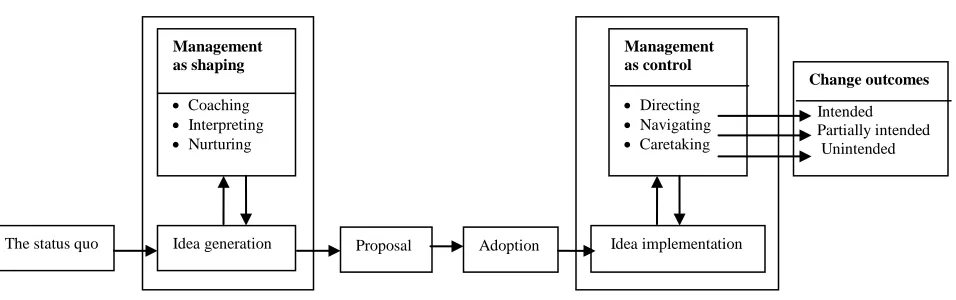
This study has related the different images of managing change - coaching, interpreting, nurturing, directing, navigating and caretaking (Palmer and Dunford, 2002; Palmer et al., 2006; Palmer and Dunford, 2008) to the innovation process (idea generation, proposal, adoption and implementation) (Wilson, 1966; Agbim, 2013) and the change outcomes (intended, partially intended and unintended) (Palmer and Dunford, 2002; Palmer et al., 2006; Palmer and Dunford, 2008). Consequently, for an organization to move from the status quo (or the present state) to another (future) state, ideas have to be generated about the future state. For the members of the organizations to generate these ideas, management has to adopt a shaping (or influencing) function that entails coaching, interpreting and nurturing activities. When the ideas which necessitates the type of innovation are generated, they are presented to management as proposal for adoption before actual implementation. This is to reduce resistance by members of the organization and other stakeholders.
[image:6.612.42.520.537.687.2]During idea implementation, management plays a control role so as to ensure that implementers comply with laid down rules and regulations. If management exercises a directing authority, the change outcome of implementing the innovation is intended. The directing function is suitable when the business environment is stable. When management plays a navigating role, the change outcome is partially intended. The partially intended change outcome is the resultant effect of the power, processes, interests and the different skill levels employed by managers during implementation. When the business environment is turbulent, change managers have limited ability to implement change owing to the uncertainties in the environment. Hence, the change outcome is unintended. The study recommends the employment of coaching, interpreting and nurturing images in idea generation, while directing, navigating and caretaking images should be employed by change managers to manage idea implementation. This must be done with recourse to the managerial capabilities of the change managers and the nature of the prevailing business environment. The unintended change outcome suggests that the prevalent environmental forces have negated all the managerial skills and strategies deployed by the management of the organization. The relationship among images of managing change, the innovation process and change outcomes are depicted in the innovation/change management model in Fig. 1.
Fig 1: Innovation/Change Management Model
Management as control
Directing Navigating Caretaking
The status quo Idea generation Proposal Adoption Management
as shaping
Coaching Interpreting Nurturing
Idea implementation
Change outcomes
REFERENCES
[1] Agbim, K.C. (2013). The impact of organizational structure and leadership styles on innovation. International Organization of Scientific Research Journal of Business and Management, 6(6), 56-63.
[2] Agbim, K.C., Oriarewo, G.O. and Ijie, N. (2013). The relative contribution of spirituality in entrepreneurship development among graduates of Nigerian tertiary institutions. International Journal of Business and Management Invention, 2(4), 25-35.
[3] Andreu, R., Baiget, J. and Canals, A. (2003). Firm-specific knowledge and competitive advantage: Evidence and KM practices. Knowledge Process Management, 15(2), 97-106.
[4] Balogun, J. and Johnson, G. (2005). From intended strategies to unintended outcomes: The impact of change recipient sensemaking. Organization Studies, 26, 1573-1601.
[5] Balogun, J., Gleadle, P., Hope-Hailey, V. and Willmott, H. (2005). Managing change across boundaries: Boundary shaking practices. British Journal of Management, 16, 261-278.
[6] Beer, M. and Nohria, N. (2000). Breaking the code of change. Boston, MA: Harvard Business School Press.
[7] Berneth, J. (2004. Expanding our understanding of the change message. Human Resource Development Review, 3(1), 36-52.
[8] Chin, R. and Benne, K.D. (1976). General strategies for effecting change in human systems. In W.G. Bennis, K.D. Benne, R. Chin and K.E. Corey (Eds.). The Planning of Change (Pp. 22-45). New York: Holt, Rinechart and Winston.
[9] Clampitt, P.G., Dekoch, R.J. and Chusman, T. (2000). A strategy for communicating about uncertainty. Academy of Management Executive, 14(4), 41-57.
[10] Daft, R.L. (1982). Bureaucratic versus non-bureaucratic structure in the process of innovations and change, In B.S. Samuel (Ed.) Perspectives in Organizational Sociology: Theory and Research. Greenwich, C.T.: JAI Press.
[11] Duygulu, E. and Ozeren, E. (2009). The effects of leadership styles and organization culture on firm’s innovativeness. African Journal of Business Management, 3(9), 475-485,
[12] Fayol, H. (1949). General and industrial management. London: Pitman. [13] French, W.L. and Bell, C.H. (1995). Organizational development:
Behavioural science intervention for organization improvement. Englewood Cliffs, NJ: Prentice Hall.
[14] Gioia, D.A. and Chittpeddi, K. (1991). Sensemaking and sensegiving in strategic change initiation. Strategic Management Journal, 12, 433-448. [15] Guaspari, J. (1996). If you want your people to buy into change, you have
to sell them. Yes sell them. Across the Board, 33(5), 32-36. [16] Haapaniemi, P. (1996). Shared vision. Chief Executive, 16.
[17] Harrison, M.I. and Shirom, A. (1999). Organizational diagnosis and assessment. Thousand Oaks, CA: Sage.
[18] Hatch, M. J. and Schultz, M. (2001). Are the strategic stars aligned for your corporate brand. Harvard Business Review, 78(2), 3-8.
[19] Hearit, K.M. (1994). Apologies and public relations crises of Chrysler, Toshiba and Volvo. Public Relations Review, 20(2), 113-125.
[20] Jones, G.R. and George, J.M. (2008). Contemporary management. New York: McGraw Hill.
[21] Kanter, R.M., Stein, B.A., and Jick, I.D. (1992). The challenge of organizational change: How companies experience it and leaders guide it. New York: Free Press.
[22] Karami, A.K. (2008). An inspection on environmental scanning and growth strategy in high tech sham firms. Conference on small firms –University of Twente, the Netherlands.
[23] Lee, H. and Yu, C. (2010). Effect of relation style on innovation performance. African Journal of Business Management, 4(9), 1703-1708. [24] Mintzberg, H. (1978). Patterns in strategy formation. Management
Science, 24, 934-948.
[25] Mintzberg, H. and Waters, J.A. (1985). Of strategies deliberate and emergent. Strategic management Journal, 6, 257-272.
[26] Oghojafor, B.E.A., Olamitunji, D. and Sulaiman, A.A. (2011). Assessing the small and medium scale enterprises environment in Nigeria in Nigeria. International Journal of African Studies, 4, 22-27.
[27] Palmer, I. and Dunford, R. (2002). Who says change can be managed? Positions perspectives and problematic. Strategic Change, 11, 243-251. [28] Palmer, I. and Dunford, R. (2008). Organizational change and the
importance of embedded assumptions. British Journal of Management, 19, 520-532.
[29] Palmer, I., Dunford, R. and Akin, G. (2006). Managing organizational change. Boston, M.A.: McGraw-Hill.
[30] Pascale, R.I., Millemann, M. and Gioia, I. (2000). Surfing the edge of chaos. New York: Crown Business.
[31] Pendlebury, J., Grouard, B. and Meston, E. (1998). The ten keys to successful change management. London: Wiley.
[32] Rollinson, D. (2008). Origination behaviour and analysis: An integrated approach. Essex: Pearson Education Limited.
[33] Shamir, B. and Howell, J.M. (1999). Organizational and contextual influences on the emergence and effectiveness of charismatic leadership. Leadership Quarterly, 10, 257-283.
[34] Shaw, R.B. (1995). The essence of discontinuous change: Leadership, identity and architecture. In D.A. Nedler, R.B. Shaw and A.E. Walton (Eds.). Discontinuous Change: Leading Organizational Transformation (Pp. 66-81). San Francisco, CA: Jersey-Bass.
[35] Thietart, R.A. and Forgues, B. (1995). Chaos, theory and organizations. Organization Science, 13, 567-582.
[36] Van de Ven, A.H. (1986). Central problems in the management of innovation. Management Science, 32, 590-608.
[37] Wilson, J.Q. (1966). Innovation in organization: Notes towards a theory. In J.D. Thompson (Ed.). Approaches in organizational design (Pp. 16-22). Pittsburgh: University of Pittsburgh Press.
[38] Wolvin, A. and Coakley, C.G. (1996). Listening. Dubuque, IA: Brown and Benchmark.
AUTHORS
First Author – Kenneth Chukwujioke Agbim, Business
Administration Department, College of Management Sciences, University of Agriculture, Makurdi, Nigeria. Corresponding author. E-mail: [email protected]. Tel: +234-703-126-3134
Second Author – Godday Orziemgbe Oriarewo, Business
Administration Department, College of Management Sciences, University of Agriculture, Makurdi, Nigeria
Third Author – Abu Emmanuel Omattah, Business