www.ijsrp.org
Analysis of Optical Time Division Multiplexing Using
Packet Interleaving Scheme
P NagaSiva Kumar, A Sangeetha, G Srikanth
School of Electronics and Engineering, VIT University, Vellore
Abstract- Optical time-division multiplexing (OTDM) expands and extends the well-known technique of electrical time-division multiplexing into the optical domain. In OTDM, optical data streams are constructed by time-multiplexing a number of lower bit-rate optical streams. In this paper we present an experiment work in optical time-division multiplexing and simulating a packet-interleaved operation using OptiSystem.
Index Terms- Compression stage, Multiplexer, Packet interleaving scheme
I. INTRODUCTION
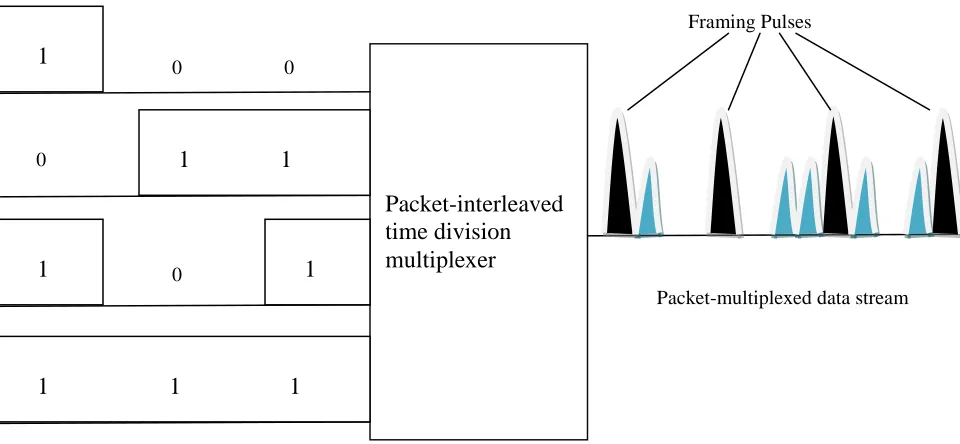
unctionally, optical TDM (OTDM) is identical to electronic TDM. The only difference is that the multiplexing and demultiplexing operations are performed entirely optically at high speeds. At the inputs to the network, lower-speed data streams are multiplexed optically into a higher-speed data streams, and at the output of the network, the lower-speed data streams must be extracted from the higher-speed data streams optically by means of demultiplexing function. Optical signals representing data streams from multiple sources are interleaved in time to produce a single data stream. The interleaving can be done on a packet by packet basis as shown in the Figure 1: If the packets are of fixed length, the recognition of packet boundaries is much simpler i.e., fixed length packets are used. In packet-interleaved case, framing pulses can be used. These framing pulses mark the boundary between the packets.
Framing Pulses
11 0 0
0
0
[image:1.612.58.538.395.617.2]Packet-multiplexed data stream
Figure 1: Function of a packet-interleaved optical multiplexer.
Assume if n data streams are to be multiplexed and the bit period of each these streams is T. Also framing pulses are used then the inter pulse width is τ = T/n+1 because n+1 pulses must be transmitted in each bit period. There is a guard time between the successive pulses. One purpose of this guard time is to provide some tolerance in the multiplexing and demultiplexing operations.
F
Packet-interleaved
time division
multiplexer
1
1 1
1
1
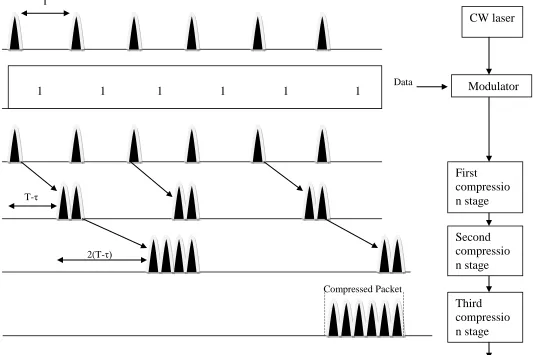
www.ijsrp.org In this packet interleaved case, the data stream externally modulates a periodic stream of narrow pulses. If the bit interval is T the separation between successive pulses is also T. In this way, we have to reduce the interval between successive pulses to τ, a high-rated multiplexed data signal. This is done by passing through the initial sequence through a series of compression stages as shown in Figure 2: If the size of each packet is l bits, the output goes through [k=log2 l] compression stages. In the first compression stage, bits 1,3,5,7…are delayed by T-τ. In the second compression stage, the pair of bits (1,2),(5,6),(9,10)…. are delayed by 2(T-τ). In the third compression stage, the bits (1,2,3,4),(9,10,11,12)….are delayed by 4(T-τ). Design of compression stages by using OptiSystem.
T
`
Data
T-τ
2(T-τ)
[image:2.612.39.572.158.513.2]Compressed Packet
Figure 2: An optical multiplexer to create a packet-interleaved TDM stream
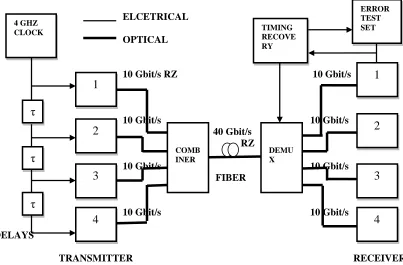
A block schematic of the four channel system is shown in Figure 3: A common 10-GHz clock drives the four transmitters via a series of micro wave delay lines that are adjusted to provide correct timing of the optical pulses. Four channels at wavelength 1550nm are RZ modulated at each 10 Gbit/s data are delayed by ¼ of the time window and then multiplexed. Total power of all channels set to -12dBm NRZ coding is a line code in which binary value ‘1’ is represented by positive voltage and ‘0’ is represented by negative voltage. The pulses have more energy than others. It requires only half the bandwidth than other coding. In RZ coding, a binary 1 is represented by first half of the bit duration, during the second half the level return to zero. Absence of a pulse represented a binary 0. Twice the bandwidth is required for RZ coding.
1 1 1 1 1 1
CW laser
Modulator
First
compressio
n stage
Second
compressio
n stage
www.ijsrp.org
ELCETRICAL
OPTICAL
10 Gbit/s RZ 10 Gbit/s 4 Gbit/s
10 Gbit/s 10 Gbit/s 40 Gbit/s
RZ
10 Gbit/s 10 Gbit/s FIBER
10 Gbit/s 10 Gbit/s
DELAYS
[image:3.612.75.478.70.335.2]
TRANSMITTER RECEIVER
Figure 3: Block schematic of 4-channel OTDM system.
To demonstrate the packet interleaving, created a sample in which packets with 6 bits length are created. The Figure 4: shows the layout with three compression stages.
Figure 4: Packet interleaving with 6bits/packet
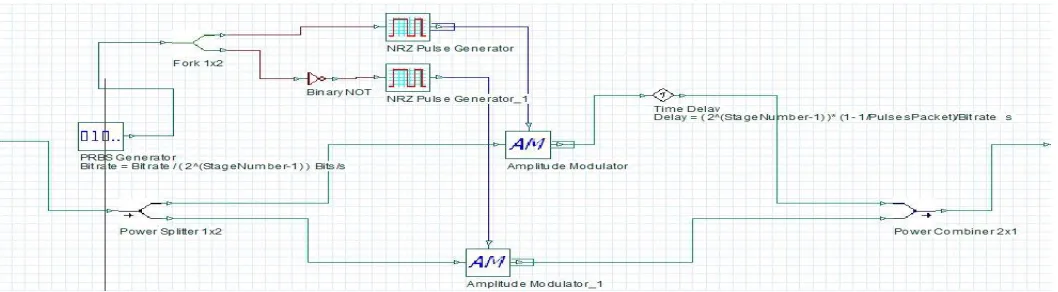
The stage was implemented in a subsystem because each compression stage has the same layout as shown in Figure 5: consist of a PRBS generator with bit rate of 10 Gbit/s and a RZ pulse generator which generates the continuous electric pulses. A light coming from a CW (Continuous Wavelength uses a Conventional band or C-band of 1550nm wavelength) laser is modulated by using AM modulator.
2
1
3
4
4
3
2
1
TIMING RECOVE RY
COMB INER
DEMU X 4 GHZ
CLOCK
ERROR TEST SET
τ
τ
[image:3.612.38.578.425.594.2]www.ijsrp.org Figure 5: Compression Stage
There are three compression stages, the only difference between these compression stages were some parameters such as Bit rate, PRBS (Pseudo Random Bit Sequence) Generator and the Delay at the time component. The Bit rate is calculated by using Bitrate/(2stagenumber-1) bits/sec and Delay is calculated by using (2stagenumber-1)*(1-1/pulses packet)/Bitrate.
Pulse time τ (τ specifies the pulse width) = 0.06bit
Pulses packet (specifies the number of bits per packet) = 6bits
Bit interval T = 1bit
Therefore, T-τ = 0.94 2(T-τ) = 2(0.94) 4(T-τ) = 4(0.94)……..
III. RESULTSANDDISCUSSIONS
The initial sequence is 11111100 and the behavior of the optical signal along the transmission can be shown in Figure 6:
www.ijsrp.org
c
d
Figure 6: (a) initial bit sequence (b) after 1st compression stage (c) after 2nd compression stage (d) after 3rd compression stage.
Here the optical pulses are compressed at each stage as following Figure 6: In the first compression stage the bits 1,3,5,7 are compressed by T-τ , similarly the bits (1,2),(5,6), and (1,2,3,4) are compressed by 2nd and 3rd stages. As the use of compressing bits the bandwidth is reduced for transmitting bits.
REFERENCES
[1] Sachin Kumar, Indu Bala Pauria, Anoop Singhal, “ Optical Fiber Communication System Performance Using MZI Switching ”, IJSCE , Volume-2, Issue-3, July 2012.
[2] Jitendra Nath Roy, “Mach-Zehnder interferometer based tree architecture for all-optical logic and arithmetic operations‖”, Optik Int Light Electron Opt. (2009). [3] Rodney S.Tucker,Steven K.Korotkey,“Optical Time-Division Multiplexing For Very High Bit-Rate Transmission”. Journal of Lightwave Technology Volume-6
NO.11, 1988.
[4] I. Shake, H. Takara, I. Ogawa, T. Kitoh, M. Okamoto, K. Magari, T. Ohara, S. Kawanishi, “160-Gbit/s full channel optical time-division de-multiplexer based on SOA- array integrated PLC and its application to OTDM transmission experiment”, IEICE Trans. Commun. 53 (1) (2005) 20–2096B.
AUTHORS
First Author – P. NagaSiva Kumar, M.Tech Communications, VIT University, Vellore, (Email: [email protected])
Second Author – A. Sangeetha received her BE degree from Madras University and her ME degree from Madurai Kamraj University in 2000 and 2002, respectively. At present, she is working as an Assistant Professor (senior) in the School of Electronics Engineering at VIT University, Vellore, India. Her current research interest is optical OFDM. She is the author and coauthor of 9 international journal papers and many international and national conference papers.