ISSN 2250-3153
Mathematics Anxiety, Mathematics Performance and
Gender differences among Undergraduate Students
Alireza Pourmoslemi*, Nasrolah Erfani**, Iraj Firoozfar***
*
Department of Mathematics, Pyame Noor University, Iran **
Department of psychology,Pyame Noor University, Iran ***
Department of education, Pyame Noor University, Iran
Abstract-This study aimed to investigate the level of mathematics anxiety and the relationship between mathematics anxiety and mathematics performance among undergraduate students of Payame Noor university (PNU) in Hamedan, Iran. In particular, the study investigated the relationship between mathematics anxiety and gender, and field of study. The sample of the study consisted of 275 (162 women and 113 men) undergraduate students of various fields of study. To measure the mathematics anxiety level, the participants responded to the 24 Items of The Revised Mathematics Anxiety Rating Scale (RMARS), which consisted of learning mathematics anxiety and mathematics evaluation anxiety subscales. The data were analyzed by One-way ANOVA and independent-samples t- tests using the Statistical Procedures for Social Sciences (SPSS 11.5). The results showed significant differences between men and women‟s evaluation anxiety and no significant difference was observed concerning field of study. Also, there is a significant correlation between high level anxiety and low academic performance.
Index Terms- Mathematics Anxiety, Mathematics performance, Gender differences.
I. INTRODUCTION
athematics anxiety is one of the most important problems for many students. “mathematics anxiety involves feelings of tension and anxiety that interfere with the manipulation of numbers and the solving of mathematical problems in a wide variety of ordinary life and academic situations” (Richardson & Suinn, 1972, p. 551). However, Byrd (1982) accepted this kind of definition as deficient both from conceptualization of mathematics and also from conceptualization of anxiety perspectives. Thus, it should be regarded from a larger perspective as a complex construct consisting of “affective, behavioral and cognitive responses to a perceived threat to self-esteem which occurs as a response to situations involving mathematics” (Atkinson, 1988). Generally, high level of anxiety is more closely associated with lower performance among low ability students (Sena et al., 2007). Mathematics anxiety can be defined as a state of discomfort created when students are required to perform mathematical tasks (Cemen, 1987). However, there is no general consensus among the scholars on its causes and effects. In fact, mathematics anxiety is more than a dislike toward mathematics (Vinson, 2001). Thus it can be observed that mathematical basic skills or concepts acquired in lower form are vital for students (Siti & Rohani, 2010). The
findings will help to improve understanding of mathematics learning concerning mathematics anxiety.
II. MATHEMATICS ANXIETY AND GENDER DIFFERENCES
A particular focus of the present study was gender differences and mathematics anxiety. The studies concerning the relationship between gender and mathematics anxiety show different results (Anglin, Pirson, & Langer, 2008; Hall, Davis, Bolen, & Chia, 1999; Meelissen & Luyten, 2008; Penner & Paret, 2008). Some studies report that women have higher mathematics anxiety than men (Baloglu & Koçak, 2006). As Aiken (1970) pointed out, „„no one would deny that sex can be an important moderator variable in the prediction of achievement from measures of attitude and anxiety‟‟. Specifically, Aiken (1970) stated that „„measures of attitude and anxiety may be better predictors of the achievement of females than that of males‟‟. Similarly, Eccles and Jacobs (1986) asserted that gender differences in mathematics anxiety are directly attributable to gender differences in mathematics achievement. However, some studies indicated that the achievement disparity in mathematics is “small and declining” with competence beliefs as a stronger driver of performance outcomes. (Frenzel, Pekrun, & Goetz, 2007). Ma‟s (1999) meta-analysis concluded that gender differences are not statistically significant in mathematics anxiety.
III. MATHEMATICS ANXIETY AND MATHEMATICS ACHIEVEMENT
Researchers have made efforts to examine individual differences in the relationship between mathematics anxiety and mathematics achievement. The relationship between Mathematics anxiety and mathematics achievement was studied by Ma and Jiangming Xub (2004). Tocci & Engelhard (1991) found that students with a higher level of mathematics anxiety perform at a lower level of mathematics achievement. Similarly, Hembree‟s (1990) meta-analysis reported an average correlation of -.34 between mathematics anxiety and mathematics achievement. In a more recent meta-analytic review on the relationship between mathematics anxiety and mathematics achievement, Ma (1999) found that the common population correlation for this relationship is -.27. This magnitude was associated with a prediction that „„measures (or treatments) that resulted in the movement of a typical student in the group of high mathematics anxiety in the group of low mathematics anxiety would be associated with improvement of the typical student‟s
ISSN 2250-3153
level of mathematics achievement from the 50th to the 71st percentile‟‟. Also a negative correlation between mathematics anxiety and mathematics achievement was reported by (Ashcraft, 2002; Ashcraft & Kirk, 2001; Bandalos, Yates, & Thorndike-Christ, 1995; Cates & Rhymer, 2003; Miller & Bichsel, 2004). The goal of the present research is to answer the question: Is there any relationship between mathematics achievement and mathematics anxiety?
IV. SAMPLE AND PARTICIPANTS
The sample of the present study was 275 undergraduate students from 960 students who took the general mathematics courses in 2010-2011 semesters at Payame Noor University of Hamedan, Iran. The participants number was determined by Cochran‟s formula (Cochran, 1977).
The students were selected by using a random sampling method. Of these students, 162 (58.9%) were female and 113 (41.1%) were male. The participants‟ age ranged between 18 to 30 years with a mean of 20.65 (SD = 2.43). Nineteen different departments were represented in the study: 3 (1.1%) subjects were from the Agricultural Mechanization department, 30 (10.9%) from Agricultural Engineering department, 83 (30.2%) from Computer Engineering department, 28 (10.2%) from Geology department; 17 (6.2%) form Hydraulics, 17 (6.2%) from Industrials engineering, 21 (7.6%) from Mathematics, 5 (1.8%) from Agricultural Economics, 4 (1.5%) from Economics, 4 (1.5%) from Law, 7 (2.5%) from Psychology, 5 ( 1.8%) from Environmental Engineering, 10 (3.6%) from Geography, 11 (4%) from Biology, 2 (.7%) from Social Sciences, 2 (.7%) from Business Management, 7 (2.5%) from public Management and 4 (1.5%) from Animal sciences and 6 ( 2.2%) from educational sciences. 9 students did not write down the names of their Fields of study.
V. INSTRUMENTS AND PROCEDURE
Mathematics anxiety was measured by using The Revised Mathematics Anxiety Rating Scale (RMARS, Plake B.S and Parker C.S, 1982) and the participants were required to complete a demographic information sheet used to collect data. The participants were informed about the research which was carried out in their classrooms. The time allocated to their answering the questions of the study was 25 minutes.
Let us say a few words about the instruments used in this study. Because the pioneering assessment was 98-item Mathematics Anxiety Rating Scale (MARS), with high reliability and validity (Richardson F.C and Woolfolk R.L, 1980), MARS was too time demanding for students (Pajares F and Urdan T, 1996), following MARS, researchers developed several shorter versions Scale. Plake and Parker (1982) developed, a 24-item shortened version of the MARS, the Revised Mathematics Anxiety Rating Scale (RMARS) and the 9-item Abbreviated Mathematics Anxiety Scale (AMAS) was introduced by Hopko D.R et al in 2003. In Iran, Vahedi and Farrokhi (2011) evaluated the psychometric properties of an Iranian version of the AMAS and to test measurement invariance across gender. Their Results showed that the AMAS has high internal consistency, with Cronbach's Alpha .82.
In this study, Revised Mathematics Anxiety Rating Scale was a 5-point, Likert-type scale composed of 24 items and two subscales: learning mathematics anxiety (the 16 first questions) and mathematics evaluation Anxiety (the 8 final questions). The Cronbach alpha coefficient for the reliability of the measurement of the RMARS was .9368, .9184 for measurement of mathematics evaluation Anxiety, and .8816 for measurement of learning mathematics anxiety. The Iranian grading system is similar to that of France in secondary schools and universities; the passing grade for undergraduate students is 10 and the maximum grade is 20. Iranian grades are not converted to the 4.0 scale GPA directly. (WES Grade Conversion Guide). Table 1 Shows the information about converting the Iranian grades to the 4.0 scale GPA.
Table1. The Iranian grading system
Iran Grading system Grade Description U.S. Grade Equiv.
16-20 4 A
14-15 3 B
12-13 2 C
10-11 1 D
0-9 0 F
In order to find the student mathematics performance, the participants were required to answer a question about their mathematics grades. The students‟ grades were divided into four sections: 12 students had mathematics grade less than 10 (4.4%). The mathematics grade of 55 students was between 10 and 12 (20%). 110 students had mathematics grade between 12 and 15 (40%) and mathematics grade of 91 students was between 15 and 20 (33.1%). 7 students did not write down their mathematics grade (2.5%) on the paper sheet.
ISSN 2250-3153
VI. RESULTS
This study assessed mathematical anxiety based on two sub-categories (learning mathematics anxiety and mathematics evaluation anxiety). According to one sample t-tests, there were significant differences between the test values and the mean of the observed data scores for the total mathematics anxiety (t (274) = -5.248, p<.01), mathematics evaluation anxiety (t (274) = 6.713, p<.01), and learning mathematics anxiety (t (274) = -11.580, p<.01) of all students. The mean of the observed data
scores for the total mathematics anxiety was 65.8764, and the test value was 72. It means that the total mathematics anxiety of the students was less than the test value. The mean of the learning mathematics anxiety scores was 38.7309 and the test value was 48. The findings showed that the students had low learning mathematics anxiety in general. The data was detected for mathematics evaluation anxiety. The mean of the observed data was 27.1455 and the test value was 24. It showed that the students had high mathematics evaluation anxiety. The findings are presented in Table 2.
Table2. One sample T-test scores of the Revised Mathematics Anxiety Rating Scale and its Subscales.
Dependent variables Mean df T Test value p
Learning mathematics anxiety 38.7309 274 -11.580 48 .0001** Mathematics evaluation anxiety 27.1455 274 6.713 24 .0001**
Total Mathematics anxiety 65.8764 274 -5.248 72 .0001**
**p<.01, n=275
The results presented in Table 3 show the gender differences in mathematics anxiety among the students. The findings from T-tests, indicated that there were significant differences (t(273)=3.56, t(273)=2.4, p< .05) between male and female students in their total mathematics anxiety and mathematics
evaluation anxiety. Although, the mean of learning mathematics anxiety for female students (39.68) was greater than that of male (37.36), there is no significant difference (t(273)=1.43, p>.05) between male and female students in their mathematicslearning anxiety.
Table 3. The independent sample t- test to show Gender differences in mathematics anxiety.
Variables Group N M SD SE T df P Value
Learning mathematics anxiety Male 113 18.25 7.64 .71 3.56 273 .0001 Female 162 28.51 7.58 .51
Mathematics evaluation anxiety Male 113 37.6 13.62 1.28 1.43 273 .154 Female 162 39.68 12.98 1.01
Total mathematics anxiety Male 113 62.54 19.59 1.84 2.4 273 .017 Female 162 68.19 18.89 1.48
In order to investigate the total mathematics anxiety between various fields of study, One-way ANOVA was used and the test indicated no significant difference (F(18,274) =1. 533, p>. 05). Also the test showed no significant difference in learning mathematics anxiety (F(18,274) =1. 529, p >.05) and
[image:3.612.56.547.199.251.2]mathematics evaluation anxiety (F(18,274) = 1.508, p >.05) for students of various fields of study (table 4). It should be noted that Scheffe‟s post hoc tests was not used because of no significant differences.
Table 4. One-way ANOVA for comparing the mathematics anxiety between various fields of study
Source Sum of squares Df Mean squares F P-value
Learning mathematics anxiety
Between groups 4694.270 18
260.793
1.529 .080 Within groups 42136.242 247
Total 46830.511 265 170.592
Mathematics evaluation anxiety
Between groups 1594.648 18
88.592
1.508 .087 Within groups 14506.740 247
Total 16101.387 265 58.732
Total mathematics anxiety
Between groups 10127.761 18
562.653
1.553 .073 Within groups 89509.355 247
Total 99637.117 265 362.386
Differences in mathematics anxiety scales based on the students mathematics grades were investigated. One-way ANOVA indicated a significant difference between the students‟ total
ISSN 2250-3153
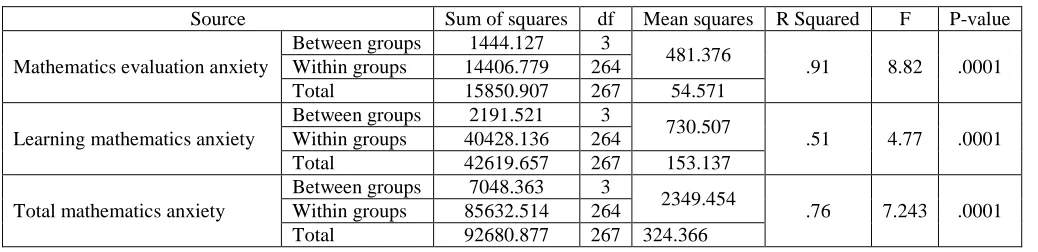
students with 10-12 and those with 15-20 mathematics grades. Students with 10-12 mathematics grades have more total mathematics anxiety than those with 15-20 mathematics grades. One-way ANOVA indicated a significant difference between students‟ learning mathematics anxiety (F(3,264) = 4.77, p <.05), and mathematics evaluation anxiety (F(3,264) = 8.82, p <.05), with respect to mathematics grades. Scheffe‟s post hoc analysis showed that the students with 10-12 mathematics grades had
[image:4.612.50.569.181.307.2]more learning mathematics anxiety than those with 15-20 mathematics grades and the those with 10-12 and 12-15 mathematics grades had more evaluation mathematics anxiety than students with 15-20 mathematics grades. Scheffe‟s post hoc analysis showed no significant differences between learning mathematics anxiety and evaluation mathematics anxiety of other students with respect to mathematics grades (Table 5).
Table 5. One-way ANOVA for comparing mathematics anxiety and mathematics performance
Source Sum of squares df Mean squares R Squared F P-value
Mathematics evaluation anxiety
Between groups 1444.127 3
481.376
.91 8.82 .0001 Within groups 14406.779 264
Total 15850.907 267 54.571
Learning mathematics anxiety
Between groups 2191.521 3
730.507
.51 4.77 .0001 Within groups 40428.136 264
Total 42619.657 267 153.137
Total mathematics anxiety
Between groups 7048.363 3
2349.454
.76 7.243 .0001 Within groups 85632.514 264
Total 92680.877 267 324.366
VII. Discussion AND conclusion
The aim of the present study was to investigate the relationship between mathematics anxiety and mathematics performance among undergraduate students. In addition, the study measured the mathematics anxiety scores and indicated the relationship between gender, fields of study and mathematics anxiety. According to the results, although the total mathematics anxiety and learning mathematics anxiety levels of all students was not higher than the mean, evaluation mathematics anxiety scores was more than the mean and the students had high evaluation mathematics anxiety. In fact we can conclude that the students had low mathematics anxiety in the classrooms when they were learning mathematics, but the examination situation could create high mathematics anxiety for them. The results showed that the differences were complex. It was probably because of the multivariate factor construction of mathematics anxiety. (Baloglu & Koçak, 2006; Kazelskis, 1998)
The results also indicated that the total mathematics anxiety scores and the evaluation mathematics anxiety scores showed a significant difference between females and males. The women scored higher than the men. However, no significant difference was observed between learning mathematics anxiety scores of females and males. Furthermore, the results of total mathematics anxiety supported previous studies which had concluded that there is a significant difference between females and males. (Baloglu & Koçak, 2006; Cook, 1998; D‟Ailly & Bergering, 1992; Flessati & Jamieson, 1991). It means that the mathematics testing situations caused more anxiety in females than males in Iran. Special programs seem to be necessary to reduce mathematics anxiety in women. Playing video games, has shown to be a good remedy (Feng, Spence, & Pratt, 2007).However, some other studies did not detect any gender differences (Coates, 1998; Cooper & Robinson, 1991). This demands further investigation to compare areas with high sex differences and
those without any sex differences in order to find part of the causes of anxiety, especially for women.
One of the purposes of this study was to make comparisons between fields of study and mathematics anxiety. There was no significant difference in mathematics anxiety of students of various fields of study. The results indicate that all two subscales as well as the total mathematics anxiety appear in the same way in all academic disciplines. This finding is notable, because it is obtained from a large number of the departments in the study. We may conclude that mathematics anxiety was not dependent on the variety of mathematics lessons: the mathematics anxiety of mathematics students was the same as those of social sciences students, but the mathematical lessons of mathematics students are different than the mathematical lessons of social sciences students.
One of the most important impacts of mathematics anxiety relates to performance, because there is a negative correlation between mathematics anxiety and mathematics achievement. (Ashcraft & Kirk, 2001; Cates & Rhymer, 2003; Ma & Xu, 2004; Miller & Bichsel, 2004). Our study showed a significant difference between mathematics anxiety and mathematics performance. The results also showed that the students with mathematics grades near the passing grade had more mathematics anxiety than others. Perhaps the optimistic belief in a successful outcome and more ability of answering mathematics questions necessitates less mathematics anxiety.
Finally, mathematics instructors should also pay closer attention to the fact that the requirements of the female and male learners may be different in the classroom. Further studies seem to be needed to compare mathematics anxiety in various fields of study. Other studies may focus on new evaluation methods to reduce the mathematics evaluation anxiety.
REFERENCES
ISSN 2250-3153
[2] Byrd, P. (1982). A descriptive study of mathematics anxiety: Its nature and antecedents. Unpublished doctoral dissertation, Indiana University.
[3] Atkinson, R. T. (1988). An exploration of the factors relating to the system of mathematics anxiety. Unpublished master‟s thesis, University of Oklahoma, Oklahoma, 18
[4] Sena, Whitaker., Lowe, Patricia., Lu, and Steven. (2007). Significant predictors of test anxiety among students with and without learning disabilities. Journal of Learning Disabilities, 40 (4), 360-376
[5] Cemen, P. B. (1987). The nature of mathematics anxiety. Stillwater: Oklahoma State University.
[6] Vinson, B. M. (2001). A Comparison of Pre-service Teachers‟ Mathematics Anxiety Before and After a Methods Class Emphasizing Manipulatives. Early Childhood Education Journal, 29 (2), 89-94.
[7] Siti, Hamad Mohamed., Rohani, Ahmad Tarmizi. (2010). Anxiety in Mathematics Learning Among Secondary School Learners: A Comparative Study between Tanzania and Malaysia. Procedia Social and Behavioral Sciences, 8,498–504.
[8] Anglin, L., Pirson, M., & Langer, E. (2008). Mindful learning: A moderator of gender differences in mathematics performance. Journal of Adult
Development, 15 (3), 132−139.
[9] Hall, C., Davis, N., Bolen, L., & Chia, R. (1999). Gender and racial differences in mathematical performance. Journal of Social Psychology, 139 (6), 677−689.
[10] Meelissen, M., & Luyten, H. (2008). The Dutch gender gap in mathematics: Small for achievement, substantial for beliefs and attitudes. Studies in
Educational Evaluation, 34 (2), 82−93.
[11] Penner, A. M., & Paret, M. (2008). Gender differences in mathematics achievement: Exploring the early grades and the extremes. Social Science Research, 37 (1), 239−253.
[12] Baloglu, M., & Koçak, R. (2006). A multivariate investigation of the differences in mathematics anxiety. Personality & Individual Differences, 40 (7), 1325−1335.
[13] Aiken Jr., L. R. (1970). Attitudes toward mathematics. Review of Educational Research, 40, 551–596.
[14] Aiken Jr., L. R. (1970). Attitudes toward mathematics. Review of Educational Research, 40, 551–596.
[15] Eccles, J. S., & Jacobs, J. E. (1986). Social forces shape math attitudes and performance. Journal of Women in Culture and Society, 11, 367–380. [16] Frenzel, A. C., Pekrun, R., & Goetz, T. (2007). Girls and mathematics - A "hopeless" issue? A control-value approach to gender differences in emotions towards mathematics. European Journal of Psychology of Education, 22 (4), 497−514.
[17] Ma, X. (1999). A meta-analysis of the relationship between anxiety toward mathematics and achievement in mathematics. Journal for Research in Mathematics Education, 30, 520–540.
[18] Ma, X., & Xu, J. (2004). The causal ordering of mathematics anxiety and mathematics achievement: A longitudinal panel analysis. Journal of Adolescence, 27 (2), 165−180.
[19] Tocci, C. M., & Engelhard Jr., G. (1991). Achievement, parental support, and gender differences in attitudes toward mathematics. Journal of Educational Research, 84, 280–286.
[20] Hembree, R. (1990). The nature, effects, and relief of mathematics anxiety. Journal for Research in Mathematics Education, 21, 33–46.
[21] Ma, X. (1999). A meta-analysis of the relationship between anxiety toward mathematics and achievement in mathematics. Journal for Research in Mathematics Education, 30, 520–540.
[22] Ashcraft, M. H. (2002). Math anxiety: Personal, educational, and cognitive consequences. Current Directions in Psychological Science, 11 (5), 181−185. [23] Ashcraft, M. H., & Kirk, E. P. (2001). The relationships among working memory, math anxiety, and performance. Journal of Experimental Psychology, 130 (2), 224−237.
[24] Bandalos, D. L., Yates, K., & Thorndike-Christ, T. (1995). Effect of math self-concept, perceived self-efficacy, and attributions for failure and success on test anxiety. Journal of Educational Psychology, 87 (4), 611−623.
[25] Cates, G. L., & Rhymer, K. N. (2003). Examining the relationship between mathematics anxiety and mathematics performance: An instructional hierarchy perspective. Journal of Behavioral Education, 12 (1), 23−34.
[26] Miller, H., & Bichsel, J. (2004). Anxiety, working memory, gender, and math performance. Personality and Individual Differences, 37, 591−606. [27] Cochran, W. G. (1977). Sampling techniques (3rd Ed.). New York: John Wiley & Sons.
[28] Plake, B.S., Parker, C.S. (1982 ). The development and validation of a revised version of the Mathematics Anxiety Rating Scale. Educational and Psychological Measurement, 42:551–557.
[29] Richardson, F.C., Woolfolk, R.L. ( 1980). Mathematics anxiety. In: Sarason I.G, editor. Test anxiety: Theory, research, and application. Hillsdale, NJ: Erlbaum
[30] Pajares, F., Urdan, T. (1996). Exploratory factor analysis of the Mathematics Anxiety Scale. Measurement and Evaluation in Counseling and Development, 29:35–47.
[31] Plake, B.S., Parker, C.S. (1982 ). The development and validation of a revised version of the Mathematics Anxiety Rating Scale. Educational and Psychological Measurement, 42:551–557.
[32] Hopko D.R, Mahadevan R, Bare R.L, Hunt M.K. ( 2003). The Abbreviated Math Anxiety Scale (AMAS): construction, validity, and reliability. Assessment, 10:178–182.
[33] Vahedi, Shahram., Farrokh, Farahmani. (2011), A Confirmatory Factor Analysis of the Structure of Abbreviated Math Anxiety Scale, Iran Journal of Psychiatry, 6 (2), 47–53.
[34] Wes .(2012). World Education Services. Retrieved 2012-02-28. From http://www.Wes.org.
[35] Baloglu, M., & Koçak, R. (2006). A multivariate investigation of the differences in mathematics anxiety. Personality & Individual Differences, 40 (7), 1325−1335.
[36] Kazelskis, R. (1998). Some dimensions of mathematics anxiety: A factor analysis across instruments. Educational and Psychological Measurement, 58, 623–633.
[37] Baloglu, M., & Koçak, R. (2006). A multivariate investigation of the differences in mathematics anxiety. Personality & Individual Differences, 40 (7), 1325−1335.
[38] Cook, R. P. (1998). An exploration of the relationship between mathematics anxiety level and perceptual learning style of adult learners in a community college setting. Doctoral dissertation, Florida Atlantic University. Dissertation Abstracts International, 58, 3801.
[39] D‟Ailly, H., & Bergering, A. J. (1992). Mathematics anxiety and mathematics avoidance behavior: A validation study of two MARS factor-derived scales. Educational and Psychological Measurement, 52, 369–377. [40] Flessati, S. L., & Jamieson, J. (1991). Gender differences in mathematics anxiety: An artifact of response bias?. Anxiety Research, 3, 303–312.
[41] Feng, J., Spence, I., & Pratt, J. (2007). Playing an action video game reduces gender differences in spatial cognition. Psychological Science, 18, 850–855. [42] Coates, J. D. (1998). Mathematics anxiety and its relationship to students‟ perceived teacher and parent attitudes toward mathematics. Doctoral dissertation, Ohio University, 1998. Dissertation Abstracts International, 58, 4590.
[43] Cooper, S., & Robinson, D. (1991). The relationship of mathematics self-efficacy beliefs to mathematics anxiety and performance. Measurement and Evaluation in Counseling, 24, 5–11.
[44] Ashcraft, M. H., & Kirk, E. P. (2001). The relationships among working memory, math anxiety, and performance. Journal of Experimental Psychology, 130 (2), 224−237.
[45] Cates, G. L., & Rhymer, K. N. (2003). Examining the relationship between mathematics anxiety and mathematics performance: An instructional hierarchy perspective. Journal of Behavioral Education, 12 (1), 23−34.
[46] Ma, X., & Xu, J. (2004). The causal ordering of mathematics anxiety and mathematics achievement: A longitudinal panel analysis. Journal of Adolescence, 27 (2), 165−180.
[47] Miller, H., & Bichsel, J. (2004). Anxiety, working memory, gender, and math performance. Personality and Individual Differences, 37, 591−606.
AUTHORS
First Author – Alireza Pourmoslemi, Mathematics Assistant Professor, Department of mathematics Payame Noor University, Bahar, Iran, [email protected]
Second Author– Nasrolah Erfani, Psychology Assistant Professor, Department of psychology Payamr Noor university, Hamedan, Iran, [email protected]
Third Author– Iraj Firoozfar, Education M.A, Department of Education Payame Noor University,Hamedan Iran,