P R O T O C O L
Open Access
Findings, phenotypes, and outcomes in
Freeman-Sheldon and Sheldon-Hall
syndromes and distal arthrogryposis types
1 and 3: protocol for systematic review and
patient-level data meta-analysis
Mikaela I. Poling
*, José Andrés Morales Corado and Robert L. Chamberlain
Abstract
Background:Freeman-Sheldon and Sheldon-Hall syndromes (FSS and SHS) and distal arthrogryposis types 1 and 3 (DA1 and DA3) are rare, often confused, congenital syndromes. Few studies exist. With reported diagnosis
unreliable, it would be scientifically inappropriate to consider articles describing FSS, SHS, DA1, or DA3, unless diagnoses were independently verified, rendering conventional systematic review and meta-analysis methodology inappropriate and necessitating patient-level data analysis (PROSPERO: CRD42015024740).
Methods/design:As part of a clinical practise guideline development process, we evaluate (1) diagnostic accuracy from 1938–2017, using the Stevenson criteria; (2) the most common physical findings, possible frequency clusters, and complications of physical findings amongst patients with FSS; and (3) treatment types and outcomes. All papers reporting diagnosis of FSS, SHS, DA1, and DA3 are included in searching PubMed and Google Scholar from December 2014 to July 2015 and again before final analyses. Patients with FSS are divided into four phenotype-defined sub-types; all patients are grouped by published diagnosis and medical speciality. Significance of physical findings and historical data is evaluated by chi-square. Associations of physical findings and history with diagnosis and treatment outcome are evaluated by Pearson correlation and linear regression analysis. Two-tailed alpha level of 0.05 is used throughout.
Discussion:The need for detailed patient-level data extraction may limit the types of articles included and questions able to be answered. For treatment and psychosocial health outcomes, we anticipate enhanced difficulties, which may limit significance, power, and results’usability. We hope to outline knowledge gaps and prioritise areas for clinical investigation.
Systematic review registration number:CRD42015024740 Universal Trial Number: U1111-1172-4670
Keywords:Freeman-Sheldon syndrome, Craniocarpotarsal dystrophy, Whistling face syndrome, Sheldon-Hall syndrome, Distal arthrogryposis type 1, Distal arthrogryposis type 3, Systematic review, Meta-analysis, Data analysis, Review of reported cases
* Correspondence:[email protected]
Guideline Task Force, Department of Applied Physiology, FSRG deGruyter-McKusick Institute of Health Sciences, 6670 Old Elkins Road, Buckhannon, WV 26201, USA
Introduction
First described by Freeman and Sheldon [1], Freeman-Sheldon and Freeman-Sheldon-Hall syndromes (FSS and SHS) are highly variable, rare, phenotypically similar but genotypi-cally distinct, and often confused congenital myopathies, despite previous attempts to simplify diagnosis [2]. While Antley et al. (1970) completed a systematic review and statistical analysis of patient-level clinical informa-tion from published reports, allelic variainforma-tion data were not available, and few cases were available for analysis [2]. Stevenson et al. (2006) executed a cohort study of geneticist-referred patients with classic FSS and SHS [3], which limited their cohort, but they were able to define meaningful and strict clinical diagnostic criteria for FSS and SHS. For FSS, they required the following: microsto-mia, whistling-face appearance (pursed lips), H or V-shaped chin dimpling, prominent nasolabial folds, and major contractures in two or more body regions [3]. For SHS, they required the following: small mouth (not microstomia), prominent nasolabial folds, small but prominent chin, neck webbing, and major contractures in two or more body regions [3].
In FSS, spinal deformities, metabolic and gastroentero-logical problems, other dysmorphic craniofacial charac-teristics, and visual and auditory impairments are frequent findings [2, 3]. Some individuals present with minimal malformation; rarely, patients die during fancy as a result of severe central nervous system in-volvement or respiratory complications. While patients with classic FSS have normal intelligence, a genotypically distinct lethal variant characterised by profound and progressive neurological motor and cognitive impair-ment exists [4]. For FSS and SHS, the most familial cases are by autosomal dominant inheritance, but expression is often from new allelic variation [3]. Frequency of it is unknown, mostly due to diagnostic uncertainty; there appears to be neither sex nor ethnic preference. Environ-mental and parental factors are not implicated in pathogenesis.
No systematic review has been completed since the genotype-verified clinical diagnostic criteria [5, 6] were published. Unfortunately, few studies involving either or both FSS and SHS exist, and with reported diagnosis unreliable, it would be scientifically inappropriate to consider articles describing FSS or SHS, unless diagnoses were independently verified. Thus, a conventional sys-tematic review and meta-analysis methodology was in-appropriate in this instance, and rigorous patient-level clinical information extraction and aggregation was required.
The systematic review and patient-level data meta-analysis objectives are as follows: to (1) determine diag-nostic accuracy from 1938–2017, using the Stevenson criteria [3]; (2) define the most common physical
findings, possible frequency clusters and complications of physical findings amongst patients with FSS; and (3) document treatment types and outcomes. Additionally, a myriad of phenotypes are described as FSS—further complicating literature searches and clinical practise guideline development. To evaluate possible differences with patients meeting and those not meeting the full Stevenson criteria [3], we group phenotypes fulfilling the craniofacial part of the Stevenson criteria [3] according to presence or absence of limb malformations. While the focus is on FSS and SHS, patients rediagnosed by review authors with the phenotypically similar conditions distal arthrogryposis types 1A, 1B, and 3 (DA1A, DA1B, and DA3) are included. In this review, no distinction is made between DA1A and DA1B, which are simply termed DA1. DA1 shares the limb malformations of FSS and SHS but lacks craniofacial features; DA3 or Gorden syndrome is associated with cleft palate, as well as simi-lar limb and skeletal malformations as FSS, SHS, and DA1.
Methods and design
Undertaken as part of the unfunded Freeman-Sheldon syndrome clinical practise guideline development process sponsored by Freeman-Sheldon Research Group, Inc., this systematic review and meta-analysis received institutional review board (IRB) approval from FSRG IRB #1 and was registered with the World Health Orgi-nisation (U1111-1172-4670) and on PROSPERO (CRD42015024740) (Additional file 1: PROSPERO Rec-ord Public View), where subsequent amendments are made available. The protocol, including development of actionable clinical questions (Table 1), was prospectively drafted in compliance with Preferred Reporting Items for Systematic Reviews and Meta-Analyses Protocols [7] (Additional file 2: PRISMA-P 2015 Checklist), and all data are reviewed for integrity and consistency by the IRB’s biostatistician. Unless otherwise stated, all actions undertaken are executed by the review authors.
Literature search
2B, distal arthrogryposis multiplex congenita, Freeman-Sheldon syndrome, Freeman-Sheldon, Sheldon-Hall syndrome, whistling face syndrome, craniocarpotarsal dystrophy, craniocarpotarsal dysplasia, cranio-carpo-tarsal dystrophy, cranio-carpo-tarsal dysplasia and cranio-facio-corporal syndrome. Searches are re-run before final analyses, and articles published since the ini-tial search are retrieved for inclusion.
Eligibility criteria
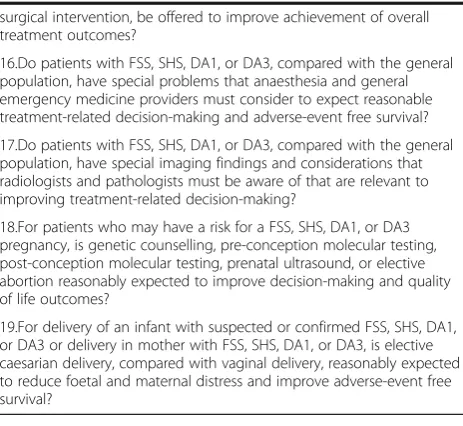
Because of the need for detailed patient-level clinical information to meet objectives, articles meeting inclu-sion criteria included are expected to be limited to observational case reports, negating the utility of evidence grading matrices such as Grading of Recom-mendations Assessment, Development and Evaluation [8]. No published article is excluded based on design alone, however. Treatment comparison is expected to be limited, as many articles describe neither interventions nor outcomes; those that do cannot be confidently Table 1Actionable guiding clinical questions
1.For patients with suspected or confirmed FSS, SHS, DA1, or DA3, is a craniofacial team, compared with individual speciality referrals, reasonably expected to improve clinical care and to improve achievement of overall treatment outcomes?
2.For patients with suspected FSS, do plastic surgeons, paediatricians, clinical geneticists, orthopaedic surgeons, anaesthesiologists, or dental surgeons have the highest diagnostic accuracy for FSS and should therefore be the first referral option for providers suspecting a diagnosis of FSS, according to the Stevenson criteria?
3.For patients with suspected FSS, SHS, DA1, and DA3, are there non-overlapping definable feature (physical findings or historical data) frequency clusters or individual features that are predictive of diagnosis and that providers must be aware of to improve treatment-related decision-making?
4.For patients with suspected or confirmed FSS, SHS, DA1, or DA3, are there definable feature (physical findings or historical data) frequency clusters or individual features that are predictive of treatment outcome and that providers must be aware of to improve treatment-related decision-making?
5.For patients with FSS, SHS, DA1, or DA3, is aggressive non-operative therapy (e.g., braces, splints, passive manipulation), compared with surgical correction, reasonably expected to improve achievement of overall treatment outcomes?
6.For patients with suspected or confirmed FSS, SHS, DA1, or DA3, is neurological consultation, compared with general evaluation, reasonably expected to improve treatment-related decision-making (i.e., distinguishing myopathic processes from primary neurological processes) and outcomes (i.e., monitoring patients with craniosynostosis).
7.For patients and families affected by FSS, SHS, DA1, or DA3, is early psychiatric consultation, compared with only a general explanation of anticipated clinical course and treatment plans, appropriate to assist in reducing psychosocial sequelae relevant to diagnosis burden?
8.For preschool and school-age patients with FSS, SHS, DA1, or DA3, is intelligence testing, compared with subjective parent and teacher observation, appropriate to assist in improving access to appropriate academic services?
9.For patients with FSS, SHS, DA1, or DA3, is ophthalmological consultation, compared with general evaluation, appropriate to assist in improving reconstructive surgery-related decision-making and to im-prove achievement of overall treatment outcomes?
10.For patients with FSS, SHS, DA1, or DA3, is otorhinolaryngology consultation, compared with general evaluation, appropriate to assist in improving reconstructive surgery and dysphagia-related decision-making and to improve achievement of overall treatment outcomes?
11.For patients with FSS, SHS, DA1, or DA3, is paediatric dentistry and oral-maxillofacial surgery referral, compared with general dentistry, required to expect reasonable treatment-related decision-making and reduce dental-related health burdens?
12.For patients with FSS, SHS, DA1, or DA3, is physiatry referral, compared with orthopaedic surgery evaluation, required to reduce morbidity from extremity and spinal deformities and other functional burdens and to improve achievement of overall treatment outcomes?
13.For patients with FSS, SHS, DA1, or DA3, is dietectics consultation, compared with general evaluation, appropriate to ensure adequate nutritional intake?
14.For patients with FSS, SHS, DA1, or DA3, are cardiology and pulmonology consultations, compared with general evaluation, appropriate to reduce consequences of recurrent lower respiratory infections and potential right heart strain?
15.For patients with FSS, SHS, DA1, and DA3 who have well vascularised equinovarus resistant to non-operative treatment, should referral for fabrication of prosthetic limb without amputation, compared with
Table 1Actionable guiding clinical questions(Continued)
surgical intervention, be offered to improve achievement of overall treatment outcomes?
16.Do patients with FSS, SHS, DA1, or DA3, compared with the general population, have special problems that anaesthesia and general emergency medicine providers must consider to expect reasonable treatment-related decision-making and adverse-event free survival?
17.Do patients with FSS, SHS, DA1, or DA3, compared with the general population, have special imaging findings and considerations that radiologists and pathologists must be aware of that are relevant to improving treatment-related decision-making?
18.For patients who may have a risk for a FSS, SHS, DA1, or DA3 pregnancy, is genetic counselling, pre-conception molecular testing, post-conception molecular testing, prenatal ultrasound, or elective abortion reasonably expected to improve decision-making and quality of life outcomes?
19.For delivery of an infant with suspected or confirmed FSS, SHS, DA1, or DA3 or delivery in mother with FSS, SHS, DA1, or DA3, is elective caesarian delivery, compared with vaginal delivery, reasonably expected to reduce foetal and maternal distress and improve adverse-event free survival?
Table 2Search strategy for PubMed database
((((((((“Freeman-Sheldon syndrome”[Supplementary Concept] OR “Freeman-Sheldon syndrome”[All Fields] OR“freeman sheldon
compared, due to high inter-patient and inter-intervention variability. It is not certain that many of the guiding questions will be able to be answered, and the objectives more clearly reflect expectations for what data will be available. There are no restrictions on patient gender, ethnicity, geographical location, religion, socio-economic status, or clinical setting. Most non-English language articles are reviewed by native speakers (Span-ish) or translated (Russian, Czech, German) in-house. Asian language articles are unable to be reviewed or translated in-house and are excluded.
Data extraction
As searches are carried out, citations of unique results are placed in spreadsheets using the current iteration of Google Sheets (Mountain View, CA) for initial inde-pendent screening by two review authors to identify those potentially meeting the inclusion criteria. After ini-tial screening, articles retrieved are independently assessed by two review authors for eligibility before in-clusion. Discrepancies and disagreements are resolved through discussion, with a third reviewer, or with the ethics director or his designee. Authors of articles being considered are not contacted with data queries. Only published reports of patients, living or deceased, of any age with a stated diagnosis of FSS, SHS, DA1, or DA3 are considered for initial inclusion. Published reports of patients without a stated diagnosis of FSS, SHS, DA1, or DA3 are not considered. Because of previously published reports of diagnostic unreliability for FSS, SHS, DA1, or DA3, only articles with sufficient patient-level clinical in-formation for diagnosis verification are included in the full analysis. Physical findings not evident in the article text are recorded as present, if they are visible in accom-panying figures; similarly, if it is clear that a certain physical feature was absent in accompanying figures, it is recorded as not present. Physical findings or historical data present in fewer than five cases are not recorded, and some physical findings or historical data items rela-tively similar to each other and affecting fewer than five individuals are combined into a single variable. Physical findings or historical data not present or missing for a given variable in a particular patient are both coded as missing. Physical findings are evaluated and described following the Elements of Morphology: Human Malfor-mation Terminology [9–15].
Patient-level clinical information from included studies is extrapolated, based on the standardised Survey of Treatment Outcomes and Practices–Freeman-Sheldon syndrome (STOP-FSS) questionnaire, and entered on a spreadsheet (Google Sheets, Mountain View, CA) for quality assessment and data synthesis. One review author extracts data for each half of the final total of in-cluded articles, with another review author verifying data
the other review author had entered and coded. The view authors then discuss any differences in their re-spective appraisals, with discrepancies discussed with a third review author or with the ethics director or his designee.
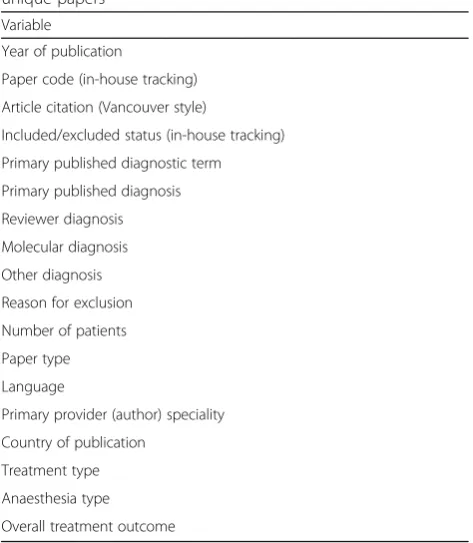
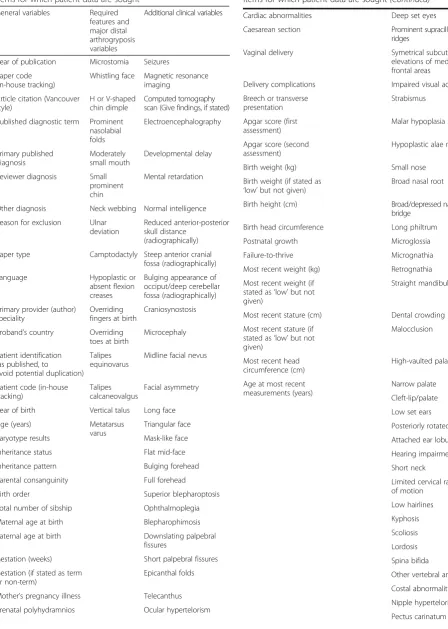
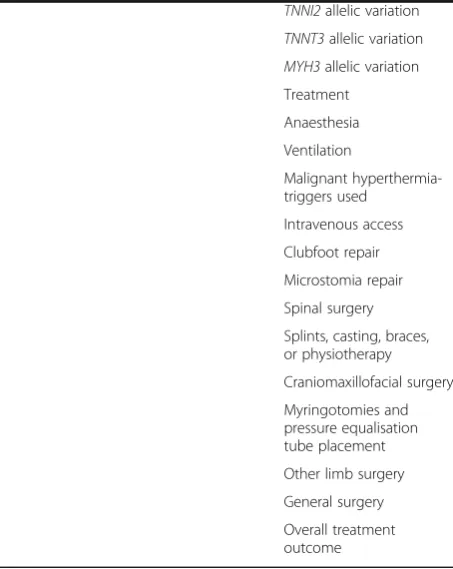
General types of patient-level clinical information sought (Tables 3 and 4) include published diagnosis, medical speciality of main author, patient congruence with Stevenson criteria [3], demographics, pregnancy complications, birth data, syndromic or potentially syn-dromic physical findings and their complications, treat-ment types, anaesthesia types, and overall treattreat-ment outcome. Treatments for which data are sought include treatments for any condition or feature actually or po-tentially complicated by or associated with (primarily or secondarily) FSS, SHS, DA1, or DA3. Such interventions include surgery, physical therapy, and any other orga-nised action to improve health or well-being. Overall treatment outcome is a subjective clinical interpretation by the review authors based on clinical data or opinions presented in the manuscript; patient perception of out-come, if presented in the manuscript, is not considered by the review authors.
Risk of Bias (Quality) Assessment
Because of the limitations of case reports, biased risk is not able to be formally assessed, particularly since the quality of case reports and patient data contained
Table 3Variables collected on unique papers. Table lists publication-related and review outcome variables tracked for unique papers
Variable
Year of publication
Paper code (in-house tracking)
Article citation (Vancouver style)
Included/excluded status (in-house tracking)
Primary published diagnostic term
Primary published diagnosis
Reviewer diagnosis
Molecular diagnosis
Other diagnosis
Reason for exclusion
Number of patients
Paper type
Language
Primary provider (author) speciality
Country of publication
Treatment type
Anaesthesia type
Table 4Variables collected for individual patients. Table lists all items for which patient data are sought
General variables Required features and major distal arthrogryposis variables
Additional clinical variables
Year of publication Microstomia Seizures
Paper code (in-house tracking)
Whistling face Magnetic resonance imaging
Article citation (Vancouver style)
H or V-shaped chin dimple
Computed tomography scan (Give findings, if stated)
Published diagnostic term Prominent nasolabial folds
Electroencephalography
Primary published diagnosis
Moderately small mouth
Developmental delay
Reviewer diagnosis Small prominent chin
Mental retardation
Other diagnosis Neck webbing Normal intelligence
Reason for exclusion Ulnar deviation
Reduced anterior-posterior skull distance
(radiographically)
Paper type Camptodactyly Steep anterior cranial fossa (radiographically)
Language Hypoplastic or
absent flexion creases
Bulging appearance of occiput/deep cerebellar fossa (radiographically)
Primary provider (author) speciality
Overriding fingers at birth
Craniosynostosis
Proband’s country Overriding toes at birth
Microcephaly
Patient identification (as published, to
avoid potential duplication) Talipes equinovarus
Midline facial nevus
Patient code (in-house tracking)
Talipes calcaneovalgus
Facial asymmetry
Year of birth Vertical talus Long face
Age (years) Metatarsus
varus
Triangular face
Karyotype results Mask-like face
Inheritance status Flat mid-face
Inheritance pattern Bulging forehead
Parental consanguinity Full forehead
Birth order Superior blepharoptosis
Total number of sibship Ophthalmoplegia
Maternal age at birth Blepharophimosis
Paternal age at birth Downslating palpebral fissures
Gestation (weeks) Short palpebral fissures
Gestation (if stated as term or non-term)
Epicanthal folds
Mother’s pregnancy illness Telecanthus
Prenatal polyhydramnios Ocular hypertelorism
Table 4Variables collected for individual patients. Table lists all
items for which patient data are sought(Continued)
Cardiac abnormalities Deep set eyes
Caesarean section Prominent supracilliary ridges
Vaginal delivery Symetrical subcutaneous
elevations of medial frontal areas
Delivery complications Impaired visual acuity
Breech or transverse presentation
Strabismus
Apgar score (first assessment)
Malar hypoplasia
Apgar score (second assessment)
Hypoplastic alae nasi
Birth weight (kg) Small nose
Birth weight (if stated as ‘low’but not given)
Broad nasal root
Birth height (cm) Broad/depressed nasal
bridge
Birth head circumference Long philtrum
Postnatal growth Microglossia
Failure-to-thrive Micrognathia
Most recent weight (kg) Retrognathia
Most recent weight (if stated as‘low’but not given)
Straight mandibular rami
Most recent stature (cm) Dental crowding
Most recent stature (if stated as‘low’but not given)
Malocclusion
Most recent head circumference (cm)
High-vaulted palate
Age at most recent measurements (years)
Narrow palate
Cleft-lip/palate
Low set ears
Posteriorly rotated pinnae
Attached ear lobules
Hearing impairment
Short neck
Limited cervical range of motion
Low hairlines
Kyphosis
Scoliosis
Lordosis
Spina bifida
Other vertebral anomalies
Costal abnormalities
Nipple hypertelorism
therein vary widely. As inter-case variability is signifi-cant, case report quality assessment is mostly a clinical decision by one review author and reviewed by a second, based on reviewer knowledge of the syndromes, relative agreement with consensus-based clinical case reporting guideline enough to establish an accurate clinical picture [16], and general clinical experience. In determining spe-ciality of the main author, ambiguity can result, as not all journals report the same type of author information, and certain other judgements, such as overall treatment outcome, are subjective and prone to bias of the original and review authors. Concerns are discussed with a third review author or with the ethics director or his designee.
Strategy for data synthesis
Most data extracted and generated for this review are nominal, representing binary coding of clinical findings and history to indicate the presence, absence, or non-reporting of each variable sought. Because of high vari-ability of physical features and historical data reported, the small volume of published reports, and anticipated poor diagnostic accuracy in published articles, classic meta-analysis is not possible. Patient-level data are ag-gregated into a single sample.
Statistical significance for all tests is calculated based on a two-tailed alpha level of 0.05. Chi-squared analysis
Table 4Variables collected for individual patients. Table lists all
items for which patient data are sought(Continued)
Pectus excvatum
Hip dislocation/dysplasia
Hip contracture
Leg length/width discrepancy
Limited knee motion/disloocation
Patellar anomalies
Equinovagus (talipes valgus)
Contracted toes
Hallux valgus or metatarsus primus Adductus or hallux varus
Limited shoulder motion/dislocation
Limited elbow motion/dislocation
Limited wrist motion
Cortical thumbs
Thickened skin on fingers’flexor surface
Brachidactyly
Syndactyly
Cutaneous syndactyly
Clinodactyly
Single palmar crease
Dysphasia
Dysphagia
Gastrointestinal symptoms
Hernia
Genitourinary anomalies
Electromyogram
Skeletal muscle weakness
Muscle hypotrophy
Hypotonia
Hypertonia
Upper airway obstruction
Ear infection and chronic fluid
Respiratory illness
Lung disease
Respiratory distress
Apnoea
Early death (state cause)
MYBPC1allelic variation
TPM2allelic variation
Table 4Variables collected for individual patients. Table lists all
items for which patient data are sought(Continued)
TNNI2allelic variation
TNNT3allelic variation
MYH3allelic variation Treatment
Anaesthesia
Ventilation
Malignant hyperthermia-triggers used
Intravenous access
Clubfoot repair
Microstomia repair
Spinal surgery
Splints, casting, braces, or physiotherapy
Craniomaxillofacial surgery
Myringotomies and pressure equalisation tube placement
Other limb surgery
General surgery
is used for nominal data, such as physical features or specific aspects of the history. For higher order data, such as measurements and ages, an independent groupt test or one-way or multiple-way between subject analysis of variance tests is conducted. For each significant p value, eta-squared or r-squared is calculated to deter-mine effect size, as appropriate. Pearson correlation, Tukey HSD, and linear regression analysis are also calcu-lated and plotted, as appropriate, to evaluate possible as-sociations between physical findings, specific aspects of the history, treatment type, anaesthesia type, reported and review author diagnosis, and overall treatment out-come. No weighting of variables or models to account for heterogenity are used. Subgroups are each analysed individually in different data files. Data are analysed using the current iterations of PSPP (The Free Software Foundation, Boston, MA) and R: A Language and Envir-onment for Statistical Computing (R Foundation for Statistical Computing, Vienna, Austria) with R Com-mander [17]. No special or additional commands are used.
Analysis of subgroups or subsets
Data are analysed by the following diagnosis-related sub-groups for both individual cases and papers: published diagnosis, reviewer diagnosis of SHS, reviewer diagnosis of FSS with only craniofacial features, reviewer diagnosis of FSS with craniofacial and upper or lower limb malfor-mations, reviewer diagnosis of FSS with craniofacial and neurological features, and reviewer diagnosis of FSS meeting the full Stevenson criteria [3]. Additionally, the following additional groups are analysed: treatment type, anaesthesia type, treatment outcome, all included cases, all reviewer-diagnosed FSS cases, all retrieved papers, and all included papers fully analysed. Data are also ana-lysed by published diagnosis grouped by major speciality (i.e. paediatrics, medical genetics, plastic surgery, ortho-paedics, and anaesthetics) of the main author. Article focus, journal focus and audience, author affiliation, and Google searches of main authors are used by the review authors to make judgements about speciality. This sys-tematic review is undertaken concurrently with an on-going retrospective cohort study using similar data syn-thesis procedures (NCT01144741).
Discussion
We expect the need for high quality, detailed patient-level clinical information will limit the effectiveness of this project in assessing the review objectives with any level of reasonable confidence, but we feel this is an ac-ceptable beginning point. Most articles are expected to demonstrate considerable variability in quality of case reports generally, clarity of writing, presence and clarity of accompanying pictorial evidence, details of treatment
and outcomes, psychosocial health descriptions, variabil-ity of descriptive terminology, and attention to clinical detail and accuracy. All present considerable obstacles, complicating data extraction, coding, and analysis efforts and severely limited significance, power, and utility of the project’s results. The span of years and countries in-cluded in the search present additional difficulties of his-torical context. For example, articles from pre-DNA in the 1930s in England, pre-human genome in the 1980s in Germany, and post-human genome in the 2010s in USA all present patients from differing perspectives and emphasise different aspects of the history, findings, and therapy. Cultural bias, focus of clinical attention, and language each modify text and presentation of articles as well.
We hope this project will begin to enable a more clear outline of knowledge gaps and help prioritise areas for clinical investigation. We feel our methodology may be applicable and helpful for others investigating a condi-tion or phenomena with similar difficulties present in the existing literature that precludes conventional meta-analysis.
Additional files
Additional file 1:PROSPERO Record Public View. (PDF 130 kb)
Additional file 2:PRISMA-P 2015 Checklist. (PDF 154 kb)
Abbreviations
DA1:Distal arthrogryposis type 1; DA3: Distal arthrogryposis type 3; FSS: Freeman-Sheldon syndrome; IRB: Institutional review board; SHS: Sheldon-Hall syndrome
Acknowledgements
The authors wish to thank CM Poling for the critical review of the manuscript. The authors undertook the project to aid in developing clinical practise guidelines, as part of the academic requirements for MIP and JAMC in their advanced study in clinical and applied physiology.
Funding
No funding was received.
Availability of data and materials
Upon project completion, results will be published in an appropriate journal. Raw datasets will be made available upon request for researchers wishing to explore them.
Authors’contributions
MIP drafted the manuscript and is the guarantor; otherwise, MIP, JAMC, and RLC contributed equally and read and approved the final manuscript.
Competing interests
The authors declare that they have no competing interests.
Consent for publication
FSRG IRB #1 has reviewed this document and approved the submission and publication.
Ethics approval
board approval from FSRG IRB #1. All data are reviewed for integrity and consistency by the IRB’s biostatistician.
Received: 11 October 2016 Accepted: 24 February 2017
References
1. Freeman EA, Sheldon JH. Two cases of cranio-carpo-tarsal dystrophy of undescribed type? Proc Roy Soc Med. 1938;31:1116–9.
2. Antley RM, Uga N, Burzynski NJ, Baum RS, Bixler D. Diagnostic criteria for the whistling face syndrome. Birth Defects Orig Artic Ser. 1975;11(5):161–8. 3. Stevenson DA, Carey JC, Palumbos J, Rutherford A, Dolcourt J, Bamshad MJ.
Clinical characteristics and natural history of Freeman-Sheldon syndrome. Pediatr. 2006;117(3):754–62.
4. Chong JX, McMillin MJ, Shively KM, Beck AE, Marvin CT, Armenteros JR, Buckingham KJ, Nkinsi NT, Boyle EA, Berry MN, et al. De novo mutations in NALCN cause a syndrome characterized by congenital contractures of the limbs and face, hypotonia, and developmental delay. Am J Hum Genet. 2015;96(3):462–73.
5. Toydemir RM, Rutherford A, Whitby FG, Jorde LB, Carey JC, Bamshad MJ. Mutations in embryonic myosin heavy chain (MYH3) cause Freeman-Sheldon syndrome and Freeman-Sheldon-Hall syndrome. Nat Genet. 2006;38(5):561–5.
6. Beck AE, McMillin MJ, Gildersleeve HI, Shively KM, Tang A, Bamshad MJ. Genotype-phenotype relationships in Freeman-Sheldon syndrome. Am J Med Genet A. 2014;164(11):2808–13.
7. Shamseer L, Moher D, Clarke M, Ghersi D, Liberati A, Petticrew M, Shekelle P, Stewart LA, PRISMA-P Group. Preferred reporting items for systematic review and meta-analysis protocols (PRISMA-P) 2015: elaboration and explanation. BMJ. 2015;349:g7647.
8. Guyatt GH, Oxman AD, Vist GE, Kunz R, Falck-Ytter Y, Alonso-Coello P, Schünemann HJ, GRADE Working Group. GRADE: an emerging consensus on rating quality of evidence and strength of recommendations. BMJ. 2008; 336(7650):924–6.
9. Allanson JE, Biesecker LG, Carey JC, Hennekam RC. Elements of morphology: introduction. Am J Med Genet Part A. 2009;149A:2–5.
10. Allanson JE, Cunniff C, Hoyme HE, McGaughran J, Muenke M, Neri G. Elements of morphology: standard terminology for the head and face. Am J Med Genet Part A. 2009;149A:6–28.
11. Biesecker LG, Aase JM, Clericuzio C, Gurrieri F, Temple K, Toriello H. Elements of morphology: standard terminology for the hands and feet. Am J Med Genet Part A. 2009;149A:93–127.
12. Carey JC, Cohen MM, Curry C, Devriendt K, Holmes L, Verloes A. Elements of morphology: standard terminology for the lips, mouth, and oral region. Am J Med Genet Part A. 2009;149A:77–92.
13. Hall BD, Graham JM, Cassidy SB, Opitz JM. Elements of morphology: standard terminology for the periorbital region. Am J Med Genet Part A. 2009;149A:29–39.
14. Hennekam RC, Cormier-Daire V, Hall J, Méhes K, Patton M, Stevenson R. Elements of morphology: standard terminology for the nose and philtrum. Am J Med Genet Part A. 2009;149A:61–76.
15. Hunter AGW, Frias F, Gillessen-Kaesbach G, Hughes HE, Jones KL, Wilson L. Elements of morphology: standard terminology for the ear. Am J Med Genet Part A. 2009;149A:40–60.
16. Gagnier JJ, Kienle G, Altman DG, Moher D, Sox H, Riley D, CARE Group. The CARE guidelines: consensus-based clinical case reporting guideline development. BMJ Case Rep. 2013. doi: 10.1136/bcr-2013-201554. 17. Fox J, The R. Commander: a basic statistics graphical user interface to R. J
Stat Softw. 2005;14(9):1–42.
• We accept pre-submission inquiries
• Our selector tool helps you to find the most relevant journal • We provide round the clock customer support
• Convenient online submission • Thorough peer review
• Inclusion in PubMed and all major indexing services • Maximum visibility for your research
Submit your manuscript at www.biomedcentral.com/submit