ISSN 2250-3153
Regeneration potential and distribution pattern of tree
species along altitudinal gradient in Central Himalaya
J P Mehta*, Shreshthamani * and V P Bhatt **
*
Department of Botany, HNB Garhwal University Srinagar Garhwal, India
**
Department of Botany, Govt P G College Gopeshwar, Chamoli, India
Abstract- The present paper reports the regeneration potential
and distribution pattern of natural forest in Taknaur Reserve Forest of Uttarkashi forest division of Garhwal Himalaya, Uttarakhand. A total of 29 tree species were recorded from the area. Density and distribution of seedlings, saplings and trees were assessed along the gradient of altitude using the quadrat size 1x1m (for seedlings) 5x5m (for saplings) and 10x10m (for trees). The numbers of individuals, frequency were recorded and height of the species in the quadrat at 100m drops in altitude. Seedling densities varied markedly among the species and altitude. Lower elevation was dominated with Pinus roxburghii and Quercus leucotrichophora was found co-dominant species whereas, Buxus wallichiana and Quercus floribunda was dominant and Taxus baccata was co-dominant species in site two (1900-2500m asl). While upper elevations were dominated by Buxus wallichiana, Quercus floribunda and Abies pindrow, Cedrus deodara, respectively, for site 3rd and 4th . However, the highest (10000 ha-1) seedling density , was reported for Pinus roxburghii at site 1 followed by Cedrus deodara (9000 individuals ha-1 ) at site 2, Buxus wallichiana, Taxus buccata, Quercus floribunda Abies pindrow and Cedrus deodara (4000 individual ha-1 of each species) at site 3 and 4, respectively. It is remarkable that economically and ecologically valued species Acer accuminatum, Ulmus wallichiana, Betula utilis Acer oblongum which are already in vulnerable in their status were found absent in seedling stage. These species were also reported as regularly distributed in tree and sapling stratum, which is very alarming for the conservation point of view. In tree layer the most of the species (65.16%) were distributed contagiously and remaing (34.84%) were distributed randomly.
Index Terms- Himalaya, Taknaur forest, regeneration potential,
Acer accuminatum, Acer oblongum, Ulmus wallichiana, Taxus buccata.
I. INTRODUCTION
egeneration is the key feature of the forest dynamics, progress and restoration of degraded forest lands. It depends on number of seedlings, saplings and their distribution pattern in the region. If seedlings and saplings are less than the mature trees, it indicates declining trends in forest and regeneration will be poor. Forest reveals variation in pattern of regeneration both through differences in their constituent species and the environmental variables in which they grow (Demel, 1997a; Denslow, 1987; Whitmore, 1996). Regeneration of any species is confined to a peculiar range of habitat conditions and the
extent of those conditions is a major determinant of its geographic distribution (Grubb 1977). Trees regenerate one or more pathways: seed rain (recently dispersed seeds), the soil seed bank (dormant seeds in the soil), and the seedling bank (established, suppressed seedlings in the understory) and coppice (root/shoot sprouts of damaged individuals (Demel, 1997b; Demel and Granstrom, 1995; Garwood, 1989; Getachew et al. 2002; Whitemore 1996). Sustainable forest utilization is only possible if adequate information on the regeneration dynamics and factors influencing important canopy tree species are available. Thus, study of regeneration of forest trees has important implications for the management of natural forests, and is one of the thrust areas of forestry.
The population structure, characterized by the presence of sufficient population of seedlings, saplings and adults, indicates successful regeneration of forest species (Saxena and Singh, 1984), and the presence of saplings under the canopies of adult trees also indicates the future composition of a community (Austin, 1977). Regeneration status of trees can be predicted by the age structure of their populations (Khan et al., 1987; Vablen et al., 1979 and Tripathi and Khan 2007).
Studies on population structure and density of major canopy tree species can help to understand the status of the regeneration of species and thereof, management history and ecology of the forest (Alvarez-Buyalla et al,. 1996; Foster 1980; Harper 1977; Hubble and Foster 1986; Lykke, 1993; Saxena et al, 1984). Plant population structure shows whether or not the population has a stable distribution that allows continuous regeneration to take place (Enright and Watson, 1991; Rao et al., 1990). Regeneration is the process of silvigenesis by which trees and forests survive over time (Bhuyan et al., 2003). If regeneration takes place continuously, then, the distribution of the species cohorts would show reverse J shape curve which is an indicator of healthy regeneration (Demel, 1997a; Silvertown, 1982). Such population structure are common in natural forests where external disturbances are limited (Getachew et al. 2002; Feyera, 2006). Seedling densities in forest understories are dynamic and rates may vary among species and in gap and shade environments (Bazzaz, 1991). The rates also vary due to mortality, which could include abiotic stresses such as light, drought and biotic factors that includes herbivores, diseases and competition (Augspurger, 1984). Information on tree seedling story can provide option for forest development through improvement in recruitment, establishment and growth of the desired species (Swaine 1996). Thus regeneration studies have significant applications on the management, conservation and restoration of degraded natural forest.
II. MATERIAL AND METHODS
Study Area
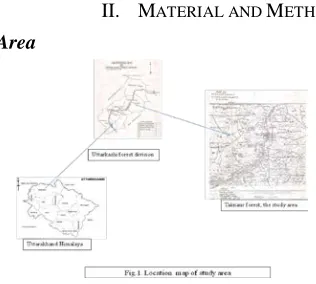
The study has been carried out in Taknaur reserve forest of Uttarkashi forest division of Central Himalaya. Geographically the forest division extends from 30° 24′ 30″ to 31° 27′ 30″ N latitude and 78° 09′ 40″ to 79° 25′ 05″ E longitude and occupies an area of about 224370.60 ha while the study area stretches between 30° 49′ 41″ to 30° 54′ 06″ N latitude and 78° 35′ 08″ to 78° 40′ 33.7″ E longitude and covers an area of about 66755.90 ha, which is 29.75% of the division, while altitudinally, the area ranges from 1280 m asl to 3500 m asl.
Geologically, the study area falls in the middle and greater Himalayan zone, which is mainly comprised of unfossiliferous sedimentary rocks of various ages from Precambrian to Paleozoic (Valdia, 1976). Climatic conditions are generally dry with low annual precipitation, but there is heavy rainfall during the monsoon from late June to early September. Prevailing mist and low cloud during the monsoon keeps the soil moist, hence the vegetation is lush than is usual in the inner areas. The area is usually snow-bound for six to seven months between late October and late March.
For understanding the study area, it was divided in four sites along gradients of altitudes as Site 1 (1280-1900m asl), Site 2 (1900-2500m asl), Site 3 (2500-3000m asl) and Site 4 (3000-3500m asl) as per its geographical condition and vegetation type Fig. 1.
Methodology
Tree, sapling and seedling survey work were conducted during October 2008 to July 2010 and data were collected from the different forest types based on stratified random sampling method. For the purpose of this study, the terms seedling, sapling and tree were defined as plants with heights up to 150cm, between 150 and 300cm and above the 300cm respectively as per Getachew et al. 2002. The vegetation data were quantitatively analyzed by laying the quadrats at different sites, 10x10m for trees, 5 × 5 m for sapling and 1 × 1 m size quadrates were laid down for seedlings randomly at each site separately for abundance, density, frequency following the methods discussed by Curtis and Cottom (1956).
III. RESULTS
Through the exhaustive phyto-sociological surveys of different sites of Taknaur forest the comprehensive data were collected and results were summarized in table 2, which describes species diversity story of the forest. A total of 29 tree
[image:2.612.64.222.58.200.2]ISSN 2250-3153
Table: 1 General characteristics of the study area of Taknaur forest.
Sites Altitude Aspect Dominant species Forest types
Site 1 1280-1900 South-west
Pinus roxburghii, Quercus leucotrichophora and Rhododendron arboreum
Pine–oak forest
Site 2 1900-2500 North Buxus wallichiana, Cedrus deodara Quercus floribunda, Lyonia ovalifolia, and Pinus wallichiana
Mixed oak- conifer forest
Site 3 2500-3000 West Quercus floribunda, Swida microphylla Lyonia ovalifolia,Cedrus deodara, Pinus wallichiana and Picea smithiana
Mixed broad leaved conifer forest
Site 4 3000-3500 East Abies pindrow, Picea smithiana, and Cedrus deodara
Table: 2. Regeneration potential and distribution pattern along gradient of altitudes and aspects of Taknaur forest of Uttarakashi forest division in Garhwal Himalaya.
Gradients of elevation
1280-1900 m 1900-2500 m 2500-3000 m 3000-3500 m
Name of species
Density (ha-1) Tree/Sap /Seedlings
A/F Ratio Tree/Sap /Seedlings
Density (ha-1) Tree/Sap /Seedlings
A/F Ratio Tree/Sap /Seedlings
Density (ha-1) Tree/Sap /Seedlings
A/F Ratio Tree/Sap /Seedlings
Density (ha-1) Tree/Sap /Seedlings
A/F Ratio Tree/Sap /Seedlings
Pinus roxburghii 490/640/10000 0.30/0.20/0.62
Quercus leucotrichophora 190/180/4000 0.47/0.23/0.10
Lyonia ovalifolia 130/260/3000 0.14/0.33/0.03 140/180/3000 .028/.01/---- 70/50/2000 .028/.024/.05 90/120/3000 .04/.024/.075
Rhododendron arboreum 90/120/---- 0.22/0.15/---- 60/60/---- .06/.07/.075
Buxus wallichiana 80/80/2000 0.80/0.50/0.20 460/560/8000 .28/.17/.09 210/180/4000 .084/.036/.04
Taxus baccata 90/140/3000 0.90/0.70/0.30 260/480/8000 .07/.04/.021 140/260/4000 .056/.02/.025 150/160/3000 .025/.02/.03
Abies pindrow 180/240/5000 .11/.03/.053 100/120/---- 0.25/0.15/---- 180/180/4000 .05/.04/.025
Acer acuminatum 70/80/---- .07/0.10/---- 40/60/---- .10/.30/---- 20/40/---- .20/.20/----
Pinus wallichiana 180/220/6000 .03/.022/.03 160/180/4000 .03/.036/.25
Quercus semecarpifolia 230/200/6000 .04/.015/.024 130/220/3000 .035/.02/.075 130/140/3000 .028/.014/.07
Swida macrophylla 60/40/---- .15/.20/---- 30/40/---- .075/.20/----
Quercus floribunda 280/420/5000 .07/.058/.02 150/260/4000 .04/.03/.025 110/140/3000 .13/.076/.075
Cedrus deodara 290/360/9000 .03/.02/.018 180/260/3000 .027/.02/.03 180/160/4000 .037/.015/.04
Aesculus indica 30/20/---- .03/.10/---- 110/20/---- .02/.10/---- 40/60/1000 .10/.075/.10
Salix babylonica 50/80/---- .50/.10/---- 20/----/---- .20/.025/----
Juglans regia 20/40/---- .20/.20/---- 30/40/1000 .075/.20/.10
Fraxinus micrantha 30/20/1000 .30/.10/.10 4/40/---- .10/.20/----
Alnus nepalensis 50/80/1000 .12/.10/.10 20/20/---- .20/.10/----
Ilex dipyrena 40/40/1000 .10/.20/.10 40/60/1000 .10/.30/.10
Acer oblongum 30/30/2000 .30/.04/.20 20/20/---- .05/.10/----
Betula anoides 120/100/3000 .03/.02/.075 30/40/---- .03/.05/----
Populus ciliata 10/20/---- .10/.10/---- 30/20/---- .075/.10/----
Toona serrata 20/40/---- .05/.20/---- 20/20/--- .20/.10/----
Cupressus torulosa 30/40/---- .30/.20/---- 50/60/1000 .13/.075/.10
Picea smithiana 20/20/---- .20/.10/---- 70/60/1000 .05/.075/.10
Carpinus viminea 10/20/---- .10/.10/----
Symplocos chinensis 30/20/---- .075/.10/----
Ulmus wallichiana 30/40/---- .75/.05/----
ISSN 2250-3153
The seedlings of Pinus roxburghii showed the concentration at lower elevation (1280m - 1900m asl) only and does not occurs throughout the elevations in the study area. Seedling densities varied considerably with altitude ranging between 530 individuals ha-1 at 1900m and 10000 individuals ha-1 at 1280m asl. Of the total seedlings 57% were less then 50cm. in height. Seedlings of Taxus baccata showed distinct altitudinal concentration between 1500m to 3000m asl. Seedling densities increased (8000 individuals ha-1) at the elevation of 2500m while it was decreased progressively (3000 individuals ha-1) at 3200m asl. The highest seedling density was recorded at 2500m asl. It was found throughout the altitudinal gradients in contagious distribution in the study area.
Cedrus deodara was found in tremendous occurrence (9000 individuals ha-1) in seedlings stratum at the site 2 (1900m-2500m) but lower at higher elevations (Site 3 & 4). Buxus wallichiana (8000 individuals ha-1) was found co-dominant, whereas, Rhododendron arboreum (3000 individuals ha-1) was showed very poor performance in new generation at site 2. Seedlings of Lyonia ovalifolia were not concentrated at any elevation and occurred across the altitudinal ranges of study area. Of all the seedlings, 45% were less than 50 cm in height. The seedling densities of different species at site 1 showed that it was young new growing Pine-oak forest. The highest seedling density (10000 individuals' ha-1) was recorded for Pinus roxbughii followed by Quercus leucotrichophora and Taxus buccata (4000 and 3000 individuals ha-1, respectively), while, Buxus wallichiana showed lowest (2000 individuals ha-1) of seedlings.
Sapling densities and distribution pattern of different species at different altitude was recorded different from their mature plants. Pinus roxburghii (640 individuals ha-1) was found dominant with contagious distribution followed by Rhododendron arboreum (260 individuals ha-1) whereas least sapling density was observed for Buxus wallichiana (100 individuals ha-1) at site first (1280-1900m asl). At second site (1900-2500m asl) sapling density was highest for Buxus wallichiana (560 individuals ha-1) followed by Taxus baccata (480 individuals ha-1) as co-dominant species. Site third had different story in compared to their mature trees that is Quercus floribunda, Taxus buccata and Cedrus deodara (260 individuals ha-1 of each species) were the dominant species and showed same sapling densities whereas their tree stratum was little varying. Lyonia ovalifolia and Aesculus indica (20 individuals ha-1) was least occurred plant species at this site. However, the site fourth was giving good regeneration potential in their second generation as Abies pindrow (180 individuals ha-1) was dominating along with Cedrus deodara and Taxus buccata (160 individuals ha-1 of each species) co-dominating species. Populus ciliata was found with very poor performance (20 individuals ha-1) at this site. Densities of different trees at different altitude was also varied as Pinus roxburghii 490, Quercus leucotrichophora 190 individuals ha-1 at site 1, while, Buxus wallichiana showed least (80 individuals ha-1) density at this site. Increasing with altitude that is site second (1900-2500m) the reverse trends were shown as Buxus wallichiana expressed highest density (460 individuals ha-1) followed by Cedrus deodara (290 individuals ha-1) whereas least was shown by Aesculus indica (30 individuals ha-1). At higher elevational range (2500-3000m) Buxus wallichiana also
maintained its dominancy with 210 individuals ha-1 which is again followed by Cedrus deodara (180 individuals ha-1) and poorly occurring species was Populus ciliata (10 individuals ha -1
). The site fourth (3000-3500m asl) had a different tree composition with dominant elements of Abies Pindrow, Cedrus deodara (180 individuals ha-1) and Taxus buccata (150 individuals ha-1) as a co-dominant species. Here Acer accuminatum was least occurred (20 individuals ha-1) plant species.
IV. DISCUSSION
Seedling densities varied significantly among species. Seedling densities were highest for Pinus roxburghii, Cedrus deodara, Abies pindrow, Taxus buccata and Quercus floribunda at different sites due to their optimum requirements of climatic, geographic and edaphic conditions and high reproductive potential of mother trees. However, 42-61% of the seedling populations of several species in Ethopian forest were lost annually due to drought, disturbances and herbivory damage (Getachew 2008). Ilex dipyrena, Populus ciliata, Picea smithiana, Juglans regia and Aesculus indica had the lowest seedling density which could be attributed due to unfavorable climatic conditions, anthropogenic disturbances, other biotic interferences and low reproductive performance of the mother trees. The pioneering species Alnus nepalensis,Pinus roxburghii and Quercus leucotrichophora were concentrated only at lower elevation whereas Betula utilis was concentrated only at higher elevation. This is very clear indications of topographic, geographic and climatic restrictions of the species.
The distribution of seedlings along elevational gradients also showed marked variations among species. Taxus buccata, and Lyonia ovalifolia showed wide distributions and occurred along entire elevational range in the forest. On the other hand Pinus Roxburghii, Quercus leucotrichophora restricted to lower elevation (1280-1900m); Betula utilis was found restricted to higher elevation (3000-3500m) only whereas, Ulmus wallichiana was concentrated only at middle evevation (2500-3000m). Maximum species were distributed in contagious pattern across the altitudinal ranges. Odum (1971) have emphasized that contagious distribution is the commonest pattern in nature. Kumar and Bhatt (2006) also reported contagious distribution pattern in foot-hills forests of Garhwal Himalaya. At the upper elevation, relatively humid climatic conditions would restrict the distribution of some species.
The data of densities and distribution of trees, sapling and seedlings (table 2) clearly explains that the site second is naturally healthy conifer-mixed oak forest with high regeneration status of Cedrus deodara folloed by Taxus buccata and Buxus wallichiana. But at the same time it is very negative sign that the valuable species Acer accuminatum has no regeneration mark in the area.
(2001) reported density values of tree ranged 652 to 1028 individual ha-1.
The absence of seedlings of Acer accuminatum, Acer oblongum, Betula utilis, Ulmus wallichiana, and Swida macrophylla may be partially attributed to the absence of a conductive environment for germination of their seeds such as severe disturbance of the canopy and forest soils. Climatic conditions and biotic interference influence the regeneration of different species in the vegetation. Higher seedling density values reduced to perform as sapling stage due to biotic disturbance and competition for space and nutrients Kumar and Bhatt (2006). In previous study similar results were obtained for several species in Ethopian forest by Getachew and Demel 2005b.
Among all the 29 tree species occurring in the study area, 10 tree species as Acer accuminatum, Acer oblongum, Ulmus wallichiana, Betula utilis, Carpinus viminea, Symplocos recemosus, Populus cilata, Toona serrata, Salix babylonica and Swida macrophylla were found completely absent in seedling stratum. This clearly says that there is no regeneration in these species. Since, these data were on the basis 2 years observations, therefore straightly it cannot be concluded that in future these species will remain absent in the area but it is essentially alarming sign of vulnerability of these species. Because out of these 10 species Acer accuminatum, Acer oblongum, Ulmus wallichiana, Betula utilis are already in vulnerable in IUCN Red data book and their mature tree and saplings are also not well in distribution and densities in the investigated area, they are in regular distribution. Therefore, it is evident that these species requires urgent conservation measures in the area for their restoration. Acer accuminatum, Acer oblongum, Ulmus wallichiana, Betula utilis are not important only due to their conservation status but also important due to their economic and ecological values in the ecosystem.
The species that requires high conservation in Uttarkashi forest division were Betula utilis, Acer oblongum, Acer accuminatum, Ulmus wallichiana. Regeneration problem was largely attributed to human disturbances, lack suitable habitat for seeds to germinate or problem associated with producing mature and fertile seeds. On the other hand, high seedling densities or adeptive defenses to herbivory were common attribute to healthy regenerating species.
Based on our results, the following recommendations are forwarded as option for sustainable forest management of the forest division. i) Initiate in-situ conservation efforts for Betula utilis, Acer oblongum, Acer accuminatum, Ulmus wallichiana, including restrict protection of remaining mother trees. ii) Promote sustainable utilization of trees through traditional knowledge based decision system such as population growth models of each species. iii) Study of reproductive ecology of the species including pollination, seed production, dispersal and germination.
ACKNOWLEDGEMENTS
Authors are thankful to the editorial board and reviewers to improve the manuscript.
REFERENCES
[1] Alvarez-Buyalla, E.R., Garcia-Barrios, R., Lara-Moreno, C., Martinez-Ramos, M. Demographic and genetic models in conservation biology: application and perspectives for tropical rain forest tree species. Ann. Rev. Ecol. Syst. 1996, 27, pp. 387-421.
[2] Augspurger, C.K. Pathogen mortality of tropical tree seedlings: experimental studies of effect of dispersal distance, seedling density and light conditions, Oecologia. 1984, 61. pp. 211-217.
[3] Austin, M.P. Use of ordination and other multivariate descriptive methods to study succession. Vegetatio, 1977, 3, pp. 165–175.
[4] Bargali, S.S., Tewari, J.C., Rawat, Y.S. and Singh, S.P. Woody vegetation in a high elevation blue pine mixed oak forest of Kumaun Himalaya. In: Pangtey YPS and Joshi SC (eds.). Western Himalaya: Environment, Problems and Development. Gyanodaya Prakashan, Nainital, 1987, 1, pp.121-155.
[5] Bazzaz, F. Regeneration of tropical forests: physiological responses of pioneer and secondary species, In: Gomez-Poma, A; Whitemore, T; Hadley, M (Eds), Rain forest regeneration and management. Parthenon Publishing, UNESCO, Peris, 1991, pp. 91-118.
[6] Bhuyan, P., Khan, M.L. and Tripathi, R.S. Tree diversity and population structure in undisturbed and human-impacted stands of tropical wet evergreen forest in Arunachal Pradesh, Eastern Himalayas, India. Biodiv. Conserv. 2003, 12, pp. 1753–1773.
[7] Demel, Teketey Seedling population and regeneration of woody species in dry Afromontane forest of Ethopia. For. Ecol. Manage. 1997a, 98, pp. 149-165.
[8] Demel, Teketey, The impact of clearing and conversion of dry Afromontane forest in to arable land on the composition and density of soil seed banks. Acta Ecol. 1997b, 18, pp. 557-573.
[9] Demel, Teketey, Granstrom, A. Soil seed banks in dry Afromontane forests of Ethopia. J. Veg. Sci. 1995, 6, pp. 777-786.
[10] Denslow, S. Tropical tree fall gaps. Ann. Rev. Ecol. Syst. 1987, 17, pp. 430-441.
[11] Enright, N.J. and Watson, A.D. A matrix model analysis for the tropical tree Araucaria cunninghamii. Aust. J. Ecol. 1991, 16. pp. 507-520.
[12] Feyera, Senbeta. Biodiversity and ecology of Afromontane rain forests with wild Coffee arabica L. Popolations in Ethopia. Ecology and Development Series. Cuvillier Verlage, Gottingen, 2006, 38, pp. 1-152.
[13] Foster, R.B. Heterogeneity and disturbance in tropical vegetation. In: Soule, M E and Wilcox, B A (Eds.), Conservation Biology. Sinauer, Sunderland, M A USA, 1980, pp. 75-92.
[14] Garwood, C. Tropical soil seed banks: a review. In: Leck, M; Simpson, R and Parker, V (Eds.), Ecology of soil seed banks. Academic Press San Diego, 1989, pp 149-209.
[15] Getachew, Tesfaye, Demel, Tiketay and Masresha, Fetene, Regeneration of fourteen tree species in Harenna forest, southeastern Ethopia, Flora. 2002, 197. pp. 461-467.
[16] Grubb, P.J. The maintenance of species richness in plant communities. The importance of the regeneration niche. Biol. Rev., 1977, 52, pp. 107–145. [17] Harper, J.L. Population biology of plants. Academic Press London. 1977. [18] Hubble, P. and Foster, B. Biology, chance and history and the structure of
tropical rain forest communities. In: Diamond, J. Case. J. (Eds), Community Ecology. Harper and Row, New York, 1986, pp 314-329.
[19] Khan, M.L., Rai, J.P.N., Tripathi, R.S. Population structure of some tree species in disturbed and protected sub-tropical forests of north-east India. Acta Oecologia: Oecologia Applicata (France), 1987, 8: 247-255.
[20] Kumar, Munesh, Sharma, C.M., Rajwar, G.S. and Mishra, A. Community structure and plant biodiversity in relation to disturbance gradient in temperate forest of Garhwal Himalaya. Van Vigyan, 2001,39(1-4): pp.1-9. [21] Kumar, Munesh, and Bhatt, V.P. Plant biodiversity and conservation of
forests in foot hills of Garhwal Himalaya. Journal of Ecology and Application, 2006,11(2): pp. 43-59.
[22] Lykke, A.M. Assessment of species composition change in savanna vegetation by means of woody plants size class distributions and local information. Biodiv. Conserv. 1993,7, pp.1261-1275.
ISSN 2250-3153
[24] Pangtey, Y.P.S., Samant, S.S., Bankoti, N.S. and Rawal, R.S. Soil and Vegetation Analysis of Pindari Area. Second Annual Report submitted to Department of Environment, New Delhi, 1989, pp.167.
[25] Rao, P., Barik, S.K., Pandey, H.N., and Tripathi, R.S. Community composition and tree population structure in a subtropical broad-leaved forest along a disturbance gradient. Vegetatio. 1990, 88. pp. 151-162. [26] Saxena, A.K., Singh, J.S. Tree population structure of certain Himalayan
forest associations and implications concerning their future composition. Vegetatio. 1984, 58: pp. 61-69.
[27] Saxena, A.K., Singh, S.P. and Singh, J.S. Population Kumaon Himalaya. Implications for management. J. Environ. Manage. 1984, 19. pp. 307-324. [28] Silvertown, J. Introduction to plant population ecology, Longman, New
York. 1982.
[29] Swaine, M.D. Ecology of tropical tree seedlings. Parthenon Publishing, UNESCO, Peris. 1996.
[30] Tripathi, R.S. and Khan, M.L. Regeneration dynamics of natural forests – A review. Proc. Indian Natl. Sci. Acad. 2007, 73, pp.167– 195.
[31] Vablen, T.T., Ashton, D.H. and Schlsgel, F.J. Tree regeneration strategies in lowland Nothofagus dominated forest in south-central Chile. J. Biogeogr., 1979, 6, pp.329–340.
[32] Whitemore, T. A review of some aspects of tropical rain forest seedling ecology with suggestion for further enquiry. In Swaine, M (Eds.), The ecology og tropical forest tree seedlings. Parthenon Publishing, Peris, 1996, pp 3-9.
AUTHORS
First Author – J P Mehta, Department of Botany, HNB Garhwal University Srinagar Garhwal, India, E mail:
Second Author – Shreshthamani, Department of Botany, HNB Garhwal University Srinagar Garhwal, India
Third Author – V P Bhatt, Department of Botany, Govt P G College Gopeshwar, Chamoli, India, E mail: