An Investigation into the Central Data Warehouse
based Association Rule Mining
Gurpreet Singh Bhamra
DCSE, M. M. University, Mullana-133203,Haryana,IndiaAnil Kumar Verma
DCSE, Thapar University, Patiala-147004, Punjab, IndiaRam Bahadur Patel
DCSE, G. B. Pant Engineering College,Ghurdauri-246194, Uttarakhand, India
ABSTRACT
Data Mining(DM) technique is used to mine interesting hidden knowledge from large databases using various computational tech-niques/tools. Association Rule Mining(ARM) today is one of the most important aspects of DM tasks. In ARM all the strong associ-ation rules are generated from the Frequent Itemsets. In this study a central Data Warehouse based client-server model for ARM is de-signed, implemented and tested. The Outcome of this investigation and the advantages of software agents forms the base and motiva-tion of using software agent technology in Distributed Data Mining.
General Terms:
Data Mining,Distributed Data Mining
Keywords:
Data Warehouse, Frequent Itemsets, Association Rule Mining
1. INTRODUCTION
The exponential growth in the stored data generated an urgent need for new technique that can intelligently transform this enormous amount of data into useful knowledge. Consequently, DM has be-come a powerful technology with a great potential to help compa-nies focus on the most important information in the huge data they have collected about the behavior of their customers and potential customers. DM involves the use of computational techniques/tools such as classification, association rules, clustering, etc. to automat-ically extract some interesting and valid data patterns or trends rep-resenting knowledge, implicitly stored in large databases [9, 10]. These tools can include statistical models,algorithms, and machine learning methods. In a classical knowledge discovery technique in distributed environment, a single centrally integrated data reposi-tory called Data Warehouse (DW) is created and then DM tech-niques are used to mine the data and extract the knowledge [15].
The central DW based approach, however, is ineffective or infeasi-ble because of heavy storage and computational costs involved in managing data form the ever increasing and updated distributed re-sources where data is produced continuously in streams. Network communication cost is also involved while transferring huge data over the wired or wireless network in a limited network bandwidth scenario. It is also not desirable to centrally collect the privacy-sensitive raw distributed data of the business organizations like
banking, and telecommunication as they want only knowledge to be exchanged globally. Data from modern business organizations are not only geographically distributed but also horizontally or ver-tically fragmented making it difficult if not possible to combine them in a central location. Performance and scalability of a DM ap-plication can be increased by distributing the workload among sites [16]. Resource constraints of distributed and mobile environment are not considered in algorithms for central DW based DM as cer-tain data sets are immovable in practice. This paper is an attempt to practically investigate the classical central DW based client-server model for association rule mining.
Rest of the sections are organized as follows. Section 2 describes the ARM concepts. Important algorithms for ARM are discussed in section 3. Section 4 completely describes the Central DW based ARM approach with subsections 4.1 for preliminary notations, 4.2 for synthetic data sets used and 4.3 for architectural layout or work-ing modal along with the various algorithms involved in the system. Experimentation and result evaluation is discussed in section 5 and finally the article is concluded in section 6.
2. ASSOCIATION RULE MINING (ARM)
LetDB = {Tj, j = 1. . . D}be a transactional dataset of size
D where each transaction T is assigned an identifier (TID) and
I ={di, i= 1. . . m}, totalmdata items inDB. A set of items in a particular transactionT is called itemset or pattern.An item-setP = {di, i = 1. . . k}, which is a set ofk data items in a particular transactionT andP ⊆I, is called k-itemset.Support of an itemset,s(P) = N o of T containing P
D %, is the frequency of occurrence of itemsetP inDB, whereN o of T containing P
is the support count (sup count) of itemset P. Frequent item-sets (FIs) are the itemitem-sets that appear in DB frequently, i.e., if
P ≥min th sup(given minimum threshold support), thenPis a Frequent k-Itemset.Finding such FIs plays an essential role in min-ing the interestmin-ing relationships among itemsets. Frequent Itemsets Mining (FIM) is the task to find the set of all subsets of FIs in a transactional database. It is CPU and input/output intensive task, mainly because of the large amount of itemsets generated and large size of the datasets involved in progress [10].
design the goods shelves, to manage the stock and to classify the customers according to the purchase patterns.AR is an implication expression of the formsP ⇒ Q[support, conf idence]where ,
P⊂I,Q⊂IandPandQare disjoint itemsets, i.e.,P∩Q=φ. An AR is measured in terms of its support and confidence factor where:
—Support s(P ⇒ Q) = p(P ∪ Q) =
N o of T containing both P and Q
D % : the probability of both
PandQappearing inT,we can say thats% of the transactions support the ruleP ⇒Q,0≤s≤1.0or0%≤s≤100% —Confidence c(P ⇒ Q) = p(Q | P) = s(sP(⇒PQ)) =
sup count(P⇒Q)
sup count(P) % :the conditional probability of Q given P,
we can say that when itemsetP occurs in a transaction there are c%chances that itemsetQwill occur in that transaction, 0≤c≤1.0or0%≤c≤100%
An Association ruleP⇒Qis said to be strong if
(1) s(P ⇒Q)≥min th sup,i.e., support of the rule is greater than or equal to the given minimum threshold support and (2) c(P ⇒ Q) ≥ min th conf, i.e., confidence of the rule is
greater than or equal to the given minimum threshold confi-dence
Association Rule Mining(ARM) today is one of the most important aspects of DM tasks. In ARM all the strong association rules are generated from the FIs. The ARM can be viewed as a two-step process [2, 17].
(1) Find all frequent k-itemsets(Lk)
(2) Generate Strong Association Rules from(Lk)
(a) For each frequent itemsetl∈L, generate all non empty subsets ofl.
(b) For every non empty subsetsofl, output the rule ”s ⇒ (l−s)”, ifsup countsup count((sl)) ≥min th conf
3. ALGORITHMS FOR MINING FREQUENT
ITEMSETS
FIM, being the first step in ARM task, has lots of proposed al-gorithms both sequential and parallel. Since ARM is dedicated to handle the huge amount of data so time complexity and resource complexity in such algorithms are carefully considered. These al-gorithms can be classified into two categories:
—Candidate-generation-and-subset-test approach —Pattern-growth approach
The first category, the candidate-generation-and-subset-test ap-proach, such as Apriori algorithm [3], is directly based on the downward closure property of the FIs, i.e., if a set cannot pass a test, all of its supersets will fail the same test as well or all nonempty subsets of a FI must also be frequent or any (k-1)-itemset that is not frequent cannot be a subset of a frequent k-itemset. This property is used in subset testing of FIs. Apriori algorithm [3] has emerged as one of the best FIM and subsequently ARM algorithms since ARs can be straightforwardly generated from a set of FIs. It has been the basis of many subsequent ARM and/or ARM-related al-gorithms. Apriori algotirhm iteratively identifies FIs in the data by making use of the downward closure property of the itemsets in the generation of candidate (possibly frequent) itemset where a candi-date itemset is confirmed as frequent only when all its subsets are identified as frequent in the previous pass.
The Apriori algorithm performs repeated scan of the database, suc-cessively computing support-counts for sets of single items, pairs, triplets and so on. At the end of each pass, sets that fails to reach the required threshold support are eliminated and candidates for the next pass are constructed as supersets of the remaining (frequent) sets. Since no set can be frequent which has an infrequent subset, this procedure guarantees that all frequent sets will be found. Since the number of database passes of the Apriori algorithm equals the size of the maximal frequent itemset, it scans the darabase k times even when only one k-frequent itemset exists. The drawback of this method is that if the dataset is very large, the required multiple database scans can be one of the limiting factors. Working model and implementation of Apriori algorithm can also be found in [5]. Many algorithms have been proposed, directed at improving the performance of the Apriori algorithm using different types of ap-proaches. An analysis of the best known algorithms can be found in [14, 13].
A second category of methods, pattern-growth methods has been proposed such as FP-growth [12] and Apriori-TFP[8] have been proposed. These algorithms typically operate by recursively pro-cessing a tree structure into which the input data has been encoded. In the study shown by [11], a novel FI tree structure, FP-tree was proposed. FP-tree is an extended prefix-tree structure for strong compressed information about FIs. It consists of one root labeled as NULL and a set of item prefix sub trees as the descendents of the root. A frequent-item header table is also kept to link all the transactions containing that item. Each node in the item prefix sub tree consists of three fields: item-name, count and node link where item-name registers which item this node represents, count regis-ters the number of transactions represented by the path reaching this node and node-link links to the next node in the FP-tree carry-ing the same item name or NULL if there is none.
Based on the FP-tree [11], an itemset fragment growth algorithm, FP-growth [12] was designed to avoid the costly generation of large number of candidate sets. The FP-growth is a partition-based, di-vide and conquer method used to decompose the mining task into set of smaller tasks for mining confined itemsets in conditional databases , thereby dramatically reducing the search space. The size of the FP-tree is usually small and will not grow exponen-tially. FP-growth method is efficient and scalable for mining both long and short FIs and faster than Apriori algorithm but has some disadvantages. Its first principal drawback is that because FP-trees are repeatedly generated, FP-growth can have significant storage requirements. Secondly, larger number of links makes it difficult to distribute the tree. These drawbacks are particularly significant with respect to the dense datasets.
4. CENTRAL DW BASED ARM
4.1 Preliminaries and Definitions
A client-server based framework for mining the strong association rules from central DW can be formally described as:
—S={Si, i= 1. . . n},ndistributed sites —SCEN T RAL,a Central site
—DBi={Tj, j= 1. . . Di}, Transactional Data Set of sizeDiat the local siteSi, where each transactionTjis assigned an iden-tifier (TID)
—I={dl, l= 1. . . m}, totalmdata items in eachDBi —DB=Sn
i=1DBi, the Central Data Warehouse atSCEN T RAL of sizeD=Sn
i=1Di
—δ1, start time of transferringDBiover the network at siteSi —δ2, end time of receivingDBiatSCEN T RAL
—δ=δ2−δ1, total network time taken in dispatchingDBiatSi —min th sup, minimum threshold support
—min th conf, minimum threshold confidence —LF I, the list of frequent k-itemsets atS
CEN T RAL
—LF ISC, the list of support count of every frequent k-itemsets in
LF I
—LSAR, the list of strong association rules atS
CEN T RAL
4.2 Data Sets
Data set consists of total 11250 transactions of 10 items which are horizontally partitioned and these horizontally partitioned synthetic transactional datasets (DBi) are created and stored across three distributed sitesS1,S2andS3, with 3500, 3850 and 3900
[image:3.595.317.556.226.376.2]transac-tions respectively using a Synthetic Transactional Dataset Genera-tor(TDSGenerator v1.0) tool [6].These data sets use Boolean values to show whether an item exists in a transaction. Table 1 shows size and density of eachDBiand snapshot of eachDBiat distributed sites are shown in Figure 1.
Table 1. Size and density of eachDBi.
Site No. of No. of Approximate Size of Name Items Transactions Density Data Set
S1 10 3500 60% 172KB
S2 10 3850 50% 192KB
S3 10 3900 65% 192KB
4.3 Framework for Central DW based ARM
Figure 2 shows the client-server model for central DW based ARM approach. Various components involved in the framework are:
(1) Dataset Dispatcher: It is a client application running at each distributed siteSi. It dispatchesDBi over the network to the Central DW Manager Server application running at
SCEN T RALand keeps track of theδ. Algorithm 1 describes the working ofDataset Dispatcher.
(2) Central DW Manager: It is a server application running at
SCEN T RAL. It handles all the incoming requests from the Dataset Dispatcher. It receives, stores eachDBiand waits con-tinuously till all the clients have dispatched theirDBi. Algo-rithm 2 describes the working ofCentral DW Manager. Vari-ous other assistant components ofCentral DW Manager appli-cation
are:-(a) Dataset Merger: It merges eachDBi into a singleDB. See Algorithm 3.
(b) FI and SC Generator: It scansDB and generates LF I and LF ISC to be further processed bySAR Harvester. Apriori [3] algorithm is used to createLF Iwith the given
min th sup. See Algorithm 4 to Algorithm 6.
(c) SAR Harvester: It generates the strong association rules from LF I and LF ISC with the constraint of given
min th conf. See Algorithm 7.
Algorithm 1DATASETDISPATCHER
Input: DBi, T ransactional Data Set of size Diat Si
Output: δ, T otal network time taken in dispatching DBi
1: procedureDATASETDISPATCHER(DBi)
2: α←open a new socket with CentralDW M anager 3: β←bind ObjectInputStream at α
4: χ←bind ObjectOutputStream at α
5: ξ←bind ObjectInputStream with local DBi
6: A←read the entire DBiobject at ξ stream
7: δ1←get start time f or dataset transf er 8: write A on χ stream
9: δ2←read end time received on β stream 10: δ←δ2−δ1
11: Close all the opened channels 12: returnδ
13: end procedure
Algorithm 3DATASETMERGER
Input: {DBi, i= 1· · ·n}
Output: DB, AggregatedDataset
1: procedureDATASETMERGER({DBi, i= 1· · ·n})
2: for allDS∈ {DBi, i= 1· · ·n}do
3: α←bind ObjectInputStream with DS 4: A←read the entire DS object at α stream 5: add A into a single unit DB
6: end for
7: Close all the opened channels 8: returnDB
9: end procedure
5. EXPERIMENT AND RESULTS
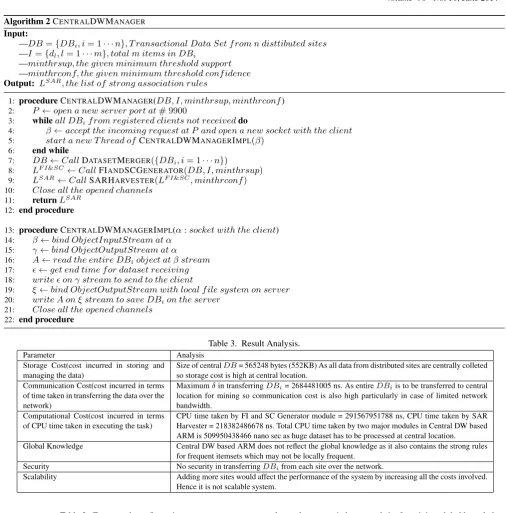
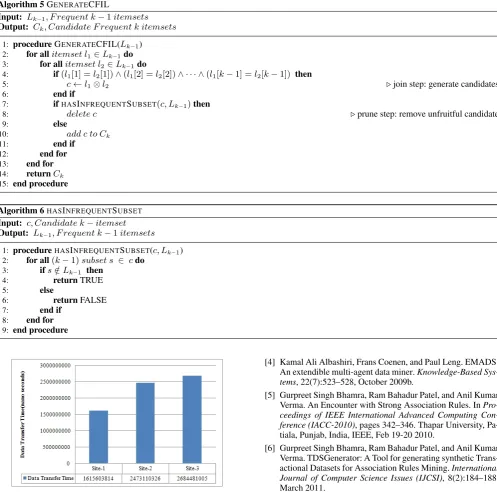
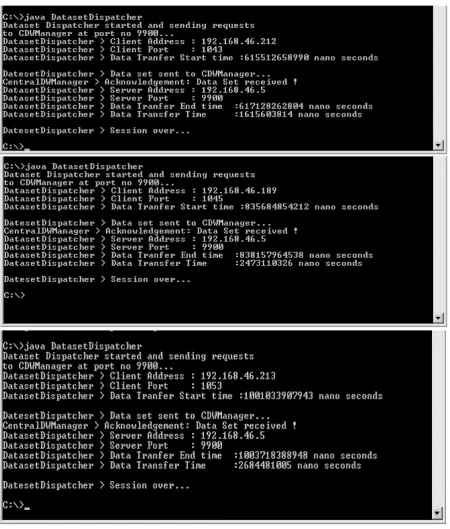
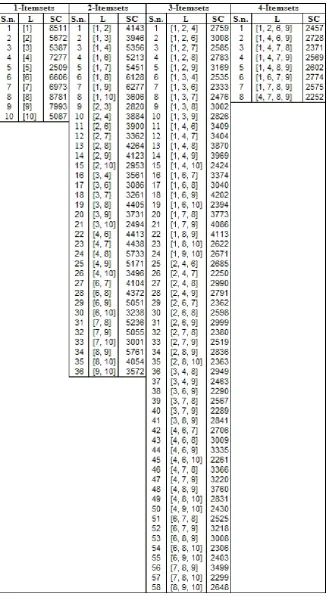
All the components of the framework are implemented in java lan-guage. Table 2 describes the required configuration for the frame-work. Figure 3 shows the snapshots of the running state of the Dataset Dispatcher at each distributed site.Time taken by each Dataset Dispatcher in transferringDBiover the network is shown in Figure 4. Figure 5 shows the snapshot of the running state of the CentralDWManager at SCEN T RAL . LF I and LF ISC lists generated by FIandSCGenerator module with 20%min th supis shown in Figure 6.
[image:3.595.66.281.456.514.2]Fig. 1. Snapshot of Transactions ofDB1,DB2andDB3
Fig. 2. Framework for Central DW based ARM
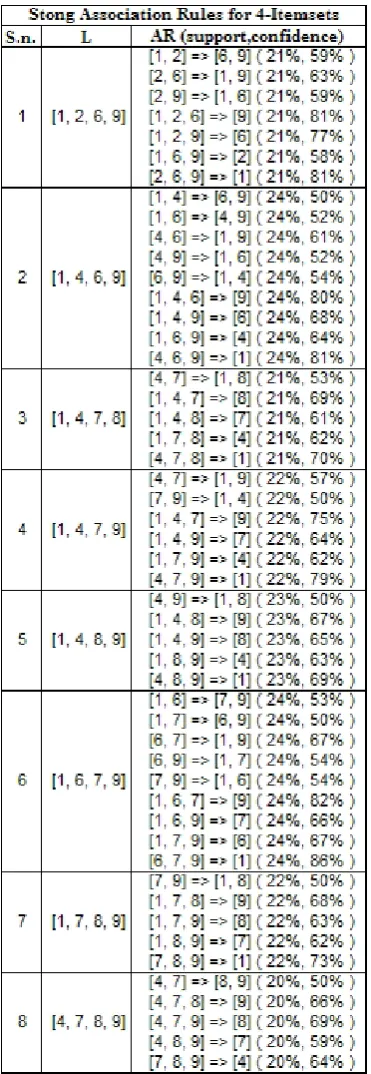
here. CPU time taken by Dataset Merger module, FIandSCGener-ater modeule and SAR Harvester modeule are 203789677 nano onds, 291567951788 nano seconds and 218382486678 nano sec-onds respectively. Number of strong ARs for frequent 2-itemsets, 3-itemsets and 4-itemsets are 54, 174 and 51 respectively. The re-sult analysis is performed in Table 3.
6. CONCLUSION
[image:4.595.70.539.343.567.2]Algorithm 2CENTRALDWMANAGER
Input:
—DB={DBi, i= 1· · ·n}, T ransactional Data Set f rom n disttibuted sites —I={dl, l= 1· · ·m}, total m items in DBi
—minthrsup, the given minimum threshold support
—minthrconf, the given minimum threshold conf idence
Output: LSAR, the list of strong association rules
1: procedureCENTRALDWMANAGER(DB, I, minthrsup, minthrconf)
2: P←open a new server port at# 9900
3: whileall DBif rom registered clients not receiveddo
4: β←accept the incoming request at P and open a new socket with the client 5: start a new T hread ofCENTRALDWMANAGERIMPL(β)
6: end while
7: DB←CallDATASETMERGER({DBi, i= 1· · ·n})
8: LF I&SC ←CallFI
ANDSCGENERATOR(DB, I, minthrsup)
9: LSAR←CallSARH
ARVESTER(LF I&SC, minthrconf)
10: Close all the opened channels 11: returnLSAR
12: end procedure
13: procedureCENTRALDWMANAGERIMPL(α:socket with the client)
14: β←bind ObjectInputStream at α 15: γ←bind ObjectOutputStream at α 16: A←read the entire DBiobject at β stream
17: ←get end time f or dataset receiving 18: write on γ stream to send to the client
19: ξ←bind ObjectOutputStream with local f ile system on server 20: write A on ξ stream to save DBion the server
[image:5.595.50.557.52.566.2]21: Close all the opened channels 22: end procedure
Table 3. Result Analysis.
Parameter Analysis
Storage Cost(cost incurred in storing and managing the data)
Size of centralDB= 565248 bytes (552KB) As all data from distributed sites are centrally colleted so storage cost is high at central location.
Communication Cost(cost incurred in terms of time taken in transferring the data over the network)
Maximumδin transferringDBi= 2684481005 ns. As entireDBiis to be transferred to central
location for mining so communication cost is also high particularly in case of limited network bandwidth.
Computational Cost(cost incurred in terms of CPU time taken in executing the task)
CPU time taken by FI and SC Generator module = 291567951788 ns, CPU time taken by SAR Harvester = 218382486678 ns. Total CPU time taken by two major modules in Central DW based ARM is 509950438466 nano sec as huge dataset has to be processed at central location. Global Knowledge Central DW based ARM does not reflect the global knowledge as it also contains the strong rules
for frequent itemsets which may not be locally frequent. Security No security in transferringDBifrom each site over the network.
Scalability Adding more sites would affect the performance of the system by increasing all the costs involved. Hence it is not scalable system.
Table 2. Framework configuration.
Site Name Processor OS LAN Configuration
IP1 Network
SCEN T RAL Intel2 M S3 192.168.46.5 N W4
S1 Intel2 M S3 192.168.46.212 N W4
S2 Intel2 M S3 192.168.46.189 N W4
S3 Intel2 M S3 192.168.46.213 N W4
1. IP address with Mask:255.255.255.0 and Gateway:192.168.46.1 2. Intel Pentium Dual Core(3.40 GHz,3.40 GHz)with 512MB RAM 3. Microsoft Windows XP Professional ver. 2002
4. Network Speed:100 Mbps and Network Adaptor: Intell 82566DM-2 Gigabit NIC
only results are carried at central site for mining global knowledge. Intelligent software agent technology and its advantages discussed in [7] makes this technology best suited for mining the distributed data. This paper is an attempt to practically investigate the classical central DW based client-server model for association rule mining and paving the way for moving ahead in further research of design-ing a framework for agent based distributed data mindesign-ing.
7. REFERENCES
Algorithm 4FIANDSCGENERATER: Part-1
Input:
—DB=Sn
i=1DBi, Central Datawarehouse —I={dl, l= 1· · ·m}, total m items in DBi
—minthrsup, the given minimum threshold support
Output: LF I&SC, the list of f requent itemsets their support counts
1: procedureFIANDSCGENERATER(DB, Itemset, minthrsup)
2: T←DB.size .No. of records in DB
3: I←Itemset.size .No. of items in DB
4: minsupcount←(T×minthrsup)/100
5: generate frequent-1 itemset list (F IL1) and support count list (F ISC1)
6: CF IL1← {1,2,3· · ·I} .candidate frequent-1 itemset
7: fori←1, Ido .initialize the support count arraySCF IL1to zero
8: SCF IL1[i]←0 9: end for
10: k←1
11: for allcandidate c∈CF IL1do .find support count for every candidate
12: for alltransaction t∈DBdo .scan DB
13: ifc⊂tthen
14: SCF IL1[k]←SCF IL1[k] + 1 15: end if
16: end for
17: k←k+ 1
18: end for
19: pruneCF IL1to generateF IL1andF ISC1 20: fork←1, Ido
21: ifSCF IL1[k]≥minsupcountthen 22: add ck ∈ CF IL1to F IL1 23: add SCF IL1[k]to F ISC1 24: end if
25: end for
26: ifF IL16=∅then 27: add F IL1to LF I 28: add F ISC1to LF ISC 29: end if
30: k←2
31: whileF ILk−16=∅do
32: CF ILk←CallGENERATECFIL(F ILk−1) .candidate frequent-k itemset
33: fori←1, CF ILk.lengthdo .initialize the arraySCF ILkto zero
34: SCF ILk[i]←0
35: end for
36: i←1
37: for allcandidate c∈CF ILkdo .find support count for every candidate
38: for alltransaction t∈DBdo .scan DB
39: ifc⊂tthen
40: SCF ILk[i]←SCF ILk[i] + 1
41: end if
42: end for
43: i←i+ 1
44: end for
45: pruneCF ILkto generateF ILkandF ISCk
46: fori←1, SCF ILk.lengthdo
47: ifSCF ILk[i]≥minsupcountthen
48: add ci ∈ CF ILkto F ILk
49: add SCF ILk[i]to F ISCk
50: end if
51: end for
52: ifF ILk6=∅then
53: add F ILkto LF I
54: add F ISCkto LF ISC
55: end if
56: k←k+ 1
57: end while
58: add T to LF I&SC
59: add LF Ito LF I&SC
60: add LF ISCto LF I&SC
61: returnLF I&SC
Algorithm 5GENERATECFIL
Input: Lk−1, F requent k−1itemsets
Output: Ck, Candidate F requent k itemsets
1: procedureGENERATECFIL(Lk−1) 2: for allitemset l1∈Lk−1do 3: for allitemset l2∈Lk−1do
4: if(l1[1] =l2[1])∧(l1[2] =l2[2])∧ · · · ∧(l1[k−1] =l2[k−1]) then
5: c←l1⊗l2 .join step: generate candidates
6: end if
7: ifHASINFREQUENTSUBSET(c, Lk−1)then
8: delete c .prune step: remove unfruitful candidate
9: else
10: add c to Ck
11: end if
12: end for
13: end for
14: returnCk
15: end procedure
Algorithm 6HASINFREQUENTSUBSET
Input: c, Candidate k−itemset
Output: Lk−1, F requent k−1itemsets
1: procedureHASINFREQUENTSUBSET(c, Lk−1) 2: for all(k−1)subset s ∈ cdo
3: ifs /∈Lk−1 then 4: returnTRUE
5: else
6: returnFALSE
7: end if
8: end for
[image:7.595.56.554.69.561.2]9: end procedure
Fig. 4. Dataset Transfer Time (δ) atS1, S2andS3
of the ACM-SIGMOD International Conference of Manage-ment of Data, pages 207–216, 1993.
[2] R. Agrawal and J. C. Shafer. Parallel mining of association rules.IEEE Transaction on Knowledge and Data Engineer-ing, 8(6):962–969, 1996.
[3] Rakesh Agrawal and Ramakrishnan Srikant. Fast Algorithms for Mining Association Rules in Large Databases. In Proceed-ings of the 20thInternational Conference on Very Large Data Bases(VLDB’94), pages 487–499. Morgan Kaufmann Pub-lishers Inc., Sept. 12-15 1994.
[4] Kamal Ali Albashiri, Frans Coenen, and Paul Leng. EMADS: An extendible multi-agent data miner.Knowledge-Based Sys-tems, 22(7):523–528, October 2009b.
[5] Gurpreet Singh Bhamra, Ram Bahadur Patel, and Anil Kumar Verma. An Encounter with Strong Association Rules. In Pro-ceedings of IEEE International Advanced Computing Con-ference (IACC-2010), pages 342–346. Thapar University, Pa-tiala, Punjab, India, IEEE, Feb 19-20 2010.
[6] Gurpreet Singh Bhamra, Ram Bahadur Patel, and Anil Kumar Verma. TDSGenerator: A Tool for generating synthetic Trans-actional Datasets for Association Rules Mining.International Journal of Computer Science Issues (IJCSI), 8(2):184–188, March 2011.
[7] Gurpreet Singh Bhamra, Ram Bahadur Patel, and Anil Ku-mar Verma. Intelligent Software Agent Technology: An Overview. International Journal of Computer Applica-tions(IJCA), 89(2):19–31, March 2014.
[8] Frans Coenen, Graham Goulbourne, and Paul Leng. Tree Structures for Mining Association Rules. Data Mining and Knowledge Discovery, 8(1):25–51, January 2004.
[9] Usama M. Fayyad, Gregory Piatetsky-Shapiro, Padhraic Smyth, and Ramasamy Uthurusamy.Advances in Knowledge Discovery and Data Mining. AAAI/MIT Press, 1996. [10] J. Han and M. Kamber. Data Mining: Concepts and
Algorithm 7SARHARVESTOR
Input:
—LF I&SC, Collection of number of records , f requent k itemset and support count —minthrconf, the given minimum threshold conf idence
Output: LSAR, List of Strong Association Rules
1: procedureSARHARVESTOR(LF I&SC, minthrconf)
2: T←LF I&SC.get(0) .No. of records
3: LF I←LF I&SC.get(1) .frequent k-itemset list
4: LF ISC←LF I&SC.get(2) .support count list
5: fork←2, LF I.sizedo
6: Lk←LF I.get(k) .get frequent k-itemset list
7: for alll∈Lkdo
8: lsubsets←generate all non−empty subsets of l
9: lspcount←get support count of l f rom LF ISC
10: ARsupport←(lspcount/T)×100 .support of the association rule
11: for allnon−empty subset s∈lsubsetsdo
12: sspcount←get support count of s f rom LF ISC
13: ARconf←(lspcount/sspcount)×100 .confidence of the association rule
14: ifARconf≥minthrconfthen
15: ARstrong←”s ⇒ l−s[ARsupport%, ARconf%]”
16: printARstrong
17: add ARstrongto LSAR
18: end if
19: end for
20: end for
21: end for
22: returnLSAR
23: end procedure
[11] Jiawei Han, Jian Pei, and Yiwen Yin. Mining frequent pat-terns without candidate generation. In Proceedings of the 2000 ACM SIGMOD international conference on Manage-ment of data, pages 1–12. ACM, 2000.
[12] Jiawei Han, Jian Pei, Yiwen Yin, and Runying Mao. Mining Frequent Patterns without Candidate Generation: A Frequent-Pattern Tree Approach.Data Mining and Knowledge Discov-ery, 8(1):53–87, January 2004.
[13] Jochen Hipp, Ulrich Guntzer, and Gholamreza Nakhaeizadeh. Algorithms for association rule mining a general survey and comparison. ACM SIGKDD Explorations Newsletter, 2(1):58–64, June 2000.
[14] Renata Ivancsy, Ferenc Kovacs, and Istvan Vajk. An analysis of association rule mining algorithms. InProceedings of the 4thInternational ICSC Symposium on Engineering of Intelli-gent Systems, pages 774–778, Feb. 29 - March 2 2004. [15] Byung-Hoon Park and Hillol Kargupta. Distributed Data
Min-ing: Algorithms, Systems, and Applications. Department of Computer Science and Electrical Engineering, University of Maryland Baltimore County, 1000 Hilltop Circle Baltimore, MD 21250, 2002.
[16] Grigorios Tsoumakas and Ioannis Vlahavas. Distributed Data Mining. Department of Informatics, Aristotle University of Thessaloniki, Thessaloniki, Greece, 2009.