Emerging Technologies and Access to
Spectrum Resources: the Case of
Short-Range Systems
Minervini, Fulvio
University of Warwick, University of Macerata
September 2007
Online at
https://mpra.ub.uni-muenchen.de/6786/
Spectrum policy:
what next?
Edited by Martin CAVE, Gérard POGOREL & Frédéric PUJOL
WRC-07: the Technological and Market Pressures
for Flexible Spectrum Access
Regulatory and Policy Implications
of Emerging Technologies to Spectrum Management
Spectrum Allocation, Spectrum Commons and Public Goods:
the Role of the Market
The Role of Licence-Exemption in Spectrum Reform
Emerging Technologies and Access to Spectrum Resources:
The Case of Short-Range Systems
Interviews with
COMMUNICATIONS & STRATEGIES, no. 67, 3rd quarter 2007, p. 107.
Emerging Technologies and Access to Spectrum
Resources: the Case of Short-Range Systems
(*)Fulvio MINERVINI
University of Warwick and University of Macerata
Abstract: Traditional regulatory arrangements have constrained access to radio frequency spectrum. This has resulted in artificial scarcity of spectrum. The paper addresses the issue of whether technological developments in short-range systems (e.g. cognitive radios and ultra wideband) might promote access to spectrum - possibly using market mechanisms such as trading - and reduce spectrum shortages.
Key words: spectrum policy, spectrum access, emerging spectrum-using technology, short-range systems.
Innovative technology and spectrum management
reform
In recent years, booming demand for wireless services has uncovered inefficiencies in spectrum management by the traditional framework of command-and-control, which, for decades, has put the bulk of decisions on how to use spectrum in the hands of regulators.
Regulators have been prescribing what services can be offered across the spectrum (which has been allocated accordingly) and have usually set detailed and narrow limits on the technologies to be used in order to deliver wireless services. Indeed, spectrum has been managed by regulatory fiat with a few relevant dimensions in mind - namely frequency, polarization,
space, time - and strict rules on transmission power. In addition, regulators have designed generous guard bands between swaths of the spectrum devoted to different services and technologies (FCC, 2004; TONMUKAYAKUL & WEISS, 2004). The aim of these arrangements was to avoid harmful interference among wireless communications. This regulatory approach - which was particularly suited for broadcasting - has worked quite well until recently (Ofcom, 2004). In a Communication of September 2005, the European Commission wrote:
"Spectrum has historically been distributed via detailed ex-ante administrative decisions. This approach has come under increasing pressure, due to the high technological turnover and the strong demand for wireless applications. The requirement for prior regulatory approval can severely delay or even prevent the introduction of new products" (EC, 2005, p. 5).
Cellular technologies (crucial for the rapid development of wireless mobile telephony), digitisation of signals, successful applications such as Wi-Fi and other developments have caused a huge increase in the demand for access to spectrum, but the supply of spectrum - governed by an administrative approach - has been adjusted slowly to the dynamics on the demand side.
A debate on the most appropriate framework for spectrum management has emerged - the "property rights vs. commons" debate, which is evolving into the question of the appropriate mix of approaches, i.e. regulation, market-based mechanisms and open access (MINERVINI & PIACENTINO, 2007; POGOREL, 2007) 1 - and this debate is becoming increasingly familiar
with a few new and emerging technologies, some of which enable novel methods for spectrum management, or even require more radical changes in the approach to spectrum usage.
Generally speaking, technology experts welcome innovations such as cognitive radios and ultra wideband with enthusiasm and set forth the argument that these innovations will contribute significantly in reducing the barriers to access the radio frequency spectrum (possibly enabling an open access spectrum commons in the future). However, service providers and - though to a lesser degree - manufacturers seem sceptical about the
advantages of the new technologies. On the one hand, service providers' concerns regard, above all, harmful interferences that their customers might suffer if these emerging technologies end up being used. Also, they might fear increased competition from new entrants, who might as well develop innovative services and erode incumbents' market. On the other hand, manufacturers are in favour of steps towards harmonisation of spectrum usage (Booz Allen Hamilton, 2006 2), in order to reach a critical mass market
for their devices more easily. Therefore, they are concerned with the potential of these technologies to become (rapidly) popular among consumers, as well as with the foreseeable commercial cycle of new devices.
The cost of using emerging technologies might be too high and reduce expected economic benefits (Qinetiq, 2006). In a recent study for Ofcom (2005b), Masons Communications and DotEcon estimated the negative and positive impacts on social welfare associated with ultra wideband deployment for personal area networks in the United Kingdom. They found that ultra wideband might generate about £ 4 bn (discounted) in value over the next 15 years, but further work is needed to assess net benefits 3.
Moreover, in HARRINGTON et al. (2004, p. 42), the authors claim that "the adaptation of SDR into networks faces challenges in the economics of its rollout. Until units can be produced in mass, prices will be high. The value for operators is that SDR systems provide flexibility and versatility that can outweigh costs".
This paper attempts to make a contribution in the debate on the potential of innovative technology to promote (dynamic) spectrum access in the area of short-range wireless systems. Therefore, an overview of expected costs and benefits associated to their development is also provided. The paper discusses, in particular, the role that technologies enabling first and second generation flexibility (CAVE, 2006) might play to make spectrum usage more
2 The results of the economic analysis in Booz Allen Hamilton (2006), regarding wide area wireless communications, suggest that "15 years after deploying a liberalised spectrum use proposition the industry would see 3% less usage per subscriber, 5% less end-user service penetration with a 7% higher ARPU, and an overall loss in consumer surplus of € 244 bn compared with the harmonised case" (p. 6). Their results are very different from those in Analysys et al. (2004). In the latter, trading and liberalisation are expected to bring significant benefits to consumers. See also Red-M & partners (2006): the variable complexity of the spectrum sharing schemes studied leads to different implementation costs and profitability dependent on the assumptions made.
intensive. Some key features of emerging technologies will be presented in order to support arguments about their foreseeable impact on two specific themes of spectrum management and regulation: spectrum sharing and frequency trading. However, some emerging technologies - especially in their most advanced concepts (e.g. cognitive radios) - will not reach the market before 2015 and some of them might be unable to leave R&D laboratories.
Although the paper will not deal with the issue of whether market-based mechanisms or open access to a spectrum commons are better suited to address the challenges involved (compared with command-and-control), there is an assumption that the highly uncertain scenarios, which might be envisaged, suggest that regulation should not take immediate steps to accommodate (the expectations associated to) specific emerging technologies. Nevertheless, regulation should remove unnecessary constraints on frequency usage, in order to enable access to spectrum on a technology and service neutral bases as much as possible. Notably, in its recent Communication of February 8, 2007, the European Commission argues that:
"The deployment of innovative wireless services and technologies is increasingly hampered by the reservation of certain spectrum bands for narrowly defined services coupled with rigid usage conditions that are unduly constraining spectrum use. Making spectrum use more flexible empowers the spectrum user to make timely commercial choices close to the market" (EC, 2007, p. 3).
The paper is structured as follows. After a brief overview of the problem of access to the resources of the radio spectrum, which are often under-used, the following Section is concerned with opportunities and challenges brought by a few emerging technologies, e.g. mesh networks, software defined radio (SDR), cognitive radio and ultra wideband 4. Such
technologies are discussed according to their level of disruptiveness with regard to the traditional spectrum management framework. Sub-sections provide a short introduction to key aspects of these innovations and address issues of spectrum sharing in the first place, and then of spectrum trading, as the latter is regarded as a form of spectrum sharing based on negotiated access among users. Then we conclude.
4 The selected technologies are those more often discussed in fora on spectrum policy reform.
Access to spectrum and the role of emerging
technologies for band sharing and trading
There is an apparent paradox in the debate on spectrum management reform. On the one hand, the discussion highlights problems of spectrum shortages - compared to an unprecedented increase in the demand for wireless communication services. On the other hand, several contributions argue that spectrum per se is not scarce - rather, it is badly managed, in ways that artificially restrict users' options to exploit this resource efficiently.
According to the Spectrum efficiency working group of the FCC:
"There is some evidence indicating that the shortage of spectrum is often a spectrum access problem. That is, the spectrum resource is available, but its use is compartmented by traditional policies based on traditional technologies. New radio technologies may enable new techniques for access of spectrum and sharing of the spectrum resources that may create quantum increases in achievable utilization" (FCC, 2002a, p. 9).
In fact, measurements of spectrum usage have demonstrated that, even in urban areas, the allocated radio frequencies are often under-used 5. For
instance, Shared Spectrum Company (2005) performed spectrum occupancy measurements from January 2004 until August 2005 at six locations in the US. The study goal was to determine the spectrum occupancy in each band (30 MHz - 3,000 MHz) and measurements showed, in particular, that (a) the average occupancy over all of the locations was 5.2%; (b) the maximum total spectrum occupancy was 13.1% (New York City) and (c) the minimum total spectrum occupancy was 1% (National Radio Astronomy Observatory).
A few studies explore ways to promote spectrum access using legacy technology (Ofcom, 2005a; Qinetiq, 2005; CEPT, 2006; Red-M & partners, 2006). Innovative technology brings opportunities - as well as problems - for spectrum usage and some technologies are closer than others to come onto the market 6. For instance, advanced antenna technologies consist of an
5 Measurements of spectrum use were carried out also in the UK and Belgium. It should be noted that the reuse pattern that was necessary for cellular systems was not considered in the measurements by the FCC. See also Analysys and Mason (2005) and Qinetiq (2006), with different predictions for cellular spectrum runs out in the UK.
evolution of traditional antennas and, if their cost can be kept sufficiently low to be implemented on popular devices (e.g. mobile phones), spectrum-based services might soon rely on them.
The perturbing dimension of various emerging technologies on spectrum usage is different. While some of them do not require or favour major changes in spectrum management (e.g. smart antennas and mobile mesh networks), others might be highly disruptive (e.g. ultra wideband and cognitive radios).
Technologies in the latter group might significantly enhance access to the resources of the radio frequency spectrum. However, compared with those in the first group, they are also (relatively) ill-defined, because R&D about them (i.e. about their potential for harmful interference as well as their useful development in novel spectrum-based services) is only in the early stages.
In the following sections, a few emerging technologies will be ideally located along a continuum, according to their degree of disruptiveness with regard to current spectrum management methods, and their relevance for issues of spectrum sharing and secondary spectrum trading will be discussed.
Spectrum-using technologies that fit the traditional framework: advanced antennas and mesh networks
Advanced antennas and mesh networks are two examples of first-generation technologies. They have features that can improve spectrum-based services and enable access to spectrum in a better or different way. However, their deployment does not impinge on the traditional approach to spectrum usage.
significant capacity gains over systems using the same bandwidth and transmit power 7.
Mesh networks are usually divided in (fixed) mesh networks and mobile (ad hoc) mesh networks. Fixed mesh networks are already in use (e.g. in fixed radio access services), while the development of mobile mesh networks is more challenging. However, under appropriate network design and where spectrum is available, mobile mesh networks might be deployed for wireless communications and enable some kind of spectrum sharing, in particular exploiting the higher (and less congested) frequencies up to 6 GHz (WEBB, 2006). According to the FCC (2003, par. 78), "mesh networks function by 'whispering' at low power to a neighbour rather than 'yelling' at a high-power to a node far away. This approach may be spectrally more efficient than simply transmitting directly to a desired receiver at some distance and provide for better sharing scenarios".
Mesh networking is a novel way to access spectrum and to enhance its usage. However, spectrum sharing by mesh systems has limits. Indeed, if shared spectrum is used, the quality of service that can be offered depends on the choice of sharing mechanisms (CCLRC/RCRU, 2006).
Fixed mesh networks might be developed in managed spectrum, hence a reduction in the potential for harmful interference, compared with uncontrolled access to spectrum. Nevertheless, the protocols employed by the users over the networks that share the same spectrum are a crucial feature (CCLRC/RCRU, 2006; Plextek et al., 2006): if some users employ impolite protocols - which do not check for frequency occupancy before transmitting (e.g. IEEE 802.16) - while others rely on polite protocols (e.g. IEEE 802.11), the former may gain an inequitable share of the available spectrum.
Spectrum sharing by mobile (ad hoc) mesh networks may bring further difficulties (Plextek et al., 2006 8). Firstly, these networks might operate in
unlicensed spectrum, thus enabling fewer ways to protect against harmful
7 MIMO systems will ensure that the signals at the antennas in the array are sufficiently uncorrelated with each other. Correlation can be reduced by exploiting various forms of diversity that arise due to the presence of multiple antennas: space diversity (locating antennas far apart), pattern diversity (using antennas with different or orthogonal radiation patterns), polarization diversity, etc. See http://users.ece.utexas.edu.
8 The report by Plextek et al. (2006) deals with mobile meshes at frequencies below 3.5 GHz. In
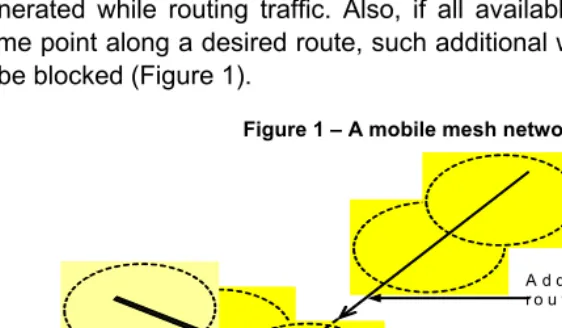
interference and to safeguard quality of service. Secondly, mesh architectures are based on spectrum re-use along traffic routes that can be flexibly designed, but only to a limited degree, due to interference zones generated while routing traffic. Also, if all available capacity is used up at some point along a desired route, such additional wanted route will be likely to be blocked (Figure 1).
Figure 1 – A mobile mesh network
I n t e r f e r e n c e z o n e s
R o u t e u t i l is i n g a l l a v a i l a b l e c a p a c i t y
A d d i t i o n a l w a n t e d r o u t e - b l o c k e d
Source: W. WEBB (2006)
While such technologies are likely to contribute to make more intensive use of spectrum by delivering present services in a new way or using less precious spectrum (i.e. up to 6 GHz) by means of mesh type network architectures, they do not seem to have any specific impact on spectrum trading.
Re-programmable devices, flexibility and interference: the case of software defined radios
Software defined radios (SDR) are a new generation of agile radios that rely very heavily on software in order to operate key radio parameters (i.e. frequency range, modulation type and output power), whereas traditional radio functionalities are mainly implemented at the level of hardware (FCC 2003, par. 82). Therefore SDR are more flexible, as operating parameters can be changed more quickly and conveniently.
The development of SDR can facilitate spectrum sharing in at least two different ways. Firstly, SDR enable carriers to run multiple standards on the same wireless network (hence a reduction in operational costs); secondly, SDR could be used to link networks of licensees authorised to operate their services at different frequencies. For instance SDR might be beneficial for public sector networks delivering safety services (e.g. emergency and police) that, historically, have been allocated various frequencies. SDR would help communicate across all networks 9.
SDR techniques have a potential to support spectrum trading. Indeed, changes in the communications environment, which are likely to follow a trade in spectrum, can be more easily taken into account in a network that deploys SDR by means of software modifications.
Two different scenarios can be envisaged: in the first one, SDR are implemented at the (higher) level of service provider; in the second one, SDR are implemented at the (lower) level of each subscriber device. There might be a trade-off between complexity and speed of adjustment in these two scenarios, following a trade to access spectrum. If SDR systems are implemented at service provider level, the bulk of software adjustments are likely to be necessary at base stations. This might require some time to fine-tune the communications network after the trade, but operations can be expected to be carried on without major disruptions, since adjustments to variations could be easily located and monitored (HARRINGTON et al., 2004).
On the other hand, with subscriber units capable of (and allowed to) determining their own requirements, spectrum trades (with a service provider) could take place almost on a real-time basis, but (very) quick
variations in a network might lead to failures in communications, in particular where systems to continuously monitor such changes are not in place, or are unable to cope with them.
Finally, swift and easy re-programmability of SDR bring a crucial challenge. Radio systems must comply with industry standards and spectrum regulations. Any software upgrade might result in a change of SDR systems such that they do not comply with regulations anymore. Moreover, harmful interference through illegitimate software modification could be either intentional (such as with computer hackers and viruses) or unintentional; either way, it would be exacerbated if the illegitimate modification is implemented into a great number of SDR devices simultaneously (FCC, 2003; MENNENGA, 2005).
Disruptive technologies: cognitive radios and spread spectrum technologies
The virtues - and limits - of SDRs will be incorporated in cognitive radios, which, in their more sophisticated designs, will be able to perform a lot of complex communications tasks in a 'cognitive' way, i.e. exploiting their capabilities to sense the spectrum environment and decide on their behaviour accordingly. In particular, high-level cognitive radios will choose frequencies, transmission power, timing and so forth (Qinetiq, 2006). Hence, they represent an innovative technology with a disruptive potential for spectrum management and regulation. Spread spectrum technology is also challenging the traditional framework of spectrum management, as they need a lot of bandwidth and use low power levels. They also entail a potential shift of spectrum regulation from frequency allocation to power limits, as suggested by the interference temperature concept put forth by the Spectrum policy task force in 2002 (FCC, 2002b) - a measure of the power generated by undesired emitters plus noise sources that are present in a receiver per unit of bandwidth 10.
Cognitive radios
Cognitive radios are a relatively large group of radios with different degrees of ‘intelligent' behaviour (SHUKLA, 2006). Devices with basic capabilities of cognitive behaviour are already on the market (e.g. wireless LAN devices and CDMA networks). Nevertheless, major challenges and opportunities are expected by the development of complex radios that are still in their technological infancy. All cognitive radios have the fundamental feature of being able to sense their environment (i.e. to monitor transmissions across a wide bandwidth) and, in particular, to exploit spectrum swaths - so-called white spaces - which appear to be (momentarily) unused (AKYILDIZ et al., 2006; Qinetiq, 2006). Hence, a cognitive radio's ability to define frequency, time, geographic location and power levels is crucial.
Opportunities to use spectrum more intensively might therefore flourish with cognitive radio access, subject to the design of an appropriate spectrum management framework that does not frustrate the development of such a new generation of devices (FCC, 2003; BRODERSEN et al., 2004). In particular, cognitive radios might enable the sharing of spectrum with licensed operations when the licensee is under-using the spectrum or if his operations do not suffer too much interference (Red-M & partners, 2006) - a form of sharing spectrum that is often referred to as overlay sharing 11.
Although cognitive radios might be deployed by a spectrum user to further exploit the resources he is already entitled to access, spectrum sharing by multiple users is a more relevant and challenging development of cognitive radios (Qinetiq, 2006).
The sharing of licensed spectrum between a licensed (primary) user and cognitive radios (secondary users) is also defined vertical spectrum sharing (PEHA, 2006): in fact, users are on different levels with regards to their rights to access shared spectrum (WWRF, 2005). If both users are licensed, co-ordination between primary and secondary users is likely to enable exclusive but interruptible access to spectrum by the secondary user (FCC, 2003) - e.g., the primary user offers public safety services, whereas the secondary user is a cellular operator whose services are not affected too heavily by occasional interruptions.
Horizontal sharing, i.e. the sharing of spectrum between peer users, is commonplace in unlicensed bands and, in general, identifies shared use of spectrum by cognitive radios with the same regulatory status, even though they are not designed to communicate with each other directly (WWRF, 2005).
To support an orderly access to shared spectrum by cognitive radios enjoying peer level, rules (such as protocols and etiquettes) to regulate horizontal sharing may be necessary. With vertical sharing, priorities in access to spectrum are defined and various approaches can regulate access to spectrum that is under-used by a primary user. The FCC (2004), for example, has put forward three options: a listen-before-talk approach, a location-based database of used frequencies and a system of dedicated beacon transmitters to identify temporarily vacant spectrum. In particular, beacon signals may be sent by a primary user to assist cognitive radios and reduce risk of harmful interference.
The interest of cognitive radio is limited when frequency bands are heavily used. If a cognitive radio cannot find vacant spectrum, it is unable to transmit; hence, in bands where the probability of cognitive access falls too low, cognitive radios would become of little value to users. This would also reduce incentives to trade with (or among) primary users.
Where spectrum is used on an exclusive basis, parties could negotiate ways to access frequencies any time a cognitive radio technology (deployed, for instance, in the radio systems of the lessee) senses white spaces available for transmissions. Thus, cognitive radios might also enable dynamic (real-time) spectrum management scenarios.
Negotiations between parties would be crucially based on the capabilities of cognitive radios to sense their surroundings and transmit accordingly (thus enabling frequency re-use, but without causing intolerable interference to the operations of other users). Thereby, parties would have to address the so called hidden terminal problem, i.e. interference problems arising from the failure of cognitive radio technology to spot a legitimate use of spectrum behind a physical obstacle - e.g. a building (CAVE & WEBB, 2003; HAARTSEN et al., no date) 12.
At this stage of cognitive radio development, the hidden terminal problem suggests that cognitive radios might work best where the (primary) licensee provides approval of cognitive access by others and broadcasts some form of beacon signal to indicate whether the spectrum can be (temporarily) accessed. By providing license holders with the right to sub-lease their spectrum, this form of access would become possible (FCC, 2003). Indeed, sub-leasing is considered by many to be part of the package of rights needed for spectrum trading. In the absence of market failures 13, primary
users should not be obliged to trade with secondary users, for only spontaneous trades between parties can bring about mutual benefits and efficiency gains.
Spread spectrum technologies
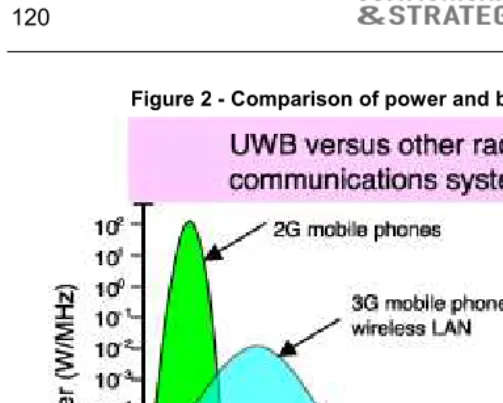
Spread spectrum technologies attempt to share spectrum with other users by arranging the trade-off between power and bandwidth in ways that allow the use of broad swaths of frequencies with low power transmissions (Figure 2). Indeed, electro-magnetic waves can be transmitted at different frequencies and the distance they propagate depends, on the one hand, on the frequency (the higher the frequency the lower the propagation distance) and, on the other hand, on the transmitter power (the higher the power the higher the propagation distance).
Shared spectrum can be either licensed or licence-exempt spectrum. If spread spectrum technologies are deployed in a number of devices that operate in the same spectrum (in particular, in unlicensed bands), then the crucial aspect for efficient and effective spectrum sharing will be the design of protocols, etiquettes or other rules that will enable these devices to simply co-exist, co-ordinate or, possibly, co-operate with each other 14. For spread
spectrum technologies that can access licensed spectrum (used by operators who offer different services with a wide range of technologies) it is crucial to establish a noise-floor such that spread spectrum technologies will generate a tolerable level of interference to neighbouring applications 15.
13 For instance, a cognitive radio might be used in a scenario where a service provider must interrupt his or her operations within milliseconds upon reception of a signal by an emergency service device.
14 Short-range, high data rate consumer applications are the focus of present commercial
attention, as expressed in the contentious 802.15.3a standard (see BRODERSEN et al., 2006).
Figure 2 - Comparison of power and bandwidth for a few systems
Source: B. BUSROPAN (2007)
As spread spectrum technologies transmit over a (very) wide part of the spectrum, at (very) low power, spectrum trading seems unviable: in order to minimise potential interference problems, users of such technologies should negotiate with a number of (licensed) users across the spectrum they need (Ofcom, 2005b). For instance, UWB transmissions require a minimum of around 500 MHz for a data rate of about 200 Mbits/s and it is very unlikely that someone (e.g. a private band manager) could acquire such a broad swath of spectrum, in particular in the most congested frequency bands 16.
Therefore transaction costs would be prohibitive.
Concluding remarks and future research
Innovative technology offers opportunities to promote spectrum access and increase its usage. This will most likely happen in two ways: by enhancing the performance of traditional communications devices, or by enabling new methods to access the radio frequency spectrum. The latter seems the more relevant and challenging way to reduce artificial scarcity of
spectrum, which is the crux of the debate about the reform of its management framework.
Emerging technologies promise ways to make spectrum usage more intensive. However, with more systems able to access the spectrum, risks of harmful interference might be greater. In the absence of market mechanisms, uncertainty about net benefits, which the technology developments discussed might offer, are great. Nevertheless, disruptive technology should not be rejected because it might be harmful for current spectrum-using services.
References
AKYILDIZ I.F., LEE W.-Y., VURAN M.C. & MOHANTY, S. (2006): "Next Generation/Dynamic Spectrum Access/Cognitive Radio Wireless Networks: A Survey", Computer Networks, vol. 50 (13), pp. 2127-2159.
AKYILDIZ, I.F., WANG X. & WANG W. (2005): "Wireless Mesh Networks: A Survey", Computer Networks, vol. 47 (4), pp. 445-487.
Analysys, Dotecon & Hogan and Hartson (2004): Study on Conditions and Options in Introducing Secondary Trading of Radio Spectrum in the European Community. Final Report for the European Commission, no place [but Cambridge], Analysys.
Analysys & Mason (2005): Spectrum Demand for Non-Government Services 2005-2025. Final Report for the Independent Audit of Spectrum Holdings, London, Analysys.
BAUMOL W.J. & ROBYN D. (2006): Toward an Evolutionary Regime for Spectrum Governance, Washington, D.C., AEI-Brookings Joint Centre for Regulatory Studies.
Booz Allen Hamilton (2006): Thriving in Harmony, www.umts-forum.org.
BRODERSEN R.W., ČABRIĆ D., MISHRA S.M., WILLKOMM D. & WOLISZ A. (2004): CORVUS: A Cognitive Radio Approach for Usage of Virtual Unlicensed Spectrum, mimeo.
BRODERSEN R.W., ČABRIĆ D., O'DONNELL I.D. & SHUO-WEI CHEN M. (2006): "Spectrum Sharing Radios", IEEE Circuits and Systems Magazine, 2nd Quarter, pp. 30-45.
BUSROPAN B. (2007): "Technological Developments and Their Impact on Spectrum Management", presentation at Sportviews Final Conference, Brussels, March 16, www.sportviews.org.
CAVE M. & WEBB W. (2003): "Designing Property Rights for the Operation of Spectrum Markets", Papers in Spectrum Trading, no. 2, University of Warwick (UK), Warwick Business School.
Foster R. & Kiedrowski T. (Eds.), Communications: The Next Decade, London, Ofcom, pp. 220-234.
CCLRC/RCRU-Radio Communications Research Unit - Spectrum Efficiency Scheme (2006): Efficient Fixed Mesh Networks, Chilton, Didcot, RCRU.
CEPT–Conférence Européenne des Administrations des Postes et des Télécommunications (2006): Enhancing Harmonisation and Introducing Flexibility in the Spectrum Regulatory Framework, Oulu, CEPT.
EC-European Commission:
- (2005): A Forward-Looking Radio Spectrum Policy for the European Union: Second Annual Report, COM (2005) 411 final, Brussels, European Commission.
- (2007): Rapid Access to Spectrum for Wireless Electronic Communications Services Through More Flexibility, COM (2007) 50 final, Brussels, European Commission.
FAULHABER G.R.:
- (2005): "The Question of Spectrum: Technology, Management, and Regime Change", Journal on Telecommunications and High Technology Law, vol. 4 (1), pp. 123-182.
- (2006): "Wireless Telecommunications: Spectrum as a Critical Resource", Southern California Law Review, vol. 79, pp. 537-559.
FCC-Federal Communications Commission:
- (2002a): Report of the Spectrum Efficiency Working Group, Washington, D.C., FCC.
- (2002b): Report of the Spectrum Policy Task Force, ET Docket no. 02-135, Washington, D.C., FCC.
- (2003): "Facilitating Opportunities for Flexible, Efficient, and Reliable Spectrum Use Employing Cognitive Radio Technologies". Notice of Proposed Rule Making and Order, FCC 03-322, ET Docket no. 03-108, Washington, D.C., FCC.
- (2004): "Unlicensed Operation in the TV Broadcast Bands". Notice of Proposed Rule Making, FCC 04-100, ET Docket no. 04-186, Washington, D.C., FCC.
HARRINGTON A.S., HONG C.G. & PIAZZA A.L. (2004): Software Defined Radio: The Revolution of Wireless Communication, Ball State University, mimeo.
HAARTSEN J.C., WIEWEG L. & HUSCHKE J. (no date): Spectrum Management and Radio Resource Management Considering Cognitive Radio Systems, mimeo.
HAZLETT T.W. (2006): "An Economic Evaluation of Spectrum Allocation Policy", in Richards E., Foster R. & Kiedrowski T. (Eds.), Communications: The Next Decade, London, Ofcom, pp. 249-258.
MENNENGA H. (2005): "Regulatory Activity in the Area of SDR in Europe", presentation at the Global Regulatory Summit on SDR and Cognitive Radio, Washington, D.C., June 21-24, www.sdrforum.org.
MINERVINI F. & PIACENTINO D. (2007): "Spectrum Management and Regulation: Towards a Full-Fledged Market for Spectrum Bands?", University of Macerata, DiSSE, working paper no. 7.
Ofcom-Office of Communications:
- (2004): Spectrum Framework Review, London, Ofcom. - (2005a): Technology Research Programme, London, Ofcom.
- (2005b): Ultra Wideband: Summary and Reaction to Responses Received to the Consultation, London, Ofcom.
PEHA J.M. (2006): "Competing Models for Spectrum Sharing", presentation at the National Academy of Sciences, Washington, D.C., February 28, www.ece.cmu.edu.
Plextek, Spectrum Trading Associates & UCL Consultants (2006): Study on Efficient Mobile Mesh Networks, Great Chesterford, Plextek.
POGOREL G. (2007): "Regulation and Competition: Nine Regimes of Radio Spectrum Management: A 4-Step Decision Guide", COMMUNICATIONS AND STRATEGIES, no. 65, pp. 167-183.
Qinetiq:
- (2005): Bandsharing Concepts, Farnborough, Qinetiq.
Red-M & partners (2006): Improving the Sharing of the Radio Spectrum: Final Report, no place [but Horsham], Red-M.
RICHARDS E., FOSTER R. & KIEDROWSKI T. (Eds) (2006): Communications: The Next Decade, London, Ofcom.
Shared Spectrum Company (2005): NSF Spectrum Occupancy Measurements Project, http://www.sharedspectrum.com.
SHUKLA A. (2006): "Emerging Technologies: Definitions, Technological Trends and Timescales", presentation at the first Sportviews Workshop, Paris, June 22, www.sportviews.org.
TONMUKAYAKUL A. & Weiss M.B.H. (2004): "Secondary Use of Radio Spectrum: A Feasibility Analysis", University of Pittsburgh, School of Information Sciences, working paper.
WEBB W. (2006): "Innovative Technology and its Impact on Spectrum Management", presentation at the first Sportviews Workshop, Paris, June 22, www.sportviews.org.