© 2018, IRJET | Impact Factor value: 6.171 | ISO 9001:2008 Certified Journal | Page 194
EXPERIMENTAL STUDY OF PARTIAL REPLACEMENT OF CEMENT AND
COARSE AGGREGATE WITH FLY ASH AND COCONUT SHELL
LAVANYA B.A
1, SUNITHA M.S
2, UMESHA .P
3, CHETHAN H.H
41
Assistant professor, Dept. of Civil Engineering, CIT, Gubbi, Tumakuru,
2,3,4
BE Student, Dept. of Civil Engineering, CIT, Gubbi, Tumakuru.
---***---Abstract
- Properties of concrete with partial replacement of coconut shell as coarse aggregate and fly ash as replacement of cement is studied. In this study M25 grade of concrete was made. Concrete mix of 10%, 20%, 30% and 40% replacement of coconut shell as coarse aggregate and constant replacement of 30% of fly ash were made. Water cement ratio of 0.45 was maintained for all the mix proportions. Properties like compressive strength, split tensile strength and flexural strength were studied at 7, 14, 28 days.Key Words
: Coconut shell, Fly ash, Compressive strength, Split tensile strength, Flexural strength, etc…1. INTRODUCTION
Civil engineers are the backbone of any developing country’s development of infrastructures. Today due to the development of the infrastructure the need of concrete has been increased at high rate. Concrete is important construction materials that have been widely used all over the world. The use of concrete has been increasing day by day. Due to this some negative impacts are there in production of concrete such as coarse aggregate extraction from natural resources, scarcity of river sand it leads to depletion of materials and ecological imbalance. Various researches have been found that replacement for coarse aggregate. The use of plastic, paper and pulp industry waste, textile waste, rice ash, recycled rubber tyres, broken bricks are some examples for replacing aggregate in concrete. Coconut shell is an agricultural by product which can be used as coarse aggregate in concrete. According to report made in 2016 India is the third largest coconut producers in world. India produces of about 119 million tonnes of coconut every year. The coconut shells are accumulated in land and get degraded around 100-120years. Due to this, a serious environment problem of disposal of coconut shells occurs. So to minimize this coconut shell can be used as aggregate in concrete. The main aim of this project is to study the strength of coconut shell concrete with different replacement percent. Also to attempt has been made to study the suitability of fly ash in concrete.
1.1 AIM AND OBJECTIVE
The aim of study is to evaluate the performance and suitability of coconut shell in concrete with as alternative for coarse aggregate.
To evaluate the compressive strength, split tensile strength, and flexural strength of concrete with replacement
of cement and coarse aggregate with fly ash and coconut shell.
The objectives of experimental study are:
Study on strength characteristics of M25 grade concrete with replacement of 10%, 20%, 30% and 40% of coarse aggregate by coconut shell
To determine the %, strength of concrete at 7, 14, 28 days.
Steel fibers are used to increase the flexural and tensile strength of concrete.
Admixture is used to minimum the water cement ratio and to achieve the workability.
2. MATERIALS USED
2.1 CEMENT
Locally available 53 grades ordinary Portland cement (OPC) of ULTRATECH brand has been used in the present investigation for all concrete mixes. The cement used was fresh and without any lumps.
2.2 FINE AGGREGATE
Fine sand should consist of natural sand or crushed stone sand. It should be hard, durable and clean and be free from organic matter etc. Fine Sand should not contain any appreciable amount of clay balls and harmful impurities such as alkalis, salts, coal, decayed vegetation etc. Locally available river sand is used in experiment which is passing through 4.75mm IS sieve and retained on 75 micron IS sieve.
Table-1: Properties of fine aggregate
Properties Results
© 2018, IRJET | Impact Factor value: 6.171 | ISO 9001:2008 Certified Journal | Page 195
2.3 COARSE AGGREGATE
[image:2.595.59.272.225.342.2]Aggregate generally occupy 70% to 80 % of volume of concrete and therefore it have an important influence on its properties of concrete. Coarse aggregate was used of size 20mm conforming to IS 383 is used. Good-quality of aggregate which is clean, hard, strong, have durable particles, and be free of absorbed harmful chemicals, coatings of clay, or other contaminates that can affect hydration of cement or reduce the paste-aggregate bond.
TABLE- 2: Properties of coarse aggregate
Properties Results
Specific gravity 2.70 Water absorption 0.29% Maximum size 20mm Minimum size 12.5mm Impact value 15.65 Crushing value 6.52
2.4 COCONUT SHELL
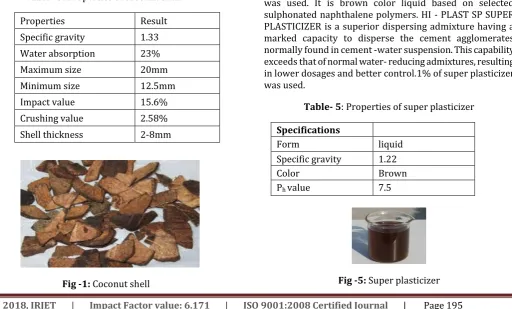
Coconut shell is an abundantly available waste material which can be used as potential or replacement material in the construction. Coconut shell passing through 20mm IS sieve and retaining on 12.5mm IS sieve. Coconut shell are soaked in water for 24hours and then used in concrete as coconut shells have more water absorption than coarse aggregate.
Table -3: Properties of coconut shell
Properties Result Specific gravity 1.33 Water absorption 23% Maximum size 20mm Minimum size 12.5mm Impact value 15.6% Crushing value 2.58% Shell thickness 2-8mm
Fig -1: Coconut shell
2.5 FLY ASH
Class f fly ash from RMC Ready Mix Plant at Hootagalli Industry area Mysore. Fly ash conforms to requirements of IS 3812 part 1. The use of fly ash as a partial replacement for Portland cement will usually reduce water demand. Usually strength development is very slow due to pozzolanic reaction of fly ash. Later age strength is higher. Class f fly ash reduces alkali -silica reactivity because of the dense structure and hence expansion is reduced which increases durability. The pozzolanic reaction between fly ash and lime generates less heat, resulting in reduced thermal cracking when fly ash is used to replace a percentage of Portland cement.
Table -4: properties of fly ash
Specifications
Specific gravity 2.22
Color Whitish grey
Fig-2: Fly ash
2.6 SUPER PLASTICIZER
HI - PLAST SP IS A HIGH RANGE WATER reducing admixture was used. It is brown color liquid based on selected sulphonated naphthalene polymers. HI - PLAST SP SUPER PLASTICIZER is a superior dispersing admixture having a marked capacity to disperse the cement agglomerates normally found in cement -water suspension. This capability exceeds that of normal water- reducing admixtures, resulting in lower dosages and better control.1% of super plasticizer was used.
Table- 5: Properties of super plasticizer
Specifications
Form liquid Specific gravity 1.22 Color Brown Ph value 7.5
[image:2.595.327.540.266.422.2][image:2.595.44.557.483.792.2]
© 2018, IRJET | Impact Factor value: 6.171 | ISO 9001:2008 Certified Journal | Page 196
2.7 STEEL FIBRE
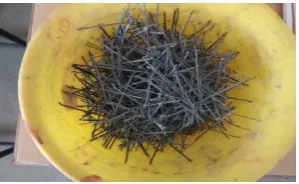
[image:3.595.87.237.203.295.2]We are using hooked steel fibre. Generally it includes mild steel, galvanized iron, low carbon. Steel fibres are made under strict quality control process and gives excellent strength and durability to concrete eliminating cracking. End hooked fibre are used in this experiment which having 30mm length and 0.5mm diameter. Significant use of steel fibre is to improve flexural strength. 1% of steel fibres used in experimental study.
Fig -4: Steel fiber
3.0 MIX DESIGN
Concrete mix of M25 grade was designed by conforming to IS 10262-1982 method. The coarse aggregate were replaced with coconut shell by 10%, 20%, 30% and 40%.30% of fly
ash with cement. 0.45 water cement ratio was kept constant.
Table -6: Mix proportion
cement Fine
aggregate Coarse aggregate Water cement ratio
Ratio 1 2.23 2.85 0.45 Mass
kg/m3 385 862 1097 140
Mixes:
M1= normal concrete
M2= 0% of CS+30% of FA+1% SP+1% SF
M3=10% of CS+30% of FA+1% SP+1% SF
M4=20% of CS+30% of FA+1% SP+1% SF
M5=30% of CS+30% of FA+1% SP+1% SF
M6=40% of CS+30% of FA+1% SP+1% SF
Where, CS= Coconut shell
FA= Fly ash
SP= super plasticizers
SF= Super fibres
4. CASTING, CURING AND TESTING OF SPECIMEN
Cement, fine aggregate and coarse aggregate of mix proportion 1:2.23:2.85 were taken corresponding to M25 grade concrete. Coconut shell as partial replacement of coarse aggregate and fly ash as cement were used. Batching of materials as per mix design is done by weigh batching. All ingredients are first dried mixed then water and super plasticizers added. Machine mix is done to get homogenous mixture. Then the mixture is poured into specimens. Vibrators are used for compaction. After vibration the surface of specimen is leveled using trowel. Specimens are kept for drying for 24 hours and then specimen were demoulded. Specimens are then kept for curing. Curing is done 7, 14, 28 days.
Testing of specimen: The 9 cubes for each proportions were tested for compressive strength of size 150 × 150 × 150 mm. 6 cylinders for each proportions of size 150mm diameter and 300mm length were casted and used for testing split tensile strength and 6 beams for each proportions of size 500mm length, 100mm width and 100mm depth were casted and used for testing flexural strength at 7, 14, 28 days curing.
4.1 COMPRESSIVE STRENGTH TESTS
Specimens of size 150 × 150 × 150 mm were casted for all the proportions and tested in compression testing machine. Capacity of machine is 2000KN.Compressive strength calculated by using equation,
F=P/A
Where, F= compressive strength in N/mm2
P= maximum load in Newton
A= cross sectional area in mm2
Table-6: Shows the average compressive strength at various proportions
Mix proportion s
7days compressiv e strength in N/mm2
14days compressiv e strength in N/mm2
28days compressiv e strength in N/mm2
Normal
[image:3.595.309.565.587.751.2]© 2018, IRJET | Impact Factor value: 6.171 | ISO 9001:2008 Certified Journal | Page 197
Fig-3: Average compressive strength for various proportions
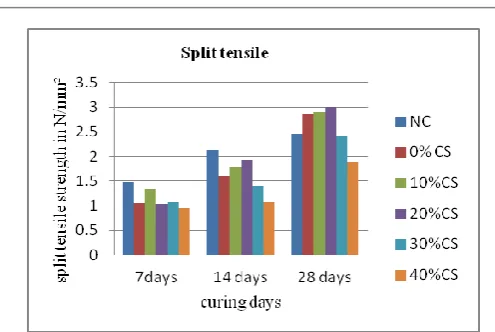
4.2 SPLIT TENSILE STRENGTH TESTS
Specimen of size 150 mm diameters and 300mm length were casted. The test was conducted on the Compression Testing Machine. Cylinder specimens were placed under the Compression Testing Machine in a horizontal direction perpendicular to the direction in which they are casted. The tensile strength was found by using equation,
F = 2P/ΠLd
Where, F=tensile strength in N/mm²
P = Maximum load applied
d = measured depth of specimen
L= Length of specimen
Table -7: Shows the average tensile strength of concrete at various proportions
Mix
proportions 7days split tensile strength in N/mm2
14days split tensile strength in N/mm2
28days split tensile strength in N/mm2
Normal
[image:4.595.39.289.60.241.2]concrete 1.48 2.12 2.45 0% 1.05 1.61 2.85 10% 1.34 1.80 2.90 20% 1.04 1.93 3.0 30% 1.06 1.40 2.4 40% 0.95 1.09 1.90
Fig -4: Average split tensile strength for various proportions
4.3 FLEXURAL STRENGTH TESTS
Concrete as we know is relatively strong in compression and weak in tension. Beams tests are found to be dependable to measure flexural strength property of concrete. The system of loading used in finding out the flexural tension is two points loading. The specimen placed in flexural testing machine in such a manner that the load to be applied to uppermost surface as cast in the mould. The flexural strength was found by using equation,
F = PL/bd2
Where, F=Flexural strength in N/mm²
P = Maximum load applied
L = Length of specimen
b = breadth of specimen
d = depth of specimen
Table -8: shows the average flexural strength at various proportions
Mix
proportions 7days split tensile strength in N/mm2
14days split tensile strength in N/mm2
28days split tensile strength in N/mm2
Normal
concrete 3.40 4.35 6.2 0% 3.75 3.75 6.9 10% 3.75 7.50 8.45 20% 3.75 7.9 9 30% 3.0 4.75 6.1
[image:4.595.307.555.65.231.2]© 2018, IRJET | Impact Factor value: 6.171 | ISO 9001:2008 Certified Journal | Page 198
Fig5: Average flexural strength for various proportions
5. RESULTS AND DISCUSSION
From the experimental analysis, it is an evident that at age of 7, 14, 28 days fig 1,2,3 shows the compressive strength, split tensile strength and flexural strength increases as a percentage of coconut shell is increased. For the further increases of coconut shell the strength decreased. Optimum strength obtained at 20% replacement of coconut shell as coarse aggregate.
6. CONCLUSIONS
Coconut shells can be used as partial replacement for coarse aggregate up to percentage of 10, 20, and 30. More than the 30% replacement decreases in strength is seen. For optimum result the 20% replacement coconut shell is good.
a. It was found that without addition of fly ash; only by replacement of coconut shell strength has decreased at 10% and 20% when compared to normal concrete.
b. When fly ash was replaced for cement along with coconut shell as coarse aggregate replacement the strength property was improved.
c. Light weight concrete can be produced by using coconut shell as coarse aggregate.
d. Increase in percentage of coconut shell, decrease the densities of concrete.
e. Coconut shell with 20% replacement shows a higher strength than normal concrete.
REFERENCES
[1] Akshay S. Shelke, Kalyani R. Ninghot, Pooja P. Kunjekar,
Shraddha P. Gaikwad (2014) International Journal of Civil Engineering Research, “coconut shell as partial replacement for coarse aggregate”.
[2] B.Damodhara Reddy, S.Aruna Jyothy, Fawaz Shaik
(2014) IOSR Journal of Mechanical and Civil
Engineering, “experimental analysis of the use of coconut shell as coarse aggregate”.
[3] Dr. B. Rajeevan and Shamjith K M (2014) International
Journal of Engineering Research & Technology (IJERT), “a study on the utilization of coconut shell as coarse aggregate in concrete”.
[4] Jyothi Kamal and J.P. Singh (2015) International Journal
of Innovative Research in Science, Engineering and Technology, “experimental study on strength characteristics of m20 concrete with partially replacement of coarse aggregate with coconut shell and cement with fly ash”.
[5] Md Taqiuddin, Nikita Munigal, Imtiyaaz Ahmed,
Sharnappa (2015) International Journal for Innovative Research in Science & Technology, “study on strength characteristics of concrete with partial replacement of cement with fly ash and coarse aggregate with coconut shell”.
[6] R. Thenmozhi and N. Balasubramani (2015) Nature
Environment and Pollution Technology, “Experimental Study on Self Compacting Concrete (M25) with 25% Fly ash Incorporating 10% Replacement of Coconut-Shell as Coarse Aggregate”.
[7] R. D. Padhye, N. S. Deo (2016) International Journal of
Engineering Research, “cement replacement by fly ash in concrete”.
[8] Shrikant M. Harle (2017) Journal of Research in
Engineering and Applied Sciences, “partial replacement of coarse aggregate with coconut shell in the concrete”.
CODE BOOK