SVM based Signature Verification by Fusing Global and
Functional Features
Biswajit Kar
Department of Electrical Engineering, IIT, Kharagpur, India.
Pranab. K. Dutta
Department of Electrical Engineering, IIT, Kharagpur, India.
ABSTRACT
On-line signature verification can be used in real time applications like credit card transactions or resource accesses because of its popularity in regular authentication. In signature verification number of signatures avalible to train a model is very limited, and therefore identification of the most suitable features which characterize the class is critical. Therefore feature selection is essential to minimize the classification error. The mRMR (minimum Redundancy Maximum Relevance) method is applied to select the features. Verification is based on global features and scores from functional features. The scores are generated by comparing the functional features of the test signature with the corresponding reference features. These scores are treated as additional features in a two-class classification problem solved with the ANN and SVM. Verification accuracy is enhanced by fusion of user specific global and functional features. The methods are tested with the database of SVC2004.
Keywords
Support vector machine, On-line signature verification, Feature selection, mRMR.
1.
INTRODUCTION
Automatic signature verification is a commonly used form of biometric verification and identification, because of wide spread acceptance of static signature in the application of personal authentication, document certification for a very long time in manual verification [1]. It can be predicted that as the technology enhances online signature will be one of the important means of biometric in this field with good user acceptance. The online context is more desirable to prevent imitation. An impostor can imitate visible shape of the signature, but it is nearly impossible to achieve the imitation of dynamic content of the signature, which is embed in the gesture of signing and is very personal.
2.
LITERATURE REVIEW
One of the first publications on on-line signature verification was by Herbst and Liu [2]. In this paper handwriting was modeled as ballistic motions that do not involve sensory feedback. Extensive literature is available in the field of online (dynamic) signature verification. A survey of signature verification can be found in [3-5].
Leclerc and Plamondon categorized the various signature verification methodologies into two types: functional approach and parametric approach [4]. In the function-based
approach, online signatures are characterized and analyzed as time sequences (e.g., position trajectory, velocity, acceleration, pressure, direction of pen movement, and azimuth) [6].
In general, function-based features show better discriminating ability than the parameter-based features but they usually require time-consuming algorithm for comparison. However, the work by Aguilar et al. reported that the parametric approaches are equally competitive with the function based approaches [7]. In parametric approaches, the authenticity of a test signature is estimated by comparing test feature set against reference feature set. Each matching method is based on similarity (or dissimilarity) measurement. In the parameter based approach, one commonly used distance measure is Euclidean distance [6]. The verification methods are based on Neural Networks (NN) [8], Hidden Markov Model (HMM) [9], and Support vector machine (SVM) are mostly used [10-11].
Function-based approaches can be classified into local and regional methods. In local approaches, the time functions of different signatures are directly matched by using elastic matching technique such as dynamic time warping [12-16]. However, the time complexity of DTW is of . In the case of function-based approach, the matching methods must take care of the phase shift and non-linear distortion of functions.
A popular technique used for signature verification is the SVM. With the help of training examples from two classes, an SVM search the maximum separating hyperplane. In [11], comparison of SVM classifiers with HMM classifiers is carried out in terms of the number of samples used for training and verification using different types of forgeries. Under both conditions, SVM appears to produce better result. However, the main limitations of SVMs are high algorithmic complexity and extensive memory requirements in large-scale tasks.
Signature verification schemes based on Neural Network are also proposed [8]. Although, the neural network-based approaches have the capabilities in generalization, the drawback is the need for a large number of genuine and forgery signatures for training, which is not always practically viable.
and at the same time the inter class variability is to be preserved. To reduce the intra class variation and keeping the discriminatory feature, it is better to normalize the signature in the function domain before feature extraction and matching. The fusion of function and feature based verification score gives better accuracy. Selection of the consistent statistical feature is a great challenge in feature based verification [17].
3.
ONLINE SIGNATURE
VERIFICATION SYSTEM
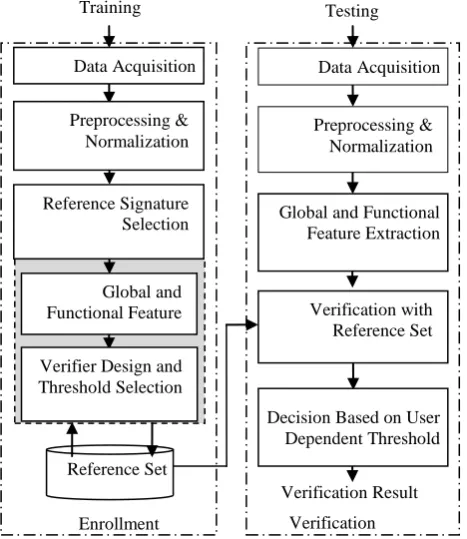
A diagram of a general signature verification system is shown in Fig. 2.
Signature verification systems are generally divided into two modules: Signature enrollment or training module and signature verification or testing module. A signature verification system must provide a solution to the problems of data acquisition, preprocessing and normalization, reference signature selection, feature extraction, matching, and performance evaluation. Out of these feature selection and verification methods have been considered in this paper. Detail discussion of other modules is beyond the scope of this paper.
4.
DATABASE
First international signature verification competition (SVC2004) was held as a step towards establishing common benchmark databases and benchmarking rules [18]. For each of the two tasks of the competition, a signature database involving 40 sets of signature data was created, with 20 genuine signatures and 20 skilled forgeries for each set. Experimental results have been conducted using the Task 1
[image:2.595.319.538.103.269.2]SVC2004 database. Shape of online signature and its associated function are shown in Fig, 1.
Figure 1: On-line signature shape and its associated functions from SVC2004 database
5.
FEATURE EXTRACTION
Both global feature and functional feature are used here for verification.
5.1
Global Feature Extraction
In the global parametric approach, a fixed set of parameter is extracted to describe a signature pattern. More importantly, this approach is expected to be more stable against the variations in local regions, which are common in signatures. The difficulty with this approach lies in selecting the salient parameters that can distinguish between the classes and are consistent among the same set. The major limitation of this approach lies in its discriminative ability [19-20]. An averaging effect arises in calculating the parameters over the whole pattern. Although this effect is obviously the reason for the above-mentioned stability, the parameters selected from a small set of signers may not work well on a larger set of signers [19].
However, verification with global features of a signature has several advantages. It is simple to compute and address the concerns related to privacy because it does not need to retain the original signature once the features are extracted. In total 48 global features are calculated here for every signature.
5.2
Functional Feature Extraction
In the functional approach, complete signals [ etc, where, is index of the signature samples] directly or indirectly constitute the feature set. The two signals, one from the reference signature and the other from the test signature, are then compared point-to-point or segment-to-segment basis [21]. The challenge within this approach is that two signals are likely to have different durations and also undergo non-linear distortions.
Seventeen signature functions (local features) are taken for score generation. Three measures are estimated for comparison, namely 1) correlation coefficient 2) DTW Data Acquisition
Preprocessing & Normalization
Global and Functional Feature Extraction Data Acquisition
Preprocessing & Normalization
Reference Signature Selection
Global and Functional Feature Extraction
Verifier Design and Threshold Selection
Reference Set
Enrollment Verification
Figure 2: General model of online signature verification Verification with
Reference Set
Decision Based on User Dependent Threshold
Verification Result Training
Signatures
Testing
[image:2.595.56.290.232.502.2]distance 3) Euclidean distance. From the outputs of three measures total scores are estimated.
6.
FEATURE SELECTION
In signature verification number of sample signature avalible to train a verifier model is very limited [22], whereas number of avalible features (or attributes) are very large compared to the sample data. Feature vector with very large dimensionality leads to th curse of dimensionality problem [23]. Identification of the most suitable features of the oserved data which characterize the class is also critical. Therefore feature selection is very essetial to minimize the inconsistancy in classification.
6.1
Feature Selection by mRMR Method
In an unsupervised situation minimal error usually requires the maximal statistical dependency of the target class, say C, on the data distribution [22, 24]. The method of Minimum Redundancy Maximum Relevance (mRMR) has been proposed by Peng et al. [22].
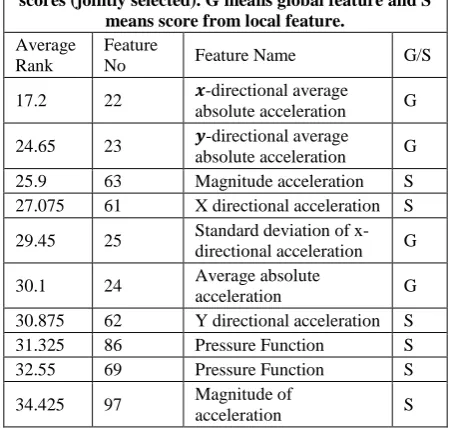
[image:3.595.313.544.82.263.2]One of the most popular approaches to realize maximum dependency is maximum relevance feature selection, i.e., selecting the features with the highest relevance to the target class C. Relevance is usually characterized in terms of correlation or mutual information. Results of global feature selection by mRMR method are shown in Table 1. Out of 48 features, 10 best selected features using mRMR method is shown in Table 1.
Table 1: 10 common selected features
Average Rank
Symbol
used Name and description.
9.45
acceleration -directional average absolute
13.85
acceleration -directional average absolute
15.1
Standard deviation of acceleration -directional
15.7
Average absolute acceleration
16.625
Average pen pressure
18.075
Standard deviation of the phase
18.45
Median of writing pen pressure
18.575
Entropy of shape signature function
18.65
Standard deviation of acceleration
18.775 Duration of the complete writing process in ms
[image:3.595.51.279.439.688.2]Out of 51 scores, 10 common selected scores using mRMR method is shown in Table 2.
Table 2: 10 common selected functional scores
Average Rank
Feature Name and Description.
Matching Method
13.325 X directional acceleration
Correlation efficient
13.675 Pressure Function Euclidean Distance
13.875 Absolute acceleration Correlation Coefficient
13.875 Pressure function DTW Distance
15.575 Y directional acceleration
Correlation Coefficient
16.4 Absolute acceleration Euclidean Distance
17.075 Pressure function Correlation Coefficient
17.55 Time function DTW Distance
17.6 Time function Euclidean Distance
19.375 Magnitude of change in XY coordinate
Euclidean Distance
In global feature and functional score concatenated . First 48 features are global features and rest 51 features are scores as explain above. Feature number 63 corresponds to score feature number Magnitude of overall acceleration with correlation score. Feature number corresponds to X directional acceleration with correlation score. Similarly feature number 97 corresponds to score feature number Magnitude of acceleration with Euclidean distance score. Out of 99 (global features and scores respectively concatenated), 10 best selected features and scores method are shown in Table 3 using mRMR method.
Table 3: 10 common selected features and functional scores (jointly selected). G means global feature and S
means score from local feature.
Average Rank
Feature
No Feature Name G/S
17.2 22 -directional average
absolute acceleration G
24.65 23 -directional average
absolute acceleration G
25.9 63 Magnitude acceleration S
27.075 61 X directional acceleration S
29.45 25 Standard deviation of
x-directional acceleration G
30.1 24 Average absolute
acceleration G
30.875 62 Y directional acceleration S
31.325 86 Pressure Function S
32.55 69 Pressure Function S
34.425 97 Magnitude of
acceleration S
Average rank has been computed as the mean of ranks corresponding to all 40 users in SVC2004 database.
7.
SUPPORT VECTOR MACHINE
[image:3.595.308.537.444.658.2]there is only one that maximizes the margin (maximizes the distance between the nearest data point of each class) as shown by bold line in Fig. 3. This is termed as the optimal separating hyperplane.
Figure 3: Optimal separating hyperplane
7.1
The Optimal Separating Hyperplane
Consider the problem of separating the set of training vectors belonging to two separate classes
with a hyperplane:
The separating hyperplane is said to be optimum if the distance between the closest vectors to the hyperplane is maximal and the separation is without error. There is some redundancy in Eq. 3, and it is appropriate to consider a canonical hyperplane [25-26], where the parameters are given by,
A separating hyperplane in canonical form must satisfy the following constraints,
The distance of a point x from the hyperplane is,
The optimal hyperplane is given by maximizing the margin, , subject to the constraints of Eq. 5. The margin is given by,
The maximization of can be implemented by minimizing a function , where
It is independent of because provided Eq. 5 is satisfied (i.e. it is a separating hyperplane) changing b will move it in the normal direction to itself. Accordingly the margin remains unchanged but the hyperplane is no longer optimal in that it will be nearer to one class than the other. The saddle point of the Lagrange functional gives the solution to the optimization problem of Eq. 8 under the constraints of Eq. 5 [27].
where are the Lagrange multipliers. The Lagrangian has to be minimised with respect to and maximised with respect to . Lagrangian duality enables the primal problem, Eq. 9, to be transformed to its dual problem, which is easier to solve. The dual problem is given by
Thus, differentiating with respect to and setting the results equal to zero, we get the following two conditions of optimality:
Condition 1:
Condition 2:
The solution vector is defined in terms of an expansion that involves the training examples. Although this solution is unique by virtue of the convexity of the Lagrangian, the same can not be said about the Lagrange coefficients, .
It is also important to note that at the saddle point, for each Lagrange multiplier , the product of that multiplier with its corresponding constant vanishes, as shown by
Therefore those multipliers exactly meeting Eq. 12 can assume nonzero values. This property follows from the Kuhn-Tucker conditions of optimization theory [28]. Hence only the points which satisfy,
7.2
Gamma and C in SVM
In signature verification number of observation is very less compared to number of features. It is better to use the linear SVM rather than nonlinear kernel SVM. Because the number of features is already much larger than the number of observations, non linear mapping is not essential which map the data into a higher dimensional features space. If linear SVM is used then only parameter C is needed to search for the better accuracy.
As conjectured in [29] a small C yields a high error rate on the training patterns, whereas a large C is bound to result in a high error rate on future patterns. In this signature verification problem training accuracy is achieving 100% with large C but testing accuracy is not able to reach near 100%. So to get better testing accuracy and thereby a more reliable SVM classifier it is needed to restrict the value of parameter C within a limited range.
8.
NUMERICAL EXPERIMENT
[image:5.595.311.545.157.438.2]Six numerical set up has been consider for verification using SVM as shown in Table 4.
Table 4: Six numerical setups.
Setup 1: Global Feature Based Verification Using Nonlinear (RBF kernel) SVM
Setup 2: Global Feature Based Verification Using Linear SVM
Setup 3: Local Score Based Verification Using Nonlinear (RBF kernel) SVM
Setup 4: Local Score Based Verification Using Linear SVM
Setup 5: Global Feature and Local Score Based Verification Using Nonlinear (RBF kernel) SVM Setup 6: Global Feature and Local Score Based
Verification Using Linear SVM
[image:5.595.48.287.357.492.2]The LIBSVM- A Library for Support Vector Machines toolbox is used for experiment [30]. Since version 1.2, it implements an SMO-type algorithm proposed in [31]. All the algorithms proposed in this thesis are implemented in MATLAB 7.7 [32]. Two class SVM parameters and their ranges are shown in Table 5.
Table 5: Parameter for the two class SVM classifier
Parameter Name Value
Kernel Type Radial basis function (RBF)
Degree 0
Gamma( )
Coefficient 0
C
Cache size 50
epsilon 0.001
SVM type Two Class c SVM
9.
RESULTS
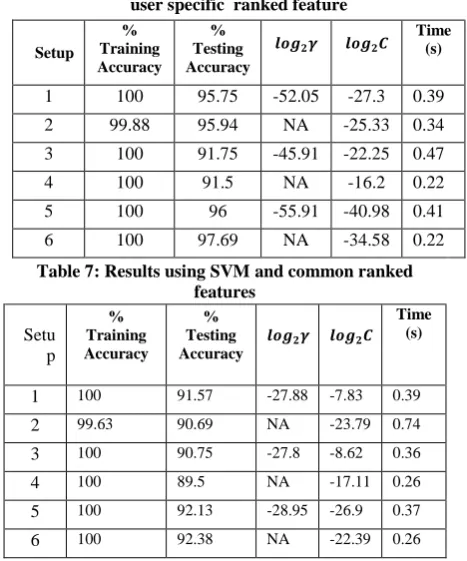
The results from the final stage of signature verification using SVM is shown in Table 6. User specific ranked features are used in this experiment. Summary of results using SVM with common ranked features is shown in Table 7.
Table 6: Summary of results using SVM technique and user specific ranked feature
Setup % Training Accuracy
% Testing Accuracy
Time (s)
1 100 95.75 -52.05 -27.3 0.39
2 99.88 95.94 NA -25.33 0.34
3 100 91.75 -45.91 -22.25 0.47
4 100 91.5 NA -16.2 0.22
5 100 96 -55.91 -40.98 0.41
6 100 97.69 NA -34.58 0.22
Table 7: Results using SVM and common ranked features
Setu p
% Training Accuracy
% Testing Accuracy
Time (s)
1 100 91.57 -27.88 -7.83 0.39
2 99.63 90.69 NA -23.79 0.74
3 100 90.75 -27.8 -8.62 0.36
4 100 89.5 NA -17.11 0.26
5 100 92.13 -28.95 -26.9 0.37
6 100 92.38 NA -22.39 0.26
Time indicated in Table 6 and 7 is the average time required to train 20 signatures and to test 40 signatures.ANN classifier model is formed with one hidden layer consist of five neuron feed-forward back propagation network. Average Testing accuracy is 96.125% for user specific best selected 5 features. Average Testing accuracy drops down to 87.25% for best selected common 5 features.
10.
DISCUSSION AND CONCLUSION
[image:5.595.48.266.598.744.2]11.
ACKNOWLEDGMENTS
The authors would like to thank the authorities of IIT Kharagpur and EU-India CultureTech Project under ECCP for their support to carry out this research work.
12.
REFERENCES
[1] Jain, Anil K., Griess, Friederike D. and Connell, Scott D. 2002. On-line signature verification, Pattern Recognition, vol. 35, no. 12, pp. 2963 – 2972.
[2] Herbst, N. M. and Liu, C. N. 1977. Automatic signature verification based on accelerometry, IBM J. Res. Dev., vol. 21, pp. 245–253.
[3] Impedovo, D. and Pirlo, G. 2008. Automatic signature verification: The state of the art, IEEE Trans. Syst., Man, Cybern. C, Appl. Rev., vol. 38, no. 5, pp. 609–635.
[4] Leclerc, F. and Plamondon, R. 1994. Automatic signature verification: the state of the art—1989–1993, Int. J. Pattern Recognition Artif. Intel., vol. 8, no. 3, pp. 643–660.
[5] Plamondon, R. and Lorette, G. 1989. Automatic signature verification and writer identification—the state of the art, Pattern Recognition, vol. 1, no. 2, pp. 107– 131.
[6] Sabourin, R., Genset, G. and Preteux, F. 1997. Off-Line Signature Verification by Local Granulometric Size Distribution, IEEE Trans. Pattern Analysis and Machine Intelligence, vol. 19, no. 9, pp. 976-988.
[7] Aguilar, J.F., Krawczyk, S., Garcia, J.O. and Jain, A.K. 2005. Fusion of Local and Regional Approaches for On-Line Signature Verification, Proc. Int’l Workshop Biometric Recognition System, pp. 188-196.
[8] Bajaj. R. and Chaudhary, S. 1997. Signature Verification Using Multiple Neural Classifiers, Pattern Recognition, vol. 30, pp. 1-87.
[9] Van, B. Ly, Garcia-Salicatti, S. and Dorizzi, B. 2007 On using the Viterbi path along with HMM likelihood information for online signature verification, IEEE Trans. Syst., Man, Cybern. B, Cybern., vol. 37, no. 5, pp. 1237–1247.
[10]Alister, K. and Yanikoglu, B. 2005. Identity Authentication Using Improved On-Line Signature Verification Method, PRL, vol. 26, no. 18, pp. 2400-2408.
[11]Justino, E. J. R., Bortolozzi, F. and Sabourin, R. 2005. A comparison of SVM and HMM classifiers in the offline signature verification, PRL, vol. 26, pp. 1377–1385.
[12]Feng, H. and Wah, C. C. 2003. Online signature verification using a new extreme points warping technique, PRL vol. 24, pp. 2943–2951.
[13]Munich, M. E. and Perona, P. 2003. Visual identification by signature tracking, IEEE Trans. PAMI, vol. 25, no. 2, pp. 200– 217.
[14]Fang, P., Wu, Z., Shen, F., Ge, Y. and Fang, B. 2005. Improved DTW algorithm for online signature verification based on writing forces, in Proc. ICIC—Part I, vol. 3844, Berlin, Germany, pp. 631–640.
[15]Kholmatov A. and Yanikoglu, B. 2005. Identity authentication using improved online signature
verification method, PRL, vol. 26, no. 15, pp. 2400– 2408.
[16]Faúndez-Zanuy, M. 2007. On-line signature recognition based on VQ-DTW, Pattern Recognition, vol. 40, no. 3, pp. 981–992.
[17]Lei, H. and Govindaraju, V. 2005. A comparative study on the consistency of features in on-line signature verification, PRL vol. 26, no. 15, pp. 2483-2489.
[18]Yeung, D., Chang, H., Xiong, Y., George, S., Kashi, R., Matsumoto, T. and Rigoll, G. 2004. SVC 2004: First international signature verification competition, in Proc. ICBA, vol. 3072, LNCS, D. Zhang and A. K. Jain, Eds., Berlin, Germany, 2004, pp. 16–22. [Online]. Available: http://www.cse.ust.hk/svc2004/ results.html
[19]Zhang, K., Pratikakis, I., Cornelis, J. and Nyssen, E. 2000. Using landmarks to establish a point-to-point correspondence between signatures, Pattern Anal. Appl., vol. 3, no. 1, pp. 69–75.
[20]Nalwa, V.S. 1997. Automatic On-line Signature Verification, in Proceedings of the IEEE, vol. 85, pp.215-239.
[21]Martens, R. and Claesen, L. 1998. Incorporating local consistency information into the online signature verification process, Int. J. Doc. Anal. Recognit. (IJDAR), vol. 1, no. 2, pp. 110–115.
[22]Peng, H., Long, F., and Ding, C. 2005. Feature selection based on mutual information: Criteria of max-dependency, max-relevance, and min-redundancy, IEEE Trans. PAMI, vol. 27, no. 8, pp. 1226-1238.
[23]Duda, R. O., Hart, P. E. and Stork, D. G. 2006. Pattern Classification, Wiley India Edition, 2nd Edition.
[24]Ding, C. and Peng, H.C. 2003. Minimum Redundancy Feature Selection from Microarray Gene Expression Data, Proc. of second IEEE CSBC, pp. 523‐528.
[25]Vapnik, V. 1995. The Nature of Statistical Learning Theory, Springer Verlag, New York.
[26]Kantardzic, M. 2011. Data Mining: Concepts, Models, Methods, and Algorithms- 2nd edition John Wiley and sons.
[27]Cortes, C. and Vapnik, V. 1995. Support vector networks. Machine Learning, 20:273 – 297.
[28]Bertsekas, D. P. 1999. Nonlinear Programming, 2nd ed. Belmont, MA: Athena Scientific.
[29]Scholkopf, B. and Smola, A. J. 2002. Learning with Kernels, MIT Press.
[30]Chang, C. C. and Lin, C. J. 2001. LIBSVM: A library for support vector machines, Tech. Rep., [Available]. Online: http://www.csie.ntu.edu.tw/»cjlin/libsvm.
[31]Fan, R. E., Chen, P. H. and Lin, C. J. 2005. Working set selection using the second order information for training svm, Journal of Machine Learning Research, vol. 6, no. 12, pp. 1889-1918.
[32]MATLAB, User's Guide, The MathWorks, Inc.,
1994-2009, Version 7.7.0.471 (R2008b)