© 2018, IRJET | Impact Factor value: 7.211 | ISO 9001:2008 Certified Journal | Page 2231
Energy Aware Multi-Hop Routing Protocol for WSNs Using Gateway
Shailendra Kumar
11Student M.Tech CSE, Bansal IET, Lucknow,Uttar Pradesh, India
---***---
Abstract-In this research, our main goal is reduce energy consumption of sensor node. we use a gateway node in center of wirelss sensor network for energy consumption of nodes of network. By which network lifetime may imporved. Sensor Network is divided in four logically regions based on location of sensor nodes and predefined threshold distance. Base Station is deployed out of network field and a gateway node is installed in center of network field. If distance of a sensor node from BS or gateway node is less than predefined threshold distance, then direct communication technique is used for sending data from sensor nodes to BS or gateway node. If distance of a sensor node from BS or gateway node is more than predefined threshold distance, then clustering technique is used for sending the data. In clustering technique cluster head is used in each region are dependent of other region. Each cluster head send data to the Gateway node which less energy is consumed by the sensor node. Sensor. We compare performance of our protocol with GEAR protocol . Performance analysis and compared results show that our proposed porotcoal performance well in terms of energy consumption, network lifetime and throughput.
Keywords- Wireless Sensor Network, Base Station, Gateway Node, Threshold distance, Cluster Head.
1. Introduction:
In mobile and wireless local place networks, wireless
conversation most effective takes place at the last hyperlink between a base station and the wi-fi give up gadget. In multi-hop wireless networks there are one or extra intermediate nodes alongside the path that get hold of and forward packets thru wi-fi links. Multi-hop wi-fi networks have numerous blessings: Compared to networks with unmarried wireless hyperlinks, multi-hop wireless networks can expand the coverage of a community and improve connectivity. Moreover, transmission over multiple “brief” links would possibly require much less transmission strength and power than over “lengthy” links. Moreover, they allow better statistics charges resulting in better throughput and extra efficient use of the wireless medium. Multi-hop wireless networks avoid extensive deployment of cables and can be deployed in a value-efficient way. In case of dense multi-hop networks numerous paths may turn out to be to be had© 2018, IRJET | Impact Factor value: 7.211 | ISO 9001:2008 Certified Journal | Page 2232
2. Related Work:
Vitality utilization and system lifetime are the greatest significant highlights inside the design of the remote sensor organize. This watch blessing grouping based thoroughly steering for WSNs. Numerous grouping principally based conventions are homogeneous, which incorporates LEACH [20] PEGASIS [21]. Cluster Heads gather insights by its people or vassal hubs, total and ahead to far flung situated Base Station. This strategy over-burdens the Cluster Head and it expends part of power. In Low Energy Adaptive Cluster Hierarchy, the Cluster Head is settled on occasionally, eat up unique vitality with the guide of picking a fresh out of the plastic new CH in each round. A hub develop to be CH in present day round on the possibility of likelihood p. Drain plays appropriately in homogenous system be that as it may, this convention isn't viewed as legitimate for heterogeneous systems as demonstrated in [23]. In [24] maker offered some other grouping protocol(TLLEACH). This tradition delineates degree packing arrange for which performs enjoyably in articulations of insignificant essentialness affirmation of lattice. Here are 2 kinds of periods of Cluster Heads, type 1 Cluster Heads and degree Cluster Heads. Sort one Cluster Heads append with their contrasting part sensor center points. Bunch Heads at 2d degree make bunches from Cluster Heads of stage one. TL-LEACH plot is without a doubt extra control along these lines; the stack of the system at the sensors is all around shared which realizes apparently unending sensor organize. In PEGASIS [21] centers shape a progression to trade estimations from source to sink. In chain improvement system each center point connect with next center point. The chain course of action system require general data of sensor center points, along these lines, it's miles hard to approve this topology. Another bundling based totally tradition is HEED wherein Cluster Heads are settled on the base of a probability. The probability of a center to ascend as CH is related to the staying nature of the center point. In HEED, it is viable that the center points with insignificant outstanding power secure immense likelihood to twist up CH. A PEGASIS fundamentally based cell sink scheme is proposed in [25]. The sink improvements along its heading and stays for a visit time at stay an area to ensure complete data game plan. A relative sink cell based totally methodology is proposed in [26]. SEP tradition is expected for heterogeneous center points. Center points in SEP are heterogenous in articulations of their starter imperativeness, insinuated as run of the mill centers and redesign centers. The chance to wind up being CH relies on at the hidden intensity of the center point. Execution of SEP in multi orchestrate Heterogeneous frameworks isn't by and large eminent. An Energy Efficient Unequal
Clustering (EEUC) tradition is shown which attempts to quality the power affirmation of the system. EEUC parcel the system prepare into unequal gatherings. In EEUC, there are several center points in organize that aren't connected with any cluster, in this manner, they're remoted inside the framework. On flexible power-viable arrangement for transmission (EAST) is proposed in [27]. This arrangement use open-revolving around input structure for temperature-insightful hyperlink pleasant estimation, however close circle remarks technique isolates organize into three sensible locale to restrain overhead of regulate packages. In [28] Quadrature-LEACH (Q-LEACH) for homogenous frameworks is proposed. This arrangement extend the throughput, lifetime of framework and change term of the system. Latif et al. [29] offered Divide-and-Rule (DR) plan. DR procedure used for static batching additionally for the choice of CH. This arrangement keeps up a key separation from probabilistic decision of CH as an elective it picks steady number of CH. Away Cluster Head (ACH) prtocol for WSN is proposed in [30]. This tradition effectively open up the stableness length and throughput. J. Kulik et al. [31] proposed sensor Protocols for Information Via Negotiation (SPIN). In SPIN, a center point exhibit it its identified information to its accomplices about the kind of the substances it recognized. An included neighboring center point will dispatch an interest for a copy of data to starting center point. Thusly, the whole center points inside the system assemble this information. The downside of this procedure is that, there's no accreditation of information movement to each center point inside the framework in light of the way that if the center point is involved with estimations from remote supply center by then records won't pass on to captivated center. This tradition isn't ideal for groups in which trustworthy assurances movement require is on apex. A creamer tradition Hybrid Energy Efficient Reactive Protocol for WSN is proposed in [32]. In this tradition, CH is picked on a very basic level in perspective of the waiting force of center point and ordinary power of framework.
© 2018, IRJET | Impact Factor value: 7.211 | ISO 9001:2008 Certified Journal | Page 2233 the creators take a gander at the base transmission scope
of the handsets this is required to gain full system network. They blessing an arrangement of principles to compute this base transmission assortment, after which examine the impact of versatility on that charge.
The creators investigate the issue of changing the transmission power with a reason to discover a harmony between the performed throughput and power admission. Calculations are provided which adaptively direct the transmission power of the hubs because of topological adjustments, with the fantasies of holding an associated arrange while utilizing negligible quality. Through reproduction, they show that an expansion in throughput, by and large with a reduction in power admission might be refined with the guide of adapting to the transmission levels of the individual hubs.
3. Methodology:
[image:3.612.88.245.370.546.2]In this article, we assume S sensors which are deployed randomly in a field to monitor environment. We represent the i-th sensor by si and consequent sensor node set S= s1, s2,..., sn .We assume the network model shown in fig 1.
Fig. 1. Network Model
We deploy the BS far away from the sensing field. Sensor nodes and the BS are stationary after deployment.
A gateway node is deployed in the same network field at the centre of the network.
Gateway node is stationary after deployment and rechargeable.
We use homogeneous sensor nodes with same computational and sensing capabilities.
Each sensor node is assigned with a distinctive identifier (ID). We use first order radio model as used in [5] and [18]. This model represents the
energy dissipation of sensor nodes for transmitting, receiving and aggregating data. The transmitter dissipates more energy then receiver as it requires more energy for the transmitter electronics and amplifier. On the other hand, in receiver, only electronic circuit dissipate energy, as shown in fig 3.2.
The energy required to transmit a data packet of k bits to a distance d and to receive a data packet of k bits, is given as:
( ) ( ) ( )
( ) ( )
( ) ( ) ( ) ( ) ( )
Fig. 2: Radio Model
3.1. The M-Gear Protocol:
In this part, we indicate detail of our proposed custom. Sensor focus focuses have preposterously perceived information for BS to process. Consequently, an altered procedure for joining or Aggregating the information into a little game-plan of critical data is required [19] [20]. The method of information conglomeration in addition named as information blend. Recalling the genuine target to enhance deal with lifetime and throughput, we pass on a section focus point at the purpose of joining of the structure field. The errand of area focus point is to collect information from Cluster Heads and from focuses close entryway, hoarding and sending to BS. The result of our examination guarantee that structure lifetime and vitality utilize enhanced with the cost of including passage focus point.. We join rechargeable area focus point since it is on ground reality that the fortifying of portal focus is essentially more reasonable than the cost of sensor focus point.
3.1.1. Beginning State
In M-GEAR, we utilize homogenous sensor focus
© 2018, IRJET | Impact Factor value: 7.211 | ISO 9001:2008 Certified Journal | Page 2234 data of the sensor focuses into the inside point information
table. The middle point information table includes certain inside ID, remaining centrality of focus point, locale of focus point and its segment to the BS and section focus point.
3.1.2. Setup State
In this segment, we disengage the system field into bona fide zones in context of the area of the inside in the structure. BS segregate the focuses into four contrasting sensible areas. Focuses in zone one utilize arrange correspondence and transmit their information obviously to BS as the division of these inside focuses from BS is short. So in like manner focus focuses close section layout territory two and send their information direct to portal which totals information and forward to BS. These two districts are proposed as non grouped region. Every last one of the inside focuses from the passage focus and BS are segregated into two practically identical half areas. We call them bunched locales. Sensor focuses in each grouped area sort out themselves into minimal social events known as cluster heads.
3.1.3. CH Selection
Initially BS divides the network into regions. CHs are elected in each region separately. Let ri represent the number of rounds to be a CH for the node Si. Each node elect itself as a CH once every ri = 1/p rounds. At the start of first round all nodes in both regions has equal energy level and has equal chance to become CH. After that CH is selected on the basis of the remaining energy of sensor node and with a probability p alike LEACH. in each round, it is required to have n x p CHs. A node can become CH only once in an epoch and the nodes not elected as CH in the current round feel right to the set C. The probability of a node to (belongs to set C) elect as CH increases in each round. It is required to uphold balanced number of CHs. At the start of each round, a node Si belongs to set C autonomously choose a random number between 0 to 1. If the generated random number for node Si is less than a predefined threshold T(s) value then the node becomes CH in the current round. The threshold value can be found as:
( ) { ( ( ))
} (3)
where P = the desired percentage of CHs and r = the current round, C = set of nodes not elected as CH in current round. After electing CHs in each region, CHs inform their role to neighbor nodes. CHs broadcast a control packet using a CSMA MAC protocol. Upon received control packet
from CH, each node transmits acknowledge packet. Node who find nearest CH, becomes member of that CH.
3.1.4. Booking
Right when all the sensor center concentrations are framed into social events, each CH makes TDMA based availabilities to the degree concerns its center core interests. All the related concentration shows transmit their apparent data CH in its own specific planned opportunity. All around center coordinates change toward sit out of mechanical assembly mode. Focus centers pivot their transmitters at time of transmission. Thusly, significance diffusing of individual sensor center lessens.
3.1.5. Chosen Phase
chosen stage arrange, all identifier hubs center
demonstrates send their perceived data Cluster Head. The Cluster Head gathers data by part center concentrations, aggregates and advances to passage center point. Area center point gets data from Cluster Heads, aggregates and advances to BS.
4. Result and Discussion:
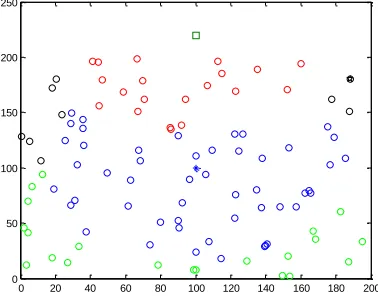
[image:4.612.356.545.420.569.2]we show the simulation results. We run extensive simulations and compare our results with MGEAR. Next subsections give detail of each metric.
Fig 3: WSN network with different zones.
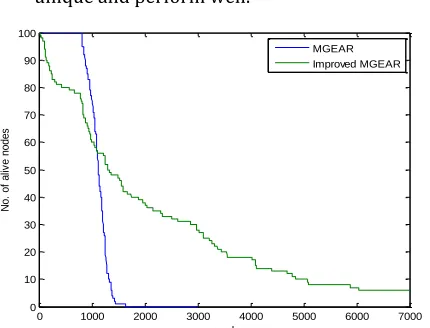
1) Network Lifetime: In fig 4, we demonstrate the
consequences of the system lifetime. Hubs are viewed as dead in the wake of expending 0.5 joule vitality. Proposed convention gets the longest system lifetime. This is on the grounds that the vitality utilization is all around circulated among hubs. System is separated into sensible districts and two of them are further sub isolated into groups. Proposed topology adjust vitality
0 20 40 60 80 100 120 140 160 180 200
© 2018, IRJET | Impact Factor value: 7.211 | ISO 9001:2008 Certified Journal | Page 2235 utilization among sensor hubs. Then again, in
MGEAR, hubs bite the dust rapidly as soundness time of system closes. It isn't apparent that foreordained CHs are dispersed consistently all through the system field. Along these lines, there is a probability that the chose CHs will be moved in one locale of the system. Subsequently, a few hubs won't have any CHs in their environs. Fig 4 speak to interim plot of system lifetime with 99% certainty interim. we take note of that, the aftereffects of M-GEAR convention are statically unique and perform well.
[image:5.612.55.270.235.399.2]
Fig. 4: Analysis of network lifetime in terms of alive nodes
Fig. 5: Analysis of network lifetime in terms of dead nodes
2) Packet Throughput: Normal bundles sent to BS are evaluated through broad reproductions. Recreation aftereffects of proposed convention represent expanded throughput. Interim plots of MGEAR in fig 5 obviously portrays execution of the two conventions. To ascertain throughput, we accept that CHs can discuss openly with passage hub. Reenactment comes about speak to an expansion throughput substantial circumstances then MGEAR. Sensor hubs close portal send their information
specifically to passage; likewise hubs close BS transmit information straightforwardly to BS. Sensor hubs in the two locales devour less transmission vitality hence, hubs remain alive for longer period. More alive hubs add to transmit more bundles to BS.
Fig 6: Packet throughput from sensor nodes to CH
Fig. 7: Packet throughput from CH to BS
3) Residual Energy: Fig 8 demonstrates normal leftover vitality of system per round. We accept that a hub has 0.5 joule vitality. The total vitality of 100 sensor hub organize is 50 joule. Enhanced M-GEAR convention give minimum vitality utilization in contrast with MGEAR. Fig 8 plainly portrays that our convention surpass MGEAR directing convention regarding vitality utilization per round. Arrangement of portal hub at the inside and high likelihood of CHs in all areas guarantees least vitality
0 1000 2000 3000 4000 5000 6000 7000
0 10 20 30 40 50 60 70 80 90 100
rounds
N
o
.
o
f
a
liv
e
n
o
d
e
s
MGEAR Improved MGEAR
0 1000 2000 3000 4000 5000 6000 7000
0 10 20 30 40 50 60 70 80 90 100
rounds
N
o
.
o
f
d
e
a
d
n
o
d
e
s
MGEAR Improved MGEAR
0 1000 2000 3000 4000 5000 6000 7000 8000 0
0.5 1 1.5 2 2.5x 10
5
P
a
c
k
e
t
s
e
n
t
to
C
H
b
y
s
e
n
s
o
rs
rounds
0 1000 2000 3000 4000 5000 6000 7000 8000
0 0.5 1 1.5 2 2.5x 10
4
P
a
c
k
e
t
s
e
n
t
to
B
S
b
y
C
H
[image:5.612.52.262.422.572.2]© 2018, IRJET | Impact Factor value: 7.211 | ISO 9001:2008 Certified Journal | Page 2236 utilization.
Fig. 8: Analysis of remaining energy
5. Conclusion:
In this examination, a vitality effective multi-jump directing convention utilizing entryway hub to limit vitality utilization of remote sensor arrange. In this examination, we separate the system into four consistent districts. All areas utilize diverse correspondence system. Two locales utilize coordinate correspondence strategy and two districts are further sub-partitioned into bunches and utilize multi-jump correspondence system. Each one hub in a district chooses itself as a Cluster Head free of other area. This strategy encourges better appropriation of Cluster Heads in the system. Recreation comes about demonstrates that our proposed convention performs all around contrasted with MGEAR. In our exploration, we locate 3 execution measurements: Lifetime of Network, Remaining vitality and performance. In future, we will contemplate Expected Transmission Count (ETX) interface measurements and we will execute this rhythmic in our plan - actualized, exhibited by a few most recent litratures.
References:
[1] Burrell, Jenna, Tim Brooke, and Richard Beckwith. “Vineyard computing: Sensor networks in agricultural production.” Pervasive Computing, IEEE 3.1 (2004): 38-45.
[2] Heinzelman, Wendi Rabiner, Anantha Chandrakasan, and Hari Balakrishnan. “Energy-efficient communication protocol for wireless microsensor networks.” System Sciences, 2000. Proceedings of the 33rd Annual Hawaii International Conference on. IEEE, 2000.
[3] Bhoomika Pandey1 & H.L.Mandoria, A Comprehensive Study Of Different Energy-Efficient Routing Protocols In Wireless Sensor Networks, International Journal of
Computer Networking, Wireless and Mobile
Communications (IJCNWMC) ISSN(P): 2250-1568;
ISSN(E): 2278-9448 Vol. 6, Issue 2, Apr 2016, 37-44.
[4] Smaragdakis, Georgios, Ibrahim Matta, and Azer Bestavros. “SEP: A stable election protocol for clustered heterogeneous wireless sensor networks”. Boston University Computer Science Department, 2004.
[5] Loscri, V., G. Morabito, and S. Marano. “A two-levels hierarchy for low-energy adaptive clustering hierarchy (TL-LEACH).” IEEE Vehicular Technology Conference. Vol. 62. No. 3. IEEE; 1999, 2005.
[6] Jafri, Mohsin Raza, Nadeem Javaid, Akmal Javaid, and Zahoor Ali Khan. “Maximizing the Lifetime of Multi-Chain PEGASIS Using Sink Mobility.” World Applied Sciences Journal 21, no. 9 (2013): 1283-1289.
[7] M. Akbar, N. Javaid, A. A. Khan, Z. A. Khan, U. Qasim, “On Modeling Geometric Joint Sink Mobility with Delay-tolerant Clusterless Wireless Sensor Networks”, 4th IEEE Technically Co-Sponsored International Conference on Smart Communications in Network Technologies (SaCoNet’13) 2013, Paris, France.
[8] K. Latif, A. Ahmad, N. Javaid, Z. A. Khan and N. Alrajeh, “Divideand-Rule Scheme for Energy Efficient Routing in Wireless Sensor Networks”, The 4th International Conference on Ambient Systems, Networks and Technologies (ANT 2013), 2013, Halifax, Nova Scotia, Canada, Procedia Computer Science, Volume 19, 2013,
Pages 340-347, ISSN 1877-0509,
http://dx.doi.org/10.1016/j.procs.2013.06.047. Procedia Computer Science.
[9] N. Javaid, M. Waseem, Z. A. Khan, U. Qasim, K. Latif and A. Javaid, “ACH: Away Cluster Heads Scheme for Energy Efficient Clustering Protocols in WSNs”, 2nd IEEE Saudi International Electronics, Communications and Photonics Conference (SIECPC 13), 2013, Riyadh, Saudi Arabia.
[10] Heinzelman, Wendi Rabiner, Joanna Kulik, and Hari Balakrishnan. “Adaptive protocols for information dissemination in wireless sensor networks.” Proceedings of the 5th annual ACM/IEEE international conference on Mobile computing and networking. ACM, 1999.
[11] N. Javaid, S. N. Mohammad, K. Latif, U. Qasim and Z. A. Khan, M. A. Khan, “HEER: Hybrid Energy Efficient Reactive Protocol for Wireless Sensor Networks”, 2nd IEEE Saudi International Electronics, Communications and Photonics Conference (SIECPC 13), 2013, Riyadh, Saudi Arabia.
0 1000 2000 3000 4000 5000 6000 7000
0 5 10 15 20 25 30 35 40 45 50
rounds
R
e
m
a
in
in
g
E
n
e
rg
y