warwick.ac.uk/lib-publications
Original citation:
Kumar, Sanjay, Nakariakov, V. M. and Moon, Y. -J. . (2016) Effect of a radiation cooling and heating function on standing longitudinal oscillations in coronal loops. The Astrophysical Journal, 824 (1).
Permanent WRAP URL:
http://wrap.warwick.ac.uk/78154
Copyright and reuse:
The Warwick Research Archive Portal (WRAP) makes this work by researchers of the University of Warwick available open access under the following conditions. Copyright © and all moral rights to the version of the paper presented here belong to the individual author(s) and/or other copyright owners. To the extent reasonable and practicable the material made available in WRAP has been checked for eligibility before being made available.
Copies of full items can be used for personal research or study, educational, or not-for-profit purposes without prior permission or charge. Provided that the authors, title and full
bibliographic details are credited, a hyperlink and/or URL is given for the original metadata page and the content is not changed in any way.
Publisher’s statement:
"This is an author-created, un-copyedited version of an article accepted for
publication/published in Astrophysical Journal. IOP Publishing Ltd is not responsible for any errors or omissions in this version of the manuscript or any version derived from it. The Version of Record is available online at http://dx.doi.org/10.3847/0004-637X/824/1/8
A note on versions:
The version presented here may differ from the published version or, version of record, if you wish to cite this item you are advised to consult the publisher’s version. Please see the ‘permanent WRAP URL’ above for details on accessing the published version and note that access may require a subscription.
S. Kumar1
V. M. Nakariakov1,2,3
and
Y.-J. Moon1
ABSTRACT
Standing long-period (with the periods longer than several minutes) oscillations in large hot (with the temperature higher than 3 MK) coronal loops have been observed as the quasi-periodic modulation of the EUV and microwave intensity emission and the Doppler shift of coronal emission lines, and have been interpreted as standing slow magnetoacoustic (longitudinal) oscillations. Quasi-periodic pulsations of shorter peri-ods, detected in thermal and non-thermal emissions in solar flares could be produced by a similar mechanism. We present theoretical modelling of the standing slow magnetoa-coustic mode, showing that this mode of oscillation is highly sensitive to peculiarities of the radiative cooling and heating function. We generalised the theoretical model of standing slow magnetoacoustic oscillations in a hot plasma, including the effects of the radiative losses, and accounting for plasma heating. The heating mechanism is not specified and taken empirically to compensate the cooling by radiation and thermal-conduction. It is shown that the evolution of the oscillations is described by a generalised Burgers equation. Numerical solution of an initial value problem for the evolutionary equation demonstrates that different dependences of the radiative cooling and plasma heating on the temperature lead to different regimes of the oscillations, including grow-ing, quasi-stationary and rapidly decaying. Our findings provide a theoretical founda-tion for probing the coronal heating funcfounda-tion, and may explain the observafounda-tions of de-cayless long-period quasi-periodic pulsations in flares. The hydrodynamic approach employed in this study should be considered as a zero-order approximation in the modelling of physical phenomena associated with flares.
1School of Space Research, Kyung Hee University, Yongin, 446-701, Gyeonggi, Korea
2
Centre for Fusion, Space and Astrophysics, Department of Physics, University of Warwick, Coventry CV4 7AL, UK
Subject headings: Sun: corona — Sun: oscillations — magnetohydrodynamics (MHD) — waves
1. Introduction
The main interest in magnetohydrodynamic (MHD) waves and oscillations in the solar atmo-sphere is connected with the possible role the waves play in heating of the atmospheric plasma, and with the exploitation of the plasma diagnostic potential of the waves (see De Moortel & Nakariakov 2012; Liu & Ofman 2014, for recent comprehensive reviews). An important class of coronal MHD oscillations is standing waves in coronal loops, where structuring of the plasma across the magnetic field acts as a waveguide, and the loop footpoints are effective mirrors that form a standing wave pattern.
Standing longitudinal oscillations in coronal loops were discovered as a periodic Doppler shift of hot coronal emission lines with the SOHO/SUMER spectrometer (Wang et al. 2002), and analysed in detail by Wang et al. (2003b,a). The oscillations, usually called “SUMER” oscillations (see Wang 2011, for a review), have periods in the range about 5–40 min, and are detected in long loops of the lengths of 200–300 Mm. SUMER oscillations are seen to be very rapidly decaying, with the decay time being about the period of oscillations. The decay time was found to be linearly proportional to the period. The relative amplitudes of plasma flows in SUMER oscillations reach 100–300 km s−1 that in some cases reaches 50% of the sound speed corresponding to the temperature of the emitting plasma. Simultaneous observations of Doppler shift and intensity variations showed in some cases a quarter-period phase shift (Wang et al. 2005). About a half of the detected SUMER oscillations were found to be associated with flares (e.g. Wang 2011).
Oscillations similar to the SUMER oscillations have been detected in the Doppler shift of hot coronal emission lines observed with Yohkoh/BCS (Mariska 2005, 2006). Intensity oscillations with periods from 13 to 60 min in X-ray bright points were observed with Hinode/XRT by Kumar et al. (2011). Also, oscillations of soft X-ray intensity with periods of 12–30 min were found in the CORONAS-F/SPIRIT data (Akimov et al. 2005). Kim et al. (2012) observed a SUMER oscillation with the period 12.6 min and the decay time of 16 min simultaneously in the microwave and EUV emission, with the Nobeyama Radioheliograph and SDO/AIA, respectively. Similar oscillations, of the period about 32 min, were found in a white light curve of a stellar megaflare (Anfinogentov et al. 2013). The first direct detection of SUMER oscillations in imaging data was recently reported by Kumar et al. (2013). Similar oscillatory patterns have recently been detected in the soft X-ray irradiance measurements data made with GOES (Dolla et al. 2012; Sim˜oes et al. 2015).
the magnetic field in the finite-β regime has been used for the seismological determination of the plasma parameter β in the oscillating loop (Wang et al. 2007). Damping of the oscillations was associated with thermal conduction.
The simple numerical 1D model of Ofman & Wang (2002) was further developed by Nakariakov et al. (2004); Tsiklauri et al. (2004); Mendoza-Brice˜no et al. (2004); Taroyan et al. (2005); Selwa et al. (2007); Ogrodowczyk et al. (2009) who subsequently included radiative effects, gravitational stratification, effects of the chromosphere near the footpoints, and effects of the magnetic field curvature. It was shown that standing slow magnetoacoustic oscillations are easily excited by a localised deposition of heat or increase in the plasma pressure. Also, the simulations showed that the oscillations may occur in two different regimes, the well-known rapidly decaying oscillations, and decayless oscillations. In the latter regime the oscillation is limited by the duration of the flare only. This regime has possibly been observed as the undamped oscillations of the flaring X-ray emission with a 20-min period detected by Svestka (1994); a 143-s period detected by Terekhov et al. (2002); the 25 to 48 s pulsations detected in the hard X-rays in the initial phase of three flares by F´arn´ık et al. (2003b); the 60-s variations of the Hαemission detected by Huang & Ji (2005); the long-period (≥60 s) variations of the radio and X-ray fluxes, detected by M´esz´arosov´a et al. (2006); the 5-min and 13.5-min oscillatory modulation of the 8-mm emission, revealed by Kislyakov et al. (2006); the persistent, semi-regular compressions of the flaring core region, modulating the plasma temperature and emission measure with the period of about 60 s, detected in soft X-rays and EUV by Sim˜oes et al. (2013); and the 4-min pulsations of the hard X-ray, radio and EUV emissions in a flare, detected by Li et al. (2015a).
For the theoretical analysis of waves, a useful alternative to full-scale numerical simulations is the method of an evolutionary equation. In this method, the wave evolution, e.g. its damping or amplification, wave shape deformation, and acceleration, is determined in terms of the intrinsic evolutionary mechanisms, such as dissipation, dispersion, nonlinearity and activity of the medium. These evolutionary mechanisms are modelled by specific terms in the evolutionary equation. Spe-cific expressions for the coefficients in front of these terms can be determined from a certain set of governing equations, e.g. MHD, or can be taken in a guessed, effective form, e.g. when some necessary but not understood physical processes (such as coronal heating) should be included in the model. Moreover, these coefficients could be determined empirically, from observations and then used to constrain the guessed expressions. In the coronal context, this approach has turned to be successful in modelling wave phenomena in the corona, e.g. propagating longitudinal waves in coronal active region fans (Nakariakov et al. 2004; Tsiklauri et al. 2004; Afanasyev & Nakariakov 2015) and polar plumes (Ofman et al. 2000), nonlinear Alfv´en waves in coronal holes (Nakariakov et al. 2000b).
and/or viscosity. It was shown that in this approximation the SUMER oscillation can be consid-ered as a superposition of two oppositely-propagating nonlinear waves governed by the Burgers equation. An interesting consequence of this study was a periodic movement of the position of the highest amplitude along the loop, caused by the nonlinearity.
An important effect that needs to be accounted for in the description of standing longitudinal oscillations in coronal loops is the radiation from the perturbed plasma. The radiation is mainly controlled by the composition of the plasma and the presence of heavy, not fully ionised ions. In the context of longitudinal oscillations the effect of radiative losses was analytically described by Bembitov et al. (2013), and shown to lead to enhanced damping. Dependence of the radiative losses on the plasma temperature and pressure is quite non-monotonic, and includes segments with both positive and negative gradients, see, e.g. Fig. 1 of Schure et al. (2009), and is additionally modified in the presence of heating. It has been known for long time (e.g. Field 1965) that under certain circumstances, e.g. in the presence of heating, thermal instability can occur in a diffuse medium due to imbalance between independent energy gains, i.e., heating, and temperature-dependent radiative losses. From the point of view of magnetoacoustic wave dynamics, peculiarities of the energy loss/gain function dependence on thermodynamical parameters (e.g., density and pressure) may lead to the amplification of oscillations and hence an increase in the nonlinearity (e.g. Nakariakov et al. 2000a). The balance of the radiative/heating effects and dissipation may lead to appearance of stationary propagating nonlinear waves (autowaves) of a saw-tooth shape (Chin et al. 2010; Molevich et al. 2011), slow magnetoacoustic auto-solitons (Nakariakov & Roberts 1999), and nonlinear resonant amplification of Alfv´en waves (Zavershinsky & Molevich 2014).
The aim of this paper is to generalise the work of Ruderman (2013) accounting for isentropic effects based on the presence of an energy loss/gain function in the energy equation. In Sec. 2 we discuss the model and governing equations. In Sec. 3 we derive and analyse linear dispersion relations. In Sec. 4 we derive the nonlinear evolutionary equation. In Sec. 5 we study different regimes of the oscillations. The results obtained are summarised and summarised in Sec. 6.
2. Governing equations
equations,
∂ρ
∂t +
∂(ρu)
∂z = 0, (1)
∂u
∂t +u
∂u
∂z = −
1 ρ ∂p ∂z + 1 ρ ∂ ∂zρν ∂u
∂z, (2)
∂p
∂t −
γp ρ
∂ρ
∂t = (γ−1)[Q(ρ, p) +∇(κ∇T)], (3)
p = kB
mT ρ, (4)
where ρ is the plasma density;T is the temperature;p is the plasma pressure; u is the speed of a field-aligned bulk flow;γ is the adiabatic index;t is the time; the coefficients
ν = 4η0
3ρ , and κ=
(γ−1)mκk ρkB
(5)
describe the viscosity and field-aligned thermal conduction, respectively, determined by the coeffi-cients of the bulk viscosityη0 and thermal conductivityκk; andQ(ρ, p) is the cooling/heating (the energy loss/gain) function that accounts for radiative cooling and unspecified coronal heating. In this study the coefficients of the bulk viscosity η0 and thermal conductivity κk are not specified as they are likely to be enhanced by microturbulent processes typical for plasmas. Eq. (3) extends the governing equations used in R13 by including the cooling/heating function Q(ρ, p).
In this study we consider weak perturbations of the equilibrium, determined by the constant equilibrium density ρ0, pressure p0, temperature T0 that are assumed to be uniform along the
loop. Hence in the equilibrium thermal conduction is zero. Thus, in the equilibrium the cool-ing/heating function Q(ρ0, p0) = 0, i.e. the heating compensates the radiative losses. The same
equilibrium was considered, e.g., in Nakariakov et al. (2000a); Chin et al. (2010); Molevich et al. (2011). The perturbations of the equilibrium have a form of field-aligned flows that satisfy the boundary conditions
u= 0 at z= 0, L, (6)
i.e. the chromosphere is considered to be a rigid wall for the longitudinal oscillations.
The perturbation amplitude is characterised by a dimensionless small parameter 1. The dissipative effects caused by finite thermal conduction and viscosity, and non-adiabatic effects caused by the radiative losses and heating, are considered to be of the order of too. Thus, the evolutionary equation will include quadratically nonlinear terms together with linear terms that represent the non-adiabatic processes. It is convenient to introduce the scaled coefficients at the dissipative terms as follows
3. Dispersion relations
Linearising the set of equations (1–4), we obtain
∂ρ
∂t +ρ0
∂u
∂z = 0, (8)
∂u
∂t +
1 ρ0
∂p
∂z = ν
∂2u
∂z2, (9)
∂p
∂t −
γp0
ρ0
∂ρ
∂t = (γ−1)
h
˜
app+ ˜aρρ+κ ∂2T
∂z2
i
, (10)
p−kBρ0
m T−
kBT0
m ρ = 0, (11)
where we used the linear terms in the Taylor expansion of the cooling/heating functionQnear the equilibrium, with ˜aρ=∂Q/∂ρtaken at p0, and ˜ap =∂Q/∂ptaken at ρ0. Here, the variablesp,ρ,
u and T are perturbations of the equilibrium state. In the following consideration we assume that the terms on the righthand side are assumed to be smaller than the terms on the lefthand side.
Assuming the harmonic dependence of the perturbed quantities∼exp(−iωt+ikz) we obtain the dispersion relation
ω2−Cs2k2−i(γ−1)
ρ0
ρ0a˜ρk2
ω + ˜apρ0ω−
κmωk2
kB +
κT0k4
ω
+iνωk2= 0, (12)
whereω is the cyclic frequency,kis the wave number, and Cs = (γp0/ρ0)1/2 is the sound speed.
Taking that the lefthand side terms in Eqs. (9) and (10) are small, and hence the last two terms in Eq. (12) are smaller than the first two terms, we obtain thatω ≈Csk, and determine the
real and imaginary parts of the frequency as
ωR ≈ Csk, (13)
ωI ≈
(γ−1) 2 A−
h(γ−1)2mκ
2γρ0kB +ν
2
i
k2, (14)
respectively, where
A= ˜aρ/Cs2+ ˜ap (15)
is the parameter determined by the heating/cooling functionQ.
Eq. (13) shows that the oscillation period is determined by the length of the loop, e.g. P = 2π/ωR = π/CsL for the fundamental longitudinal mode, and the sound speed. Eq. (14) contains
In the caseA < 0 this terms contributes to damping. However, as it is independent of k the damping caused by this term is the same in short and long loops. In the case A > 0, this term suppresses damping. When the condition
A=Acrit=
2 (γ−1)
h(γ−1)2κm
2γρ0kB +ν
2
i
k2 (16)
is fulfilled, the oscillation becomes undamped. For A > Acrit, the plasma becomes unstable and
the oscillation amplitude grows in time — the thermal over-stability occurs. The critical value Acrit corresponds to the threshold of the over-stability, which is determined by thermodynamical
parameters of the plasma, the heating/cooling function, and the length of the loop.
4. Evolutionary equation for standing longitudinal oscillations
Observations show that the relative amplitude of standing longitudinal oscillations in coronal loops reaches 30–50% (e.g. Wang 2011). Thus, it is necessary to account for nonlinear effects in the evolution of the oscillations. The presence of the small parameter allows us to perform the asymptotic analysis of weakly-nonlinear, weakly-isentropic standing longitudinal oscillations, following the methodology developed in R13.
Consider the nonlinear and non-adiabatic processes (the latter are caused by the finite viscosity and thermal conductivity, and the heating/cooling function) to operate at the slow time t1 = t.
Thus, we look for a solution to Eqs. (1–4) in the form of expansions
f =f0+f1+2f2+... (17)
wheref represents the quantities u,ρ,p andT. The termf0 represents the unperturbed state i.e.
f0 = const withu0 = 0.
4.1. First-order approximation
Substituting the expansions (17) into Eqs. (1)–(4) we collect the terms of the same power of the small parameter. The first order approximation, after the elimination of all variables in favour of u1 gives us the acoustic wave equation,
∂2u1
∂t2 −C
2 s
∂2u1
∂z2 = 0 (18)
Eq. (18) has the solution u1 =Cs[f(ξ) +g(η)], where
ξ =ω(t−z/Cs), η=ω(t+z/Cs) (19)
Applying the boundary conditions given by Eq. (6) we obtain the solution in a form of standing waves,
u1 =Cs[f(ξ)−f(η)], (20)
which is a superposition of two waves propagating in opposite directions. The function f(y) is periodic with the period 2π, which requiresω =πCs/L. This cyclic frequency corresponds to the
fundamental longitudinal mode of a loop of length L, filled in with a uniform plasma with the sound speedCs. The perturbations of other physical quantities are
ρ1 =ρ0[f(ξ) +f(η)], p1 =ρ0Cs2[f(ξ) +f(η)], T1 = (γ−1)T0[f(ξ) +f(η)]. (21)
Solutions (20)–(21) correspond to the real part of the solution to dispersion relation (13).
4.2. Second-order approximation
Collecting terms of the order of 2, and again eliminating all variables in favour of u2, we
obtain
∂2u2
∂t2 −C
2 s
∂2u2
∂z2 =
ω3[γν+ (γ−1)κ]
γCs
(f−000−f+000)−2ωCs(
∂f−0 ∂t1 − ∂f 0 + ∂t1 )
+ ω2Cs
h
(γ+ 1) f−0
2
−f+0 2+f−f−00−f+f+00)
+ (3−γ)(f−f+00 −f+f−00)
i
+ (γ−1)ωCsA(f−0 −f+0 ),
(22)
where f− = f(ξ, t1), f+ = f(η, t1), and the prime denotes the partial derivatives of the function
f(y, t1) with respect to the spatial coordinate y, the independent variable t1 is the “slow” time
that describes the evolution of the oscillations in the presence of the effects of non-adiabaticity and nonlinearity (i.e. the righthand side of Eq. (22)). Eq. (22) is similar to Eq. (30) of R13 with the additional term on the righthand side, which accounts for the cooling/heating function via the parameterA. Eq. (22) should be supplemented by the boundary conditions
u2= 0 at z= 0, L. (23)
The asymptotic expansion given by Eq. (17) is valid when the second order terms f2 do not
experience a secular growth. Such a growth is possible if the righthand side terms of Eq. (22) are in resonance with the eigenfunctions of the boundary problem constituted by the lefthand side of Eq. (22) and boundary conditions (23). This possibility is excluded by demanding the righthand side of Eq. (22) to be orthogonal to the eigenfunctions of Eq. (22) with (23). Following the procedure described in R13 (similar methods have also been used in the solar context in the description of weakly-nonlinear fast waves in Nakariakov & Oraevsky 1995; Nakariakov et al. 1997) we obtain the condition of the orthogonality,
∂f
∂τ −2λf
∂f
∂y −
∂2f
whereτ =t/tdl, and
tdl=
2γL2
π2[γν+ (γ −1)κ], λ=
γ(γ+ 1)CsL
2π[γν+ (γ−1)κ], α=
γ(γ−1)AL2
π2[γν+ (γ−1)κ]. (25)
Eq. (24) is a generalised Burgers equation, similar to Eq. (38) of R13, with the fourth, linear term accounting for the finite cooling/heating function. Solutions to Eq. (24) with boundary conditions (6) should be substituted in Eq. (20) that describes a standing oscillation and its evolution.
5. Evolution of standing longitudinal waves
An initial value problem constituted by Eqs. (24), (6), (20), and the initial conditionf(y,0) =
−sin(y) was solved numerically with the use of the standard procedure pdede in Matlab 8.51. Numerical solutions f(y, t1) with the use of expressions (19) were substituted in equation (20) to
obtain the oscillations of the field-aligned velocityu1.
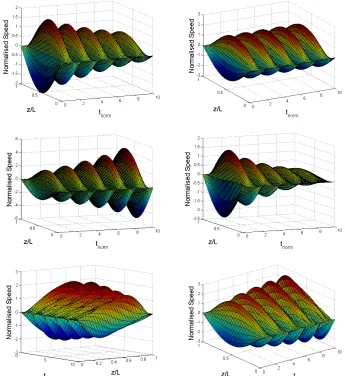
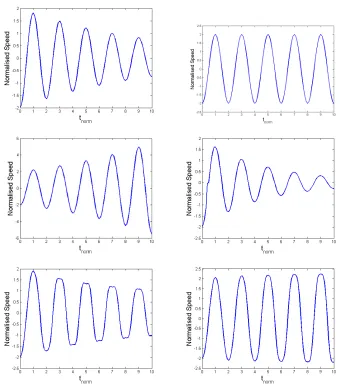
Figures 1 and 2 show different regimes of the oscillations, determined by different combinations of the parameters of Eq. (24). The top-left panels of both the figures show the decaying linear oscillation that was in detail considered in R13. Other panels show the effect of the cooling/heating function Q(ρ, p). In the middle-left panels the oscillation grows because of the thermal over-stability. In the top-right the oscillations is undamped. This regime occurs when the profile of the dependence of the cooling/heating function on the density and pressure has a value given by condition (16). In this case the damping caused by thermal conduction and viscosity is compensated by the amplification caused by the thermal over-stability. In the middle-right panels the oscillation damps stronger than in the case without the cooling/heating function (the top-left panel). In this case the profile of Q(ρ, p) does not satisfy condition (16), and hence contribute to the oscillation damping. Despite the finite value of the nonlinear coefficient λ, the oscillation remains practically harmonic, as it rapidly decreases in time. The bottom panels show nonlinear deformation of the oscillations caused by the finite amplitude. The plot in the bottom-left panel is rotated to make the nonlinear deformation better visible. The nonlinearity manifests itself as the appearance of higher spatial harmonics of the oscillation, i.e. the instant snapshots of the oscillations can be considered as a sum of the fundamental mode sin(πz/L) and the nonlinearly generated modes sin(πN z/L), where the integerN ≥2 is the spatial harmonic number. Fig. 2 shows the gradual distortion of the oscillation profile that becomes anharmonic. For higher values of the nonlinear coefficient λ (c.f. the bottom-left and bottom-right panels), the distortion is more pronounced. Observationally, it would lead to the movement of the position of the highest amplitude along the loop from the top where it is in the fundamental mode.
6. Discussion and conclusions
Our study shows that the cooling/heating function that accounts for radiation and unspecified heating of the coronal plasma can significantly affect longitudinal (slow magnetoacoustic) oscilla-tions of coronal loops. The main contribution to this effect is caused by the gradient of this function at the equilibrium point on the thermodynamic parametric plane (e.g. thep–ρplane). The specific dependence of the cooling/heating function on these parameters has not been established yet, as it is connected with the enigmatic coronal heating mechanism. Moreover, fine details of the radiative-loss function are also continuously updated following new and improved calculations of atomic data and transition rates (see, e.g., discussion in Reale & Landi 2012). What is also important for our study is that the dependence of the radiative-loss function on the thermodynamical parameters is not steady, and even approximated dependences show steep positive and negative gradients for coronal conditions. Thus, we could treat the cooling/heating function as a free parameter in our study. Unfortunately, this uncertainty does not allow us to make any quantitative estimations, re-stricting our attention to the discussion of the possible regimes and their seismological implications only.
It should be pointed out that governing equations (4) used in our derivation, as well as in R13, are rather simple, and may miss some important physical effects. In particular, these additional effects include the complex interactions between thermal and non-thermal effects in flares, and long-durational, in comparison with the oscillation period, field-aligned up- and downflows (e.g. F´arn´ık et al. 2003a; Warren & Antiochos 2004; Li et al. 2015b). Thus, the specific values of the coefficients given by Eqs. (25) may need to be modified if these additional effects are taken into account. However, despite the possible changes in the governing equations, the general view of the evolutionary equation will be similar to Eq. (24) that accounts for the intrinsic mechanisms responsible for the wave evolution: nonlinearity, dissipation and activity. Our main finding is that the effects associated with the activity of the medium, modelled by the fourth term in Eq. (24), may cause a dramatic change in the slow wave evolution, and should not be neglected. Furthermore, in the context of the the specific value of the radiative losses is not important, as the effect of the thermal over-stability is prescribed by the derivatives of the radiative losses and heating function with respect to the local thermodynamical parameters of the plasma.
Anyway, it is clear that one of obvious shortcomings of the presented analysis is the applicability of the effective fluid approach to flaring plasmas, which is not established and needs a dedicated study. On the other hand, the Burgers equation formalism is known to work well as the zero-order approximation even in a collisionless plasma (e.g. Hasegawa 1975). Also, the main intrinsic features of nonlinear wave dynamics, such as nonlinear cascade and appearance of dissipative structures, described by the generalised Burgers equation given by expression (24) are similar in very different environments.
this case, the oscillatory modulation of thermal emission (e.g. EUV, soft X-ray) come from the variation of the plasma density and temperature. Oscillatory modulation of non-thermal emission (e.g. microwave, hard X-ray, γ-ray) could be produced by the modulation of the magnetic reconnection rate by a magnetoacoustic oscillation in a loop situated nearby the flaring site (Chen & Priest 2006; Nakariakov et al. 2006). In those scenarios, the modulation of non-thermal emission is produced by the periodic modulation of the plasma resistivity, caused by the modulation of the macroscopic plasma parameters, such as the density and temperature, by an MHD or acoustic wave. In addition, the periodic modulation of the density of the plasma, and hence the electron plasma frequency, by a slow magnetoacoustic wave, can periodically mod-ulate the gyrosynchrotron emission produced by non-thermal electrons (Nakariakov & Melnikov 2006). Another possibility for the modulation of the non-thermal emission by a periodic variation of macroscopic plasma parameters in an MHD wave is the pe-riodic variation of the magnetic mirror condition in the legs of flaring loops (Zaitsev & Stepanov 1982). Thus, admitting that the non-thermal emission is definitely caused by non-MHD effects, we would like to point out that its periodic modulation can be associated with the periodic variations of the macroscopic plasma parameters in MHD oscillations, considered in this paper.
We found that, depending on the specific gradient of the cooling/heating function at the thermal equilibrium there are three main different regimes of longitudinal oscillations possible in coronal loops. The radiative cooling and heating effects can either increase the oscillation damping, or suppress the damping caused by finite thermal conduction and viscosity. In the latter case we can observe either undamped oscillations, or even increase in the oscillation amplitude in time -the regime of -thermal over-stability. In all -these regimes, -the oscillation period remains determined by the loop length and temperature. We should point out that undamped oscillations have been detected in coronal oscillations during solar flares (e.g. Svestka 1994; Terekhov et al. 2002; F´arn´ık et al. 2003b; Huang & Ji 2005; M´esz´arosov´a et al. 2006; Kislyakov et al. 2006; Sim˜oes et al. 2013; Li et al. 2015a), and hence could, at least in some cases, be attributed to this effect. In the undamped regime, the oscillation period remains determined by the length of the loop and the temperature of the plasma. For example, for a 120-s oscillation in a flaring plasma of 20 MK temperature, the length of the oscillating loop should be about 40 Mm for the fundamental harmonics, and 80 Mm for the second spatial harmonics. It is necessary to mention that an undamped or growing regime of another MHD mode, the kink oscillation, has recently been discovered observationally (Wang et al. 2012; Nistic`o et al. 2013) during non-flaring periods of time, while its nature remains unrevealed. Anyway, undamped kink oscillations are not likely to be responsible for the undamped or growing QPP detected in solar flares, as that regime is observed during the quiet periods of the solar activity.
wave-length. It suggests that the undamped and over-stable regimes are more likely to occur in longer loops, in which the efficiency of the damping by thermal conduction and viscosity is lower. How-ever, realisation of these regimes in specific situations depends on the specific thermodynamical parameters of the plasma in the oscillating loop. Also, the observational detection of an undamped or growing long-period oscillation is only possible in the case when the flaring emission in e.g. the soft X-rays lasts longer than several cycles of the oscillation.
The nonlinear movement of the position of the highest amplitude along the loop, that was revealed in R13, becomes even more important in the case of undamped or growing oscillations. In those cases, nonlinear corrections get accumulated for a longer time, causing more significant departure from the harmonic shape of the oscillations.
Thermal over-stability can also lead to the excitation of oscillations. A gradual change of thermodynamical conditions in a loop, could reach the instability’s threshold (16), causing the onset of the over-stability and hence increase in the oscillation amplitude. In this reasoning one could also take into account the possible onset of some plasma micro-instabilities caused, e.g. by plasma flows in the oscillations, resulting in the increase in the viscosity and thermal conductivity. This scenario could explain the sudden appearance of the oscillation and its rapid decay by the enhance dissipation. However, this discussion remains speculative till more detail investigation of this possibility.
Our results demonstrate that the behaviour of slow magnetoacoustic oscillations in coronal loops is sensitive to the peculiarities of the coronal cooling/heating function. Different dependences of the combination of the radiative cooling and heating on the plasma’s thermodynamical parame-ters result in qualitatively different regimes of the oscillations (over-damped, undamped, growing), providing us with a potential ground for the seismological diagnostics of the cooling/heating func-tion in observafunc-tions. This finding motivates a more detailed study of compressive oscillafunc-tions in observational data. Special attention should be paid to the search for the undamped and growing regimes, similar to those described in (e.g. Svestka 1994; Terekhov et al. 2002; F´arn´ık et al. 2003b; Huang & Ji 2005; M´esz´arosov´a et al. 2006; Kislyakov et al. 2006; Sim˜oes et al. 2013; Li et al. 2015a), the shape of the oscillation curve, and the appearance of higher spatial harmonics.
The significant limitations of the used governing equations, discussed above, require a further development of the model by including additional physical effects typical for flaring plasmas. The formalism for the derivation of evolutionary equation (24) presented here provides one with a convenient starting point. Another limitation of the present study is the use of rigid-wall boundary conditions (6). However, if necessary, the developed formalism can be modified for the cases of open or asymmetric boundary conditions, which is out of scope of the present paper.
Research Project No. 321141 (VMN).
REFERENCES
Afanasyev, A. N., & Nakariakov, V. M. 2015, A&A, 573, A32
Akimov, L. A., Beletskii, S. A., Belkina, I. L., et al. 2005, Astronomy Reports, 49, 579
Anfinogentov, S., Nakariakov, V. M., Mathioudakis, M., Van Doorsselaere, T., & Kowalski, A. F. 2013, ApJ, 773, 156
Bembitov, D. B., Veselovsky, I. S., & Mikhalyaev, B. B. 2013, Geomagnetism and Aeronomy, 53, 1013
Chen, P. F., & Priest, E. R. 2006, Sol. Phys., 238, 313
Chin, R., Verwichte, E., Rowlands, G., & Nakariakov, V. M. 2010, Physics of Plasmas, 17, 032107
De Moortel, I., & Nakariakov, V. M. 2012, Royal Society of London Philosophical Transactions Series A, 370, 3193
Dolla, L., Marqu´e, C., Seaton, D. B., et al. 2012, ApJ, 749, L16
F´arn´ık, F., Hudson, H. S., Karlick´y, M., & Kosugi, T. 2003a, A&A, 399, 1159
F´arn´ık, F., Karlick´y, M., & ˇSvestka, Z. 2003b, Sol. Phys., 218, 183
Field, G. B. 1965, ApJ, 142, 531
Hasegawa, A. 1975, Springer Verlag Springer Series on Physics Chemistry Space, 8
Huang, G., & Ji, H. 2005, Sol. Phys., 229, 227
Kim, S., Nakariakov, V. M., & Shibasaki, K. 2012, ApJ, 756, L36
Kislyakov, A. G., Zaitsev, V. V., Stepanov, A. V., & Urpo, S. 2006, Sol. Phys., 233, 89
Kumar, M., Srivastava, A. K., & Dwivedi, B. N. 2011, MNRAS, 415, 1419
Kumar, P., Innes, D. E., & Inhester, B. 2013, ApJ, 779, L7
Li, D., Ning, Z. J., & Zhang, Q. M. 2015a, ApJ, 807, 72
Li, Y., Ding, M. D., Qiu, J., & Cheng, J. X. 2015b, ApJ, 811, 7
Liu, W., & Ofman, L. 2014, Sol. Phys., 289, 3233
—. 2006, ApJ, 639, 484
Mendoza-Brice˜no, C. A., Erd´elyi, R., & Sigalotti, L. D. G. 2004, ApJ, 605, 493
M´esz´arosov´a, H., Karlick´y, M., Ryb´ak, J., F´arn´ık, F., & Jiˇriˇcka, K. 2006, A&A, 460, 865
Molevich, N. E., Zavershinsky, D. I., Galimov, R. N., & Makaryan, V. G. 2011, Ap&SS, 334, 35
Nakariakov, V. M., Foullon, C., Verwichte, E., & Young, N. P. 2006, A&A, 452, 343
Nakariakov, V. M., & Melnikov, V. F. 2006, A&A, 446, 1151
Nakariakov, V. M., Mendoza-Brice˜no, C. A., & Ib´a˜nez S., M. H. 2000a, ApJ, 528, 767
Nakariakov, V. M., Ofman, L., & Arber, T. D. 2000b, A&A, 353, 741
Nakariakov, V. M., & Oraevsky, V. N. 1995, Sol. Phys., 160, 289
Nakariakov, V. M., & Roberts, B. 1999, Physics Letters A, 254, 314
Nakariakov, V. M., Roberts, B., & Petrukhin, N. S. 1997, Journal of Plasma Physics, 58, 315
Nakariakov, V. M., Tsiklauri, D., Kelly, A., Arber, T. D., & Aschwanden, M. J. 2004, A&A, 414, L25
Nistic`o, G., Nakariakov, V. M., & Verwichte, E. 2013, A&A, 552, A57
Ofman, L., Nakariakov, V. M., & Sehgal, N. 2000, ApJ, 533, 1071
Ofman, L., & Wang, T. 2002, ApJ, 580, L85
Ogrodowczyk, R., Murawski, K., & Solanki, S. K. 2009, A&A, 495, 313
Reale, F., & Landi, E. 2012, A&A, 543, A90
Ruderman, M. S. 2013, A&A, 553, A23
Schure, K. M., Kosenko, D., Kaastra, J. S., Keppens, R., & Vink, J. 2009, A&A, 508, 751
Selwa, M., Ofman, L., & Murawski, K. 2007, ApJ, 668, L83
Sim˜oes, P. J. A., Fletcher, L., Hudson, H. S., & Russell, A. J. B. 2013, ApJ, 777, 152
Sim˜oes, P. J. A., Hudson, H. S., & Fletcher, L. 2015, Sol. Phys., arXiv:1412.3045
Svestka, Z. 1994, Sol. Phys., 152, 505
Taroyan, Y., Erd´elyi, R., Doyle, J. G., & Bradshaw, S. J. 2005, A&A, 438, 713
Tsiklauri, D., Nakariakov, V. M., Arber, T. D., & Aschwanden, M. J. 2004, A&A, 422, 351
Wang, T. 2011, Space Sci. Rev., 158, 397
Wang, T., Innes, D. E., & Qiu, J. 2007, ApJ, 656, 598
Wang, T., Ofman, L., Davila, J. M., & Su, Y. 2012, ApJ, 751, L27
Wang, T., Solanki, S. K., Curdt, W., Innes, D. E., & Dammasch, I. E. 2002, ApJ, 574, L101
Wang, T. J., Solanki, S. K., Curdt, W., Innes, D. E., & Dammasch, I. E. 2003a, Astronomische Nachrichten, 324, 340
Wang, T. J., Solanki, S. K., Curdt, W., et al. 2003b, A&A, 406, 1105
Wang, T. J., Solanki, S. K., Innes, D. E., & Curdt, W. 2005, A&A, 435, 753
Warren, H. P., & Antiochos, S. K. 2004, ApJ, 611, L49
Zaitsev, V. V., & Stepanov, A. V. 1982, Soviet Astronomy Letters, 8, 132
Zavershinsky, D. I., & Molevich, N. E. 2014, Technical Physics Letters, 40, 701