Multiple Load Balancing to Support Non-Congestion
based Multicast Routing in Adhoc Network
ABSTRACT
In this paper, Mobile Ad hoc Networks (MANET) is wireless networks consisting of a collection of mobile nodes without fixed infrastructure. According to decentralized, self-configuring and dynamic nature, MANETs offer many advantage and easy to install. But with this dynamic topology, MANETs have some challenges like the design of an efficient routing protocol. The multiple paths routing protocol with load balancing provides a solution for the congestion network and increases its capacity. MANET consists of a set of mobile nodes which are connected with each other by using radio waves. Load balancing is the way of improving the performance of a parallel. The central administration, hence it is called infrastructure less network. It is very difficult to find the path between two end points. This paper shows a solution for finding path between nodes in mobile ad hoc network. The multipath routing protocol with Load Balancing (LB) provides a solution. The results of this algorithm shows better throughput as compared to existing result. In this paper, the result show the performance analysis of various load balancing algorithms based on different parameters. The analysis represents that static and dynamic both types of algorithm can have advancements as well as weaknesses. Deciding type of algorithm to be implemented will be based on type of parallel applications to enhance the Quality of Service (QoS).
Keywords
Load balancing (LB), MANET; multipath routing protocol; QoS.
1.
INTRODUCTION
A Mobile Ad hoc Network (MANET) consists in a collection of wireless mobile nodes, which form not a fixed network without depending on any existing infrastructure or centralized administration [1]. The advantages of ad hoc networks are the convenience (no any centralization), mobility, productivity and expandability. The topology of network is changed randomly. Hence it is not easy to create path between two nodes. This paper deals with the improvement for congestion of on-demand ad-hoc network routing which can achieve load balancing for packet switched network. The algorithm is inspired by Ant Colony Optimization(ACO)[2][3] is shows improvement in congestion. Routing in algorithm [4] [5] is through interaction of network exploration a mobile agents builds path between pairs of nodes by exchanging information and updating routing tables. MANET networks have several usages. First these networks were devised to be used in military applications. MANET networks are mostly used in survey,
helping and saving operations, tracing and operations, scientific conferences.
The problem of mobile ad-hoc network (MANET) can be summarized in the answer of this question: how to find the route between the communicating two nodes. The reasons is that routing in MANETs is a particularly challenging task due to the fact that the topology of the network changes constantly and paths which were initially efficient can quickly become inefficient or even not feasible. The control information of the network is not more because of the bandwidth of the wireless medium is very less, and path is shared. It is important to design algorithms that are adaptive, robust. Moreover, the work in a fixed decided way, due to the limitation of centre control or infrastructure in the network [6,8].
2.
PROTOCOLS
Congestion control was defined similar to TCP, for achieving TCP friendliness [10]. In this paper, two methods improve the Ad-Hoc On-Demand Distance-Vector (AODV) protocol. The main motive of the design of the protocol was to reduce the overhead, buffer overflow, delay and increase the performance. A multi-path routing protocol is introduced. It is based on AODV. It proposes a load balancing method that uses all discovered paths simultaneously for transmitting data. In this way, data packets are balanced over discovered paths and energy consumption is distributed across many nodes through network.
3. ROUTING OF AD HOC NETWORK
The routing is a method which attends to forward the information to destination along the network. It consists to determine an optimal forwarding for packets along the network according to certain criteria hop number The problem consist to find the investment with minimum cost of nominal capacity and reserve that provide the routing of nominal traffic and guarantee its reliability in case of any failure of link or node. In this method the performance [11] [12] of the processors is determined at the beginning of processing. Then depending upon their work load is distributed in the start by the master processor. The slave processors evaluate their allocated work and submit their result to the master processor. A task is executed on the processor to which it is assigned that is static load balancing methods are non-preemptive. The aim of static load balancing method is to reduce the overall execution time of a concurrent program while minimizing the communication delays. A normal disadvantage of all static schemes is that the final selection of a host for process allocation is made when the process is created and cannot be changed during process execution to make changes in the system load.Minakshi Sharma
Lecturer of Computer and Science Department
Sai Institute of Engineering and Technology
Amritsar, 143001
Tanu Preet Singh
PhD Research Scholar Department of Computer Science &
Engineering
4.
A NEW TECHNIQUE: AD HOC ON
DEMAND MULTIPATH DISTANCE
VECTOR
To reduce interruption of communications in ad hoc network, the discover procedure of routes must be efficient specially with the continuous mobility of the nodes and also the frequent change of network topology, many routing protocols are proposed such as technique: the multipath routing protocol [9] that extends the single path AODV protocol to compute multiple path routing.
4.1
Routing
The main idea in technique is to compute multiple paths during route discovery procedure for contending link failure. In fact, the main goal to concept this protocol is to search multiple routes during the same route discovery procedure, but only the best path based on some metric (number of hop) is chosen and is used for data transmission between source and destination. The other paths are used only when the primary path fails. This protocol is intended for ad hoc network where the mobility of nodes is very important and consequently the route breaks frequently. The technique use the information available in AODV, but to compute multiple paths it adds additional number of control packet overhead.
4.2
Multipath route construction
This new technique is based on the advertised hop count [14]. The advertised hop count of a node for a destination represents the maximum hop count of the multiple paths for available. The protocol accepts only alternate routes with hop count lower than the advertised node count, alternate routes with higher or the same hop count are discarded. This condition is necessary to guarantee loop-freedom. Figure shows the structure of the routing table entries for AODV and new technique.
4.3
Computing Multiple Loop free Paths
This new technique allows building multiple link disjoint paths. It ensures multiple paths without common link between routes from source to destination. The additional modifications are made in the route discovery process to allow formation of node-disjoint paths from intermediate nodes to the source and destination. This technique adds a new field called first hop for every packet. This field indicate the first hop (neighbor to node source) to set. In addition, each node maintains first hop list. For each packet keeps track of the list of neighbors of the source through which a copy of the request route has been received. At the intermediate nodes, not like in AODV, duplicate copies of route request are not immediately discarded. Every copy is examined to see if it provides a new node-disjoint path to the source. This is provided to examine the first node in the route request copy and the first hop list in the node for the route request. If it does provide a new path, route update rule is invoked to check if a reverse path can be set, In the round robin [13] processes are divided evenly between all processors. Every new process is assigned to new processor in round robin order. This process allocation order is maintained on each processor locally independent of allocations from remote processors. With equal workload round robin algorithm is expected to work well. Round Robin and Randomized schemes [12] work well with number of processes larger than number of processors. Advantage of Round Robin algorithm is that it does not require inter-process communication. Round robin and randomized algorithm can attain the best performanceamong all load balancing algorithms for particular special purpose applications. In general Round Robin and Randomized algorithm [16] are not expected to achieve good performance in general case.
4.4
Technique problem
In such protocols a link failure in the main path, which data transmission is actually taking place and causes the source to switch to an alternate path instead of initiating another route discovery. A new route discovery occurs only in case all precompiled paths break. The problem with these Multipath protocols [15] is that though during the route discovery process multiple paths are discovered, where the best path based on some metric is chosen and is used for data transmission. The other paths are used only when the main path fails.
Actually, the compute and the maintenance of multipath between source and destination require a very important occupation of routing table, achieve tremendously memory resource at every node and increase the heading packet size. These constitute a handicap, in view that there is only one path to transmit.
5.
IMPROVEMENT TO MULTIPLE
PATH PROTOCOLS BY USING NS2
In this part, the technique proposes an extension in order to support certain mechanism and technique to improve its performance. The technique can allow finding many routes between source and destination during the same route discovery procedure but only one path is used to transmit data. When the source receives one or many route reply the packets from many disjoint paths.6.
PROPOSED MODEL
The technique selects the route with the lower hop count to forward data. However, the less congestion routes can provide short end to end delay than routes providing lower hop count. To choose the less congestion routes, there is need of a new metric which allow source node to select the less congestion routes. For this reason, technique propose a new metric which achieve load balancing between the selected routes to take into account the number of active paths through every nodes according to the following. The division with hops, forming the route, ensures that the metric takes into account the hop count number to estimate the traffic load.
If (node position is found) {
Transmit the data; }
If (load is allowed load) {
Forward data packets; }
Else {
Count for load value; Check the optimal path; }
If (optimal path is found) {
Check for routing table; }
If (transmission is allowed) {
} Else
/* if no. of routes are known from source to destination*/ {
Distribute forward data packet to less congestion routes; }
The packets sent by source node are scheduled according to this above algorithm.
7.
PERFORMANCE EVALUATION
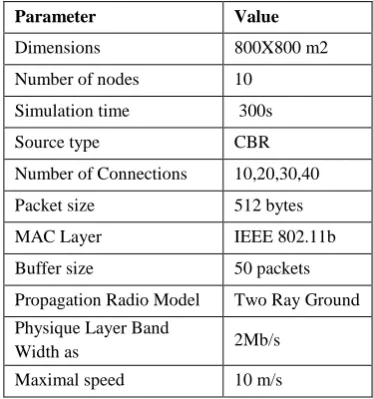
The problems use NS 2.34 to simulate a technique. For the initial simulations and the validation of the system the following parameters have been chosen:
Table 1. Parameter of simulation
All nodes have the same transmission range of 200 meters. The mobility model selected is the random waypoint model. In this mobility model, a node moves in the direction of the destination with a speed uniformly chosen between the minimal speed and maximal speed.
In this simulation, Net Travel time (NT) is combination of travel time and node ni where i is 10,20,30,40.
40
NT =
∑
travel time* ni i=10The 10 nodes simulation is shown in below figures. Here fig 1 and fig 2 are shown the problem of data dropping. In fig 2, the energy level of nodes is weak because of passing heavy data through the nodes. That heavy data passing converts into red node passing converts into red nodes. In fig 3, the solution dropping the packets is controlled by a particular technique. The load is balance through new technique.
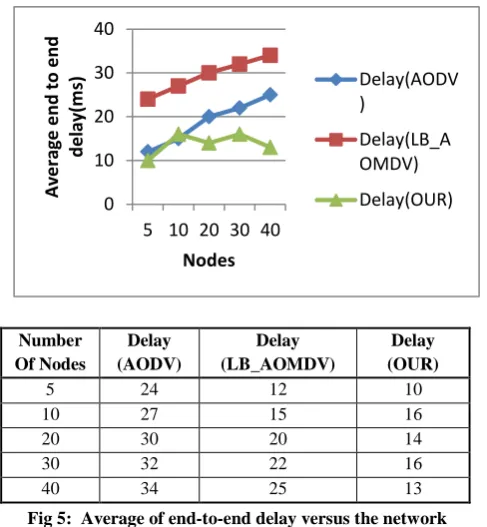
The effect of the end-to-end delay decrease of the protocol by the use of the less congestion route selection mechanism which distribute traffic load fairly across routes selected between source and destination.
[image:3.595.66.253.259.459.2]Fig1: Problem of dropping the packets
Fig 2: Energy Low by passing heavy packets in red nodes
Fig 3: Solution of problem by implementing load balancing technique
8.
SIMULATION RESULTS
8.1 Packet Delivery Ratio (PDR) versus the
network load
Fig 4 shows that the packet delivery ratio decreases according to the number of nodes. The performance of multipath routing is foreseeable under heavy load. When the traffic load is about 40 connections (which is a heavy load), PDR achieved by OUR protocol is better than the PDR achieved by
LB-Parameter Value
Dimensions 800X800 m2
Number of nodes 10
Simulation time 300s
Source type CBR
Number of Connections 10,20,30,40
Packet size 512 bytes
MAC Layer IEEE 802.11b
Buffer size 50 packets
Propagation Radio Model Two Ray Ground
Physique Layer Band
Width as 2Mb/s
AOMDV, also better than the PDR of AODV.
Fig 4: PDR versus the network load
[image:4.595.313.552.150.440.2]8.2 Average end-to-end delay versus the
network load
Fig 5, here note the increase of the average end to end delay according to the network load for all the routing protocols. The protocol is the most efficient because, under heavy load (40 connections) its average end to end delay.
Fig 5: Average of end-to-end delay versus the network load
[image:4.595.48.292.462.726.2] [image:4.595.56.528.467.742.2]8.3 Average buffer size versus the network load
Fig 6 shows that the average buffer sizes increase according to the network load for all the routing protocols. According to this figure, here note that the multipath routing protocols have less loaded buffers then single path routing protocols. The new protocol reduces the congestion level of the network and increases its capacity.Fig 6: Average of buffer size versus the network load
8.4 Traffic Overhead(TOH) versus the network
load
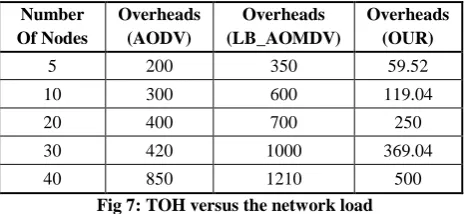
The observation of fig 7 shows that our protocol generates the highest traffic overhead. When the number of connections is equal to 5, the traffic overhead produced by all protocols is low. This traffic increases significantly when the network load increases (till 40 connections).
88 90 92 94 96 98 100 102
5 10 20 30 40
PD
R
(%
)
Nodes
PDR % (AODV)
PDR % (LB_AOMDV )
PDR % (OUR)
0 10 20 30 40
5 10 20 30 40
A
ve
rag
e
e
n
d
to
e
n
d
d
e
lay
(m
s)
Nodes
Delay(AODV )
Delay(LB_A OMDV) Delay(OUR)
0 5 10 15 20 25 30
5 10 20 30 40
B
u
ff
e
r(b
its)
Nodes
Buffer Size (AODV)
Buffer Size (LB_AOMDV )
Buffer Size (OUR)
0 200 400 600 800 1000 1200 1400
5 10 20 30 40
Tr
aff
ic
Over
Head
s(b
its)
Nodes
Overheads( AODV)
Overheads( LB_AOMDV )
Overheads( OUR)
Number of Nodes
PDR % (AODV)
PDR % (LB_AOMDV)
PDR % (OUR)
5 98 99 100 10 96 97 99 20 95 96 99 30 94 95 96 40 92 94 95
Number Of Nodes
Delay (AODV)
Delay (LB_AOMDV)
Delay (OUR)
5 24 12 10
10 27 15 16
20 30 20 14
30 32 22 16
40 34 25 13
Number Of Nodes
Buffer Size (AODV)
Buffer Size (LB_AOMDV)
Buffer Size (OUR)
5 6 5 2
10 10 9 5
20 14 12 8
30 18 15 11
[image:4.595.314.545.540.740.2]Fig 7: TOH versus the network load
Here explain the results by using of high number of control packets to search and maintain routes belonging to multipath routing protocols.
9.
CONCLUSION
In this work, the multipath routing protocols in this paper. Load balancing mechanism to fairly distribute the traffic on different active routes selected between source and destination nodes. To select the less congested routes, a new multipath routing protocol with new metric. Among the performance evaluation of different routing protocols simulated: AODV and LB-AOMDV. This protocol improves the network performance in terms of capacity and congestion level compared to other technique of LB-AOMDV and AODV routing protocols under heavy loaded network. In the future work, some other metric would be included to improve QoS of protocol.
10. REFERENCES
[1] Abolhasan, M., Wysocki, T., and Dutkiewicz, E., “A review of routing protocols for mobile ad hoc etworks,” Ad Hoc Networks 2, pp. 1-22 (2004).
[2] E. Bonabeau, M. Dorigo, and G. Théraulaz, Swarm intelligence: from natural to artificial systems, Oxford University Press, 1999.
[3] T. White, "Swarm intelligence and problem solving in telecommunications", Canadian Artificial Intelligence Magazine, spring, 1997. International Journal of Next-Generation Networks (IJNGN),Vol.1, No.1, December 2009.
[4] G. Di Caro and M. Dorigo, "Mobile agents for adaptive routing", Proc. 31st Hawaii International Conference on System Sciences, IEEE Computer Society Press, Los Alamitos, CA, pp. 74-83, 1998.
[5] Schoonderwoerd R, Holland O, Bruten J, Rothkrantz L. “Ant-Based load Balancing in telecommunications networks, Adaptive Behavior Hewlelt-Packard Laboratories, Bristol-England, pp 162-207, 1996.
[6] G. Di Caro and M. Dorigo, AntNet: distributed stigmergetic control for communications networks, Journal of Artificial Intelligence Research, 9 (1998), 317–365.
[7] G. Di Caro, F. Ducatelle, and L. M. Gambardella, AntHocNet: an adaptive nature-inspired algorithm for routing in mobile ad hoc networks, Tech. Report IDSIA-27-04-2004, Dalle Molle Institute for Artificial Intelligence (IDSIA), Manno-Lugano, Switzerland, September 2004.
[8] M. Dorigo and G. Di Caro, The ant colony optimization metaheuristic,in New Ideas in Optimization, D. Corne, M. Dorigo, and F. Glover, eds., McGraw-Hill, London, UK, 1999, 11–32. [8] Macker. J and Corson. S, Mobile
ad hoc networks (MANET), 1997,
http://www.ietf.org/html .charters/manet/charter.html.
[9] YuHua Yuan, Hui Min Chen, and Min Jia “An optimized Ad hoc On-Demand Multipath Distance Vector ( THE TECHNIQUE) Routing Protocol,” Communications, 2005 Asia-Pacific Conference on Volume, Issue, 03-05 Oct. 2005 Page(s):569 – 573.
[10] R.R. Stewart et al., Stream control transmission protocol, RFC 2960, October 2000.
[11] Derek L. Eager, Edward D. Lazowska, John Zahorjan, “Adaptive load sharing in homogeneous distributed systems”, IEEE Transactions on Software Engineering, v.12 n.5, p.662-675, May 1986.
[12] R. Motwani and P. Raghavan, “Randomized algorithms”, ACM.
[13] Erik Andersson, Magnus Andersson, Mattias Flodin, Peter Gardfjäll, Alexander Hellström, ”Understanding THE TECHNIQUE routing in practice”, May 15, 2003.
[14] Marina M. K., Das S. R., “Ad hoc On- demand Multipath Distance Vector Routing” , Computer Science Department, Stony Brook University,2003
[15] Mueller S., P. Tsang, and D Ghosal, “Multipath Routing in Mobile Ad Hoc Networks: Issues and Challenges” , IEEE conference on Computer Communications (INFOCOM 2003).
[16] Paul Southerington, “The Smoothed Round-Robin Scheduler”, Member, IEEE, ECE742, 28 April 2005. Number
Of Nodes
Overheads (AODV)
Overheads (LB_AOMDV)
Overheads (OUR)
5 200 350 59.52
10 300 600 119.04
20 400 700 250
30 420 1000 369.04