Munich Personal RePEc Archive
Approaches to Using e- and m-Business
Components in Business
Collan, Mikael and Sell, Anna and Anckar, Bill and Harkke,
Ville
Institute for Advanced Management Systems Research
February 2005
Online at
https://mpra.ub.uni-muenchen.de/4332/
Tur ku Cent r e for Comput er Science
TUCS Technical Report
No 668, February 2005
Author One | Author Two | Author Three
Author Four | Author Five
Title of the Technical Report
Mikael Collan | Anna Sell | Bill Anckar
Ville Harkke
TUCS Technical Report
No 668, February 2005
Approaches to Using e- and m-Business
Components in Business
Mikael Collan
Åbo Akademi University, Institute for Advanced Management Systems Research and Department of Information Systems
Anna Sell
Åbo Akademi University, Institute for Advanced Management Systems Research
Bill Anckar
Åbo Akademi University, Institute for Advanced Management Systems Research and Omena Hotels Oy
Ville Harkke
Abstract
This paper discusses using e- and m-business components in supporting and enhancing existing businesses and in creating new business innovations. A framework illustrating two different approaches companies have to adoption of e- and m-business components is proposed. Three cases of how Finnish companies have, in an innovative way, used e- and m-business components to support, to enhance, and to launch businesses are presented. Based on the illustrative framework and the cases, some rules of thumb for using e- and m-business components in business are proposed. The aim of this paper is to offer managers helpful insights for planning e- and m-business component investments.
Keywords: e-Business, m-Business, Business Models, Case Studies
IAMSR
1
1.
Introduction
It is quite clear that electronic (e) and mobile (m) commerce are here to stay, and that they give established companies a set of new alternatives to conduct their businesses, and opportunities for starting of new companies. In general we can characterise e- and m-commerce as the different ways of supporting and conducting business over the Internet (e) and/or with mobile devices (m). Examples of e-Commerce can, e.g., be a store operating exclusively the World Wide Web, e.g., amazon.com, or a company offering only very limited services through the Internet, e.g., e-mail-based reservations. m-Commerce can be understood in equally diverse ways, indeed, there may be a number of different definitions for e- and m-commerce, which are all correct. Due to the possibility of very diverse views in understanding what e-commerce and m-commerce are, in this paper, we refer to application of e- and m-commerce techniques to business as using e- and m-business components.
There are, and have been, many misperceptions as to what e- and m-commerce are, about what they are not, and especially about how and how much they generate value.
These misperceptions have lead to a number of spectacular failures, e.g., those of the on-line grocer Webvan and the Internet clothing retailer Boo.com, which for their part, have made many managers feel suspicion towards applying e- and m-business components in their companies.
The aim of this paper is to support managers in understanding what kind of e- and m-business components would possibly suit their companies. A key issue in assessing the suitability of e-and m-business components for a company is underste-anding the orientation that the company has in its approach to e- and m-business components, i.e., is the company a technology- or a business-orientated e- and m-business component adopter. Observing the different orientations of approaches of different companies to adopting e- and m-business components helps managers to better understand the orientation of their own company and may significantly reduce the risk of misinterpreting the e- and m-business component investment needs of the organisation.
It cannot be argued that e- or m-commerce would be almighty forces that guarantee success and indeed if such statements are made, they are undoubtedly wrong. However, there are a number of positive experiences from successfully using e- and m-business components to enhance and to revitalise existing businesses, such as the British grocer Tesco, whose online endeavour Tesco.com is profitable. Another example is the e-commerce early adopter Lands’ End. There have also been successful starts of new businesses, such as that of the profitable online community Classmates.com.
The successful applications of e- and m-business components are often the result of insightful innovations, more specifically, insightful innovations within the core business (idea) of the company. A business innovation can be to replace an old way of doing business with a new way, or by introducing a business idea that has never been tested before. In many successful e-and m-commerce cases the success has often come from the insightful application of existing technology that a company has used to support, enhance, or extend its core business [6].
2
and technologies within companies to core competence areas build competitive advantage. Such consolidation is reached through enhanced communication and constructive managerial involvement in the areas, which have been identified as the strengths of the company. The basis of the competitive advantage of a company, according to the core competence thinking, can be said to be the systematic application of the things the company does best in everything the company does.
Creating competitive advantage through concentrating and developing core competencies is one issue, retaining the competitive advantage is another. Companies need to change in order to keep up with the changes in their environment, otherwise they are likely to lose their competitive advantage, i.e., ways of applying core competencies must change as the competitive environment changes. The efforts that companies make to change have been done under different names and concentrated on different issues within the organisation of a company, e.g., TQM, reengineering, right sizing, restructuring, cultural change, and turnaround. Despite the different approaches the basic goal has been the same, to make fundamental changes into how business is conducted to cope with the changing environment [14].
We can view e- and m-business components as tools that can be used to transform the business processes to retain competitive advantage, or as the core competence area of a company. In fact, we can view e- and m-business components as any other core competence, or tool of business transformation. For the companies that base their business idea on e- and m-business components they are parts of the core competence areas, for others they are tools to retain competitive advantage.
Companies that have an existing core business and decide to analyse enhancing their operations with e- and m-business components they should keep their eye on the ball, i.e., on their core business and not get carried away [19]. We want to point out that creating core competencies out of e- and m-business components is as difficult as creating any core competencies, i.e., very difficult.
If companies utilise e- and m-business components to transform their core business(es) it is very important to critically analyse, if the revenue logic of the business changes. If the revenue logic remains unchanged, then it is to be expected that also the valuation principles of the business most likely remain unchanged. In other words, there is no reason to draw the conclusion that e-and m-business components will miraculously increase the profitability of the company. Indeed, overstatements of the value of e- and m-component based companies and investments have been common enough, [10] and [13].
3
There are some models available for measurement of potential, e.g., the real options approach is a collection of methods to understand, measure, and value potential. The real option approach offers valuation rules that can be used to assist in the analysis of the profitability of e- and m-business investments in companies, e.g., see [16]. Like with any other methods, the correct use of the methods used in the real options approach is important. All methods can be made to show desired results; at the end of the day it is in the interest of everyone to be realistic.
In the next section we will propose a framework to illustrate the different orientations that companies have in approaching e- and m-business component investments. This is followed by presenting three cases from Finnish companies that illustrate adoption of e- and m-components in business. Based on the introduction, the proposed framework, and the cases three rules of thumb for successful application of e- and m-business components are proposed and shortly discussed. The paper closes with a summary and conclusions.
2.
The Technology and Business Oriented Approaches
to e- and m-Business
In the introduction we argue that there are undoubtedly a number of different definitions for e-and for commerce e-and that business components, or concepts that are based on e- e-and m-technology, "e- and m-business components", can be used in different ways. We point out that e- and m-business components can be used to support existing core businesses by replacing old ways of doing with new e- and m-ways and for creating totally new core business areas. In both of these ways companies can retain their competitive advantage.
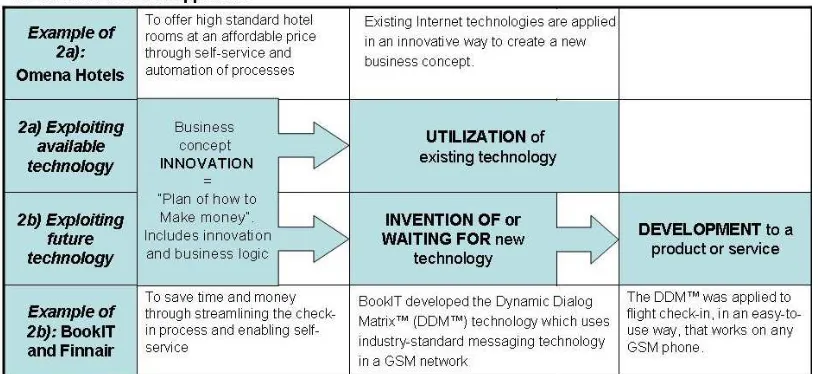
We feel that it is important to separate companies according to what is their orientation to e- and m-business component investments and starting e- and m-business. Do companies develop technology and utilise existing (or create new) business ideas to commercialise the technology, or do they develop business ideas and utilise existing (or create new) technology to commercialise the business ideas?
To discuss this interesting issue, we propose a framework that illustrates the two different orientations of approaches. This framework is useful in understanding the different approaches and in raising questions about the difference in risks and possibilities that they entail to the success and profitability of e- and m-business component investments.
4
Figure 1. Technology oriented approach
The technology oriented approach is based on the notion that new technology will create business, i.e., "this technology will make us money if we can figure out how to sell it". The companies that have the technology oriented approach to e- and m-business fund the development and commercialisation of the majority of new e- and m-technology.
Companies that have their core competence in other areas than R&D usually do their e- and m-business by using the m-business oriented approach (see Figure 2) and utilise available, or future, e- and m-technology in their core business areas. Their e- and m-business is supporting their core business areas, and often the decision to adopt e- and m-business components is justified on cost savings or maintaining competitive advantage.
[image:10.612.102.511.468.655.2]5
The business-oriented approach is based on the notion that we need to have a good business concept and revenue logic and then we find the matching technology to realise it. This includes finding cost savings for an existing business, the basis of the approach is: "we could make money if we had this technology".
The separation to the technology and the business oriented approaches may seem to be trivial, because no matter which approach we have to achieve success a company needs to have both, the right technology and the right revenue logic. Indeed it is intuitive, however, it is too often forgotten. Because it is easy to understand the differences in the technology and business oriented approaches it may become easier to understand and identify potential for failures of e-and m-business component implementations. Starting from underste-anding the core competence areas and their effect on the orientation and approach of companies to e-and m-business innovations it is easier to pinpoint the risks that managerial myopia and misunderstandings connected to the orientation may cause.
In the following section we will present three business innovations based on e- and m-components, which are actual implementations from Finnish companies. Finland is a country of five million inhabitants in Northern Europe, ranked by many surveys and analysts as one of the countries with the highest penetration of the Internet and mobile devices.
3.
Some e- and m-Business Cases
Below we go through three cases that present business innovations that use e- or m-business components to enhance existing core business of companies. A short background of the companies and their business is given, then the innovation is described, and the viability of the innovation shortly discussed.
Case 1: Omenahotellit - Hospitality Online1
In spite of the fact that many players in the travel industry have been forerunners in the field of IT, the information systems and technologies used in the hospitality sector have, as a rule, been constructed to support or extend - but rarely to radically alter or replace - the existing, conventional, business models: The traditional services and functions continue to exist abreast with the new technological solutions, and the business models have tended to remain relatively unchanged after the implementation of new technologies and systems. Information and communication technologies (ICT) have thus primarily been used to broaden the market share (by making the product available to more people), to cut costs, and/or to enhance the efficiency of a particular business process. However, with the great advances in ICT, the progress to the next generation of Web sites and services, and increasingly positive attitudes among consumers to embrace the Internet as an advanced commercial medium, we will continue to witness the emergence of many innovative and interesting business models - even in the somewhat conservative accommodation sector.
1 This section largely builds on the paper ”Omenahotellit: A Room with a View for the Internet
6
Omenahotellit (Omena Hotels), a new Finnish hotel chain, is a good example of a company which fundamentally builds is operations on a new, innovative e-business model. The company challenges the traditional service concept used by most other players in the accommodation sector by fully exploiting the Internet and other forms of ICT in its operations. Spurred by new insights as well as innovative - and successful - attempts and methods to utilize IT and the Internet in the travel sector (for instance the paths shown by successful low-cost air carriers), Omenahotellit has developed an IT-enabled business model previously unseen even on a global scale in the accommodation sector.
The basic idea in the operational concept of Omenahotellit and the main promise of the company is to offer travelers high standard hotel accommodation at prime locations - in city centers - at a truly affordable, fixed room rate. High class yet inexpensive prices may seem like an impossible equation, but Omenahotellit’s business model excels in cost-efficiency by offering the core product of hotel operations - a room for the night - without expensive built-in auxiliary services. Maximum occupancy per room is 4 persons. All rooms are similar in terms of size, amenities and interior design, and they certainly do not pale in comparison with the typical 4-star hotel rooms offered by the main competitors on the Finnish market as far as the room size and amenities are concerned.
The inexpensive room rate offered by Omenahotellit is largely a result of the radical cost cutting achieved by truly maximizing the use of IT and the Internet in the reservations and payments, reception procedures, customer safety and convenience as well as management and maintenance tasks.
The entire booking/cancellation process is handled by the customer himself through the company’s proprietary online reservation system at www.omena.com. The customer makes a reservation, pays for it by using secure online banking/credit card payment solutions, and receives a booking confirmation which shows the room number and the key to the room - a 5-digit numerical personal door code, which is valid throughout his stay. The customer can also book and pay for extra services such as pay-TV services and broadband Internet access already when booking his room, or later through the in-room TV. Companies and organizations that have signed a key customer agreement with Omenahotellit do not have to pay for the reservation online, but can choose to get an electronic invoice (which is automatically generated and sent by the reservation system and entered in the ledger) instead. As a result, even the traditional invoicing tasks have been fully automated.
All Omena hotels operate without a reception desk or reception personnel, as all traditional reception tasks have been completely automated using IT. Since all reservations have already been paid for, and the room keys have been delivered electronically in advance, there is no need for check-in or check-out procedures such as handing over keys or charging the customer. The entrances are equipped with Internet-connected electronic service points, "kiosks", through which walk-in customers can make reservations, and pay with their credit cards.
7
necessary hotel information, and contact the service company for maintenance or extra housekeeping, etc.
Many time-consuming management and maintenance tasks such as providing key partners and government authorities with important data have been almost completely automated. The lists of rooms to be cleaned are automatically generated and delivered to the housekeeping staff by e-mail every morning. The hotel room textiles (bed linens, towels, etc.) are ordered from the laundry service directly by the system based on the number of rooms booked and the total number of occupants.
The business model of Omenahotellit marks originality also when observing the company’s organizational structure: Since the routine tasks have been arranged according to self-service principles and automated using IT, the company is, to a certain extent, managed by its customers and by computerized systems. Omenahotellit has, in fact, only one employee - the managing director. Instead, the company draws on a rather extreme outsourcing strategy, relying on a large network of partners to handle tasks such as: (i) project management relating to opening new hotels (architects and engineers); (ii) IS (hosting, system monitoring, etc.); (iii) housekeeping (cleaning and maintenance); (iv) security; (v) customer service; and (vii) marketing. The company has no office facilities, but is operated through “laptop management” using a virtual, largely paperless office. The foundation stone in Omenahotellit’s strategy is the proprietary online reservation and hotel administration system (launched in May 2003), which has been tailor-made for Omenahotellit’s exceptional, automation-based business model.
Omenahotellit has set up an ambitious expansion plan: The company wants to operate almost 40 small units, a total of 2000 rooms2, in the 30-35 largest cities in Finland by the year 2008. From 2006 onwards, the company will also aim at an international expansion, primarily into the neighboring countries.
The main driving factor in Omenahotellit’s chosen strategy was that a company cannot exploit, in full, the many potential benefits of IT and e-commerce by using new technologies just to support (or as an extension of) existing processes and operations. Although many big players have been able to attain a dominant position on both traditional and electronic markets (largely thanks to their established reputation and sufficient financial resources), it can be argued that such a phenomenon reflects the insecurity and lack of trust among online customers in the early phases of e-commerce rather than superiority in terms of online value creation. Optimizing the special advantages offered by IT and e-commerce requires as a rule, rather, pure e-business models and a lack of restrains set by existing bricks-and-mortar operations. For Omenahotellit, this meant focusing exclusively on the electronic sales channel, thus not offering alternative sales channel such as call centers or sales offices - not even reception desks or personnel.
Value creation is a complex process which strongly relates to every aspect of a company’s operation and the choices it makes; what it sells and how its products are marketed. The key value proposition of Omenahotellit primarily relates to: (i) the provision of real-time information, instant gratification, and high quality of content and applications online; (ii) simplicity of lodging (no check-in/check-out procedures), and especially (iii) a fixed room rate and a very attractive price/quality ratio. The low prices are the end result of numerous factors, the most important of which are:
8
- A full automation of many tasks with a resulting reduction in labor costs in comparison to hotels using traditional business models.
- Customer self-bookings: Following both intuitive logic and established theory, Omenahotellit reasons that online self-bookers, which clearly cut costs for suppliers in comparison to reservations handled by a sales workforce, both can and should be rewarded in the form of lower rates.
- Disintermediation: No middlemen are used in the booking process, meaning that no commissions have to be paid to intermediaries. The savings are returned to the customers in the form of inexpensive prices.
At present, four Omena Hotels are in operation in Finland, but several new units will be opened in the next two years, primarily by transforming existing office spaces located in city centers into new, modern hotels.
Thus far, the marketing efforts of Omenahotellit have been limited, but more massive advertising campaigns will be carried out as soon as the number of hotels increases to 8-10 by mid-2006. In spite of that, the first year of operations has showed promising figures, with room occupancy rates clearly exceeding the expectations set for the initial period, and passing the break-even margin at a surprisingly early stage. The early adopters were primarily young people, groups and families who recognize the value of an inexpensive room which can accommodate 4 persons, a fact which is confirmed by the extremely high average number of guests per room (2.45). However, a significant increase in the number of business travelers has taken place in the recent months, as more and more companies learn about this new, interesting alternative.
In this brief case study we have presented Omenahotellit, a new Finnish hotel chain which challenges the conventional service concept used by most other players in the accommodation sector by drawing on a new, innovative e-business model. In doing so, we have aimed at providing insights as to the opportunities the Internet and IT can offer even in a sector, which justly can be characterised as conservative. In addition, we have highlighted a number of important issues that are at the core of the customer value creation process in an online environment, where new modes of competition emerge.
Case 2: The Helsinki City Transport Company - mTicket
The Helsinki City Transport Company provides public transport services for the Helsinki metropolitan area. The company operates buses, trams, subway lines and ferries to the islands outside the city centre. In 2003 the company sold 93,4 million bus, 56,8 million tram, 55,4 million subway and 1,3 million ferry fares, altogether 206,9 million fares.
9
For the customer the system is extremely simple to use. The user sends an SMS containing the code “a 641” to a service number and receives, within a minute, a SMS- ticket, valid for one hour that can be shown to a ticket controller. The ticket is billed in the customer’s telephone bill, just as any service line call or similar.
The benefits from the system, to an occasional user of public transportation, are obvious: it’s easy to use; it requires no cash or other means of payment, no ticket counter or vending machine, no registration, and it makes boarding public transports faster, since there is no hassle with the ticket.
The system has proven to be a success: in 2003 whole 55% of the single-fare tram tickets were purchased via SMS. In all of the HKL’s transports the percentage of SMS-tickets was 9,4 of all single fare tickets, or around 130 000 tickets per month.
From the service providers point of view, the system has also proven to be beneficial: easy ticketing increases ticket sales, freeing the drivers from selling tickets makes transportation faster, costs for printing and distribution, as well as, investments in vending machines decrease. The ease of use of the system has even decreased the amount of passengers travelling without a valid ticket.
The basic technological innovation underlying the system is simple: building a system that can distribute valid ticket code via SMS to the customers and through mobile terminals to the controllers. The business model innovation is by far more crucial: there are clear benefits for the users of the system compared with the earlier ways of buying tickets. The core benefits of mobile electronic business are encompassed by the system: it’s used on the move, it’s simple to use, and it satisfies a need that can arise unexpectedly. The success of the system proves that a well designed mobile system satisfying a true existing need of the customers will be used to it’s full potential.
Case 3: Finnair and BookIT - Check-in with SMS
Airlines are globally struggling to reach profitability through cutting costs and streamlining operations, while news of rising oil prices and airline bankruptcies flow in [11]. At the same time, providing value for customers remains important. e-ticketing is one of the biggest trends in airline business, reaching almost 100 % in the United States, while other countries are following suite [17].
Check-in is another area where airlines have sought to restructure operations through offering customers unmanned computerised check-in kiosks and online check-in self-services. These alternatives are said to offer the customers freedom and time savings, while cutting down on personnel costs for the airlines. The situation in Finland is the same as elsewhere; Finnair Airlines is facing increased competition from budget airlines and needs to provide its customers with novel services in order to maintain its competitive edge.
10
In contrast to e-check in, it gives the user the added freedom to use the service wherever, e.g., in the taxi or in hes hotel room, without needing to boot up her laptop. The service can be used on all cell phone models and with any operator’s subscriptions, without having to modify any settings or download additional components. It is easy to use; BookIT CEO Jussi Salonen states “the service operates on a one-button principle – it identifies the user automatically without passwords or codes. Using the service is so simple that even operating instructions are unnecessary”. He also states that the guiding idea was that he did not believe in the fast advent of broadband Internet for everyone, instead he deemed it sensible to build applications for an existing technology, in the check-in case the short message service, SMS.
In addition to emphasizing the importance of utilizing an existing infrastructure, he underlines the necessity for know-how regarding commercialization of ideas. “Organizing an international supply chain, marketing and customer support is a bigger endeavor than technical details”. Before starting any entrepreneurial venture, the business logic must be in place. He brings up the example, that there is no sense in building an SMS-based service to a country where sending SMSes is free of charge and the operator can not charge for it.
While submitting this paper, the service has only just launched and it is too early to give predictions of usage numbers, customer satisfaction, or the overall success of the service. The logic of launching this service in a country where cell phones are ubiquitous and SMS services widely used seems sound. The service can very well claim its place alongside e-check in and check-in kiosks, provided that the service is as easy to use as promised. Widening the service to include, e.g., Finnair’s partner airlines, might be feasible in most of Europe where SMS usage is common.
4.
Three Rules of Thumb
Below we will propose three rules of thumb that may guide managers wanting to explore why, when, and how to implement e- and/or m-business components in their businesses, or to launch a new business based on e- and/or m-business components. The rules of thumb presented are explained and analytically commented, and we hope will give managers easy to follow advice on some basic issues on adopting e- and m-business components in businesses.
Rule 1: e Is Not Free
From the point of view of profitability, investing in e- and m-business components is just like any other investment that managers make in their organisations, they must be profitable. In other words, the investments are profitable only, if the proceeds from the investments pay for the investments and give an adequate return on the invested capital. Investments in e- and m-business components cannot be said to be categorically riskier than any other types of investments, risk for each investment must be assessed separately.
Valuation of e- and m-business component investments is to be made using realistic estimates of future cash flows. Some common mistakes causing overly optimistic cash flow estimates from e- and m-business components are caused by erroneous expectations, e.g.,
11
enough to observe the problems many companies are facing when implementing, e.g., SAP and other ERP systems.
· It is an error not to calculate costs of changes that have to be made to other existing ways of doing business for enabling e- and m-business components to work. These costs have to be included in the total cost of e- and m-business component investments.
· It is an error to think that the additional potential that is brought by e- and m-business component investments will necessarily be realised. The case that all potential realised is the optimal case, how many times do things play out in the best possible way? When valuing potential one has to understand the valuation methods, their possibilities, and especially their limitations.
· It is an error to expect that e- and m-business components bring profits, only because they represent the latest in technology [20]. This is something that we call the “engineer’s approach” and it does not work. Latest technology is exciting; however, it does not guarantee profitability. It is easy to point out a number of cases where superior technology has not been the one adopted by markets, e.g., Beta vs. VHS video standard and OS/2 vs. Microsoft Windows.
Correct expectations are based on pragmatic thinking and on a realistic view of the world. Sometimes even a slightly pessimistic attitude towards the future may be especially useful for new businesses struggling with limited resources. Many small entrepreneurial businesses cannot wait long for the potential from e- and m-business component investments to be realised, they need the cash fast. Examples of cases where e- and m-component investments can deliver almost immediately and hence the harvesting of the gains from the investment can be started relatively fast, are:
· Situations where e- and m-business components can be used to replace more expensive existing ways of doing business (see the Omena Hotellit case).
· Situations where e- and m-business components can be used to enable a way of doing business that is otherwise prohibitively expensive to the company
· Situations where e- and m-business components add value to the customer in a way that it significantly supports the business value chain (see the BookIT case and the HKL case).
Bottom line: e is not free – it pays to analyse profitability realistically, “show me the money”. This line of thinking is often more compatible with the business-oriented approach to e- and m-business component investments than with the technology-oriented approach. Having analysed consumer potential, consumer needs, markets and business logic already at the beginning of the development cycle lessens the risk of unrealistically high revenue expectations.
Rule 2: Right Time at the Right Place
12
· Is their project technology oriented or business logic oriented?
· If their project is technology oriented, is there underlying, sound business logic? For example, is there enough potential consumer interest in the product or service to make adoption possible?
· If their project is business oriented, is the needed technology in place? For example, does a sufficient percentage of the targeted consumer segment own the necessary mobile device technology to use the service?
An illustrative example of this is how the highly hyped WAP services were not able to take off while the phones were not at the right level. In a Finnish survey answered by 485 consumers in 2001, 86 % of the respondents had a GSM mobile phone, but only 7.6 % had a WAP-enabled phone [2]. At the same time, WAP was being labelled a failure and companies were quickly moving their efforts away from consumer-centred applications. A survey made three years later, in January 2004, showed that the adoption of advanced handsets in Finland was still at a low level, below 5% for smart phones [4].
A study conducted in 2001, asking mobile commerce companies among other things, what they thought to be the largest barriers to mobile commerce, reported that the companies thought the availability of mobile devices to be the least of conceivable barriers [5]. It seems that companies do not have sufficient knowledge of the environment they are operating in, i.e., the actual market situation regarding the diffusion of the necessary technologies to the consumer. The availability of suitable devices in shops does not necessarily mean they have found their way to the hands of the consumers. It can be argued that since a significant majority of consumers did not own a suitable device in 2001, the possibilities for a large scale WAP success were slim to none at the time. The marketing of WAP services was essentially marketing of a technology, not marketing of value-adding services, which also meant that the average consumer could not see a reason to upgrade her device.
· If the time is right but the place seems not to be, it makes sense to see if the “place” can be constructed at an acceptable cost, e.g., NTT Docomo achieved this by heavily subsidizing easy-to-use i-Mode-enabled replacement mobile phones, thus effectively constructing the right environment for i-Mode success [8]. They succeeded in bringing interactive mobile services to the everyday life of millions of Japanese consumers. This kind of strategic marketing is an example of successful business oriented approach to m-business innovation done proactively.
· If the place is right but the time is not, it makes sense to wait and see, or to licence out or sell the idea to someone else, willing to wait or willing to be proactive. For example, many governments in Europe sold their 3G bandwidths to private companies with the desire to get in place 3G services that they were not ready to invest in themselves.
13
Rule 3: Old Customers Learn New e- and m-Tricks
Sophisticated e- and m-business elements can be adopted by unsophisticated customers, if they are made easy-to-use and if they offer substantial benefits to the customer. Instead of "nice-to-have" services companies should aim at offering "must-"nice-to-have" services [12]. Again, hot technology does not sell itself, it has to be marketed to the consumer in the shape of value-adding services that are easy to use. Ease of use, important in e-business conducted on-line, has been found to be even more essential in a wireless m-business context [21].
When customers see a good concept they become more interested and are likely to adopt the technology. If the product or service that is based on an e- or m-business component is not complete in a way that it delivers the promised functionality or value added, it is defective like any other malfunctioning product. Independent of the approach (technological or business oriented), the product must be finished before launch, or there may be irreparable damage done to the possibilities to reach large-scale success. The minimum requirement for the fast adoption of any new innovation that replaces an old one, is that it works at least as well as the old one. New e- and m-business component-based services can replace existing old ways, if they are so much better that they justify learning. Customers must want to adopt; when there is a will there is a way.
All the above presented cases illustrate a clear added value to the customers, the Omena Hotellit Internet booking system has lowered the room price and thus made the product very interesting due to the direct cost reduction that has been passed on to the consumer.
The HKL mobile ticket and Finnair/Book-IT cases illustrate a value added for the customer in the form of added convenience and speed. In the HKL case the product has already proved to be successful; learning how to send a text message and receiving a m-ticket is more than fully compensated by the fact that one no longer needs to carry spare change to be able to travel by local traffic in Helsinki.
There is an established literature on technology acceptance and adoption that supports our third proposed rule of thumb.
Bottom line: Look at the e- and m-business components with the eyes of the customers. If the product justifies the "cost" of learning, then where there is a will there is a way.
5.
Summary and Conclusions
This paper discusses an interesting issue of companies using e- and m-business components in their businesses. Some use them to support and enhance their existing core businesses and some to create new core business areas, in either way they are often perceived as providing a way to keep up with the competition and to retain the competitive advantage of businesses.
14
been in the minds of many and also discussed in the philosophy of invention discussions, however, not often concretised in the e- and m-business arenas.
Three cases from Finland are presented that show how different companies having the business oriented approach to e- and m-business investments have utilised technology to support and enhance their core business ideas, and in the case of Omena Hotellit built a new core competence that relies on the use of an e-business component, namely an e-booking system.
Three rules of thumb are proposed integrating the ideas in this paper. Profitability and realistic approach in valuing e- and m-business component investments, the orientation to commercialisation of and m-business in companies, and the importance of looking at the e-and m-business component with the eyes of the customer.
This paper offers some shortcuts to managers thinking about e- and m-business component investments for asking the right questions. Businesses are like snowflakes, there are never two exactly the same, however, when things get too hot businesses, like snowflakes melt. Hopefully the proposed rules of thumb help managers to keep their heads cool when thinking about elaborate e- and m-business schemes.
References
[1] Amit, R., & Zott, C. (2001). Value Creation in e-Business, Strategic Management Journal, 22, pp. 493-520
[2] Anckar, B., & D’Incau, D. (2002). Value-Added Services in Mobile Commerce: An Analytical Framework and Empirical Findings from a National Consumer Survey, Proceedings of the 35th Hawaii International Conference on System Sciences, January 2002
[3] Anckar, B., & Patokorpi, E. (2004). Omenahotellit: A Room with a View for the Internet Generation, Proceedings of the Tenth Americas Conference on Information Systems, New York, New York, August 2004, pp. 2536-2543.
[4] Carlsson, C., Hyvönen, K., Repo, P., & Walden, P. (2004). It's all about my phone!, Proceedings of the 17th Bled eCommerce Conference, Bled, Slovenia, 21-23 June, 2004
[5] Carlsson, C., & Walden, P. (2002). Extended Quests for Value-Added Products and Services in Mobile Commerce, Proceedings of the DSIAge2002 conference, July 2002, pp 763-774
[6] Coltman, T., Devinney, T., Latukefu, ´A., & Midgley, D. (2001), E-Business: Revolution, Evolution, or Hype?, California Management Review, 44, 1, pp. 57-86
[7] Desmet, D., & Francis, T., & Hu, A., & Koller, T., & Riedel, G.(2000). Valuing dot-coms, The McKinsey Quarterly, 1/2000, pp. 148-157
15
[9] Fernandez, P. (2003). 75 common and uncommon errors in company valuation, Working Paper No 515, University of Navarra, IESE Business School
[10] Glasner, J. (1999). And the Most Overvalued IPO is…, Wired News, http://www.wired.com/news/business/0,1367,33164,00.html, Dec 23, 1999
[11] Jonas, D. (2004). Airlines stagger through 1Q. Business Travel News, 4/26/2004, Vol 21, Issue 7.
[12] Järvenpää, S., Lang, K., Takeda, Y., & Tuunainen, V. (2003), Mobile Commerce at Crossroads, Communications of the ACM, 46, 12, pp. 41-44
[13] Kanter, R. (2001) The Ten Deadly Mistakes of Wanna-Dots, Harvard Business Review, January 2001, pp. 91-100
[14] Kotter, J. (1995) Leading Change: Why Transformation Efforts Fail, Harvard Business Review, March-April, 1995, pp. 59-67
[15] Lederer, A.L., & Mirchandani, D.A., & Sims, K. (2001). The Search for Strategic Advantage from the World Wide Web, International Journal of Electronic Commerce, Vol 5, Nr 4, Summer 2001, pp 117-133.
[16] Mehler-Bicher, A. & Ahnefeld, M. (2002). Valuing a Private Equity Venture Investment: The Case of a B2B Marketplace Start-Up, Proceedings of the 6th Annual International Conference on Real Options, July 4-6, Paphos, Cyprus
[17] Michels, J. (2004). Airlines the world over huddle to write profitability game plan, TravelAgent, June 14, 2004.
[18] Prahalad, G. & Hamel, G. (1990). The Core Competence of the Corporation, Harvard Business Review, May-June, 1990, p. 70-91
[19] Ross, J., & Vitale, M., & Weill, P. (2001). From Place to Space: Migrating to Profitable Electronic Commerce Business Models, MIT Sloan Working Paper No. 4358-01, November, 2001.
[20] Sarker, S. & Wells, J.D. (2003). Understanding mobile handheld device use and adoption, Communications of the ACM, Vol 46, Nr 12, Dec 2003, pp 35-40
University of Turku
• Department of Information Technology • Department of Mathematics
Åbo Akademi University
• Department of Computer Science
• Institute for Advanced Management Systems Research
Turku School of Economics and Business Administration • Institute of Information Systems Sciences