Munich Personal RePEc Archive
Least squares estimation of a shift in
linear processes
Bai, Jushan
Massachusetts Institute of Technology
16 February 1993
Online at
https://mpra.ub.uni-muenchen.de/32878/
Least Squares Estimation of a Shift in Linear
Processes
by
Jushan Bai
Massachusetts Institute of Technology
Feburary 16, 1993
Mailing Address:
Department of Economics
E52-274B
Massachusetts Institute of Technology
Cambridge, MA 02139
U.S.A.
Abstract
This paper considers a mean shift with an unknown shift point in a linear process
and estimates the unknown shift point (change point) by the method of least squares.
Pre-shift and post-shift means are estimated concurrently with the change point. The
consistency and the rate of convergence for the estimated change point are established.
The asymptotic distribution for the change point estimator is obtained when the
mag-nitude of shift is small. It is shown that serial correlation affects the variance of the
change point estimator via the sum of the coefficients (impulses) of the linear process.
When the underlying process is an ARMA, a mean shift causes overestimation of its
order. A simple procedure is suggested to mitigate the bias in order estimation.
Keywords. Mean shift; linear processes; change point; rate of convergence; order
1.
Introduction and notations
The problem of a mean shift with an unknown shift point in an independent and
identically distributed sequence has received considerable attention in the literature.
Sen and Srivastava (1975a,1975b), Hawkins (1977), Worsley (1979, 1986), James,
James, and Siegmund (1987), and Srivastava and Worsley (1986) proposed tests for
testing a shift in a sequence of normal means. Hinkley (1970), Bhattacharya (1987),
Yao (1987), and many others considered the estimation of the shift point in a sequence
of independent variables. For serially correlated data, Picard (1985) estimated a shift
in a Gaussian autoregressive process with a known order. These authors considered
maximum likelihood estimation (MLE).
In this paper, we apply the least squares method (LS) to the estimation of a shift
point. Unlike the MLE, the LS method does not need to specify the underlying error
distribution function and is computationally simple. The least squares procedure
also allows a broader specification of correlation structure in the data than MLE can
typically permit. In particular, we assume that observations are drawn from a linear
process of martingale differences, rendering ARMA processes as special cases. When
the underlying process is assumed to have an ARMA representation, the orders of the
process is not assumed to be known. This is important because of the following two
reasons. First, in practice, orders of an ARMA process are rarely known and have
to be estimated. Second, order determination via the AIC and BIC criteria tends
to overestimate the order of an ARMA process if a shift exists, as was reported by
MacNeill and Duong (1982). In this paper, a simple procedure is suggested to alleviate
the bias caused by a mean shift when estimating the orders.
The model considered in this paper is as follows:
Yt=µ(t) +Xt (t=· · ·,−2,−1,0,1,2,· · ·) (1)
given by
Xt =
∞
X j=0
ajεt−j =a(B)εt (2)
with a(B) =P∞
j=0ajBj, Blεt=εt−l (l ≥0), andεt being white noise.
We consider the simple case that µ(t) only takes two different values, µ1 before
time k0 and µ2 after time k0. That is,
µ(t) = (
µ1 if t≤k0
µ2 if t > k0
where µ1, µ2, and k0 are unknown and k0 is the change point.
The problem is to estimate µ1, µ2, and k0 givenT observations Y1, Y2,· · ·, YT. We assume that k0 = [T τ] for some τ ∈ (0,1), where [·] is the integer-valued function. When Xt has an ARMA representation, we may also want to estimate its orders as
well as its coefficients.
The least squares (LS) estimation of a shift is not new. Hawkins (1986) examined
the LS method for a shift in an i.i.d. sequence. He proved that T1/2−δ(ˆτ −τ)→0 in probability for any δ >0, where ˆτ is the LS estimator of τ (defined below). Hawkin’s
rate of convergence is improved in this paper despite serial correlations in observations.
We shall show that T(ˆτ −τ) = Op(1). We also show how serial correlation in data affects the variance of the change point estimator. In particular, we find that , when
Xt is an ARMA process given by Ψ(B)Xt= Θ(B)εt, the variance of the change point
estimator is smaller than that of an i.i.d. sequence with a shift if |Θ(1)Ψ(1)−1|<1.
Throughout this paper, we assume:
(A) the εt are i.i.d. with mean zero and variance σ2, or
(A′) the ε
t are martingale differences satisfying: E(εt|Ft−1) = 0, Eε2t = σ2,
n−1Pn
t=1E(ε2t|Ft−1) → σ2, and there exists a δ > 0 such that suptE|ǫt|2+δ < ∞, where Ft is the σ-field generated by εs, s≤t.
We shall focus on the estimation of the change point. Once the change point is
estimated, µ1 and µ2 can be estimated by using the estimated pre-change and post
follows:
ˆ
k = argmink
min µ1,µ2
k X t=1
(Yt−µ1)2+ T X t=k+1
(Yt−µ2)2
. (3)
Thus the shift point is estimated by minimizing the sum of squares of residuals among
all possible sample splits. Statistical properties of this estimator will be examined in
later sections.
We denote the mean of the first k observations by ¯Yk and the mean of the last
T −k observations by ¯Y∗
k. If the shift point is k, then ¯Yk and ¯Yk∗ are the usual least squares estimators of µ1 and µ2, respectively. The corresponding sum of squares of
residuals is
Sk2 = k X t=1
(Yt−Y¯k)2+ T X t=k+1
(Yt−Y¯k∗)2.
Thus ˆk= argmink(S2
k) and the LS estimators forµ1 andµ2 are ˆµ1 = ¯Yˆk and ˆµ2 = ¯Ykˆ∗,
respectively. Next, write ¯Y = ¯YT, which is the overall mean of the given data. Since
for each k (1≤k ≤T −1), T X t=1
(Yt−Y¯)2 =Sk2 +Vk2
where
Vk=
k(T −k)
T
!1/2
( ¯Yk∗−Y¯k), (4)
it follows that
ˆ
k = argmink(Sk2) = argmaxk(Vk2) = argmaxk|Vk|.
As will be seen, the statistical properties of the change point estimator are obtained
by studying the behavior of Vk and the argmax functional.
Denote the LS residuals by ˆXt, which is defined as
ˆ
Xt=Yt−µ1ˆ −(ˆµ2−µ1ˆ )I(t >ˆk),
where I(·) is the indicator function. We shall call ˆXt the generalized residuals in view of the presence of a change point estimator. If Xt is an ARMA process, then
experiments show that the order estimation based on ˆXtyields almost identical results
as those based on Xt, thus providing a practical solution to the problem reported by
MacNeill and Duong (1984). This two step procedure for estimating the parameters
of the model is much simpler than MLE from the computation point of view.
Denote ˆτ = ˆk/T. We shall establish the consistency, the rate of convergence,
and the limiting distribution of ˆτ in the following several sections. We shall first,
however, generalize the H´ajek and R´enyi inequality to serially correlated variables.
This inequality is important to our results.
2.
A generalization of the H´
ajek and R´
enyi
in-equality
Let ε1, ε2,· · ·, be a sequence of martingale differences with Eε2
i = σ2, and {ck} be a decreasing positive sequence of constants. H´ajek and R´enyi (1955) proved that
P r max
m≤k≤nck| k X i=1
εi|> α !
≤ σ
2
α2
mc2m+ n X i=m+1
c2i
. (5)
This inequality was initially stated in terms of i.i.d. random variables and was later
generalized to martingales by Birnbaum and Marshall (1961). We now generalize this
inequality to serially correlated variables. Let Xt be given by (2). We assume:
(B) P∞
j=0j|aj|<∞.
This condition is satisfied for stationary ARMA processes. Under assumptions (A or
A′) and (B), the generalized H´ajek and R´enyi inequality takes the following form:
P r max
m≤k≤nck| k X i=1
Xi|> α !
≤Aσ 2
α2
mc2m+ n X i=m+1
c2i
, (6)
where A < ∞ is a constant only depending on the a′
js. The proof is given in the appendix. For ck = 1/k, because P∞k=mk−2 =O(m−1), we have
P r sup
k≥m 1
k|
k X i=1
Xi|> α !
for some A1 <∞. The weak law of large numbers is an immediate consequence of the
above inequality. Next consider the case ck = 1/
√
k and m= 1. By inequality (6),
P r sup
1≤k≤n 1 √ k| k X i=1
Xi|> α !
≤Aσ 2 α2 n X k=1 1 k ≤
Clogn α2
for some C >0. This implies
sup
1≤k≤n 1 √ k k X i=1 Xi
=Op(qlogn) (8)
Furthermore, the following invariance principle holds for Xt under assumptions (A or
A′) and (B) (see Hall and Heyde 1980, Theorem 5.5, p. 141-146),
T−1/2 [T s]
X t=1
Xt⇒(
∞
X j=0
aj)σB(s) (9)
where B(s) is a standard Brownian motion on [0,1].
3.
The consistency of
τ
ˆ
The proof of consistency is almost standard. Recall how we prove, in general, the
con-sistency of an estimator obtained by maximizing an objective function. We need to
argue that the objective function converges uniformly in probability to a
nonstochas-tic function of parameters and that the nonstochasnonstochas-tic function has a unique global
maximum. The objective function in our problem is |Vk| (k = 1,2,· · ·, T −1). How-ever, we will be able to work with Vk (without the absolute sign). This is because
the expected values of Vk (k = 1,2,· · ·, T −1) do not change signs. We shall prove that the expected value of Vk has a unique maximum at k0 and that (Vk −EVk) is uniformly small in k for large T.
First notice that
|Vk| − |Vk0| ≤ |Vk−EVk|+|Vk0 −EVk0|+|EVk| − |EVk0| (10)
≤ 2 sup k |
Vk−EVk| !
For the sake of simplicity, we shall assume that T τ itself is an integer and is equal to
k0. Writed=k/T and τ =k0/T. We next show that|EVk| achieves its maximum at
k =k0 by showing that
|EVk0| − |EVk| ≥Cτ|λ(d−τ)| (12)
for some Cτ >0, where λ=µ2−µ1 is the magnitude of shift. We need only consider the case k≤k0 because of symmetry. We assume without loss of generality thatλ >0 (otherwise consider the series −Yt). Then
EVk=
1−τ
1−d{d(1−d)}
1/2λ >0 fork
≤k0. (13)
In particular, EVk0 ={τ(1−τ)}1/2λ. It follows that
|EVk0| − |EVk|=λ
{τ(1−τ)}1/2− {d(1−d)}1/2(1−τ)(1−d)−1
=λ(1−τ)
τ
1−τ
1/2
− 1 d −d
!1/2 .
Multiplying and dividing the above expression by [τ /(1−τ)]1/2 + [d/(1−d)]1/2, we
obtain
|EVk0| − |EVk|=λ
τ −d
1−d
τ
1−τ
1/2
+ d
1−d
!1/2
−1
(14)
≥ 12λ(τ −d) τ
1−τ
−1/2
.
This proves (12) for Cτ = [τ /(1−τ)]−1/2/2. By (11), (12), and |Vˆk| − |Vk0| ≥ 0, we obtain immediately (replacing d by ˆτ = ˆk/T),
|τˆ−τ| ≤2Cτ−1λ−1sup k |
Vk−EVk|.
From (4),
Vk−EVk =T− 1
2(k/T)(T −k)−1/2 T X t=k+1
Xt−T− 1
2(1−k/T)k−1/2 k X t=1
Xt,
hence
|Vk−EVk| ≤T− 1 2
(T −k)−1/2 T X t=k+1
Xt
+k−1/2
k X t=1 Xt
It follows from (8) that the above is T−1/2O
p(logT) uniformly in k. Therefore
|τˆ−τ|= (T−1/2λ−1)Op(logT), (16)
establishing the consistency. Notice that λ is kept on the right hand side in order to
illustrate how the rate depends on the magnitude of change. In addition, this allows us
to incorporate the case that λ varies with the sample sizeT. In fact, we will examine
specifically the case of a small change in the sense that λ = λT → 0. When λ is a fixed constant, (16) implies that T1/2−δ(ˆτ −τ)→p 0 for any δ > 0, giving rise to the result of Hawkins (1986) for i.i.d. errors. This result is improved in the next section.
4.
The rate of convergence
We shall establish the stronger result:
ˆ
τ−τ =Op 1
T λ2
. (17)
To this end, choose a δ > 0 such that τ ∈ (δ,1−δ). Since ˆk/T is consistent for τ, for every ǫ >0,P r(ˆk/T 6∈(δ,1−δ))< ǫ whenT is large. Thus we now only need to examine the behavior of Vk over those k for which T δ≤k≤T(1−δ). To prove (17), we shall prove that P r(|τˆ−τ|> M(T λ2)−1) is small when T and M are large. For
every M >0, define DT,M ={k; T δ≤k ≤T(1−δ),|k−k0|> M λ−2}. Then
P r|τˆ−τ|> M(T λ2)−1
≤P r(ˆτ 6∈(δ,1−δ)) +P r|τˆ−τ|> M(T λ2)−1,τˆ∈(δ,1−δ)
≤ǫ+P r sup k∈DT ,M
|Vk| ≥ |Vk0| !
.
Because |x| ≥ |y| implies eitherx−y≥0 and x+y ≥0 or x−y≤0 and x+y ≤0, we have
P r sup
k∈DT ,M
|Vk| ≥ |Vk0| !
≤P r sup k∈DT ,M
Vk−Vk0 ≥0 !
+P r sup k∈DT ,M
Vk+Vk0 ≤0 !
def
We next argue that P1 and P2 are small when T and M are large. Define b(k) =
{(k/T)(1−k/T)}1/2 (k = 1,2, ...T). The following fact will be useful:
0≤b(k)≤1, |b(k0)−b(k)| ≤B|k0−k|/T for some B >0 (18)
Now consider P2.
P2 = P r sup
k∈DT ,M
{EVk0 −Vk0 −(Vk−EVk)} ≥EVk0 +EVk !
≤ P 2 sup k∈DT ,M
|Vk−EVk| ≥EVk0 !
since EVk >0
≤ P r
2 sup T δ≤k≤T(1−δ)
b(k) 1
T −k
T X t=k+1
Xt− 1 k k X t=1 Xt
≥EVk0
≤ P r
2 sup k≤T(1−δ)
1
T −k
T X t=k+1
Xt
≥ 12EVk0
+P r 2 sup k≥T δ
1 k k X t=1 Xt ≥ 1 2EVk0
!
.
Because EVk0 = {τ(1−τ)}1/2λ, inequality (7) implies that each of the two terms above converges to zero as T tends to infinity.
The argument forP1 is more delicate. Note that
P1 =P r sup
k∈DT ,M
{Vk−EVk−(Vk0 −EVk0)} ≥EVk0 −EVk !
.
However,
Vk−EVk−(Vk0 −EVk0)
=b(k)
1
T −k
T X t=k+1
Xt− 1 k k X t=1 Xt
−b(k0)
1
T −k0
T X t=k0+1
Xt− 1 k0 k0 X t=1 Xt =
b(k0) 1
k0
k0 X t=1
Xt−b(k) 1 k k X t=1 Xt +
b(k)
T −k
T X t=k+1
Xt−
b(k0)
T −k0
T X t=k0+1
Xt
def
= G(k) +H(k). (19)
Since (EVk0 −EVk)≥Cτλ(k0−k)/T by (12), we have
P1 ≤ P r sup
k∈DT ,M
|G(k)|> 1
2λ
|k0−k|
T C
!
+P r sup k∈DT ,M
|H(k)|> 1
2λ
|k0−k|
T C
!
def
We now prove that P1,1 is small if T and M are large. Again because of symmetry,
we consider only the case of k ≤k0 and k ∈DT,M. More precisely, we consider those
k′s such that T δ ≤k ≤ T τ −M λ−2. By adding and subtracting terms, G(k) can be
written as:
G(k) = b(k0) k−k0
kk0
k0 X t=1
Xt+{b(k0)−b(k)}
1
k
k X t=1
Xt+b(k0)
1
k
k0 X t=k
Xt (20)
By (18) and k ≥T δ, we have
|G(k)| ≤ k0 −k
T δk0 k0 X t=1 Xt
+Bk0−k T 1 T δ k X t=1 Xt
+k0−k
T δ
1
k0−k
k0 X t=k+1
Xt . (21)
It follows that
P1,1 ≤ P r
1
T τ|
T τ X t=1
Xt|> 1 2δλC
!
+ P r sup
1≤k≤T 1
T|
k X t=1
Xt|> 1 2δλCB
−1
!
+ P r sup k≤T τ−M λ−2
1
T τ −k|
T τ X t=k
Xt|> 1 2δλC ! ≤ A 2σ δCτ 2 1
T λ2 +A
2Bσ
δC
2 1
T λ2 +
4A1 δ2C2M
by inequality (6) and (7). The last three terms are negligible when T andM are large.
The proof for P1,2 is similar.
5.
The limiting distribution
In this section, we aim to derive the asymptotic distribution of ˆτ when the sample
size increases to infinity. The limiting distribution provides a way for constructing
confidence intervals for the change point. The limiting distribution also provides some
qualitative aspects on how the estimated change point is related to other parameters
in the model. We now assume that λ depends on T and it diminishes as T increases.
When λ is a constant not depending on T, the results of Hinkely (1971a, 1971b) for
distribution of the innovations εt and also on λ in quite an intricate way. Thus
confidence intervals can not be easily constructed. In addition, whenλis large (relative
to the variance of the innovations), the estimation of the change point is quite precise.
Thus it might be more important to be able to construct confidence intervals for small
changes. Furthermore, a confidence interval based on the limiting distribution for
small λ is expected to cover the corresponding interval when λ is actually large and
thus can always be used as a more conservative confidence interval even if λ is large.
We shall useV(k) andVk interchangeably in this section. Now denoteλ byλT. If
λT is not too small in the sense that T1/2λT/logT → ∞, then the estimator ˆτ is still consistent, as can be seen from (16). The consistency in turn leads to (17).
Let us now assume that, for some 0< α <1/2
(C) λT →0,T1/2−αλT → ∞.
This assumption is sufficient for ˆτ to be consistent and is used by Picard (1985). Also
note that λT ≫T−1/2. From (17), we have ˆτ −τ =Op(T−1λ−T2), or equivalently,
ˆ
k−k0 =Op(λ−T2). (22)
Notice
ˆ
k = argmaxk(V2
k) = argmaxkT
V2
k −Vk02
.
Given the rate of convergence in (22), to study the limiting distribution, we only need
to examine the behavior of T(V2
k −Vk02) for those k in the neighborhood of k0 such that k = [k0+vλ−T2], wherev varies in an arbitrary bounded interval. We shall obtain some weak convergence result forT(V2
k −Vk02) and then apply the continuous mapping theorem for the argmax functional. The idea is similar to that of Picard (1985) and
Yao (1987). To this end, connect by linear segments the points (k, V2
k −Vk02) ∈
R2, (k= 1,2,· · ·, T −1) and define:
ΛT(v) =T nV([k0+vλT−2])2−V(k0)2o.
We will find the limiting process of ΛT on |v| ≤ M for every given M > 0. Let
Theorem 1. Under assumptions (A), (B), and (C), then for every M < ∞, ΛT(v)
converges weakly in C[−M, M] to
Λ(v) = 2
a(1)σW(v)− 1 2|v|
(23)
and
T λT2(ˆτ −τ)→d a(1)2σ2argmaxv
W(v)−1 2|v|
(24)
where a(1) = P∞
j=0aj and W(v) is a two-sided Brownian motion on R. A two-sided
Brownian motion W(v) is defined as W(v) = W1(−v) for v <0 and W(v) = W2(v)
for v ≥ 0 where Wi(v) (i = 1,2) are two independent Brownian motions defined on the non-negative half real line.
As a consequence of Theorem 1, we have
Theorem 2. When Xt is a stationary ARMA(p,q) process such that
Xt =ρ1Xt−1+· · ·+ρpXt−p+εt+θ1εt−1+· · ·+θqεt−q,
then
T λT2(ˆτ−τ)→d 1 +θ1+· · ·+θq 1−ρ1− · · · −ρp
!2
σ2argmaxv
W(v)− 1 2|v|
. (25)
A few comments are in order. First, ifa(1) = 0, Theorem 1 implies thatT λ2
T(ˆτ−
τ) →p 0, a degenerate limiting distribution. Thus the convergence rate will be faster than T λ2
T. A simple example of a(1) = 0 is given by the first order moving average process Xt = εt−εt−1. Second, in Theorem 2, when θ1 =· · ·θq = 0 and ρ1 = · · ·=
ρp = 0, the right hand side of (25) gives the limiting distribution corresponding to the
case of i.i.d. normal variables with a shift in mean and the result is consistent with that
of Bhttacharya (1987) and Yao (1987). Third, (25) agrees with the result of Picard
(1985) for a pure autoregressive process (θ1 =· · ·θq = 0) under normality assumption with maximum likelihood estimation. Thus it is reasonable to expect that (25) is
also the limiting distribution of the maximum likelihood estimator for ARMA model
find that the effect of serial correlation in Xt can be beneficial or detrimental to the
precision of the change point estimates depending on whether
1 +θ1+· · ·+θq 1−ρ1− · · · −ρp
<1.
For example, in the ARMA(1,1) case (stationary and invertible), a negative ρ1 and a
negative θ1 should help us in locating the change point. On the other hand, when ρ1
is near the (positive) unit root, the change point estimator has a large variance since
(1−ρ)−1 can be very large. These qualitative results are all confirmed by Monte Carlo
simulations.
Proof of Theorem 1.We only consider the case of v ≤0 because of symmetry. Define the set KT(M) = {k; k is the integer part of k0 +vλ−T2 for all |v| ≤ M}. Notice
T(Vk2−Vk20) = 2T Vk0(Vk−Vk0) +T(Vk−Vk0)
2
= 2T (EVk0)(Vk−Vk0) + 2T(Vk0 −EVk0)(Vk−Vk0) +T(Vk−Vk0)2. (26)
Let us first prove that the last two terms on the right are negligible onKT(M). Since
T1/2(V
k0 −EVk0) is stochastically bounded due to (15), it is enough to show that
T1/2(V
k−Vk0) is negligible on KT(M). Because,
T1/2|Vk−Vk0| ≤ T
1/2
|Vk−EVk−Vk0 +EVk0|+T
1/2
|EVk−EVk0|
= T1/2|G(k) +H(k)|+T1/2|EVk−EVk0|, (27)
whereG(k) andH(k) are defined in (19), it suffices to show that each of the two terms
on the right converges to zero uniformly on KT(M). It is clear that whenk ∈KT(M), there exists aδ >0 such thatk ≥T δ. Thus the upper bound forG(k) given in (21) is valid. This bound consists of three terms. Consider the first term of (21) multiplied
by T1/2,
T1/2k0−k T δk0 k0 X t=1 Xt ≤ M
δτ T λ2
T 1
T1/2
k0 X t=1 Xt = 1
T λ2
T
uniformly for k∈KT(M). The second term of (21) can be treated similarly. Consider the third term of (21) multiplied by T1/2,
T1/2 1 T δ k0 X t=k+1
Xt = 1
T1/2λ
T λT k0 X t=k+1
Xt (29)
Because λT
Pk0 t=k+1Xt
=Op(1) uniformly onKT(M) by the invariance principle (the number of elements in KT(M) is no larger than 2M λ−T2), (29) converges to zero in probability uniformly. Similarly, we can show that T1/2H(k) is negligible on K
T(M). Next consider the second term of (27). Notice that
0≤T1/2(EVk0 −EVk) = T
1/2 b(k0)λ
T −b(k)
T −k0
T −k λT
!
≤ T1/2{b(k0)−b(k)}λT +T1/2b(k)|
k0−k| T −k λT.
From (18) and k ∈ KT(M), we can easily show that T1/2(EVk0 −EVk) is bounded by C(T1/2λ
T)−1 for some C > 0, which converges to zero. We now prove that for
k = [k0+vλ−T2]
2T (EVk0)(Vk−Vk0) = 2{τ(1−τ)}1/2T λT{V(k0+vλT−2)−V(k0)} (30)
has the stated limiting distribution. For the sake of simplicity, we shall assume that
k0+vλ2
T and thus vλ2T are integers. By (19) we have
T λT(Vk−Vk0) = T λT{G(k) +H(k)} −T λT(EVk0 −EVk). (31)
As in proving (28), we can easily show that the first two terms in (20) multiplied by
T λT are op(1) uniformly on KT(M). However the product ofT λT and the third term
of (20) does not vanish as T increases and can be written as:
T λT b(k0) 1
k
k0 X t=k+1
Xt=b(k0)
T k
λT
|v|λ−2
T
X t=0
Xk0−t
for k = k0 +vλ−T2. By the invariance principle of (9), (λT P
|v|λ−2
T
Moreover, b(k0) = {τ(1−τ)}1/2 andT /k →τ−1 fork ∈KT(M), thereforeT λTG(k0+ vλ−T2) converges weakly to
τ−1{τ(1−τ)}1/2a(1)σW1(−v).
Similarly, we can prove that
T λTH(k0+vλT−2) = op(1) +b(k0)
T
T −k
λT
|v|λ−2
T
X t=0
Xk0−t .
As b(k0)T /(T −k)→(1−τ)−1{τ(1−τ)}1/2, we have
T λT{G(k0+vλ−T2) +H(k0+vλ−T2)} ⇒(τ−1 + (1−τ)−1){τ(1−τ)}1/2a(1)σW1(−v) ={τ(1−τ)}−1/2a(1)σW1(−v). (32)
From (14),
T λT(EVk0 −EVk) = T λ2T
τ −d
1−d
τ
1−τ
1/2
+ d
1−d
!1/2
−1
→ |v|{τ(1−τ)}−1/2/2 (33)
since d = k/T → τ uniformly on KT(M) and T λ2T(τ −d) = −v = |v|. Combining (30) to (33), we obtain for v ≤0,
ΛT(v)⇒2
a(1)σW1(−v)−1 2|v|
.
Similarly, working with the case for v >0, we find that
ΛT(v)⇒2
a(1)σW2(v)− 1 2|v|
,
wherea(1)σW2(v) is the limiting process ofλT Pkt=k0+1Xt =λT P vλ2
T
t=1 Xk0+t. It remains to show that W1(·) and W2(·) are independent. From (A.1) in the appendix,
λT k0 X t=k+1
Xt =λT k0 X t=k+1
a(1)εt−λTXk0∗ +λTXk∗
but supk∈KT(M)λT|X
∗
byεt witht≤k0. Similar arguments show thatW2(·) is determined byεt witht > k0.
Thus W1 and W2 are determined by non-overlapping sequences of {εt} and hence
W1 and W2 are independent. This finishes the proof of (23). To prove (24), define
Cmax[−M, M] to be the subset of C[−M, M] such that each function has a unique maximum. It is straightforward to show that the argmaxfunctional is continuous on
the set Cmax[−M, M]. This together with (22) permits us to invoke the continuous mapping theorem, which implies
T λ2T(ˆτ−τ)→d argmaxvΛ(v).
For a rigorous treatment of the continuous mapping theorem for argmax functionals,
see Kim and Pollard (1990). Since bW(v) =d W(b2v) for every b ∈ R, a change in
variable leads to argmaxvΛ(v) =d a(1)2σ2argmax
s(W(s)− |s|/2), which is (24). The proof of Theorem 1 is now complete.
Given the rate of convergence of ˆτ in Section 4, it is an easy matter to obtain the
limiting distributions of ˆµ1 and ˆµ2. Recall that ˆµ1 = ¯Yˆk and ˆµ2 = ¯Y∗
ˆ
k.
Proposition 1.
T1/2(ˆµ1−µ1)→d N(0, τ−1a(1)2σ2), (34)
T1/2(ˆµ2−µ2)→d N(0,(1−τ)−1a(1)2σ2). (35)
Thus the limiting distributions are the same as if k0 is known. The proof is given in
the appendix.
6.
Monte Carlo simulation
In this section, we assess through Monte Carlo simulations some qualitative aspects
of the change point estimator predicted by the theory. We also examine the effect of a
mean shift on the order identification of an ARMA process via the AIC criterion. The
basic conclusion is that a shift in mean causes over-estimation of orders of the model.
shift in the AR coefficients rather than in the mean of an AR process. Since we can
obtain a consistent estimator of the change point, we can remove to some extent the
shifted mean and then use the generalized residuals ˆXt in place of Xt to identify the
orders. The simulation results suggest that this is quite a satisfactory procedure.
6.1.
Estimation of the change point
In this simulation, the series is generated according to
Yt =µ+λI(t≥k0) +Xt (t= 1,2,· · ·, T)
where Xt is an ARMA(1,1) process Xt = ρXt−1 +εt +θεt and I(·) is the indica-tor function. Experiments are carried out for T = 100, k0 = .5T, λ = 2, ρ =
−.8,−.6,−.4,0.0, .4, .6, .8, andθ =−.5, .5. Theεtare i.i.d. N(0,1). The least squares estimator of k0 is defined by (3). The change point is estimated by maximizing Vk2
defined in (4).
Theorem 2 indicates that the asymptotic variance of the estimated change point
is smaller for a negative ρ than a positive ρ even if the magnitude of change λ is the
same. A similar conclusion applies to the sign of θ. More precisely, the asymptotic
variance is a decreasing function of |(1 +θ)/(1−ρ)|. Thus the range of the change point estimates in the simulation is expected to be smaller for a negative value of ρ
and a negative value of θthan any positive values. Indeed these theoretical results are
all confirmed by simulations. Figure 1 plots the histograms of the estimated change
points for θ =.5 and for different values of ρ. It is seen that asρ varies from -.8 to .8,
the range of ˆk is becoming larger. The case for θ = −.5 is graphed in Figure 2. By examining the seven sub-figures in Figure 2, one finds that the range of the estimated
change points is smaller than each of its counterparts in Figure 1, as predicted by
6.2.
Effect of a mean shift on order estimation
ARMA models have been proved to be a powerful tool in time series analysis. In
practice, however, the order of a series is unknown and has to be estimated. In
fact, order determination often turns out to be the most challenging part in time
series modeling. Akaike (1974) identifies the order by the AIC criterion which, for an
autoregressive process, is defined as:
AIC(k) =T log ˆσ2(k) + 2k
where ˆσ2(k) is the residual variance when an AR model of order k is fitted and T
is the sample size. The AIC criterion is an automatic procedure and is found in
many computing packages. We thus investigate the effect of a mean shift on the order
selection via the AIC procedure. The findings presumably shed light on other order
selection criteria as well. It is interesting to compare our simulated result with that
of MacNeill and Duong (1982) who considered a shift in AR coefficients rather than
in mean. The mean shift seems to have more adverse effect on order estimation.
The model employed in the simulation is the following AR(1) with a mean shift:
Yt=µ+λI(t≥k0) +Xt
Xt=ρXt−1+εt (t = 1,2,· · ·, T)
Simulations have been performed with T = 50,100,500, ρ =−.8,−.6,−.4,0, .4, .6, .8 and λ = 1,2 in various combinations. The change point k0 is chosen to be T /2.
For each combination, 100 series are generated. The white noise εt are normally
distributed with zero mean and unit variance. For comparison purposes, the data are
generated in such a way that across different combinations of parameters, the white
noise series is the same. In searching for an order, the upper bound is limited to 10.
The autoregressive parameters are estimated using the Yule-Walker method. Note
that parameter µplays no role because the overall mean is subtracted from the series
It is expected that a change in parameter, when ignored, introduces distortions in
order identification, consequently rendering incorrect order selection. In other words,
misspecification causes bias in order estimation. This is indeed the case and is verified
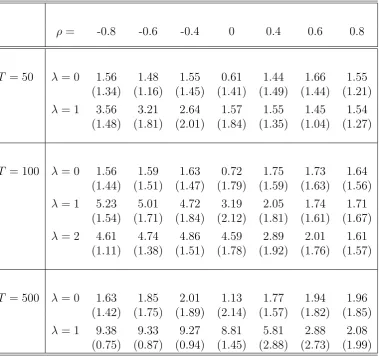
by Monte Carlo simulations. Table 1 summarizes the simulation results in terms of the
mean and standard deviation of the selected orders. Means and standard deviations
are computed based on 100 repetitions for each combination. Standard deviations are
provided in parentheses. The rows for λ = 0 correspond to models with no shift. By
inspecting the table, one concludes that a change in mean causes over estimation of
orders. The over estimation is particularly significant for negative ρ′s. For positive
and large ρ′s, order selection is virtually unaffected by a shift. For example, for
ρ = −.8, the average value of selected orders is 1.56 with no shift (λ = 0) and 3.56 with a shift (λ = 1); whereas for ρ = .8, the corresponding values are 1.55 and 1.54
respectively. The bias in order selection becomes larger as the number of observations
(T) increases. Consider the column for ρ = −.8, for instance, when the number of observations varies from 50 to 100 then to 500, the average selected orders are 3.56,
5.23, and 9.38 respectively (λ = 1). To see how the selected orders are distributed,
We plot histograms of the selected orders for two cases. Figure 3 plots the selected
orders when no shift exists (λ = 0). Figure 4 plots the counterpart when a shift does
exist (λ= 1).
6.3.
Order estimation based on generalized residuals
In the previous subsection, the shift is ignored and the order determination is based on
a misspecified model which leads to over estimation. Thus if a high order is identified in
practice, one should consider a possible parameter change. Tests should be performed
to test the parameter constancy. Many tests have been proposed in the literature
for testing parameter stability for time series models, for example, Andrews (1990),
Bai, Lumsdaine, and Stock (1991), Hansen (1990), MacNeill and Duong (1982), and
Ploberger, Kramer, and Alt (1989).
Table 1: Mean and Standard Deviation of Selected AR Orders
ρ= -0.8 -0.6 -0.4 0 0.4 0.6 0.8
T = 50 λ= 0 1.56 1.48 1.55 0.61 1.44 1.66 1.55
(1.34) (1.16) (1.45) (1.41) (1.49) (1.44) (1.21)
λ= 1 3.56 3.21 2.64 1.57 1.55 1.45 1.54
(1.48) (1.81) (2.01) (1.84) (1.35) (1.04) (1.27)
T = 100 λ= 0 1.56 1.59 1.63 0.72 1.75 1.73 1.64 (1.44) (1.51) (1.47) (1.79) (1.59) (1.63) (1.56)
λ= 1 5.23 5.01 4.72 3.19 2.05 1.74 1.71
(1.54) (1.71) (1.84) (2.12) (1.81) (1.61) (1.67)
λ= 2 4.61 4.74 4.86 4.59 2.89 2.01 1.61
(1.11) (1.38) (1.51) (1.78) (1.92) (1.76) (1.57)
T = 500 λ= 0 1.63 1.85 2.01 1.13 1.77 1.94 1.96 (1.42) (1.75) (1.89) (2.14) (1.57) (1.82) (1.85)
λ= 1 9.38 9.33 9.27 8.81 5.81 2.88 2.08
(0.75) (0.87) (0.94) (1.45) (2.88) (2.73) (1.99)
once a change point is estimated. Recall that the generalized residuals are defined as
ˆ
Xt=Yt−µ1ˆ −(ˆµ2−µ1ˆ )I(t >ˆk).
Because µ1, µ2, and τ can be consistently estimated we expect that order
determina-tion using the generalized residuals will remove, to some extent, the bias caused by
a shift. Figure 5 displays the selected orders based on the generalized residuals ˆXt.
Comparing with Figure 3, which is based on Xt, we find that the results are almost
Figure 1: Histogram of Estimated Change Points. Data is Generated According to:
Yt=µ+λI(t ≥k0) +Xt, with Xt=ρXt−1+εt+θεt−1, λ= 2, θ =.5, T = 100, and
Figure 2: Histogram of Estimated Change Points. Data is Generated According to:
Yt =µ+λI(t ≥ k0) +Xt, with Xt = ρXt−1+εt+θεt−1, λ= 2, θ = −.5, T = 100,
Figure 5: Selected Orders Via AIC Criterion Using Generalized Residuals ˆXt. Data is Generated According to: Yt =µ+λI(t ≥k0) +Xt, with Xt =ρXt−1+εt, λ= 1,
A
Appendix
Proof of (6). Write a∗
j = P
k≥j+1ak and Xt∗ = P∞
j=0a∗jεt−j. Under assumptions
(A or A′) and (B), X∗
t is second-order stationary. Let σ12 =E(Xt∗)2 = σ2 P∞
j=0(a∗j)2. Then we have
Xt=a(1)εt−Xt∗+Xt∗−1, (A.1)
thus
ck k X i=1
Xi =a(1)ck k X i=1
εi+ckX0∗−ckXk∗,
where a(1) =P∞
j=0aj. Sinceck ≤cm for k≥m by assumption, we have
P r max
m≤k≤nck| k X i=1
Xi|> α !
≤P r max
m≤k≤nck|a(1) k X i=1
εi|> α/3 !
+ P r(cm|X0∗|> α/3) + P r
max m≤k≤nck|X
∗
k|> α/3
≤ 9σ
2a(1)2 α2
mc2m+ n X i=m+1
c2i
by H´ajek and R´enyi inequality
+ 9σ
2 1
α2 c
2
m+ n X i=m
c2i
!
by Chebyshev inequality.
Hence if we chooseA= 9 max{a(1)2,P∞
j=0(a∗j)2}, then inequality (6) follows. Equation (A.1) is called the Beveridge-Nelson decomposition in the econometrics literature.
Phillips and Solo (1991) provide many interesting applications of this decomposition.
Proof of Proposition 1. Write ˆµ1(k) = 1kPkt=1Yt, then ˆµ1 = ˆµ1(ˆk). If k0 is known,
the LS estimation for µ1 is ˆµ1(k0). To prove (34), consider
T1/2µ1ˆ (ˆk)−µ1ˆ (k0)=T1/2
1 ˆ k ˆ k X t=1
Yt− 1 k0 k0 X t=1 Yt
=I(ˆk ≤k0)
T1/2
k0−kˆ k0kˆ
k0 X t=1
Xt+T1/2 1 ˆ
k
k0 X
t=ˆk
Xt
+I(ˆk > k0)
T1/2
k0−ˆk k0ˆk
k0 X t=1
Xt−T1/2 1 ˆ k ˆ k X t=k0
Xt+λT ˆ
k−k0
ˆ
k
Now use k0 = T τ, ˆk = k0 +Op(λ−T2), and T λ2
T → ∞, we find that the above is (T1/2λ
the same limiting distribution. The latter has a limiting distribution given by the
right hand side of (34). The proof of (35) is similar.
Acknowledgments. This paper is based on Chapter 4 of my dissertation at the
University of California at Berkeley. I am grateful to my advisor, Professor Thomas
Rothenberg, for his encouragement and guidance throughout my study at Berkeley. I
am indebted to Professors Deborah Nolan and James Stock for their advice. I thank
professor Peter Bickel for invaluable discussions. Financial support from the Alfred P.
Sloan Foundation Dissertation Fellowship is gratefully acknowledged.
References
[1] Akaike, H. (1974) A new look at the statistical model identification. I.E.E.E.
Trans. Auto. Contr. Ac-19, 716-723.
[2] Andrews, D. W. K. (1990) Tests for parameter instability and structural change
with unknown change point. Manuscript, Cowles Foundation, Yale University.
[3] Bai, J., Lumsdaine, R. L., and Stock, J. H. (1991) Testing for and dating breaks
in integrated and cointegrated time series. Manuscript, Kennedy School of
Gov-ernment, Harvard University.
[4] Bhattacharya, P. K. (1987) Maximum likehood estimation of a change-point in
the distribution of independent random variables: General Multiparameter case.
J. of Multivariate Analysis 23, 183-208.
[5] Birnbaum, Z. W. and Marshall, A. W. (1961) Some multivariate Chebyshev
in-equalities with extensions to continuous parameter processes. Ann. Math. Stat.
32, 687-703.
[6] Chung, K. L. (1968) A Course in Probability Theory. Harcourt, Brace & World
[7] H´ajek, J. and R´enyi, A. (1955) Generalization of an inequality of Kolmogorov.
Acta. Math. Acad. Sci. Hungar. 6, 281-283.
[8] Hall, P. and Heyde C. C. (1980) Martingale Limit Theory and its Applications.
New York: Academic Press.
[9] Hansen, B.E. (1990). Testing for structural change of unknown form in models
with non-stationary regressors. manuscript, University of Rochester.
[10] Hawkins, D. L. (1986) A simple least square method for estimating a change in
mean. Commun. Statist.-Simul. 15, 655-679.
[11] Hawkins, D. M. (1977) Testing a sequence of observations for a shift in location.
J. of American Statistical Asso. 72, 180-186.
[12] Hinkley, D. (1970) Inference about the change point in a sequence of random
variables. Biometrika 57, 1-17.
[13] James, B., James, K., and Siegmund, D. (1987) Tests for a change point.
Biometrika 74, 71-83.
[14] Kim, J. and Pollard, D. (1990) Cube root asymptotics. Annals of Statistics 18,
191-219.
[15] MacNeill, I. B. and Duong, Q. P. (1982) Effect on AIC-type criteria of change of
parameters at unknown time. In Time Series Analysis: Theory and Practice 1,
edited by O.D. Anderson. North-Holland Publishing Company.
[16] Picard, D. (1985) Testing and estimating change-points in time series. J. Applied
Prob. 14, 411-415.
[17] Phillips, P. C. B. and Solo, V. (1989) Asymptotics for linear processes. Cowles
[18] Ploberger, W. K., Kramer W., and Alt R. (1989) A modification of the CUSUM
test in the linear regression model with lagged dependent variables. In W. Kramer
(ed.) Econometrics of Structural Change. Physica-Verlag, Heidelberg.
[19] Sen, A. and Srivastava, M. S. (1975a) On tests for detecting change in mean.
Ann. stat. 3, 96-103.
[20] (1975b) Some one-sided tests for change in level. Technometrics 17,
61-64.
[21] Srivastava, M. S. and Worsley, K.J. (1986) Likelihood ratio tests for a change in
the multivariate normal mean. J. Amer. Stat. Asso. 81, 199-204.
[22] Worsley, K. J. (1979) On the likehood ratio test for a shift in locations of normal
populations. J. of the American Statistical Association72, 180-186.
[23] (1986) Confidence regions and tests for a change-point in a sequence of
exponential family random variables. Biometrika 73, 91-104.
[24] Yao, Y. C. (1987) Approximating the distribution of the ML estimate of the
change-point in a sequence of independent r.v.’s. Annals of Statistics 3,