Baltic Sea Region Programme
2007-2013
Programme under European Territorial Co-operation
Objective and European Neighbourhood and Partnership
Instrument
Final approved version as of 21 December 2007
CCI No. 2007CB163PO020
Operational Programme of European Territorial Co-operation financed by the European Regional Development Fund, European Neighbourhood and Partnership Instrument and the Government of Norway
Table of contents
EXECUTIVE SUMMARY ... 4
INTRODUCTION ... 7
THE JOINT PROGRAMMING PROCESS ... 8
PART I. CONTENT PROVISIONS ... 9
1. THE PROGRAMME AREA ... 9
2. SOCIO-ECONOMIC CONTEXT OF THE TRANSNATIONAL ACTIONS ... 10
2.1TERRITORIAL POTENTIAL OF THE REGION... 10
2.2EAST-WEST DIVIDE... 13
2.3ISSUES OF COMMON CONCERN... 14
3. SUMMARY OF ASSETS AND CHALLENGES FOR THE DEVELOPMENT OF THE BALTIC SEA REGION ... 17
3.1SWOT ANALYSIS... 17
3.2RATIONALE FOR TRANSNATIONAL ACTIONS IN THE AREA... 19
4. STRATEGY AND FOCUS OF THE PROGRAMME ... 22
4.1GEOGRAPHICAL FOCUS... 24
4.2THEMATIC FOCUS... 25
4.3TRANSNATIONAL AND QUALITY FOCUS... 26
4.4INTEGRATING THE EUROPEAN NEIGHBOURHOOD AND PARTNERSHIP INSTRUMENT... 28
4.5STRATEGIC PROJECTS... 28
5. POSITIONING AND COMPLEMENTARITY OF THE PROGRAMME ... 30
5.1COHERENCE WITH EU AND NATIONAL POLICY FRAMEWORKS AND STRATEGIES... 30
5.2COHERENCE WITH THE NORTHERN DIMENSION POLICY FRAMEWORK AND PAN-BALTIC STRATEGIES... 32
5.3COHERENCE WITH THE EU SECTOR POLICIES... 34
5.4COHERENCE WITH MEASURES FINANCED BY THE EAFRD,EFF AND ESF ... 34
5.5COHERENCE WITH OTHER EU-FUNDED PROGRAMMES FOR SOCIO-ECONOMIC DEVELOPMENT... 35
6. PRIORITIES OF THE PROGRAMME ... 38
6.1PRIORITY 1FOSTERING OF INNOVATIONS ACROSS THE BSR... 40
6.2PRIORITY 2:EXTERNAL AND INTERNAL ACCESSIBILITY OF THE BSR ... 42
6.3PRIORITY 3:MANAGEMENT OF THE BALTIC SEA AS A COMMON RESOURCE... 45
6.4PRIORITY 4:PROMOTING ATTRACTIVE AND COMPETITIVE CITIES AND REGIONS... 48
6.5PRIORITY 5:TECHNICAL ASSISTANCE... 51
6.6SYSTEM OF INDICATORS FOR THE PROGRAMME... 52
PART II. IMPLEMENTING PROVISIONS... 61
7. INTRODUCTION ... 61
8. BODIES IMPLEMENTING THE PROGRAMME... 63
8.1MONITORING COMMITTEE... 63
8.2NATIONAL SUB-COMMITTEES... 67
8.3MANAGING AUTHORITY... 67
8.4CERTIFYING AUTHORITY... 71
8.5AUDIT AUTHORITY... 74
8.6GROUP OF AUDITORS... 76
9. GENERATION, APPLICATION AND SELECTION OF OPERATIONS ... 78
9.1LEAD BENEFICIARIES AND OTHER BENEFICIARIES... 78
9.2SUPPORT FOR GENERATION AND IMPLEMENTATION OF OPERATIONS... 81
9.3APPLICATIONS FOR FUNDING... 82
9.4ASSESSMENT OF APPLICATIONS... 83
9.5SELECTION OF OPERATIONS... 83
9.6CONTRACT BETWEEN THE MANAGING AUTHORITY AND THE LEAD BENEFICIARY... 84
10. VALIDATION/VERIFICATION OF EXPENDITURES, RECOVERY OF FUNDS, IRREGULARITIES... 84
10.1VALIDATION OF EXPENDITURE (ERDF AND NORWEGIAN FUNDS)... 84
10.2VERIFICATION OF EXPENDITURE (ENPI FUNDS) ... 85
10.3.RECOVERY OF ERDF FUNDING... 86
10.4.RECOVERY OF ENPI FUNDING... 86
10.5RECOVERY OF NORWEGIAN FUNDING... 87
10.6IRREGULARITIES... 87
11. MONITORING... 87
12. EVALUATION ... 88
12.1EX-ANTE EVALUATION... 88
12.2STRATEGIC ENVIRONMENTAL ASSESSMENT... 90
12.3EVALUATIONS DURING THE PROGRAMME PERIOD... 91
12.4EX-POST EVALUATION... 92
13. INFORMATION AND PUBLICITY ... 92
13.1COMMUNICATION PLAN... 92
13.2INFORMATION AND PUBLICITY MEASURES... 93
14. PROCEDURES FOR THE EXCHANGE OF COMPUTERISED DATA TO MEET THE PAYMENT, MONITORING AND EVALUATION REQUIREMENTS ... 94
PART III. FINANCIAL PROVISIONS ... 94
15. FINANCING PLAN ... 94
16. ELIGIBILITY OF EXPENDITURE... 96
17. PROCEDURES FOR THE MOBILISATION AND CIRCULATION OF FINANCIAL FLOWS IN ORDER TO ENSURE THEIR TRANSPARENCY ... 97
PART IV. ANNEXES TO THE OPERATIONAL PROGRAMME ... 98
Executive Summary
The Baltic Sea Region (BSR) Programme 2007-2013 has been designed under the European Community’s territorial co-operation objective, while integrating the objectives of the European Neighbourhood and Partnership Instrument’s cross-border co-operation (ENPI CBC). It is built on the experience of the two predecessor programmes supporting transnational co-operation in the Baltic Sea region under the Community Initiatives ‘INTERREG IIC’ (1997-1999) and ‘INTERREG III B Neighbourhood Programme’ (2000-2006).
The overarching strategic objective of the Baltic Sea Region Programme is to
strengthen the development towards a sustainable, competitive and territorially integrated Baltic Sea region by connecting potentials over the borders. As part of Europe, also the Baltic Sea region is expected to become a better place for its citizens to invest, work and live. The programme will thus address the European Union’s Lisbon and Gothenburg strategies in order to boost knowledge-based socio-economic competitiveness of the Baltic Sea region and its further territorial cohesion. The programme likewise addresses strategic objectives of the EU’s external relations as expressed within the framework of the multilateral cross-border co-operation.
The programme is focused on preparation of investments and actions aimed at
improving the territorial potential of the region, minimising the considerable differences in the level of socio-economic development between the western and eastern parts of the region and at resolving several issues of common concern for all the countries around the Baltic Sea. Through several pan-Baltic networks in almost all fields of activity the programme aims also to enhance policies towards an integrated development of the Baltic Sea region and its better identity in Europe and worldwide.
The eligible area includes the whole territory of Denmark, Estonia, Finland, Latvia,
Lithuania, Poland and Sweden, and northern parts of Germany as EU member states. Also the neighbouring countries of Norway (whole country), Russia (some North-Western regions – see chapter 1) and Belarus (whole country) belong to the programme area. The contribution from the European Regional Development Fund (ERDF) amounts to
some 208 million EUR. Norway will make available 6 million EUR national funding. Some
23 million EUR will be provided by the European Neighbourhood and Partnership Instrument (ENPI) for the benefit of the eligible regions in Russia and Belarus. Within
limits, programme funds from ERDF and Norway can be applied for by partners from outside the eligible area. Projects will present a single joint application to the programme, which integrates the objectives of EU and Norwegian territorial co-operation and objectives of the European Neighbourhood and Partnership Instrument cross-border co-operation.
Eligible beneficiaries comprise public authorities from national, regional and local level
as well as public equivalent bodies (such as research and training institutions, business development institutions and other non-profit organisations). Private (commercial) organisations may act as additional partners with own financing. At least three benefiting institutions from at least three different countries shall form a partnership for transnational co-operation.
The programme features four prioritised thematic areas:
The first priority is focused on facilitating generation and dissemination of innovations
across the BSR. It is dedicated to core innovations in the field of natural and technical science but also to selected non-technical innovations, such as business services, design and other market-related skills. Actions will be targeted at the performance of innovation sources and their links to SMEs, facilitation of transnational transfer of technology and
knowledge as well as at making social groups of citizens fitter for generating and absorbing knowledge. The priority will also, especially in a context of co-operation with Russia and Belarus, support actions aimed at broader socio-economic development at the regional level.
The second priority is dedicated to improving the external and internal accessibility of
the Baltic Sea region. Priority topics highlights promotion and preparation of joint transnational solutions in the field of transport and information and communication technology (ICT), in particular those overcoming functional barriers to both, diffusion of innovation, and to traffic flows. Also further integration of already existing strategic development zones, spread along the transnational transport corridors in the BSR, will be promoted, as well as creating new transnational links.
The third priority concentrates on environmental pollution of the Baltic Sea in a broader
framework of a sustainable management of the sea resources. It supports operations aiming at limiting pollution inputs into and pollution impacts on the marine environment. Special emphasis is put on enhanced maritime safety. The priority also promotes economic management of open sea areas by means of best available technologies and practices. Attention is given to an integrated development of offshore and coastal areas in the BSR in the context of climate change tendencies.
The fourth priority promotes co-operation of metropolitan regions, cities and rural
areas enhancing its attractiveness for citizens and investors. It features action programmes and policies at the BSR level to make cities and regions more competitive engines for economic development. At the same time, ideas will be promoted, which strengthen urban-rural partnerships and support a viable economic transformation of BSR areas with smaller and less dense settlements. The priority is also open for preparation of pan-Baltic strategies, action programmes, policies and subsequent investments. A special ENPI feature under this priority is joint actions dedicated to the social issues within regional and city development, as well as governance and capacity building in the public sector, exclusively promoted in co-operation projects with Russia and Belarus.
Actions supported by the programme are expected to meet a range of quality requirements. Project initiators shall address jointly identified relevant needs and
deficiencies, demonstrate the added value through joint actions, raise policy-making competence in the participating institutions and produce durable results. Within the scope of actions, project developers are strongly encouraged to prepare investments of transnational relevance. Progress in the programme and project implementation will be monitored through a system of output and result indicators. Projects will be expected to specify planned achievements and quantify expected targets from the outset. Projects shall also contribute to an effective marketing of results and benefits achieved through the means of EU Structural Funds.
As a new element, the programme features a concept of ‘strategic projects’ under
ERDF. Such projects are expected to address a vital problem for the stable development of the overall Baltic Sea region and respect a number of additional criteria.. Expected results of strategic projects include that national authorities will endorse policy recommendations developed under such a project and will take responsibility for implementation of the prepared investments.
The programme will retain the ‘lead partner principle’, according to which an
institution leading the project will be responsible for implementation of the entire project, including the management of funds.
The co-financing rate from the ERDF is up to 85 % for beneficiaries located in Estonia,
Latvia, Lithuania or Poland, while it is up to 75 % for lead beneficiaries and other beneficiaries located in the programme area of Denmark, Finland, Germany or Sweden.
In case of Norway, the co-financing rate of eligible expenditures from Norwegian national co-financing is up to 50%. The co-financing rate for beneficiaries receiving ENPI funds is up to 90 %.
The implementation structure of the BSR Programme is built on the experience of the
preceding Baltic Sea Region INTERREG III B Neighbourhood Programme. It complies with the legal regulations for both, the Structural Funds and the European Neighbourhood and Partnership Instrument.
The Monitoring Committee (MC) will be the main decision making body composed of
representatives of all eleven participating states. The MC will be responsible for ensuring the effectiveness and quality of programme implementation including the selection of projects. The work of the MC will be supported by national sub-committees
safeguarding the information flow to regional and local authorities, economic and social partners, and non-governmental organisations during the implementation of the programme.
A single Managing Authority (MA) will be responsible for managing and implementing
the programme on behalf of the participating states in accordance with the relevant Community and national rules. This function will be performed by the Investitionsbank Schleswig-Holstein, located in Kiel/Germany.
The Managing Authority will set up a Joint Technical Secretariat (JTS) responsible for
providing all necessary information and management services towards the project partners. Furthermore, the JTS will launch information measures and communicate the benefits of EU Structural Funds to the citizens of the Baltic Sea region. The JTS will also support the Monitoring Committee, Managing Authority, Certifying Authority and the Audit Authority in meeting their tasks. The main office of the JTS will be located in Rostock, Germany, and the branch office will be seated in Riga, Latvia.
The Investitionsbank Schleswig-Holstein will also act as a Certifying Authority (CA)
responsible for certifying eligible expenditures to the European Commission and Norway, as well as requesting payments, to be made to beneficiaries, from the European Commission and Norway.
Germany, as the member state hosting the Managing Authority, will also set up an Audit Authority (AA), responsible to ensure that audits are carried out to verify the effective
functioning of the management and control system of the programme.
The Audit Authority will be assisted by a Group of Auditors comprising a representative
of each Member State and Norway, as well as representatives of Russia and Belarus as observers.
Introduction
Over the recent decades the co-operation between local, regional and national governments in the Baltic Sea region has been growing rapidly and got additional momentum in effect of the EU enlargement. Collaboration across the borders already includes many thematic fields and there is a high level of convergence in trade exchange and investments. Yet, the region needs more integration in order to strengthen its competitive position in Europe and to become a global economic player.
Socio-economic, environmental and territorial reports (see the list of reference sources) still emphasise a need for more common efforts from the member countries of the Region to fully realise its development potential. It is argued that the good economic standing of the Baltic Sea region seems to result rather from successes of the individual countries. Improvements in infrastructure, human capital development and increased economic and financial integration are considered necessary as building blocks for enhanced regional competitiveness, growth and ultimately - jobs and prosperity.
By virtue of its geographical scale and envisaged multi-stakeholder actions, the transnational territorial co-operation programme is a useful tool for better functional integration and territorial convergence of the Baltic Sea region and its more competitive status towards other European spaces. The present Baltic Sea Region Programme 2007-2013 will be the third in a row of joint co-operation undertakings of eleven countries around the Baltic Sea. Like its predecessors, the programme is designed to respond to real expectations of stakeholder authorities, institutions and organisations by providing an added value to their routine activities. However, in comparison to its predecessors, the programme comfortably integrates the EU funding coming from two sources – ERDF and ENPI – which makes it possible to include transnational co-operation interests of eligible Russian and Belarusian areas in a sufficient manner.
Building on the experience of Interreg IIC and IIIB Community Initiatives in the Baltic Sea region, the present programme has its point of departure in the description of the situation made in the year 2001 and attempts to identify relevant issues, which persevere despite previous programme actions or which pose new challenge to the transnational co-operation. In addition, the programme addresses issues not solved during the previous periods and takes up new challenges.
Important analytical sources for the BSR Programme are provided by extensive investigations carried out by several pan-Baltic organisations, regarded strategic partners of the programme authorities in its preparation and implementation. The list of references includes relevant reports by Baltic Development Forum, Baltic 21, CBSS, HELCOM, VASAB 2010 and many others. Further useful sources include research findings by various BSR Interreg IIIB projects, such as MECIBS and COMMIN. In addition, specific analysis on accessibility of the BSR was carried out. Furthermore, the outcome of the Interreg II C and III B projects in the BSR was used as a ground to specify the orientation of the chosen priorities.
These analyses are not replicated or presented in detail in the programme document. Instead, they have been used to illustrate specific development problems in the Baltic Sea region, in order to define a basis for the transnational actions (SWOT table) and to justify the programme strategy, priorities and principal areas of support. The analyses are partly visualised through a number of maps and listed under the reference sources. Built on this rationale, the programme strategy highlights a common objective and thematic scope of transnational co-operation in the Baltic Sea region in the period of 2007-2013. The range of topics supported by the programme is streamlined to disallow actions, which are not conducive to territorial development and do not demonstrate added value to the existing Baltic Sea region experience. To set a delineation line, the
document describes complementarity of the programme to both sector initiatives at the EU level, to EU co-financed convergence programmes as well as to cross-border programmes operating in the same space of the Baltic Sea region.
The chosen thematic priorities interlink one another and present a particular orientation (specific focus), leading to concrete areas of support. In addition, the programme lays out samples of strategic projects, which have been developed together with the major pan-Baltic organisations during the public consultation process on the draft programme document. These strategic projects are based on policy developments, which are closely linked to the overarching objective of the Programme. The programme also sets the targets for each of the priorities, progress in fulfilment of which is measured by means of result indicators.
Finally, the document features financial plan for the programme and its implementation provisions, including management structures and decision-making procedures.
The joint programming process
The preparatory process for the Baltic Sea Region Programme 2007-2013 was commenced with establishment of the Joint Programming Committee (JPC) composed of national and regional representatives of all 11 countries around the Baltic Sea. At its first meeting in November 2005 the JPC appointed the working structures: two drafting teams, dealing with content and implementation issues, and the Partnership Dialogue Network (PDN), which gathered a larger representation of national, regional and sector organisations acting at the pan-Baltic level. The role of the PDN was seen as to provide an important political backing and advice to the JPC in the programming process and to disseminate information concerning the future programme to the members of respective organisations and other partners.
Detailed information on the procedures taken for the ex-ante evaluation and strategic environmental assessment is given in chapters 12.1 and 12.2
An inquiry distributed among the pan-Baltic organisations on their expectations to the scope and contents of the transnational territorial co-operation in the Baltic Sea region helped develop a Baltic profile of the priorities laid down in the Commission regulation (1080/2006). Subsequent work by the JPC resulted in preparation of the first consolidated draft of the BSR Programme, which was presented for comments from the audience of about 450 individuals attending the conference of the BSR Interreg IIIB Neighbourhood Programme organised in Malmö on 16-17 May 2006.
The received remarks were reflected in the second draft of the programme document, released for public consultation in the beginning of July 2006. The consultation process was arranged both through a series of public hearings on the programme in the respective countries and through uploading the draft document to the BSR Interreg IIIB Neighbourhood Programme website for direct comments. For transparency, all comments received during the public consultation and the JPC statements on their relevancy were collated in a separate document.
In order to adjust the programming process to the expectations of the European Commission on the programme quality, a consultation meeting with the Commission was organised on 14 September.
Outcome of the public consultation process closed on 15 September 2006 was transferred to the third draft of the programme document, which embodied almost all content and implementation features on the ERDF side. Among them were also the concept and exemplary themes of the programme strategic projects, subject to intensive dialogue with the pan-Baltic organisations. This phase of concertation was closed in
November with presentations on the programme document to several pan-Baltic organisations.
At its meeting in October 2006 the JPC took a decision to develop an integrated Baltic Sea Region programme including funding from ERDF and ENPI. The JPC members of Belarus and Russia provided inputs to the integration of relevant ENPI-related content issues into the programme and discussed their proposals with the European Commission. The programme document, with integrated ENPI-related content issues and key principles for implementation of the ENPI, was approved by the JPC at its successive meeting in January 2007. In effect of the taken decisions, an integrated document with incorporated basic ENPI implementation provisions was endorsed by the JPC on 5 March 2007 and submitted to national approval procedures in the programme countries.
Part I: Content provisions
1.
The programme area
The eligible programme area in the Member States encompasses, as laid down in the Commission decision of 31 October 2006 [C(2006)5144] drawing up the list of regions and areas eligible for funding from the European Regional Development Fund under the cross-border and transnational strands of the European territorial co-operation objective for the period 2007 to 2013 (Art. 2 and Annex 2):
Denmark: the whole country, Estonia: the whole country, Finland: the whole country,
Germany: the States (Länder) of Berlin, Brandenburg, Bremen, Hamburg, Mecklenburg-Vorpommern, Schleswig-Holstein and Niedersachsen (only NUTS II area Lüneburg), Latvia: the whole country,
Lithuania: the whole country, Poland: the whole country, Sweden: the whole country.
In the Non Member States, the eligible area includes: Belarus: the whole country,
Norway: the whole country,
Russia: St Petersburg and the surrounding Leningrad Oblast, Republic of Karelia, the Oblasts of Kaliningrad, Murmansk, Novgorod and Pskov; for projects addressing the Barents Region, also co-operation with Archangelsk Oblast, Komi Republic and Nenetsky Autonomous Okrug is envisaged.
2. Socio-economic context of the transnational actions
2.1 Territorial potential of the Region
2.1.1 Socio-economic conditions
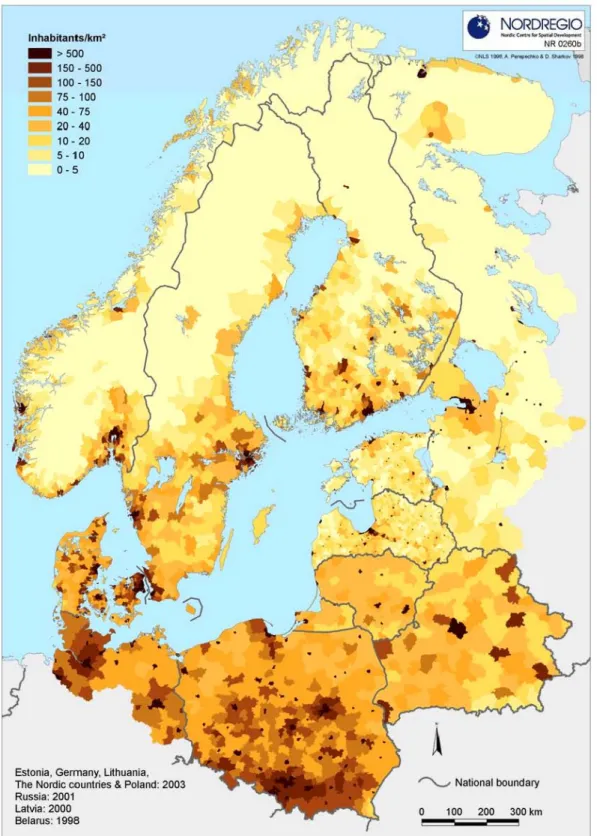
The land area of the Baltic Sea region is approximately 2.4 million km² and is composed of whole or parts of territories of 11 countries. The population size of about 110 million inhabitants gives an average population density of some 46 inhabitants/km (ref. Fig. 1). More than a third of the BSR inhabitants live in Poland and nearly a quarter in Norway, Denmark, Sweden and Finland. Another quarter of the population of the Baltic Sea region lives in seven German Länder.
Although the land area of the Baltic Sea region equals a little less than half of the area of the EU, the share of its population is 23 percent and the aggregated GDP about 16 percent of the total EU value. The figures clearly show that the BSR in overall terms
does not form the economic centre of Europe [3]. This is largely on account of
substantially low levels of economic production per capita in the eastern part of the area. Nevertheless, economies of the BSR countries are growing faster than the EU average
Western countries (W-BSR) to their Eastern neighbours (E-BSR) - to a more balanced exchange. In 2005 nine of eleven countries had a higher growth rate than the EU average of 2.1 percent. On account of the substantial growth potential in the new Member States, Russia and Belarus, the BSR is forecast to be among the fastest growing regions of Europe in the near future or even to take the leading position. Between the years 1995 and 2004, the aggregated GDP of the BSR (excluding Russia and Belarus) grew by 42 %. One of its main reasons is constantly increasing trade within the BSR, driven by deregulation and removal of a number of customs administrative procedures in the new EU member states and especially high inflow of foreign direct investments to these countries [3]. Further, the Region has over recent years retained its world export market position and strong export orientation. The BSR’s share of world export is more than 50% higher than its share of world GDP [2].
In terms of shares at the global market, the Region is positioned even higher with regard to knowledge creation. Compared to other European and world regions, the BSR features a fundamental asset with regard to high levels of education, further education, and R&D personnel and expenditure, which provided excellent ground for formation of several leading scientific and technologic clusters in many fields of expertise [2], [29]. This
potential is coupled with high degrees of organisation, public participation and communication as well as with broad awareness in the countries around the Baltic Sea of the role the social factors play in sustainable economic development. However, although the average rate of R&D investments and the share of researches in the BSR are significantly above the European average, the output from that capital, for instance in
form of patents, is below EU standards. Among reasons, both a quality of innovation
policies opening the markets for new products and services, as well as unsatisfactory progress in formation of transnational clusters are pointed out. As the differences in innovation performance persist between the BSR countries and the instances of leading knowledge creation on a global scale seem too few to reach critical mass, smoother co-operation and co-ordination of efforts across the Baltic Sea as well as joint networking and marketing are needed to better exploit this territorial capital [2], [23].
The engine for social and economic development in the BSR is small and medium sized companies. SMEs make up 99% of all companies and provide around 70% of all jobs in
the Baltic Sea region, with a high level of innovative ability. More than two thirds of new patents come not from universities, research laboratories and major companies, but from the very smallest and small companies. The pronounced SME-based structure and advanced entrepreneurship stand behind a high level of the BSR potential in all six dimensions of innovations: project, process, market, organisational, relationship and logistical [19]. Such a potential can be better activated through continuous and targeted access of SMEs to new knowledge across the Baltic Sea.
2.1.2 Transport conditions
A specific feature of the BSR is an important role of almost all means of transport (with some exception of inland waterways) in the transport system of the area, which does not occur in any other transnational space in Europe. This transport system operates, however, in a very imbalanced territorial pattern with low density in the North and
considerably higher southwards, especially in the south-western part of the BSR. Vertical elongation of the BSR causes long geographic distances and extensive travel times not only in internal relations between settlement centres but also in external relations to large market areas in Europe (ref. Fig. 11) [28].
Another prominent feature of the BSR is the location of the Baltic Sea in the very centre of the programme area, which poses at the same time a barrier and a linking element
to the co-operation. The Baltic Sea is an important means of transport, subject of the sea-based economy and an important area for recreation and tourism [33].
2.1.3 Environmental conditions
So far in the territorial transnational co-operation in the BSR, the environment of the Baltic Sea has not been comprehensively regarded as a common heritage. The growing
sense of self-identification in the Region, to which the Interreg IIC and IIIB programmes sought to contribute, gives ground for setting the future perspective for this common resource.
The Baltic Sea is one of the largest bodies of brackish water in the world. Being a shallow and almost landlocked sea, surrounded by many large cities and regions with intensive agriculture and industry, it constitutes a unique and fragile ecosystem highly sensitive to all kinds of pollution [20] [32].
This resource experiences now increasing environmental threats due to pressure from the booming sector of coastal and sea tourism, intensified agri- and aquaculture, emerging transport chains across the sea basin, the growing use of the energy, forestry, minerals and living stock of the Baltic Sea as well as to global climate changes. Among these threats and problems are eutrophication, pollution by hazardous substances, losses in biodiversity and increasing risks from maritime transport. The natural balance of the Baltic Sea has been seriously disrupted by excessive nutrient inputs, which originate from diffuse sources like over-fertilised farmland and air pollution, as well as point sources like sewage treatment plants and industrial wastewater outlets [20]. As a result of pollution abnormal algal blooms on the surface waters and lifeless areas on the seabed have been observed in the Baltic Sea starting from 1960s. Despite positive changes seen in the last two decades (e.g. improvement in the waste and wastewater treatment measures), volumes of land-based pollution in the Baltic Sea waters remain too high.
The Baltic Sea carries some of the busiest shipping lanes in the world. This increases pressure on the marine environment resulting e.g. from oil spills or release of hazardous substances carried by ships [20].
According to forecasts, development of almost all marine-related industries will continue to increase in the coming years, with especially high rate for sea bottom excavation of mineral resources [11].
One of the biggest natural resources of the BSR is woodland. It represents a
development potential in sparsely populated areas and trade of forest products (e.g. timber) is a major source of export income for many countries (e.g. Sweden, Latvia and Russia). Opportunities exist to increase the contribution of forests to the BSR economy and to its environment, including biodiversity, water storage and effects of the climate change.
2.1.4 Conditions for urban and regional co-operation
BSR cities at large have a sufficient potential to play an important role in global economy i.e. to form a new global integration zone (GIZ) in Europe. This is a very specific
feature of the Region, which makes the BSR different to other peer transnational spaces outside the European core. Its exemplary asset is location of 15% of headquarters of large international companies in the BSR (ref. fig. 10) [18]. Formation of such a Zone in the BSR would however hardly benefit from proximity between the cities, due to low population density and relatively high distances. Therefore, a prerequisite of strengthening development of cities in the BSR and their co-operation is to encourage their networking – for both material (e.g. trade, foreign direct investments) and immaterial (e.g. transfer of knowledge, decision-making networks) flows.
The Baltic Sea region shares many historical ties, symbolised by the legacy of the
acting at the pan-Baltic level and dealing with joint solving of sustainable development (e.g. Baltic 21) and territorial cohesion problems (e.g. VASAB 2010). Respective visions and strategies are subject to public validation and political endorsement as high as at the ministerial level.
The Baltic Sea region was the first large transnational region to articulate a sustainable concept of future development and a vision for spatial development. This innovative and forward-looking approach stems in large part from the Region’s political and public commitments to sustainability. It is based on integration of the policies for economic growth, social progression and environmental protection as mutually interdependent elements of long-term development. Open and transparent participation by all relevant stakeholders in decision-making processes at all levels of governance is a key feature of the Region’s endeavour towards achieving a status of Baltic Sea Eco-region [5].
One of the recent initiatives (by Baltic Development Forum) has been targeting a branding of the Baltic Sea region on the world arena as an easily recognisable entity, identifiable, among all, with stable democracies, proximity of markets, great investment climate, superb education, dynamic metropolises and successful environmental protection measures. A good ground for this initiative is given by a growing number of human interactions around and across the Baltic Sea, which contributes to development of a ‘Baltic community’.
Among distinguishable features of the Baltic Sea region are: intellectual resources and educated labour force across the Region, high growth potential of the new EU Member States, considerable market potential of North-Western Russia and Belarus and efficient innovation systems of the old EU member states. Such combination gives the Region an advantage in the global competition for international investments and for high-quality resources, such as labour force and know-how. In particular, human capital of the BSR should forms one of its main assets in comparison to other peer areas.
However, on the way to the functional integration of the area several obstacles need to be overcome. Among them are significant differences in socio-economic situation across the Region and common development challenges.
2.2 East-West divide
While the gap between the older and newer market economies slowly narrowed for some years, the latest data indicate that economic disparities between and within Baltic Sea countries are now widening. Considerable differences in the level of socio-economic development between the western and eastern Baltic Sea region countries, as well as the lagging development of rural areas in some parts of the Region are major weaknesses in terms of its overall cohesion.
Despite evident growth tendencies, territorial disparities in per capita production are among the highest across the continent. The Region has some of the wealthiest as well as some of the poorest areas of Europe, in many cases adjacent to each other. The disparities in general align to the former iron curtain dividing Europe, with the largest gaps along the boundary between Finland/Norway and Russia, and between former West Germany and the new Länder. It must also be noted that Poland has the five poorest regions of the EU25.
The East-West divide continues to exist in such essential fields as:
− Intensity of economic production. Despite fast catching-up processes in the new
Member States (ref. fig. 2), the GDP per capita index for the E-BSR countries is still at least 4-5 times lower than for their Western counterparts. In 1995 the ratio between the W-BSR and E-BSR was roughly 3:1 (to the advantage of the former) whereas by 2003 this ratio has decreased to approximately 2,5:1 (ref. fig. 3). If the relative production value of the two groups of countries changed linearly at a steady
rate, this gap would be closed by the year 2039. Such linearity of growth, however, is highly unlikely.
− Unemployment. In effect of structural transformation of the economies towards
better productivity, some new Member States and the new German Länder encountered severe problems with securing employability of former agricultural and manufacturing workforce, especially in the rural areas. Due to national and regional aid programmes co-funded by EU, the rising rate of unemployment was suppressed and somewhat reversed, yet still in some eastern Polish regions and the new German Länder, the unemployment rate exceeds 20% of the people in the productive age (ref. fig 4). The gap in unemployment rate between W-BSR and E-BSR rising up till 2002 has since then gone on a reverse trend due to rising levels especially in Germany and diminishing figures in the new Member States (e.g. Poland) and in Russia (ref. fig. 5).
− Sectoral composition of employment. At a national level, Lithuania, Latvia and
Poland still have low shares of their work force employed in the service sector (ref. fig. 6). Although the tendency of a gradual change in the structure of the E-BSR economies from manufacturing to services is positive, the service sector employs only 54 percent of the work force. In comparison, in the W-BSR the service sector provides three quarters of all jobs.
− Quality of business environment susceptible to innovations. While the business
environment of the W-BSR features dense physical infrastructure (e.g. transport and telecommunication), skilled labour force and strong clusters and companies competing on innovation and uniqueness - public support for innovation and clustering in the E-BSR is lagging behind. Even though the E-BSR countries continue to exhibit strong GDP growth and positive trends in the service sector and ICT investments, there is still a large performance gap in innovation input and output between on one hand the Nordic countries and Germany, and the E-BSR countries on the other. This is particularly visible in formation of and production within clusters, R&D investments, patenting and in scientific publications [23] [29].
− Endowment in transport and ICT infrastructure. The BSR exhibits huge
disparities in access to transport infrastructure (especially to rail stations, airports and intermodal terminals). Except for the Nordic peripheries, the Baltic States, Belarus and Russia show the lowest accessibility rates within the BSR and also within Europe. There are also clear disparities in availability of fast internet access, which pose a threat of a widening NW-SE digital divide in the BSR [23] [28] [33].
− Environmental protection. Public awareness on environmental problems and
related possible solutions is lagging behind throughout the E-BSR countries. At the same time, this area offers renewable energy sources and potential for both the energy saving better waste water treatment, for which know-how and funding is readily available in the W-BSR.
− Social conditions and impact of development. Whereas social and human capital
is among key BSR assets, in the E-BSR it requires further strengthening with regard to participation of broader public, better access to social services and health care as well as to the management of the natural environment.
2.3 Issues of common concern
Common challenges, to which the BSR countries are exposed, are associated with global socio-economic and environmental trends, which affect the territorial cohesion. Among them are (in thematic order):
(1)Concentration of knowledge-intensive service activities, especially business services in and around capitals and metropolitan regions. Such a tendency might reinforce the development gap between highly urbanised regions and rural areas. In addition, several
BSR cities despite a solid economic potential have a low penetration of ICT in the public domain (e.g. e-government, e-health, e-learning).
(2)Inward oriented transport solutions in the BSR countries, with insufficient transnational components, which are important for the integration of the BSR and good connectivity of its urban system. Except for the densely populated and well interconnected south-western part of the area and for some metropolitan areas (mainly capital cities), vast areas in the BSR (e.g. north-eastern part, Baltic States, Belarus) suffer from low connectivity both in external and internal relations [28] [33]. Additionally, the Baltic Sea forms a functional barrier in trade exchange between the BSR countries and makes communication in the area dependent on maritime links and crossings. Noteworthy is also lack of transversal airborne connections in the Nordic peripheries, which reduces the potential for interaction between peripheral regions and increases the dependence on the capital region [16].
(3)Road transport, which makes up the biggest share in international transport of goods and the growth of which in both short- and long-range distances has been especially evident in the new Member States [3]. In the last decade only, the freight volumes handled in the area have more than doubled, and this tendency is even expected to accelerate on account of the enlarged EU and the increased Russian and Belarusian trade. This may deepen traffic capacity problems, already now visible in the road network of the south-western part of the Baltic Sea region, and may cause serious environmental threats. Currently, the transport sector in the BSR is the fastest growing contributor to Europe’s rising energy demand and CO2 emissions [3]. In
terms of geographical directions, a gradual shift of flows to the east-west exchange is being observed.
(4)Enormously high growth of passenger aviation due to expansion of low fare operators, which breaks a so far low accessibility pattern of many remote and poorly connected areas in the BSR. The process triggers also serious competition to long-distance passenger service on land and ferry crossings on sea. At the same time, however, this growth causes environmental problems.
(5)Spatial disparities in the diffusion of IT technology (e.g. broadband access in households), which are visible both between countries and between urban and rural regions within all BSR countries.
(6)Safety on sea, on account of the Baltic Sea being the most crowded water basin in Europe. It is predicted that the risk of accidents and environmental damage (risk of spills) may even increase with fast growing ferry services to and from the new Member States and with more and more voluminous transports of crude oil and oil products by seas from the Russian ports on the Gulf of Finland. According to the forecasts, in the year 2020 shipping is to become the leading mode of transport in the BSR trade, carrying 54 percent of the total volume of internationally traded goods [3]. Its fast booming segment is maritime tourism [9] [24].
(7)Pressure on the use of marine resources due to continuing development in all marine-related sectors. This pressure has caused conflicts between functions of the marine space as well as impact on the environmental quality of the Baltic Sea. Of common interest are also challenges resulting from implementation of the proposed Marine Strategy Directive (e.g. preparation of national environmental plans) and the co-operation it will require from the Member States and third countries [8].
(8)Pollution of the Baltic Sea waters by nitrogen and phosphorous as well as by hazardous substances from the catchment area. Although in general nutrient loads within the area have decreased over the last 15 years, eutrophication has accelerated and algae blooms have become more common [4], [20]. Marine industries, sea traffic
and nutrients coming from agriculture, forestry, industrial production and settlements constitute main sources of the pollution.
(9)Status and future development of the coastal areas in the BSR, which call for harmonisation and capacity building actions over the national borders. These are expected to facilitate implementation of integrated coastal zone management plans at regional and national level, following the recommendation of the European Parliament and the Council (2002/413/EC) to be reviewed in 2006 [15].
(10) Natural disasters, such as massive floods affecting several countries, hurricanes or forest fires, which happened frequently in the recent past and which are partly attributed to the global climate change.
(11) Demographic tendencies with ageing of the BSR societies and an extending life expectancy, which presents economic and social challenges, like securing enough work force to sustain the growth or providing third age services. The opposite situation, however, exists in the North-West Russian regions partially due to high mortality rates and no gains in life expectancy (ref. fig. 7, 8).
(12) Migration, which continues to be directed towards metropolitan areas and large cities as well as towards university towns, and thereby worsens the uneven distribution of population (ref. fig. 9). Severe population decline processes are observed in the Nordic peripheries, where a large proportion of administrative areas have lost over 10% of their population over recent 10 years, eminently in the age class of younger generations [16] [17]. The trends put a high pressure on liveability of especially small and medium size cities in the peripheral, rural and declining industrial areas, which lose young and well educated inhabitants. Between 1995 and 2000 economic disparities between metropolitan and non-metropolitan regions continued to grow [17]. In recent years the migration processes tend to be even more dynamic between E-BSR and W-BSR Europe because of gradual opening of the labour markets in the European Union and Norway for employees from the new Member States.
(13) Economic standing of rural areas, which cover predominant space of the BSR and which stand as an important area of income generation, with more than 15% employed in the primary sector in many BSR subregions (ref. fig. 6).
(14) Insufficient performance of urban centres in the rural areas distant from the metropolitan cores; in these areas small and medium sized towns fail to provide a sound alternative for employment of the rural population willing to move from agriculture to manufacturing and services [32] [33].
(15) Energy efficiency in housing and production, as the consumption of all types of energy is expected to increase by 60% by year 2030. Most of this increase is in fossil fuels; however, fast relative growth is also seen in nuclear energy and renewable energy [5]. Significant challenges still remain in reducing emissions of CO2, being the
major greenhouse gas contributing to climate change.
These common challenges need to be addressed jointly through the transnational co-operation, which should provide ground for specific interventions.
3.
Summary
of
assets
and
challenges
for
the
development of the Baltic Sea region
3.1 SWOT analysis
Analysis of the socio-economic standing of the area, of its territorial divide and of the identified common challenges allows for creating the profile of the Baltic Sea region (see the SWOT table below.
STRENGTHS WEAKNESSES
Socio-economic assets
− Good conditions for cluster development, rich portfolio of regional clusters and advanced industries having their base especially in W-BSR − Well-educated population and considerable R&D capacity as a high potential for knowledge-based development
− Innovative potential of Baltic SMEs
− Large disparities in the status of socio-economic
development between W-BSR and E-BSR, as well as lagging behind development of rural areas in some parts of the BSR
− Insufficient use of innovation potential and low intensity of joint efforts
− Weak innovation absorption capacity in some parts of the BSR, especially in rural areas − Large disparities in the territorial distribution of
leading clusters
− Insufficient support structures for boosting and transferring innovations due to low population and settlement density and to lagging behind socio-economic development especially in the E-BSR Transport assets
− Dense network of maritime connections, especially in the western part of the BSR
− Advanced multimodal transport solutions in some parts of the area
− TEN-T network extending to countries neighbouring the EU
− High ICT usage in some parts of the BSR (top leading countries)
− Relatively good coverage of the area by transnational development zones enhancing cohesion and integration in the BSR
− Peripheral geographical location of the BSR to important economic centres in Europe − Poor accessibility of some parts of the BSR
(especially in the north and east) due to
deficiencies in land and air transport infrastructure and perseverance of functional and institutional barriers (e.g. national planning systems) − Decreasing road infrastructure capacity around
some metropolitan areas
− Disparities in IT endowment between urban and rural areas in the BSR
Environmental assets
− Well developed monitoring system on the environmental quality of the Baltic Sea
− Good scientific knowledge base for management of the marine environment
− Established integrated coastal zone management and river basin practices at the local and regional level as a good potential for transnational co-operation
− Great nature values of European interest, relatively high quality of environment (incl. vast forest areas) and important cultural heritage − High potential and know-how for production of
renewable energy
− Lack of joint actions and action plans to prevent and to combat land-based marine pollution (nutrification of arable land and ground waters, leaky wastes disposal areas, insufficient waste water treatment) resulting, among others, in eutrophication of sea waters, oxygen depletion at the Baltic Sea bottom and high level of dioxins in fish
− Lack of well coordinated joint plans to prevent and to respond to maritime accidents, incl. oil spills and contamination by hazardous substances − Lack of transnational co-operation and joint
planning in usage of Baltic Sea space and in minimalisation of risks caused by natural disasters Assets for urban and regional co-operation
− System of metropolitan regions acting as engines of development towards a Global Integration Zone − Strong political support to BSR co-operation
though existent pan-Baltic associations and high degree of institutional organisation across the BSR − Vision of the territorial development of the BSR
acknowledged by the pan-Baltic ministerial co-operation
− Good experience of transnational co-operation at all levels in result of the Interreg IIC and IIIB programmes in the BSR
− Prevalence of the monocentric settlement pattern and weak structure of small and medium sized cities in several parts of BSR
− Lack of potential for city networking based on physical proximity because of low population density in the northern and eastern part of the Region
− Insufficient social dimension of sustainable development in some parts of the BSR, including public health problems
OPPORTUNITIES THREATS
Socio-economic challenges
− Formation processes of new competitive clusters − Improving education and R&D footing in the BSR countries for fostering innovations across the area − Good preconditions to develop and market the
BSR as a model for:
o A knowledge and innovation-oriented area o Demonstrating the linkage between growth,
social progress and protection of the environment
o Demonstrating that quality products, efficient organisation, boosting innovation and high social standards can be combined for global competitiveness
− Attracting human, industrial and financial resources, as well as more targeted foreign direct investments in the field of technical innovations − Making use of the vast innovation potential of the
E-BSR for the whole area
− Increasing regional disparities inside the BSR
countries
− Insufficient progress in developing a knowledge and innovation basis in the E-BSR
− Decreasing potential for innovations due to ageing
of the BSR population
− Insufficient use of human resources of Russia and
Transport challenges
− High potential to absorb future transport growth through maritime services
− Opportunity to enhance the gateway function of the BSR in serving especially flows to and from Russia and the Far East market
− Rising penetration of air services and advanced communication (Internet, mobile phone) to counteract peripherality and low population density
− More and more widely used e-government practices
− Strong potential to benefit from globalisation due to highly developed businesses and advanced ICT technologies in some parts of the BSR and to the sizeable BSR market
− Declining public passenger transport services and heavy increase of road transport due to weakness of more environment friendly modes
− Environmental problems associated with the growth in both road and sea transport including reliability of the transport means as well as preparedness and response issues
− Increasing territorial divide in access to ICT and absorption capacity of digital services
Environmental challenges
− Growing awareness of the poor status of the Baltic Sea environment
− Good natural and cultural heritage incentives to develop pan-Baltic tourism products as a measure for the BSR branding
− Good quality of the marine environment as an asset to fish stocks
− EU Marine Strategy Directive giving a higher status to protection of the marine environment and regional co-operation
− Uncontrolled exploration of marine resources leading to environmental hazards and/or use conflicts
− Lack of political commitment and low
harmonisation of national management plans and legislation related to the marine environment − Insufficiently prepared administrative personnel at
regional and national level to adapt and implement UE regulations on ICZM and marine environment
− Economic development needs overriding other interests and weakening efforts to safeguard sustainable development of the Baltic Sea and its catchment area
− Natural disasters such as rising sea level, flooding, forest fires etc
Challenges for urban and regional co-operation
− Complementarity of the BSR Programme 2007-2013 to cross-border, convergence as well as to regional competitiveness and employment programmes in the BSR
− Strengthening of the BSR identity and creation of the BSR brand
− Inclusion of social groups vulnerable to segregation or other social problems in the sustainable development process in the area
− Disadvantageous demographic (e.g. ageing and negative birth rate) and migration processes in already sparsely populated parts of the BSR − Lack of co-ordinated civil protection actions and
rescue assistance in case of disasters
3.2 Rationale for transnational actions in the area
3.2.1 Fostering of innovations
The Baltic Sea Region has a competitive advantage with regard to high levels of education, further education and research & development. The exploitation of these advantages by fostering innovations is the key development factor for the BSR. A major challenge in that context is a better association of partners across the Region to intensify the use of human resources and organisational advantages for a broad application of new knowledge in the BSR economy. This especially holds true to the Baltic SMEs, which need
assistance in their international activities. In these actions all groups of the society, irrespective of age, gender, profession and social background, need to be integrated. Given the partly disadvantageous population structures (over-aging population) the challenge before the programme is also to enhance the attractiveness of the Baltic Sea region for human, financial and industrial resources, including young innovative individuals from other parts of the world.
3.2.2 Better accessibility
Good accessibility is an important precondition for the transfer of knowledge and information. The BSR demonstrates certain peripherality towards the main economic areas of EU and at the same time certain specificity of a transport system where all land (rail and road), sea and air modes have almost equal importance. Despite completed and planned TEN-T investments more efforts are needed at the transnational level to improve accessibility of the BSR from the outside, bearing especially in mind a need to better connect the TEN-T with the Pan-European transport corridors, opening the BSR as a gateway to the Russian, Belarusian and Far East markets, as laid down in the Commission Communication (COM(2007)32) on extension of the major trans-European transport axes to the neighbouring countries.
Fast growing east-west flows in the BSR – when added to already voluminous north-south figures – constitute a high potential to transform the BSR to a gateway region in serving commodities and passengers traffic. The pre-requisite to attract external flows to the BSR is, however, its good connectivity to adjacent stretches of Europe and other continents.
On the Baltic Sea arena noteworthy transport isolation and low connectivity of some areas impede good internal accessibility of the BSR. This dimension of accessibility is crucial in particular for the eastern part of the BSR, rural areas as well as for some urban agglomerations [28] [33]. The found imbalances result not only from insufficient provision of high-capacity transport connections but also from inward-oriented transport solutions and regulations in respective countries.
The key challenge is hence to develop a comprehensive multimodal transport system across the area and to compensate disadvantageous effect on the area’s accessibility. Also adaptation to unfavourable climatic conditions in the northern parts (Barents area) has to be taken into consideration.
At the same time the rapid development of information and communication technology (ICT) has become an important competitiveness factor, affecting the economic and social attractiveness of locations. The promotion of ICT may become a viable opportunity for the BSR to combat the impact of geographical distance and physical barriers in both internal and external accessibility. This has already been pursued by the Nordic countries, whose economic over-performance compared with their geographical situation, beside skilled labour and technology orientation - results from good infrastructural access to contacts and information. The problem, however, remains in insufficient endowment of many - especially rural - areas with the fast access ICT infrastructure as well as in user response due to language barriers, which hamper participation of the general public and small businesses in the Internet and e-commerce community.
Improvement of the BSR accessibility shall be followed through actions stimulating functional integration across borders within concrete transnational development zones. These development zones, having one or several transport links as a backbone, extend beyond cross-border co-operation and promote the BSR integration in larger territories. However, only few zones stretch beyond the EU border so far and have not managed yet to demonstrate sufficient undertaking of development issues vital for Russia and Belarus [33].
3.2.3 Effective management of Baltic Sea resources
Because of a growing number of commercial activities affecting the Baltic Sea resources, efforts are needed to ensure sustainable use of those resources and to prevent them against pollution. Wise management and reconciliation of different needs and interests focused on the same territory becomes a real challenge for the transnational actions. This management should aim at economically justified and sustainable utilisation of marine resources, starting with identification of their availability and ending up with workable resolutions of potential conflicts between users. Prospective conflicts on functional use of the marine space and its environmental protection need to be recognised and resolved at the planning stage. The offshore and coastal zone planning and management tools should be regarded as a means for resolution of conflict of interests, covering the inland areas and the whole marine space in its all dimensions. Also, possibility as well as the impacts of natural hazards should be taken into consideration.
3.2.4 Making the BSR and its cities and regions more competitive and attractive
City co-operation on strategic issues is a key pre-requisite to strengthen competitiveness of the BSR at the global level. Cities and regions are key actors in meeting the Lisbon and Gothenburg challenges in the BSR. They enhance economic development through provision of public services and create important environment for business growth. Successful policies in that respect require active co-operation of public and private sectors. The local and regional governments require a policy support at the transnational level in order to better contribute to the BSR competitiveness and integration. Key actions to this end, such as stimulation of entrepreneurship, attraction of foreign direct investment, promotion of knowledge economy, corporate decision-making, business environment quality or labour productivity, require joint efforts of local, regional and national level of public authorities pursued in close concertation with private and research sector. Capitalising on this, the governments may improve their decision-making on economic and social investments in the city areas and their surroundings.
For internal BSR integration, functionality of secondary (small and medium-sized) cities has to be given attention, as well as specific settlement patterns with large areas of low population and settlement scarcity (e.g. the Barents area). Of similar importance are strategies and practical solutions how city development can be combined with enhancement of surrounding rural areas.
All the actions should contribute to creation of efficient communication and identity building in the BSR as well as enhancing its competitiveness and cohesion. This is of key importance taking into consideration territorial digital divide and language barriers, which hamper flow of ideas across the BSR and tele-working.
For the BSR competitiveness, apart from cluster building, enhancement of innovation and urban co-operation, important and decisive is also a proper use of other assets.
Nature is one of the most important assets of the BSR in comparison to other transnational spaces. Using the rich potential of renewable raw materials and energies in a sustainable way could be considered a major perspective for rural areas and a specific competence of the BSR. Cultural inheritance represents an important asset for a further enhancement of the BSR identity, which should be used to attract domestic and external tourists and to support forming of an attractive business environment.
An outstanding specific natural and cultural heritage of the BSR should be given a twofold perspective. On one hand, it should be maintained, used and further improved as an
excellent soft environment location factor for business development. On the other hand it represents a sustainable resource for future generations and for production of innovations (e.g. in the field of bio-mass production, renewable energy, environmental technologies etc.). In the past, several examples were created on maintaining, using and marketing elements of that heritage for the BSR development. An integrative and harmonised view on how to exploit the economic potential of these resources in a sustainable way is, however, still needed.
Therefore, in order to maintain the unique features of the natural environment, also protection and long-term strategies have to be launched, addressing e.g. an adaptation to climate change and prevention of natural hazards.
The described profile of the Baltic Sea region needs to be reflected in the transnational operation actions. Bearing in mind limited available funding and presence of other co-operation programmes at the national, cross-border and interregional level, the strategy for proposed actions shall be given a clear focus.
4. Strategy and focus of the programme
The Baltic Sea region has become a European laboratory of integration where three different economic backgrounds and cultures came together. Joint transnational projects involving partners from old and new EU Member States as well as from the neighbouring countries (Belarus, Norway, Russia), have substantially contributed to the territorial cohesion and building of durable networks of co-operating organisations and institutions. The Baltic Sea Region Programme 2007-2013 follows the logic of the two past transnational programmes - Interreg IIC (1997-99) and Interreg IIIB (2000-2006) but presents a new stage of transnational co-operation in the area. The mutual learning process, which started from the exchange of experience in spatial planning and development, and which went through commonly elaborated studies, action plans and strategies, will for this period aim to demonstrate the Baltic Sea region profile and identity in addressing the challenges of the Lisbon [6] and Gothenburg [7] strategies of the European Union especially towards territorial cohesion. It will thus be instrumental also to the forthcoming Territorial Agenda of the EU, which demonstrates the territorial consequences of the Lisbon and Gothenburg strategies [25].
The programme – reflecting the trends and tendencies of the area’s socio-economic situation – addresses issues that need intervention at the transnational level. The programme hence relates to the deficits in the territorial cohesion across the Baltic Sea, dwelling on its regional identity features, the existing East-West divide in the distribution of socio-economic processes and the issues of common concern. For the long-term regional sustainability of the BSR essential is merging of the territorial potential of the western and eastern parts of the BSR and recognition of the partner countries in the east (Russia and Belarus) as increasingly meaningful neighbours and collaborates in various co-operation domains.
The programme, however, through its rather modest funds is not able to directly influence socio-economic situation in the BSR (see chapter 5). However, it may prepare larger investment interventions, aimed at minimising of the East-West divide or at resolving other issues of common concern (see chapter 2.3). Further, based on the advanced organisational structure (with several well established pan-Baltic organisations and networks in almost all fields of activity), the programme may promote policies towards the complex and integrated development of the whole Region and its better identity (region building).
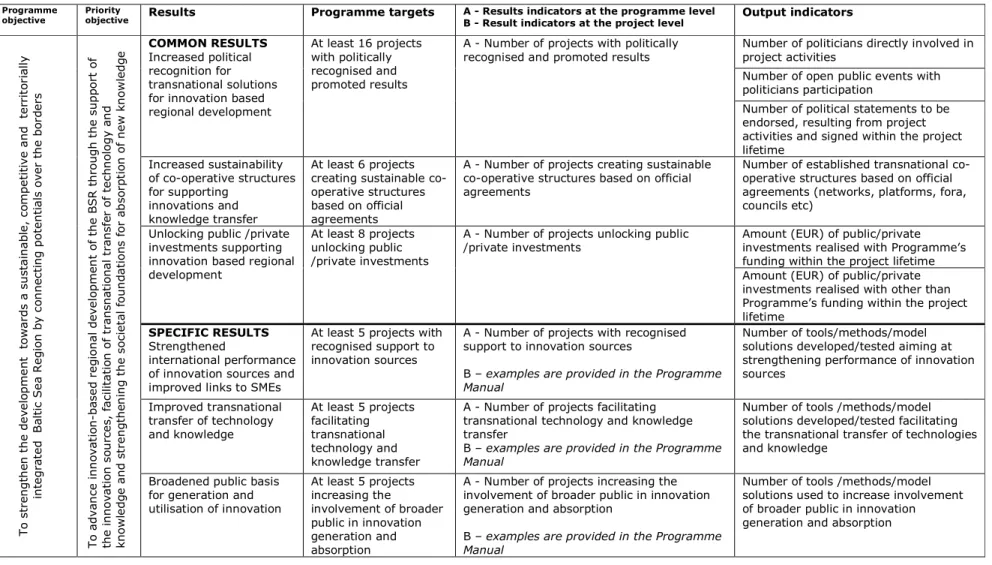
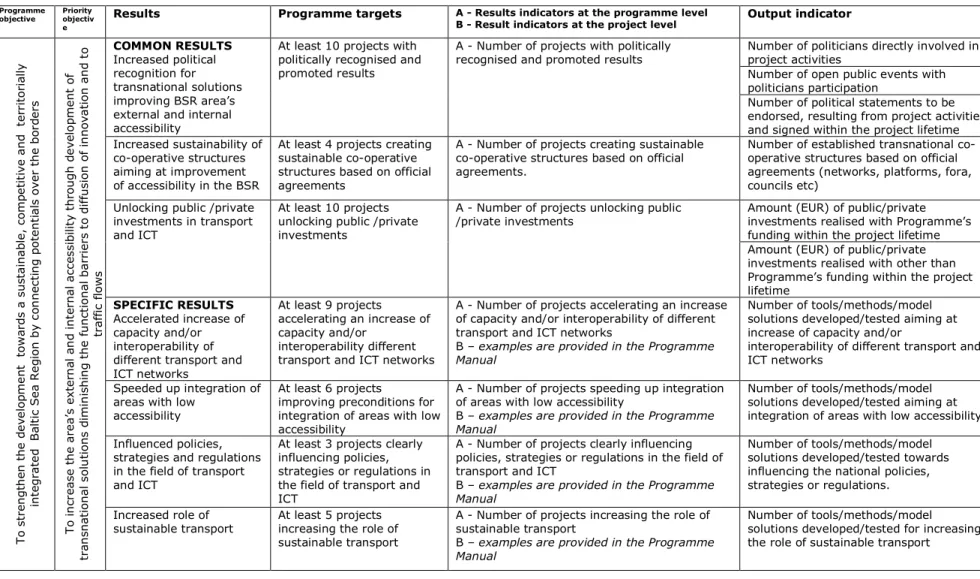
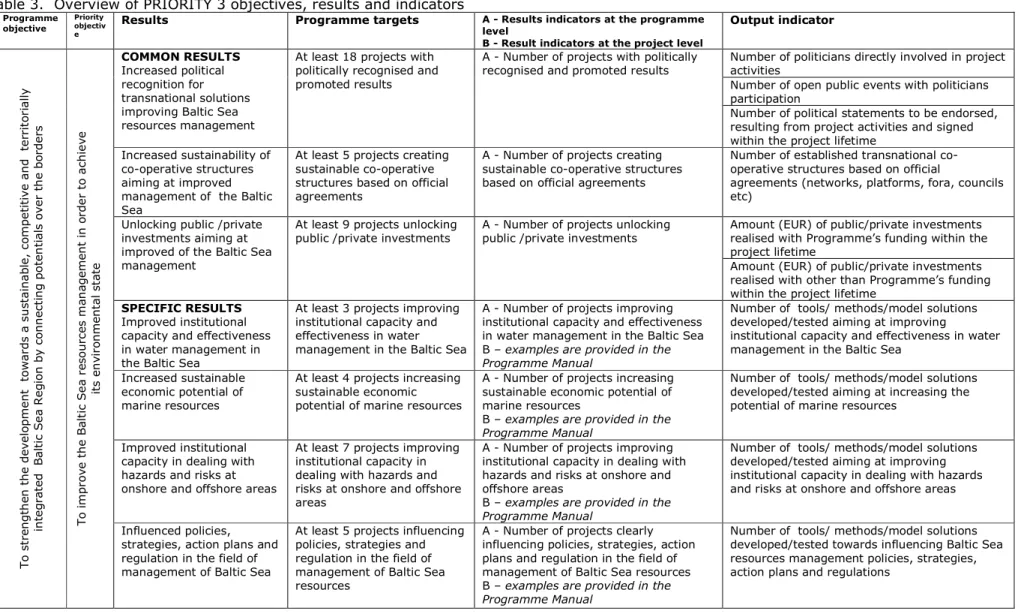
![TABLE 2: Code 1 2 3 4 TABLE 3: Code 1 2 3 4 5 6 7 8 9 10 0 TABLE 4: Code 1 2 3 4 5 6 7 8 9 10 11 12 13 14 15 16 17 18 19 20 21 22 0 TABLE 5: Code[3] [1] [2] [3] [4]](https://thumb-us.123doks.com/thumbv2/123dok_us/1415193.2689402/104.918.229.665.110.876/table-code-table-code-table-code-table-code.webp)