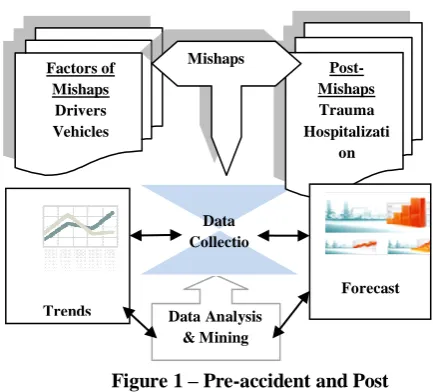
Soft Computing Techniques for Mishaps Prediction
Dinesh Kumar Saini
Faculty of Computing and IT, Sohar
University, Oman
Faculty of Engineering and IT, University of
Queensland, Australia
Jabar H Yousif
Faculty of Computing and IT, Sohar
University, Oman
ABSTRACT
An attempt is made to implement the soft computing techniques in the prediction of the mishaps behaviors. The main objective of this paper is to implement the Multilayer Perceptron (MLP) neural network topology in mishap analysis and prediction. Efforts are made to summarize past research on the road mishaps causes and their analysis techniques and point out their weaknesses. Indicate new ideas in this area and Identify research directions leading to successful development and use of analytical techniques in the area of mishap analysis leading to Road safety
General Terms
Mishaps, Computer Science, Safety System, Soft Computing, ITS Systems,
Keywords
Artificial Intelligence, Neural Networks Multi-layered Perceptron (MLP), Fuzzy ARTMAP, Predictions,
1.
INTRODUCTION
Soft computing techniques can be used to study the road safety which is a major area of concern for every country’s government and people residing in that country [1]. The need for mishap analysis arrives because of the reason that number of vehicles are increasing day by day and loads on the transportation system in increasing heavy [2,3]. The reasons and types of accidents depend largely upon the traffic density, road network system and average traffic speed on highways, environmental conditions and population of the city/region/country [4].
2.
RELATED WORK
There is work going on various aspects of mishaps and accidents, researchers are using various approaches for studying the mishaps [5, 6]. The accident is studied by many researchers and compared the performance of Multi-layered Perceptron (MLP) and Fuzzy ARTMAP, and found that the MLP classification accuracy is higher than the Fuzzy ARTMAP. Neural networks to analyse vehicle accident that occurred at intersections [7].
They chose feed-forward MLP using BP learning. The model had 10 input nodes for eight variables (day or night, traffic flows circulating in the intersection, number of virtual conflict points, and number of real conflict points, type of intersection, accident type, road surface condition, and weather conditions). Shankar, et al. [14] suggested a nested logic formulation for estimating accident severity likelihood conditioned on the occurrence of an accident.
3.
SOFT COMPUTING TECHNIQUES
IN ANALYSIS
There is an increased use of data collection and storage on every step of life in today’s time. There is a sufficient scope of discovering new trends and predicting mishap models to aid the process of reduction of accidents in the Sultanate of Oman [8, 9, and 10].
This can be achieved by making use of the latest analytical techniques in data mining and artificial intelligence. Increased costs of deaths and injuries resulting from traffic accidents have a major impact on society. This prompts the researchers to make great efforts in order to determine the factors that significantly affect the traffic accidents. Several researchers have been addressing this problem of the mishaps using artificial intelligent techniques. These include neural network, nesting logic formulation, log-linear model, fuzzy ART maps, etc. Applying soft computing techniques to formulate traffic accident data can facilitate to comprehend the characteristics of driver’s behaviour, road condition and climate condition that were causally connected with different injury harshness [11, 12, 13 and 14].
This can help decision makers to improve traffic safety control policies. This paper proposed the using of soft computing techniques like MLP neural networks and hybrid techniques to build models that could effectively predicate the number of traffic mishap.
Neural networks are implemented in the areas that traditionally have been used statistical methods. A neural network is a powerful data modelling tool that is able to capture and represent complex input/output relationships both linear and non-linear one [15].
The artificial neural network is a computational model that is motivated by the structure and/or functional aspects of biological neurons. It is considered as one of the most techniques for the learning from the rare data [16].
4.
FACTORS FOR THE MISHAPS
Identify the need and scope of implementation of analytical techniques in mishap analysis and reduction. Propose new methods of analytical of data and the used of soft computing techniques which will be effective for mishap analysis and prediction [21,22, and 23].
ITS systems
Speed cameras play an important role in the road safety measures taken by the transport authorities. It is also important to assess whether the use of speed cameras reduces the incidence of speeding, road traffic crashes, injuries and deaths
Driver behaviour
Driver behaviour is an important aspect of accident occurrence and its causes. It is very important to understand driver needs [7]. This study focuses on the difficulties faced by the drivers when they meet with an accident.
Effect of Drugs on drivers
Effect of drugs/alcohol on drivers which adversely affect their driving skills is one of the serious causes leading to road accidents.
Reduction in severity of injuries due to road accidents There are many theories which aim to reduce the severity of injuries happening due to road accidents on the highways.
Effect of weather conditions
Effect of weather and changes in climatic conditions within a country has a significant influence on the occurrence of road accidents.
Accident prediction models
Information on the incidents of crashes, traffic flow, geometric design, road environment, and traffic control helps develop crash prediction models such as Poisson and negative binomial regression models, to investigate the associations between crash occurrence and explanatory factors.
Multilevel modelling for the regional effect of enforcement on road accidents:
The use of multilevel models for the analysis of road traffic accident outcome data, and has illustrated the
application of the methodology to a study of seriously and fatally injured casualties.
5.
CASE STUDY OF DATA OF
ACCIDENTS
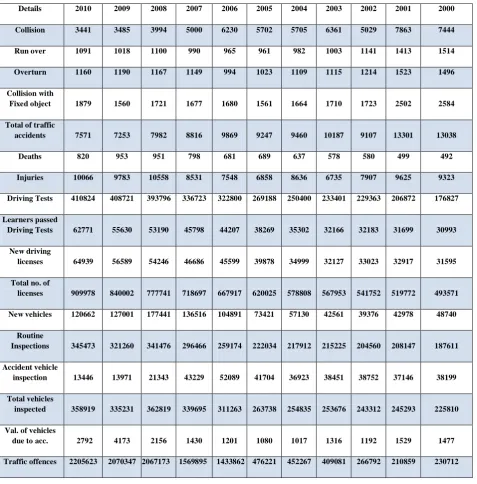
Table 1.0 below shows the statistics of accident data for the last 10 years, obtained from Royal Oman Police. Along with this, a lot of data needs to be collected and analysed by using data mining techniques. It can thus be made useful by trying to find trends and situations which lead to occurrence of road mishaps. Hereby, accident rate can be reduced by providing information and encouraging authorities to take necessary steps
.
6.
IMPLEMENTATION
OF
SOFT
COMPUTING TECHNIQUES
6.1. MLP Configuration & Design
Supervised learning techniques are used for classification of the given set of data and it is the same set of data used for learning. Multilayer Perceptron (MLP) neural network topology is used in the analysis of behaviour of mishaps. The discriminate functions take shapes which are not definite but it gives the shapes according to the input data set cluster. Normalization of input data set is used to achieve a high performance of the maximum a posterior receiver. The output classes gives values of 0/1 clusters, which is optimal from a classification point of view [24,25]. Back Propagation learning algorithm is used for purpose of learning and generalization of the network, and it permits to accomplish the adaptation of weights in the layers of PEs. Accident analysis is carried out in order to conclude the causes of an accident which can be helped to prevent further incidents of a similar kind. It may be achieved by a number of experts, including forensic scientists, forensic engineers or health and safety advisers. The analysis includes the coding of the levels of selected variables of the accident data. Besides, specifying the membership value of the data using cluster analysis techniques. Furthermore, determine the main factors causing the accident using ANN and predicting future values. [19]
In this paper, we are used Neuro solution software to implement a multilayer perceptron which have one hidden layer, 11 PEs as input, 4 PEs as output, data set of 200 pairs (year, type of mishap). The maximum number of epochs is 1000. The TanhAxon as transfer function is implemented in hidden and output layer. The TanhAxon function applies a bias and Tanh formula to each neuron in the layer. This will flatten the range of each neuron in the layer to be between [-1 and 1]. Such nonlinear elements provide a network with the ability to make soft decisions.
The back propagation learning algorithm is used to propagate the errors through the network and permits to accomplish the adaptation of weights in the hidden PEs. The error correction learning works in the response at PE i at iteration n, yi(n), and the preferred result di(n) for a given input pattern an instantaneous error ei (n) is defined by the formula 1.
ei (n) = di(n) - yi(n), …..(1)
With the aim of adaptation of each weight in the network, the theory of gradient learning techniques is used. It corrects the present value of the weight as depicted in formula 2.
)
2
)...(
(
)
(
(n)
w
1)
(n
[image:2.595.45.262.63.259.2]w
ij
ij
in
x
jn
Where the local error
i(
n
)
is computed from ei (n) at theoutput PE or can be computed as a weighted sum of errors at the internal PEs. The constant step size is
.For the sake of an improvement to the straight gradient descent, the Momentum learning is used which is speed up and stabilize convergence of network. The update of the weights of momentum learning computed as in formula 3.
1)
w
(n)
(
)
(
)
(n
w
ij ij
in
x
jn
1))
-(n
w
-(n)
w
(
ij ij
The best value of
the momentum value is to be set between 0.1 and 0.9.6.2. DATASET COLLECTION
This research used datasets which is produced by the Royal Police of Oman (Which can be reached at www.ropoman.org). This datasets are intended to be a nationally representative probability sample from the annual estimated around thousands of accident reported in Oman. The dataset for the study contains traffic accident records of a decade from 2000 to 2010. According to the variable definitions for dataset, this dataset has mishaps cause’s records only and does not include passenger’s information. It includes labels, which are listed in the table 1.
6.3. Data Preparation and Interpretation
The variables are already categorized and represented by numbers of Mishaps. Infect we are predicting the mishap factors verses the causes. In Figure2 MSE Epoch is coming very close to the real values which validate our claims. In the figure 3 the number of real collision is coming out very close to the output of our network, which means it gives us the correct values and indicates that we can predicate the number of collision in the future. Figures 4, 5, and 6 suggest that the output of our network is very close to the real data of the run over, overturn and collision with the fixed object, which give clear indicates that we can predicts the number of mishaps happening at any time because of these factors.
6.4. experiments
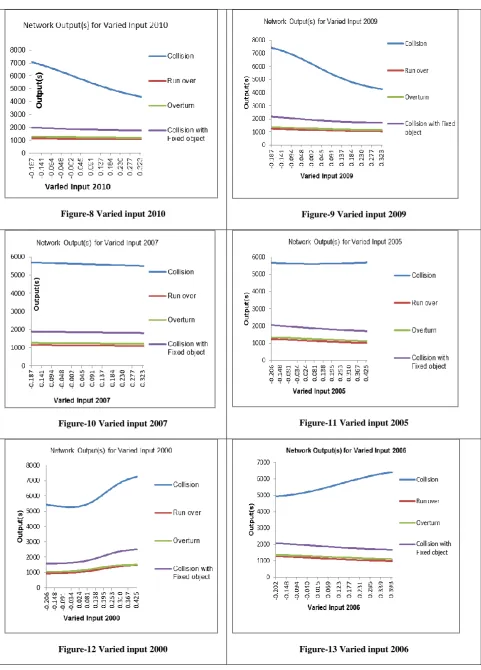
With the given set of experiments it is observed that in 2004, 2005 the median is going up , in year 2010, 2009, 2008 the average is getting down and in year 2002 , 2006 , 2005 the average shows it is static, but in year 2000 , and 2001 it is observed to be moving very high as depicted in Figures 8, 9 , 10, 11 ,12, 13.
7. CONCLUSION
The attributes used in this test are collisions, Run over, Overturn and Collision with the fix Objects. The table 2 illustrates the best network results for the training and cross validation phases of the network. It clearly shows that the MSE is very reasonable. The Final MSE is also coming very reasonable. In the paper we analyzed the causes of the mishaps and the data set for the study contains accidents records from year 2000 to 2010. The data of main factors like collisions, Run over, Overturn and Collision with the fix Objects are taken from Royal Oman Police and investigated the performance of Multi-Layer Perceptron Networks for classifying and predicting classification accuracy.
Table-1 the best network results for the training and cross validations
Best Networks Training Cross Validation
Epoch # 788 934
Minimum MSE 0.003086226 0.004111095 Final MSE 0.003437341 0.004912488
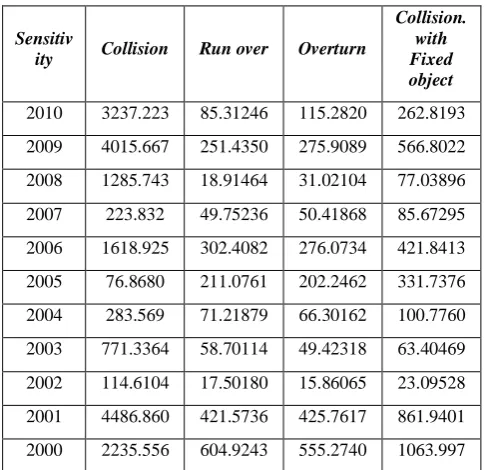
[image:3.595.306.550.210.445.2]Sensitivity analysis is very useful technique to find out the impact of independent variables on dependent variables with some assumptions.
Table 2 Sensitivity with respect to the factors responsible
In order to predict the output under different situation as compared to the expected predictions, the best suited technique is sensitivity analysis.From our analysis about sensitivity of the factors it is concluded that collision is the main factor of mishaps which is affecting the other factors of mishaps. The other finding is that collision with fix object also has greater sensitivity in comparison with other factors that also leads to increase mishaps.
8. FUTURE DIRECTION
The Genetic Algorithm optimization techniques can be used for optimizing the feature selection to reduce the dimensionality of the dataset. This can help to reduce the time of training of the network. The research can be extended to implement the more factors like different cases such as Mishaps, Casualty and Vehicle for finding the cause of mishaps and the severity of accident. The other factors can be considered are like tyer burst and other factors.
9. REFERENCES
[1] R Andrew P. Jones and Stig H. Jorgensen, “The use of multilevel models for the prediction of road accident outcomes,” Accident Analysis and Prevention 35 (2003) 59–69.
[2] Anna Andersson and Lee Chapman “The use of a temporal analogue to predict future traffic accidents and winter road conditions in Sweden,” Meteorol. Appl. 18: 125–136 (2011).
Sensitiv
ity Collision Run over Overturn
Collision. with Fixed object
[3] Becky P.Y. Loo, S.C. Wong , W.T. Hung, Hong K. Lo, “A review of the road safety strategy in Hong Kong,” Journal of Advanced Transportation, Vol. 41, No. 1, pp. 3-37 (2005).
[4] Christopher A. Alford, “Sleepiness, countermeasures and the risk of motor vehicle accidents,” Drugs, Driving and Traffic Safety © 2009 Birkhäuser Verlag/Switzerland. [5] Dai, Ying, Basabi Chakraborty and Minghui Shi. "Kansei
Engineering and Soft Computing: Theory and Practice." IGI Global, 2011. 1-436. Web. 19 Mar. 2012. doi:10.4018/978-1-61692-797-4
[6] Eleni Petridou & Maria Moustaki, “Human factors in the causation of road traffic crashes,” European Journal of Epidemiology 16: 819-826, 2000.
[7] Erin Kelly, Shane Darke and Joanne Ross, “A review of drug use and driving: epidemiology, impairment, risk factors and risk perceptions,” Drug and Alcohol Review (September 2004), 23, 319 – 344.
[8] Florence Conche, Miles Tight, “Use of CCTV to determine road accident factors in urban areas,” Accident Analysis and Prevention 38 (2006) 1197–1207.
[9] Guy D. Vitaglione,“Driving under the influence (of mass media): A four-year examination of NASCAR and West Virginia aggressive-driving accidents and injuries,” Journal of Applied Social Psychology (2006).
[10]Helai Huang, Hong Chor Chin, “Modeling road traffic crashes with zero-inflation and site-specific random effects,” Stat Methods Appl (2010) 19:445–46.
[11]Jabar H. Yousif, “INFORMATION TECHNOLOGY DEVELOPMENT”, LAP LAMBERT Academic Publishing, Germany ISBN 9783844316704, 2011. [12]Jabar H. Yousif, and Mabruk A. Fekihal," Neural
Approach for Determining Mental Health Problems" , Journal of Computing, Volume 4, Issue 1, pp6-11, January 2012.
[13]Kathleen Beullens, Keith Roe, Jan Van den Bulck, “Excellent gamer, excellent driver? The impact of adolescents’ video game playing on driving behavior: A two-wave panel study,” Accident Analysis and Prevention 43 (2011) 58–65.
[14]Kenneth M. Bach, “Evaluating driver attention and driving behaviour:comparing controlled driving and simulated driving,” Published by the British Computer Society, pg 193-201 (2008).
[15]Masahiro TADA, Haruo NOMA, Kazumi RENGE, “Evidence-aased automated traffic hazard zone mapping using wearable sensors,” ACM 978-1-4503-0414-6/10/11, Japan (2010).
[16]Mika Moran, Orna Baron-Epel, Nassim Assi, “Causes of road accidents as perceived by Arabs in Israel: A qualitative study,” Transportation Research Part F 13 (2010) 377–387.
[17]Patrick Brézillon and Juliette Brézillon, “Ch. 42: Context-sensitive decision support systems in road safety,” part of the ACC project supported by PREDIT and the French Minister of Transportation.
[18]Paul Atchley, Stephanie Atwood, Aaron Boulton, “The choice to text and drive in younger drivers: Behavior may shape attitude,” Accident Analysis and Prevention 43 (2011) 134–142
[19]Poul Greibe, “Accident prediction models for urban roads,” Accident Analysis and Prevention 35 (2003) 273–285.
[20]Dinesh Kumar Saini, Lingaraj A. Hadimani and Nirmal Gupta “Software Testing Approach for Detection and Correction of Design Defects in Object Oriented Software” Journal of Computing, Volume 3, Issue 4, April 2011, ISSN 2151-9617, Page No. 44-50.
[21]Samer H. Hamdar and Hani S. Mahmassani, “Colliding particles: Beyond accident-free car following models,” research funded by the National Science Foundation’s Human and Social Dynamic Systems under Award Number 0527573.
[22]Dinesh Kumar Saini “A Mathematical Model for the Effect of Malicious Object on Computer Network Immune System” Applied Mathematical Modeling,
35(2011) Page No. 3777-3787 USA,
doi:10.1016/.2011.02.025.
[23]Sharon Clarke and Ivan T. Robertson, “A meta-analytic review of the Big Five personality factors and accident involvement in occupational and non-occupational settings,” Journal of Occupational and Organizational Psychology (2005),78, 355–376.
[24]Taimur Usman, Liping Fu, Luis F. Miranda-Moreno, “Quantifying safety benefit of winter road maintenance: Accident frequency modeling;” Accident Analysis and Prevention 42 (2010) 1878–1887.
[25]Wilson C, Willis C, Hendrikz JK, Le Brocque R, Bellamy N., “Speed cameras for the prevention of road traffic injuries and deaths”, Cochrane database of systematic reviews 2010, Issue 11. Art. No.: CD004607. [26]Dinesh Kumar Saini “Testing Polymorphism in Object
Table-3 the statistics of accident data for the last 10 years
Details 2010 2009 2008 2007 2006 2005 2004 2003 2002 2001 2000
Collision 3441 3485 3994 5000 6230 5702 5705 6361 5029 7863 7444
Run over 1091 1018 1100 990 965 961 982 1003 1141 1413 1514
Overturn 1160 1190 1167 1149 994 1023 1109 1115 1214 1523 1496
Collision with
Fixed object 1879 1560 1721 1677 1680 1561 1664 1710 1723 2502 2584
Total of traffic
accidents 7571 7253 7982 8816 9869 9247 9460 10187 9107 13301 13038
Deaths 820 953 951 798 681 689 637 578 580 499 492
Injuries 10066 9783 10558 8531 7548 6858 8636 6735 7907 9625 9323
Driving Tests 410824 408721 393796 336723 322800 269188 250400 233401 229363 206872 176827
Learners passed
Driving Tests 62771 55630 53190 45798 44207 38269 35302 32166 32183 31699 30993
New driving
licenses 64939 56589 54246 46686 45599 39878 34999 32127 33023 32917 31595
Total no. of
licenses 909978 840002 777741 718697 667917 620025 578808 567953 541752 519772 493571
New vehicles 120662 127001 177441 136516 104891 73421 57130 42561 39376 42978 48740
Routine
Inspections 345473 321260 341476 296466 259174 222034 217912 215225 204560 208147 187611
Accident vehicle
inspection 13446 13971 21343 43229 52089 41704 36923 38451 38752 37146 38199
Total vehicles
inspected 358919 335231 362819 339695 311263 263738 254835 253676 243312 245293 225810
Val. of vehicles
due to acc. 2792 4173 2156 1430 1201 1080 1017 1316 1192 1529 1477
Appendix – Graphs
Figure2 MSE versus Epoch Figure-3 the resuls of real valuse of collision and network output
Figure-4 the resuls of real valuse of run over and network output
Figure-5 the resuls of real valuse of collision with fixed object and network output
Figure-6 the resuls of real valuse of overturn and network output
Figure-8 Varied input 2010 Figure-9 Varied input 2009
Figure-10 Varied input 2007 Figure-11 Varied input 2005