Development on Mobile Robot Controller by using High
Level Language Programming: a Review
Saliyah Kahar
Faculty of Information Science and Technology, Universiti Kebangsaan Malaysia, 43600
Bangi, Selangor.
Riza Sulaiman
Faculty of Information Science and Technology, Universiti Kebangsaan Malaysia, 43600
Bangi, Selangor.
Suziyanti Marjudi
Faculty of Information Science and Technology, Universiti Kebangsaan Malaysia, 43600
Bangi, Selangor.
ABSTRACT
This paper describes research and investigation on programming language used in mobile robot controller development by using mobile communication technologies such as Bluetooth, Infrared, Wireless LAN and Zigbee. We found that most mobile robot controllers have been developed using C/C++. It is because C/C++ has powerful extensions that the unit type information can be added within the language with concepts such as overloading and templates. Concerning future work, the best solution and programming language will be chosen on this research development project. Java ME used for mobile phone application development and C/C++ used for development for Dr Robot (WiRobot X80) movement.
General Terms
Mobile Robot
Keywords
Mobile Robot Controller, Mobile Technology, Bluetooth, Infrared, Wireless LAN, ZigBee, Programming
1.
INTRODUCTION
Mobile robot is presented with a situation or a different form depending on the area of application usage. The robot can drive, walk, swim or fly. An appropriate sensor is required to design a mobile robot and know how to control it. Therefore, various mechanisms used to control this mobile robot. With the advancement of wireless communication technology in mobile robots, there is a great possibility that there will be a cell-phone controlling a robot maid, wheel chair or an autonomous robot car as in [1-9]. Regardless of the method used either by using the 1G, 2G or 3G technology owned by mobile device or Web page.
Therefore, a more detailed study is needed to diversify the mobile robot controller mechanisms, particularly for industries that use mobile robots to improve the business such as manufacturing and security. Mobile robot controllers are rather complex systems that have to deal in real time with a number of tasks in order to allow the robot to operate autonomously. These tasks include motion control, sensing, planning, navigation, etc. [10]. Hence, it is important also to compare technology used and the bandwidth, frequency, data rate to transfer data among the devices for better development for mobile robot controller [11]. By using the latest technology, mobile robot can control anything, anytime and anywhere.
Mobile robot controller has many approaches to control the navigation. Three main approaches are present as in for controlling the robot. The most basic approach is teleoperation where the robot sensor data is transmitted to a remote operator. Then, the operator send each command separately back to the robot. The commands used are very simple and step by step such as turn left, go ahead, grab etc. Second approach is the robot controlling program that runs directly on the robot. The robot executes only one program which is initially installed on it. Then, the robot executes the program autonomously and it can only receive to control data. Third approach is mobile code where the robot executes a framework which downloads and executes the robot controlling program dynamically.
There are various types of mobile robot controller developed by previous expert in robotic such as fuzzy control, neural network, PID (proportional-integral-derivative), etc. Fuzzy logic control (FLC) have been widely used for mobile robot navigation [12-13],mainly due to FLC is capable of offering inference using environmental data, even under motion and sensor uncertainties. As in [14], the fuzzy logic controller is constructed by designing the fuzzy rules and membership functions (input and output) based on expert knowledge or through observation of the mobile robot action.
In this paper, we investigate and compare the programming language used for mobile robot controller based on wireless communication technologies such as Bluetooth, Infrared, Wireless LAN and ZigBee.
2.
RELATED WORK
Many programming languages had been used to develop mobile robot controller. To create the functionality of the robot and customise the robot for the applications, environments and tasks, robot must be programmed at the development stage [15].
It is important that robots become easier to program, so that their potential may be fully realised. Hence there are many programming languages used in development of mobile robot controller using mobile communication technology such as Blueetooth, Infrared, ZigBee, Wireless LAN etc.
2.1
Bluetooth
Java programming language, with the Java VM run on the hardware itself is used to write a program for Sun SPOTs technology [17]. Actually, in this paper mobile robots motion in an unknown environment with obstacle is control by wireless sensor-based using the Bluetooth wireless transmission and Sun SPOT technology. Because of its Java implementation, programming the Sun SPOT is easy. The Software consists of two parts: first from the program used on the base station and from the program implemented on the free range SPOT.
C++ and Java programming language are used to write a program[18]. C++ is written for the server which runs directly on the board computer of the robot. Direct access to the Bluetooth stack (Linux included Bluez) and standard TCP/IP sockets are combined with a multithreaded programming model using POSIX threads. Meanwhile, Java programming is used for mobile device application. The application is written in Java using the Java Micro Edition’s MIDP (Mobile Information Device Profile)and JSR82(Bluetooth) API. Using Java one version of the client can be executed by many different cell and smartphones.
2.2
Infrared
Remote Control and Monitor System for Autonomous Mobile Robot Based on Virtual Cell Phone are developed as in [19]. The autonomous mobile robot named ROBO-E is used as an experiment. For this robot, there are 12 infrared sensors and two-way wireless data communication modem (FRH-SD05T) with 2.4GHz band spectrum is disposed. This robot is possible to autonomously run, because it has the running algorithm of evading the obstacle according to information from the infrared sensor and running
.
This project is based on a mobile device platform with the application environment of Qualcomm BREW (Binary Runtime Environment for Wireless). The feature of BREW can develop the application by using the C/C++ language and the execution speed is so fast that the TCP/IP communication protocol needs to be used.2.3
Wireless LAN
VC++, OpenGL and 3DS MAX is used for geometry modeling of the virtual environment[20]. OpenGL is an excellent three-dimensional graphics standard strictly designed according to the computer graphics principle. It has the strong three-dimensional modeling ability and real-time graph interactive operation function. WLAN in this paper is responsible for transmitting operators’ commands, the position information of the robot and the leak, remote video from the real robot, and so on. On the spot, control center is far from the real robot, and several buildings are among them. Through using a high gain antenna and an amplifier communication distance of WLAN can extend to over 30km.
[21] robot programming has been extensively done in C or C++ languages and a Java-based multiagent development system was chosen to develop the architecture of robots. Any common agent architecture can be used, but it has been implemented by means of the JADE (Java Agent DEvelopment Framework), a tool for the development of multiagent systems, implemented in JAVA that fulfils the FIPA specifications.
2.4
ZigBee
ZigBee is a wireless network protocol specifically designed for low data rate sensors and control networks [22]. There are
peripherals are some of the many possible applications. The controller connects with RF transceiver via the SPI bus and a few discrete control signals. The controller acts as an SPI master and the RF transceiver acts as a slave. The controller implements the IEEE 802.15.4 MAC layer and ZigBee protocol layers. It also contains application specific logic. It uses the SPI bus to interact with the RF transceiver. The Microchip Stack provides a fully integrated driver, which relieves the main application from managing RF transceiver functions.
By combining ZigBee technique with Visual Basic (VB) programming language, a graphical human machine interface was used to remote control the omni directional mobile robot (ODMR) movement to reach the desired location[23].
3.
CONCLUSION
This paper presents utilization of programming language for mobile robot using mobile communication technologies such as Bluetooth, Infrared, Wireless LAN and ZigBee. Programming language is one of the important mechanisms in any development. An approach often used to ease programming in a certain domain is to create an application-specific language. This approach allows the design of the programming language to overcome the challenges unique to that environment, without the language design decisions being compromised either by more general programming concerns, or by characteristics of other environments.
Languages such as C++ have powerful extensions that the unit type information can be added within the language with concepts such as overloading and templates. Therefore, most mobile robot controllers have been developed as discussed above using C++ in its development. In other languages, such as Java, units have been treated as a class. There have also been a few scientific tools that consider units such as a unit-checking tool for Microsoft Excel Spreadsheets and Unit extension for FORTRAN.
Concerning future work, the best solution and programming language will be chosen on research development projects. Mobile robot controller will be developed by using mobile technology [24]. The mobile phone application system controls the actuator part of the robot system. [25] by using portable devices such as mobile phones provide opportunities for alternative communication service provider. It will also facilitate the industry to control the robot using the mobile device.
In the algorithm shown in Figure 1, user must make a video call to communicate with mobile robot. Then user can check the status for mobile robot. If mobile robot is turned on, the application can be used. User can select instruction based on movements required. Code used to represent a particular movement from code 1 until 6. If mobile robot is not turned on, the user can terminate the video call.
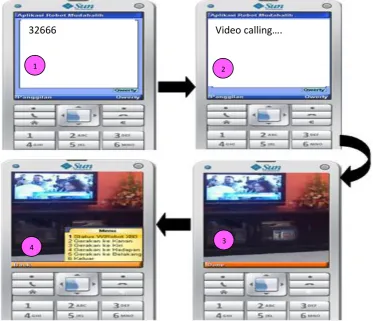
Figure 2 shows the proposed application system to control mobile robot by using mobile phone (MTech-X80). Before start using this application, user need to make sure the mobile robot can properly function. In this research, Dr Robot (WiRobot X80) will be used. This mobile robot includes
forward facing CMOS camera with a wireless connection to the server. Through video call, user can see the mobile robot environment by using mobile phone. User can choose instruction for mobile robot movement display on the mobile phone screen. Users choose instruction code such as 0,1,2,3 etc. So, data by this code transfer from mobile phone to mobile robot. At this level, generic application interface in communication layer is very important. This layer plays the role of a bridge between mobile phone and mobile robot. Programming language used in this proposed system is Java Micro Edition’s (Java ME). By using Java ME, it can be executed by many different cell and smart phones.
Fig. 2: MTech-X80 application
1.0 Make a video call
2.0 Check status for Mobile Robot whether turned ON or NOT 2.1 If Mobile Robot NOT turned ON
2.1.1 Go to step 3 2.2 If Mobile Robot turned ON
2.2.1 Display image of mobile robot environment
2.2.2 Display menu instruction for mobile robot navigation 2.2.3 Choose instruction
2.2.3.1 If instruction equal to 1, display status environment of mobile robot. 2.2.3.2 If instruction equal to 2, mobile robot move to right.
2.2.3.3 If instruction equal to 3, mobile robot move to left. 2.2.3.4 If instruction equal to 4, mobile robot move to front. 2.2.3.5 If instruction equal to 5, mobile robot move to back. 2.2.3.6 If instruction equal to 6, exit from application. 3.0 End video call
Video calling….
32666
1 2
[image:3.595.113.487.385.706.2]Table 1. MTech- X80 Description
User Interface Task
1 Dialing number for video call 2 Connecting to video call
3 Display image of mobile robot environment
4 Display instruction menu for user to choose movement of mobile robot
4.
ACKNOWLEDGMENTS
The research university grant HEJIM-FTSM-FKAB-MTDC-101101005 is supporting this work. Universiti Selangor (UNISEL) Scholarship Programme is also acknowledged with gratitude.
5.
REFERENCES
[1] Gross, H.-M., Boehme, H.-J., and Wilhelm T., “Contribution to vision based localization, tracking and navigation methods for an interactive mobile service-robot,” In the Proceedings of the IEEE International Conference on Systems, Man, and Cybernetics, pp. 672– 677, 2001
[2] Jeonghye Han, Jaeyeon Lee, and Youngjo Cho, “Evolutionary role model and basic emotions of service robots originated from computers,” In the Proceedings of the IEEE International Workshop on Robot and Human Interactive Communication (ROMAN), pp. 30-35, 2005
[3] Moonzoo Kim, Kyo Chul Kang, and Hyoungki Lee, “Formal verification of robot movements - a case study on home service robot SHR100,” In the Proceedings of the IEEE International Conference on Robotics and Automation (ICRA), pp. 4739-4744, 2005
[4] Bischoff, R., and Graefe, V., “HERMES - a versatile personal robotic assistant,” Proceedings of the IEEE, vol. 92, pp. 1759-1779, 2004.
[5] Dong To Nguyen, Sang-Rok Oh, and Bum-Jae You, “A framework for Internet-based interaction of humans, robots, and responsive environments using agent technology,” IEEE Transactions on Industrial Electronics, vol. 52, Issue 6, pp. 1521-1529, 2005
[6] Lenser, S., and Veloso, M., “Sensor resetting localization for poorly modeled mobile robots,” In the Proceedings of the International Conference on Robotics and Automation (ICRA), pp. 1225–1232, 2000.
[7] Taipalus, T., and Kazuhiro K., “Development of service robot for fetching objects in home environment,” In the Proceedings of the IEEE International Symposium on Computational Intelligence in Robotics and Automation (CIRA), pp. 451-456, 2005
[8] Yoshikazu K., Takayuki K., Yasuyuki S., Kiyoshi K., and Hiroshi I., “An approach to a integrating an interactive guide robot with ubiquitous sensors,” In the Proceedings of the IEEE/RSJ International Conference on Intelligent Robots and Systems (IROS), pp. 2500-2505, 2004
[9] Yeong Che Fai, Shamsudin H.M. Amin, Norsheila bt Fisal, J. Abu Bakar. “Bluetooth enabled Mobile Robot.” IEEE lCIT'02, Bangkok, THAILAND 2002.
[10] Andrey A. Loukianov, Hidenori Kimura, Masanori
on Artificial Life and Robotics, Oita, Japan, January 24–26 2003
[11] Kahar, S., Sulaiman, R., Amran, M.F.M., Marjudi,S, Prabuwono, A.S. “Utilization of mobile technology for mobile robot controller”. 2011 IEEE Conference on Open Systems (ICOS2011), September 25-28, 2011, Langkawi, Malaysia
[12] Azlan, N.Z., et al. ”Fuzzy logic controlled miniature LEGO robot for undergraduate training system. Industrial Electronics and Applications, 2007. ICIEA 2007. 2nd IEEE Conference on. 2007.
[13] Ying-Shieh, K., et al. “FPGA-realization of a motion control IC for wafer-handling robot. in Industrial Informatics (INDIN), 2010 8th IEEE International Conference on. 2010.
[14] Khairulmizam Samsudin, Faisul Arif Ahmad, Syamsiah Mashohor and Norfadzilah Mohd Latif, “Comparison of direct and incremental genetic algorithm for optimization of ordinal fuzzy controllers”, Ninth ACIS International Conference on Software Engineering, Artificial Intelligence, Networking, and Parallel/Distributed Computing, 2008.
[15] Geoffrey Biggs and Bruce A. MacDonald, “A pragmatic approach to dimensional analysis for mobile robotic programming”, Volume 25, Number 4, 405-419, DOI: 10.1007/s10514-008-9103-x, 2008.
[16] Yeong Che, F., et al. ”Bluetooth enabled mobile robot” Industrial Technology, 2002. IEEE ICIT '02. 2002 IEEE International Conference on. 2002
[17] Gyula Mester, “Wireless sensor-based control of mobile robots motion”, 2009, Intelligent Systems and Informatics, SISY '09. 7th International Symposium on 25-26 Sept. 2009
[18] Hess, D. and C. Rohrig. “Remote controlling of technical systems using mobile devices”. Intelligent Data Acquisition and Advanced Computing Systems: Technology and Applications, 2009. IDAACS 2009. IEEE International Workshop on. 2009
[19] Dong-ying, J., Z. Rui, and M. Takahashi. “Development of remote control and monitor system for autonomous mobile robot based on virtural cell phone”. Innovative Computing, Information and Control, 2007. ICICIC '07. Second International Conference on. 2007
[20] Feng, C., et al. “A robot teleoperation system based on virtual reality and WLAN”. Intelligent Control and Automation, 2006. WCICA 2006. The Sixth World Congress on. 2006
Advanced Robotics, 2005. ICAR '05. Proceedings., 12th International Conference on 18-20 July 2005
[22] Jun Xiao, Shuai Sun, Ning Xi, “ZigBee protocol based mobile sensor node design and communication configuration implementation”, 2009, Control and Decision Conference, 2009. CCDC '09. Chinese, 17-19 June 2009
[23] Kuo-Huang Lin, Hsin-Sheng Lee, Wei-Ting Chen, ”Implementation of obstacle avoidance and ZigBee control Functions for omni directional mobile robot”, IEEE International Conference on Advanced Robotics and its Social Impacts Taipei, Taiwan, Aug. 23-25, 2008
[24] Kahar, S., Sulaiman, R., Prabuwono, A.S., Amran, M.F.M., Marjudi,S. “Data transferring technique for mobile robot controller via mobile technology “, 2011 International Conference on Patern Analysis and Intelligent Robotics, Putrajaya, Malaysia, Volume: 1. 28-29 June 2011.
[25] Kahar, S.; Sulaiman, R.; Prabuwono, A.S.; Amran, M.F.M.; Marjudi, S.; ”Comparative study of data transfer for mobile robot controller via mobile technology”. 2011 International Conference on Electrical Engineering and Informatics, 17-19 July