© 2017, IRJET | Impact Factor value: 5.181 | ISO 9001:2008 Certified Journal
| Page 3389
Anti-Hijack: Real-Time Detection and Prevention of Attack on Android
1
LOKESH KUMAR MISHRA,
2RAHUL DEVKAR,
3TUSHAR DESALE,
4RAHUL BIDKAR,
5
JAYANT WAGHALE,
6PROF. S.R. BHAMARE
123456
Dept. of Computer Engineering, NDMVP’s Karmaveer Baburao Thakare College of Engineering, Nashik,
Maharashtra, India
---Abstract
—Examining the latest studies, Android haveachieved the highest market value share in Smartphones. The Android applications are increasing numerously. Hence threats and attacks on Android technology are also rising. There are many applications which bypass user by hiding their functionalities and send user private and important information and data across the network. . In this paper, we are summarizing detection of two fatal malware attacks i.e. intent based hijacking and authenticated session based hijacking. We are using the honey-pot concept for detection of these two authentication hijacking attacks. To achieve this, we have tested various apps and their cooperation with the honey-pot maintained by android device i.e. smartphone or an emulator. We have designed benevolent app as a honey framed app. We quibble that hijacking malware would be detected with higher accuracy using our methodology at real-time by comparing the traditional machine learning strategies. Our detection method Anti-Hijack is a helping hand in this platform which provides light weight, device operated real-time detection at hijacking malware.
Key words— Vulnerabilities, Smartphone, Security, Honey-net, Spoofing Attack, Anti-spoofing, Android, Permissions.
I. INTRODUCTION
One of the most widely used mobile OS these days is ANDROID. Android is a bunch of software comprising
not only operating system but also middleware and key applications. People are contracting with the growth of mobile technology. As the number of users is increasing, also facilities are increasing. With old regular handsets which were used just for phone calls, mobiles have changed life and have become member of it. Now they are not used just for making calls but they have innumerable uses and can be used as a Camera, Music player, T.V., Web-browser etc. and with the new technologies, new software and operating systems are required. Specifically from some malware samples, we find that some of them are repackaged versions of legitimate applications with malign payloads, which indicates the policing need of detecting repackaged applications in the current Android Markets.
II. PROBLEM STATEMENT
This application is useful for the users to provide security to
the mobile phones. In current time, there has been many cases
where personal and confidential information of a user can be
accessed by many other hijackers. This usually happens when
we install a new application to our system and then all our
personal data can be seen by others. Also, while doing
banking transactions, we have experienced many cases where
confidential data is shared to an unknown person (hijacker).
For this, we have proposed a new version of security system,
whether it checks the downloaded application or redirected
URL is safe to access or not.
Thinking on the drawbacks and inadequacies of existing
© 2017, IRJET | Impact Factor value: 5.181 | ISO 9001:2008 Certified Journal
| Page 3390
proposed system rectifies the demerits and existing processdefects to a large extend.
III. LITERATURE SURVEY
Android is a Linux-based open-source operating system, with a layered structure of services including core native libraries and application frameworks. Android natively separates applications and provides safety through operating system primitives and environmental features such as type safety each software package is sandboxed that employs privilege separation as a matter of course. Applications request access to system resources using special application level permissions, such as which must be granted by the user. Android’s permission model requires each application to explicitly request the right to access protected resources. The permission model is intended to prevent the unwarranted intrusion by an application on the user’s data and the data of other applications, as well as limit access to features that directly or indirectly cause financial harm. Before installing an application, the user is presented with a list of all1 the permissions requested by that application which they must accept before installation begins Unprivileged application attacks can take advantage of the complexity of the Android permission model and the Android market to persuade users to install malicious software and grant
applications the permissions required to deliver a harmful payload. Applications advertised in
the Market must be signed by the author, but the user has no means of verifying that a signature is associated with any particular entity. Even users that carefully monitor permission requests may not fully understand the semantics of a particular permission or the framework behavior surrounding a permission.
SMS application will have the ability to process the incoming SMS message first, including the ability to prevent the broadcast from being observed by any other application. Malware employing covert communication channels in this manner has already been seen. When a user grants permissions based on prompts that show a RECEIVE_SMS permission, such behavior is likely unexpected. Similarly, the only means a user has
of understanding the capabilities of an application is through the list
of permissions presented at install time.
IV. PROPOSED SYSTEM
© 2017, IRJET | Impact Factor value: 5.181 | ISO 9001:2008 Certified Journal
| Page 3391
Figure 1: System Architecture (1)1.1 Anti-Hijack System: This system contain harmful permission and attack dataset. Initially this system must be turn on in mobile.
1.2 Monkey-Runner Tool: 1) It is a functional tool for testing the android applications at a time of development phase of their own.
2) This monkey-runner tool is checking the permissions and system calls of the testing application with the benign application which doesn’t contain any malicious permission and system call.
3) If monkey-runner tool found any suspicious permission or system call that do not match with benign application then it prevents the downloading of the application.
Figure 2: System Architecture (2)
The figure 2 gives analysis of capturing the attack and saving the attack information into log file which is our database.
Attack information includes name of attack e.g. session attack, intent attack, password hacking etc. as well as date and time when attack is performed.
© 2017, IRJET | Impact Factor value: 5.181 | ISO 9001:2008 Certified Journal
| Page 3392
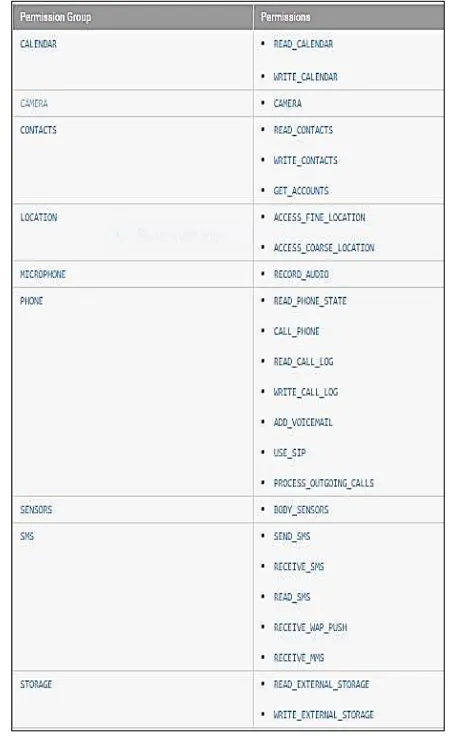
Figure 3: Dangerous permissions and permission groups.
V. CONCLUSION
By implementing this project there would be
improved security and reduce vulnerabilities and malicious activities which are performed on android devices. Proposed approach is a strong estimated framework for exploitation vulnerabilities using real time analysis. Main aim of honey-pot based model is to allow malign apps to do its activities. This information is used for security of benign apps and detection of malicious apps. In this paper, we made two key contributions, one is detecting intent hijacking and second is detecting session hijacking using our framework Anti-Hijack. We would like to
implement some more approaches to detect root exploits and scripts which violate sandbox to gain special privileges in next approach. Anti-Hijacking System can detect malicious activities which are performed on android devices. We also introduce the concept of Anti-Hijack, by accepting, introducing as well as protecting our devices from threats so by considering all these feature our application make most user friendly, and also efficient and easy to use.
VI. REFERENCES
1. T. B`Ieasing, L. Batyuk, A.-D. Schmidt, S. A. Camtepe, and S. Albayrak, An android application sandbox system for suspicious software detection, In 5th International Conference on Malicious and Unwanted Software (MALWARE 2010), pages 55–62, Nancy, France, October 2010. IEEE Conference Publications.
2. O. C.C, Oladej, F.A.Benjamin, B.C.Alakiri, and H.A.Olisa, Penetration testing for android Smartphone’s, October 2013
3. F. D. Cerbo, A. Girardello, F. Michahelles, and S. Voronkova, Detection of malicious applications on android os, In H. Sako, K. Franke, and S. Saitoh, editors, ICWF, volume 6540 of Lecture Notes in Computer Science, pages 138–149. Springer, 2010, ISBN 978-3-642-19375-0
4. M. Chandramohan and H. B. K. Tan, Detection of mobile malware in the wild,
http://www.infoq.com/articles/detection-of-mobile-malware, 2014.
5. E. Chin, A. P. Felt, K. Greenwood, and D. Wagner, Analyzing inter-application communication in android, In Proceedings of the 9th International Conference on Mobile Systems, Applications, and Services, MobiSys ’11, pages 239–252.
6. A. Cozzette, Intent spoofing on android, http://blog.palominolabs.com/2013/05/13/android-security/, 2013.
© 2017, IRJET | Impact Factor value: 5.181 | ISO 9001:2008 Certified Journal
| Page 3393
privacy monitoring on Smartphone’s, In Proceedings of the9th USENIX Conference on Operating Systems Design and Implementation, OSDI’10, pages 1–6
8. R. Hay, A new vulnerability in the android framework: Fragment injection, URL https://securityintelligence.com, (Online; Last Accessed January 21, 2015).
9. D. W. Kelly Casteel, Owen Derby, Exploiting common intent vulnerabilities in android applications, In MIT CSAIL Computer Systems Security Group, December 2012
10. J. Lessard and G. C. Kessler, Android forensics: Simplifying cell phone examinations, September 2010.