http://dx.doi.org/10.4236/ojpm.2015.52007
Self-Efficacy as a Suicidal Ideation
Predictor: A Population Cohort
Study in Rural Japan
Yoshio Kobayashi1,2, Koji Fujita1, Yoshihiro Kaneko1, Yutaka Motohashi3 1Department of Public Health, Akita University Graduate School of Medicine, Akita, Japan 2Nakadori General Hospital, Akita, Japan
3Kyoto Prefectural University of Medicine, Kyoto, Japan
Email: [email protected]
Received 20 December 2014; accepted 8 February 2015; published 12 February 2015
Copyright © 2015 by authors and Scientific Research Publishing Inc.
This work is licensed under the Creative Commons Attribution International License (CC BY).
http://creativecommons.org/licenses/by/4.0/
Abstract
Keywords
Self-Efficacy, Suicidal Ideation, Mental Health, Suicide Prevention, Community Health
1. Introduction
Suicide is the 15th leading cause of death, with more than 800,000 people dying of suicide each year, thus ac-counting for 1.4% of all deaths worldwide [1]. In Japan, the suicide numbers have been rising to over 30,000 each year [2], making it the 7th leading cause of death [3] and six times more than road-accident mortality [4]. Since suicide rose to become a critical issue in Japan, it has become necessary to explore the causes of suicide and find strategies for intervention.
Various studies have concluded that suicide is a complicated issue, and that risk factors comprise social, cul-tural, environmental, personal, financial, or mental health factors [1]. Among these factors, depression is most strongly associated with suicidality [5]. National campaigns of suicide prevention often highlight depression, encouraging early diagnosis and treatment of depression to save lives. However, in reality, limited mental health facilities and personnel as well as stigmatizations are often blocking the way for early diagnosis of depression and its treatment [6] [7], especially in Japan [8], where people tend to hide their negative feelings.
On the other hand, low self-efficacy is often reported to be associated with higher levels of depressive and anxiety symptoms [9]-[12]. It is also reported to be associated with suicidal ideation and suicide attempts [13] [14]. Cognitive behavioral therapy (CBT) applied for suicidal ideation was found to be effective when self-ef- ficacy was increased [15]. It was also found that CBT increased self-efficacy along with reduction in depression and suicidal ideation [16]-[18]. Self-efficacy has also been studied as a measure to avoid suicide attempts [19]. These findings are exciting because self-efficacy can be measured in many settings, and intervention to improve self-efficacy can be accomplished in common settings with less stigmatization and resistance as found for de-pression.
On the basis of these findings, we hypothesize that self-efficacy may predict suicide ideation. To the best of our knowledge, the causal relationship between self-efficacy and suicide ideation has not been explored in a population cohort study.
The aim of this study therefore was to examine the relationship between self-efficacy and suicidal ideation through a population cohort study.
2. Methods
2.1. Study Population
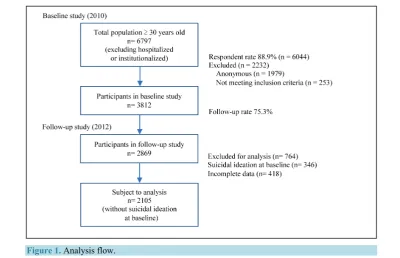
Participant flow is shown in Figure 1. The community-based household survey was conducted in a rural area of Japan, Happo Town, in Akita Prefecture with 2870 households, where the percentage of elderly persons (aged 65 and over) was 35.8% (male = 29.5%, female = 41.1%), and the number of community residents age 30 and over (excluding those who were hospitalized or institutionalized) was 81.5% (n = 6702) of the total population (n = 8220, male = 3795, female = 4425) in 2010.
A set of self-administered questionnaires was distributed door-to-door to the community residents age 30 and over at two respective time points by local health volunteers. The questionnaire could be filled in at home by the person him/herself or by family members. The signed and sealed questionnaire was then collected by the health volunteers. The baseline survey was conducted in 2010 with a response rate of 88.9% (n = 6044), and 4066 questionnaires were retained by excluding the anonymous questionnaires. After further excluding residents age 85 and over to avoid gender and selection biases, questionnaires from 3812 residents remained for analysis. The follow-up survey was conducted in 2012 with a response rate of 75.3% (n = 2869).
2.2. Exposure Variables
Figure 1. Analysis flow.
health”. The answer choices consisted of “excellent”, “good”, “not so good”, and “poor”. Excellent and good were considered healthy, not so good and poor were considered not healthy. Self-perceived economic status was also measured by a simple question, “what do you think about your economic circumstance” with four choices of answers, “excellent”, “good”, “not so good”, and “poor”. Excellent and good were considered wealthy, not so good and poor were considered not wealthy.
Depression was measured by the K6 (The Kessler 6-Item Psychological Distress Scale) [20]-[22], a 5-point Likert scale (0 = never, 1 = rarely, 2 = sometimes, 3 = often, 4 = always), and severity of depressive mood can be classified into normal (0 - 4), slightly depressive (5 - 8), moderately depressive (9 - 12), and severely depres-sive (13 - 24). We considered moderately and severely depresdepres-sive mood as depression [23].
Self-efficacy was measured by the GSES (General Self-Efficacy Scale) [24] [25], a 4-point Likert scale (0 = not at all true, 1 = hardly true, 2 = moderately true, 3 = exactly true) consisting of 10 items. Higher scores indi-cate higher self-efficacy. To assess the relative risk of suicidal ideation, we divided the scores into high (26 - 40) and low groups (0 - 25) by the median. We predicted that higher scores of the GSES were indicative of higher stress-coping levels in the participants.
2.3. Outcome Variable
Suicidal ideation was measured by a simple question, “have you ever wished to die” that was requested from the participants without suicidal ideation at baseline and during the follow-up study. The choices of answer were “no”, “a little”, or “yes”. Participants who answered “a little” or “yes” were classified as the group with suicidal ideation thoughts.
2.4. Statistical Analyses
2.5. Ethics
Basic demographic characteristics of individual participants were traceable for the follow-up study. Privacy of the participants was protected, that is, personal information was not disclosed and not used elsewhere. The par-ticipants also had all rights to refuse participation or choose not to disclose some specific information. The In-stitutional Review Board and the Ethics Committee of Akita University approved the study protocol and all subjects signed informed consent.
3. Results
Suicidal ideation was assessed at baseline and in the follow-up study. During baseline, 346 participants that had indicated suicidal ideation (13.6%, male = 136, female = 210) were excluded, leaving 2105 participants for sta-tistical analysis. During the follow-up survey, 8.2% of the participants responded having suicidal ideation (n = 172, male = 70, female = 102).
Table 1 shows the basic characteristics; psychosocial, economic, and health factors of the participants at
baseline. In general, males tended to be younger than females, although this difference was not significant. Sig-nificantly more participants lived in families of two generations and more compared to participants who lived alone, and there were significantly more married than single or separated participants. Significantly more wom-en were widows. Significantly more females reported having lower self-efficacy, more depressive symptoms, and poorer objective and subjective health status compared to males. Job status also varied significantly between male and female participants.
Table 2 shows that suicidal ideation was significantly related with marital status, subjective health status, self-perceived economic status, depressive mood, and self-efficacy. Participants with suicidal ideation were sig-nificantly less likely to be married/cohabitant, they reported poorer subjective health and self-perceived eco-nomic status, stronger depressive mood, and had lower self-efficacy scores.
Table 3 shows that the odds ratio of the self-efficacy scores at the follow-up survey for participants who de-veloped suicidal ideation were about 2 times lower than at baseline (95% CI = 1.42 - 2.91) after adjusting for age, gender, and marital status. The differences remained statistically significant even after further adjusting for additional confounding factors such as self-perceived health, economic status, and depressive mood. When ex-amined separately by gender, the association between self-efficacy and suicidal ideation remained significant in females but not in males (Table 4 and Table 5).
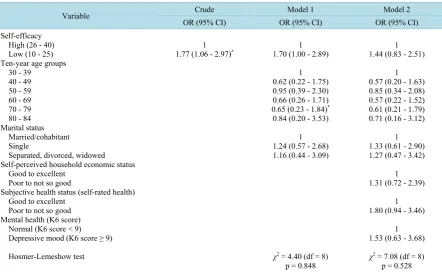
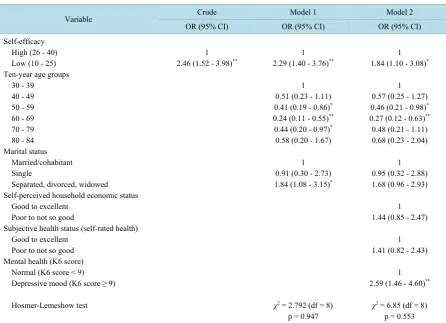
Table 3 shows that the odds ratio of the self-efficacy scores at the follow-up survey for participants who de-veloped suicidal ideation were about 2 times lower than at baseline (OR = 2.03, 95% CI = 1.42 - 2.91) after ad-justing for age, gender, and marital status (Model 1). The differences remained statistically significant (OR = 1.66, 95% CI = 1.15 - 2.42) even after adjusting for additional confounding factors such as self-perceived health, economic status, and depressive mood, although self-perceived health and depressive mood are significant (Model 2). When examined separately by gender, the association between self-efficacy and suicidal ideation remained significant in females (OR = 1.84, 95% CI = 1.10 - 3.08) but not in males (OR = 1.44, 95% CI = 0.83 - 2.51) (Table 4 and Table 5).
4. Discussions
This study involved residents of an entire community thus allowing generalizability of the findings. People with high self-efficacy at the baseline survey were 2 times less likely to develop suicidal ideation within the 2 years until the follow-up survey. This finding was not affected by adjusting confounding factors such as gender, age, marital status, self-perception of economic status, self-perception of health, and depression. This result suggests that suicidal ideation may be prevented by increasing self-efficacy. However, when the data were analyzed sep-arately for each gender, the association between self-efficacy and suicidal ideation remained significant in fe-males but not in fe-males. This could be explained by the population structure in our study, which is typical for an aging society.
Table 1. Demographic characteristics and psychosocial, economic, and health factors at baseline.
Variable Male Female
n = 959 (45.6%) n = 1146 (54.4%) p-value Age (mean ± SD)
Ten-year age groups (%) 30 - 39
40 - 49 50 - 59 60 - 69 70 - 79 80 - 84
Household structure (%) Living alone Living with others
Spouse (without children) Two generations and more Others Marital status Single Married/cohabitant Separated Divorced Widowed Educational Elementary school Middle school High school
College, university, graduate school Others
Job Status (%) Self-employed White collar Blue collar Engineer Sales/service Housewife/husband Unemployed Others
Self-perceived household economic status (%) Good to excellent
Poor to not so good Objective health status (%)
None
Having disease under treatment
Subjective health status (self-rated health) (%) Good to excellent
Poor to not so good Mental health (K6 score) (%)
Normal (K6 score < 9) Depressive mood (K6 score ≥ 9) Self-efficacy (%)
High (26 - 40) Low (10 - 25)
59.8 ± 13.3
8.9 13.8 24.0 26.7 21.1 5.6 4.8 29.4 61.9 3.8 11.1 81.5 1.0 3.4 3.0 3.7 27.6 50.6 17.1 1.1 29.1 12.4 15.3 4.1 3.7 0.0 21.6 13.7 35.8 64.2 48.2 51.8 82.1 17.9 93.5 6.5 57.6 42.4
61.0 ± 13.5
8.5 12.8 21.0 26.1 24.9 6.7 23.2 23.2 61.2 4.3 4.5 69.2 1.9 4.0 20.3 4.9 32.4 44.0 17.4 1.3 18.9 6.7 3.6 4.6 3.2 19.0 18.0 26.2 38.8 61.2 39.8 60.2 77.2 22.8 88.7 11.3 47.0 53.0 0.062 0.235 <0.001 <0.001 0.027 <0.001 0.093 <0.001 0.003 <0.001 <0.001
Table 2. Association between suicidal ideation during the past 24 months and demographic characteristics and psychosocial, economic, and health factors at follow-up.
Variable
Considered suicide during past 24 months No
n = 1933 (91.8%) n = 172 (8.2%) Yes p-value
Gender (%) Male Female
Ten-year age groups (%) 30 - 39
40 - 49 50 - 59 60 - 69 70 - 79 80 - 84
Household structure (%) Living alone Living with others Marital status
Married/cohabitant Single
Separated, divorced, widowed Educational
Elementary school Middle school High school
College, university, graduate school Others
Job Status (%) Self-employed White collar Blue collar Engineer Sales/service Housewife/husband Unemployed Others
Self-perceived household economic status (%) Good to excellent
Poor to not so good Objective health status (%)
None
Having disease under treatment
Subjective health status (self-rated health) (%) Good to excellent
Poor to not so good Mental health (K6 score) (%)
Normal (K6 score < 9) Depressive mood (K6 score ≥ 9) Self-efficacy (%)
High (26 - 40) Low (10 - 25)
92.7 91.1 86.3 91.8 91.1 94.2 91.8 92.4 91.9 91.8 92.8 90.3 88.8 93.3 91.1 92.5 90.8 88.0 94.1 92.3 93.0 88.9 90.1 91.4 91.7 90.1 94.0 90.4 91.7 91.9 93.0 87.2 92.8 81.7 94.3 88.5 7.3 8.9 13.7 8.2 8.9 5.8 8.2 7.6 8.1 8.2 7.2 9.7 11.2 6.7 8.9 7.5 9.2 12.0 5.9 7.7 7.0 11.1 9.9 8.6 8.3 9.9 6.0 9.6 8.3 8.1 7.0 12.8 7.2 18.3 5.7 11.5 0.104 0.032 1.000 0.031 0.670 0.451 0.002 0.872 <0.001 <0.001 <0.001
Table 3. Multiple logistic regression analysis on suicidal ideation in the 24-month follow-up period.
Variable Crude Model 1 Model 2
OR (95% CI) OR (95% CI) OR (95% CI)
Self-efficacy High (26 - 40) Low (10 - 25) Gender (%)
Male Female
Ten-year age groups 30 - 39
40 - 49 50 - 59 60 - 69 70 - 79 80 - 84 Marital status
Married/cohabitant Single
Separated, divorced, widowed Self-perceived household economic status
Good to excellent Poor to not so good
Subjective health status (self-rated health) Good to excellent
Poor to not so good Mental health (K6 score)
Normal (K6 score < 9) Depressive mood (K6 score ≥ 9)
Hosmer-Lemeshow test
1
2.16 (1.53 - 3.06)** 2.03 (1.42 - 2.91)1 **
1 1.14 (0.80 - 1.64)
1 0.55 (0.30 - 1.03) 0.59 (0.33 - 1.03) 0.37 (0.20 - 0.69)** 0.52 (0.28 - 0.97)* 0.70 (0.30 - 1.62)
1 1.07 (0.58 - 1.98) 1.64 (1.04 - 2.56)*
χ2 = 4.79 (df = 7) p = 0.685
1 1.66 (1.15 - 2.42)**
1 1.13 (0.78 - 1.64)
1 0.56 (0.30 - 1.06) 0.60 (0.34 - 1.07) 0.37 (0.20 - 0.70)** 0.53 (0.27 - 1.02) 0.71 (0.30 - 1.69)
1 1.13 (0.61 - 2.12) 1.58 (0.99 - 2.52)
1 1.41 (0.95 - 2.10)
1 1.55 (1.02 - 2.35)**
1 2.22 (1.38 - 3.55)**
χ2 = 10.22 (df = 8) p = 0.250 Notes: OR = odds ratio; CI = confidence interval. *p < 0.05; **p < 0.01.
Table 4. Multiple logistic regression analysis on suicidal ideation in the 24-month follow-up period (males).
Variable Crude Model 1 Model 2
OR (95% CI) OR (95% CI) OR (95% CI)
Self-efficacy High (26 - 40) Low (10 - 25) Ten-year age groups
30 - 39 40 - 49 50 - 59 60 - 69 70 - 79 80 - 84 Marital status
Married/cohabitant Single
Separated, divorced, widowed Self-perceived household economic status
Good to excellent Poor to not so good
Subjective health status (self-rated health) Good to excellent
Poor to not so good Mental health (K6 score)
Normal (K6 score < 9) Depressive mood (K6 score ≥ 9)
Hosmer-Lemeshow test
1
1.77 (1.06 - 2.97)* 1.70 (1.00 - 2.89) 1
1 0.62 (0.22 - 1.75) 0.95 (0.39 - 2.30) 0.66 (0.26 - 1.71) 0.65 (0.23 - 1.84)* 0.84 (0.20 - 3.53)
1 1.24 (0.57 - 2.68) 1.16 (0.44 - 3.09)
χ2 = 4.40 (df = 8) p = 0.848
1 1.44 (0.83 - 2.51)
1 0.57 (0.20 - 1.63) 0.85 (0.34 - 2.08) 0.57 (0.22 - 1.52) 0.61 (0.21 - 1.79) 0.71 (0.16 - 3.12)
1 1.33 (0.61 - 2.90) 1.27 (0.47 - 3.42)
1 1.31 (0.72 - 2.39)
1 1.80 (0.94 - 3.46)
1 1.53 (0.63 - 3.68)
[image:7.595.93.536.437.709.2]Table 5. Multiple logistic regression analysis on suicidal ideation in the 24-month follow-up period (females).
Variable Crude Model 1 Model 2
OR (95% CI) OR (95% CI) OR (95% CI)
Self-efficacy High (26 - 40) Low (10 - 25) Ten-year age groups
30 - 39 40 - 49 50 - 59 60 - 69 70 - 79 80 - 84 Marital status
Married/cohabitant Single
Separated, divorced, widowed Self-perceived household economic status
Good to excellent Poor to not so good
Subjective health status (self-rated health) Good to excellent
Poor to not so good Mental health (K6 score)
Normal (K6 score < 9) Depressive mood (K6 score ≥ 9)
Hosmer-Lemeshow test
1
2.46 (1.52 - 3.98)** 2.29 (1.40 - 3.76)1 **
1 0.51 (0.23 - 1.11) 0.41 (0.19 - 0.86)* 0.24 (0.11 - 0.55)** 0.44 (0.20 - 0.97)* 0.58 (0.20 - 1.67)
1 0.91 (0.30 - 2.73) 1.84 (1.08 - 3.15)*
χ2 = 2.792 (df = 8) p = 0.947
1 1.84 (1.10 - 3.08)*
1 0.57 (0.25 - 1.27) 0.46 (0.21 - 0.98)* 0.27 (0.12 - 0.63)** 0.48 (0.21 - 1.11) 0.68 (0.23 - 2.04)
1 0.95 (0.32 - 2.88) 1.68 (0.96 - 2.93)
1 1.44 (0.85 - 2.47)
1 1.41 (0.82 - 2.43)
1 2.59 (1.46 - 4.60)**
χ2 = 6.85 (df = 8) p = 0.553 Notes: OR = odds ratio; CI = confidence interval. *p < 0.05; **p < 0.01.
declines and thus raises the probability for suicidal ideation. This is supported by previous findings, where self- efficacy was found to be an important predictor for suicidal ideation in a residential care home [26] and among multiple sclerosis patients [27] along with other factors including internal locus of control and coping style. As self-efficacy indicates the ability to challenge and cope with difficulties, failing to do so may cause stress to ac-cumulate and lead to depression, which may eventually induce suicidal ideation.
Our study suggests that self-efficacy influenced suicidal ideation risk factors. We also found that people who had lower self-efficacy concurrently suffered from stronger depressive mood and poorer subjective health. This finding agrees with our prediction, as self-efficacy is believed to have a strong correlation with mental distress [28]-[32]. Self-efficacy can influence how people choose to cope with problems and difficulties. People who have low self-efficacy may have difficulties in coping with stress and problems, thus resulting in depression.
The strong relationship between suicidal ideation and hopelessness as well as mental illness cannot be denied. However, in reality, mental illness including depression is often under-diagnosed and under-treated [33]-[35]. Identifying people with suicidal ideation or depression for intervention is difficult, as they maybe under-reported for several reasons including self-stigmatization and hesitation in exposing the mental health issues. Unlike de-pression and hopelessness scales, a self-efficacy scale may evoke less resistance from participation. We suggest that self-efficacy can be an effective tool for identifying people with suicidal ideation, and increasing self-effi- cacy can be strategically beneficial for broader suicide prevention.
Future studies need to examine the impact of increasing self-efficacy in suicide prevention for different age groups and develop specific strategies accordingly. For example, a middle-aged man may need more mental health support to increase self-efficacy at the work place, while elderly people may need more opportunities for social involvement, and community empowerment may serve these needs.
makes sense to use self-efficacy as a countermeasure for preliminary screening of suicidal ideation, as we un-derstand now that self-efficacy is not only a key element of depression and hopelessness, but also has a general impact on suicidal ideation. Modifying self-efficacy is expected to induce behavioral change and perhaps alter the attitudes towards life. Self-efficacy can be improved in all aspects of life, and it plays a major role in shaping the early development of thoughts and personal characteristics. Early self-efficacy intervention should be consi-dered for early school education as well as a family approach.
Limitations
This study has several shortcomings. Although the self-administered, signed, and sealed questionnaire promised a certain level of privacy, there may have been some resistance towards the idea of signing as an identifiable in-dividual. This may have resulted in a bias in the findings, where people with poor mental health may have re-fused to participate in the study to avoid identification. Study subjects were community residents, which allow a certain generalizability of the findings; however, they are limited to the population living in rural Japan, where crop production is the major economic activity and main source of income. The time span between baseline and follow-up study might have been too short (2 years), as mental health problems develop over an extended period of time. We suggest that a future study should consider a longer time span to evaluate the relationship between self-efficacy and mental health as well as its effects on suicidal ideation.
5. Conclusion
In our study, self-efficacy was associated with suicidal ideation. Low self-efficacy may be regarded as a predic-tor of suicidal ideation, and increasing self-efficacy can be strategically beneficial for broader suicide preven-tion.
Acknowledgements
We thank for the cooperation of all staff of the Department of Health and Welfare of the Happo town Govern-ment Office, and Ms. Yong for assisting with the manuscript. This work was supported by JSPS KAKENHI Grant Numbers 20590632, 23590773.
References
[1] World Health Organization (WHO) (2014) Preventing Suicide: A Global Imperative.
http://www.who.int/mental_health/suicide-prevention/world_report_2014/en/
[2] Cabinet Office, Government of Japan (2014) The White Paper on Suicide Prevention Policy 2014. (In Japanese)
http://www8.cao.go.jp/jisatsutaisaku/whitepaper/w-2014/html/gaiyou/chapter1_01_01.html
[3] Ministry of Health, Labour and Welfare (2010) Vital Statistics of Japan 2010. Health and Welfare Statistics Associa-tion, Tokyo.
[4] Japan National Police Agency Traffic Bureau (2014) The Outbreak Situation Of A Traffic Accident in 2013. (In Japa-nese) http://www.e-stat.go.jp/SG1/estat/List.do?lid=000001117549
[5] Cavanagh, J.T., Carson, A.J., Sharpe, M. and Lawrie, S.M. (2003) Psychological Autopsy Studies Of Suicide: A Sys-tematic Review. Psychological Medicine, 33, 395-405. http://dx.doi.org/10.1017/S0033291702006943
[6] Sirey, J.A., Bruce, M.L., Alexopoulos, G.S. and Perlick, D.A. (2001) Stigma as a Barrier to Recovery: Perceived Stig-ma and Patient-Rated Severity of Illness as Predictors of Antidepressant Drug Adherence. Psychiatric Services, 52, 1615-1620. http://dx.doi.org/10.1176/appi.ps.52.12.1615
[7] Livingston, J.D. and Boyd, J.E. (2010) Correlates and Consequences of Internalized Stigma for People Living with Mental Illness: A Systematic Review and Meta-Analysis. Social Science &Medicine, 71, 2150-2161.
http://dx.doi.org/10.1016/j.socscimed.2010.09.030
[8] Ando, S., Yamaguchi, S., Aoki, Y. and Thornicroft, G. (2013) Review of Mental-Health-Related Stigma in Japan. Psy-chiatry ClinNeurosci, 67, 471-482. http://dx.doi.org/10.1111/pcn.12086
[9] Cutrona, C.E. and Troutman, B.R. (1986) Social Support, Infant Temperament, and Parenting Self-Efficacy: A Media-tional Model of Postpartum Depression. Child Development, 57, 1507-1518. http://dx.doi.org/10.2307/1130428
[11] McFarlane, A.H., Bellissimo, A. and Norman, G.R. (1995) The Role of Family and Peers in Social Self-Efficacy: Links to Depression in Adolescence. American Journal of Orthopsychiatry, 65, 402-410.
http://dx.doi.org/10.1037/h0079655
[12] Maciejewski, P.K., Prigerson, H.G. and Mazure, C.M. (2000) Self-Efficacy as a Mediator between Stressful Life Events and Depressive Symptoms Differences Based on History of Prior Depression. The British Journal of Psychiatry, 176, 373-378. http://dx.doi.org/10.1192/bjp.176.4.373
[13] Rothmann, S. and van Rensburg, P. (2002) Psychological Strengths, Coping and Suicide Ideation in the South African Police Services in the North West Province. SA Journal of Industrial Psychology, 28, 39-49.
[14] Valois, R.F., Zullig, K.J. and Hunter, A.A. (2013) Association between Adolescent Suicide Ideation, Suicide Attempts and Emotional Self-Efficacy. Journal of Child and Family Studies, 24, 237-248.
http://dx.doi.org/10.1007/s10826-013-9829-8
[15] Jongen, P.J., Ruimschotel, R., Heerings, M., Hussaarts, A., Duyverman, L., van der Zande, A., et al. (2014) Improved Self-Efficacy in Persons with Relapsing Remitting Multiple Sclerosis after an Intensive Social Cognitive Wellness Program with Participation of Support Partners: A 6-Months Observational Study. Health and Quality of Life Outcomes, 12, 40. http://dx.doi.org/10.1186/1477-7525-12-40
[16] Hyun, M.S., Chung, H.I. and Lee, Y.J. (2005) The Effect of Cognitive-Behavioral Group Therapy on the Self-Esteem, Depression, and Self-Efficacy of Runaway Adolescents in a Shelter in South Korea. Applied Nursing Research,18, 160-166. http://dx.doi.org/10.1016/j.apnr.2004.07.006
[17] Nash, V.R., Ponto, J., Townsend, C., Nelson, P. and Bretz, M.N. (2013) Cognitive Behavioral Therapy, Self-Efficacy, and Depression in Persons with Chronic Pain. Pain Management Nursing, 14, e236-e243.
http://dx.doi.org/10.1016/j.pmn.2012.02.006
[18] Pasha, H., Faramarzi, M., Esmailzadeh, S., Kheirkhah, F. and Salmalian, H. (2013) Comparison of Pharmacological and Nonpharmacological Treatment Strategies in Promotion of Infertility Self-Efficacy Scale in Infertile Women: A Randomized Controlled Trial. Iranian Journal of Reproductive Medicine, 11, 495-502.
[19] Czyz, E.K., Bohnert, A.S., King, C.A., Price, A.M., Kleinberg, F. and Ilgen, M.A. (2014) Self-Efficacy to Avoid Sui-cidal Action: Factor Structure and Convergent Validity among Adults in Substance Use Disorder Treatment. Suicide and Life Threatening Behavior, 44, 698-709. http://dx.doi.org/10.1111/sltb.12101
[20] Kessler, R.C., Andrews, G., Colpe, L.J., Hiripi, E., Mroczek, D.K., Normand, S.L., et al. (2002) Short Screening Scales to Monitor Population Prevalences and Trends in Non-Specific Psychological Distress. Psychological Medicine, 32, 959-976. http://dx.doi.org/10.1017/S0033291702006074
[21] Kessler, R.C., Barker, P.R., Colpe, L.J., Epstein, J.F., Gfroerer, J.C., Hiripi, E., et al. (2003) Screening for Serious Mental Illness in the General Population. Archives of General Psychiatry, 60, 184-189.
http://dx.doi.org/10.1001/archpsyc.60.2.184
[22] Kessler, R.C., Green, J.G., Gruber, M.J., Sampson, N.A., Bromet, E., Cuitan, M., et al. (2010) Screening for Serious Mental Illness in the General Population with the K6 Screening Scale: Results from the WHO World Mental Health (WMH) Survey Initiative. International Journal of Methods in Psychiatric Research, 19, 4-22.
http://dx.doi.org/10.1002/mpr.310
[23] Furukawa, T.A., Kawakami, N., Saitoh, M., Ono, Y., Nakane, Y., Nakamura, Y., et al. (2008) The Performance of the Japanese Version of the K6 and K10 in the World Mental Health Survey Japan. International Journal of Methods in Psychiatric Research, 17, 152-158. http://dx.doi.org/10.1002/mpr.257
[24] Schwarzer, R. (1992) Self-Efficacy: Thought Control of Action. Hemisphere, Washington DC.
[25] Schwarzer, R. and Jerusalem, M. (1995) Generalized Self-Efficacy scale. In: Weinman, J., Wright, S. and Johnston, M., Eds., Measures in Health Psychology: A User’s Portfolio. Causal and Control Beliefs,NFER-NELSON, Windsor, 35- 37.
[26] Malfent, D., Wondrak, T., Kapusta, N.D. and Sonneck, G. (2010) Suicidal Ideation and Its Correlates among Elderly in Residential Care Homes. International Journal of Geriatric Psychiatry, 25, 843-849.
http://dx.doi.org/10.1002/gps.2426
[27] Viner, R., Patten, S.B., Berzins, S., Bulloch, A.G. and Fiest, K.M. (2014) Prevalence and Risk Factors for Suicidal Ide-ation in a Multiple Sclerosis PopulIde-ation. Journal of Psychosomatic Research, 76, 312-316.
http://dx.doi.org/10.1016/j.jpsychores.2013.12.010
[28] Coon, D.W., Thompson, L., Steffen, A., Sorocco, K. and Gallagher-Thompson, D. (2003) Anger and Depression Management: Psychoeducational Skill Training Interventions for Women Caregivers of a Relative with Dementia. The Gerontologist, 43, 678-689. http://dx.doi.org/10.1093/geront/43.5.678
http://dx.doi.org/10.1080/13607860802626223
[30] Howell, E.A., Mora, P.A., DiBonaventura, M.D. and Leventhal, H. (2009) Modifiable Factors Associated with Changes in Postpartum Depressive Symptoms. Archives of Women’s Mental Health, 12, 113-120.
http://dx.doi.org/10.1007/s00737-009-0056-7
[31] Chang, Y., Wang, P.C., Li, H.H. and Liu, Y.C. (2011) Relations among Depression, Self-Efficacy and Optimism in a Sample of Nurses in Taiwan. Journal of Nursing Management, 19, 769-776.
http://dx.doi.org/10.1111/j.1365-2834.2010.01180.x
[32] Sawatzky, R.G., Ratner, P.A., Richardson, C.G., Washburn, C., Sudmant, W. and Mirwaldt, P. (2012) Stress and De-pression in Students: The Mediating Role of Stress Management Self-Efficacy. Nursing Research, 61, 13-21.
http://dx.doi.org/10.1097/NNR.0b013e31823b1440
[33] Naganuma, Y., Tachimori, H., Kawakami, N., Takeshima, T., Ono, Y., Uda, H., et al. (2006) Twelve-Month Use of Mental Health Services in Four Areas in Japan: Findings from the World Mental Health Japan Survey 2002-2003. Psy-chiatry and Clinical Neurosciences, 60, 240-248. http://dx.doi.org/10.1111/j.1440-1819.2006.01492.x
[34] Waza, K., Graham, A.V., Zyzanski, S.J. and Inoue, K. (1999) Comparison of Symptoms in Japanese and American Depressed Primary Care Patients. Family Practice, 16, 528-533. http://dx.doi.org/10.1093/fampra/16.5.528