© 2018, IRJET | Impact Factor value: 6.171 | ISO 9001:2008 Certified Journal | Page 3518
Compressive strength of high performance concrete by using different
type of additives
Gourav
1, Er. SUMIT Kumar
21
M.Tech Scholar at Department of Civil Engineering, GIET Sonipat
2Assistant Professor Scholar at Department of Civil Engineering, GIET Sonipat
---***---Abstract
- The objective of this study is to evaluate thestructural strength of high performance concrete by utilizing green and pozzolanic material as supplementary cementitious material. About 95 Specimens of different mix proportions were analyzed in the study. This study primarily focuses on the Strength characteristics for estimating the 7, 14 and 28 days Compressive strength with constant W/C ratio of 0.35. Detailed laboratory investigations are performed covering almost all the available Supplementary cementitious materials nearby area in Delhi , NCR.
The study helps in identifying influence of SCMs on strength characteristics of HPC. The use of alternative material of Portland cement leads to reduction of emission gasses and impact on production capacity of cement plant and provides a strategy to reducing the cost of waste disposals. This research work will enhance and accelerates the decision making process in the pre, during and post construction phases of any infrastructure projects.
Key Words:
High, Supplementary and Cementitious Material, Waste Material , Concrete, Mechanical property.1. INTRODUCTION
Sustainability is defined as “development that meets the needs of the present without compromising the ability of future generations to meet their own needs” (Brundtland, 1987). Therefore, sustainable development is disturbed with protecting the world’s resources and sharing its benefits for the betterment of generations to come.
In order to fulfill its commitment to the sustainable development of the whole society, the concrete of tomorrow will not only be more durable, but also should be developed to satisfy socio-economic needs at the lowest environmental impact (Aitcin, 2000). In his prediction for the 21st century concrete construction, Swamy (1998) stated “bearing in mind the technical advantages of incorporating PFA, slag, SF and other industrial pozzolanic by-products in concrete, and the fact that concrete with these materials provides the best economic and technological solution to waste handling and disposal in a way to cause the least harm to the environment, PFA, Slag, SF and similar materials thus need to be recognized not merely as partial replacements for PC, but as vital and essential constituent of concrete”. Thus, using various wastes or by-products in concrete is a major contribution of the 21st century concrete industry to the sustainable development of human society.
It is mistaken to bestow that supplementary cementitious materials were used in the concrete only because of their availability and just for economic considerations. These materials present some unique desirable properties which cannot be met by using OPC only (Neville, 1995a). For producing high performance concrete (HPC), it is well recognized that the use of supplementary cementitious materials (SCMs), such as Silica Fume (SF), Alccofine and Fly Ash (FA) are necessary. The concept of HPC has definitely evolved with time. Initially it was equated to high strength concrete (HSC), which certainly has some merit, but it does not show a complete and true picture.
There is a need to consider other properties of the concrete as well which sometimes, may even take priority over the strength criterion. Various authors proposed different definitions for HPC. According to Forster (1994), “High Performance Concrete is a concrete which made with appropriate materials, combined according to a selected mix design; properly mixed, transported, placed, consolidated and cured so that the resulting concrete will give an excellent performance in the structure in which it is placed, in the environment to which it is exposed and with the loads to which it will be subjected for its design. Thus, HPC is directly related to durable concretes. There are numerous ways to measure the durability of concrete. The resistance to chloride, water and air penetration is some of the simplest measures to determine the durability of concrete. The penetration of water, chloride and other aggressive ions into concrete primarily governs the physical and chemical processes of deterioration (Monteiro, 1993).
© 2018, IRJET | Impact Factor value: 6.171 | ISO 9001:2008 Certified Journal | Page 3519
2. Research Methodology
Concrete is the most widely used construction material in India and other countries also. It is difficult to point out another material of construction which is as versatile as concrete. It is the material of choice where strength, performance, durability, impermeability, fire resistance and abrasion resistance are required. It is so closely associated with every construction activity that it touches every human being in his day to day living. Cement concrete is one of the seemingly simple but actually complex materials. Many of its complex behaviors are yet to be identified to employ this material advantageously and economically. The behavior of concrete with respect to long-term drying shrinkage, creep, fatigue, morphology of gel structure, bond, fracture mechanism and polymer modified concrete, fibrous concrete are some of the areas of active research in order to have a deeper behavior of these materials. In India the annual consumption of cement is in the order of 22 million tons. Concrete is a site-made material unlike other materials of construction and as such can vary to a very great extent in its quality, properties and performance owing to the use of natural materials except cement. From materials of varying properties, to make concrete of stipulated qualities, an intimate knowledge of the interaction of various ingredients that go into the making of concrete is required to be known, both in the fresh and hardened conditions. This knowledge is necessary for concrete technologists as well as for site engineers.
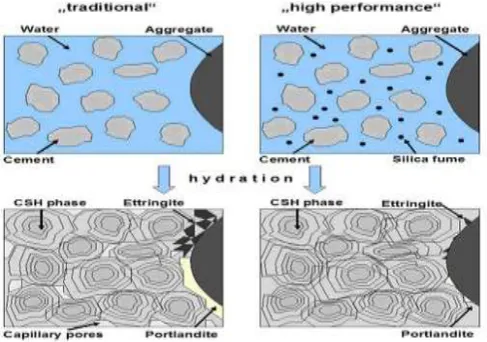
[image:2.595.40.284.567.738.2]During 1970s, any concrete mixtures which showed 40 MPa or more compressive strength at 28 days were designated as high strength concrete. As the time passed, more and more high strength concrete such as 60 – 100 MPa, were developed which were used for the construction of long-span bridges, skyscrapers etc. While high strength concrete is defined purely on the basis of its compressive strength, Mehta and Aitcin defined the high-performance concrete (HPC) as concrete mixtures possessing high workability, high durability and high ultimate strength.
Fig.1 Conventional Concrete Vs High Performance Concrete
ACI defined high-performance concrete as “a concrete meeting special combinations of performance and uniformity requirements that cannot always be achieved routinely using conventional constituents and normal mixing, placing, and curing practice”.
2.1 BINDER
The function of the binder in concrete is to chemically bind all the constituent materials to form a stone like material. The commonly used binders in concrete are cement, Fly Ash (FA), Silica Fume (SF), Alccofine(A) and Rice Husk Ash (RHA).
Fly Ash (FA) class F, known also as pulverized- fuel ash, is the by-product obtained by electrostatic and mechanical means from flue gases of power station furnaces fired with pulverized coal. The similarity of FA to natural pozzolans of volcanic origin has encouraged the use of FA in conjunction with Portland cement in making the concrete.\ FA is complicated in its chemical and phase compositions. It consists of heterogeneous combinations of glassy and crystalline phases. However, wide ranges exist in the amounts of the three principal constituents- SiO2 (25 to 60%), Al2O3 (10 to 30%), and Fe2O3 (5 to 25%). FA can be categorised into two classes, i.e. Class F and Class C, according to ASTM C 618-99 (1999). If the sum of these three ingredients is 70% or greater, the FA is categorised as Class F. However, as Class C, FA generally contain significant percentages of calcium compounds reported as CaO, the sum of the three constituents just mentioned is required only to be greater than 50%.
Silica Fume (SF) is an extremely reactive pozzolanic material. It is a by-product obtained from the manufacture of silicon or ferro-silicon. It is extracted from the flue gases from electric arc furnaces. SF particles are very fine with particle sizes about hundred times smaller than those of average size of OPC particles. It is a densified powder or is in the form of water slurry. The standard specifications of Silica Fume are defined in ASTM 1240. It is commonly used at a replacement level of 5% to 15%by mass of total cementitious materials.
© 2018, IRJET | Impact Factor value: 6.171 | ISO 9001:2008 Certified Journal | Page 3520 used to determine the oxide composition and loss on ignition
of RHA.
Alccofine is a new generation, ultrafine, low calcium silicate product, manufactured in India. It has distinct characteristics to enhance 'performance of concrete' in fresh and hardened stages. Alccofine performs in superior manner than all other mineral admixtures used in concrete within India. Due to its inbuilt CaO content, Alccofine triggers two way reactions during hydration
• Primary reaction of cement hydration.
• Pozzolanic reaction: ALCCOFINE also consumes by product calcium hydroxide from the hydration of cement to form additional C-S-H gel
Ground granulated blast furnace slag (GGBS) is a byproduct achieved in the manufacturing of pig iron, when iron ore is reduced to pig iron. The granules shaped slag is then ground to fineness similar to Portland cement. GGBS should conform to the standard specification, ASTM C989. In ASTM C989, there are three grades denoted as 80, 100, and 120 designated according to their contribution in strength development. GGBS is cementitious material itself; however, its combination with PC enhances the properties. Its normal dosage is between 20% to 70% by mass of the cementitious materials. The Slag used in this study was obtained from Shri Balaji Industries , Hasangarh ,Teh. Sampla , Distt. Rohtak , Haryana.
The basic raw material is clinker, which is made from the limestone. Three grades of cement are generally available in market – 53, 43 & 33 grades. The requirements of properties of all these cements are given in the following Indian standards. IS: 12269 -1987 (53 grade), IS: 8112-1989 (43 grade), IS: 269-1989 (33 grade).Cement Used in this study is Ultra Tech Cement .
Physical Properties
Property Average Value
for OPC obtained Standard Value for OPC
Specific gravity 3.15 _
Consistency (%) 31% _
Initial setting time (min) 42 > 30
Final setting time (min) 450 <600
Soundness (mm) 1.1 <10
The aggregate for concrete consists of coarse aggregate and fine aggregate. The fine aggregate has a grading of size between 150 μm to 4.75 mm whereas coarse aggregate has larger size than fine aggregate, up to the size of 63 mm (ASTM C33-03, 2003).
To produce high strength concrete, it is very important to select the materials. In this study, the aggregate used is
coarse aggregate which has maximum size of 10 mm. This use is based on the result investigated in previous research which showed that the use of small coarse aggregate leads to the increase of concrete strength in comparison to the larger aggregate as smaller aggregate is stronger than the larger ones. In addition, the low strength of concrete using larger aggregate is caused by the bigger size of aggregate make the transition zone becomes larger and more vary (Aïtcin P.C, 1988, Aïtcin, 2004).
In addition to the aggregate size, since the cement matrix becomes a granular skeleton of the aggregate, the lower the distance between two adjacent coarse aggregate particles, the higher the matrix strength. Aggregates may be natural, man-made. Recycled from material previously used in construction can be used as aggregates. As at least three quarters of the volume of concrete is occupied by aggregates, they impart considerable influence on strength, dimensional stability, and durability of concrete. They also play a major role in determining the cost and workability of concrete mixtures.
FM Value for fine Aggregate=2.67
FM Value for coarse Aggregate=6.5
The Normal Concrete is one of the old forms been used to build this world but now a new word came to existence saying High Performance Concrete. This HPC has all properties enhanced due to usage of cementitious material and now granite powder. This granite is the strongest of all material which is used for construction and now this is used for concrete in the form of powder as a partial replacement for natural sand.
The conventional concrete is converted to High-Performance Concrete by the use of chemical and mineral admixtures which plays a vital role in improving the characteristics like workability, strength parameters and many more. The admixtures added to cement concrete as a partial replacement along with super plasticizer as a water reducer to get the high performance. Granite Powder used in the study was taken from Mangol Puri, Delhi.
For this purpose four different series of concrete-mixtures were prepared by replacing the fine sand (passing 0.25 mm sieve) with WGP (Waste granite powder) at proportions of 10, 15 and 20% by weight. In order to determine the effect of the WGP on the compressive strength with respect to the curing age, compressive strengths of the samples were recorded at the curing ages of 7,14 & 28 days. Granite powder used in this study was taken from Mangol puri, Dehli .
© 2018, IRJET | Impact Factor value: 6.171 | ISO 9001:2008 Certified Journal | Page 3521 marble mass is lost in the form of dust. In India marble dust is
settled by sedimentation and then dumped away which results in environmental pollution, in addition to forming dust in summer and threatening both agriculture and public health. Therefore, utilization of the marble dust in various industrial sectors especially the construction, agriculture, glass and paper industries would help to protect the environment (Karasahin and Terzi, 2007). Marble Dust used in this study was taken from Mangol puri , Dehli.
GLENIUM SKY 8784 is the super plasticizer based on second generation polycarboxylic ether polymers, developed using nano technology. The product has been primarily developed for producing economical, high performance, high grade ready-mix concrete with total performance control.
GLENIUM SKY 8784 is free of chloride and low alkali. It is compatible with all type of cements. Major Uses of GLENIUM SKY 8784 are following.
• To produce economical, high grade concrete (>M45) with minimum micro-silica orMetakaolin.
• GLENIUM SKY 8784 is used for the production of high quality ready-mix concrete.
• GLENIUM SKY 8784 may be used in combination with GLENIUM STREAM 2 for producing Rheodynamic concrete, capable of self-compaction, even in the presence of dense reinforcement.
Cubes of size 150 mm x 150 mm x 150 mm are caste by using different types of Supplementary Cementitious Materials (SCMs) and Waste Material Aggregates(WMA). Before casting the cubes clean the cube-mould properly and apply oil on inner surface of mould
The compression test is used to determine the hardness of cubical specimens of concrete. The strength of concrete specimen depends on cement, aggregate, w/c ratio, Admixtures, curing temperature, age and size of specimen. Mix design is the major factor that controls the strength of concrete. After Curing the specimen should be loaded in the compression testing machine upto its failure load. Compressive strength is calculated by the following formula,
Compressive strength = Load / Cross-sectional area of the cube
3. TEST RESULTS
Cube Testing Machine
In the experimental program, mechanical property of concrete was conducted i.e. tests for compressive strength. The mechanical property of concrete was tested at the ages of 7 days, 14 days and 28 days. The compressive strength was tested on concrete cubes of 150 x 150 x 150 mm after water curing for 7 days, 14 days and 28 days with the help of Cube test machine.
Cube Testing Machine is meant for testing the concrete cube which is part of a simple yet cost effective test process that allows in judging compressive strength of concrete.
The sample for the test is taken from concrete that is being poured which is then cast as well as air cured under BIS standard conditions. Further, these are then water cured for specified time period and then crushed for determining maximum compressive strength of concrete cube.
COMPRESSIVE STRENGTH TEST
The compression test was conducted as per IS 516–1959. The specimens were kept in water for curing for 7 days, 14 days and 28 days and on removal were tested in dry condition and grit present on the surface. The load was applied without shock and increased continuously until the resistance of the specimen to the increasing load breaks down and no greater load can be sustained. The maximum load applied to the specimen was then recorded and the appearance of the concrete for any unusual features in the type of failure was noted. Average of three values was taken as the representatives of the compressive strength of the sample as noted.
Compressive Strength of Fly Ash (FA)
Mix %age
Slump
(mm) W/C Ratio Compressive Strength (Mpa) 7 Days 14 Days 28 Days
20 40 0.35 17.1 26.1 32.5
25 44 0.35 18.1 27.4 34.35
30 43 0.35 15.7 24.7 32.2
35 39 0.35 13.9 22.2 29.5
Compressive Strength of Slag (GGBS)
Mix %age
Slump
(mm) W/C Ratio Compressive Strength (Mpa) 7 Days 14 Days 28 Days
20 85 0.42 22.5 26.3 32.1
30 76 0.42 23.3 26.54 34.89
40 74 0.42 21.8 28.4 39.9
50 74 0.42 19.3 24.8 34.1
60 70 0.42 17.2 22.5 30.1
Compressive Strength of Silica Fumes (SF)
Mix %age
Slump
(mm) W/C Ratio Compressive Strength (Mpa) 7 Days 14 Days 28 Days
5 50 0.35 15.1 22.5 29.54
10 52 0.35 17.5 26.54 32.8
© 2018, IRJET | Impact Factor value: 6.171 | ISO 9001:2008 Certified Journal | Page 3522
3. TEST RESULTS
The objective of this study is to evaluate the Structural strength of high performance concrete by utilizing green and pozzolanic material as supplementary cementitious material. To assess this series of tests were conducted on various concrete mixes which includes Fly Ash, Slag , Silica Fume , Rice Husk Ash and Alccofine as SCM and Granite Powder , Marble Dust as WMA . About 116 concrete specimens were analyzed of different mix proportions. This research study primarily focused on the development of Compressive Strength of Cube for estimating Time Period of 7 Days , 14 Days and 28 Days with water/cement ratio of 0.35 for binary and ternary concrete mixes.
Detailed laboratory investigations are performed covering almost all available supplementary cementitious materials (SCMs) nearby area of Delhi NCR of India. In this research an attempt has been made to produce high performance concrete with commonly used ingredients such as cement, sand and coarse aggregates, which are locally available along with Supplementary Cementitious Materials.
1- Compressive strength testing of various mix proportions by considering all available supplementary cementitious materials, it was depicted that for binary mix incorporating Slag has given good results as compare to others. The compressive strength of concrete is increased with increase in Alccofine content up to 10 % & Silica content up to 10%. It was observed that there is possibility of production of concrete having compressive strength more than 70 MPa from ternary mix including Alccofine or Silica Fume as SCM.
2- It was observed that there is significant improvement in durability measure for high performance concrete. High durable concrete achieved through the use of supplementary cementitious materials will decrease the maintenance cost of structure. Thus life cycle cost will decrease.
3- Conventional high performance concrete was modified by incorporating Fly Ash, Alccofine, Silica Fume, Rice Husk Ash and as SCM. The modifications will minimize the CO2 emission and make concrete environmental friendly.
4- Compressive strength testing of various mix proportions by considering all available supplementary cementitious materials, it was depicted that for binary mix including rice husk ash has given good results as compare to others.
5- It was observed that there is significant improvement in durability measure for high performance concrete. High durable concrete achieved through the use of supplementary cementitious materials will decrease the maintenance cost of structure. Thus life cycle cost will decrease.
CONCLUSION
1- The Main aim of addition of fly ash is for economy and for improving the strength of hardened concrete. It is possible to produce low cost HPC, with 28 days strength in the range of
34.35 MPa,with W/B Ratio of 0.35 using low quality fly ash . It is possible to replace up to 35% of cement by Using low quality fly ash.
2- Replacement of cement by Slag (GGBS) showed in M25 grade concrete compressive strength improvement up to the replacement of 40% in all ages. As the Slag (GGBS) content increases the compressive strength increases up to 40% and then decreases. It has been seen that initially slag observe water in it and after compaction it releases the water content so therefore care should be taken while casting the concrete with SCM as Slag . The 7 days, 14 days and 28 days cube compressive strength ratio of HPC is 21.8 , 28.4 and 39.9 Respectively with W/B ratio of 0.42. The percentage replacement of cement by Slag (GGBS) increases, the workability decreases.
3- The main aim of silica fume is to increase strength . As the silica fume content increases the compressive strength increases up to 10% and then decreases. Hence the optimum replacement is 10%. The 7 days, 14 days and 28 days cube compressive strength ratio of HPC is 29.54 , 32.8 and 25.7 Respectively with W/B ratio of 0.35. The percentage replacement of cement by silica fume increases, the workability decreases. At all the ages of 7 , 14 and 28 days, the compressive strength of HPC with silica fume is more than that of normal concrete. It may be noted addition of silica fume causes increase in strength at all ages.
4- The optimum addition of RHA as partial replacement for cement is in the range (0%, 5% ,10%, 15% & 20%). Due to addition of RHA it is observed that early strength gain is increasing with addition of 0%, 5% ,10%, 15% & 20% RHA in normal concrete at 7 days.The compacting factor values of the concrete reduced as the percentage of RHA increased. The Compressive Strengths of concrete reduced as the percentage RHA replacement increased. Replacement of cement with Rice Husk Ash leads to increase in the compressive strength improved the workability and achieved the Maximum strength at 10% replacement for the grade of concrete is 37.5 Mpa with W/B ratio of 0.35.
5- The compressive strength of concrete is increased with increase in Alccofine content up to 10%. The optimum replacement level of OPC by Alccofine (A) was 10 %, which gave the highest compressive strength at the age of 28 days . It has been observed that the maximum compressive strength was obtained for mixes containing 10% Alccofine with 1% super plasticizer average value for 28 days was found to be 32.8 Mpa with W/B Ratio of 0.35 . As the percentage replacement increases beyond 10%, the 28 days compressive strength of HPC started decreasing.
© 2018, IRJET | Impact Factor value: 6.171 | ISO 9001:2008 Certified Journal | Page 3523 7- Compressive Strength of HPC shows increasing trend till
15% increment of Granite powder and again it was very near to the conventional concrete. The workability of concrete is good even after addition of the granite powder as replacement into concrete.
The current experimental work shows that the strength properties of the concrete could be enhanced by utilization of granite powder in the place of river sand, granite powder in concrete are the best choice, where they are available. Hence the granite aggregates can be considered as an alternative for fine aggregates (river sand).
8- In all mix proportions strength gain up to 7 days is excellent, between 7 to 28 days strength gain is comparatively less, but between 28 to 56 days strength gain is high because of fly ash, in M3 proportion get acceptable strength at 28 days as per Table-7, clause 6.2.1 of IS 456-2000. It concluded that initial compressive strength achieved by using Fly-Ash (22%) and Alccofine (8%) is 41.3 Mpa and 65.62 Mpa at 7 and 28 days respectively, but after 28 days strength gain is comparatively less than 7 days Strength .
9- Fly ash and Rice Husk Ash is found to be superior to other supplementary materials like slag, and Silica fume. RHA used in this study is efficient as a pozzolanic material Cement is costly material, so the partial replacements of these materials by Rice husk ash reduces the cost of concrete.
FUTURE SCOPE OF RESEARCH WORK
1 It is recommended that these co-relation should be developed with other mineral admixtures like Red mud, Plastic waste ,Burnt brick, or any other material available in other parts of India.
2 Future study should investigate the other durability properties by including these SCM’s.
3 The Use of HDPE (High Density poly-ethylene) which is polyethylene thermoplastic made from petroleum should be use to make High Strength Concrete.
4 This study recommends that use laboratory tests to determine the suitability of these mineral admixtures in self-compacting concrete also.
5 It will also recommend that conduct a comprehensive laboratory testing of concrete mixes with of these mineral admixtures includes light weight aggregates.
REFERENCES
1-Ashwani, 2017, Effect of Steel Fibres on Strength of Concrete with Partially Replaced Marble Dust, International Journal of Science and Research, Vol.6, pp 118-122
2-ACI Committee 116,(1967) "Cement and Concrete Terminology," Publication SP-19, pp. 24
3-Amudhavalli. N. K., and Jeena M., (2012) ―Effect of Silica Fume on Strength and Durability Parameters Of Concrete‖, International Journal of Engineering Sciences & Emerging Technologies, Vol-3,No -1, pp.28-35.
4- Andrew J. M., Jason H. I., Maria C.G.J., (2007) ―Alkali silica reactivity of agglomerated silica fume, Cement and Concrete Research 37, 166–174
5- AnkitNileshchandra Patel, ―Stone Waste in India for Concrete with Value Creation Opportunities”, International Journal of Latest Trends in Engineering and Technology (IJLTET) Vol. 2, 2 March 2013.
6- ASTM C 618-99, "Standard Specification for Fly Ash and Raw or Calcined Natural Pozzolan for Use as a Mineral Admixture in Portland Cement Concrete", Jul. 1999
7- ASTM 1240 – Standard specification for silica fimes
8- ASTM C33-03 (2004) ―Standard Specification for Concrete Aggregates
9- ASTM D 422 (2002) ―Standard Test Method for Particle-Size Analysis of Soils, Annual Book of ASTM Standards
10- Bala M. S., Mohan G. G., Santhi A.S. (2010) ―Behaviour Of Class C and Class F Fly Ash in High Volume Fly Ash Concrete, ACECON pp:639-644.
11- Basu. P.C., Saraswati,S., (2006)―Are existing IS Codes Suitable for Engineering of HVFAC?, The Indian Concrete Journal, Vol.-80, No.-10, pp.17-21.
12- Bhanja. S., Sengupta B., (2004.) ―Influence of silica fume on the tensile strength of concrete‖, Cement and Concrete Research 35, Pg no 743–747.
13-Bhattacharjee B, Mishra A, Rai H S,(2011) ―Specifications for High Performance Concrete in India, Proceedings of the International UKIERI Concrete Congress, New Delhi, India, pp. 1-12.
14- BouzianiTayeb (2011) ―Effect of Marble Powder on the Properties of Self-Compacting Sand Concrete”, The Open Construction and Building Technology Journal, 2011, 5, 25-29
15- Brunauer, Stephen, and Copeland L. E. (1964) "The chemistry of concrete." Scientific American, Pg No.80-92.
16- Brundtland, Gro Harlem. (1987) "World commission on environment and development." Our common future: 8-9.
17- BS 8110-1. (1997) "Structural use of concrete Part 1: Code of practice of design and construction", British Standards Institution
© 2018, IRJET | Impact Factor value: 6.171 | ISO 9001:2008 Certified Journal | Page 3524 19- Chander Garg, Ankush Khadwal.(2014) “Behavior of
Ground Granulated Blast Furnace Slag and Limestone Powder as Partial Cement Replacement” . International Journal of Engineering and Advanced Technology Volume-3 Issue-6,
20- Desai S N, Patil H S., (2011) ―Utilization of Industrial Waste in Mortar and Concrete‖ Proseedings of the International UKIERI Concrete Congress, New Delhi, India, pp. 131-142 March 8-10.
21- Donald B., (2006) ―The Durability of Concrete Containing High Levels of Fly Ash, The University of New Brunswick,
22- Dr. G. Prince Arulraj, Mr. A .Adin and Mr. T. Suresh Kannan “Granite Powder Concrete” Department of Civil Engineering, SNS College of Technology, Coimbatore, Vol.3, No.1, February 2013.
23- Dr. T. Felix Kala 1 “Effect of Granite Powder on Strength Properties of Concrete” , Department of Civil Engineering, Dr. M.G.R. Educational and Research Institute University, Maduravoyal, Chennai, Vol.2, Issue 12 Pp 36-50 (May 2013)
24- D.B.Rajiwala, H.S.Patil(2011) “Geopolymer Concrete : A Concrete Of Next Decade” Journal of Engineering Studies and Research (JERS) Vol. II Issue 1.
25- EN, BS. 206-1 (2000). "Concrete–Part 1: Specification, Performance, Production and Conformity." British Standards Institution.
26- Erdem, Tahir K. and Önder K., (2008) "Use of binary and ternary blends in high strength concrete." Construction and Building Materials 22.7: 1477-1483.
27- Gandage A. S., Kalantri A., Dixit B., (2010) ―Study of the Properties of Concrete with Processed Fly Ash‖ ACECON pp:607-613.
28- Gastaldini, A. L. G., et al. (2010) "Influence of curing time on the chloride penetration resistance of concrete containing rice husk ash: A technical and economical feasibility study." Cement and Concrete Composites 32.10: 783-793.
29- Gopalakrishnan. S., (2005) ―Demonstration of Utilizing High Volume Fly Ash Based Concrete For Structural Applications‖, Structural Engineering Research Centre, Chennai.
30- Harald J., (2012) "How to make Conceret More Sustainable‖, ICI Journal Vol.- 13, No.-1,pp.28-39.
31- Indian Standard Code IS 456-2000, ―Code of Practice for Plain and Reinforced Concrete.