http://dx.doi.org/10.4236/apm.2015.52010
Rogue Wave for the Benjamin Ono
Equation
Lili Song1, Wei Chen1, Zhenhui Xu2, Hanlin Chen1
1School of Science, Southwest University of Science and Technology, Mianyang, China
2Applied Technology College, Southwest University of Science and Technology, Mianyang, China
Email: [email protected], [email protected], [email protected], [email protected]
Received 16 January 2015; accepted 8 February 2015; published 13 February 2015
Copyright © 2015 by authors and Scientific Research Publishing Inc.
This work is licensed under the Creative Commons Attribution International License (CC BY). http://creativecommons.org/licenses/by/4.0/
Abstract
In the paper, the homoclinic (hateroclinic) breather limit method (HBLM) is applied to seek rogue wave solution of the Benjamin Ono equation. We find that the rational breather wave solution is just a rogue wave solution. This result shows that rogue wave can come from the extreme behavior of the breather solitary wave for (1+1)-dimensional nonlinear wave fields.
Keywords
Benjamin Ono Equation, Extended Homoclinic Test Method, Homoclinic (Hateroclinic) Breather Limit Method, Rogue Wave Solution
1. Introduction
As is well known that solitary wave solutions of nonlinear evolution equations play an important role in nonli-near science fields, especially in nonlinonli-near physical science, since they can provide much physical information and more insight into the physical aspects of the problem and thus lead to further applications [1]. In this paper, we will consider the Benjamin Ono (BO) equation
( )
20
tt xx xxxx
u +β u +γu =
In recent years, rogue waves, as a special type of nonlinear waves and also known as freak waves, monster waves, killer waves, extreme waves, abnormal waves [12], have triggered much interest in various physical branches. Rouge wave is a kind of wave that seems abnormal which is first served in the deep ocean. It always has two to three times amplitude higher than its surrounding waves and generally forms in a short time for which people think that it comes from nowhere. Rouge waves have been the subject of intensive research in oceano-graphy [13] [14], optical fibers [15]-[17], superfluids [18], Bose-Einstein condensates, financial markets and other related fields [19]-[22]. In this work, we will apply the homoclinic (hateroclinic) breather limit method (HBLM) [23], to seek rogue wave solution of the BO equation. We take the following four steps:
Step 1
By Painleve analysis, a transformation u=T f
( )
is made for some new and unknown function f. Step 2By using the transformation in step 1, original equation can be converted into Hirota’s bilinear form
(
t, x,)
0G D D f = , where the D-operator [24] is defined by
( ) ( )
, ,( ) (
, ,)
,m n
m n
x t x x t t
D D f x t g x t f x t g x t
x x t t ′= ′=
∂ ∂ ∂ ∂
′ ′
= − × −
′ ′
∂ ∂ ∂ ∂
Step 3
Solve the above equation to get homoclinic (heteroclinic) breather wave solution by using extended homoc-linic test approach (EHTA) [25].
Step 4
Let the period of periodic wave go to infinite in homoclinic (heteroclinic) breather wave solution, we can Ob-tain a rational homoclinic (heteroclinic) wave and this wave is just a rouge wave.
2. Rational Breather Wave (Rogue Wave)
The BO equation,
( )
20
tt xxxx
xx
u +β u +γu = (1) By Painleve analysis, let
(
)
0 6
ln xx
u u γ f
β
= + (2)
where f x t
( )
, is unknown real function, and u0 is the small perturbation parameter. Substituting (2) into (1) will get the following equation:(
)
(
)
2(
(
)
)
2 2(
)
0
6 36 6
ln f tt 12 u ln f xx ln f xx ln f xxxx 0
γ γ γ γ
β + + β + β = (3)
By means of the hirota bilinear operator, which is defined by
( ) ( )
, ,( ) (
, ,)
,m n
m n
x t x x t t
D D f x t g x t f x t g x t
x x t t ′= ′=
∂ ∂ ∂ ∂
′ ′
= − × −
′ ′
∂ ∂ ∂ ∂
(4)
we will get
(
)
2(
)
2
2 ln 2
2 x
D f f
f
x f
⋅
∂ =
∂ (5)
(
)
(
)
(
)
2
4 2
4
4 2 2
3 ln
2 2
x x
D f f D f f
f
x f f
⋅ ⋅
∂ =
−
∂ (6)
Putting (5) (6) into (3) implies the following bilinear equation:
(
2 2 4)
(
)
0 0
t x x
( )
(
(
)
)
( )1 1 1 1
1 2 2 2
e p x w t cos ep x w t
f = − − +c p x+w t +c − (8) where p1, p2, w1, w2, c1 and c2 are real constants to be determined.
Substituting Equation (8) into (7), collecting coefficients of the terms ep x w t1( − 1), e−p x w t1( −1),
(
(
)
)
2 2
sin p x+w t ,
(
)
(
2 2)
cos p x+w t and the constant, and let coefficients of these terms to zero, we get an algebraic equation
(
)
(
)
(
)
(
)
(
)
2 2
1 1 2 1 2 0 1 1 2 1 1 2 1 2
2 2
1 2 1 2 1 2 0 1 2 1 2 1 2 1 2 1 2
2 2 2 2 2 2 4 4 2 2
1 2 1 1 2 2 0 1 2 1 2 1 2 1 2 1 2 1 2
2 4 2 2 4 2 2 2 2
1 2 1 2 0 2 1 1 2 2 2 1 0
2 4 4 0
2 4 4 0
2 6 0
4 2 16 8 4
c p p w w u c p p c p p p p
c c p p w w u c c p p c c p p p p
c c p w p w u c c p p c c p p c c p p
c p c p u c p c p w c p u c
β γ
β γ
β γ γ
γ β γ β
− + − + =
− + + − =
− + − + + − =
− + − + + 2 2 2 1 1
4 2 2 4 2 2 2 2 2 2
1 1 1 1 2 1 2 1 1 0 1 2 0 1 1 1 1 2 2
0
6 2 2 0
p w c p c p p c p c p u c p u c p w c p w
γ γ γ β β
= − + + − + − = (9)
Solving Equation (9), then taking p2= p1, we have
(
2 2 2 2 2)
(
)
1 2 0 0 2 2 2 2 2
1 2 2 2 2 2 1 2 0 1 1 2
1 2 0 0 2
2 2 1
2 , 2 ,
4
4 2
p w u u w c
c w w u p w w
p w u u w
γ β β
β
γ γ β β
+ +
= ± = = −
− + + (10)
where w1, w2, c2 are some free real constants. Choosing β ≠u0 0 and c2 >0, we get from(10) w1 > w2 . Substituting (10) into (8), we get
( )
(
(
)
)
( )
(
(
)
)
0
1 2 1 2 1 2 2
2
0
2 2 1 2 1 2 2
2 2
, 2 cosh ln cos ,
2
and , 2 cosh ln cos .
u
f x t c p x t c h p x w t
w
u
f x t c p x t c h p x w t
w β β = − + + + = − + − + (11)
where
(
)
2 2 2 2 2
1 2 0 0 2 2
1 2 2 2 2 2
1 2 0 0 2
2 2
2
4 2
p w u u w c
h
p w u u w
γ β β γ β β
+ + = − + + , 2 2 1 2 1 1 2 w w p γ −
= ± , w1, w2∈R . Substituting (11) into (2) yields the solutions of (1) as follows, respectively
( )
(
(
)
)
(
)
(
)
2 0 2 2 2
1 1 2 1 2 2 2 1 1 2 1
2
1 0 2
0
2 1 2 1 2 2
2 2
4 2 sinh ln sin 4
6 ,
2
2 cosh ln cos
u
h p c p x t c p x w t h p c p
w u x t u
u
c p x t c h p x w t
w β γ β β − − + + − + = + − + + + (12)
( )
(
(
)
)
(
)
(
)
2 0 2 2 2
1 1 2 1 2 2 2 1 1 2 1
2
2 0 2
0
2 1 2 1 2 2
2 2
4 2 sinh ln sin 4
6 ,
2
2 cosh ln cos
u
h p c p x t c p x w t h p c p
w u x t u
u
c p x t c h p x w t
w β γ β β − − + + − + = + − + − + (13)
The solution u1
( )
x t, (or u2( )
x t, ) shows a new family of two-wave, breather solitary wave, which is a so-litary wave and also is a periodic wave.Substituting c2 =1 into the solution u2
( )
x t, , it can be rewritten as follows( )
( )
(
(
)
)
(
)
(
)
2 2 0
1 1 1 1 2 2
2 1
2 0 2
0
1 1 2 2
2 2
1 2 sinh sin
6 ,
2
cosh cos
u
p k k p x t p x w t
w
u x t u
u
p x t k p x w t
where
2 2 2 2 2
1 2 0 0 2
1 2 2 2 2 2
1 2 0 0 2
2 2
4 2
p w u u w
k
p w u u w
γ β β γ β β
+ + =
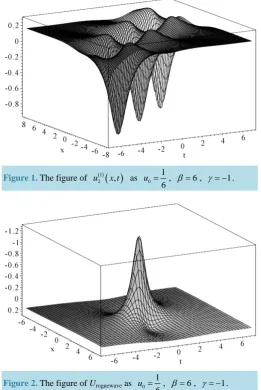
− + + (see Figure 1).
Now we consider a limit behavior of u( )21
( )
x t, as the period 1 2πp of periodic wave cos
(
p x1(
+w t2)
)
goesto infinite, i.e. p1→0. By computing, we get the following result
(
)
(
)
0
2 2
roguewave 0 2 2
2 0
2 2
2
24 2
2
u
R x t x w t
w
U u
u
x t x w t R
w
β γ
β β
− − +
= +
− + + +
(15)
where
2 2
2 2 2
0 0 2
6 2
w R
u u w
γ β β
− =
+ , and k1→0 and w1=w2 as p1→0 (see Figure 2).
[image:4.595.77.543.79.289.2]Especially, if let u0=0, we will get c2<0, so the two breather wave solution can not be obtained, mean-while, the rational breather wave solution (rogue wave solution) can’t also be find. The small perturbation pa-rameter u0 =0 plays a huge part in finding rouge wave solution.
Figure 1. The figure of ( )1
( )
2 ,u x t as 0 1 6
u = , β=6, γ= −1.
Figure 2. The figure of Uroguewave as 0
1 6
[image:4.595.183.445.323.714.2]Equation (15) is a rational solution of Equation (1), and it is also a breather-type solution. U→0 for fixed t
as x→ ±∞. So, the solution Uroguewave is a rogue wave solution which has two to three times amplitude higher than its surrounding waves and forms in a short time. One may think that whether the energy collection and su-perposition of breather solitary wave in many periods lead to a rogue wave or not.
3. Conclusion
In the paper, we apply the homoclinic (hateroclinic) breather limit method (HBLM) to find the BO equation’s breather solitary solution and rational breather solution. Meanwhile, rational breather solution obtained here is just a rogue wave solution of the BO equation. Furthermore, the small perturbation parameter u0 plays an impor-tant role in seeking rouge wave solution too. Next, we will try to use some methods to look for multi-rogue waves, such as the two-order wronskian determinant, Darboux transformation and so on.
Acknowledgements
The authors are grateful to the referee for a number of helpful suggestions to improve the paper.
References
[1] Ablowitz, M.J. and Clarkson, P.A. (1991) Solitons, Nonlinear Evolution Equations and Inverse Scattering. Cambridge University Press, Cambridge. http://dx.doi.org/10.1017/CBO9780511623998
[2] Korpel, A. and Banerjee, P. (1984) Heuristic Guide to Nonlinear Dispersive Wave Equation and Soliton-Type Solution.
Proceedings of the IEEE, 72, 1109-1130. http://dx.doi.org/10.1109/PROC.1984.12992
[3] Fan, E. (2004) The Integrable Systems and The Computer Algebra. Science Press, Beijing.
[4] Fu. Z., Liu, S., et al. (2003) The JEFE Method and Periodic Solutions of Two Kinds of Nonlinear Wave Equations.
Communications in Nonlinear Science and Numerical Simulation, 8, 67-75.
http://dx.doi.org/10.1016/S1007-5704(02)00082-5
[5] Wang, Z., Li, D., et al. (2005) A Method for Constructing Exact Solutions and Application to Benjamin Ono Equation.
Chinese Physics, 14, 2158-2163. http://dx.doi.org/10.1088/1009-1963/14/11/003
[6] Dai, Z., Huang, J., et al. (2005) Homoclinic Orbits and Periodic Solitons for Boussinesq Equation with Even Constraint.
Chaos, Solitons & Fractals, 26, 1189-1194. http://dx.doi.org/10.1016/j.chaos.2005.02.025
[7] Dai, Z., Jiang, M., et al. (2006) Homoclinic Bifurcation for Boussinesq Equation with Even Constraint. Chinese Phys-ics Letters, 23, 1065-1067. http://dx.doi.org/10.1088/0256-307X/23/5/001
[8] Dai, Z., Liu, J. and Li, D. (2009) Applications of HTA and EHTA to YTSF Equation. Applied Mathematics and Com-putation, 207, 360-364. http://dx.doi.org/10.1016/j.amc.2008.10.042
[9] Dai, Z., Li, Z., et al. (2008) Exact Homoclinic Wave and Soliton Solutions for the 2D Ginzburg-Landau Equation.
Physics Letters A, 372, 3010-3014. http://dx.doi.org/10.1016/j.physleta.2008.01.015
[10] Dai, Z., Liu, Z. and Li, D. (2008) Exact Periodic Solitary-Wave Solution for KdV Equation. Chinese Physics Letters,
25, 1531-1533. http://dx.doi.org/10.1088/0256-307X/25/5/003
[11] Xu, Z.H., Xian, D.Q. and Chen, H.L. (2010) New Periodic Solitary-Wave Solutions for the Benjamin Ono Equation.
Applied Mathematics and Computation, 215, 4439-4442. http://dx.doi.org/10.1016/j.amc.2009.11.009
[12] Ohta, Y. and Yang, J.K. (2012) General High-Order Rogue Waves and Their Dynamics in the Nonlinear Schrödinger Equation. Proceedings of the Royal Society A: Mathematical, Physical and Engineering Sciences, 468, 1716-1740. [13] Muller, P., Garrett, C. and Osborne, A. (2005) Rouge Waves. Oceanography, 18, 66-75.
[14] Kharif, C., Pelinovsky, E. and Slunyaey, A. (2009) Rogue Waves in the Ocean, Observation, Theories and Modeling. Springer, New York.
[15] Akhmediev, N., Ankiewicz, A. and Soto-Crespo, J.M. (2009) Rogue Waves and Rational Solutions of the Nonlinear Schrödinger Equation. Physical Review E, 80, Article ID: 026601. http://dx.doi.org/10.1103/PhysRevE.80.026601
[16] Solli, D.R., Ropers, C., Koonath, P. and Jalali, B. (2007) Optical Rogue Waves. Nature, 450, 1054-1057.
http://dx.doi.org/10.1038/nature06402
[17] Bludov, V.Y., Konotop, V.V. and Akhmediev, N. (2009) Rogue Waves as Spatial Energy Concentrators in Arrays of Nonlinear Waveguides. Optics Letters, 34, 3015-3017. http://dx.doi.org/10.1364/OL.34.003015
http://dx.doi.org/10.1103/PhysRevLett.101.065303
[19] Bludov, V.Y., Konotop, V.V. and Akhmediev, N. (2009) Matter Rogue Waves. Physical Review A, 80, Article ID: 033610. http://dx.doi.org/10.1103/PhysRevA.80.033610
[20] Montina, A., Bortolozzo, U., Residori, S. and Arecchi, F.T. (2013) Rogue Waves and Their Generating Mechanisms in Different Physical Contexts. Physics Reports, 528, 47-89. http://dx.doi.org/10.1016/j.physrep.2013.03.001
[21] Solli, D.R., Ropers, C. and Jalali, B. (2008) Active Control of Optical Rogue Waves for Stimulated Supercontinuum Generation. Physical Review Letters, 101, Article ID: 233902. http://dx.doi.org/10.1103/PhysRevLett.101.233902
[22] Yan, Z.Y. (2011) Vector Financial Rogue Waves. Physics Letters A, 375, 4274-4279.
http://dx.doi.org/10.1016/j.physleta.2011.09.026
[23] Xu, Z.H., Chen, H.L. and Dai, Z.D. (2014) Rogue Wave for the (2+1)-Dimensional Kadomtsev-Petviashvili Equation.
Applied Mathematics Letters, 37, 34-38. http://dx.doi.org/10.1016/j.aml.2014.05.005
[24] Hirota, R. (1985) Fundamental Properties of the Binary Operators in Soliton Theory and Their Generalizartion. In: Ta-keno, S., Ed., Dynamical Problem in Soliton Systems, Springer Series in Synergetiecs, Springer, Berlin, 42-49. [25] Dai, Z.D., Liu, J. and Li, D.L. (2009) Applications of HTA and EHTA to YTSF Equation. Applied Mathematics and