Munich Personal RePEc Archive
Estimation Theory for the Cusp
Catastrophe Model
Cobb, Loren
University of Colorado Denver
April 1980
Online at
https://mpra.ub.uni-muenchen.de/37548/
Estimation Theory for the Cusp Catastrophe Model
REVISED EDITION1
Loren Cobb
Abstract
The cusp model of catastrophe theory is very closely related to certain multi-parameter exponential families of probability density functions. This relationship is exploited to create an estimation theory for the cusp model. An example is pre-sented in which an independent variable has a bifurcation effect on the depend-ent variable.
Introduction
The elementary catastrophe models of Thom (1975) and Zeeman (1977) have at-tracted the attention of researchers and theorists throughout the sciences. A per-sistent problem with virtually all published applications, however, has been the absence of statistical procedures for detecting the presence of catastrophes in any given body of data. This lack has resulted in some severe criticism of catastrophe models being, among other things, speculative and unverifiable (Sussmann and Zahler, 1978). Thus catastrophe models have become associated in many minds with reckless speculation and intellectual irresponsibility. As part of an effort to overcome this problem, this paper presents an estimation theory and the begin-nings of an inferential theory, in a form useful for survey research applications of catastrophe models.
Catastrophe models come in both dynamic and static forms, the static forms be-ing simply the equilibria (stable and unstable) of the dynamic forms. The capac-ity for multiple stable equilibria is inherent in catastrophe models: this is the principal feature which distinguishes them from the standard models used in linear and polynomial regression.
There are two ways of overcoming this difficulty. Both of these ways have emerged from a study of various forms of dynamic stochastic catastrophe models (Cobb, 1978, 1980; Cobb & Watson, 1981). One of these is based on the method of moments, while the other is based on maximum likelihood estimation. The latter permits hypothesis testing through the use of the chi-square approximation to the likelihood ratio test. The former has the advantage of computational simplic-ity, while the latter is clearly preferable when hypotheses must be tested.
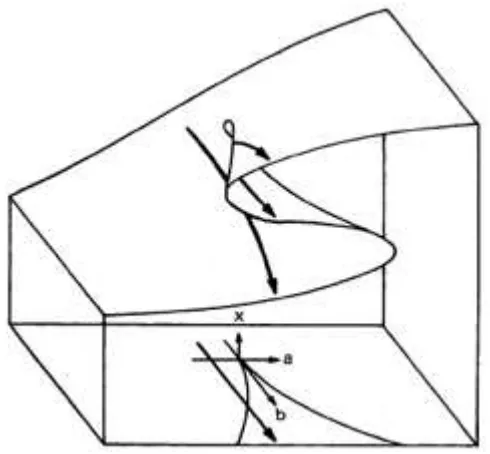
Figure 1: The cusp catastrophe model.
The Cusp Model
The canonical cusp model can be thought of as a rather peculiar response surface model. It's shape may be seen in Figure 1 below. Note that sections taken through the depicted surface parallel to the α-axis are just cubic polynomial in y, the dependent variable. The entire surface is defined by the implicit equation
0=α+β y−λ σ ⎛
⎝⎜ ⎞⎠⎟−
y−λ σ ⎛ ⎝⎜ ⎞⎠⎟
3
.
If we let z= y−λ
σ be the "standardized" dependent variable, then the cubic
equa-tion is simply
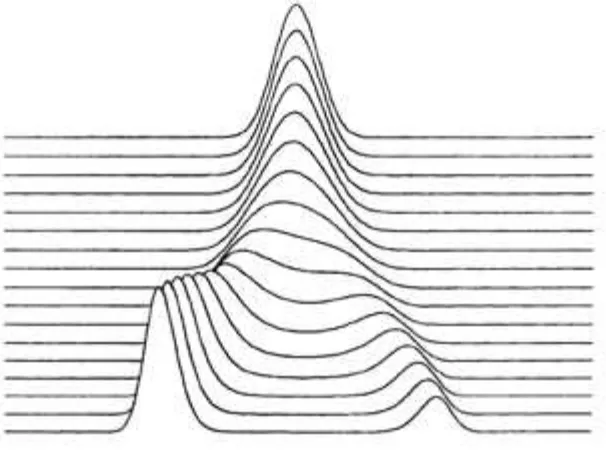
It may be seen that λ and σ are location and scale parameters, respectively, for y. The roots of the cubic polynomial are the predicted values of z, given α and β. When there are three roots, the central root is an "anti-prediction": a prediction of where the dependent variable will not be. This feature of the cusp model is clari-fied in Figure 2, which shows the sequence of conditional probability density functions for y, with α fixed as β is increased. This sequence corresponds to the trajectory and its projection that are shown in Figure 1. These probability density functions will be discussed in a later section.
Figure 2: The cusp family of probability density functions.
The two dimensions of the control space, α and β, are canonical factors which depend upon the actual measured independent variables, say X
1,...,Xv. As a first
approximation, we may suppose that the control factors depend linearly upon the independent variables:
α =α0 +α1X
1+...+αvXv,
β=β0 +β1X1+...+βvXv.
Thus the statistical estimation problem is to find estimates for the 2v+4 parame-ters
λ,σ,α0,...,αv,β0,...,βv
(
)
,from n observations of the v+1 variables
Y,X 1,...,Xv
As β changes from negative to positive, the conditional probability density func-tion of y changes in shape from unimodal to bimodal. For this reason the β factor will be called the bifurcation factor (it has also been called the splitting factor, by Zeeman and others). When α is zero the PDF is symmetrical no matter what the value of β. When the PDF is unimodal, α determines its skew: α positive implies positive skew, and vice versa. However, when the PDF is bimodal, then α deter-mines the relative height of the two modes: α positive implies that the right-hand mode is higher, and vice versa. To encompass these attributes with a single term,
α will be called the asymmetry factor (it has also been called the normal factor, a rather misleading term in the statistical context).
Because the model is based on a cubic polynomial, it is possible to define a statis-tic which discriminates between the unimodal and bimodal cases. This is
Cardan's discriminant:
δ = 1 2α
(
)
2− 1 3β
( )
3.
When δ is negative the PDF is unimodal, and when it is positive the PDF is bi-modal.
Statistical Theory
The probability density function upon which all of the preceding descriptive sta-tistics were based is the standard 4-parameter cusp PDF:
f(y;α,β,λ,σ)=ξexp αz+ 1 2βz
2
−1 4z
4
(
)
, with z= y−λσ .
The constant ξ merely normalizes the PDF so that it has unit integral over its range, which is the whole real line. The modes and antimodes of the cusp PDF
may be found by solving ∂f
∂y=
0. This yields the equation
0=α+βz−z3,
which is exactly the same as the implicit equation which defined the cusp surface. The modes of the cusp PDF are the predicted values of the cusp model, while the antimodes of the cusp PDF are the anti-predictions of the cusp model. The deriva-tion of the cusp PDF from stochastic catastrophe theory, using stochastic differ-ential equations, may be found in (Cobb & Watson, 1981). The statistical theory was first presented in rudimentary form by (Cobb, 1978).
f(y)=exp −η+τ1y+τ2y 2
+τ3y 3
+τ4y 4
(
)
.Now the well-developed theory (e.g. Lehman, 1959) of exponential families can be applied: we know that maximum likelihood estimators (MLEs) exist, are unique, and can be found for example by a Newton-Raphson search. This search procedure proceeds as follows. Let τ stand for the vector of parameters
τ = τ
1,τ2,τ3,τ4
(
)
,let S be the vector of sample means defined by
Sk = 1
n Yi
k
i=1
n
∑
, for k=1, 2, 3, 4,let Mk(τ) be the vector of expectations of Y given τ defined by
Mk(τ)=E⎡⎣ ⎤⎦Yk , for k=1, 2, 3, 4,
and let H(τ)be the 4x4 covariance matrix defined by
Hij(τ)=Cov⎡⎣Yi,Yj⎤⎦, for i,j=1, 2, 3, 4.
The Newton-Raphson search is an iterative procedure which starts from an ini-tial guess for τ, say t
0. Each iteration is given by the vector expression
tk
+1 =tk+
(
S−M(tk))
H(tk)−1 .
This calculation is performed repetitively until S=M(t), within the limits of
computational accuracy.
It should be noted that after each iteration the vector M(t) and the matrix H(t) must be recalculated. These moments must be found by numerical integration, since closed-form expressions for the moments of the cusp PDF are not known.2
The preceding discussion applies to the estimation of the four parameters of the cusp PDF, given observations of the variable Y. If, however, the cusp PDF is to be used as the conditional density of Y, given the values of the independent vari-ables, then the maximum likelihood procedure becomes more complicated. If we use the previously-stated assumption that the factors α and β are linear combina-tions of the independent variables, then the extension of the Newton-Raphson technique for finding the maximum likelihood estimates is straightforward. There are now 2v+4 parameters to be estimated, and the matrix H(t) becomes
We now proceed to estimation by the method of moments. It will be seen that this method, in contrast to the method of maximum likelihood, is extremely easy to implement.
Even though closed-form expressions for the moments of the cusp PDF do not exist, moment estimators are trivial to derive with the aid of the following gen-eral theorem:
Theorem: Let g(x,y) be a polynomial function of x and y such that
0< exp⎡⎣−
∫
g(x,y)dy⎤⎦−∞
+∞
∫
<∞, ∀x.Let ψ(x) be the reciprocal of this quantity. Suppose that a random variable Y
de-pends upon x in such a way that its conditional density is given by
f(y x)=ψ(x)exp⎣⎡−
∫
g(x,y)dy⎤⎦.Assume that the joint density of X and Y has moments of all orders, and let h(x)
denote the density of the random variable X. Then for any non-negative j and k,
E⎡⎣XjYkg X
(
,Y)
⎤⎦=kE⎡⎣XjYk−1⎤⎦.Proof: Note that f(y x) is asymptotically zero as y tends to either +∞ or −∞.
Since g(x,y) is a polynomial, we also have that ykf(y x) to zero in the same way. Further, we can write g(x,y) as
g(x,y)=− ∂
∂yln
(
f(y x)
=−∂f(y x) ∂y
f(y x) .
Substituting this expression into the moment formula, we obtain
E⎡⎣XjYkg X
(
,Y)
⎤⎦=∫∫
xjykg(x,y)f(y x)h(x)dydx=
∫∫
xjyk(
−∂f(y x))
h(x)dx=
∫
xjh(x)(
−∫
yk∂f(y x))
dx.Now use integration by parts on the inner integral, and observe that one of the parts is identically zero:
− yk∂ f(y x)
∫
=−ykf(y x) −∞ +∞
+k y
∫
k−1f(y x)dyThus we now have
E⎡⎣XjYkg X
(
,Y)
⎤⎦=∫
xjh(x)(
k y∫
k−1f(y|x)dy)
dx=k
∫∫
xjyk−1h(x)dy dx=kE Xj
Yk−1
⎡⎣ ⎤⎦,
which was to be shown.
This theorem enables the method of moments to be applied to models that, like the elementary catastrophes, are expressed as implicit equations. Before examin-ing the cusp model, it may be worthwhile to show how it can be applied to ordi-nary linear regression. The linear regression model
y=a+bx+ε
can be written in implicit equation form as
g(x,y)= y−a−bx
σ2 =0,
where σ2 will turn out to be the variance of ε . The conditional PDF of y given x
is
f(y x)=ψ(x)exp −
1 2y
2 −
ay−bxy
σ2 ⎡ ⎣ ⎢ ⎤ ⎦ ⎥
=ψ1(x)exp − 1 2
y−(a+bx) σ ⎛ ⎝⎜ ⎞⎠⎟ 2 ⎡ ⎣ ⎢ ⎢ ⎤ ⎦ ⎥ ⎥.
This is clearly a parametrized family of normal densities, N a
(
+bx,σ2)
. (Toob-tain this formula, simply complete the square and absorb the terms in x into the function ψ, the normalizing constant.)
To find estimation equations for a and b, use the theorem twice, first with j = k = 0 and second with j = 1 and k = 0:
1. E⎡⎣g X
(
,Y)
⎤⎦=0 ⇒ a+bE[ ]
X =E[ ]
Y ,2. E⎡⎣Xg X
(
,Y)
⎤⎦=0 ⇒ aE[ ]
X +bE⎡⎣ ⎤⎦X2 =E[
XY]
,Notice that when sample moments are substituted for these expectations, we ob-tain the usual Gauss-Markov normal equations for linear regression.
3. E⎡⎣Yg X
(
,Y)
⎤⎦=1 ⇒ E⎡⎣ ⎤⎦ −Y2 aE[ ]
Y +bE[
XY]
=σ2,which is the correct formula for the residual variance of Y after the linear effect of
X has been removed by linear regression.
Turning now to the cusp model, let us consider first the model with no inde-pendent variables:
g(y)=a+by+cy2+dy3,
(
d>0)
.This model has a PDF given by
f(y)=ξexp ay+1 2by
2 + 1
3cy 3
+ 1 4dy
4
⎡⎣ ⎤⎦,
which has modes and antimodes at the roots of g(y)=0. The transformation of the parameters from
(
a,b,c,d)
to the standard coefficients(
α,β,λ,σ)
is accom-plished by:σ = 4 d,
λ=− c 3d,
α =−σ
(
a+bλ+cλ2 +dλ3)
, andβ=−σ2 b +cλ
(
)
.Estimation of the parameter vector
(
a,b,c,d)
proceeds from an application of thetheorem. Let
µk =E Y k
⎡⎣ ⎤⎦.
From a single application of the theorem we can derive a linear difference equa-tion (with on varying coefficient) for the moments of Y:
E⎡⎣Ykg(Y)⎤⎦=kE⎡⎣Yk−1⎤⎦
⇒kµk−1=aµk +bµk+1+cµk+2+dµk+3.
Simply apply this result with k = 0, 1, 2, 3 to obtain a system of four linear equa-tions in the four unknowns
(
a,b,c,d)
. Substitute sample moments for theexpec-tations, and solve the system. Transform the resulting estimates as indicated above to obtain
(
α,β,λ,σ)
.g(x,y)=b1+b2x+b3y+b4xy+b5y2 +b6y3.
Estimation of the coefficients b
1,b2,b3,b4,b5,b6
(
)
proceeds as before. Apply the theorem six times, with j = 0 and k = 0, 1, 2, 3, and then with j = 1 and k = 0, 1. Substitute sample moments for expectations, and solve the resulting system. Fi-nally, the standard coefficients are obtained fromσ = b 6
4 ,
λ=− b5
3b 6
,
α0 =−σ b1+b3λ+b5λ 2
+b 6λ
3
(
)
,α1 =−σ
(
b2+b4λ)
,β0 =−σ 2 b
3+b5λ
(
)
,β1 =−σ 2b
4.
Estimation by the method of moments does not yield estimators with known sampling distributions, and cannot easily be used for hypothesis testing [Note: The approximate sampling distribution of these estimators was later derived by Ferdon in her PhD dissertation (Ferdon, 1983).] The maximum likelihood method yields esti-mators that are efficient and that have known asymptotic sampling distributions, but they are, from a computational point of view, inefficient. It is possible, how-ever, to use the moment estimates as the initial guess for the Newton-Raphson iterations, thus cutting down somewhat the time required to calculate the MLEs. Once MLEs have been obtained, it is possible to test hypotheses — for example, to compare a linear regression model to the equivalent cusp catastrophe model — using the chi-square approximation to the likelihood ratio test.
An Example
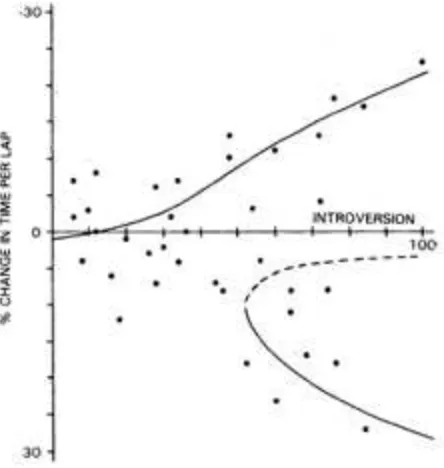
An excellent example of published empirical data which seems to exhibit a bifur-cation in the dependent variable has been quoted by (Zeeman, 1977, pp. 373–85). The data come from a study of driving performance before and after the inges-tion of alcohol (Drew, Colquhoun, and Long, 1959). Essentially, the authors found that the change in time per lap (i.e. the driving speed) was strongly af-fected by the position of the subjects on the Bernreuter scale of introversion. However, as is visible from Figure 3, it is clear that whereas extroverts continued to drive at about the same speed after drinking, the introverts either drove faster or slower, and few stayed at the same speed.
data using the method of moments as given above, and the resulting relationship between change in driving speed after alcohol (the dependent variable) and in-troversion (the independent variable) is shown. The dashed line indicates values that are predicted not to occur (the anti-predictions).
Figure 3: A bifurcation model fitted to data.
Zeeman also used a cusp model in his article, although it differs substantially from the one in Figure 3. Poston and Stewart (1978, pp. 420–23) criticized Zee-man's model on psychological grounds, and suggested the bifurcation model that appears here.
References
Cobb, Loren (1978) “Stochastic catastrophe models and multimodal distribu-tions,” Behavioral Science, v. 23, 360–374.
Cobb, Loren (1980) “Stochastic differential equations for the social sciences,” Chapter 2 in Mathematical Frontiers of the Social and Policy Sciences, edited by Loren Cobb and R. M. Thrall. Boulder, CO: Westview Press.
Cobb, Loren and Watson, William B. (1981) “Statistical catastrophe theory: An overview,” Mathematical Modeling, v. 1, 311–317.
Ferdon, Marybeth E. (1983) Inference for Quadratic and Catastrophe Response Surface Models. Unpublished doctoral dissertation. Charleston, SC: Department of Biostatistics and Epidemiology, Medical University of South Carolina.
Grasman, Raoul P., van der Maas, Han L., and Wagenmakers, Eric-Jan (2009) “Fitting the cusp catastrophe in R: A cusp package primer,” Journal of Sta-tistical Software, vol. 32, #8, 1–27.
Lehman, E.L. (1959) Testing Statistical Hypotheses. New York: Wiley.
Poston, Timothy and Stewart, Ian (1978) Catastrophe Theory and Its Applications. London: Pitman.
Sussmann, H.J. and Zahler, R.S. (1978) “A critique of applied catastrophe theory in the behavioral sciences,” Behavioral Science, vol. 23, 383–389.
Thom, René (1975) Structural Stability and Morphogenesis. Reading, MA: Benjamin.
Zeeman, E. Christopher (1977) Catastrophe Theory: Selected Papers. Reading, MA: Addison-Wesley.
Endnotes
1
This non-refereed proceedings paper is one of my most-cited articles. For this revision I have fixed several grammatical and mathematical errors, and brought some references up to date. 2