
PRESENCE AND RePRESENTATION
KONSTANTINOS GIANNAROUDIS
PRESENCE AND RePRESENTATION
KONSTANTINOS GIANNAROUDIS
A report submitted in partial fulfillment
of the requirements of the School of Arts and Digital Industries,
University of East London, for the degree of
Doctor of Fine Art
CONTENTS
INTRODUCTION 1
1. AUTOBIOGRAPHICAL CONTEXT:
PREVIOUS EDUCATIONAL AND CREATIVE PRACTICE 2
1.1. BA in Painting creative practice and theory 2
1.2. BA in Sculpture creative practice and theory 3
1.3. MA creative practice and theory 3
2. ARTISTS AND THEORISTS 8
2.1. Francis Bacon and Gilles Deleuze 8
2.1.1. Sensation and the figural 8
2.1.2. Chance in Bacon’s method 9
2.1.3. Rhythm 9
2.2. Gerhard Richter and Hal Foster 11
2.3. Representation and the real 12
2.4. Gerhard Richter’s colour chart images 13
2.5. Gerhard Richter’s 4900 colours 15
2.6. Giorgio Morandi, Arthur Danto and Mathew Gale 19
2.7. Iannis Xenakis, Henri Lefebvre and rhythm 21
2.8. Susan Hiller 23
3. CREATIVE PRACTICE 26
3.1. Creative practice 2009-2010 26
3.2. Creative practice 2010-2011 31
3.3. Creative practice 2011-2012 37
4. PROFESSIONAL PRACTICE 46
5. CONCLUSION 47
BIBLIOGRAPHY 48
APPENDIX 52
A) THEORETICAL CONTEXT i
1. Aporia on artistic methodology i
2. The traditional concept of representation ii
3. Semiotics and representation ii
5. Reprise v
6. Modulatio v
7. 0 vii
8. Jacques Derrida viii
9. ( ) Parenthesis viii
10. Ricercare xi
11. Metaphor xii
12. Epilogue like a prologue xiv
1
The act of representation is, to an extent, a sine qua non condition within the artistic process and always acquires its meaning in relation to a presence. Presence acts as an internal or external stimulus, and re-presentation is the effect of a presence. From this perspective, I have examined the work of Francis Bacon, Susan Hiller, Giorgio Morandi, Gerhard Richter, Iannis Xenakis, and, among others, the theories of Giorgio Agamben, Benjamin Buchloch, Daniel Chandler, Gilles Deleuze, Jacques Derrida, Hal Foster and Henri Lefebvre.
Within the frame of this enquiry, I have created a series of polyptychs exploring different possibilities, correlations and aspects of my topic. The internal or external stimulus for the creation of these series varies: from recorded video stills of London’s urban scenery to a one-wave loop videotaped at a Greek coast, and from a specific architectural site to various landscapes – all painted in situ or from photographs. Although this variety calls for dissimilar creative strategies for each polyptych, all of them are connected with each other, as they share the following properties:
• the openness, which practically relativizes the beginning and the end of the artwork, the part and the whole, the real space–time and the imagery space–time,
• the rhythm (practically, its simplified form is repetition), as the element that makes the synthesis and unification of different states of presence possible – through the function of consonance,
• the pictorial language (i.e., colour, line, shape, etc.), as the intermediate between the individual and the collective evaluation of the artwork.
In the context of my semisite-specific practice, I reactivate the notion of topicality to approximate the foundation of a stable and real ground where the artwork forms and develops. By exploring the act of representation, I discuss the poetic metaphor from and to the real, the constitution of the real and its consequences on how we value art.
I argue that, both practically and theoretically, rhythm is identified through the principle of presence, and I examine rhythm as the methodological tool whose vibration penetrates practical experimentation and whose contents are susceptible to theoretical exploration. Odysseas Elytis’ poem eloquently describes the experience that artists relish during the creative process – the poetic point of view. By the same token, art practice repulses a well established methodology, thus maintaining an entropy, or an openness. I put forward the hypothesis that rhythm can offer a sustainable methodological tool for art practice-based areas of study.
In my research, I explore the structure and limits of visual/pictorial language, that are simultaneously historical and physical. Practically, this exploration is correlated with a quest for the proper (proportion, colour, gesture, etc.) within my compositions – i.e., a search on artistic manipulation and its criteria of evalutation.
Finally, I investigate the theoretical context of Presence and Representation, its relation to the real and how different comprehensions correspond with and influence different viewpoints and theses, which, in turn, have personal and social consequences. As Daniel Chandler (1994) indicates, it is unavoidable to ask ‘whose realities are privileged in particular representations’, a recognition which eschews a retreat to mere subjectivism, as it ‘pays due tribute to the unequal distribution of power in the social world.’
Before the ridge of Serifos, as the sun rises, the guns of all the great world theories fall silent. The mind is overcome by a few waves and some rocks; absurd perhaps but nevertheless sufficient to reveal man in his true dimensions.
1. AUTOBIOGRAPHICAL CONTEXT
PREVIOUS EDUCATIONAL AND CREATIVE PRACTICE
1996-2003, Aristotle University of Thessaloniki, BA painting. 2004-2008, Athens School of Fine Arts, BA sculpture. 2008-2009, Wimbledon College of Art, MA Fine Art: painting.
1.1. BA in Painting creative practice and theory
During both BA courses I engaged into a thorough exploration and study of the pictorial language and space. This exploration took place through the physical observation of the human figure and its surrounding space as it is interpreted, manipulated and transited in the pictorial space of the painting. The content and subject matter of my paintings was to be explored, negotiated and discovered through the process – or, better still, is this process itself.
This exploration would be based on colour and form, i.e., the pictorial vocabulary, and the relations and dynamics it formed within the context of the surrounding pictorial elements. During the representational process of the observed human figure, an elaboration o f t h i s k i n d ( i . e . , t h e c o n t i n u o u s rearrangement of colour and form) had simultaneously and unavoidably an element of abstraction, as well as an element of figuration.
The development of my paintings had an organic character, as I would realize multiple readings of every part of the painting day after day, rearranging several times the form in relation to the continuously changing context of plastic relations in the flow of time. This process would give to the painting the essence of a palimpsest and a materiality that was the result of the insertion of multiple spaces and times in the same work, through its organic development.
[image:6.595.293.494.286.519.2]Furthermore, even though the work had a relation/affinity to reality, it would simultaneously stand and bear a reality of its own, because of the interpretation of the artist and the obvious presence of the materials.
Figure 1
Untitled, 2003, oil on canvas, 180 x 120 cm
1.2. BA in Sculpture creative practice and theory
After finishing my BA in painting, I continued my studies in the field of sculpture. My studies in sculpture included works made of clay from observation of a model, then cast in plaster.
In painting I had already detected physicality caused by the way I was applying or removing the paint on the canvas and a tension for solid structural composition. Especially during the last period of my BA painting studies I had become particularly preoccupied with the limits of the canvas, the edges [the limits] of the pictorial space and the way they affect and are affected by the overall composition of the painting.
These preoccupations led me to expand my studies from the two-dimensional space of painting to the three-dimensional space of sculpture, that has, from its base, a physical character because of the gravity of its materials as well as its realization in the form of an object.
Through sculpture I could study issues of the plastic language that exist in painting as well, but in a more “mild” and hidden form. Such issues are the full and the void, the relation between the figurated space as matter, in the case of the sculptural figure, and as air/ void, in the case of its surrounding space, the presence and the absence, the elements of the positive and the negative space/form.
Additionally, through sculpture I could better explore the multiple aspects of view and the rhythm and movement that such a viewing produces in time. My exploration on these issues was realized in three dimensional figurative sculptures (see Appendix: Image 5) and concluded in the form of reliefs, that had an affinity with the two dimensional nature of painting (see Figure 2).
1.3. MA creative practice and theory
The central question which I explored during my MA research was the relation between the actual/ preexisting space–time and the pictorial space–time. I initially started experimenting with an installation that combined different materials, some preexisting and rough and others fabricated and made by me: painting with oil colour, sculpting and curving on wooden boards nailed with actual nails on the wall, and a rough tree trunk on the floor whose shape corresponded to the composition and rhythm of the artifact on the wall (see Appendix: Images 7-10).
Figure 2
Figure 3
Polyptych I, 2008, oil paint and carving on wood, tree trunk, nails, 200 x 180 x 100 cm
The plastic gesture of combining a tree trunk as a preexisting piece of nature with the man-made elements initiated a dialogue between the actual preexisting elements and the pictorial elements. The form of the work deliberately remained open, as a continuous transposition from the one element to the other occurred.
In this work (see Figure 3), even though there was a dialogue between the essences of the preexisting and the pictorial, the pictorial space was not realized through the observation of a theme taken from the actual space. So the question of the relation between the actual/preexisting space and the pictorial space was not put as cogently as it could if the pictorial space had representational character.
For this reason, in order to reexamine the function of interpretation when creating a pictorial space through observation of reality, in a following painting I tried to make a self-sufficient painting (see Figure 4) protected and limited by a wooden frame that I cut and painted for this purpose. Thus, this sculptural element and its heavier material was restricted and restricting the edges of the pictorial space.
The question on the relation between the actual and the pictorial space was more decisively addressed at the work presented for the MA final examination, in which I integrated architectural elements with sculptural and pictorial ones (see Figures 5, 6, Appendix: Images 12-18).
In this installation called Polyptych II (where the preexisting space was a constitutive element of the total work presented) I realized an intense study of the constant dialogue that occurs when painting from observation between the actual and the pictorial elements. I explored how each of them affects the experience, perception and meaning of the other, as well as the spectrum of transformations from the one condition to the other.
I worked in a large scale and initially adopted the materials and ways by which the existing architectural space was constructed. After a preparatory architectural drawing of the space, that I made in situ (see Appendix: Image 12), I placed six mdf white primed panels (in two groups of three) of dimensions 2m x 1m x 9mm with screws on two preexisting opposite white walls made as well from mdf panels. This first gesture was at the edge of being a gesture, as the nature of its outcome was very close to the nature of the preexisting space, but it was also an intervention in order to balance the structure of the space. In this way, the compositional process was manifest as a pursuit of balance that had to be regained in the work that would occupy the surface of three of the six white panels. On them I represented the existing space and myself (while observing and painting this space by standing at its center) as I observed them both directly and through the reflection on a mirror. The three primed panels were acting as an anchor to the three painted, carved and cut ones at the other side of the space, as they constituted the transitional point from the preexisting actual space to the pictorial one, and vice versa (see Appendix: Images 13, 14). In addition, the insertion of sculptural applications in the pictorial space, i.e., the carving, the cuttings and the use of screws to
Figure 4
attach the pieces on the wall, as they naturally contain characteristics of the actual space (for example, more apparent materiality, the full and the void, three dimensions), they also constitute a transitional condition between the two spaces (see Appendix: Images 15-18).
In this process of painting/sculpting from observation and considering the surrounding space under observation as a constitutive element of the total work, the created/painted space gradually becomes perceived as part of the observed space itself, strengthening the relationship and the dialogue between the actual/objective and the created/subjective space. Furthermore, the spectrum of relations created between the two conditions and their meanings, were to be intensively experienced by the viewer as well, as the nature of the installation allows the viewer to become immersed in space, to confront and reflect in the flow of time on the reality of things.
Figure 5
[image:10.595.104.496.424.686.2]Polyptych II, 2009, oil paint acrylic primer and carving on mdf wood, screws, 300 cm x 200 cm x 9 mm (x 2)
Figure 6
Polyptych II, 2009, oil paint, acrylic primer, carving on mdf wood, screws, 300 cm x 200 cm x 9 mm
2. ARTISTS AND THEORISTS
Francis Bacon, Gerhard Richter and Giorgio Morandi follow different representational processes. I have chosen these specific three artists because each of them has developed his own approach to representation in relation to presence and the notion of the real. They all overcome the antithesis between abstraction and figuration, and renegotiate and question our perception and constitution of the real. In the framework of this enquiry, I also make reference to the works of Iannis Xenakis and Susan Hiller, and to the related theories of Gilles Deleuze, Hal Foster, Henri Lefebvre and Benjamin Buchloch. Furthermore, in the theoretical context section I discuss in depth the issues of pictorial/ visual language and rhythm, which are essential in the context of Presence and Representation and the grounding of my research. My estimation is that the reference to some of the ideas of Daniel Chandler, Jacques Derrida and Giorgio Agamben will cast new light to the artworks, clarify key concepts and offer a different perspective to the present examination.
2.1. Francis Bacon and Gilles Deleuze
2.1.1. Sensation and the figural
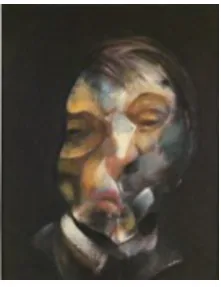
A first important issue that interests me in Bacon is the fact that, despite the distortions and the physical presence of the paint, his work is not abstract, as there is always a recognizable figure, or – in Bacon’s terminology – a fact that is recorded (Sylvester, 1975, p. 58). But his work is neither illustrative or narrative, because of the way that this fact is visualized and modulated. A figure is readdressed not through an illustration but through a notion opposite to illustration, i.e., its distortion (see Figure 7). This is what Deleuze (2008, p. 2) presents as the opposition of the “figural” to the “figurative”.
Bacon explains this opposition: ‘the difference is that an illustrational [figurative] form tells you through the intelligence immediately what the form is about, whereas a non-illustrational [figural] form works first upon sensation and then slowly leaks back into the fact’ (Sylvester, 1975, p. 56). Sensation from which the way of the non-illustrational, the non-figurative, the way of the figure derives is thoroughly presented by Deleuze (2008, p. 25):
[image:12.595.378.489.321.465.2]Sensation has one face turned towards the subject (the nervous system, vital movement, “instinct”, temperament…) and one face turned toward the object (the fact, the place, the event). Or rather […] it is both things indissolubly, it is Being-in-the-World, as phenomenologists say: at one and the same time I become in the sensation and something happens through the sensation, one through the other, one in the other.
Figure 7 Self-portrait, 1971, oil on canvas, 35.5 x 30.5 cm
2.1.2. Chance in Bacon’s method
Bacon manages to activate sensation, achieve the figural (=the way of the figure) and overcome the figurative/illustrational. He does this by inserting “chance” in his method. Trying to put aside all his preconceptions and figurative givens, his first marks and strokes on the canvas are accidental. For him, figure is the improbable itself and ‘this manipulated chance [is] opposed to conceived or seen probabilities. […] A probable visual whole (first figuration) has been disorganized and deformed by free manual traits which, by being reinjected into the whole, will produce the improbable visual figure (second figuration)’ (Deleuze, 2008, p. 66). By his method, apart from the illustrational, he overcomes pure abstraction as well.
2.1.3. Rhythm
Bacon’s system and method elaborate three simultaneous elements of painting, that can be clarified/ described with the help of sculptural terminology (Deleuze, 2008, p. 4), which I find very interesting as I constantly reflect on the dialogue between painting and sculpture:
• the armature or material structure (bone), • the pedestal or contour (mobile), • the figure (flesh).
On top of the structure, the contour and the figural forces take place. Systolic movements that come from the structure pressure the figure and at the same time diastolic ones go the opposite direction. The contour between them assures the communication among them. The coexistence of all these forces and movements produce the rhythm, that is the vital power of sensation (Deleuze, 2008, p. 30) (see Figure 8).
‘Force is closely related to sensation: For a sensation to exist, a force must be exerted on a body, on a point of the wave’ (Deleuze, 2008, p. 40). The primary function of the figures in Bacon’s work is, exactly, to make invisible forces (like pressure, inertia, weight, attraction, gravitation, germination) visible, and ‘it is the rhythm itself that would become the figure, that would constitute the figure’ (Deleuze, 2008, p. 50).
Figure 8
Empirically, in Bacon’s work we perceive three rhythms: ‘[…] an “active” rhythm, with an increasing variation or amplification, then a “passive” rhythm, with a decreasing variation or elimination, and, finally, the attendant rhythm’, i.e., the constant one. Pictorially, we usually recognize the first two as verticals in a descending–rising opposition, a diastolic–systolic opposition, a naked–clothed opposition and an augmentation–diminution opposition, and the attendant rhythm as horizontal, which ‘defines a rhythm that is retrogradable in itself, thus without increase or decrease’ (Deleuze, 2008, p. 54).
The importance of this Deleuzean examination lies in the fact that it closely relates theory with practice. The analysis of Bacon’s artwork and his process reflects on my preoccupation with the presence of the figure in painting and on my interest in the figural, as opposed to the figurative, that is organically related with the making process of the work and the wider notion of rhythm as an essential element of the nature of the artwork.
2.2. Gerhard Richter and Hal Foster
My interest in Gerhard Richter’s contemporary painting lies in the use of photography as vital research material and in the opposition of the elements of abstraction and representation in his work.
Richter accepts the dominance of photography in contemporary reality. ‘Photographs are almost nature,’ he notes (2005, p. 187). Hal Foster poses the question if this dependence suggests that ‘our very sensorium, memory and unconscious have become, at least in part, “photogenic” in semblance’ (Foster, 2003, p. 123). Has our modern world a photographic and digital face? Richter depends on photography as a source material, but reflects on the above question in his painting through the opposition between representation and abstraction throughout his work.
It is very interesting for me how he manages to produce ‘a piercing referentiality out of flimsy representation’ (Foster, 2003, p. 127). That is the point where the contradictions that appear in his work meet, and a third factor/condition is produced, that finds its place between representation and its destruction, between the manipulation of resemblance of appearance and apprehension of appearance. This condition is expressed mainly by the effect of blurring.
A series of works entitled Mother with Child, indicative of these contradictions, were made in 1995 (see Figure 9). As he says (2005, p. 226), ‘Something had to be shown and simultaneously not shown’, and the blurriness helps ‘in order perhaps to say something else again, a third thing.’
For Richter (2005, p. 227), ‘the picture is the depiction, and painting is the technique for shattering it.’ Which is to say that ‘photography delivers a resemblance (it merely “sees” objects) that the painting can – indeed, for Richter must – open up so that semblance might be revealed, “apprehended”’ (Foster, 2003, p. 127). ‘In this sense, semblance is less appearance than our apprehension of appearance, it is about human perception, embodiment, and agency – not as they are for all time but precisely as they are altered by social change and technological transformation’ (Foster, 2003, p. 126).
The accumulation of photographs in the contemporary world is said to be an attempt to banish the recollection of death. But Baudrilliard (1998, p. 236) believes the truth is that the object of photography ‘becomes the site of absence and disappearance of the subject.’ Given all this, the hypothesis that Richter paints from photography and depicts it through the blurring technique ‘to reveal the deathliness of this photographic face [of the world] and to render the photographic mnemonic in painting, as painting’ (Foster, 2003, p. 120) can be valid.
It can be said that in Richter’s work recognition and disavowal, exposure and concealment meet, and the reconciliation of the opposites can be found in the “shiny blurs” which, as Foster puts it (2003, p.131) ‘reflect on the vicissitudes of the Shein (= light in Germain) in modern times.’ Figure 1
[image:15.595.330.494.374.517.2]Images used for the composition of Untitled 2010
2.3. Representation and the real
A basicpath of my inquiry on Presence and Representation concerns their function in the constitution of the real, aiming to revaluate their meaning. This questioning involves a practical and a theoretical analysis of the visual language, trying to detect the hidden conventions.
Umberto Eco argues that ‘through familiarity an iconic signifier can acquire primacy over its signified. Such a sign becomes conventional step by step, the more its addressee becomes acquainted with it. At a certain point the iconic representation, however stylized it may be, appears to be more true than the real experience, and people begin to look at things through the glasses of iconic convention’ (Chandler, 1994, ch. 3). Jean Baudrillard in his paradigm of Disney/land (1994, p. 12) informs us about how deep this iconic convention goes: ‘Disney/land is presented as imaginary in order to make us believe that the rest is real, whereas all of Los Angeles and the America that surrounds it are no longer real, but belong to the hyperreal order and to the order of simulation. It is no longer a question of a false representation of reality (ideology) but of concealing the fact that the real is no longer real, and thus of saving the reality principle1.’
The examination of this faculty of convention and the consequent replacement of the real by mute images, by the ‘present without presence’, is what Lefebvre (2004, p. 39) named le dressage: ‘To enter into a society, group or nationality is to accept values (that are taught), to learn a trade by following the right channels, but also to bend oneself (to be bent) to its ways. Which means to say: dressage’. The inherent and endogenous rhythmical element of the visual language contains conventional rhythms. ‘The sciences of dressage take account of many aspects and elements: duration, harshness, punishments and rewards. Thus rhythms compose themselves. [...] Dressage determines the majority of rhythms’ (Lefebvre, 2004, p. 40). In this context, the adoption of rhythm as a methodological tool – both theoretical and practical – in my research becomes apparent.
According to Pierce’s model of the sign, reality can only be known via signs. ‘If representations are our only access to reality, determining their accuracy is a critical issue. Pierce adopted from logic the notion of modality to refer to the truth value of a sign’ (Chandler, 1994, ch. 3). I theoretically and practically examine the relevance of contemporary critical discourse to representation and associate it with older considerations such as Aristotle’s, who expresses the view (Metaphysics, i, 6.4) that, ‘things exist in their plurality by participation in (µ!"#$%& [methexis]) the forms after which they are named, that to say that they exist by imitation or exist by participation is no more than a use of different words to say the same thing.’ In the Aristotelian terminology, ‘Form (=#'()& [eidos] as %(!* [idea]) and presentation (=+*%,-µ#,), [phenomenon]) are nama (name, quiddity)
and rupa (shape, appearance, body); or in the special case of verbal expressions, artha (meaning,
value) and sabda (sound); the former being the intellectual (manasa, ,)./-&) and the latter the tangible or aesthetic (sprsya, drsya, *%0"./%1-&, )2*/-&) apprehensions’ (Coomaraswamy, 1981, p. 144).
Such would be, according to Jean Baudrillard, the complex implications of representation and its relation toreality in successive phases of the image:
• !t is the reflection of a profound reality;
1 The emphasis with bold letters, here as well as throughout the whole paper, is added by me.
• it masks and denatures a profound reality; • it masks the absence of a profound reality;
• it has no relation to any reality whatsoever, it is its own pure simulacrum.
‘In the first case, the image is a good appearance – representation is of the sacramental order. In the second, it is an evil appearance – it is of the order of maleficence. In the third, it plays at being an appearance – it is of the order of sorcery. In the fourth, it is no longer of the order of appearances, but of simulation’ (Baudrillard, 1994, p. 6).
2.4. Gerhard Richter’s colour chart images
I insisted on and continued the research that I had initiated last year on Gerhard Richter and his critique on the mediation of the creative process. This year I concentrated on his series of Colour charts (see Figure 10), which, apart from the apparent relation with the colour charts that I use in my work, ‘represent a middle point, in the sense of a point of indifference, between photographic and painterly means, establishing a more direct relationship to the problematic of
visual per se’ (Osborne, 1998, p. 97).
For Peter Osborne (1998, p. 99), “image” is the most appropriate word to refer to Richter’s work, as ‘It is the virtue of the notion of the image that it combines the aesthetic, spatiotemporal concretion of an object of sight with the element of abstraction inherent in ideas. [...] an image has always been a visual presentation of reality, at once sensuous and particular, ideal and abstract.’
The split that the theoretician observes between aesthetics and semiotics reconnects, in a peculiar manner, the contemporary critique with the older considerations on representation described by Aristotle. ‘Aesthetics and semiotics are the torn, antinomic halves of the artwork between which contemporary art theory shuttles back and forth, in a decidedly non-dialectical oscillation. This historical split, internal to the theoretical comprehension of the image – a split between meaning
and sensibility [artha and sabda, or, !"#$and %$!&'µ(&)&, respectively] signification and aesthesis
– registers both the changing social function of images consequent upon the declining power of the church (desacralization and commodified reenchantment) and the development of new technologies of image production. It forms the background to Richter’s art. Indeed, it is to a great extent its content: what it is about’ (Osborne, 1998, p. 100).
[image:17.595.356.495.258.407.2]It can be said that in Richter’s work, recognition and disavowal, exposure and concealment meet, and the reconciliation of the opposites can be found in the “shiny blurs” which, as Hal Foster puts it, ‘reflect on the vicissitudes of the Shein (= light in German) in modern times’ (Foster, 2003, p. 131). Richter introduces a new kind of image space within his creative strategy, as he highlights ‘both the aesthetic dimension of the denotative aspect of the photograph (the aesthetic dimension of semiosis) and the mechanical reproductive (semiotic) quality of the painterly image, through the literal mapping of the painterly onto the photographic image, in a speculative identity which produces a qualitatively new kind of image space’ (Osborne, 1998, p. 103).
Figure 10
!he directional manner that guides my creative process for the completion of the work Polyptych IV allows the reproduction of an unlimited number of the units, which may produce an unlimited number of compositions, and the production of unlimited combinations of the both technically and manually produced pixels glued on each unit. In this way, I identify a connection with what Osborne mentions (1998, p. 109) about a ‘modification of Benjamin’s opposition of reproduction to the aura.’
I cite here the quotation from Adorno’s Aesthetic theory, as it offers me a stimulus in order to make
further progress in my research inquiry:
“There is an obvious qualitative leap between the hand that draws an animal on the wall of a cave and the camera that makes it possible for the same image to appear simultaneously at
innumerable places. But the objectivation [Objektivation] of the cave drawing vis-à-vis what
is unmediatedly seen already contains the potential of the technical procedure that effects the
seperation of what is seen from the subjective act of seeing. Each work, insofar as it is intended for many, is already its own reproduction.” (Osborne, 1998, p. 109)
This constitutes reproducibility as “the ground of iconicity”; reproducibility produces resemblance.
In my practice, the chart compositional arrangement also refers to the traditional conception of such orientation manifested in the chess board. It is a different generation of numerical organization of the surface than that of Richter’s, where he worked out a system with a continual subdivision (differentiation) through equal gradations. 4 x 4 = 16 x 4 = 64 x 4 = 256 x 4 = 1,024.
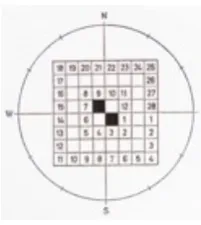
[image:18.595.393.494.406.519.2]The chessboard formation represents the world and it is related to ‘a mathematical equation revealing the inner connection between freedom of action and the inevitability of fate [the notion of chance, possibility and freedom has been explored by all three artists discussed in my research, i.e., Xenakis, Richter and Bacon]. [...] It is a simplified representation of the cosmic cycles, which are reproduced in a geometrical scheme on the chessboard. The four center squares of the chessboard represent the four basic phases of all cycles, ages as well as seasons. The squares immediately surrounding them correspond to the orbit of the sun, or the twelve signs of the zodiac, while the outer rim of squares represent the twenty eight houses of the moon. The alternatives of black and white is like that of day and night. The whole square board, which the Indians call asthapada, with its squares of eight by eight, is a “congelation” of the cosmic movements, which unfold in time – it is the world’ (Burckhardt, 1972, p. 118) (see Figure 11).
Figure 11
The geometrical scheme of the chess board
2.5. Gerhard Richter’s 4900 colours
‘The concept is really chance. The possibility to produce paintings that I haven’t made.’
(Richter, 2008, p. 117)
Gerhard Richter’s work 4900 colours forms a paradigm of a basic strand of his creative process and research, that exemplifies the operation of chance in the production of the artwork. With the adoption of a systematic incorporation of chance in 4900 colours, Richter problematizes and questions the mastership of the author, thus removing the subjective compositional preferences of the artist and desubjectivising painting. Additionally, reciting Theodor Adorno’s “radical negativity”, Richter ‘denied the credibility of any traditional form of cultural representation that claims to articulate and mediate subjective experience’ (Buchloh et al., 2008, p. 69).
Historically, the particular artwork is placed by Benjamin H.D. Buchloh within the general “abstract art” category as a “diagrammatic abstraction”, where ‘abstraction becomes a purely quantitative regime and functions as a schema of data collection and registration’ (Buchloh et al., 2008, p. 66). ‘The diagram [contributes] a dissenting voice to the heroic chorus of abstraction, recognizing the degree to which the painter and the spectator as perceptual and desiring subjects are always already contained in systems of spatiotemporal quantification1 – an episteme of control and statistical registration. Thus diagrammatic abstraction records the forms of the disenchantment of the world, the subject’s submission to legal and administrative control’ (Buchloh et al., 2008, p. 64).
Diagrammatic abstraction betrays an affinity with deconstructional strategies, as it opposes abstraction’s traditional transcendence (i.e., the metaphysical reading of signification) and rejects the ‘myth of painterly subjectivity in favor of an emphatic foregrounding of a pre-existing, external structural determination’ (Buchloh et al., 2008, p. 68). Furthermore, testifying to this affinity, ‘Richter’s 4900 colours confronts us with the conundrum of a possibly endless repetition of the same and a potentially endless accumulation of difference’2 (Richter, 2008). The colour chart
paintings are ‘eradicating any hierarchy of subject3 or representational intent and focusing on
1 Quantification in mathematics and in empirical science is the act of counting and measuring that transforms human sense observations and experiences into members of some sets of numbers.
2 Cf. the differance/trace concept of Jacques Derrida in the theoretical context section.
3 It may be beneficial if this is seen in the light of the Derridean endless deferment-differentiation of differance, i.e., archi-trace: ‘Probabilistic or not, the perception of chance [in 4900 colours] acknowledges scansions of time, while the subject defines itself through the introduction of the temporal, an interval’ (Richter, 2008, p. 128).
colour to create an egalitarean language of art’ (Richter, 2008, p. 7). The syntax of the grid formation of 4900 colours and its units modulation and continuous re-contextualization of the overall text comply with my personal practical investigations that are translated into the polyptych compositional arrangement4 and the modules of the Polyptych IV project (see Figure 12, Appendix:
Images 31-35). In effect, this strategy tests the literalness of the visual language. ‘In his colour charts Richter made as much recourse to the aesthetic of trivial anonymity and the motley colours of Pop Art as he did to the reductionist principles of a visual language reduced to impersonal, neutral and lapidary forms, the literalism of Minimal Art – the strategies in both cases being serial’ (Buchloh et al., 2008, note 11, p. 130). In charts like Richter’s, that have become modular, Pelzer wonders, ‘where is the whole? Depending on the version, the independent parts can be separated and then reunited. In this whole of fixed yet unlimited form, there is and there isn’t a whole. Richter disassociates the idea of all from the whole’ (Buchloh et al., 2008, p. 125).
The quest (on Richter’s behalf) of an open5
elaboration of the work stemmed from an acceptance of the priority of a shifting signified. According to Pelzer, ‘If the work exists as a concept, Richter adds that in its appearance as a visual phenomenon, it is different every time, and that it matters to him to find a form allowing for this dissemblance, this oddness within the 11 versions of 4900colours’ (Buchloh et al., 2008, p. 117). This Richter’s statement inevitably entails and reflects a preconception of presence (the concept) and its representation (the appearance as a visual phenomenon) and exemplifies the mode of their coherent introduction.
Chance, that, for Birgit Pelzer, ‘allowed [Richter] to take on his age-old adversaries, uncertainty and arbitrariness’ (Buchloh et al., 2008, p. 117), points at the argumentation on the arbitrariness of the signifier, originating from the early semiotical analysis. The strategy to overcome this arbitrariness is ‘by putting powerlessness in a position to act, [so that it] could fight the indeterminate on its own grounds, using its own weapons’6 (Richter, 2008).
4 Cf. the notation on Derrida at the end of the paragraph dedicated to him in the theoretical context section, as well as the greek movie To p!thari, and especially Veggos’ poem, at http://www.youtube.com/watch?v=rVZXTJAgMpI. 5 Cf. Agamben’s (1999, p. 66) definition of the “open”: ‘“Open work” means: work that does not possess itself in its own "#$%& as in its end, work that is never at work, that is (if it is true that work is "'()*"!+), nonwork, $,'+µ!&, availability, and potentiality.’
6 Cf. the entropy registration in the theoretical context section.
Figure 12
The computer generated numbers for the 25 colours in 4900 colours
Richter’s parallel investigation of chance application during the creative process involves, in Pelzer’s words, ‘an appeal to numeric chance’, where he ‘renders visible a logical numbered writing, a combination disconnected from any noticeable proof. We are faced with a literal formalisation of colour. [...] To formalise is to reduce to the syntactic. In the colours that are reduced to a number there is no longer call for sensitive intuition but for wavelengths’ (Buchloh et al., 2008, p. 123).
Alain Badiou (2008, p. 3) states that ‘number governs cultural representations. [...] It is in its very essence that the cultural fabric is woven by number alone. A cultural fact is a numerical fact.’7 According to Pelzer, ‘The power of the programmed numbered formula is that it is wordless, beyond dialogue. The algorithm acts, it works. The computer obeys, operating like an automaton with its cold indifference. Numbering brackets the question of meaning, of the address, of the destination. The language is that of the computer programme. It encodes, puts in order, combines, moves and repeats the 25 colours. It proposes continuities, redundancies and exclusions according to its semantics. The result is close to a visual language, with its syntax, its vocabulary reduced to 25 colours. A strange state of visual language’ (Buchloh et al., 2008, p. 126). This visual language incorporates number theorizing and practical application, i.e., the distribution of the compositional units. ‘This definitive stature of numbering [...] results in a transformation of our rapport with reality’ (Buchloch et al., 2008, note 10, p. 130).
As ‘appearance cannot put itself in order from nothing, but from something that presents itself as a kind of articulation [=the nexus of the text], which in this case is a combination of 25 colours’, it may be argued that this kind of desubjectifized – chance-processed – presence is ‘turned toward nothingness. [...] Availability-toward-nothingness, although it is not yet work, is in some way a negative presence, a shadow of being-at-work: it is !"#$%!&', work, and as such constitutes the most urgent critical appeal that the artistic consciousness of our time has expressed toward the alienated essence of the work of art’ (Agamben, 1999, p. 67).
As Pelzer puts it, chance ‘becomes the method of selection of colours in an integrated principle of equivalence’ (Buchloh et al.,2008, p. 119). Derrida, whose deconstructive theory consisted of an assault on the visual – as a form of presence that his idea of spacing as an aspect of deferral (or différance) was meant to dismantle – often invented surprisingly effective visual metaphors for his concepts. For example, the insertion of Mallarmé’s Mimique into a corner of Plato’s Philebus suggests, visually, the idea of the fold [=ptych], or redoubling, that Derrida produces as a new
7 Cf. the chapter about Xenakis and the 0 subsection in the theoretical context section. Figure 13
The 25 colour scale for 4900 colours, the magic square and diagram of the sequence of numbers in the magic square
concept of mimesis, in which the double (or second-order copy) doubles no single (or original). Another example occurs in the essay The parergon, where a succession of graphic frames is interspersed throughout a text focused on the function of the frame of the work of art, a frame that attempts to essentialize the work as autonomous but which does nothing more than connect it to its context or nonwork (Buchloch et al., 2008, p. 46).
2.6. Giorgio Morandi, Arthur Danto and Mathew Gale
In the last few years there has been a renewed interest in Morandi’s work, and many contemporary artists refer in different ways to his work; to the notions of collection and archive related to the process of his work and the spatiotemporal character of his artistic vocabulary. A recent example of this association can be demonstrated in the exhibition Passing thoughts and making plans at the Jerwood place, where three of the artists, Tacita Dean, Rachel Whiteread and Cornelia Parker, have evidently linked their practice with Morandi’s work, verifying the contemporary relevance of his art.
It is very interesting to me that his work is characterized by a progressive move towards a kind of abstraction that is developed through and connected to observation (see Figure 15).His saying that ‘nothing is more abstract than reality’ shows his reflection on the real and reveals the way he regarded painting, which goes beyond a mere representation of objects. His painting is an ‘ontological investigation of the act of making’ (Gale and De Salvo, 2001, p. 15), an investigation of the “basics of art”.
It is essential that the theoretical analysis of his vocabulary has mainly been attempted through the notions of space and time. Cornelia Parker notes, ‘[…] Somehow, the narrowing of focus, the limited tonal range, the repetitive exploration of the most ordinary of objects, all add up to the creation of an immense space for projection’ (Gale and De Salvo, 2001, p. 60).
The spatiotemporal characteristics in his work are very closely related to his process, starting from the preparatory stage, when he arranges the objects in space, on the several tables he used. After each arrangement that he made on a table, he would mark the position of each bottle on the horizontal plane. In a future arrangement he would move some of the bottles to other positions or out of the arrangement, and he would put others on the “stage”, keeping one or some in the exact previous position. Then he would re-mark their position in the horizontal plane. In this way he was creating a palimpsest in space that would reflect the temporal aspect of his compositions (see Figure 14).
This arrangement would often coincide with applying a coat of paint over the actual objects, so there is an in-between stage of painting among the actual objects in space and the painting on the canvas. ‘The process through which Morandi built up his compositions is traced through a step by step discussion of the passage from arrangement to finished painting’ (Gale and De S a l v o , 2 0 0 1 , p . 8 6 ) . T h i s methodology generates a history of
simultaneity, that can be found in his process of arrangement as well as in the compositions of the finished painting themselves, where ‘the same bottle […] occupies two different spots in the same composition’ (Danto, 2008, p. 36) (see Figure 14, Appendix:!mage 20).
Morandi’s process to record and keep an archive of the spatiotemporal changes of his arrangements of objects and different conditions of light, together with the scholar’s critical discourse on this strategy, influenced the generation of my archival recordings and the way I intend to use them as a tool in my research methodology.
I have examined the work of Francis Bacon, Gerhard Richter and Giorgio Morandi in order to understand the way they overcome the antithesis between abstraction and figuration in their different representational processes. They all renegotiate and question our perception and constitution of the real.
Figure 15 Still life, 1947
2.7. Iannis Xenakis, Henri Lefebvre and rhythm
In continuation of my previous research on rhythm, I initiated a research on the work of the composer and architect Iannis Xenakis. His explorations on the relationship between music and architecture, which were manifested by composing music for specific locations and architectural buildings, and designing buildings to host specific musical compositions (see Figure 16), open up new perspectives for my questioning on Presence and Representation and my interdisciplinary practice.
Xenakis used the term polytope to describe his audiovisual installations. ‘The term polytope captures the complexity of the spatial designs and multiple spaces of this unusual light-and-sound works’ (Harley, 1998, p. 55). The spatial properties of sound were at the centre of his explorations and are exemplified in the creation of the sonic “spatial relief”. In the elaboration of his projects he used the language of mathematics and geometry – points, lines and surfaces – to discuss aural phenomena (see Figure 17). These investigations are ‘examples to demonstrate how an auditory space could be structured by means of abstract morphological principles’ (Harley, 1998, p. 56). The element of representation is manifested in various projects and sketches, such as the Anemone (see Figure 18), a distant resemblance of a natural phenomenon. The Anemone sketch represents a light pattern for the Polytope de Cluny. ‘The pattern is created by laser beams reflecting off mirrors placed on the scaffolding in the performance space. As
the position of these mirrors shifted, so did the shapes of the anemones’ (Harley, 1998, p. 60). I initiated such an exploration in the work Polyptych IV, in which I use a representational element (the sea waves), along with geometry elements (points, lines and surfaces), as well as a rhythmical analysis to discuss optical phenomena.
Lefebvre (2004, p. 17) classifies rhythms ‘by crossing the notion of rhythm with those of the secret and public, the external and internal’, and Xenakis’ installations in specific locations (Montreal, Persepolis, Mycenes) seem to fulfill the criteria of all Lefebvre’s (2004, p. 18) categorizations:
a) Secret rhythms: First, physiological rhythms, but also psychological ones (recollection and memory, the said and the non-said, etc.).
b) Public (therefore social) rhythms: Calendars, fetes, ceremonies and celebrations; or those that one declares and those that one exhibits as virtuality, as expression (digestion, tiredness, etc.).
c) Fictional rhythms: Eloquence and verbal rhythms, but also elegance, gestures and learning processes. Those which are related to false secrets, or pseudo-dissimulations (short-, medium- and long-term calculations and estimations). The imaginary!
d) Dominating-dominated rhythms: Completely
Figure 16
[image:25.595.331.494.403.515.2]Iannis Xenakis / Le Corbusier, model of the Philips pavillion, 1958
Figure 17
[image:25.595.330.497.549.684.2]Drawing for the work Achorripsis, 1957
Figure 18
made up; everyday or long lasting, in music or in speech, aiming for an effect that is beyond themselves.
The relation of rhythm with music is self-evident. ‘Music integrates the functions, the values of Rhythm’. (Lefebvre, 2004, p. 66). Xenakis applied a logistic distribution ‘to create the musical form, rhythmic transformations, complex timbres and the variable streams of pitch-and-intensity patterns he called tresses rhythmiques (rhythmic strands)’ (Harley, 1998, p. 61).
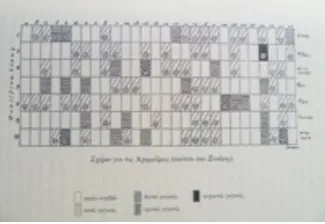
I detect a link between the description of Xenakis’ work Pithoprakta and its rhythmical analysis, and the Deleuzean analysis on rhythm that is inspired by Bacon’s work. Pithopracta (see Figure 19) is a rendition of a musical code to a different code, thus visualizing the sonic. Towards the top of the vertical axis acerb sounds are positioned, and towards the bottom of the vertical axis roll sounds. At the horizontal axis time is indicated. Thus a point on this two-dimensional space signifies an instantaneous sound without temporal extension or sonic differentiation, the pizzicato in musical terminology. A sound that outlasts for a definite temporal period without sonic differentiations is represented with a horizontal line. An ascending or descending diagonal line represents a glissando, i.e., a differentiated sound. All these calculations are made for each instrument of the orchestra.
Deleuze (2008, p. 54) observes:
[image:26.595.102.496.458.684.2][…] an “active” rhythm, with an increasing variation or amplification, then a “passive” rhythm with a decreasing variation or elimination, and finally, the “attendant” rhythm, i.e., the constant one. Pictorially we usually recognize the first two as verticals in a descending–rising opposition, a diastolic–systolic opposition, a naked–clothed opposition and an augmentation–diminution opposition […] and the attendant rhythm as horizontal that defines a rhythm that is retrogradable in itself, thus without increase or decrease. (Deleuze, 2008, p. 54)
Figure 19
Drawing for the work Pithoprakta, 1955-56
2.8. Susan Hiller
‘You’ve never seen me, you don’t know that we’re civilized nation, we have beautiful language.’ (Gallagher, 2011, p. 34)
My personal interest on Susan Hiller’s work lies on her overall interdisciplinary approach and methodology, as she often adopts the role of the artist as a curator, reinstating, inter alia, questions of authorship, the interrelationship between image and text/language and reality, in an effort ‘to make the invisible visible’ (Gallagher, 2011, p. 20).
Specifically, I focus on the nexus1of Hiller’s visual language – its a r t i c u l a t i o n s , m e t a p h o r s a n d transpositions – retaining the “idiosyncratic nature” of the cultural artifacts.2 ‘Hiller brought with her from anthropology a methodology
rather than any specific theory. When she uses cultural artifacts, from potshards to postcards, she does not project meanings onto them but retains their “idiosyncratic nature” which affects the way they are perceived and illuminates their significance in relation to our own c u l t u r e – s o m e t h i n g m o s t anthropologists ignore and of which most artists are ignorant’ (Gallagher, 2011, p. 12).
Hiller developed a “taxonomic method” of presentation, ‘indicative of [her] interest in museological traditions of display’ (Gallagher, 2011, p. 13), which I relate to my elaboration of polyptychs, and especially to their “specificity” (the
1 Cf. the related to the text/textile paragraph in the theoretical context section.
[image:27.595.259.492.190.584.2]2 Cf. Hiller’s montage practice and editing, as well as her “coagulated” fragments – ‘Yes, I am interested in fragments of films’ (Gallagher, 2011, p. 33).
Figure 20
literal) and Richter’s visual syntax.3 Her artistic enterprise, in accordance with my personal creative practice, ‘was also reluctant to eliminate materiality or any suggestion of craft from the artwork. She began to develop strategies that reconciled these opposing impulses’ (Gallagher, 2011, p. 14).
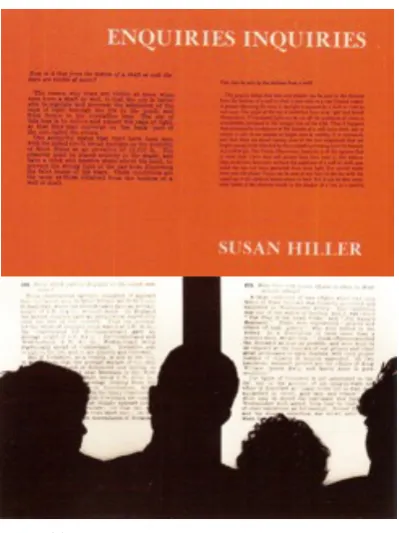
On top of that, the research on Hiller’s work informs the evolution of the rhythm concept which I use in many instances, both in theoretical analysis and practical application, reexamining the endless reformation of (visual) language, i.e., its entanglement with the reality (see Figure 20).
In her work The last silent movie Hiller acknowledges rhythm as ‘a very important aspect of this work, the way the speech rhythm controls the visual rhythm’ (Gallagher, 2011, p. 34). The acoustic traces transcribed on paper by the oscilloscope traces of the voices are comparable, inter alia, with Iannis Xenakis’ permutations between senses and the metre studies of basic rhythmic structure of a verse or lines in poetry.4 Important to this research is the consideration and rethinking of the in-between, the gap, the pause, the interval, the white page – an articulation of rhythm as in the etymological sense.5
In the ancient Greek description of rhythm can be found early traces of the modern linguistic analysis of word function as difference relevant to a big area of Hiller’s research (see Figure 21). ‘In the first book of Metaphysics (985b), Aristotle, explaining the theory of the atomists, who put emptiness and fullness at the origin and derived all things from them by way of “difference,” says that according to Leucippus and Democritus this “difference” had three species – !"#µ$ %&' ('&)'*+
3 Cf. the chapters about Richter.
4 Cf. Aris Retsos’ research on Greek ancient µ,-!'%+ (metre), at http://www.youtube.com/watch?v=wTNekOYh3mQ.
5!"#µ$%, Ion. !"&µ$% (v. infr. 111, IV), ': (!()): A. any regular recurring motion
I. measured motion, time, whether in sound or motion,
2. special phrases: *+,"#µ-, in time, of dancing, marching, etc., *+.),"#µ-/+/0+*1+, respireregularly, Arist.Pr.882b1
II. measure, proportion or symmetry of parts, at rest as well as in motion III. generally, proportion, arrangement, order
IV. state or condition of anything, temper, disposition
V. form, shape of a thing, Democr.5i; identified by Arist. with &23µ/, Metaph.985b16,1042b14; µ*.(4/56+.6+ ,. .)+7,/µµ8.)+, changed the form or shape of the letters, Hdt.5.58
VI. manner, fashion of a thing.
(Liddell and Scott, A Greek-English lexicon, at www.perseus.tufts.edu) Also cf. the presence–absence dipole in the chapters about Richter.
[image:28.595.303.503.124.391.2]24 Figure 21
%&' -!./+ – and defined rhythm as #0+µ& (from 102), way of holding together, structure’6 (Agamben, 1999, p. 127, note 3). In Giorgio Agamben’s (1999, pp. 97-99) reading of Aristotle, he ‘identifies [...] the original principle of presence precisely with !")µ34 (rhythm)’ and, additionally, argues that this principle of presence ‘opens and maintains the work of art in its original space.’ This ‘ekstasis in a more original dimension’ is achieved by a kind of stop in time (=ek-stasis) of the !.+, i.e., the flow of time.7 Rhythm is ‘the power that grants the work of art its original space.’ The word “rhythm” comes from the Greek !12, which means to flow, as in the case of water.8 ‘That which flows does so in a temporal dimension: it flows in time’ (Agamben, 1999, p. 99). Time and space, as shown throughout art history,9 are intrinsic elements of the visual language.10
‘Every work of art is one rhythm.’ –Hölderlin11
6 Cf. the signatures doctrine in the theoretical context section.
7 See above the Liddell-Scott definition of !.+=rhythm.
8 See the artwork Sea.
9 Cf. the chapter about Morandi.
10 That is, essentially and etymologically, the metaphor – i.e., the transposition, as Hiller comments.
3. CREATIVE PRACTICE
3.1. Creative practice 2009-2010
During the academic year 2009-2010 I have been exploring the transitions between the actual perceptible space and the created visual space of the artifact by using painting, sculptural and architectural means. With the osmosis and synthesis of the two notions I aim to re-examine the constitution of the notion of the real, the process of re-presentation and the interrelated spatiotemporal dynamics of presence. I investigate the multiplicity of the different aspects of space and the implications of time, and I undertake a process of negotiation, transformation and re-composition of all of these stimuli into artwork where the figural and the abstract coexist. The outcome, which may seem to be characterized by the notion of fragmentation, displacement and simultaneity, is a pursuit to co-ordinate the spatiotemporal dynamics of space and re-achieve the unity and the inner rhythm of my perception of space through plastic means.
Early in the year, I was mainly working on the subject matter of the human figure and its surrounding space, that I considered and manipulated as inseparable and always in flux. I was working directly from observation of the perceptible world and I was moving my position of observation in relation to the subject as a sculptor does. This multidimensional lived experience is affected by two interrelated and inseparable factors: (a) the object (i.e., the place, “the fact” in Deleuze’s terms) and (b) the subject (nervous system, vital movement, “instinct”, temperament) (Deleuze, 2008, p. 25).
The manipulation of diverse means and techniques (i.e., painting, carving, sculptural applications, sculptural use of colour) corresponds to the transition from the actual space to the space of the artifact, as the lived multidimensional experience is not only visual but haptic as well.
Soon, my research, the reflection on my aims and the feedback from supervisory tutorials, led me to include in the method of my creative strategy the use of photography.
During a first stage of working from observation in order to gain an intimate experience of my subject-matter and begin composing the work, I started collecting photographic documentation of my subject from different points of view and at different times of the day, capturing the changes of light.
[image:30.595.100.305.477.678.2]In a second phase, I would work by using the collected photographic archive that contained fragmented aspects of my subject, initiating an abstract process of experimentation and changes informed by the photographical fragments and the fragmented attributes of my memory from the first phase. I would Figure 22
Untitled, 2010, oil on wood, 35 x 35cm
compose, reflect on the outcome and recompose in a manner that hovers between figuration and abstraction.
Finally, when the composition of these fragments would start to acquire an overall unity and rhythm, the work would develop in a more decisive direction, always preserving a condition where the figural and the abstract coexist (see Figures 22, 23).
With the inclusion of photography in my creative process I tried to reassess my process through the different possibilities afforded by this medium. Baudrillard (1998, pp. 236-237) describes this difference as follows: ‘Rather than having the presence and representation of the subject foisted upon the object, […] the object becomes the site of the absence and disappearance of the subject. […] Photography conveys the state of the world in our absence.’ This dialogue is about the reality principle itself.
The addition of photography in my method changes the function of the lived experience presented above to a degree, as now the photography allows only a visually static experience of an absent object. The wide range of sensations that form the experience and affect the development of my work have to be retrieved through the activation of the memory. The potential to capture the changes by photographing multiple aspects of the subject in many different times, and the activation of memory that transforms and blurs the apprehension of reality added new dimensions to the figural and the abstract elements that coexist in my artwork.
The adaption of the technical medium of the camera in my creative process and the reflection on its potentials during my creative experimentation led to an expansion of my subject matter to the space of the urban landscape. This evolution of my research was accompanied by the insertion of the medium of video documentation in my methodology. This tool allowed me to explore the spatiotemporal dynamics of presence more deeply, as it offered me the chance to collect and reflect on material that records not only different aspects of space and different moments in time but also more attributes related to space and time; attributes such as the movement, the speed, the extent of diversities and similarities/repetitions and the inherent rhythm of the recorded landscape.
[image:31.595.104.284.128.263.2]In the first phase I recorded day and night aspects of the city both from fixed points and in motion, from the inside of the train (see Figure 24). I elaborated my material using the Adobe Premier Figure 23
Detail: Untitled, 2010, oil on wood
Figure 24
computer programme, chosing the clips and extracting video stills that interested me. This process allowed me to reflect on both the spatial attributes of the recorded spaces (forms, patterns, materials, repetitions and diversities, scales, light, etc.) and the attributes of the medium itself (the structure of the digital image from pixels, the blurring when recording in motion, etc.). This process was accompanied by a realization of preparatory compositional drawings, where I reflected on and manipulated my choices from the fragments of data, studying, measuring and re-composing the spatial relationships of the pictorial and sculptural elements (see Figure 25).
A priority in my process was the discovery of ways in which the broad subject matter of London’s urban space could be reduced in the small scale of the artwork and ways in which the artwork could acquire a tension that would imply its expansion to such a wide scale. This experimentation led me to several decisions, the main ones being the adaption of the form of the polyptych (see Figures 26, 27, Appendix: Images 22, 23) and the preoccupation with the correlation of the work to the actual architectural space in which it would be positioned (see Figure 26, Appendix: Images 25, 26, 28).
[image:32.595.102.495.129.411.2]The choice of the polyptych as a compositional arrangement (a) relativizes the beginning and the end of the artwork’s limits, (b) follows existing patterns of the urban landscape, (c) allows the constitutive parts of the work to integrate with the space where the work is positioned as they function as parts in a wider structure, (d) relativizes the perception of the whole and the part of the composition, and (e) promotes the rhythmical element of the outcome.
Figure 25
Preparatory drawing for the Polyptych London
F igur e 26 P ol ypt yc
h III, 2010,
ac
ry
lic
gouac
he
, wood, pe
rs
pe
x, c
ar
ving on wood, 5 pi
ec
es
: 80 x
Figure 27
Polyptych III, acrylic gouache, wood, perspex, carving
3.2. Creative practice 2010-2011
In the previous year’s research I inaugurated an exploration of the notion of rhythm as a mode of analysis both in theory and practice. Further explorations concerning rhythm marked it out as a central methodological tool for my inquiry on PresenceandRepresentation.
In the academic year 2010-2011 I experimented with applying a rhythmical manipulation in my creative process through the use of different techniques. I initially elaborated a still-in-progress work that includes the projection of 25 painted frames (see Figures 28, 29) on a marble’s surface (seeAppendix: Image 30). Metaphorically, the marble’s surface will welcome the projected image in a way similar to that of a shore that welcomes the sea. In this way, I aim to study the presence of the immaterial projected light and its meeting with the hard edged marble. Furthermore, carving on marble makes the rhythm that the piece of marble imposes by its own character more apparent. By means of the sound of the rhythmical carving and the rhythm of the carved marks and pauses, I make an attempt to connect the making process with the outcome of the artwork.
In this creative process, three different considerations of space and time are interwoven: • space and time as inherent components of the creative process,
• the space and time of the 25 frames per second of my video camera, • the “timeless” recurrence of the sea’s waves.
[image:35.595.310.497.458.651.2]My reflection on the feedback that I have received from the work in progress seminars helped me clarify my method of rhythmical analysis by better defining the quantitative rhythmical aspects and elements of my work, as the qualitative ones were already more apparent. This progress led to the work entitled Polyptych IV.
Figure 29 Frame no. 10/25,
acrylic paint, pencil, rapidograph, 40 x 40 cm
Figure 28 Frame no. 5/25,
[image:35.595.100.284.460.663.2]Figure 30
One wave loop, video stills for the Polyptych IV






![[ carpet maintenance made simple ]](data:image/gif;base64,R0lGODlhAQABAIAAAP///wAAACH5BAEAAAAALAAAAAABAAEAAAICRAEAOw==)