Crossing Crossing Conceptual Boundaries III
ISSN 2041-9090
University of East London Docklands Campus University Way London E16 2RD
University of East London Stratford Campus
Water Lane Stratford E15 4LZ
Crossing Conceptual Boundaries
PhD Annual Yearbook New Series Volume III
Production Editor: Cigdem Esin
Cover Image: ‘Crossing borders – Athena's voyage of discovery’ by Sharon Gallagher
School of Law and Social Sciences
School of Law and Social Sciences
Crossing Conceptual Boundaries III
1. Maria Tamboukou: Editorial Introduction
Articles
2. Matthew Hawkins: The concept of affective tonality and its manifestation as narrative experience in the short film Bullseye (Hawkins, 2010).
3. Kate Sicchio: Frames within Frames within Frames: Compositional Space in Choreography with Real-time Video
4. Ray Campbell: The Comedy of the Spectacle (and its alternative)
5. Mastoureh Fathi: Becoming Iranian women doctors: class pathways of womanhood
6. Mohammad Sadiqunnabi Choudhury: Rural People Facing Crisis: How Microfinance Institutions (MFIs) in Bangladesh Ensure Safety Net?
Book Reviews
1. Matthew Hawkins: Review of „Cinema, The Thinking Machine: Filmosophy‟ by D. Frampton (2006).
2. Mohammad Sadiqunnabi Choudhury: Review of Just Give Money to the Poor: The Development Revolution from the Global South by J. Hanlon et al. (2010).
3. Truscott, Ross, „The Indissolubility Apartheid Sexuality‟: A Review of. The Cultural Politics of Female Sexuality in South Africa by H. Gunkel (2010).
4. Jesús Peña Moya: Review of El déficit mediático: donde España no converge con Europa by B. Diaz Nosty (2005).
Notes on contributors
Editorial Introduction
Making connections and new beginnings
Maria Tamboukou
Writing an introduction for the third volume of Crossing Conceptual Boundaries (CCB3) has become a difficult and moving endeavour: difficult because there are many people and institutional settings that we need to say farewell to and moving since this volume marks the end of the School of Humanities and Social Sciences within which this publication was initially conceived as an idea and realized and developed as a project of our PhD community in the last six years. But to follow Hannah Arendt (1998) what is exciting about life and the human condition is indeed the possibilities and hope for new beginnings. In this light, this volume marks the end of an era but also the beginning of a new one, where we hope that its core idea, namely the attempt to cross conceptual boundaries, will also become an experiment in crossing institutional boundaries within the new structures of the University of East London. Not accidentally, given the interdisciplinary character of the School of Humanities and Social Sciences the papers and book reviews in this volume most strongly carry this idea of making interdisciplinary and transdisciplinary connections in a most vivid and intellectually rigorous way as I will further discuss.
The volume opens with two papers exemplary demonstrating the rich practice-based research culture of the School of Humanities and Social Sciences. What these papers most persuasively show is that the art/research encounter can be both beautiful and rigorous and that aesthetic sensibility and theoretical depth and complexity can co-exist and make exciting connections.
Matthew Hawkins‟ contribution takes up the idea of cinema as philosophy and develops it through a thoughtful and illuminating reflection on the making of a short documentary film, BULLSEY, which becomes the focal point of his paper. In challenging the idea of the sequential imperative of the narratological tradition (see Hyvärinen et al, 2010) Hawkins filmwork forces and indeed encourages the viewer to be seduced by the „affective tonality‟ of the film, its colours, the force of its sounds and the speed of its movements rather than its plotless storyline and „the banality‟ of its context. Hawkins actually challenges and reverses the notion of „the banal‟ transposing into one of the constituting elements of his artwork Although drawing on complex and notoriously opaque philosophical concepts from Deleuze and Guattari‟s theories, Hawkins discussion and analysis is clear and illuminating, successfully intertwining theory and film practice. Hawkins‟ original contribution is complemented in the volume by a book review of the book Filmosophy by Daniel Frampton. It is indeed the central idea of this book, interfaces between films and philosophy that Hawkins not only reviews but also develops and materializes through his contribution to the volume.
studies research1 becomes a point of reference, a theme for reflection and an interesting theoretical question in Sicchio‟s analysis and discussion. Here again Deleuze and Guattari‟s philosophies underpin the theoretical direction of the paper and guide its artistic experimentation through dance-practice led research. As its title indicates, Sicchio‟s original proposition is a conceptualization of space in terms of interrelated and intersecting planes of frames. Her analysis further considers differentiated levels and kinds of space generated through actual and virtual connections. In this light, four space forms are discussed, what Sicchio delineates as „physical space, camera space, projection space and compositional space‟. In putting forward the argument of conceptualizing choreographic practice and digital video technologies as a topology, Sicchio beautifully and persuasively complements her analysis with „the nuts and bolts of her recorded performances‟, so that the reader can have a tangible idea of the plausibility of the artist/researcher‟s original proposition.
On a different note and emerging from „more traditional‟ social sciences theoretical problems and empirical concerns we include two papers that discuss intersections between gender, social class and race, as well as questions, strategies and tactics around poverty and development. These papers highlight a key research orientation of the University of East London in general and the School of Social Sciences and Humanities in particular: our theoretical and empirical interest in questions of social equality and justice and our commitment to working for social change.
Mastoureh Fathis‟s paper explores connections between gender, social class, race and the idea of home and belonging in the formation of intersectional identities of Iranian women doctors and dentists living in the UK. Her paper emerges from a narrative-led empirical research that draws on the research expertise, culture and tradition of two major research centres of the University of East London, the Centre for Research on Migration, Refugees and Belonging (CMRB, http://www.uel.ac.uk/cmrb/) and the Centre for Narrative Research (CNR, http://www.uel.ac.uk/cnr/). In analyzing 14 life histories interviews, Fathi looks into the content but also the context of her stories, namely contemporary Iranian society and the discourses around its constitution and formation in modernity. Taking an intersectional approach in the way we perceive contemporary identities (See Yuval-Davis 2010), Fathi looks into the fluidity of classical sociological axes of difference such as class, gender and race amongst others, without downplaying their role in generating, sustaining and prolonging acute regimes of domination and social inequalities in women‟s lives. Further working in between Iran and the UK, Fathi has the opportunity to trace transpositions of western sociological concepts as they migrate from one geographical context to another. It is therefore real life as well as intellectual migration trails that Fathi follows, ultimately raising crucial questions around women, home and belonging.
In looking into the economic hardships of rural households in Bangladseh, Mohammad Sadiqunnabi Choudhury considers the role and multi-levelled functions of what in his paper presents and discusses as Microfinance Institutions (MFIs). Bracketing macro-economic concerns, practices and strategies, Choudhury adopts a pragmatic approach to the everyday needs and crises of poor rural households. There are two main advantages that Choudhury presents and discusses: a) the importance of supporting immediately and on the ground vulnerable rural households and b) informal finance strategies and tactics can become effective when there is planning and efficient management. This is not to deny or refute the importance of macro-finances in
1 See for example details of a major interdisciplinary UK led, EU project on „Understanding Cultural
developing countries, it is rather a way to work in the interstices, gaps and inevitable ruptures of macro-economic planning particularly within geographical, physical, social and political contexts where unforeseen circumstances tend to be recurring. This approach that attends to the importance of the „micro‟ has of course a long and rich tradition in the fields of sociology, economics and politics: it is on these rich fields of scholarship and research that Choudhury‟s analysis draws. It is therefore not accidental that Choudhury‟s contribution to the books review section of this module discusses and present a relevant book, with a provocative and politically suggestive title: Just Give Money to the Poor: The Development Revolution from the Global South (Hanlon et al., 2010). Here again the central idea that the book puts forward is that poor people need money and they will know what to do with them. Whether you agree or not you should read the book to check the plausibility of the argument and Choudhury‟s review offers an excellent introduction to it.
The final paper of the volume oscillates between artistic, cultural and socio-political concerns, questions and themes, artfully keeping a fine balance between the range of diverse areas in the School of Humanities and Social Sciences. In „The Comedy of the Spectacle‟ Ray Campbell explores differences between contemporary British comedy culture and the „alternative comedy‟ of the 1980s. Campbell‟s interest and analysis emerges from his own involvement in the 1980‟s alternative scene: here again the author is both a researcher and a comedian, both an outsider and an insider of the research problem that he presents, dissects and analyzes. Drawing on Guy Debord‟s (1983) famous work, Society of the Spectacle, Campbell scrutinizes and interrogates both the notions of the comedy and that of the spectacle. Looking into the causes of what he describes as „the decline and demise of alternative comedy‟ Campbell charts a dynamic diagram of power relations between the pragmatic conditions within which comedy is produced, hegemonic cultural discourses and audience dynamics. But is it all bleak in Campbell‟s analysis? You should read the paper to find out how in the midst of „the demise and the decline‟ the author/comedian finds a way to discern alternative possibilities for the future. So, no worries: you can still read the article and enjoy your next stand-up comedy show. Alternative comedians will always be waiting for you.
Having already discussed two contributions to the book reviews section of the volume, we are pleased to include a review of a wonderful book on The Cultural Politics of Female Sexuality in South Africa. The author is our alumna, Henri Gunkel and the book very much draws on her PhD thesis here at the University of East London. The book was published by Routledge as a hard back last year, it sold out within six months and is now been re-issued as a paper back. What an achievement for Henri, and what a priviledge for us to be able to include a review of the book here.
Peña‟s optimistic leap into future possibilities is indeed important as a farewell to the School of Humanities and Social Sciences. Many things will change in the way we work and communicate this coming academic year while the editorial board will be reconstituted and reconvened to include academics and PhD students from more than one school. In his influential book on The Idea of the University, Karl Jaspers has pointed out the importance of the human factor in university life: „All of university life depends upon the nature of the people participating in it […] The truest idea of the university is all in vain if the people who could realize it are not available‟. Jaspers pithily notes. (1960, 112) Well, our editorial board might be losing some of its founding figures this year, while our PhD community has already been relocated in a number of different schools across the university. Let us then hope that despite the changes, Crossing Conceptual Boundaries will not lose the spirit and the vital forces that have made it such a successful intellectual project in the last six years.
References
Arendt, H. 1998 [1958]. The Human Condition. Chicago: University of Chicago Press.
Debord, G. 1983. Society of the Spectacle. London: Rebel Press.
Díaz, Nosty, Bernardo. 2005. El déficit mediático: donde España no converge con Europa.[Media deficit; points where Spain does not converge with Europe] Barcelona: Bosch
Frampton, D. Filmosophy.2006. London: Wallflower Press.
Hanlon, Joseph, Hulme David, Barrientos Armando. 2010. Just Give Money to the Poor: The Development Revolution from the Global South. Sterling: Kumarian Press.
Hyvärinen, Matti, Hydén, Lars-Christer, Saarenheimo, Marja and Maria Tamboukou. 2010. Eds. Beyond Narrative Coherence, Amsterdam: John Benjamins Publishing.
Jaspers Karl. 1960. The Idea of the University. London: Peter Owen.
Yuval-Davis, Nira. 2010. Intersectional Politics of Belonging. London: Sage.
The concept of affective tonality and its manifestation as
narrative experience in the short film
Bullseye
(Hawkins, 2010).
Matthew Hawkins
Abstract
This paper will explore the concept of affective tonality as a method of understanding narrative, as expressed through my own film practice as research. 'Bullseye' (Hawkins, 2010) is a short narrative film that encapsulates the narrative modes of Aristotelian linearity through simple „plotting‟ that centers on the British pub game of darts and a protagonist‟s attempts to achieve his goal of throwing a „bullseye‟.
However, this paper will argue that the spectator experiences this narrative through the affective rhythm created by the movement within the frame, the variations of light andcolour on screen and the measure of thediagetic sound heard, and that this experience is as important to understanding the narrative as character identification and linearity. The film is an expression of the banal and the everyday, which does not lend itself to grand historical events. I will argue that the banal in 'Bullseye' is not a signifying, representational reproduction of banality, the banal is embodied in the film itself, and through the affective tone of the film it becomes embodied in the spectator. Drawing on concepts of affect and sensation developed by Gilles Deleuze, as well as his concept of the rhizome and minor-literature developed with Felix Guattari this paper shall map out the concept of affective tonality as a tool for understanding the holistic cinematic experience and how this can be then used to understand the physical mechanisms of narrative cinema
Bullseye (Hawkins, 2010) is my introduction to the concept of affective tonality, and its manifestation as narrative experience, as expressed through my film and video practice. My research revolves around the concept of affective tonality in relation to narrative cinema. By affective tonality I refer to the mood and the rhythm of a film, or how narrative can be understood through embodied experience, rather than cognition alone.
Through my research I try and create and maintain a symbiotic relationship between my practice work (that of making films) and my theory work (that of thinking and writing about film). In this sense my practice influences my theory, which in turn influences my practice and so on and so forth. This paper and the accompanying film work as a way into understanding my broader interest in narrative cinema and how film can be experienced and understood through affective tonality.
what can be termed classical narrative cinema2, which presents a drama told through a series of juxtaposed images and dialogues in which narrative is privileged over formal construction and style. In the classical mode of filmmaking the drama is often played out over ninety minutes, and the dramatic structure originates from Greek antiquity, specifically the work of Aristotle in The Poetics. Through the dominance of Hollywood cinema in contemporary film culture this form of filmmaking has become to be considered the norm. By terming Bullseye experimental I mark the film as a deviation from the practice of classical narrative cinema. However, I do argue that Bullseye is a work of narrative cinema, only one that privileges affect, mood and tone over drama, conflict, character development and resolution.
Bullseye is a film captured in a single take. The spatial co-ordinates of the frame do not change, and the angle of the shot remains the same. It is one shot held for a duration of eight minutes and twenty-seven seconds. The film depicts a man playing darts, alone in a pub, and his attempt to throw a „bullseye‟. The narrative follows a simple line of linear action, but it also can be experienced through an affective rhythm created by the movement within the frame, the variations of light and colour on screen and the measure of the diagetic3 sound heard. This experience is as important to understanding the film as character identification and linearity.
I will be draw theoretically from the work of Gilles Deleuze and Felix Guattari. I will also be referring to concepts developed by Henri Bergson in Matter and Memory. Deleuze published two books on cinema in the 1980s, Cinema 1: the Movement Image I (1983), Cinema 2: the Time Image (1985). These two books were as much works of philosophy as works on cinema itself. In the following twenty years the books have slowly gained more and more prominence within the field of film studies. Although I draw on Deleuze‟s work on cinema in some of my other research on affect and the cinema I do not concentrate on these books in this paper. Instead I will be focusing on concepts Deleuze developed with Guattari in their work on Franze Kafka, (towards a minor literature), in particular their notion of minoritarian, of which I will go into more detail shortly.
For much of this paper I will be discussing the banal nature of Bullseye‟s narrative, how this is experienced by the spectator through embodiment, and how through this embodiment affect becomes political. I will also discuss my ideas around different levels or categories of affect at work within the film.
The film can be seen here4: http://www.youtube.com/watch?v=wQrTogn-3ds
The experience of the affective tone determines our understanding of the work through experience, rather than representation, cognitivism or character identification. Seymour Chatman reminds us that for Italian film director, Michelangelo Antonioni, the form [of the film] cannot be separated from the content (2008 p 11). The content or narrative of the film is experienced through the form that that the film takes. In Bullseye the formal elements of the film embody the narrative. The form becomes content, and the content is expressed in rather than by the formal elements.
Bullseye can be considered as a film with a linear narrative. The protagonist of the film has a goal, which is to throw a bullseye. He has to use his skill to achieve this goal.
2 The most thorough overview of this mode of filmmaking can be found in The Classical Hollywood
Cinema: Film Style and Mode of Production to 1960 (Bordwell, Staiger, Thompson, 1985).
3 Diegetic sound: sound that emanates from the world of the film. The sound of footsteps as a character
can be seen walking through the frame, in opposition to a musical soundtrack, for example.
The rules of the game of darts act as an obstacle to be overcome, and with the last dart thrown the protagonist achieves his goal. He throws a bullseye! In this respect the film follows the structure of classical Hollywood cinema, albeit reduced to the base and banal elements. However, the protagonist‟s „goal‟ is an insignificant one in terms of understanding the nature of the film. The film ends with the freezing of action or movement, and thus the freezing of time. The goal has been achieved, but nothing has changed in the socio-cultural conditions of the protagonist‟s life, or in the conceptualisation (cogito) of the world of the protagonist by the spectators that have experienced the film. At the end of the film, when time stops, the question that may be asked is; what is next? What is next for the protagonist of Bullseye? As I see it, there are two options, stop playing or continue to play; finish with the darts, stop throwing, stop playing, or begin again, return to the game and try once more to throw a bullseye. The two options that face the protagonist are reductive; for to stop playing is to cease to exist, yet to play again is to simply resume a cycle that can never end.
In effect, Bullseye is a film that resists resolution, as resolution is not possible for a film that is concerned with the banal. The banal is constant and unchanging; it resists the Aristotelian tropes of linear narrative or character transcendence and revelation. The banal is an event that exists outside of specificities of historicized space and time. Steven Shaviro mobilizes Alfred Whitehead‟s example of Cleopatra‟s Needle in order to explain how a seemingly solid object is a series of events or a multiplicity (2009 p 17 - 20). An event in these terms is not fixed, not a beginning or an end but something in the middle. It is the meeting of two of more forces, which produce something new. An event is an act of happening, an act of becoming. For Whitehead and Shaviro, Cleopatra‟s Needle is more than an object to which grand historical events occur, such as the creation of the monument in Egypt, the moving of the monument to London in 1877 and the eventual, future destruction or disintegration of the monument. Cleopatra‟s Needle is a constant site of events, from the movement of molecules and electrons within the construction to collecting dirt from the city surroundings and being cleaned by Westminster council employees, the monument is ever changing, constantly happening (ibid). Bullseye is an expression of the event of the banal, which does not lend itself to grand historical events. It is an event that does not „stand for‟, reflect or represent bigger political, social, and cultural concerns outside of itself, although the image is open to interpretation or analysis using a socio-historical framework. The event of the banal exists within the image itself, it is embodied within the frame and through the experience of the affective tone generated by the image it becomes embodied in the spectator. Whilst the boarders of the frame are static, within the boarders there is constant movement, and there is constant change. No two frames are the same. The character of the dart player is always moving through the frame, both picture grain and digital picture noise are a constant and ever changing presence, darts dissect the frame and holes are created in the dartboard, all of which are events and moments of becoming. These events are not however, ones to which major ideological or symbolic value can be ascribed. If there is a major event in the film it is the throwing of the bullseye, although as I have stated above, achieving a bullseye does not result in any ontological shift for the protagonist. The event does not occur in any competition, and no prize is at stake. For the protagonist there is no change in the nature of his existence. This is the banal in Bullseye, and it is manifest in the rhythm and tone of the film.
style of Hollywood cinema, as identified by Bordwell et al (1985), whilst retaining some of its features. For Deleuze and Guattari “a determination different from that of the constant will therefore be considered minoritarian, by nature and regardless of number (1987 p 117). Rather than expressing hegemonic ideals Bullseye is a film that is open to becoming, eschewing standards and Ideas. In other words, the film rejects cognitive interpretations in favour of affect and tone. As Deleuze and Guattari state; “That is why we must distinguish between: the majoritarian as a constant and homogenous system; minorities as subsystems; and the minoritarian as a potential, creative and created, becoming” (ibid). Bullseye does not reinforce dominant ideas of power, race, gender or class, it alters perception through the affective tone generated by the film, which leads to a becoming in the spectator, and a new way of existing in the world. The affective tone is not power, but force. To quote Brian Massumi, “Force in its wild state arrives from outside to break constraints and open new vistas. Power builds walls” (1992 p 6). Affect does not represent, it exist prior to representation. It is the physical/bodily sensation experienced by the spectator whilst watching the film. The affective tone of the film is the culmination of all of the affective elements of the film itself, be it sound, colour, movement and so on. The spectator, affected by the rhythm and tone of the film, is faced with a different way of seeing and being once the film is finished, the nature of which is not fixed. An ontological shift is experienced by the spectator, which has the potential to become again something new.
Bullseye could draw comparisons with a mode of filmmaking that has been described as contemplative cinema in which the purpose is to “paint a state of mind” rather than tell a story,5 a cyclical film that captures a moment in a never-ending cycle. John Updike notes that the „unfinished‟ is a characteristic of the literature of Franz Kafka. For Updike,
Kafka was obsessed with building, with work that is never done, that can never be done, that must always fall short of perfection… Incompletion is a quality of his work (1983 p 3).
In this sense, to avoid completion and resolution is to open up to affect, and a bodily way of experiencing cinema that can be taken in many different directions. Perfection is a closed, concrete state that, like the order word in Deleuze and Gauttari‟s Plateaus (1987), results in death. There is constant movement, change and speed in Bullseye, but there is no evolution or development, only becoming. The character does not transcend or reach a new state of peace or a Todarovian „new equilibrium‟ in which fresh majoritarian regimes are implemented. The film, through rhythm and duration, presents a deterritorialisation of the male body, of notions of sport, success, class, and achievement. Deterritorialisation, here can be understood as a coming undone, or a deconstruction, to borrow a concept from Derrida. It is to move from Majoritarian ideas of masculinity to a more open system in which the body can be reassessed.
In Kafka, Toward a Minor Literature (1986) Deleuze and Guattari reconceptualise the literature of Franz Kafka in order to express their concept of a minor literature in which dominant power structures can be subverted from within. Language is not used metaphorically or to signify in minor literature, language has an intensity of its own that is freed from major signifying practices.
It is no longer a question of a resemblance between the comportment of an animal and that of a man; it is even less a question of a simple wordplay. There
5 Definition of Contemporary Contemplative Cinema on the blog, Unspoken Cinema, accessed on
is no longer man or animal, since each deterritorializes the other, in a conjunction of flux, in a continuum of reversible intensities. Instead, it is now a question of a becoming that includes the maximum of difference as a difference of intensity, the crossing of a barrier, a rising or a falling, a bending or an erecting, an accent on the word. The animal does not speak "like" a man but pulls from the language tonalities lacking in signification; the words themselves are not "like" the animals but in their own way climb about, bark and roam around, being properly linguistic dogs, insects, or mice. To make the sequences vibrate, to open the word onto unexpected internal intensities in short, an asignifying intensive utilization of language (1986: 22).
The banal in Bullseye is not a signifying, representational mimetic reproduction of banality, the banal is embodied in the film itself, and through the affective tone of the film it becomes embodied in the spectator. Jon Beasley-Murray discusses Italian neorealism‟s ability to render extraordinary what Hollywood normally considers boring, thus saving the cinema from the “death schemes of closure premised upon action” (1997 p 49). Murray references David Overbey‟s realisation that the most important characteristic of neorealism is the directors‟ discovery that the need to use story was just a way to mask defeat in the face of reality (Overbey, 1979 p 67). For Murray, resisting cinematic closure opens up new possibilities for exploring reality through what Michael Taussig describes as a contact-sensuosity (1993 p 27). This is accentuated through the use of the long take, in which the bodily sensation of time is prioritised over narrative decoding (Murray, 1997 p 49). It is through duration and rhythm that Bullseye is experienced, and this duration and rythm is interpreted through an embodied encounter with the banal. It is a becoming-minor of the banal and by its very nature it is political. As Reda Bensmaia states in his forward to Deleuze and Guattari‟s book on Kafka, an author‟s style is a total and energetic investment of his/her political being-in-the-world (1986 p xxiii). However, Bullseye is not political, because it speaks the political, or represents political ideas, it is political in its becoming, its anonymising and its shedding of majoritarian forms, as will be discussed further later.
Bullsye‟s narrative encapsulates the banal nature of everyday life, which finds its reflection in the modern construction of the factory assembly line, the houses built on building sites, the structure of the week and the activities of the weekend. In Bullseye, the repetition of the action of throwing the dart is pacifying, both for the thrower and the spectator. The process of watching the film is nullifying, and a feeling of inertia is manifest in the bodies of the spectator as the film draws to a close. This is the practice of everyday life, the anonymous repetition of inconsequential action. All of this is expressed through the affective tone of the film, which, I argue, is developed on three planes, the micro, the macro and the reverbatory.
The first plane consists of aspects of the film in which affect is most dominant, or noticeable (and thus most likely to be cognitavised or noticed). This plane consists of what I have termed macro-affective elements. I include in this category the elements of; composition (the position of people and objects within the frame), editing or lack there of, which relates to shot length, which in turn has a direct relationship with the spectators‟ experience of time and rhythm, montage (in an Eisensteinean sense, and Deleuze‟s Movement Image) and continuity editing. The final element in this category would be sound, mainly the musical sound track if used, but any sound that would dominate the soundtrack.
elements of the first plane. These affective elements emerge from the screen like ripples in a pond. The affective elements of the first plane take the role of the stone in this imaginary water feature. The affective elements of the second plane behave like the circles that flow out, or move away from the stone that is dropped into water. I have termed the second plane Reverberatary-Affective Elements. They consist of major, localised movements within the frame, colours or lack there of, and diagetic sound. Major localised movement within the frame often stems from the movement of the characters, but can consist of any movement of objects within the frame, or the parallax that occurs through camera movement. The colour or lack thereof, relates in the initial stages to whether the film is in colour or black and white, although there can be a mix of the two modes, The Wizard of Oz (Fleming, 1939) providing a famous example of a film that switches from the state of black and white to a state of colour (with the moment of changing from one state to the other producing a large ontological shift in the film and the spectator), whilst Steven Speilberg‟s Schindler‟s List (1993) provides another well documented example of a film that deploys both black and white and colour photography in the same frame. Dominant colours within a single frame would also come under the category of Reverbatory-Affective Elements. Striking examples of this feature can be found in Jean-Luc Godard‟s use of red and blue within compositions in Pierrot Le Fou (1965) or Michalangelo Antonioni‟s use of red within the frames of il Deserto Rosso (1964) for example. I would also consider diagetic sound and dialogue to belong to the second plane.
The third plane of affective elements operates on an unconscious level, affecting the body in ways that the spectator does not often recognise. Here, I write of what I call Micro-Affective Elements. I am referring to formal aspects, such as contrast within a given shot or scene, the change in light and shade, broad movement that encompasses the whole frame, changes in exposure levels, colour hue often deriving from lighting, colour correction/timing or film stock, and what I term elemental traces. I define elemental traces as formal elements that arise from the mode of production that have left there mark on the film, such as flicker produced by watching the frames pass through the projection gate, scratches on the film, sudden changes in exposure that occur at the end of reels, digital picture noise or film grain.
Category One – Macro-Affective Elements:
Composition. Editing. Sound.
Category Two – Reverberatary-Affective Elements:
Major, localised movement within specific parts of the frame (usually stemming from the character).
Diagetic sound.
Colour, or lack there of.
Category Three – Micro- Affective Elements:
Light and Shade. Colour Hue.
Broad movement, encompassing the whole frame. Changes in exposure levels.
Elemental Traces.
Thus, if stage three comprises of Micro-Affective Elements, stage one comprises of Macro-Affective Elements, with stage two bridging these two extremes it can be perceived that at any given time during the duration of a film a complex composition of affective elements are working on the spectator‟s bodily and conscious experience of the film. It is the combination of these affective elements that culminate in the production of the affective tone of the film. Understanding the affective tone of a film is key to understanding the creative mechanisms of cinema, and the way in which a spectator experiences narrative.
from representation to affect, and from the figurative to the figural6. Following Bergson it is important to note that affect and representation (or perception) exist along the same plane of experience. Between the two states is a difference in degree rather than in kind. Bergson gives the example of contact with the pin. For Bergson,
There is hardly any perception which may not, by the increase of the action of its object upon our body, become an affection, and, more particularly, pain. Thus we pass insensibly from the contact with a pin to its prick. Inversely the decreasing of pain coincides with the lessening perception of its cause, and exteriorises itself, so to speak, into a representation, (2004 [1912]: 53).
When the affective properties of perception and representation are increased they will inevitably reach the point in which pain is experienced. At this point representation ceases to be perceived and what is experienced is pure affect. For example, a red traffic light at a certain brightness would be perceived and congnitavised as a traffic light, also a sign to stop in a Western paradigm, but if the brightness or intensity of this traffic light increased it would shift away from the concept of a traffic light and become at first a bright red light, no longer a cognitivisable percept, but more an experience of redness to one that looks upon it, before reaching an intensity that would cause pain to those that looked upon it, forcing one to look away or risk permanent damage to the retina. To follow again Bergson‟s example, the process of increasing intensity could be reversed and the bright red light would move from a site of pure affect to one of representation, an object that becomes represented so to speak. The same example could be applied to sound. The threshold for pain caused by sound is 120db, and prolonged exposure to sound at this level causes permanent damage to hearing. If a certain sound increases in volume it will over time cease to be a sound that can be linked to an image or representation, and become pure affect and vice-versa. This is why I say that affect and representation are different in degree, not in kind. Any percept can become a represented image (in the Bergsonian sense) or a site of pure affect depending on intensity. The nature of the thing is not fixed. It is possible to witness the changing of state from representation to pure affect by correlating intensity with duration. To quote Bergson, “external perception is formed by projecting into space a perception that has become harmless” (ibid). Narrative signs in the cinema act as facilitators through which affect can emerge. To return to Bullseye, over the duration of the film the image of the man throwing darts moves from one in which representation is dominant to an image that privileges affect.
The major social and cultural signs that are attributed to the image dissolve over the duration of the film. The film becomes about the rhythm and the movement, about the banal. It is a becoming-minor of the image, in which majoratarian norms are shed. In effect it becomes about affect, and through the affective tone of the film it is possible for the spectator to experience the banal and the everyday, rather than have it represented to them.
6 A figurative image is one that maintains a sense of fidelity with its source. In the case of Bullseye the
source is a man playing darts. A figurative image is a representational image. The figural however, is an abstract image. It bares a resemblance to the form of a representational image, but it rejects representation in father of affect and sensation. Deleuze writes of these concepts in more detail in relation to the painting of Francis Bacon, in the first two chapters of Francis Bacon: The Logic of Sensation
Bibliography
Aristotle, (1997 [1895]) Poetics trans. S. H. Butcher, Mineola, New York: Dover Publications
Bensmaïa, R. (1986) Forward: The Kafka Effect trans. T. Cochran in Deleuze, G. Guattari, F. (1986 [1975]) Kafka: Towards a Minor Literature, trans. D. Polan, Minneapolis, London: University of Minnesota Press.
Barthes, R. (1977) Image, Music, Text, trans. Stephen Heath, New York: Hill and Wang.
Bergson, H. (2004 [1912]) Matter and Memory, trans. by Nancy Margaret Paul and W. Scott Palmer, Dover Publication: Mineola, New York.
Bordwell, D. Staiger, J. & Thompson, K. (1985) The Classical Hollywood Cinema: film style & mode of production to 1960, London: Routledge.
Bordwell, D. & Carroll, N. (eds) (1996) Post-Theory: Reconstructing Film Studies, London/Wisconsin: University of Wisconsin Press.
Chatman, S. (2008) Michelangelo Antonioni: Poetry and Motion - The Film Art of Michelangelo Antonioni, London: Taschen.
Deleuze, G. (1989) Cinema 2: The Time-Image, trans. by Tomlinson, H. & Galeta, G. London: The Athlone Press.
Deleuze, G. (1992) Cinema 1: The Movement-Image, trans. by Tomlinson, H. & Habberjam, B. London: The Athlone Press.
Deleuze, G. (1991) Bergsonism, trans. by Tomlinson, H. & Habberjam, B. New York: Zone Books.
Deleuze, G. (2003 [1981]) Francis Bacon: The Logic of Sensation trans. by David W. Smith, London, New York: Continuum.
Deleuze, G. Guattari, F. (1986 [1975]) Kafka: Towards a Minor Literature, trans. D. Polan, Minneapolis, London: University of Minnesota Press.
Deleuze, G. and Guattari, F. (1987) A Thousand Plateaus: Capitalism and Schizophrenia, trans. by Massumi, B. London/New York: Continuum Press.
Massumi, B. (1992) A User‟s Guide to Capitalism and Schizophrenia: Deviations from Deleuze and Guattari, Cambridge, Massachusetts/ London, England: The MIT Press.
Murray, J.B. (1997) „Whatever Happened to Neorealism? Bazin, Deleuze and Tarkovsky‟s Long Take‟ in Iris: A Journal of Theory on Image and Sound: Gilles Deleuze, Philosopher of Cinema, no.23, Spring 1997, Iowa: University of Iowa Press.
Ray, R. B. (2001) How a Film Theory Got Lost, and Other Mysteries in Cultural Studies, Bloomington, IN: Indiana University Press.
Shaviro, S. (2009) Without Criteria: Kant, Wihitehead, Deleuze and Aesthetics, Cambridge, Massachusetts/ London, England: The MIT Press.
Taussig, M. (1993) Mimesis and Alterity: A Particular History of the Senses, New York/London: Routledge.
Frames within Frames within Frames: Compositional Space in
Choreography with Real-time Video
Kate Sicchio
Abstract
This paper focuses on topologies of space within choreography that utilizes real-time video projections in live performance and also reflects on a two-week creative residency undertaken by the author and the resulting performance that investigates these spaces. When exploring the construction of choreography, it can be said that choreography includes four strands – space, movement, performers, and sound (Sanchez-Colberg, 1992). When including real-time video projections in a dance performance these strands become more complex as new definitions and approaches to these strands appear, including within the strand of space. One of the main devices used to create this discussion is the concept of space as a frame and how the use of video systems introduces new frames in which choreography is placed. This framing of space and emerging types of space, such as physical space, camera space, projection space and compositional space became the basis for a practice-based inquiry led by the author and have provided a topology by which the body of this text will be presented.
Dance with real-time video projection7 creates various spaces for choreography. These
spaces range from the physical space of the black box theatre to the lens of the camera, however they are all related via movement. This research will focus on these spaces, exploring them as frames for movement and how the discussion of these frames as topological spaces may be used as a conceptual framework for examining performance work created by the author.
In this research, topology is defined as sets of space that continuously transform movement. These spaces are not measured as in Euclidian geometry but instead form relationships with other spaces through movement. This research draws on definitions such as Massumi (2002) and Rotman (2009) and reflects geometric concepts from this field. This interdisciplinary approach to dance works begins to reveal the complex space within choreography with real-time video and how frames for movement interrelate.
Space as Frames
When one begins to think of space in terms of frames, one can begin to consider Deleuze‟s definition of the frame within cinema as a closed system set with many elements. “The frame therefore forms a set which has a great number of parts, that is of elements, which themselves form sub-sets… Obviously these parts are themselves in image [en image]” (Deleuze, 1986, p12). Dance also has many elements, such as
7Real-time video refers to the processing of video by a computer, so it has as little latency as possible
the strands of choreography, discussed by Sanchez-Colberg (1992), that create an image within the frame of the stage. When the addition of real-time video becomes part of the choreography, there are new sets and sub-sets, which create frames for movement.
For most dance performances this frame is the physical location, which creates a “sense of intimacy or extensiveness, the feelings of familiarity or majesty that a space may covey” (Foster, 1986, p60). Many performances are presented in a proscenium stage space or a black box theatre space, and this physical space communicates to its audience a specific framing of the dance as a set of elements such as movement, performers, or in performance with real-time video projections. The performance by the author discussed later in this research was performed within a black box theatre space.
But unlike the cinema frame, the dance frame may consist of different interpretations. “The typical proscenium stage creates a theatre of illusion whereas smaller, more informal spaces lend themselves to performances in which events are to be seen as happening in a quotidian time and place...non-proscenium spaces communicate the proximity of life to art” (ibid). Placing dance in a physical space creates the first frame for the choreography that is considered by dance makers. Within this work the black box theatre because the first frame.
Dixon (2007) states, “in live multimedia theatre, projection screens or video monitors frame additional spaces, this time in two dimensions...Yet despite the flatness of the screen frame, projected media can in one important sense offer far more spatial possibilities than three-dimensional theatre space” (p335). These spatial possibilities are produced by the new frames for the dance created by the real-time video, which include combinations of camera lens, computer manipulation of images, projection screens, and live performers within a performance space. This is explored in the work of practitioners such as Troika Ranch, Chunky Move, Carol Brown and many others who produced work that also involve real-time video projections within theatre spaces.
When one adds real-time video systems, which consist of digital cameras and projections, more types of space and frames need to be considered in both the performance and the choreographic process of presenting movement within these spaces. As Giesekam (2007) highlights, “onstage action may be reframed through live relay, multiplying or magnifying performer's [movement] onscreen, showing them in microscopic close-up, fragmented or shot from different angles – rhetorical effects that affect how spectators interpret character and action” (p11). Brown (2006) echoes this discussion by suggesting that “through dancing space unfolds. In the refolded space of data dance we discover a haunting virtuality and a new biodiversity of material-informational figures” (p86).
The framing goes beyond the camera angle and placement as new software allows for manipulation of video images in real-time through software such as Isadora8. The software may change not only the viewpoint but also the time duration, or the aesthetic of the visual being captured. This is illustrated in Chunky Move's work Glow created by choreographer Gideon Obarzanek and engineer in the arts Frieder Weiss (2005). A single CCTV camera is placed above a performer and using Weiss's beta software Kalypso, the real-time video image is transformed in various ways through
8 Isadora is software designed for use in live performances by Mark Coniglio. It is a visual programming
abstracting the outline of the performer's body into geometric lines and shapes or figures with soft edges that leave video trails behind. It is not just the point of view of the camera that changes the live image, but also what software can do to this live image. This means the software is also part of the framing of the performer.
Another example of a piece, which explores the use of performance, live video and space, is Trisha Brown's It's a Draw/Live Feed, performed at The Fabric Workshop in Philadelphia, PA, USA (2003). The piece, which is a voyeuristic view of Brown as she dances to draw across a giant sheet of paper placed on the floor, was performed in a gallery space with the audience placed outside of the space, watching the performance live on monitors and projection screens.
Several layers of abstracted space and Brown has not even started dancing-drawing. The first layer derives from the room's participation in the visual-ideological economy of the art museum. The second layer derives from Brown's performance being televised, thus further placing her dancing-drawing into the virtual. Third layer: the perspective framing and its inevitable disembodiment of vision. Fourth layer, particularly relevant for dance studies, and brought by the specificity of white space: the abstract space Brown walks in echoes historically with one particular foundational abstraction that initiated modern choreography (Lepecki, 2006, p69).
Within dance work by the author, the layers become derived from the “visual-ideological economy” of the dance studio or the black box theatre, the layer of the performance being televised becomes replaced with those being projected, and the layer of the camera lens remains. However, what does shift is the placement of all of these layers within an overall composition. Although Brown's work does not present the real-time video and the live performance in the same physical space, it demonstrates choreographic decisions about topology of space within work that has movement being framed by physical space, cameras, and projections. A choreographer working with video and live performance must consider “...frames within frames within frames: the still frame of the video screen, the still frame of the camera lens, the still frame of the gallery walls [performance space]” (ibid). In dance pieces with real-time video projections, the work is also framed by the video projection, the video camera, and the frame of the theatre space or rehearsal space, again creating the “frames within frames within frames”.
The frame of the camera is within the frame of the projection space in work that interweaves live dancers and real-time video. This is where the video is then presented within the physical space usually via a video projector. The projection space is a combination of physical space (i.e. - a screen, a cyclorama, the floor, a performer) and the results of the camera space. It is a frame and a location resulting in the movement being placed in the overall composition in a new space, perhaps with a different view point as suggested by Dixon or Giesekam. “In these matrixial spaces the stage metamorphoses from a physical location – grounded, fixed, actual – to a relational space – incorporating the ungrounded, the fluid, and the virtual” (Brown, 2006, p85). The projection frame is complex when it is incorporated in a real-time system for choreography, because it reveals new imagery of the live performance created by the camera, while being located within the physical space of the live performance.
“topology is the science of self-varying deformation” (Massumi, 2002, p134), reflecting on how topological forms can have “connections between them are not merely continuous but differentiable in the sense of calculus, making them the natural arena for the concept of change -- change of structure, form, properties -- understood as motion in time” (Rotman, 2009, p12). This is demonstrated in the camera creating new imagery of the live performance – while both are happening as movement at the same time they are presented in different forms and within different structures such as physical space and projection space and the “metamorphoses from physical” as discussed by Brown (2006).
Within “frames within frames within frames” there is reminder of how frames in moving image create a “dovetailing of frames that the parts of the set of the closed system are separated, but also converge and are reunited” (Deleuze, 1986, p14), creating a form of topology that reflects both the “set-based” nature as well as the continuous change of structure and properties of movement are changed when presented through the frames of the performance.
Another choreographer dealing with these frames of space is Helen Bailey (2008) in the AHRC e-Dance research project. Bailey suggests five categories of space within a telematic dance9 performance environment, which include compositional space, physical space, camera space, video space, and performative space. She describes each space in the eDance blog in reference to a week log intensive using the access grid to create a performance in which these categories are used to describe the choreographic approaches to using video, projection, live performance, and physical location. While Bailey‟s system is designed to be translocal and involve multiple physical sites of performance, the relationships presented by the spaces still could be considered for real-time video systems that do not use telematic technologies and occur within one single setting, such as a theatre space or dance studio.
According to Bailey, the compositional space contains the movement and begins with tasks for devising movement and a choreographic structure. The physical space is the location of the live performers. In the case of Bailey‟s research there was also a construction of a „z-shaped‟ set that defined the physical space and where the performers, movement, and video projection could occur. The camera space in Bailey‟s work refers to the placement of the cameras for the Access Grid system and while there is much consideration to where the cameras are in the physical space, there is no discussion of what kind of view/shot they are capturing or how this frames the space. The video space refers to multiple aspects of the video projections used within this telematic work as Bailey placed three small projections on the set. Bailey also writes of a performative space, but without much explanation of whether this term is referring to space created by performer's bodies or if it relates to live activity in the physical space.
Despite the vagueness of the terminology on Bailey's blog, the concepts of physical space, camera space, video space, and compositional space seem to have useful relevance when describing the types of space or frames in work with camera based real-time systems, regardless of them being telematic or not. There is no longer just the physical performance space to choreograph, but also the camera and the video projection. The overall stage picture must include consideration to all of these elements and constructing these spaces as frames called for “the frame conceived as a
9Telematic performance is usually created via the streaming video over the internet and is commonly
dynamic construction in act [en acte], which is closely linked to the scene, the image, the characters and the objects which fill it” (Deleuze, 1986, p13) or more importantly in the case of choreography, the movement which fills it. This overall image is also constructed by the relationships of the spaces in the choreography and the movement continuously through these spaces.
To apply this research to practice, four categories or frames of space have been created that reflect the research of practitioners working with real-time video and dance, such as Bailey and Brown, and theory of frames, performance and topology as presented by Deleuze, Lepecki, and Rotman. The terms physical space, camera space, projection space, and compositional space were used by the author to discuss the creation of a new dance piece and reflect on the topology created when real-time video technology is used within choreography.
Yorkshire Dance Residency, October 2008
The creation of a new performance piece for six dancers over a two-week residency period at Yorkshire Dance in Leeds, UK in October 200810 became the basis of an exploration in emerging types of space within dance work, which includes real-time video projections. The main aim of the residency was to explore types of spaces, such as physical, camera, projection, and compositional, as Bailey, Brown, Dixon and Giesekam have suggested the addition of video systems will create new spaces.
The piece was designed as an abstract dance work that utilized real-time images from a camera source and then processed these images with various effects and time delays to create relationships between the live dancers and the projected images. The technology being used to facilitate this work was a combination of a single live feed video camera, a MacBook laptop running Isadora real-time media manipulation software, and a single video projector. The simple set up was important as the technology needed to be portable, travel with the choreographer, and need to be deconstructed several times a day, as the studio space was not solely dedicated to the project.
The terms compositional space, physical space, camera space, and projection space were used as the starting points in which space would be researched throughout the creative investigation. These spaces also became the frames in which the choreographer made choices to display movement.
Physical Space
One important realization about physical space was that it did not just frame the piece by presenting the limitations of walls, ceilings, and seating arrangement for the showing of the piece. The physical space for the creation of the new work also impacted on the process. For example, throughout the first week of the choreographic process there was a lot of changing dance studios from one room to another. This changing of physical space greatly impacted the material that could be created and ultimately may have affected the dancers within the performance of the work.
The physical spaces impacted technologies in unexpected ways by providing unwanted elements such as natural lighting and mirrors, which are usually what one wants in a
10Week one of the residency was work on choreography and the real-time system by Kate Sicchio. Week
studio space. One studio, in which the creative process was taking place, had two mirrored walls, and two walls that were entirely made of windows. The dance agency sponsoring the residency provided a projection screen that was intended for meetings to use for power point presentations and therefore the projection space was extremely limited, measuring about one meter wide and similar in height. The other studio space did have a wall that was useful for projection, however, the only place to put the projector so that the technical set up was portable, was the floor, facing the projection surface, creating feedback loops. Although at times this could be solved with a series of video background subtractions within the real-time system, it was frequently an issue. The studio spaces were also not possible to completely black out so lighting conditions would change and effect the real-time system, or light would spill across the projection space, making it impossible to see. Not only does the technology effect how one engages with space compositionally but it also has a huge effect on how one engages with space in the choreographic process. The physical surroundings were dictating the working methods and order of process of creation, producing a “visual-ideological economy” as Lepecki proposes in his analysis of It's a Draw/Live Feed, but with hindering results.
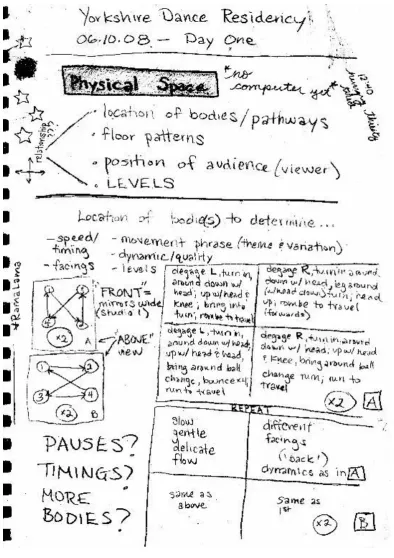
Despite these problematic occurrences with physical space, choreographic tasks were set to explore the physical space, in terms of floor patterns and locations of dancers in the physical space. A movement phrase, containing smaller footwork elements such as dégagés and larger dynamic changes such as dropping the upper body over the leg, was created based on theme and variation. The variations were tiny changes, such as the order of the movements, or performing the movement with the right leg instead of the left, or the facing of the body during the phrase.
The different variations were performed in different quadrants within the physical space with travelling steps in between as a solo at first. The floor pattern was repeated four times with different paths for travelling during the last two repetitions. The system set up was the camera in front of the performers, directed straight into the physical space where the movement was occurring and the projection space was on a wall behind the dancers. When the dancers joined in the process, this floor pattern was reconsidered and it was decided two dancers would perform this phrase but one was facing the audience and the other was facing the projection. Merce Cunningham's work also allowed for multiple facings for dancers in the space as “no single point in the space is in any way privileged and thus guide the observers' vision and perception – not even the framed stage as such” (Boenisch, 2006, p 106).
Not only did this give the performers a relationship to the physical space and to the projection space without one being more dominate because of the ultimate placement of the audience, but because they were always in opposite corners of the space as they performed, this meant that they will be picked up by the camera in different ways at different times. This one initial choreographic device of creating a floor pattern in the physical space, immediately demonstrated how the movement in one type of space (physical) impacts all the other spaces (camera and projection) within the composition.
synchronous movement in all the frames. “Here it is by degrees of mixing that the parts become distinct or confused in a continual transformation of values” (Deleuze, 1986, p15).
[image:30.595.104.499.138.696.2]A similar use of physical space, which translated to choreographing the camera and projection space, was a section of the work that focused on movement travelling on a diagonal from one corner of the physical space to the other. It was originally created with the concept of a solo live performer performing with her digital dance double. The movement is mirrored in the projection space and therefore the two travelling paths cross. It is intended to create a hybrid image for the audience and show the same movement in two types of spaces and also demonstrate the self-varying nature of topology. However, during rehearsals this section was developed into a duet and due to technical problems with the lighting in the physical space during rehearsals, never fully accomplished its goal of being a hybrid image.
Other sections of the piece were also created based on inspiration and choreographic tasks that looked at the location in the physical space, but attention of the choreographer during the creative process also had to be shared with the other constructs of space as topology is about connections and “deformation” from one space to the next.
Camera Space
Choreographing in camera space meant multiple things. It meant designing movement that was in view of the camera, so the camera could then use that image to create the projection. It also meant being very aware of when movement was close to the camera and certain gestures or parts of a movement were enlarged and abstracted and aware of when movement was far away from the camera and the image created for the projection was made much smaller. This choreography reflects ideas of topology as the movement is constantly being transformed and shows the interrelationships of the frames within the dance.
Towards the end of the piece there is a moment when the dancers start to walk in a circle in the space, and slowly develop this into a run and then back into a walk, before travelling to the centre of the stage and lying down on top of each other. This circle was purposely chosen as the pattern of movement in the physical space because of the way it would play with close up and long shots ranges with the stationary camera. This reflects Dixon's comment that “screen media facilitates multiple viewpoints on the same subject through the variation of camera angles; and perspective and spatiality can be transformed from a vast panorama to a huge close-up” (2007, p335).
choreographic as they change the dynamics and timings of the movements, help create choreographic devices such as cannons, as well as allow the choreography for the camera space to be reframed for the projection space, again creating “frames within frames within frames.”
Projection Space
Projection space is a complex frame, which is a physical space but also a two-dimensional digital video. This meeting creates this frame for movement, which finds both pragmatic attributes such as the location of the projector as well as artistic choices such as the visual aesthetic used to present the movement.
The projection space was limited due to the technical set up of the projector during the creative process and knowing the piece would be performed in a black box space with a single large projection across the back of the physical space, it was felt the projection could be explored more by dividing it into columns containing the live video processed in different ways. At first, being inspired by the floor patterns for the first phrase that was created, the projection space was also going to have four sections. However, this approach in this projection space was not successful as the projections became too small to see detail such as perspective or depth, and just resulted in a very busy array of tiny versions of the same image, with some delayed video. The concern was this projection would dominate the compositional space when live movement is paired with it in physical space because more was happening on screen than on stage.
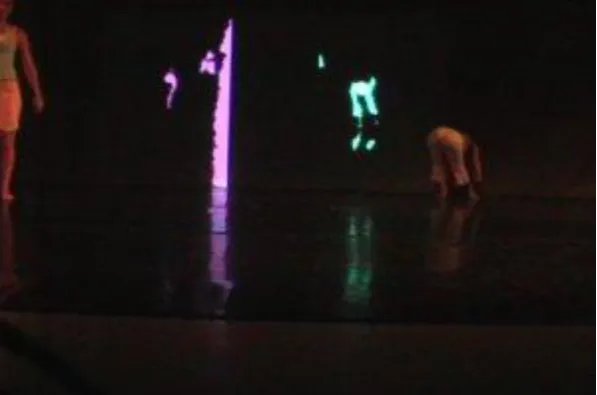
Rather than change the way the dance moves in the physical space to make the projection space work with the choreography, the projection/real-time system was changed to make the projection space less dominant and was rearranged to create a triptych. One third of the projection space was cropped to show one third of the live feed video with a delay (stage left), the centre third was empty, and the other third was another third of the cropped live video feed. The creation of a triptych, rather than the quarter, led to many ideas for the rest of the piece in the projection and physical spaces, including the use of delays and the use of entering and exiting the sections made by the triptych.
Figure 2 – Choreographer with triptych projections (video still)
Compositional Space
By devising the real-time video system early, it became easy to choreograph the overall composition as one could see the visuals with the movement. There could be interplay between live and digital and this could be choreographed via delays and which space the dancer is in (physical and projection). By looking at all the relationships being created, one could say this is the choreography of the topology.
One side of the stage is the live feed and there is unison between live and digital movement in this space. The middle projection space is designed to be empty and leaves a space for the live dancer to exist by them selves. The other side of the physical and projection space is a call and response between the live and digital movement. Between the three spaces various choreographic choices can be made such as cannons, unison movements, or mirrored movements.
One moment in the choreography towards the end of the first section has the live dancers in various parts of the stage performing duets. Two dancers have their image behind them live, another two have no image, and the other two have a delayed image. The two with the delayed image travel towards the other duets, but a lingering image is left as they move on. All the dancers again travel and this time no image is created as the centre of the projection space is programmed to be empty. The live and digital dancers all appear as they come together on the other side of the stage with live projections. This appearance and disappearance of the movement in the projection space directs the audience's attention to the live performers in certain moments and allows for a certain space, physical or projection, to be the focus.