Assessing the Impact of Global Variables on
Program Dependence and Dependence
Clusters
David Binkley
1Mark Harman, Youssef Hassoun, Syed Islam,
and Zheng Li
King’s College London, Centre for Research on Evolution, Search and Testing (CREST) Strand, London, WC2R 2LS, UK
Abstract
This paper presents results of a study of the effect of global variables on the quantity of dependence in general and on the presence of dependence clusters in particular. The paper introduces a simple transformation–based analysis algorithm for mea-suring the impact of globals on dependence. It reports on the application of this approach to the detailed assessment of dependence in an empirical study of 21 pro-grams consisting of just over 50K lines of code. The technique is used to identify global variables that have a significant impact upon program dependence and to identify and characterize the ways in which global variable dependence may lead to dependence clusters. In the study, over half of the programs include such a global variable and a quarter have one that is solely responsible for a dependence cluster.
Key words: Dependence Cluster, Program Slice, Global Variable
1 Introduction
Global variables are generally deprecated in advice to programmers, with many authors arguing that they have negative effects [39,47,53]. The use of global variables has been argued to have harmful effects on many aspects of software engineering, including maintainability [54] and correctness [3]. Some programming practitioners have gone so far as to suggest, perhaps only semi– seriously, that programmers might be fired for using global variables [49]. Of course, the introduction of global variables can produce potential efficiency gains [45], but such global–introduction transformations are performed as a
meaning–preserving compiler optimization, not as an approach to source-level code improvement.
Though the typical view in programming language texts (for example Stroup-trup’sC++ book [46]) is that global variables may often be a source of prob-lems, this view is not universally held. Some authors have even suggested that global variables should be used in place of local variables [24]. However, despite much debate and advice on the use of global variables over several decades, there remains little empirical study of the effects of global variables.
Program dependence, which captures the influence of one program compo-nent on another, is important because it has a bearing on so many aspects of software engineering. For example, program dependence has been linked to the ease with which a program can be understood, in work on program com-prehension [2,21]. The effect of program dependence is also felt in software maintenance and re–engineering, where it delimits the changes that may be performed [25,50] and captures the impact that such changes will have [19].
Dependence analysis forms the cornerstone for many software engineering activities that rely upon program analysis, such as program comprehension [2,21], impact analysis and reduction [19,50], reuse [20], software maintenance [25], testing and debugging [11,30,41], virus detection [37], and restructuring and reverse engineering [4,36].
This paper presents a technique used to study the effects of global variables on dependence as well as results from empirical studies of these effects. The impact of even a single global can be very far–reaching; in some of the programs studied, a single global was found to account for most of the program’s overall dependence connectivity.
The paper is also concerned with the effect that a global variable has on the presence or absence of large dependence clusters. A dependence cluster is a set of program statements, all of which are dependent upon one another. Recent work [9] has shown that dependence clusters are surprisingly prevalent. Therefore, one of the additional goals of the study reported herein is to explore the ways in which global variables can lead to dependence clusters.
them or to treat them as special cases. Furthermore, the ability to break some clusters will improve the applicability of these approaches.
The paper makes the following primary contributions:
(1) It introduces an algorithm for variable substitution that allows the de-pendence due to a particular global variable to be ignored. This is used to assess and measure the effects of the global variable on dependence. (2) The paper presents quantitative results that assess the effect on
depen-dence of 849 global variables in 21 programs. The study reveals that more than half the programs considered have individual global variables that have a significant impact on overall program dependence.
(3) The paper presents further qualitative results of the effect these high dependence globals have on large dependence clusters. In some cases, a single global was found to be the sole cause of a cluster, establishing evidence for a link between the use of globals and the presence of large dependence clusters. The study also investigates the categories into which these effects fall and the source code constructs that cause them.
(4) Finally, the paper presents a case study in which sets of global variables collectively combine to cause dependence clusters.
The rest of the paper is organised as follows: Section 2 presents background material on dependence clusters. Section 3 introduces the algorithm for elimi-nating dependence due to a global variable and uses this to measure the effect of each global has on overall program dependence. Sections 4 and 5 present the five research questions addressed by the experiments and the experimental design. Sections 6 and 7 present the results of the quantitative and qualitative studies of global variable dependence effects, while Section 8 presents the case study of multi-global variable dependence effects. Sections 9 and 10 consider threats to validity and related work, and finally, Section 11 summarises the paper.
2 Dependence Clusters
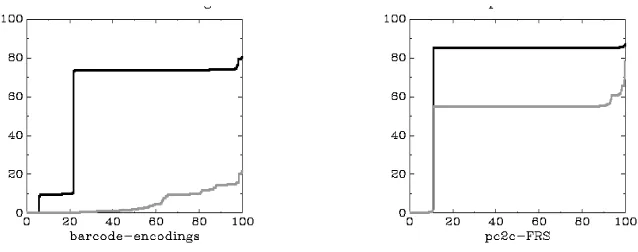
Fig. 1. Two kinds of reduced dependence. In the left chart, the dependence cluster is broken. In the right chart, the cluster size is reduced, but the cluster remains unbroken.
To visualize dependence clusters the Monotone Slice-size Graph (MSG) was introduced [9]. A slice is a sub-program that captures a semantically mean-ingful sub-computation from a program. Slices can be efficiently computed using the System Dependence Graph (SDG) [31]. An MSG is a graph of all a program’s slice sizes plotted in monotonically increasing order on the x-axis. The y-axis measures slice size.
For ease of comparison the MSGs shown in this paper use the percentage of the entire program on they-axis. Thus, an MSG plots a landscape of monotonically increasing slice sizes, in which dependence clusters correspond to sheer–drop cliff faces followed by a long flat plateau (e.g., see the black line in Figure 1).
To illustrate cluster identification using an MSG, Figure 1 shows four example MSGs. As explained below, each graph includes two MSGs: an original MSG in black and a post reduction MSG in grey. For example, the MSG in black in the left chart shows (reading along the horizontal axis) that approximately the first 20% of slices are very small (containing about 10% of the program), after which the MSG reveals a sharp increase to almost 80% of the program. Most of the remaining slices are all of essentially the same size. This is visual evidence of a dependence cluster in the program. The MSG for a program devoid of clusters is shown in grey under this line.
3 Assessing the Impact of Global Variables on Dependence
program with and without the dependence due tog will be deemed to denote the impact of g on overall program dependence.
Of course, reducing the quantity of overall program dependence may not mean the breaking of a dependence cluster for which MSG area reduction is a neces-sary, but not sufficient condition. This is illustrated in Figure 1 where the two charts show the two kinds of reduction. Both original (black) MSGs include a considerable cluster. The (lower) grey MSG in the left chart shows the result of ignoring the dependence associated with the global variableencodings; this clearly breaks the cluster. In the chart on the right the (lower) grey MSG shows only a reduction in the size of the slices making up the cluster. In this example the cluster itself is still present.
In order to measure the impact of ignoring the dependences associated with a given global variable, the approach adopted in this paper transforms the pro-gram to remove all such dependence. However, although this may be simple in principle, it turns out that the program analysis task of ‘ignoring dependence’ is not entirely trivial in practice.
The goal is to ignore all dependence that can be caused by definitions and references of the global variable. To achieve this, it is insufficient simply to mark as untraversable dependences due a given global variable. The reason for this is that such an edge-ignoring approach will not take into account the secondary effects that a global variable has. For example, upon computations that support the identification of dependence, such as dependencies due to pointers and the summary edge computation used by CodeSurfer [27] to build an SDG.
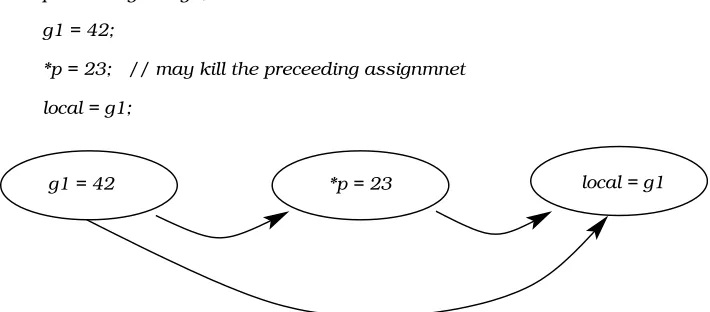
To illustrate, consider ignoring the dependence caused by global variableg2 in the code fragment and partial SDG shown in Figure 2. Because p may point to g1 or g2, the assignment *p = 23 does not definitely kill the assignment g1 = 42. However, in the absence ofg2, *p = 23kills the assignment g1 = 42 because p only points to g1. This obviates the need for the data dependence edge fromg1 = 42 to local=g1.
As this example shows, simple edge marking is insufficient. To overcome this, the paper introduces a simple transformation to syntactically delete the global variable from the AST. Of course, such a transformation is not meaning pre-serving. It is not intended to be. It merely serves the purpose of ignoring all dependence due to the global variable under consideration. The resulting SDG is used to analyse the impact of the global by comparison to the original SDG (with all dependence due to the global included). In this way, the global variable’s impact upon dependence can be fully assessed.
local = g1;
p = ... ? &g1 : &g2;
g1 = 42;
*p = 23; // may kill the preceeding assignmnet
[image:6.595.112.467.152.308.2]g1 = 42 *p = 23 local = g1
Fig. 2. Illustration were marking edges is insufficient.
(1) The size of the program should not be changed more than necessary. (2) The effects of dependences not due to the global should remain unaffected
Taking these two concerns into account, the transformation rules replace each occurrence of a global in such a way that dependence structure is otherwise un-changed while having minimum impact on program size. For example, consider the assignment a=g+b where only the dependencies associated with global variable gis to be ignored. A minimum impact replacement, assuming that g
is anintvariable, would be to replacegwith a constant of the appropriate type (e.g.,0). While this would clearly change the meaning of the program (unless
ghappens to always have the value0), the revised statement a=0+bpreserves the dependence of a on b and also the size of the program (in this case right down to the character level); its sole effect is to removal the dependence of the statement on global variable g.
In the general case, any type-appropriate constant will suffice. In the for-malization of the replacement, the name ‘T AC’ is used to denote this type-appropriate constant. For example, the constant((int *)0) is used for a global variable of type int *.
To further illustrate the transformation, consider the replacement of the ex-pression “g++”. This is a two step process. The first replacesg++ withgand then second replaces g with T AC. The resulting expression removes depen-dencies associated with g, but does not change the number of SDG vertices used to represent the code; thus, in terms of the analysis presented in the next section, this change does not impact the program’s size.
and thus removes the dependence associated with the global array. For ex-ample, global array[i++] is transformed into T AC[i++] where the resulting program omits dependencies associated with global array, but maintains the dependencies associated withi.
The formal rules for when a type-appropriate constant is suitable are given by the function DL (which identifies expressions that denote a named location). When this function returns bottom (⊥) then the use of T AC is permitted. Otherwise, the expression involving the global, must be deleted from the pro-gram. In the transformation rules, this latter case leads to the global being rewritten to the empty string, λ. In most cases, such a replacement does not impact the program’s (SDG’s) size. Its effect is primarily on the source repre-sented by a given SDG vertex.
The remainder of the section formalizes the global variable dependence-elimination transformation. The algorithm, which operates onCprograms, is presented as a set of transformation rules. Modification for other similar languages (e.g.,
C++) is straightforward.
Transformation rules are written as
constraint set
input source
output source
and make use of the following notation
• T AC denotes a type appropriate constant
• λ denotes the empty string
• [x|y] denotes the selection of x ory
• var(declarator) denotes the variable declared For example, var(a[]) and var(*a) are botha.
• g denotes the global targeted by the transformation
The rules transform declarations and expressions that involve g. In general,
C language declarations involve storage class and type specifiers followed by a list of declarators. The transformation, shown in the upper left of Figure 3 removes declarators that resolve tog(e.g.,g,g[10], or**g). While syntactically valid, if this leaves an otherwise empty declaration, the tool removes the entire declaration.
lvalue → identifier
→ * expression
→ primary ’[’ expression ’]’
→ primary -> identifier
→ lvalue . identifier
→ ( lvalue )
Only lvalues that denote (part of the) the location represented by g require special treatment. Those that simply involveg in denoting some other location do not. For example, no special treatment is needed for g[i], which is replaced by T AC[i] to correctly retain the use of i. As noted above, this is legal in C
and thus a convenient method for achieving the minimum impact removal of the dependence induced by the global. In the four special cases, the function DL identifies those lvalues that denote a location directly associated with an identifier:
fun DL identifier = identifier
| DL * expression = ⊥
| DL primary ’[’ expression ’]’ = ⊥ | DL primary -> identifier = ⊥
| DL lvalue . identifier = DL(lvalue)
| DL ( lvalue ) = DL(lvalue)
Thus, DL(a[i]++) = ⊥ because there is no identifier associated with the in-cremented memory location, while DL(p.x) = p because part of the location referred to by p is modified.
The four special cases are shown as the bottom four rules in Figure 3; they occur when (some part of) g’s address is taken, when it is modified by an as-signment operator, and when an increment or decrement operator is involved. In the first case, NULL is used rather than T AC. For the second, the assign-ment portion of the assignassign-ment expression is removed. That is, “g += i++” is transformed into “i++”. For the final two cases, the increment or decrement operator is simply removed.
{ var(declarator)= g }
declarator
λ
{}
g
T AC
General Cases
{DL(lvalue) = g }
& lvalue
NULL
{ DL(lvalue) = g }
lvalue assign op expression
expression
{DL(lvalue) = g }
[ −− |++ ]lvalue
lvalue
{ DL(lvalue) = g }
lvalue [ −− |++ ]
lvalue
[image:9.595.91.467.97.569.2]Special Cases
Fig. 3. Transformations for removing variableg.
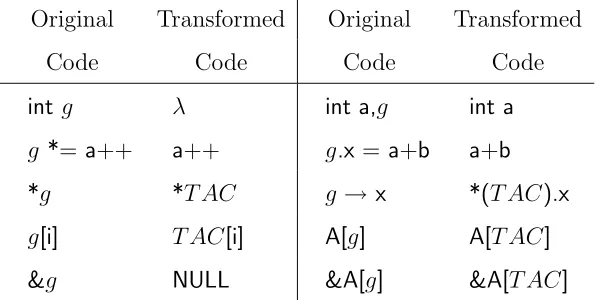
Original Transformed Original Transformed
Code Code Code Code
int g λ int a,g int a
g *= a++ a++ g.x = a+b a+b
*g *T AC g → x *(T AC).x
g[i] T AC[i] A[g] A[T AC]
&g NULL &A[g] &A[T AC]
Fig. 4. Transformation examples showing the replacement of gwith T AC.
4 Research Questions
The empirical analysis addresses three sets of research questions, concerning the qualitative and quantitative effects of single globals and the combined effects of sets of globals (multiple globals). The study reports results on the quantitative effects that global variables have upon program dependence in general and the specific qualitative effect that high dependence globals have upon the program’s large dependence clusters.
[image:9.595.92.391.435.585.2]potentially produce the most valuable information to the software engineer. That is, if it is possible to identify a single global variable that can be deemed to be responsible for a dependence cluster, then the engineer has a chance to consider the meaning of this variable and ways in which it might be possible to account for, ameliorate or otherwise reduce the impact of the dependence clus-ter. Clearly, where clusters have multiple causes, such amelioration may also be possible, but it is likely that dealing with single causes will be preferable.
Research Question RQ1.1:
Overall Quantitative Effect of Single Globals
Over all programs, what proportion of dependence is due to global variables and how many globals have a significant impact (as defined in Section 5.2) to total program dependence?
Research Question RQ1.2:
Quantitative Effect of Single Globals on Each Program
For each program considered separately, how many globals have a significant impact (again using the statistical tests described in Section 5.2) on depen-dence and what is the magnitude of their effect? (This question make more sense knowing the results for RQ1.1.)
Research Question RQ2.1:
Qualitative Assessment of Effect of Single Global on Dependence Clusters
What effects do global variables have upon dependence clusters?
Research Question RQ2.2:
Qualitative Assessment of the Causes in Source Code
What source code patterns are found that correspond to the effects of global variables on dependence clusters?
The four research questions above concern the effects ofsingleglobal variables. Research Question RQ3 concerns the effects of multiple globals on dependence clusters.
Research Question RQ3:
Qualitative and Quantitative Effect of Multiple Globals on Each Program
5 Experimental Design
This section briefly describes the programs studied and the tests used to assess whether a global variable has a significant impact upon dependence.
5.1 Programs Studied and their MSGs
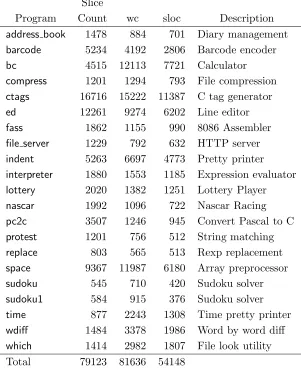
The 21 programs used as subjects in the study are described in Figure 5. They were taken from online repositories such as directory.fsf.org and planet-source-code.comexcept forspacewhich is code created for the European Space Agency. For each program, the figure includes the name of the program, the number of slices taken when analyzing it, its size in lines of code as counted by the unix utilitywc and the number of non-blank non-comment lines of code as counted bysloc[52], and finally a brief description. These programs cover a va-riety of application domains such as programming utilities, terminal software, booking systems, simulations, games, interpreters, and code transformation tools.
5.2 Statistical Tests Applied
The statistical tests used in this paper follow the well established approach to measuring the significance of effects adopted in work on control limits the-ory [42]. Two statistical tests are applied to determine those global variables that have significant impact on overall program dependence. The first is based on the notion of outliers, while the second is based on variance. A global vari-able is taken to have a significant impact upon program dependence if it is determined to be significant by both tests. The reason for considering both tests is to reinforce each individual test. Furthermore, tests based upon out-liers are more robust against non-normality in the data distribution. Finally, note that most common statistical tests, such as at-test, are not applicable in this case. Many such tests assume that the data come from normal population and compare population means but are not designed to test if a given value is expected to lie outside a population.
Slice
Program Count wc sloc Description
address book 1478 884 701 Diary management barcode 5234 4192 2806 Barcode encoder
bc 4515 12113 7721 Calculator
compress 1201 1294 793 File compression ctags 16716 15222 11387 C tag generator
ed 12261 9274 6202 Line editor
fass 1862 1155 990 8086 Assembler
file server 1229 792 632 HTTP server indent 5263 6697 4773 Pretty printer interpreter 1880 1553 1185 Expression evaluator lottery 2020 1382 1251 Lottery Player nascar 1992 1096 722 Nascar Racing
pc2c 3507 1246 945 Convert Pascal to C
protest 1201 756 512 String matching replace 803 565 513 Rexp replacement space 9367 11987 6180 Array preprocessor sudoku 545 710 420 Sudoku solver sudoku1 584 915 376 Sudoku solver
time 877 2243 1308 Time pretty printer
wdiff 1484 3378 1986 Word by word diff which 1414 2982 1807 File look utility
[image:12.595.138.439.149.519.2]Total 79123 81636 54148
Fig. 5. The 21 programs studied
interquartile range below the mean. In the variance approach [1], a point more than two standard deviations below (or in general above) the mean is significantly different, while a point three or more standard deviations below the mean is taken ashighly significantly different. Thus, using this approach, a global variable has asignificant impactupon program dependence if it causes a reduction in the area under the MSG that is two standard deviations below the mean. Furthermore, it has a highly significant impact if it causes a reduction in the area under the MSG that is three standard deviations below the mean.
of all global variables in that program.
It turns out that, for all programs, the variance approach is a stricter test for significance than the outlier approach: if a result is significant according to the variance approach, then it is also significant with respect to the outlier approach (though not necessarily vice versa). In the experiment while both tests were applied and the resulting sets of global variables intersected, the result was always the same as if only the more strict variance approach was used.
6 Impact on Dependence Levels
The quantitative study is concerned with addressing Research Questions RQ1.1 and RQ1.2. It provides results of the assessment of the impact of each global variable (of 849 in total) on the dependence in the programs in which these globals reside.
6.1 RQ1.1: Overall effects of Single Global Causes
For each of the programs, the MSG was first computed using the unmodified program. Then, it was re-computed 849 times. Each re-computation ignored the dependence due to one of the global variables. Dependence effects were then assessed by comparing the area under the MSGs.
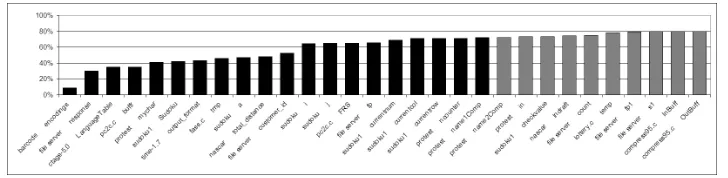
Over all globals in the study, the average area remaining after a global vari-able’s dependences are ignored was 97.4% with a standard deviation of 8.6%. Figure 6 shows a histogram of results for the reduction due to globals. Clearly, most globals cause little reduction: 800 of the 849 global variables no more than a ten percent reduction. However, more importantly, as can be seen in the right hand detailed histogram, there do exist some global variables that have a considerable impact on the quantity of dependence in the programs in which they reside.
Fig. 6. Histogram showing the counts (on the y-axis) of globals leading to different ranges of dependence reduction. As the left-hand histogram shows, most global variables have little effect; they fall into the 0-10% range. The right-hand histogram zooms in on the remaining data which shows reductions from 10-100%.
Fig. 7. Impact of ignoring dependencies for each global variable. The chart measures theremaining dependenceon they-axis for the 3.5% of the global variables that have a significant impact. Highlighted in black are those that have a highly significant impact.
6.2 RQ1.2: Per Program Effects of Single Global Causes
The answer to Research Question RQ1.1 suggests that there are only a few global variables that have a significant effect on dependence. A natural ques-tion to ask is whether these are concentrated in a few programs that are in some way ‘special cases’, or whether there are many programs that contain a global that causes a significant effect on dependence. This is the question raised by Research Question RQ1.2.
[image:14.595.108.472.339.428.2]Fig. 8. Impact of ignoring dependencies for each global variable. The chart shows the four reduction causing global variables for programs where at least one significant global variable exists.
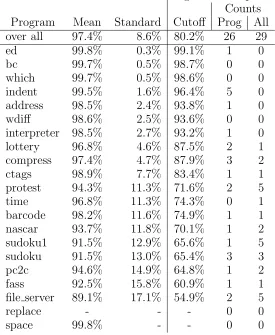
Section 5.2 describes two statistical tests that are applied to determine if a global variable causes a significant difference. These test can be applied to the entire pool of global variables (as done above) or to the globals of each programs independently. This second version asks not whether a variable, g is significant among all variables studied, but whether g is significant among only those globals that reside in the same program asg. The results serve to strengthen confidence in the answer to RQ1.2.
Figure 9 shows a comparison of the two approaches to assessing significance. Figure 10 shows the visual relationship between the two approaches to test-ing for significance. As can be seen from Figure 9, apart from one case (the programtime),allthose programs that contain global variables that are signif-icant among all globals, also contain globals that are signifsignif-icant in the program in which they reside. This lends additional evidence to support the belief that many programs may contain globals with a significant effect on dependence.
7 Impact on Dependence Clusters
Significant Impact Counts Program Mean Standard Cutoff Prog All over all 97.4% 8.6% 80.2% 26 29
ed 99.8% 0.3% 99.1% 1 0
bc 99.7% 0.5% 98.7% 0 0
which 99.7% 0.5% 98.6% 0 0
indent 99.5% 1.6% 96.4% 5 0
address 98.5% 2.4% 93.8% 1 0
wdiff 98.6% 2.5% 93.6% 0 0
interpreter 98.5% 2.7% 93.2% 1 0 lottery 96.8% 4.6% 87.5% 2 1 compress 97.4% 4.7% 87.9% 3 2
ctags 98.9% 7.7% 83.4% 1 1
protest 94.3% 11.3% 71.6% 2 5
time 96.8% 11.3% 74.3% 0 1
barcode 98.2% 11.6% 74.9% 1 1 nascar 93.7% 11.8% 70.1% 1 2 sudoku1 91.5% 12.9% 65.6% 1 5 sudoku 91.5% 13.0% 65.4% 3 3
pc2c 94.6% 14.9% 64.8% 1 2
fass 92.5% 15.8% 60.9% 1 1
file server 89.1% 17.1% 54.9% 2 5
replace - - - 0 0
[image:16.595.152.427.169.504.2]space 99.8% - - 0 0
Fig. 9. For each program, the mean reduction leading to the number of globals causing a significant reduction (penultimate column). Each line of the table includes the mean area when ignoring the dependence of each global, the standard deviation of the mean, the cutoff for a significant impact, and the two counts. The final column is the number of significant globals using the mean over the entire collection of programs, which is shown in the first line. The programreplace has no globals and the program spacehas only one.
7.1 RQ2.1: Overall Categorization of the Effects of Single Global Causes
From Section 2, a reduction in area under the MSG is a necessary, but not sufficient condition for the breaking of a dependence cluster. Research Ques-tion RQ2.1 asks if the reducQues-tion in area under the MSG is accompanied by a corresponding breaking of clusters. This is a more subjective determination.
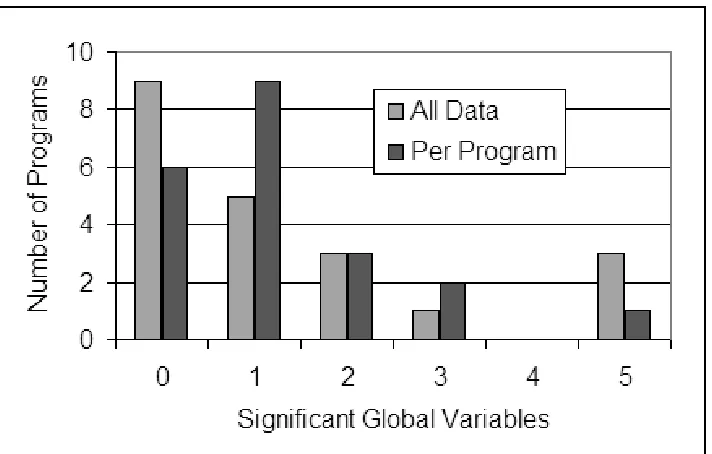
Fig. 10. Number of programs with various numbers of global variables having a significant impact.
dependence of the given global variable in grey. For example, the MSGs for
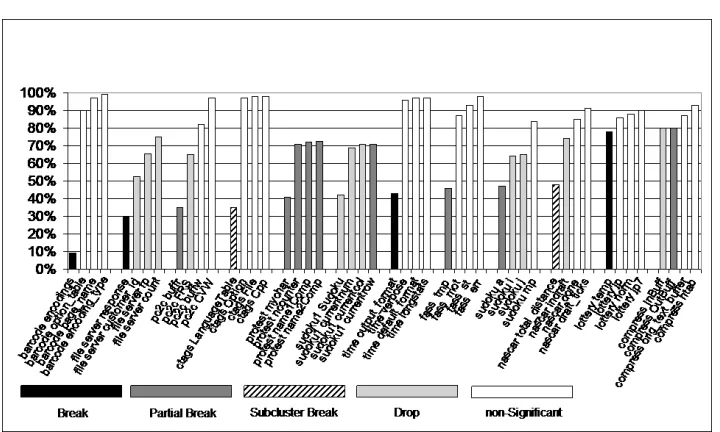
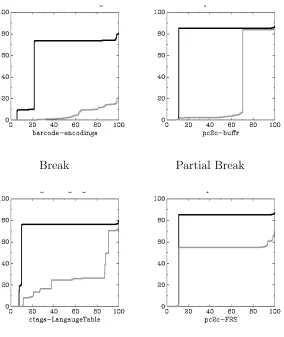
barcode shown at the far left illustrate the break case where a large depen-dence cluster disappears. Next to this is a partial break. Here the MSG (when ignoring buffr of pc2c) shows a clear but partial breaking of the dependence clusters of pc2c. In this case approximately three fifths of the cluster disap-pears. Next to this, is a sub-cluster break where the one large cluster in the MSG forctags fractures into a collection of smaller clusters (evidenced by the stair step pattern in the MSG). The final MSG illustrates thedropcase where no cluster breaking occurs; the size of the slices making up the cluster are simply reduced, though the cluster remains. Thus, the characteristic cliff-face and plateau is still present but with reduced height.
As shown in Section 6 using the data over all programs, 29 global variables are significant, while using the per program data, 26 global variables are identified. Those global variables identified by the per-program data that are not by the all-program data are alldrops of small magnitude.
Break Partial Break
[image:18.595.157.441.139.476.2]Sub-cluster Break Drop
Fig. 11. Examples from the classification of MSGs
Partial Sub-cluster
Break Break Break Drop
All Data 4 10 2 13
Per Program 3 6 2 15
Both 3 6 2 5
Fig. 12. Effect of global variables with a significant impact on dependence clusters.
[image:18.595.93.365.566.654.2]7.2 RQ2.2: Source Code Features that Appear to Cause Clusters
To answer Research Question RQ2.2 the source code of each program with one or more significant global variable was inspected in an attempt to identify source code patterns that cause the use of globals to lead to the presence of dependence clusters. Four patterns emerge. These will be denoted: central data structure, top-up, lazy programmer, andlibrary. Each is now defined and illustrated using case study examples from the code studied.
Examples of a central data structure include theboardin a game, the memory registersused byinterpreter, thecurrent instructionprocessed by the assembler
fass, and current state of the parser within the pretty printer indent. In most cases, ignoring the dependence associated with such a global variable simply causes a drop, but not a breaking of dependence clusters. This is primarily because dependencies involving other variables continue to tie the disparate parts of the cluster together.
However, in some cases, the central data structure is all that binds the clus-ter; ignoring its dependencies breaks it. For example, in fass, the current in-struction is held in a central data structure. Ignoring this global variable’s dependencies disconnects the code for processing each kind of instruction.
The second pattern, top up, is caused by a variable that adds an often small increment to a large collection of slices. The most common cause of this pat-tern is an input buffer where the reading of the input is part of most slices and gets ‘cut off’ from each of these slices when ignoring the input buffer’s dependencies.
In four of the twelve occurrences of this pattern, the input was subsequently used in sufficient decision logic to also lead to some evidence of cluster break-ing. With three of the four, this applies to only a small number of slices. The fourth is buffr from pc2c. As shown in the upper right chart of Figure 11, approximately three fifths of the large cluster is broken up by ignoring the (decision based) dependencies of buffr.
The third pattern, lazy programmer, occurs when a single global variable is used in place of a collection of locals. Often this pattern is obvious from the global variable’s name (e.g., temp or xxindex). This pattern causes needless dependence connections between functions; thereby, linking together otherwise unrelated parts of the program.
An example of this pattern is the global FRS (Function Return String) from
The final pattern, library, occurs in three of the programs. It is the only one that was always associated with at least partial breaking of dependence clusters in this study. This pattern is similar to the central data structure pattern except that the data structure is read only. Instances include
struct encoding encodings[]; frombarcode,
static parserDefinition** LanguageTable;from ctags, and
char *output format; fromtime.
For example, the arrayencodingsholds a pointer to each of the kinds of barcode that the barcode program is able to encode. Similarly, ctagscan produce tags for a variety of languages. The selection is achieved by indexing into the global array LangaugeTable. Finally,output format is used by the output function of
time. The format is iterated over; thus, tying together the code for all the various output formats.
Library variables cause dependence clusters primarily because static analysis tools cannot determine that the particular element chosen will not change. For example, from the static analysis point of view, it is possible for barcode
to switch encoding functions in the middle of an encoding. This serves to link together the different encoders into one large cluster. The (external) insight that only one encoder is ever used for any given encoding (execution of the program) would allow a comprehension tool, for example, to break the cluster. However, such a tool would require sophisticated domain knowledge, placing this beyond the abilities of current dependence analysis technology.
8 Multiple Global Causes
This section considers the effects of ignoring the dependencies associated with combinations of globals. Several of the programs shown in Figure 8 include such sets of multiple significant global variables. Program pc2c is used as an illustrative case study. Similar patterns exist in compress, file server, protest, andsudoku. The case study considers the two significant global variables: FRS
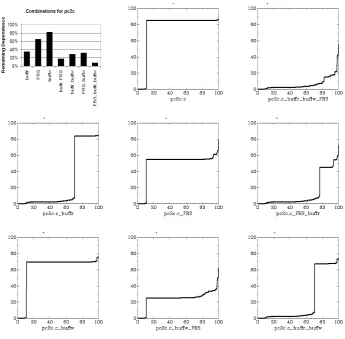
and buffr and the ‘almost significant’ global variable buffw. The dependence reductions achieved by ignoring various combinations are shown on they-axis of the chart at the top left of Figure 13.
Next to the percent reduction bar chart, the top row of Figure 13 shows
pc2c’s original MSG and the MSG resulting from ignoring the dependence of all three variables. The interesting thing to note in the final MSG is the complete breaking of the clusters. The second row shows the MSGs forbuffr,
Fig. 13. MSGs for selected global variable of pc2c showing the impact of ignoring dependences associated with combinations of global variables.
MSG produced when ignoring dependence associated with buffw, buffw and
FRS, and buffr and buffw.
9 Threats to Validity
Internal validity is the degree to which conclusions can be drawn about the causal effect of the independent variable on the dependent variable. In this experiment, the primary threat comes from the potential for faults in the tools used to gather the data. A mature and widely used slicing tool (CodeSurfer [27]) was used to mitigate the concern.
Construct validity assesses the degree to which the variables used in the study accurately measure the concepts they purport to measure. Note that in the presence of human judgments, construct validity is a more serious concern. In this study the only measurement is of slice size, which can be done accurately.
10 Related Work
This paper considers the role global variables play in source-level dependence in general and dependence clusters in particular. Though global variables have long been regarded as a potential causes of problems [53], there has been no previous work that has provided a quantitative assessment of their impact on dependence. Previous work on dependence clusters in software engineer-ing [22,38,40] has focused on higher levels of abstraction, such as models or functions. Previous work on source-level dependence clusters has been primar-ily carried out in support of compiler analysis where semantics preservation is a key requirement [23,33,43].
Dependence analysis has been shown to be effective at reducing the computa-tional effort required to automate the test-data generation process [29]. Using dependence analysis, it is possible to reduce both the amount of code to be tested and the size of the input domain. However, the presence of large depen-dence clusters will mean that no such reduction can be achieved when testing any part of the program that lies in a cluster. Identifying and busting these clusters can therefore be thought of as a step towards improving testability.
In software maintenance, dependence analysis is used to protect a software maintenance engineer against the potentially unforeseen side effects of a main-tenance change. This can be achieved by measuring the impact of the proposed change [19] or by attempting to identify portions of code for which a change can be safely performed, free from side effects [25,50]. Unfortunately, all state-ments in a dependence cluster transitively impact all other statestate-ments in the cluster. Therefore, the ripple effect for these statements will be large and any attempt to perform a modification will be challenging.
slicing, barriers are used to prevent consideration of any dependence past the barrier. In tucking, a wedge is inserted into the code to ‘cap off’ dependence before the wedge so that the code may be split out and folded into smaller, ideally more cohesive, sub units.
The work reported in this paper is part of a research agenda, currently being pursued by two of the present authors (Harman and Binkley) and their col-leagues and collaborators. For this agenda, dependence analysis is advocated as a way to provide tools and techniques for empirical assessment of depen-dence structures. The present paper is an invited submission to a special issue of JSS and it was largely through this work that the invitation to submit the present paper arose. The authors have been encouraged by the editor to in-clude a brief overview of this previous work in this section. To achieve this, the following paragraphs set out the results so far established in this on-going ‘empirical dependence analysis’ research agenda.
Binkley and Harman [14] presented the first study which aimed to answer the question: ‘How big is a typical program slice?’. Though slicing had been first proposed some 24 years previously by Mark Weiser [51], there had not been any subsequent attempt to systematically slice a large code base using every possible slicing criterion, thereby providing baseline data on slice size. This paper aimed to do just that. The paper constructed slices for 43 pro-grams containing just over one million lines of code. To date, this remains the largest empirical study of slicing in the literature. It also considered the impact that calling context and structure field expansion has on slice size. In order to construct the large number of slices required, several novel slice efficiency techniques were introduced [15,18]. The paper was later extended [12] to provide a larger study that also considered the effects of dead code, pointer analysis, and slice granularity on the size of slices produced.
Subsequently, Binkley and Harman noticed that, though forward and back-ward slicing are dual notions of dependence, there is an interesting difference in the distribution of size of slices. That is, because of the duality of forward and backward dependence, theaveragesize of a set of forward slices of proce-dure or program p will be identical to the average size of the backward slices of p. However the distributions of these slices are very different; the forward slices tend to be smaller. This was demonstrated empirically, where it was shown that the difference in slice–size distribution is entirely due to the ef-fects of control dependence in structured languages [8]. This realization lends to forward slicing a hitherto unrealized importance, making it all the more sur-prising that forward slicing has been largely overlooked in the literature, by comparison with its much more widely–studied counterpart: backward slicing.
be rather large. That is, a programmer faced with a million line program, is unlikely to be consoled by a 300,000 line slice; though the slice may be smaller than the original program, the threshold at which comprehension support becomes realistic remains some way off. In order to address this slice size problem, a new form of dependence analysis called Key Statement Analysis was introduced [28] and recently empirically studied [6]. In Key Statement Analysis, dependence computation is used to target those few statements upon which the program’s dependence revolves. The empirical findings demonstrate that key statement analysis can be used to identify the few statements in a program that capture most of the impact of the whole program’s dependence.
A separate study presented the effects of formal parameters and global vari-ables on levels of predicate dependence [13,16]. Predicate dependence was con-sidered a subject worthy of study because the predicates of a program capture its essential logical intention, the comprehension of which underpins so many software engineering activities. The primary finding of this work was the ob-servation that, as the number of formal parameters available to a predicate increases, the proportion upon which it depends tends to decrease. This was noticed in many of the programs studied and it was a trend that was borne out by statistical analysis. No such trend was observed for backward slicing. This result may indicate that as functions increase the number of formal parameters available, they tend to become less cohesive.
Subsequent work [32,48], exploited this observation regarding cohesion to de-velop Search Based Software Engineering techniques for automating the pro-cess of slicing procedures, guided by fitness functions that capture dependence interactions.
Previous work has also considered other potential harmful effects of depen-dence structures that can be uncovered using static analysis. Chief among these ‘dependence anti patterns’ [7] are dependence clusters [9]. This work provided a definition of several forms of anti pattern and dependence–based techniques for locating them. The empirical results indicated how these tech-niques found examples of anti patterns in open source and production indus-trial code. Other work illustrated the way in which the normally static nature of these forms of dependence analysis could be brought to life in animations, that provide a ‘fourth dimension’ to dependence visualization [10].
Previous work has also presented empirical results on the relationship between high level program concepts (such as credit, undercarriage and holiday enti-tlement) and low level dependence at the statement level [5,26]. This work revealed that code which is conceptually similar also has a tighter, more co-hesive dependence structure.
on program slicing [17], to which the reader is referred for a more detailed account of related work and results concerning program slicing and program dependence.
11 Summary and Future Work
This paper is concerned with the effect of global variables on program depen-dence. It introduces a technique for measuring the effect of a global variable on the quantity of dependence present in a program and uses this to study the effects of 849 global variables from 21 programs. The results show that, while most global variables have essentially no impact on program dependence, there are a few that have a large and significant effect. Moreover, though there may be few such global variables, many programs (more than half those studied) have at least one such significant variable.
The paper also studies the way in which dependencies due to some global vari-ables hold together large dependence clusters. The results show that globals can be the sole cause of such clusters. The paper presents a categorization of these effects and examines the source code patterns behind the clusters.
The empirical results presented in the paper are findings from a study of C and C++ programs. Future work will consider other programs and program-ming paradigms to assess the degree to which these results generalize. It will also investigate the opportunities for dependence cluster-breaking refactoring suggested by the finding that global variables may be the sole cause of some dependence clusters.
Future work will consider the relationships between the dependence clusters of a program, techniques for helping the programmer to break them into smaller, more manageable clusters, empirical assessment of their effects on program comprehension and other potential causes of dependence clusters.
References
[1] P. Armitage, G. Berry, Statistical methods in medical research, Macmillan, London, 1994.
[2] F. Balmas, Using dependence graphs as a support to document programs, in: 2nd
[3] J. Barnes, High Integrity Software: The SPARK Approach to Safety and Security, Addison Wesley, New York, NY, 2003.
[4] J. Beck, D. Eichmann, Program and interface slicing for reverse engineering, in: IEEE/ACM 15th
Conference on Software Engineering (ICSE’93), IEEE Computer Society Press, Los Alamitos, California, USA, 1993, pp. 509–518.
[5] D. Binkley, N. Gold, M. Harman, Z. Li, K. Mahdavi, An empirical study of the relationship between the concepts expressed in source code and dependence, Journal of Systems and SoftwareTo appear.
[6] D. Binkley, N. Gold, M. Harman, Z. Li, K. Mahdavi, Evaluating key statements analysis, in: 8th International Working Conference on Source Code Analysis and Manipulation (SCAM’08), IEEE Computer Society, Beijing, China, 2008, pp. 121–130.
[7] D. Binkley, N. Gold, M. Harman, Z. Li, K. Mahdavi, J. Wegener, Dependence anti patterns, in: 4th
International ERCIM Workshop on Software Evolution and Evolvability (Evol’08), L’Aquila, Italy, 2008, pp. 25–34.
[8] D. Binkley, M. Harman, Forward slices are smaller than backward slices, in: 5th
IEEE International Workshop on Source Code Analysis and Manipulation, IEEE Computer Society Press, Los Alamitos, California, USA, 2005, pp. 15–24.
[9] D. Binkley, M. Harman, Locating dependence clusters and dependence pollution, in: 21st
IEEE International Conference on Software Maintenance, IEEE Computer Society Press, Los Alamitos, California, USA, 2005, pp. 177– 186.
[10] D. Binkley, M. Harman, J. Krinke, Animated visualisation of static analysis: Characterising, explaining and exploiting the approximate nature of static analysis, in: 6th
International Workshop on Source Code Analysis and Manipulation (SCAM 06), Philadelphia, Pennsylvania, USA, 2006, pp. 43–52.
[11] D. W. Binkley, Semantics guided regression test cost reduction, IEEE Transactions on Software Engineering 23 (8) (1997) 498–516.
[12] D. W. Binkley, N. Gold, M. Harman, An empirical study of static program slice size, ACM Transactions on Software Engineering and Methodology 16 (2) (2007) 1–32.
[13] D. W. Binkley, M. Harman, An empirical study of predicate dependence levels and trends, in: 25th
IEEE International Conference and Software Engineering (ICSE 2003), IEEE Computer Society Press, Los Alamitos, California, USA, 2003, pp. 330–339.
[15] D. W. Binkley, M. Harman, Results from a large–scale study of performance optimization techniques for source code analyses based on graph reachability algorithms, in: IEEE International Workshop on Source Code Analysis and Manipulation (SCAM 2003), IEEE Computer Society Press, Los Alamitos, California, USA, 2003, pp. 203–212.
[16] D. W. Binkley, M. Harman, Analysis and visualization of predicate dependence on formal parameters and global variables, IEEE Transactions on Software Engineering 30 (11) (2004) 715–735.
[17] D. W. Binkley, M. Harman, A survey of empirical results on program slicing, Advances in Computers 62 (2004) 105–178.
[18] D. W. Binkley, M. Harman, J. Krinke, Empirical study of optimization techniques for massive slicing, ACM Transactions on Programming Languages and Systems 30 (2007) 3:1–3:33.
[19] S. E. Black, Computing ripple effect for software maintenance, Journal of Software Maintenance and Evolution: Research and Practice 13 (2001) 263– 279.
[20] A. Cimitile, A. De Lucia, M. Munro, A specification driven slicing process for identifying reusable functions, Software Maintenance: Research and Practice 8 (1996) 145–178.
[21] Y. Deng, S. Kothari, Y. Namara, Program slice browser, in: 9th
IEEE International Workshop on Program Comprenhesion, IEEE Computer Society Press, Los Alamitos, California, USA, 2001, pp. 50–59.
[22] T. Eisenbarth, R. Koschke, D. Simon, Locating features in source code, IEEE Transactions on Software Engineering 29 (3), special issue on ICSM 2001.
[23] C. N. Fischer, R. J. LeBlanc, Crafting a Compiler, Benjamin/Cummings Series in Computer Science, Benjamin/Cummings Publishing Company, Menlo Park, CA, 1988.
[24] D. L. Fisher, Global variables versus local variables, Software – Practice and Experience 13 (5) (1983) 467–469.
[25] K. B. Gallagher, J. R. Lyle, Using program slicing in software maintenance, IEEE Transactions on Software Engineering 17 (8) (1991) 751–761.
[26] N. Gold, M. Harman, Z. Li, K. Mahdavi, An empirical study of executable concept slice size, in: 13th
Working Conference on Reverse Engineering (WCRE 06), Benevento, Italy, 2006, pp. 103–114.
[27] Grammatech Inc., The codesurfer slicing system (2002). URLwww.grammatech.com
[29] M. Harman, Y. Hassoun, K. Lakhotia, P. McMinn, J. Wegener, The impact of input domain reduction on search-based test data generation, in: ACM Symposium on the Foundations of Software Engineering (FSE ’07), Association for Computer Machinery, Dubrovnik, Croatia, 2007, pp. 155–164.
[30] M. Harman, L. Hu, R. M. Hierons, J. Wegener, H. Sthamer, A. Baresel, M. Roper, Testability transformation, IEEE Transactions on Software Engineering 30 (1) (2004) 3–16.
[31] S. Horwitz, T. Reps, D. W. Binkley, Interprocedural slicing using dependence graphs, ACM Transactions on Programming Languages and Systems 12 (1) (1990) 26–61.
[32] T. Jiang, M. Harman, Y. Hassoun, Analysis of procedure splitability, in: 15th
Working Conference on Reverse Engineering (WCRE’08), Antwerp, Belgium, 2008, pp. 247–256.
[33] N. Jones, S. Muchnick (eds.), Program Flow Analysis: Theory and Applications, Prentice-Hall, Englewood Cliffs, NJ, 1981.
[34] J. Krinke, Static slicing of threaded programs, in: ACM SIGPLAN-SIGSOFT Workshop on Program Analysis for Software Tools and Engineering (PASTE’98), 1998, pp. 35–42.
[35] J. Krinke, Barrier slicing and chopping, in: IEEE International Workshop on Source Code Analysis and Manipulation (SCAM 2003), IEEE Computer Society Press, Los Alamitos, California, USA, 2003, pp. 81–87.
[36] A. Lakhotia, J.-C. Deprez, Restructuring programs by tucking statements into functions, Information and Software Technology Special Issue on Program Slicing 40 (11 and 12) (1998) 677–689.
[37] A. Lakhotia, P. Singh, Challenges in getting formal with viruses, Virus Bulletin.
[38] K. Mahdavi, M. Harman, R. M. Hierons, A multiple hill climbing approach to software module clustering, in: IEEE International Conference on Software Maintenance, IEEE Computer Society Press, Los Alamitos, California, USA, 2003, pp. 315–324.
[39] L. F. Marshall, J. Webber, Gotos considered harmful and other programmers taboos, in: A. Blackwell, E. Bilotta (eds.), 12th
Psychology of Programmers Interest Group Annual Workshop (PPIG 12), 2000, pp. 171–180.
[40] B. S. Mitchell, S. Mancoridis, On the automatic modularization of software systems using the bunch tool, IEEE Transactions on Software Engineering 32 (3) (2006) 193–208.
[41] A. Podgurski, L. Clarke, A formal model of program dependences and its implications for software testing, debugging, and maintenance, IEEE Transactions on Software Engineering 16 (9) (1990) 965–79.
[43] T. W. Reps, Solving demand versions of interprocedural analysis problems, in: P. Fritzon (ed.), Compiler Construction, 5th International Conference, vol. 786 of Lecture Notes in Computer Science, Springer, Edinburgh, U.K., 1994, pp. 389–403.
[44] D. Ritchie, The c reference manual (1975).
URLcm.bell-labs.com/cm/cs/who/dmr/cman.pdf
[45] P. Sestoft, Replacing function parameters by global variables, in: Fourth International Conference on Functional Programming Languages and Computer Architecture, Imperial College, London, IFIP and ACM, ACM Press and Addison-Wesley, 1989, pp. 39–53.
[46] B. Stroustrup, The C++ Programming Language, 3rd ed., Addison-Wesley, 2000.
[47] R. E. Sward, A. T. Chamillard, Re-engineering global variables in Ada, ACM SIGADA Ada Letters 24 (4) (2004) 29–34.
[48] J. Tao, N. Gold, M. Harman, Z. Li, Locating dependence structures using search based slicing, Information and Software TechnologyTo appear.
[49] P. Tennberg, Refactoring global objects in multithreaded applications, C/C++ Users Journal 20 (5) (2002) 20–24.
[50] P. Tonella, Using a concept lattice of decomposition slices for program understanding and impact analysis, IEEE Transactions on Software Engineering 29 (6) (2003) 495–509.
[51] M. Weiser, Program slices: Formal, psychological, and practical investigations of an automatic program abstraction method, Ph.D. thesis, University of Michigan, Ann Arbor, MI (1979).
[52] D. A. Wheeler, SLOC count user’s guide,
http://www.dwheeler.com/sloccount/sloccount.html (2005).
[53] W. Wulf, M. Shaw, Global variables considered harmful, ACM SIGPLAN Notices 8 (2) (1973) 28–34.