1 | P a g e
IUCN UK Committee Peatland Programme
Briefing Note N
o2
Peat Bog Ecosystems: Structure, Form,
State and Condition
Structure : two layers
Critical
importance of the living surface layer (acrotelm)
1. Acrotelm
2. Catotelm
Peat-forming species are wetland species
Tussock forms
Actively-growing bogs are wetlands which consist of two layers – a thin living
surface layer of peat-forming vegetation (the acrotelm), generally between 10 cm and 40 cm deep, and the relatively inert, permanently-waterlogged peat store (the catotelm) which may be several metres deep. A peat bog can thus be thought of as a tree, much-compressed in the vertical dimension. The acrotelm represents the thin canopy consisting of leaves on a tree, the catotelm represents the branches and trunk of the tree. The analogy is not perfect because in a tree the water travels upwards through the trunk to the leaves, whereas water in a bog travels from the living canopy downwards into the trunk of the catotelm. The acrotelm supplies plant material which then forms peat in the catotelm, much as leaves provide the products of photosynthesis to create the trunk and branches of a tree. Without an acrotelm a bog cannot accumulate peat or control water loss from the catotelm, just as a tree cannot grow without its canopy of leaves. In a fully functioning natural bog only the acrotelm is visible because the catotelm peat beneath is normally shielded from view by the living acrotelm, much as only the forest canopy is visible when forests are viewed from above.
2 | P a g e
Mire form: surface patterning
Micro-topography
Narrow vertical vegetation zones
Tierra del Fuego biodiversity based on two Sphagnum species
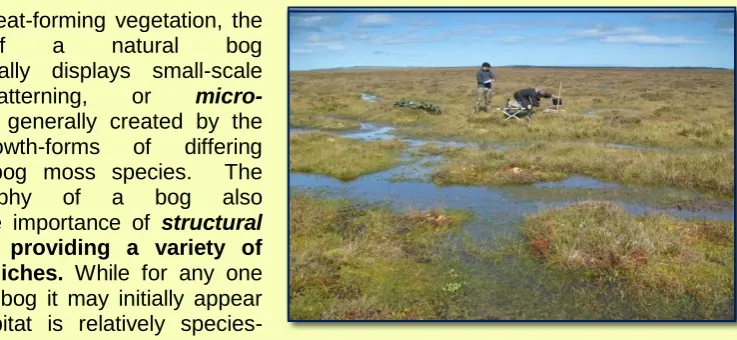
As well as peat-forming vegetation, the surface of a natural bog characteristically displays small-scale surface patterning, or micro-topography, generally created by the varying growth-forms of differing
Sphagnum bog moss species. The
microtopography of a bog also highlights the importance of structural diversity in providing a variety of ecological niches. While for any one locality on a bog it may initially appear that the habitat is relatively
species-poor, closer examination of differing parts within the pattern, and of differing patterns within the bog as a whole, will often reveal a surprising diversity of plant and animal species. The surface microtopography, for example, provides an important range of small-scale environmental conditions which are exploited by a wide variety of birds, invertebrates and even mammals.
Within peat bogs, individual species and vegetation groups occupy, or utilise, particular zones within the small-scale surface pattern which resemble the vertical zonation observed on rocky seashores, but squeezed into a total vertical range which typically occupies less than 50-75 cm. Thus the various carnivorous plant species of UK peat bogs occupy differing zones characterised by differing species of Sphagnum bog moss (right), while birds such as dunlin use higher zones for nesting and wetter zones for feeding. Each bog zone spans only 10-20 cm, but is sufficiently stable to persist for centuries or even millennia. The persistence of such narrow life-zones is made possible because the bog water table is a remarkably stable feature. It sits within just 5 cm of the bog surface for the majority of the year, summer and winter, almost whatever the weather.
Bogs in Tierra del Fuego created by only two species of Sphagnum bog moss display as much ecosystem diversity through their microtopography as do the more celebrated patterned bogs of the Flow Country in the far north of Scotland. This allows natural bogs to support a wide range of plant, insect and other species, contrary to the mistaken view that bogs are a species-poor habitat.
Water balance controls patterning
[image:2.595.190.559.76.246.2]water-3 | P a g e
Hollows and pools
Ridges and hummocks
Resilience to climate change
Natural States:
Three typical states across the UK
Different degrees of patterning in different places
Natural states reflect different climatic
conditions
Equal levels of ecosystem function
surplus than does a bog surface which is almost level. Significant quantities of surplus water are stored as hollows or pools, and the greater the quantity of available surplus water, the larger and more complex these pool systems will be. Furthermore, during wet phases in the climate there will be a tendency for greater hollow and pool formation whereas during dry phases bogs will become dominated by mossy ridges and hummocks at the expense of hollows and pools. This adaptive response has allowed UK bogs to lay down peat almost continuously throughout the past 10,000 years despite several major shifts in climate during this period. Bogs in their natural state are remarkably resilient wetland systems.
Describing Bogs:
vegetation is not enough!
JNCC '-tope' system
Thus vegetation describes only one facet of diversity in peat bogs, yet, among western nations with substantial peat deposits, the UK is one of the few not to use an integrated system of vegetation, microtopography and overall site hydrology to characterise the biodiversity of its bog systems. Instead it relies almost exclusively on vegetation description, most commonly in the form of the National Vegetation Classification (NVC), despite the fact that an integrated system has been recommended for use by the statutory conservation agencies (now through the Joint Nature Conservation Committee – JNCC) for the past two decades.
4 | P a g e
provided in the SSSI Selection Guidelines because the NVC offers a valuable set of vegetation categories which work well at regional level. The system of description is further supplemented, amplified and illustrated by Lindsay (2010). Within the UK, this system has just begun to feature in a few large-scale survey programmes and research publications.
Damage Loss of acrotelm (living layer) is critical
'Haplotelmic' bog
Damage-transition model:
States of degradation
1 b/c Loss of aquatic zones
2 Burnt/drained
3 Eroding bog
4 Complete loss of surface living layer (acrotelm)
In a damaged bog the acrotelm has often been lost because of drainage, burning, trampling, grazing, atmospheric pollution, afforestation or even agricultural inputs such as fertilizer and seeding. This exposes the unprotected catotelm peat to the effects of oxygen, sun, wind, frost and rain and so it begins to degrade, losing carbon back into the atmosphere and into watercourses as it does so, much as a defoliated tree may stand for a century or more, but with its trunk and bare branches slowly rotting away. A peat bog in this state is termed a haplotelmic bog (i.e. a single-layered bog). It may still have a vegetation cover, often of a heathland character, but this vegetation is not adding fresh peat because it is not a wetland vegetation and is more likely to be causing further degradation of the peat through the aerating and drying action of its root systems. Neither is this vegetation capable of altering the natural pattern of microtopgraphy and thus provide ecosystem resilience. Indeed any such pattern is likely to have been lost, degraded into a tussock-dominated micro-erosion complex, or developed into a full-blown erosion complex dominated by haggs and gullies.
Overall shape, pattern and vegetation are all needed to describe bog
5 | P a g e
habitat condition
Non-wetland species are a sign of damage
The majority of UK bogs are damaged: (the default position for assessment)
associated species assemblages. As these impacts, whether caused by drainage, burning, trampling, domestic peat cutting or other factors, become more intense or more evident, the various stages of degradation become clearer. For example, in an area of peat bog with drainage ditches, the microtopography around the drained area may display a dominance of somewhat uniform Sphagnum-rich ‘high ridge’ conditions. The area
appears 'active' and therefore seemingly undisturbed. Despite this, comparison with the microtopography and vegetation of areas more distant from the drained area particularly if combined with evidence from the recent peat archive in the drained area, will often provide signs of change following drainage.
Comparing the 'damage transition model' (previous page) with the earlier 'natural states' model, it is possible to see that drainage can induce small-scale pattern changes similar to those under different climate conditions and the drainage impacts may therefore be mis-interpreted. Careful examination will nevertheless reveal distinct morphological changes at the mesotope scale (see Drainage Briefing Note 3). As impacts become more intense, however, any ambiguity in the condition or response of the bog system vanishes because the various transition states become more evident, displaying distinctive forms of degradation in response to damage (see 'damage transition model'). The various degradation states still possess a microtopography, but now the individual patterns are those of a bog surface undergoing ecosystem breakdown (or recovery from breakdown - as in the tussocks and re-vegetating micro-erosion shown here). Damage to a peatland may increase the number of
species locally by introducing additional dry habitat such as heath, but the ‘invasion’ of species which compete more successfully in drier conditions is at the cost of species characteristic of peat-forming conditions, some of which are nationally rare while others have shown steep declines in some areas. Loss of such species and their associated habitat thereby threatens biodiversity at a national scale.
It is important to be aware that the majority of the UK peat bog habitat is currently in a state of degradation or recovery. Very little is in a state which can be regarded as 'near-pristine'. Consequently the likelihood is that, when looking at a peat bog system, it will be a system which is in degradation state 2, 3 or 4 (or a recovering version of these). This should therefore be taken as the default position until closer examination is able to prove otherwise.
Importance of adequate description
Failure of scientific literature
If the nature and condition of a bog are not adequately described, it is impossible to judge the need for, and nature of, any conservation actions. Equally, it is impossible to judge whether any such conservation actions have achieved the desired result. Inadequate description of research sites also makes it difficult or impossible to judge the significance or relevance of a given scientific study. A site which is described as ‘undisturbed’ but is in fact recovering from the effects of a severe fire several years ago will display a different set of responses from a site which is genuinely undisturbed.
6 | P a g e
Benefits of better
descriptions
More effective descriptions of the peat bog ecosystem would improve correlations between ecosystem condition and the range of ecosystem behaviours noted within the scientific literature. It would also enable more accurate assessments of restoration requirements to be made, and would provide a framework of description for the monitoring of restoration effectiveness.
Areas at risk of being confused
Any area of upland, 'moorland' or lowland 'heath' has the potential to contain peatland soils and should therefore be checked for the presence of dark organic soil exceeding 30 cm in thickness, as should any area of wetland or agricultural land. There are even examples of peat soils in urban areas.
Gaps in Knowledge
Identified gaps are:
lack of descriptions of the full range of UK peat bog vegetation stands and their relationship with microtopography; the NVC provides high-level categories, the JNCC SSSI Guidelines for Bogs provide sub-categories linked to microtopography but the list is not geographically comprehensive;
adequate training for field surveyors to apply the 'tope' system.
Practical Actions
Practical actions:
adoption of the JNCC ‘tope' system is an urgent priority;
further development of the vegetation elements of the 'tope' system to provide good coverage of the geographical and ecological spectrum;
training for field surveyors in use of the 'tope' system. See also:
http://jncc.defra.gov.uk/pdf/SSSIs_Chapter08.pdf http://www.uel.ac.uk/erg/PeatandCarbonReport.htm
Other Benefits By addressing the gaps and undertaking the practical actions listed above, the resulting system of peatland habitat description would enable all sectoral interests to develop a robust understanding of the current condition, future sustainable capacity, and scale of ecosystem services provided to society by the peatland resource.
More
Information
Underpinning scientific report:
http://www.rspb.org.uk/Images/Peatbogs_and_carbon_tcm9-255200.pdf (low resolution)
http://www.uel.ac.uk/erg/PeatandCarbonReport.htm(high resolution : downloadable in sections)
IUCN UK Peatland Programme:
http://www.iucn-uk-peatlandprogramme.org/
Natural England Uplands Evidence Review:
http://www.naturalengland.org.uk/ourwork/uplands/uplandsevidencereviewfeature.aspx
Scottish Natural Heritage Report on peat definitions:
http://www.snh.org.uk/pdfs/publications/commissioned_reports/701.pdf
Peatland Action:
http://www.snh.gov.uk/climate-change/what-snh-is-doing/peatland-action/
7 | P a g e
research findings and planning the recovery of damaged peatlands.
These briefs have been produced following a major process of review and comment building on an original document: Lindsay, R. 2010 ‘Peatbogs and Carbon: a Critical Synthesis’ University of East London. published by RSPB, Sandy. http://www.rspb.org.uk/Images/Peatbogs_and_carbon_tcm9-255200.pdf, this report also being available at high resolution and in sections from:
http://www.uel.ac.uk/erg/PeatandCarbonReport.htm
The full set of briefs can be downloaded from:www.iucn-uk-peatlandprogramme.org.uk
The International Union for the Conservation of Nature (IUCN) is a global organisation, providing an influential and authoritative voice for nature conservation. The IUCN UK Peatland Programme promotes peatland restoration in the UK and advocates the multiple benefits of peatlands through partnerships, strong science, sound policy and effective practice.
We are grateful to Scottish Natural Heritage, Natural England, Natural Resources Wales, the Forestry Commission RSPB Scotland and the Peter de Haan Charitable Trust for funding support. Authors
Date