A Data Association Algorithm for Multiple
Object Tracking in Video Sequences
M.H. Jaward, L. Mihaylova, N. Canagarajah and D. Bull
Abstract This paper presents a particle filtering
algorithm for multiple object tracking. The proposed particle filter (PF) embeds a data association technique based on the joint probabilistic data association (JPDA) which handles the uncertainty of the measurement origin.
I. Introduction
Tracking a group of targets in video sequences has many surveillance applications. It has been used for security monitoring [1], [2], as well as for traffic flow measuring [3], accident detection on high-ways, and routine maintenance in nuclear facilities. The goal is to obtain a record of the trajectory of the moving objects such as humans or vehicles over space and time by processing the data. The moving target can undergo non-rigid deformations, rotations or occlusions.
During multiple target tracking, several challeng-ing issues arise which do not exist in schalleng-ingle target tracking. One of them is the management of multiple tracks caused by newly appearing targets and the disappearance of already existing targets. In earlier works, this is handled by using hybrid state esti-mation framework with joint tracking of all existing targets [4]. Joint tracking of targets avoids the neces-sity of maintaining several filters, but the identity of the individual targets might be lost, especially when targets are close to each other. A separate single tracking filter can be used for multiple target tracking, only when all targets are fairly well separated.
When the targets are close to each other, or their paths cross, it has been shown in aerospace applications [5], [6], [4], that the data association techniques can assist tracking without loosing the identity of each target. However, some of the tech-niques developed for aerospace applications are not applicable to vision problems because of the
particu-The authors are with the Department of Electrical and Electronic Engineering at the University of Bristol, Wood-land Road, Bristol, BS8 1UB, United Kingdom, email:
[email protected], [email protected]
larities of visual tracking based on different features such as colour and motion. In vision tracking there are no measurements in explicit form. It is computa-tionally expensive to obtain external measurements in the form of blobs, but is is easier to obtain mea-surements from the image region specified by the state vector. For example, the clustering techniques proposed in [7] to evaluate the varying number of targets cannot be used as we do not have explicit external measurements.
In this paper, a sequential Monte Carlo version of a data association scheme is designed to track mul-tiple targets and the track management is handled by existence probabilities calculated from the data association stage. This proposed scheme is simple and does not demand high computational resources. Tracking is based on multiple independent particle filters and the Probabilistic Data Association (PDA) algorithm which handles the uncertainty due to the measurement origin. The data association algorithm also helps to recover from full or partial occlusions. The proposed algorithm can estimate the number of active targets in the video sequence and can accordingly stop unwanted tracking filter(s).
The rest of the paper is organised as follows. Section 2 formulates the tracking problem and describes the motion and measurement models. Section 3 formulates the Joint Probability Data Association problem and presents the developed PF tracking algorithm based on Joint Probabilistic Data Association Algorithm (JPDA). Section 4 contains results demonstrating the PF-JPDA performance over natural video sequences. Section 5 summarises the results and discusses open issues for future research.
2. Problem Formulation
The aim is to sequentially track multiple objects described by the same specified colour histogram
q∗, in a video sequenceZ
requires to specify a motion model, i.e., the evolution of the statep(xk|xk−1), and a measurement model,
linking the state and the current measurement,
p(zk|xk).
The Monte Carlo approach relies on a sample-based construction to represent the state pdf. Mul-tiple particles (samples) of the state are generated, each one associated with a weight which charac-terises the quality of a specific particle. An estimate of the variable of interest is obtained by the weighted sum of particles. Two major stages can be distin-guished: prediction and update. During prediction, each particle is modified according to the state model of the region of interest in the video frame, including the addition of random noise in order to simulate the effect of the noise on the state. In the update stage, each particle’s weight is re-evaluated based on the new data. An inherent problem with particle filters is degeneracy, the case when only one particle has a significant weight. A resampling procedure helps to avoid degeneracy by eliminating particles with small weights and replicating the par-ticles with larger weights.
The next two subsections describe the object motion model and the measurement likelihood function.
2.1. State Vector and Motion Model
The moving object is surrounded by a rectangular region. We describe the motion of the object by the random walk model,
xk =Fxk−1+vk−1, (1)
where the state vector xk = (xk, yk)T comprises the coordinates of the centre of this image region.F is the transition matrix (F = I for our random walk model) and vk−1 is the process noise, assumed to be white, zero-mean, Gaussian, with a covariance matrix Q. Other variables can be added, such as width and height of the image region, velocities and scale change rate, depending on the application.
2.2. Colour Measurement Model
The work described in this paper is based on colour measurement cue. Other cues, e.g. texture, edges or motion and joint variations of any of them can be used. The choice of the specific cue depends on many factors such as the resolution of the video, background/ foreground environment and dynamic nature of the targets to be tracked. Following [8] and [9], we do not use the entire image zk as a
measurement, but rather we extract from the image the colour histogram qk, computed inside the image region that is specified by the state vector xk. The centre is defined by(xk, yk). Furthermore, we adopt the Gaussian density for the likelihood function of the measured colour histogram as follows:
p(qk|xk)∝ N(Dk; 0, σ2) = √1 2πσexp
(
−D2k
2σ2
)
, (2)
where Dk is the distance between the reference histogram q∗ of the objects to be tracked and the histogram qk computed from the current frame zk in the region specified by the state vector xk. The standard deviation σ of the Gaussian density in (2) is a design parameter.
If the two histograms are calculated over U bins, the distanceDk between two histograms is derived in [8] from the Bhattacharya similarity coefficient:
D2
k= 1− PU
u=0
p
q∗(u)qk(u).
3. Joint Probability Data Association
Data Association algorithm [5] to multiple targets. It estimates the states by a sum over all the as-sociation hypothesis weighted by the probabilities from the likelihood. The most general data associa-tion method, the multiple hypothesis tracking (MHT) technique, is computationally intensive, and calcu-lates every possible update hypothesis [11]. In [12], the probabilistic MHT (PMHT) method is presented, and a maximum-likelihood method in combination with the expectation maximisation (EM) method. A comparative study of JPDAF and PMHT is made in [13]. In [14], the solution to the assignment problem for data association is proposed within the Bayesian framework by incorporating the association in the estimation equations. In [15], [16], this idea is sug-gested for particle filtering, when the problem of maintaining a track on a target in the presence of intermittent spurious objects. Samples are drawn from the overall target probability density. The so-called joint-filter in [17] is a solution to the joint data association and estimation problem for particle filters. The estimation is performed by a particle filter and a Gibbs sampler [18] is used for the data association.
The JPDA approach that we follow is an extension of the PDA developed in [5], [6] for single targets. In the JPDA, a known number of targetsτ is assumed. The index t = {1, . . . , τ} designates one among the τ targets. The measurements at time step k
are denoted as zk = {zjk}mk
j=0, where an artificial
measurementz0is introduced to handle false alarms
or clutter and the number of measurements is given bymk. The measurement to target association prob-abilities are evaluated jointly across the targets. Letθ
denotes the joint association event (the time indexk
is omitted for simplicity) andθtjis the particular event which assigns the measurementjto the targett. By assuming that the estimation problem is Markovian and by applying the Bayes’ theorem, the joint asso-ciation probabilities are
P(θ|Zk) = 1cp(zk|θ,Xk)P(θ|Xk), (3)
where c is a normalisation constant and Xk =
{x1, . . . ,xk}. Additionally, it is assumed that the
measurements are detected independently of each other. The probability of the assignment θ con-ditioned on the sequence of the targets’ states
P(θ|Xk)is approximated by
P(θ|Xk) =PDτ−n(1−PD)nPF Amk−(τ−n), (4) where PD denotes the probability of detection, n is
the number ofz0 assignments andPF A denotes the probability of false alarm.
The innovation between the j-th measurement zjk and the predicted measurement ˆzjt,k of target t
at time step k is νt,kj = zjk −ˆzjt,k and Sjt,k is the corresponding innovation covariance matrix. Then the normalised innovationdjt,kis defined as
djt,k= (νt,kj )T(Sjt,k)−1νt,kj . (5) By assuming that the measurement is of dimension
M, it follows that the M-dimensional Gaussian as-sociation likelihood for the j-th measurement to the targettis
p(νt,kj ) = 1
(2π)M/2|Sj
t,k|1/2 exp
−(djt,k)2
2
, (6)
where|Sjt,k|is the determinant ofSjt,k.
Finally, the probability of an individual joint associ-ation event is given by
P(θ|Zk) =PDτ−n(1−PD)nPF Amk−(τ−n) Y
θj t∈θ
p(νt,kj ). (7)
As shown in [19], the number of associations in-creases exponentially with an increase in the num-ber of measurements and targets, rendering the use of all hypothesis infeasible for even moderate values for these quantities. The number of possible associations λ, given that ND of the τ targets have been detected, is
Nλk(ND, τ) =
mk!τ!
ND!(mk−ND)!(τ −ND)! (8)
and so the total number of possible hypotheses (sinceND is not known) is
min(Xmk,τ) ND=0
Nλk(ND, τ). (9)
Even for the case of three targets and three measurements, this amounts to 34 hypotheses. Therefore, in practice, it is common to apply gating techniques [5] to reduce the number of hypotheses and the computational cost respectively.
3.1. Monte Carlo JPDA
represented with Monte Carlo samples, instead of with Gaussian approximations, as it is in the standard JPDAF. The PF-JPDA algorithm implemented in our paper is given below. In the algorithm, x(t,ki) refers to the ith sample of the state vector corresponding to targettat timek.
The JPDA particle filter for multiple target tracking
1) Initialisation.
Set k = 0, generate N samples x(t,i0) for all targetst= 1, . . . , τindependently.
x(t,i0) is drawn from p(xt,0), with initial weights
w(t,i0) = 1/N, fori = 1, . . . , N particles and set
k= 1.
2) Fori= 1, . . . N predict new particles
x(t,ki∗)=Fxt,k(i)−1+v(t,ki)−1.
3) For each particles compute the weights for all measurements (j = 0, . . . , mk) to target (t = 1, . . . , τ) associations wt,k(i) = PθP(θ|Zk) (Equation (7)) and normalise the weights for
each target:w˜(t,ki)= Pw(t,ki) N i=1w
(i)
t,k .
4) For each target, generate a new set{x(t,ki)}N i=1,
by resampling with N times from {x(t,ki∗)}N i=1,
whereP(x(t,ki) =xt,k(i∗),t) = ˜wt,k(i). 5) Increasekand iterate to step 2.
3.2 Particularities of the JPDA Implementation
The algorithm assumes knowledge of the maxi-mum number of targets,τ. It is based on the sequen-tial Monte Carlo version of the JPDA algorithm [20], [21]. All objects to track are manually selected within rectangular regions. The reference histograms for each object are obtained from these selected re-gions with the help of colour cue. During the tracking process the number of objects is estimated. This is used to detect when an object disappears from the scene and to stop the corresponding tracking filter.
Let P(Hl|Zk) (l = 1, . . . , τ) denotes the posterior probability of the existence of l number of targets. In general, this probability depends on the ‘full’ hy-pothesis list which considers all possible hypotheses from frame1to framek. However, it can be approxi-mately estimated from the hypotheses assumed in the Monte Carlo JPDA. Using the total probability
theorem, the existence probability of l number of targets is given by
P(Hl|Zk) = X
θ∈χl
P(θ|Zk), l= 1, . . . , τ, (10)
where χl is the event (hypothesis) that l number of targets exists. Joint existence probabilities of specific targets (such as the existence of target 1 with target 2 or target 1 with target 3) also can be estimated, in a similar way.
The probabilities in (10) give the number of targets active at time instantk. We also need to know which target(s) disappeared from the scene. This can be obtained from the posterior probabilities of existence of individual targets. LetHt1,t2,...,tρ be the hypothesis that t1, t2, . . . , tρtargets exist, withρ ={1,2, . . . , τ}. Then the existence probability of this event is given by:
P(Ht1,t2,...,tρ|Zk) =
X
θ∈χt1,t2,...,tρ
P(θ|Zk), (11)
where χt1,t2,...,tρ denotes the events that targets
{t1, t2, . . . , tρ} exist. If a target (tracked by the al-gorithm) disappears from the scene, the changes in the number of objects is reflected in the probabilities
P(Ht|Zk). From the probabilities P(Ht1,t2,...,tρ|Zk), we can obtain the identity of the target which just disappeared. The use of these probabilities in track management is further explained in the next section with an example. Accordingly, we can stop the cor-responding filter and this reduces the computational complexity.
In many cases, the colour information of the object of interest varies in time. In such situations, adaptation of the initial reference histograms are required for continous tracking similarly to [9]. The algorithm proposed in this paper can be used with or without adaptation. With adaptation, the reference models for some or all targets can be modified such as in [23]
4. Performance Investigation
The proposed algorithm is tested using real world image sequences. We show results with a video se-quence obtained from www.visualsurveillance.org. The aim is to track two people as shown in figure 1(a). The maximum number of targets is two (τ = 2). The algorithm is used with N = 150 samples for each filter.The PF is used with a system noise covariance ofQ= diag{5, 5}and observation noise covariance ofσ2 = 0.01. The probability of detection
Fig. 1. Image frames of the video sequence: (a) Initial frame. Targets to be tracked are selected within a rectangle (b) Frame 80. Tracked players are marked with a rectangle.
colour cue used U = 128 ×128×128 number of histogram bins.
The two targets are selected manually from the first frame. The person on the left is denoted as target #1 and selected second person on the right is denoted as target #2. A reference model adaptation is performed only for target #1 as it was found to be difficult to track without adaptation. The adaptation scheme proposed in [23] is used in this paper.
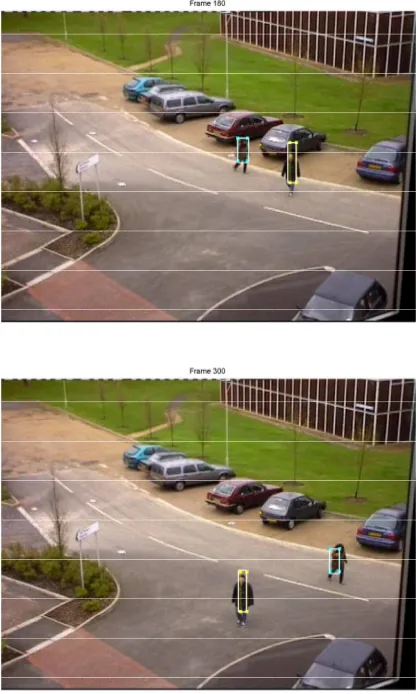
[image:5.595.67.272.56.404.2]Figure 1 illustrates the tracking performance of the proposed algorithm. As shown in this figure 1(b), at frame 80 both filters are locked to their targets. Figure 2 shows the performance of proposed algo-rithm with a presence of partial occlusion. The figure in the top row shows that both filters are tracking their corresponding targets at frame 160. After the occlusion, as seen from the figure in the bottom row, the two filters are still successfully tracking the two objects. Variations of the number of targets tracked
Fig. 2. Image frames of the video sequence: (a) Frame 180-before occlusion (b) Frame 300- after occlusion. Tracked players are marked with a rectangle.
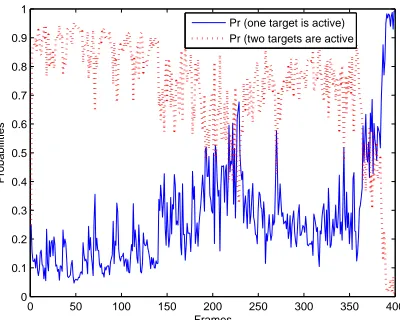
is shown in Figure 3. As seen from this figure, before frame 360 the number of targets is two. When the target #1 disappears from the frame, the number of active targets becomes 1. This plot does not indi-cate which target disappeared and this information can be obtained from the existence probabilities as shown in Figure 4. Figure 4 presents the existence probability for targets #1 and #2. The probability for target #1 is very low after the frame 360 compared to that of target #2. This indicates that the disappeared target is the target #1. The probabilities of number of active targets change around frame 230. This is caused by the occlusion of two targets and at this period, the number of active targets becomes close to one.
5. Conclusions
0 50 100 150 200 250 300 350 400 0
0.1 0.2 0.3 0.4 0.5 0.6 0.7 0.8 0.9 1
Frames
Probabilities
[image:6.595.64.264.62.222.2]Pr (one target is active) Pr (two targets are active
Fig. 3. Probabilities of the number of targets: one active object or two active targets.
0 50 100 150 200 250 300 350 400 0
0.1 0.2 0.3 0.4 0.5 0.6 0.7 0.8 0.9 1
Frames
Probabilities
Pr (target #1 is active) Pr (target #2 is active)
Fig. 4. Existance probabilities of individual targets.
concentrated on coping with full occlusions and using other features apart from colour.
Acknowledgements. The authors are grateful to the
financial support by the UK MOD Data and Information Fusion Defence Technology Centre.
REFERENCES
[1] E. Stringa and C.S. Regazzoni, “Real-time video-shot detection for scene surveillance applications,” IEEE Trans.
Image Processing, vol. 9, pp. 69–79, Jan. 2000.
[2] I. Haritaoglu, D. Harwood, and L. Davis, “w4
: who? when? where? what? a real time system for detecting and tracking people,” in Proc. IEEE Conf. Face Gesture Recognition, 1998, pp. 222–227.
[3] D. Koller, J. Weber, T. Huang, J. Malik, B. Rao G. Oga-sawara, and S. Russell, “Toward robust automatic traffic scene analysis in real-time,” in Proc. Int. Conf. Pattern
Recog., 1994, vol. 1, pp. 126–131.
[4] W. Ng, J. Li, S. Godsill, and J. Vermaak, “A review of recent results in multiple target tracking,” in Proc. of the
International Symp. on Signal Processing and Analysis,
2005.
[5] Y. Bar-Shalom and X.R. Li, Estimation and Tracking:
Prin-ciples, Techniques and Software, Artech House, Boston,
MA, 1993.
[6] S. Blackman and R. Popoli, Design and Analysis of Modern
Tracking Systems, Artech House, 1999.
[7] W. Ng, J. Li, S. Godsill, and J. Vermaak, “Tracking variable number of targets using sequential monte carlo methods,” in Proc. of the IEEE Statistical Signal Processing
Work-shop, 2005.
[8] D. Comaniciu, V. Ramesh, and P. Meer, “Real-time tracking of non-rigid objects using mean shift,” in Proc. IEEE Conf.
Comp. Vision Pattern Recog., 2000, pp. 142–149.
[9] K. Nummiaro, E. Koller-Meir, and L. Van-Gool, “An adap-tive color-based particle filter,” Image and Vision
Comput-ing, vol. 21, pp. 99–110, 2003.
[10] T. Kirubarajan and Y. Bar-Shalom, “Probabilistic data association techniques for target tracking in clutter,” Proc.
of the IEEE, vol. 92, no. 3, pp. 536–557, 2004.
[11] D. Reid, “An algorithm for tracking multiple targets,” IEEE
Trans. Automatic Control, vol. 24, no. 6, pp. 84–90, 1979.
[12] H. Gauvrit, J-P. Le Cadre, and C. Jauffret, “A formulation of multitarget tracking as an incomplete data problem,” IEEE
Trans. Aerospace and Systems, vol. 33, no. 4, pp. 1242–
1257, Oct. 1997.
[13] C. Rago, P. Willett, and R. Streit, “A comparison of the JPDAF and PMHT tracking algorithms,” in Proc. of the
ICASSP, 1995, vol. 5, pp. 3571–3574.
[14] D. Avitzour, “A stochastic simulation bayesian approach to multitarget tracking,” IEE Proc. Radar, Sonar and Navig., vol. 142, pp. 41–44, 1995.
[15] D.J. Salmond, D. Fisher, and N.J. Gordon, “Tracking om the presence of intermittant spurious objects and clutter,” in SPIE Conf. on Signal and Data Processing of Small
Targets, 1998.
[16] N.J. Gordon, “A Hybrid Bootstrap Filter for Target Tracking in Clutter,” IEEE Trans. on Aerospace and Electronic Systems, vol. 33, no. 1, pp. 353–358, 1997.
[17] C. Hue, J-P. Le Cadre, and P. Perez, “Tracking multiple objects with particle filtering,” IEEE Trans. Aerospace and
Systems, vol. 38, no. 3, pp. 791–812, July 2002.
[18] S. Gemen and D. Gemen, “Stochastic relaxation, Gibbs distributions and the Bayesian restoration of images,” IEEE
Transactions on Pattern Analysis and Machine Intelligence,
vol. 6, pp. 721–741, 1984.
[19] B.Ristic, S. Arulampalam, and N.Gordon, Beyond the Kalman Filter: Particle Filters for Tracking Applications,
Artech House Radar Library, 2004.
[20] R. Karlsson and F. Gustafsson, “Monte Carlo data asso-ciation for multiple target tracking,” in IEE Target tracking:
Algorithms and applications, Netherland, Oct 2001.
[21] D. Schultz, W. Burgard, D. Fox, and A.B. Cremers, “Track-ing multiple mov“Track-ing targets with a mobile robot us“Track-ing particle filters and statistical data association,” in IEEE
International Conf. on Robotics and Automation, 2001.
[22] J. Vermaak, S.J. Godsill, and P. Perez, “Monte Carlo fil-tering for multi-target tracking and data assoication,” IEEE
Trans. Aerospace and Systems, vol. 41, no. 1, pp. 309–
332, January 2005.
[23] M.H. Jaward, N. Canagarajah, and D. Bull, “Adaptive tracking using combined colour and motion cues,” Under
[image:6.595.63.266.279.437.2]