Published Online January 2014 (http://www.scirp.org/journal/me) http://dx.doi.org/10.4236/me.2014.51009
Parametric Decomposition of the Malmquist Index in
Output-Oriented Distance Function: Productivity in
Chinese Agriculture
Bingxin Yu1, Xiyuan Liao2, Hongfang Shen3 1
International Food Policy Research Institute, Washington DC, USA 2
Seed Management BureauMinistry of Agriculture of China, Beijing, China 3
China National Rice Research Institute, Hangzhou, China
Email: [email protected], [email protected], [email protected]
Received November 23, 2013; revised December 23, 2013; accepted December 30, 2013
Copyright © 2014 Bingxin Yu et al. This is an open access article distributed under the Creative Commons Attribution License, which permits unrestricted use, distribution, and reproduction in any medium, provided the original work is properly cited. In accor-dance of the Creative Commons Attribution License all Copyrights © 2014 are reserved for SCIRP and the owner of the intellectual property Bingxin Yu et al. All Copyright © 2014 are guarded by law and by SCIRP as a guardian.
ABSTRACT
This paper decomposes the Malmquist productivity index into several assembling components: technical change (further break down into technical change magnitude, input bias and output bias), technical efficiency change, scale efficiency change, and output-mix effect. A translog output distance function is chosen to represent the production technology and each component of the Malmquist index is computed using the estimated parameters. This parametric approach allows us to statistically test the hypothesis regarding different components of the Malmquist index and the natural of production technology. The empirical application in Chinese agriculture shows that the average productivity grows at 2 percent per year during 1978-2010. This growth is mostly driven by technical change, which is found to be neutral.
KEYWORDS
Malmquist Index; Output Distance Function; Translog; Bias; Scale Efficiency; Chinese Agriculture
1. Introduction
Productivity change is defined as the ratio of change in outputs to change in inputs. Reference [1] pioneered by introducing the Malmquist index to measure productivity through distance functions. Reference [2] showed that the index can be directly estimated using nonparametric techniques like Data Envelopment Analysis (DEA). They also developed the decomposition of the Malmquist in- dex into two mutually exclusive and exhaustive compo- nents: technical change and efficiency change. Afterwards, many researchers have extended this decomposition to develop a more detailed analysis of the Malmquist index, including several alternative approaches to understand te- chnical change and scale efficiency ([3-6]).
The majority of Malmquist index estimation falls un- der the nonparametric DEA approach ([7]). The DEA ap- proach estimates the Malmquist index and its compo- nents through the calculation of distance functions under
both constant and variable returns to scale technologies. The popularity of DEA stems from its advantages of non- parametric approach: easy to compute, applicable in cas- es of multiple outputs, no assumptions of economic beha- vior such as cost minimization and profit maximization, no need for price information, neither any particular functional form for estimation nor a large number of ob- servations. These features are very attractive in cases where price data is unavailable or cannot be constructed in detail, sample is too small or there is insufficient un-derstanding of firm behavior. However, the nonparame- tric approach cannot provide a way to directly test statis- tical significance or hypotheses regarding the signific- ance of the assembling components or model specifica-tion. It cannot separate measurement errors and random noise from technical inefficiency, either.
been adopted by some recent studies in the estimation of the Malmquist index ([4,8,9]). In the parametric ap- proach, the Malmquist index is not directly obtained through the estimation of distance functions under differ- rent returns to scale technologies. Instead the Malmquist index and its components are calculated based on the fitted distance function with globally variable returns to scale, evaluated at adjacent time periods’ input and out-put quantity, as implemented by [4,8-10]. In addition to statistical testing, the parametric approach has the advan- tages of accommodating random errors and enabling dif- ferent interactions between outputs and inputs if a flexi- ble functional form is chosen to closely approximate the underlying production technology.
This paper extends the methodology of [3,4] to decom- pose the Malmquist index into different components while taking into account of technology bias and scale effi- ciency change simultaneously. We test some hypotheses regarding the production technology, functional specifi-cation, and returns to scale by imposing parametric re-strictions in the estimation. The hypotheses include 1) no technical inefficiency; 2) no heterogeneous inefficiency effect; 3) no technical change; 4) production technology exhibits input Hicks neutral (no input bias); 5) output Hicks neutral (no output bias); 6) input and output Hicks neutral; 7) input-output separability; 8) Cobb-Douglas functional form; and 9) constant returns to scale. The test of each hypothesis examines the corresponding compo- nents of the Malmquist index. If technical efficiency term is statistically not different from zero, there will be no efficiency change and the contribution of efficiency change to productivity growth will be zero. If technical change or its components are insignificant, no productiv-ity growth comes from improvement in production fron-tier. If the functional form can be simplified to Cobb- Douglas function, the production technology becomes time invariant and separable. Finally, if the hypothesis of constant returns to scale is not rejected, scale effect term disappears from the Malmquist index.
By answering these questions, the paper adds value to the existing literature in several ways. First, it decom- poses the Malmquist productivity index into different components using an output distance function. Unlike [9] the decomposition of this paper is based on the geometric mean of two adjacent Malmquist index, filling a gap in the existing literature of productivity analysis. Second, it demonstrates the advantages of the parametric output dis- tance function approach to characterizing the agricultural technology and productivity decomposition. The empirical model is a four output, four input stochastic output dis- tance function in 31 Chinese provinces over the period of 1979-2010. This technique is appropriate for the issue at hand because it requires only quantity data on inputs and
outputs, which are well recorded and easily accessible. It does not require price information, which is hard to col-lect and construct. Third, the parametric approach ad-dresses common methodological issues in TFP estima-tion like testing hypothesis regarding the producestima-tion technology, which has been lacking in the empirical lite-rature. For example, the hypothesis of input-output sepa-rability is rejected, suggesting results from a stochastic production function can be misleading. This technique can also be applied to other economic investigations of productivity in various setting to produce credible and relevant results. Finally, this paper updates productivity performance of the whole agricultural sector in China with the latest data, adding evidence in designing agri-cultural development strategy in the developing country context. We found TFP grows at 2 percent annually in China, which is consistent with other studies in the coun-try. The results have important policy implications in policy design to promote productivity growth.
The paper is organized as follows. Section 2 presents the theoretical framework of decomposition of the Malmquist index based on an output-oriented distance function. Assuming a translog output distance function, parametric calculation of different components of the Malmquist index is derived in Section 3. The data and empirical results are discussed in Sections 4 and 5. Sec- tion 6 concludes with major finding and policy implica- tions derived from this study.
2. Theoretical Framework
The production technology is defined as the set of all feasible input-output combinations. The production tech- nology T in period t is:
(
,)
, 1, , .t t t
T = x y t= T (1) where xt is a K-dimensional vector of non-negative inputs
(
1, ,)
,t t t K
K
x ≡ x x ∈R+ and yt is a M-dimen-
sional vector of non-negative outputs
(
1, ,)
t t t M
M
y ≡ y y ∈R+ , Tt is the production possibil- ity set for all feasible input-output combination in period t.
The output distance function t
(
t, t)
oD x y is measured as the distance of a vector of inputs and outputs in period t with respect to the technical frontier in period t:
(
,)
min{
0 :(
,)
}
,1, , .
t t t t t
o
D x y x y T
t T
θ θ
= > ∈
= (2)
where subscript o refers to output orientation. The output distance function satisfies the inequality Dot
(
x yt, t)
≤1.(
,)
1t t t
o
The Malmquist index measures the total factor prod-uctivity (TFP) change between two adjacent periods by calculating the ratio of the distance of each data point relative to a common technological frontier. Following [2], the Malmquist index between period t and t + 1 based on the period t technology is given by
(
1 1)
(
(
1,)
1)
, , , .
,
t t t o t t t t t
o t t t
o
D x y
TFP x y x y
D x y
+ +
+ + =
(3)
The Malmquist index can be greater, equal to or less than 1 if productivity grows, is stagnant or declines be-tween the two periods.
Similarly, the Malmquist index between period t and t+1 based on the period t + 1 technology is
(
)
1(
(
1)
1)
1 1 1
1
,
, , , .
,
t t t
o t t t t t
o t t t
o
D x y
TFP x y x y
D x y
+ + +
+ + +
+
= (4)
Measures of the productivity change between period t and t + 1 generally changes if reference technology is different. To avoid the arbitrary choice of reference te- chnology, [2] suggested a geometric mean of the two Malmquist indexes:
(
)
(
)
(
)
(
(
)
)
, 1 1 1
1 2
1 1 1 1 1
1
, , ,
, ,
, , .
t t t t t t o
t t t t t t
o o
t t t t t t
o o
TFP x y x y
D x y D x y
D x y D x y
+ + + + + + + + + = (5)
Reference [4] showed that the Malmquist index can be decomposed into four components: primal technical change (TC), technical efficiency change (EC), scale efficiency change (SEC) and output-mix effect (OME):
.
TFP=TC×EC SEC OME× × (6)
where
(
)
(
)
(
(
)
)
1 2 1 1
1 1 1 1
,
, ,
, ,
t t t t t t
o o
t t t t t t
o o
D x y D x y
TC
D x y D x y
+ + + + + + = (7)
(
)
(
)
1 1, 1
, ,
t t t o
t t t o
D x y
EC
D x y
+ + +
= (8)
(
)
(
)
(
(
)
)
1 2
1 1 1 1
1 1
, ,
, , ,
t t t t t t
t t t t t t
OSE x y OSE x y SEC
OSE x y OSE x y
+ + + + + + = (9)
(
)
(
)
(
(
)
)
1 21 1 1 1
1 1
, ,
.
, ,
t t t t t t
t t t t t t
OSE x y OSE x y OME
OSE x y OSE x y
+ + + + + + = (10)
The first term TC refers to technical change, whose magnitude in general depends on the particular input- output combination. There is technical progress when
TC is greater than one and technical regress when it is less than one. If TC x
(
t+1,yt+1)
=TC x y(
t, t)
, the tech- nical change is output neutral.The technical efficiency, TE=Dot
(
x yt, t)
, measures the distance of the firm’s position inperiod t relative to the period t frontier of the technology, or how far the observed production is from maximum potential produc- tion. By definition TE≤1, and the production unit is ef- ficient if and only if TE=1. The second term EC meas- ures technical efficiency change between period t and t+1. If EC is greater than one, the production unit moves closer to the frontier—in other words, that the production unit is catching up to the production frontier by improv-ing efficiency. A value of less than one indicates effi-ciency regress.The third term SEC refers to scale efficiency change between two periods, which measures how the output- oriented scale efficiency changes over time conditional on a certain output mix. It is the ratio of output orientated measure of scale efficiency OSE in period t
and t + 1, where
(
)
(
)
(
)
ˆ ,
,
,
t t t o t t t
t t t o
D x y
OSE x y
D x y
= and
(
)
ˆt t, t o
D x y is the output distance function based on the cone technology
(
) (
)
{
}
ˆt t, t t, t t, 0
T = λ λx y x y ∈T λ> .
If OSE = 1, the frontier point that can be reached by proportionally expanding yt is a point of technically optimal scale. At that point the technology exhibits con-stant return to scale (CRS) and scale elasticity equals to one ot
(
x yt, t)
=1. If SEC is greater than one, the output bundle at period t + 1 lies closer to the point of technical optimal than the output bundle at period t and thus scale efficiency improves. If SEC is less than one, the scale efficiency deteriorates.The fourth term is labeled as output-mix effect (OME) by [4], which measures how the distance of the frontier point to the frontier of the cone technology changes when the output-mix changes, that is, the change in the output- oriented scale efficiency from a change in output mix when inputs remain constant. When output mix changes the scale efficiency increases if OME values greater than one, and scale efficiency declines if OME is less than one. In the case of single-output OME = 1. Under global CRS technology, both SEC and OME are identically equal to one.
(
)
(
)
(
(
)
)
(
)
(
)
(
(
)
)
(
(
)
)
(
)
(
)
(
(
)
)
(
(
)
)
1 2 1 11 1 1 1
1 2
1 1 1
1 1 1 1
1 1 1 1
1 1 1 1 1
, , , , , , , , , , , , , , , ,
t t t t t t
o o
t t t t t t
o o
t t t t t t t t t
o o o
t t t t t t t t t
o o o
t t t t t t t t t
o o o
t t t t t t t t t
o o o
D x y D x y
TC
D x y D x y
D x y D x y D x y
D x y D x y D x y
D x y D x y D x y
D x y D x y D x y
+ + + + + + + + + + + + + + + + + + + + + + = = =
(
)
(
)
(
(
)
)
1 2 1 2 1 1 1 1 , , , , .t t t t t t
o o
t t t t t t
o o
D x y D x y
D x y D x y
TCM OB IB
+ + + + × = × × (11)
where
(
)
(
)
1
, , ,
t t t o t t t o
D x y
TCM
D+ x y
= (12)
(
)
(
)
(
(
)
)
1 2
1 1 1 1
1 1 1 1
,
, ,
, ,
t t t t t t
o o
t t t t t t
o o
D x y D x y
OB
D x y D x y
+ + + + + + + + = (13)
(
)
(
)
(
(
)
)
1 2 1 1 1 1 , , , , .t t t t t t
o o
t t t t t t
o o
D x y D x y
IB
D x y D x y
+ + + + = (14)
TCM is the index of technical change magnitude. It is greater than one if the input requirement set expands along a ray through period t data, and less than one if the input requirement set shrinks. OB is referred as a period t + 1 output bias index. It compares the magnitude of te- chnical change along a ray through yt+1 with the mag-nitude of technical change along a ray through yt while holding the input vector constant at t 1
x+ . The period t input bias index IB compares the magnitude of technical change along a ray through t 1
x+ with the magnitude of technical change along a ray through t
x , holding the output vector constant at yt
. The bias indexes OB and IB are greater than one if the magnitude of technical change measured along a ray through period t + 1 data exceeds the magnitude of technical change measured along a ray through period t data, and vice versa. Refer-ence [3] proved that OB (IB) equal to one if the technol-ogy is said to exhibit implicit Hicks output-neutral (in-put-neutral) technical change. In other words, the output (input) set shifts in or out by the same proportion along a ray through period t + 1 data as it does along the ray through period t data. OB equals to one in the case of single output and IB equals to one in the case of single input.
3. Parametric Estimation of the Malmquist
Index
Unlike nonparametric DEA approach, the parametric
approach requires pre-defined functional form of dis- tance function for estimation. According to [11] this spe-cification fulfills a set of desirable characteristics: flexi-ble, easy to derive and allowing the imposition of homo-geneity. The flexible form of translog has been widely used to estimate distance functions as it meets all the required characteristics ([4,6,9,10,12]). This paper will also adopt translog functional form.
The period t technology is represented by a translog output distance function
(
)
0
1 1 1 1
1 1 1 1
2
1 1
.
ln ,
1
ln ln ln ln
2
1
ln ln ln ln
, 2
1
ln ln ,
2
t t t o
K M K K
t t t t
k k m m kk k k
k m k k
M M K M
t t t t
mm m m km k m
m m k m
K M
t t
kt k mt m t tt
k m
K M
D x y
x y x x
y y x y
x t y t t t
x y
α α β α
β γ
δ τ θ θ
′ ′ ′ = = = = = = = = = ′ ′ ′ = + + = + + + + + + + + + ∈ℜ ∈ℜ
∑
∑
∑∑
∑∑
∑∑
∑
∑
(15) The parameters must satisfy a set of restrictions. First the conditions for linear homogeneity in outputs is im- posed to obtain an output oriented radial distance func- tion,1 1 1 1
1, 0, 0, 0
M M M K
m mm mt km
m m m m
β β ′ τ γ
′
= = = =
= = = =
∑
∑
∑
∑
.Second, symmetry is applied as ,
kk k k mm m m
α ′=α ′ β ′ =β ′ .
The output distance function (15) is expressed as
(
)
ln t t, t, ;
o
D =TL x y tπ for notational convenience, where TL denotes the translog function specification and
(
, , , , ,)
π = α β γ δ τ θ is the vector of the parameters to be
estimated. The parameters of the distance function can be estimated only if linear homogeneity in outputs is im- posed. Following [11], all output quantities in the right hand side of Equation (15) is divided by the quantity of an arbitrary output, say the first output, as the numeraire. Lets’ denote y*m=ym y1, the translog function is re- written as
t o
1 1
lnD , , , ;
t t
t t
t t
y y
x TL x t
y y π
=
and hence
( )
(
*)
(
)
1
ln t t, , ; ln t t, t .
m o
y TL x y tπ D x y
− = − (16)
Since ln t
(
t, t)
oD x y is unobservable, setting
(
)
ln ,
t t t t
o
(
*)
10
1 2
1 1 2 2
1 2 1 2
2
ln , , ;
ln ln
1 1
ln ln ln ln
2 2
ln ln ln ln
1
2 .
t t t t
K M
t t
k k m m
k m
K K M M
t t t t
kk k k mm m m
k k m m
K M K M
t t t t
km k m kt k mt m
k m k m
t t t tt
y TL x y t u v
x y
x x y y
x y x t y t
t t u v
π
α α β
α β
γ δ τ
θ θ ∗ ∗ ∗ ′ ′ ′ ′ ′ ′ ∗ ∗ = = = = = = = = = = − = + + = + + + + + + + + + + +
∑
∑
∑∑
∑ ∑
∑∑
∑
∑
(17) where u represents the stochastic shortfall of the pro-duction unit’s output from the propro-duction frontier due to technical inefficiency, u is a random non-negative er-ror term and v is a symmetric and normally distributed error term of N(
0,σv2)
.Both error terms are independently distributed. Identi-fication of the inefficiency stochastic term requires some structure to be placed on the heterogeneous and temporal pattern of technical efficiency. Following [13] the sto-chastic term uit is defined as a normally distributed
variable N
(
µ σit; u2)
truncated at zero..
it zit
µ = ϕ (18) where zit is a vector of observable explanatory vari-
ables and ϕ is a vector of parameters to be estimated. The predicted value of the output distance function can be estimated as a conditional expectation
(
)
( )
(
)
(
)
(
2)
, exp
1
exp
1 2 .
t t t t t
o
t
A A t
A t
A
D x y E u ε
σ χε σ
χε σ χε σ
= −
− Φ −
= +
− Φ
(19)
where
2
2 2 2
2
, , ,
t t t u
u v
u v σ
ε σ σ σ χ
σ
= + = + =
(
)
21
A
σ = χ −χ σ and Φ represents a standard nor-mal the distribution function.
Once the parameters of Equation (17) are estimated, the assembling parts of the Malmquist productivity index and its components can be calculated ([4,8]).
The technical change magnitude TCM
(
)
(
)
(
)
(
)
( )
1 * * * 1 2 ˆ ˆ , ,exp , , ; , ,
ˆ ˆ ˆ ˆ
1;
1
exp 1 ln ln .
2
t t t
o
t t t
o
t t t t
m m
K M
t t
kt k mt m t tt
k m
D x y TCM
D x y
TL x y t TL x y t
x y t
π π
δ τ θ θ
+ = = = = − + = − × + + + +
∑
∑
(20) Output bias index OB(
)
(
)
(
)
(
)
(
)
1 1* 1 1*
1 * 1 *
* 1*
2 exp
1
exp , , ;ˆ , , 1 ˆ
ˆ ˆ
ˆ
; 2
1
exp , , 1; , , ;
2
1
ln ln .
2
t t t t
m m
t t t t
m m
M
t t
mt m m
m
OB
TL x y t TL x y t
TL x y t TL x y t
y y π π π π τ + + + + + + + = = × − + × × + − = × −
∑
(21) Input bias index IB(
)
(
)
(
)
(
)
(
)
1 * 1 *
* *
1
1
1
exp , , ; , , 1;
2
1
exp , , 1; , , ;
2
ˆ ˆ
ˆ
1
exp ln ln .
ˆ
2 ˆ
t t t t
m m
t t t t
m m
K
t t
kt k k
k
IB
TL x y t TL x y t
TL x y t TL x y t
x x π π π π δ + + + = = × − + × × + − = × −
∑
(22) Efficiency change EC(
)
(
)
{
1 1* *}
exp t , t , 1;ˆ t, t , ;ˆ .
m m
EC= TL x+ y+ t+ π −TL x y tπ (23)
Reference [4] showed that the SEC and OME can be computed by using estimates of the output-oriented scale efficiency without estimating the output distance func-tion under CRS, as required in the nonparametric ap-proach. For any arbitrary pair
(
x y,)
the output oriented measure of scale efficiency of a translog distance func-tion is:(
)
(
)
2
, 1
ln , .
2 t o t t x y OSE x y
α
−
= − (24)
where the scale elasticity
(
)
(
)
1 1
*
1 2 1
ln ,
ˆ
ˆ ˆ ˆ
,
ln
ln ln .
K k t K o t o k k
K M K
t t
k kk k km m kt
k m k
D x y
x y
x
x y t
α α γ δ
= ′ ′ ′ = = = = ∂ = ∂ = + + +
∑
∑
∑
∑
∑
(25) And 1 1 ˆ K K t kk k kα α ′
′ = =
=
∑∑
.Since local scale efficiency can never exceed the op-timal scale efficiency, or OSEt
(
x y,)
≤1, which re-quires that α >t 0Scale efficiency change SEC
(
)
(
)
(
)
(
)
2 2
1
2 2
1 1 1 1 1
.
, 1 , 1
1 exp
2 2 2
, 1 , 1
1 exp
2 2 2
t t t t t t
o o
t t
t t t t t t
o o
t t
x y x y
SEC
x y x y
α α
α α
+
+ + + + +
− −
= × − +
− −
× × − +
(26) Output-mix effect OME
(
)
(
)
(
)
(
)
2 2
1 1 1
2 2
1 1 1
, 1 , 1
1 exp
2 2 2
, 1 , 1
1
exp .
2 2 2
t t t t t t
o o
t t
t t t t t t
o o
t t
x y x y
OME
x y x y
α α
α α
+ + +
+ + +
− −
= × − +
− −
× × − +
(27) Thus, all the assembling components of Malmquist index can be computed from evaluation of the translog output distance function.
4. Data
A panel of provincial level data is collected for the 32 provinces, municipal cities and autonomous regions from China Statistical Yearbook ([14]). There are four sub- sectors within agriculture: crop, livestock, fishery and forestry. The sub-sector outputs are valued at constant 2010 billion Yuan. Four major agricultural inputs are in- cluded: area, labor, machinery and fertilizer. Area is de- fined as total sown area in 1000 hectares, labor measures rural employment in 10,000 persons, machinery meas- ures agricultural machinery in 10,000 kilowatts, fertilizer is the consumption of chemical fertilizer in 10,000 tons. Although infrastructure and market structure does not directly contribute to output growth, they can affect pro-duction through improvement in productivity and its components. Rural infrastructure is proxied by share of irrigated area in crop sown area. Agricultural policies in- clude market openness and taxation. Market openness is calculated as the value share of agricultural products whose prices are not directly managed or stipulated by the government. Taxation is the average rate of net agri- cultural tax (agricultural tax minus subsidies) per hectare of crop sown area. Dummies are introduced to capture unique biophysical conditions in the province.
Reference [15] provides a comprehensive review of policy reform in China from 1978 to 2010, breaking into 6 stages. In the first reform stage of decentralization (1978-83), the government procurement quotas were re- duced and some commodities were phased out the
pro-curement programs to be traded in markets. Agricultural output grew sharply in this period after the establishment of household responsibility system. In the second stage of marketing system liberalization (1984-1989), although more products were liberalized the government main-tained control over strategic products (grain, cotton and oilcrops). Rapid increase in input prices dampened far-mers’ investment in agriculture and resulting in lower output growth. In the third stage of 1989-1993, reform in grain marketing system further cut the number of com-modities subject to state procurement programs, but re-gional markets remained segmented due to various price and quantity controls for strategic crops. The fourth stage (1994-99) is characterized by increased procurement prices, which brings in a fast expansion in agricultural output. In the fifth stage (1998-2003), the grain procure-ment quota was abolished and a free grain market was applied to the majority of China. The government shifted its focus from taxing agriculture to supporting producers in the sixth stage (2003-2010), with policies including input subsidies, direct payment and agricultural tax re- form.
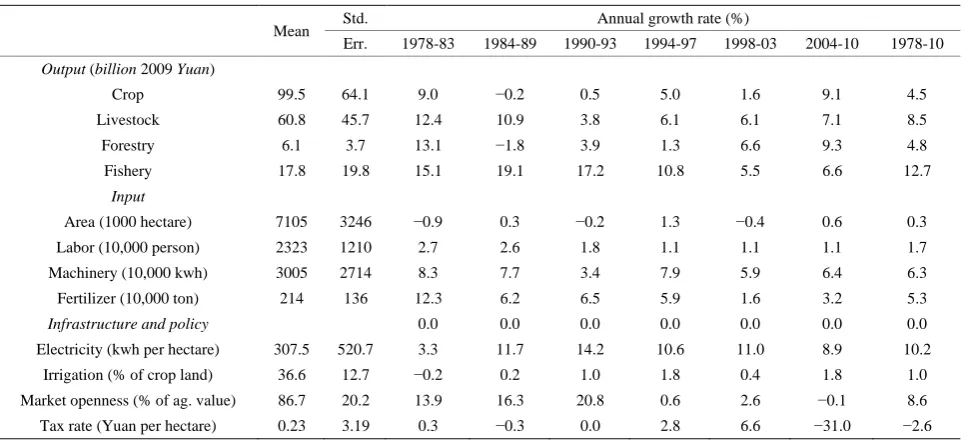
Despite fluctuations and shift of focus in policy, agri-cultural production has exhibited an impressive growth since reform. The output of agricultural sector has in-creased exponentially after the reform in China as aver-age annual growth rate reaches nearly 6 percent during 1978-2010 (Table 1). Although crop production rises at 4.3 percent annually, it is dwarfed by the surge of high value and nutritional animal products in livestock and fishery sector, which grows at 8.6 and 13 percent, re-spectively. The structure of input usage also shifted sub-stantially with modern inputs including machinery and fertilizer growing at a faster pace than traditional inputs like land and labor. Given land scarcity, rapid urbaniza-tion and economic transformaurbaniza-tion in the country, it is not surprising that land barely expanded while labor engaged in rural activities increases by less than 2 percent per year. On the other hand, input intensification is widely observed since new machines serving agricultural pro-duction grow by 6.3 percent and total fertilizer consump-tion increases by nearly 5 times within three decades.
Table 1. Descriptive statistics.
Mean Std. Annual growth rate (%)
Err. 1978-83 1984-89 1990-93 1994-97 1998-03 2004-10 1978-10
Output (billion 2009 Yuan)
Crop 99.5 64.1 9.0 −0.2 0.5 5.0 1.6 9.1 4.5
Livestock 60.8 45.7 12.4 10.9 3.8 6.1 6.1 7.1 8.5
Forestry 6.1 3.7 13.1 −1.8 3.9 1.3 6.6 9.3 4.8
Fishery 17.8 19.8 15.1 19.1 17.2 10.8 5.5 6.6 12.7
Input
Area (1000 hectare) 7105 3246 −0.9 0.3 −0.2 1.3 −0.4 0.6 0.3
Labor (10,000 person) 2323 1210 2.7 2.6 1.8 1.1 1.1 1.1 1.7
Machinery (10,000 kwh) 3005 2714 8.3 7.7 3.4 7.9 5.9 6.4 6.3
Fertilizer (10,000 ton) 214 136 12.3 6.2 6.5 5.9 1.6 3.2 5.3
Infrastructure and policy 0.0 0.0 0.0 0.0 0.0 0.0 0.0
Electricity (kwh per hectare) 307.5 520.7 3.3 11.7 14.2 10.6 11.0 8.9 10.2
Irrigation (% of crop land) 36.6 12.7 −0.2 0.2 1.0 1.8 0.4 1.8 1.0
Market openness (% of ag. value) 86.7 20.2 13.9 16.3 20.8 0.6 2.6 −0.1 8.6
Tax rate (Yuan per hectare) 0.23 3.19 0.3 −0.3 0.0 2.8 6.6 −31.0 −2.6
Source: Authors’ calculation based on data from China Statistical Yearbook (various years).
5. Empirical Results and Discussion
Before reporting the estimated productivity growth, we need to check whether the translog functional form is sui- table for the study.
5.1. Curvature Condition
We first check whether the curvature condition is satis-fied. Reference [16] provides the general regularity pro- perties for output distance functions: monotonicity (non- decreasing in outputs and non-increasing in inputs), ho-mogeneity of degree 1 in outputs, convex in output and quasi-convexity in inputs.
Monotonicity and curvature conditions involve con-straints on functions of the partial derivatives of the dis-tance function. The elasticity of disdis-tance with respect to input k and output m is
( )
( )
*
1 2 1
,
ln ,
ln
ln ln ˆ , 1
ˆ ˆ ˆ , , .
t k
t o
k
K M K
t t
k kk k km m kt
k m k
x y
D x y
x
x y t k K
α α ′ ′ γ δ
=
′= =
∂ =
∂
= +
∑
+∑
+∑
=
(28)
( )
( )
*
* *
2 2
ˆ ,
ln ,
ln
ln ln ln ,
ˆ ˆ ˆ
2, , .
t m
t o
m
M M
t t t
m mm m km k m mt
m m
x y
D x y
y
y x y t
m M
β β γ τ
= ′ =
′ ∂ =
∂
= + + +
=
∑
∑
(29)
For output distance function to be non-increasing in input k
( )
( ) ( )
( ) ( )
( )
, for 1, , ., ln , ,
ln ,
, 0 , 0
t t t
o o o
k
k k k
t o
t t
k k
k
k K
D x y D x y D x y f
x x x
D x y
x y x y
x =
∂ ∂
= =
∂ ∂
= ≤ ⇔ ≤
(30) because distance functions are positive by definition and input quantities are positive.
For output distance function to be non-decreasing in output m
( )
( ) ( )
( ) ( )
( )
* * *
*
, ln , ,
ln ,
, 0 , 0, for 2, , .
t t t
o o o
m
m m m
t o
t t
m m
m
D x y D x y D x y h
y y y
D x y
x y x y m M
y
∂ ∂
= =
∂ ∂
= ≥ ⇔ ≥ =
Output distance function is quasi-convexity in inputs if and only if the bordered Hessian matrix is negative defi-nite. Hessian matrix of inputs is
1
1 11 1
1
0 K
K input
K K KK
f f
f f f
H
f f f
=
,
where
(
)
(
)
2
. ˆ
k k
k kk
k k k k
kk k k kk k
k k
D x f
D f
x x x x
D x x
α ξ
′
′ ′ ′
′ ′ ′
′
∂ ∂ ∂
= = =
∂ ∂ ∂ ∂
= + −
(32)
And ξkk′=1 if k=k′ and 0 otherwise.
Output distance function is convex in output if and only if the Hessian matrix of outputs is positive definite.
21 2
2
M
output
M MM
h h
H
h h
=
,
where
(
)
(
)
2
* * * *
* * ˆ
m m
mm
m m m m
mm m m mm m
m m
D y
D h
h
y y y y
D y y
β ξ
′
′ ′ ′
′ ′ ′
′
∂
∂ ∂
= = =
∂ ∂ ∂ ∂
= + −
(33)
And ξmm′=1 if m=m′ and 0 otherwise.
The Hessian matrix of inputs is found to be negative semi-definite, and two out of three eigenvalues of output Hessian matrix are positive. These results confirm the quasi-convexity in inputs of the estimated function is satisfied, but convexity in outputs is only partially satis-fied.
5.2. Parameter Estimates and Hypothesis Tests
Parameter estimates of the translog output distance func-tion from the maximum likelihood procedure are pre-sented in Appendix Table 1. The variance parameters are statistically significant at 1 percent level and the ratio of σu2 in total variance is estimated at 0.687.
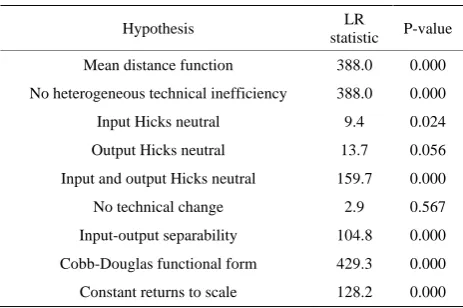
The parametric approach permits formal testing of the statistical significance of various sources of productivity changes. Alternative model specifications can be eva-luated using likelihood ration tests, which compare the likelihood functions under the null and alternative hypo-thesis based on the translog output distance function de-fined above.
First we compare the frontier with the mean output distance function, estimated by considering the ineffi-ciency term u as non-stochastic and equals to zero.
Any deviation from the production frontier is interpreted as random errors and the distance function can be esti-mated using ordinary least squares (OLS). This assump-tion translates into the parameter restricassump-tion of
0 Dummy 1 2 3 0.
χ µ ϕ= = =ϕ =ϕ =ϕ =ϕ = (34) The technical inefficiency exists because null hypo-thesis is rejected at 1 percent level (Table 2). This is confirmed by the significantly large value of parameter
χ (0.687) that indicates more than two-thirds of the out- put variability can be explained by technical inefficiency, rather than random shocks.
In addition, we want to test whether the variables in-troduced as inefficiency effects improve the explanatory power of the model. The null hypothesis is reduced as
1 2 3 0. Dummy
ϕ =ϕ =ϕ =ϕ = (35) The null hypothesis is firmly rejected at 1 percent, in-dicating that the distribution of inefficiencies is not iden-tical across individual observations but depend on the variables capturing local natural endowment and policies. This test supports the heterogeneity of inefficiency term.
The second set of hypotheses is about the technology bias and technical change by checking the parameters used for OB, IB and TCM calculation.
For the production technology to be implicit Hickneu-tralin inputs and makes no contribution to productivity growth, input bias index IB = 1, lnIB = 0. That means to test parameters
0, for all 1, , .
kt k K
δ = = (36) Similarly, the test for implicit Hicksneutral in outputs OB = 1 or lnOB = 0 is
0, for all 1, , .
mt m M
τ = = (37)
Similarly, the test for implicit Hicksneutral in outputs OB = 1 or lnOB = 0 is
0, for all 1, , .
mt m M
[image:8.595.307.539.569.723.2]τ = = (38)
Table 2. Results of hypothesis test.
Hypothesis LR
statistic P-value
Mean distance function 388.0 0.000
No heterogeneous technical inefficiency 388.0 0.000
Input Hicks neutral 9.4 0.024
Output Hicks neutral 13.7 0.056
Input and output Hicks neutral 159.7 0.000
No technical change 2.9 0.567
Input-output separability 104.8 0.000
Cobb-Douglas functional form 429.3 0.000
Constant returns to scale 128.2 0.000
No technology bias is a combination of the two tests above.
If there is no change in the technical change magnitude, TCM = 1 or lnTCM = 0 requires us to jointly test the parameters
. 0,
or 1, , and 1, ,
kt mt t tt f
k K m M
δ =τ =θ =θ =
= = (39)
Hence, no technical change, or TC = 1, is the equiva-lent of joint test of the significance of Equations (36), (37) and (38).
The hypothesis of input Hicks neutral cannot be re-jected output Hicks neutral is rere-jected at 5 percent level, resulting in a marginal rejection of technology bias. The joint test result implies that the technical change is pre- sent.
Separability of outputs is an important property of pro- duction. It implies that marginal rates of substitution be-tween pair of outputs in the separated group are indepen- dent of the levels of outputs outside the group, hence out- puts can be aggregated in the analysis.
The hypothesis of separability is defined as all interac-tion terms between outputs and inputs to be zero,
0, for 1, , and 1, , .
km k K m M
γ = = = (40)
These restrictions on parameters are strongly rejected, which shows that it is not possible to aggregate the four outputs consistently into a single index. This again de-monstrates the strength of distance function compared with a traditional stochastic frontier production function, which requires aggregation of outputs prior to model estimation, as revealed by [17].
Then we test whether the true output distance function can be simplified and represented by the Cobb-Douglas functional form instead of the translog form. The para-meter restrictions are
0, for 1, , and 1, , .
kk mm km kt mt
k K m M
α ′ =β ′ =γ =δ =τ =
= = (41)
The null is rejected, suggesting that the Cobb-Douglas form is inappropriate for this study.
The last hypothesis is the constant returns to scale, which requires the output distance function to be homo-genous of degree -1 in input quantities ([11]), or the fol-lowing restrictions should hold:
1 1 1 1
1, 0, 0, 0,
for 1, , and 1, , .
K K K K
k kk km kt
k k k k
k K m M
α α γ δ
= ′= ′ = =
= − = = =
= =
∑
∑
∑
∑
(42)
The hypothesis of constant returns to scale is rejected as well, suggesting that the component of scale ineffici- ency should be considered in measuring productivity change.
Following [18], returns to scale can be computed from the output distance function as follows
(
)
(
)
1
ln ,
, .
ln
t t t
K o t t
t
k k
D x y x y
x
ε
=
∂
= −
∂
∑
The expression in brackets is the proportional increase in all outputs caused by an increase in all inputs in the same proportion. Therefore, increasing (decreasing) re-turns to scale are indicated by a value of rere-turns to scale greater (less) than one.
The mean returns to scale is 0.967. The null hypothesis of constant returns to scale against alternative hypothesis of decreasing returns to scale is strongly rejected, sug-gesting a decreasing return to scale is appropriate to de-scribe the production technology.
5.3. TFP Growth and Its Components
First we look at technical efficiency. Average technical efficiency is 0.884 despite more efficient production in mid-1990s to early 2000s. In terms of regional distribu-tion, north and central regions report the highest effi-ciency score, where agricultural production is encour-aged by favorable biophysical condition and policy sup-port (Table 3). Technical efficiency is the lowest in nor- theast region, with an average TE index of 0.76. The low efficiency score means that with the same amount of in- puts the low performing provinces can increase the level of outputs by about 50 percent (Appendix Table 2). The sharp drop in technical efficiency since 2004 is especial-ly alarming, which is caused by several weather shocks and the outbreak of animal diseases in northeast and south China where pork production is concentrated.
We expect rural infrastructure, market openness and agricultural support should improve technical efficiency. The coefficients of market openness and real agricultural support are both of the expected sign but only the latter is statistically significant (Table 2). Combined with the sig- nificant constant term in technical inefficiency variables, we not only confirm the existence of technical ineffici- ency, but the positive role of agricultural policy in im-proving technical efficiency.
Table 3. Technical efficiency in China.
Region 1978-83 1984-89 1990-93 1994-97 1998-03 2004-10 1978-10
North 0.948 0.898 0.896 0.921 0.947 0.954 0.938
Northeast 0.808 0.784 0.822 0.796 0.772 0.714 0.757
Central 0.901 0.893 0.94 0.94 0.957 0.920 0.928
South 0.859 0.848 0.881 0.918 0.924 0.862 0.882
Southwest 0.897 0.877 0.891 0.902 0.896 0.781 0.850
West 0.898 0.824 0.823 0.816 0.859 0.842 0.842
China 0.884 0.865 0.894 0.906 0.916 0.863 0.884
[image:10.595.53.542.257.384.2]Source: Authors’ calculation.
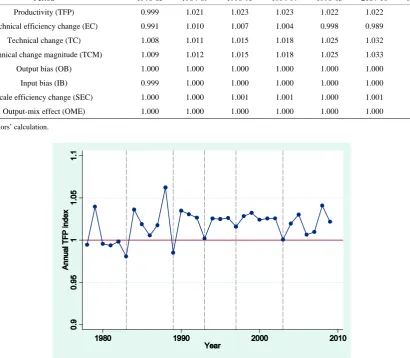
Table 4. Decomposition of Malmquist productivity index.
Period 1978-83 1984-89 1990-93 1994-97 1998-03 2004-10 1978-04
Productivity (TFP) 0.999 1.021 1.023 1.023 1.022 1.022 1.020
Technical efficiency change (EC) 0.991 1.010 1.007 1.004 0.998 0.989 0.997
Technical change (TC) 1.008 1.011 1.015 1.018 1.025 1.032 1.023
Technical change magnitude (TCM) 1.009 1.012 1.015 1.018 1.025 1.033 1.024
Output bias (OB) 1.000 1.000 1.000 1.000 1.000 1.000 1.000
Input bias (IB) 0.999 1.000 1.000 1.000 1.000 1.000 1.000
Scale efficiency change (SEC) 1.000 1.000 1.001 1.001 1.000 1.001 1.001
Output-mix effect (OME) 1.000 1.000 1.000 1.000 1.000 1.000 1.000
Source: Authors’ calculation.
Figure 1. Evolution of TFP over time. Source: Authors’ calculation.
The overall TFP development can be explained by the components of the Malmquist index, namely, technical change and bias, technical efficiency change, scale ciency change and output-mix effect. The technical effi-ciency change is below one for the whole period, imply-ing deteriorated technical efficiency. However, technical efficiency rises from 1984-97, and declines afterwards.
This decline is most pronounced after 2004, further hig-hlighting the urgent need for efficiency improvement.
[image:10.595.96.507.266.624.2]1978-83 to 3.2 percent in 2004-10. Table 4 also shows the decomposition of the technical change component into the production of technical change along a ray through the data of each period (TCM) and the bias ef-fect. Although statistically significant, the impact of out- put bias on productivity is very small. Since both input and output bias indexes are close to one, neither an input bias effect nor an output bias effect is occurred during the period of study and we conclude that the technical change is Hicks neutral. In other words, there is globally neutral shift in the production frontier and technical change does not have much influence in the relative con-tribution of each output or input to the production pro- cess. Therefore, productivity gain cannot be obtained by change the mix of outputs or the mix of inputs, and cur-rent technology does not favor output and input mix from different periods. This results in a wide distribution of in- put and output combination in Chinese agriculture.
Scale efficiency boosts Malmquist index by a small margin (average SEC is 1.001), which implies that the output mix moves closer to technical optimal and scale efficiency improves over time. Together with the output bias, we observe the mix of output is closer to optimal mix of output under the technology as SEC averages 1.001. In relatively land abundant northern China, scare efficiency improves because the output mix is moving closer to the optimal production technology. There is lit- tle change in the output-oriented scale efficiency from a change in output mix and hence the output-mix effect (OME) does not contribute to productivity growth.
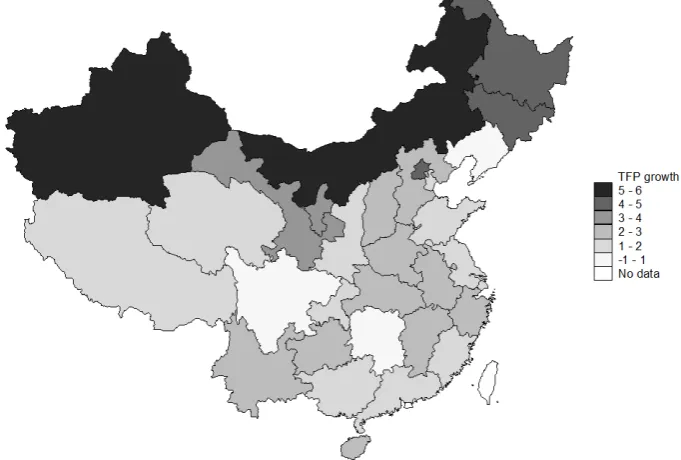
The spatial distribution of agricultural productivity is presented in Figure 2 and Table 5. The highest TFP
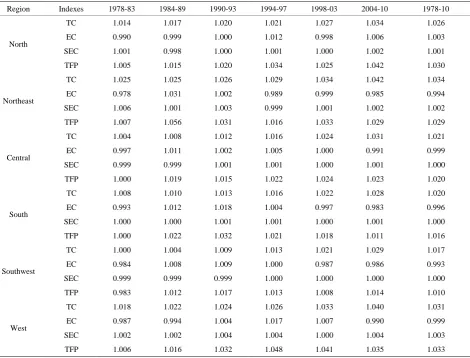
growth is observed in north and northwest border prov-inces of Xinjiang and Inner Mongolia at above 5 percent per annum, partly due to the rapid growth of crop and livestock sector. Northern provinces (Heilongjiang and Jilin) follow the suit by reporting impressive TFP growth rate between 4 - 5 percent. Gansu and Ningxia, two in-land provinces located in north China, also benefit from the boom in agricultural sectors in the neighborhood. On the other hand, the provinces exhibit low productivity growth include Sichuan, Liaoning and Hunan, mainly caused by efficiency deterioration with efficiency scores dropped at more than 1 percent per year.
It is important to examine the distribution of technical change and efficiency change given its key role as the engine of TFP growth. Similar to the pattern of TFP growth, the northern provinces move closer to production frontier represented by provinces reporting TE = 1 (He-bei, Shanxi, Heilongjiang, Henan and Guizhou). Low TC growth occurs in more urbanized municipalities and coastal provinces of Jiangsu and Zhejiang where agri-culture becomes a small player in local economy. Effi-ciency improves in the northern provinces along with Hubei while efficiency declines in provinces scored low TFP growth like Liaoning, Hunan and Sichuan.
[image:11.595.127.468.487.717.2]Low and sharply declined efficiency scores are more pronounced in Liaoning, Hainan and Sichuan, where output only reach less than 70 percent of full potential, and annual TE indexes fall at an alarming rate of 2-4percent per year. This is especially noticeable in Si-chuan province, which is a major producer of agricultural commodities and contributes to 6 percent of national agricultural production in 2010. Among top five major
Table 5. Decomposition of Malmquist productivity index by region.
Region Indexes 1978-83 1984-89 1990-93 1994-97 1998-03 2004-10 1978-10
North
TC 1.014 1.017 1.020 1.021 1.027 1.034 1.026
EC 0.990 0.999 1.000 1.012 0.998 1.006 1.003
SEC 1.001 0.998 1.000 1.001 1.000 1.002 1.001
TFP 1.005 1.015 1.020 1.034 1.025 1.042 1.030
Northeast
TC 1.025 1.025 1.026 1.029 1.034 1.042 1.034
EC 0.978 1.031 1.002 0.989 0.999 0.985 0.994
SEC 1.006 1.001 1.003 0.999 1.001 1.002 1.002
TFP 1.007 1.056 1.031 1.016 1.033 1.029 1.029
Central
TC 1.004 1.008 1.012 1.016 1.024 1.031 1.021
EC 0.997 1.011 1.002 1.005 1.000 0.991 0.999
SEC 0.999 0.999 1.001 1.001 1.000 1.001 1.000
TFP 1.000 1.019 1.015 1.022 1.024 1.023 1.020
South
TC 1.008 1.010 1.013 1.016 1.022 1.028 1.020
EC 0.993 1.012 1.018 1.004 0.997 0.983 0.996
SEC 1.000 1.000 1.001 1.001 1.000 1.001 1.000
TFP 1.000 1.022 1.032 1.021 1.018 1.011 1.016
Southwest
TC 1.000 1.004 1.009 1.013 1.021 1.029 1.017
EC 0.984 1.008 1.009 1.000 0.987 0.986 0.993
SEC 0.999 0.999 0.999 1.000 1.000 1.000 1.000
TFP 0.983 1.012 1.017 1.013 1.008 1.014 1.010
West
TC 1.018 1.022 1.024 1.026 1.033 1.040 1.031
EC 0.987 0.994 1.004 1.017 1.007 0.990 0.999
SEC 1.002 1.002 1.004 1.004 1.000 1.004 1.003
TFP 1.006 1.016 1.032 1.048 1.041 1.035 1.033
Source: Authors’ calculation.
agricultural producing provinces, Sichuan is the only one experienced negative TFP growth in 1978-2010, which can be partly due to the lack of rural infrastructure and unfavorable agricultural policies. Only 25 percent of crop sown area is irrigated in Sichuan, far below the average of 40 percent. Sichuan also has a long history of high agricultural tax discouraging investment in agricultural sector.
6. Conclusions
This paper extends the decomposition of the Malmquist productivity index suggested by [3,4] by using an output- oriented parametric approach. The Malmquist index is decomposed into several assembling components, which allows us to examine the ray expansion of technology, input- and output-induced shifts of technology frontier, technical change, scale efficiency change and the change of productivity caused by output-mix. A translog output distance function is chosen to represent the production technology. Computable form of each component of the Malmquist index is expressed as a function of parameters
estimable in the output distance function, and the Malm- quist index is derived from these components.
The advantage of the parametric approach is the flex- ibility to statistically test the hypothesis regarding differ- rent components of the Malmquist index, the natural and bias of production technology, returns to scale and func-tional form by imposing restrictions on parameters. In addition, this paper differs from other studies by express- ing results in a discrete changes format, instead of deriv- atives. This is very useful in empirical studies because most economic variables are not presented as continuous, and the estimated productivity growth index using first order derivative can lead to incorrect results ([9,20]).
by technical change. Additionally, the result of the de-composition of the technical change indicates that the technical change is neutral despite that the output mix moves closer to technical optimal. Scale efficiency mar- ginally contributes to productivity growth whereas there is less output-mix effect. The findings have clear policy implications regarding improving agricultural performance in China. For example, past agricultural policies have failed to address the huge efficiency gap to decrease wasteful use of agricultural inputs and cut down envi- ronmental cost. Whether productivity can be improved through a shift in current technology is another relevant issue worth exploring. Additionally, given the considera- ble spatial variation, agricultural development policies need to be tailored to local conditions during planning and implementation. Another important issue not dis-cussed in this paper is future sources of productivity growth, including investment in agricultural research, rural education and water.
REFERENCES
[1] D. W. Caves, L. R. Christensen and W. E. Diewert, “The Economic Theory of Index Numbers and the Measure- ment of Input, Output and Productivity,” Econometrica, Vol. 50, 1982, pp. 1393-1414.
http://dx.doi.org/10.2307/1913388
[2] R. Färe, S. Grosskopf, M. Norris and Z. Zhang, “Produc- tivity Growth, Technical Progress and Efficiency Change in Industrialized Countries,” American Economic Review, Vol. 84, No. 1, 1994, pp. 66-83.
[3] R. Färe, E. Grifell-Tatjé, S. Grosskopf and C. A. K. Lo- vell, “Biased Technical Change and the Malmquist Prod- uctivity Index,” The Scandinavian Journal of Economics, Vol. 99, No. 1, 1997, pp. 119-127.
http://dx.doi.org/10.1111/1467-9442.00051
[4] B. M. Balk, “Scale Efficiency and Productivity Change,”
Journal of Productivity Analysis, Vol. 15, No. 3, 2001, pp. 159-183. http://dx.doi.org/10.1023/A:1011117324278 [5] C. A. K. Lovell, “The Decomposition of Malmquist Pro-
ductivity Indexes,” Journal of Productivity Analysis, Vol. 20, 2003, pp. 437-458.
http://dx.doi.org/10.1023/A:1027312102834
[6] S. Ray, “Measuring Scale Efficiency from the Translog Multi-Input, Multi-Output Distance Function,” Econom-ics Working Papers 2003-25, Department of EconomEconom-ics, University of Connecticut, 2003.
[7] R. Färe, S. Grosskopf and P. Roos, “Malmquist Producti- vity Indexes: A Survey of Theory and Practice,” In: R. Färe, S. Grosskopf and R. R. Russell, Eds., Index Num- bers: Essays in Honour of Sten Malmquist, Kluwer Aca- demic Publishers, Boston, 1998.
http://dx.doi.org/10.1007/978-94-011-4858-0_4
[8] H. Fuentes, E. Grifell-Tatje and S. Perelman, “A Parame-
tric Distance Function Approach for Malmquist Producti- vity Index Estimation,” Journal of Productivity Analysis, Vol. 15, 2001, pp. 79-94.
http://dx.doi.org/10.1023/A:1007852020847
[9] C. J. Pantzios, G. Karagianis and V. Tzouvelekas, “Para- metric Decomposition of the Input-oriented Malmquist Productivity Index: With an Application to Greek Aqua- culture,” Journal of Productivity Analysis, Vol. 36, No. 1, 2011, pp. 21-31.
http://dx.doi.org/10.1007/s11123-010-0202-2
[10] L.Orea, “Parametric Decomposition of a Generalized Ma- lmquist Productivity Index,” Journal of Productivity Ana- lysis, Vol. 20, 2002, pp. 437-458.
[11] T. J. Coelli and S. Perelman, “Technical Efficiency of Eu- ropean Railways: A Distance Function Approach,” Appli- ed Economics, Vol. 32, No. 15, 2000, pp. 1967-1976. http://dx.doi.org/10.1080/00036840050155896
[12] K. Kounetas and K. Tsekouras, “Measuring Scale Effici- ency Change Using a Translog Distance Function,” Inter- national Journal of Business and Economics,Vol. 69, No. 1, 2007, pp. 63-69.
[13] G. Battese and T. Coelli, “A Model for Technical Effici- ency Effects in a Stochastic Frontier Production Function for Panel Data,” Empirical Economics, Vol. 20, 1995, pp. 325-332. http://dx.doi.org/10.1007/BF01205442
[14] “China Statistical Yearbook, National Bureau of Statistics of China,” China Statistics Press, Beijing, Various Years. [15] Y. Zhang and B. Brummer, “Productivity Change and the
Effects of Policy Reform in China’s Agriculture since 1979,” Asian-Pacific Economic Literature, Vol. 25, No. 2, 2011, pp. 131-150.
http://dx.doi.org/10.1111/j.1467-8411.2011.01307.x
[16] C. J. O’Donnell and T. Coelli, “A Bayesian Approach to Imposing Curvature on Distance Functions,” Journal of Econometrics, Vol. 126, No. 2, 2005, pp. 493-523. http://dx.doi.org/10.1016/j.jeconom.2004.05.011
[17] A. D. Alene, V. M. Manyong and J. Gockowski, “The Pro- duction Efficiency of Intercropping Annual and Perennial Crops in Southern Ethiopia: A Comparison of Distance Functions and Production Frontiers,” Agricultural Sys-tems, Vol. 91, 2006, pp. 51-70.
http://dx.doi.org/10.1016/j.agsy.2006.01.007
[18] R. Färe and D. Primont, “Multi-Output Production and Duality: Theory and Applications,” Kluwer Academic Pub- lishers, Boston, 1995.
http://dx.doi.org/10.1007/978-94-011-0651-1
[19] A. Nin-Pratt, B. Yu and S. Fan, “The Total Factor Prod- uctivity in China and India: New Measures and Appro- aches,” China Agricultural Economic Review, Vol. 1, No. 1, 2009, pp. 9-22.
http://dx.doi.org/10.1108/17561370910915339
[20] T. J. Coelli, P. D. S. Rao and G. E. Battese, “An Introduc- tion to Efficiency and Productivity Analysis,” Kluwer, Boston, 1998.
Appendix Table 1. Parameter estimates of the translog output distance function.
Parameter Estimate Std. Err. Parameter Estimate Std. Err.
1
β −0.575 (0.437) γ22 −0.026 (0.027)
2
β −0.617 (0.150)*** γ23 0.016 (0.036)
3
β 0.798 (0.163)***
31
γ 0.061 (0.052)
1
α 0.862 (0.629) γ32 −0.021 (0.016)
2
α −3.242 (0.352)***
33
γ 0.091 (0.031)***
3
α 0.079 (0.422) γ41 −0.228 (0.067)
***
4
α 1.293 (0.535)**
42
γ −0.002 (0.026)
11
β 0.061 (0.089) γ43 0.148 (0.034)
***
12
β 0.082 (0.015)***
1t
τ 0.008 (0.005)*
13
β 0.010 (0.030) τ2t −0.001 (0.002)
22
β −0.030 (0.008)***
3t
τ −0.004 (0.003)*
23
β −0.032 (0.012)***
1t
δ −0.019 (0.009)**
33
β 0.042 (0.020)**
2t
δ 0.015 (0.006)***
11
α −0.425 (0.181)**
3t
δ −0.002 (0.005)
12
α 0.497 (0.106)***
4t
δ 0.008 (0.007)
13
α −0.094 (0.105) θt 0.029 (0.038)
14
α −0.018 (0.108) θtt −0.002 (0.001)
***
22
α −0.314 (0.095)*** α0 4.313 (1.802)
**
23
α 0.205 (0.081)**
24
α −0.212 (0.077)***
1
ϕ 0.011 (0.017)
33
α −0.098 (0.077) ϕ2 −0.007 (0.005)
34
α 0.037 (0.072) ϕ3 −0.188 (0.051)
***
44
α −0.050 (0.091) ϕ0 −3.725 (0.750)
***
11
γ 0.304 (0.086)***
12
γ 0.099 (0.032)*** 2
lnσv −4.247 (0.074)
***
13
γ −0.241 (0.043)*** χ 0.687
21
γ −0.132 (0.061)** log likelihood 493.9