Proceedings of the 2019 Conference on Empirical Methods in Natural Language Processing 378
CaRe: Open Knowledge Graph Embeddings
Swapnil Gupta
Indian Institute of Science Bangalore, India [email protected]
Sreyash Kenkre
Walmart Labs Bangalore, India [email protected]
Partha Talukdar
Indian Institute of Science Bangalore, India
Abstract
Open Information Extraction (OpenIE) meth-ods are effective at extracting (noun phrase, re-lation phrase, noun phrase) triples from text,
e.g.,(Barack Obama, took birth in, Honolulu).
Organization of such triples in the form of a graph with noun phrases (NPs) as nodes and relation phrases (RPs) as edges results in the construction of Open Knowledge Graphs (OpenKGs). In order to use such OpenKGs in downstream tasks, it is often desirable to learn embeddings of the NPs and RPs present
in the graph. Even though several
Knowl-edge Graph (KG) embedding methods have been recently proposed, all of those methods
have targeted Ontological KGs, as opposed
to OpenKGs. Straightforward application of existing Ontological KG embedding methods to OpenKGs is challenging, as unlike
Onto-logical KGs, OpenKGs are notcanonicalized,
i.e., a real-world entity may be represented us-ing multiple nodes in the OpenKG, with each node corresponding to a different NP refer-ring to the entity. For example, nodes with
labelsBarack Obama,Obama, andPresident
Obamamay refer to the same real-world
en-tityBarack Obama. Even though
canonical-ization of OpenKGs has received some at-tention lately, output of such methods has not been used to improve OpenKG
embed-dings. We fill this gap in the paper and
propose Canonicalization-infused Representa-tions (CaRe) for OpenKGs. Through extsive experiments, we observe that CaRe en-ables existing models to adapt to the chal-lenges in OpenKGs and achieve substantial improvements for the link prediction task.
1 Introduction
Open Information Extraction (OpenIE) methods
such as ReVerb (Fader et al., 2011), OLLIE
(Mausam et al.,2012), BONIE (Saha et al.,2017)
and CALMIE (Saha and Mausam, 2018) can
au-tomatically extract(noun phrase, relation phrase,
Sentences in Text Corpus:
•Barack Obama, 44th president of USA, took birth in Honolulu.
•Michelle Obama wife of Barack was born in Chicago.
OpenIE
OpenKG
Barack Obama
USA Michelle
Obama
Chicago 44th pr
esident of
Honolulu
Took birth in Barack
Wife of
Was bor
n in First lady of
[image:1.595.306.528.162.433.2]?
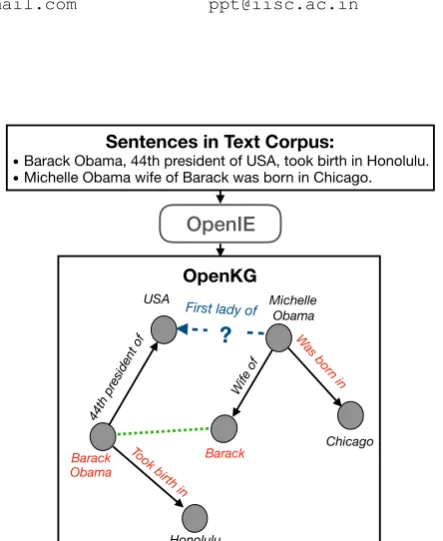
Figure 1: Challenges in OpenKG. KG embedding
methods are effective in downstream tasks such as Link Prediction. Existing KG embedding methods are in-effective on OpenKGs as they are not canonicalized. CaRe can effectively utilize canonicalization informa-tion to learn better embeddings in OpenKGs. Green dotted line represents the missing NP canonicalization
information. Please see Section1for more details.
noun phrase) triples from text, e.g., (Barack
Obama, took birth in, Honolulu), (Michelle
Obama, wife of, Barack), etc. An Open
Knowl-edge Graph (OpenKG) can be constructed out of
such triples by representing noun phrases (NPs) as nodes and relation phrases (RPs) as edges connect-ing them. Example of an OpenKG is shown in
Fig-ure1. OpenKGs do not require pre-specified
on-tology, making them highly adaptable. In order to use OpenKGs in downstream tasks such as Ques-tion Answering, Document ClassificaQues-tion, etc., it is often necessary to learn embeddings of NPs and RPs present as nodes and edges in an OpenKG.
embed-ding has been an active area of research
(Bor-des et al., 2013; Yang et al., 2014), all the
pro-posed KG embedding methods have focused on
embedding Ontological KGs, such as WikiData
(Vrandeˇci´c and Kr¨otzsch, 2014), DBpedia (Auer
et al., 2007), YAGO (Suchanek et al., 2007),
NELL (Mitchell et al.,2018), and Freebase
(Bol-lacker et al.,2008). Existing KG embedding
mod-els train representation of each node and edge la-bel based on the context of triples they are present in. Doing this is suitable for ontological KGs as
they are canonicalized. However, in OpenKGs,
the same latent entity may be represented in dif-ferent nodes labelled with difdif-ferent NPs. Simi-larly, the same latent relation can be represented
with different RPs. For example, in Figure 1,
Barack Obamathe entity is represented using two
NP nodes: Barack ObamaandBarack. Similarly,
the two RPs –took birth inandwas born in–
re-fer to the same underlying relation. Hence, the paradigm of learning embeddings for each node and edge label only from the context of the triples they appear in is ineffective for OpenKGs.
A possible solution is to canonicalize the
OpenKGs. This involves identifying NPs and
RPs that refer to the same entity and relation,
and assigning them unique IDs. Nodes in the
OpenKG having the same ID aremerged, leading
to a clean and canonicalized graph. Recent works that automatically canonicalize OpenKGs,
includ-ing (Gal´arraga et al., 2014) and CESI (Vashishth
et al.,2018), pose canonicalization as a clustering
task of the NPs and RPs. However, due to auto-matic generation, the output clusters often contain some incorrectly canonicalized elements. Thus, directly merging nodes or relations with the same IDs would result in the propagation of errors in the canonicalization step to down-stream tasks.
Our premise is that the output of these auto-matic canonicalization models can be utilized to improve OpenKG embedding. Instead of explic-itly merging nodes with common IDs, KG em-bedding models can be designed to judiciously account for mistakes during the canonicalization step. Towards establishing this premise, we pro-pose a flexible OpenKG embedding approach to integrate and utilize the output of a canonicaliza-tion model in an error-conscious manner. Our con-tributions are as follows:
• We draw attention to an important but
rela-tively unexplored problem of learning
repre-sentations for OpenKGs.
• We propose Canonicalization-infused
Repre-sentations (CaRe) for Open KGs - a novel ap-proach to enrich OpenKG embedding models with the output of a canonicalization model. To the best of our knowledge, this is the first model of its kind.
• Through extensive experiments on real-world
datasets, we establish CaRe’s effectiveness in embedding OpenKGs.
CaRe source code is available at https://
github.com/malllabiisc/CaRE.
2 Related Work
OpenKG extraction and canonicalization: Mul-tiple OpenIE systems have been developed over
the years. These include TextRunner (Yates
et al.,2007), (Angeli et al.,2015), ReVerb (Fader
et al., 2011), OLLIE (Mausam et al., 2012),
SR-LIE (Christensen et al.,2011), RelNoun (Pal and
Mausam, 2016) and ClauseIE (Del Corro and
Gemulla,2013). A recent survey on the progress
in OpenIE systems is presented in (Mausam, 2016).
To perform automatic canonicalization of
OpenKGs, (Gal´arraga et al., 2014) first cluster
NPs over manually defined feature spaces. These
are then passed to AMIE (Gal´arraga et al.,2013)
for RP clustering. Whereas, CESI (Vashishth
et al.,2018) jointly learns vector representations of
NPs and RPs by infusing side information in KG embedding models which are then used to cluster NPs and RPs. In this work, we use CESI to gener-ate canonicalization clusters for our datasets.
KG Embedding Methods: KG embedding meth-ods aim to learn low dimensional vector represen-tations for the nodes and edge labels encoding the graph topology. All these methods train the em-beddings by optimizing a link prediction based ob-jective. They primarily differ in their way of math-ematically modelling the likelihood of a triple be-ing true. Translation-based hypothesis which
re-gards relation vector for any(subject, relation,
ob-ject) triple as a translation from the subject
vec-tor to the object vecvec-tor is used in methods like
TransE (Bordes et al., 2013) and TransH (Wang
et al.,2014). Semantic matching models, such as
DistMult (Yang et al.,2014), ComplEx (Trouillon
USA United States of
America United States An NP cluster from
canonicalization model
Is the president of
United States
of America Washington, D.C.
North America USA Is the capital of
Is in
Donald Trump United States
Original OpenKG
(a)
United States Is the president of
Donald Trump USA
North America Is in
Washington, D.C. United States
of America
Is the capital of Canonicalization Augmented OpenKG
(Canonicalization edges represented as dotted lines)
[image:3.595.86.521.64.187.2](b)
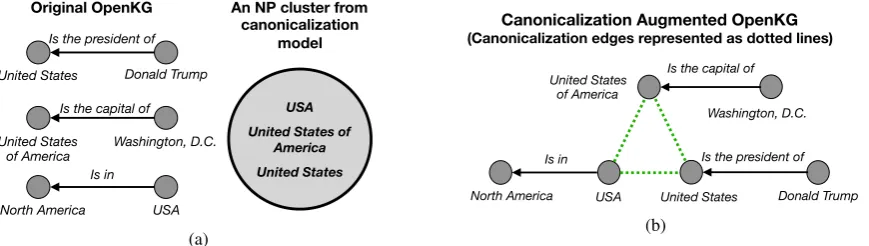
Figure 2: CaRe Step 1: First CaRe augments the original OpenKG with the output of a canonicalization model.
(a) OpenKG and NP clusters from a canonicalization model. (b) Augmented OpenKG by adding undirected edges
between canonical NPs (represented as dotted lines). Please refer to Section4.2for more details.
similarity-based scoring functions to measure the likelihood of a fact. Multi-Layer neural network
models, ConvE (Dettmers et al., 2018) and
R-GCN (Schlichtkrull et al.,2018) have shown better
expressive strength. R-GCN adapts graph
convo-lutional network (GCN) (Kipf and Welling,2016)
to a relational graph proposing an auto-encoder model for the link prediction task. Implicit in all these approaches is the assumption that each node in the graph is a different entity, and distinct edge labels refer to distinct relations. This assumption does not hold in OpenKGs. Existing KG embed-dings are thus unsuitable for a task like link pre-diction on OpenKGs. CaRe addresses these limi-tations by infusing the output of a canonicalization model with the KG embedding models.
3 Background
In this section, we present a quick overview of a few basic methods which are useful for under-standing the rest of the paper, especially the exper-iments section. We first start with the notations.
Notations: OpenKG is denoted as G =
(N,R,T+), where N and R are the set of NPs and
RPs, respectively, and T+ ={(s, r, o)|s∈N, r∈
R, o ∈N}is the set of observed triples. Heres, o
are the subject and object phrase, respectively.
TransE: Given a triple (s, r, o), consider
es, rr, eo ∈ Rd as the d-dimensional vector
rep-resentations of subject (s), relation (r) and object
(o) respectively. TransE follows a translation
based triple scoring functionψ(.):
ψ(s, r, o) =− kes+rr−eokp.
Here, k.k denotes norm and p is either 1 or
2. For training parameters, TransE uses
margin-based pairwise ranking loss with negative sam-pling.
ConvE: ConvE (Dettmers et al., 2018) first
re-shapeses andrr to e¯s andr¯r , respectively, and
passes them through a 2D convolution layer to compute the score corresponding to a triple:
ψ(s, r, o) =f(vec(f([ ¯es; ¯rr]∗w))W)eo.
Here, ∗ and w denote the convolution
opera-tor and convolution filters, f represents an
ac-tivation function and W, the weights of the
fi-nal linear layer. For training, ConvE uses binary cross-entropy loss with correct samples consid-ered as positive instances while negative instances are generated through negative sampling.
Graph Neural Networks (GNN):GNNs were
in-troduced in (Gori et al.,2005) and (Scarselli et al.,
2009) as a generalization of recursive neural net-works. Later, the generalization of CNN to graph-structured data, popularly known as Graph Con-volution Network (GCN), was proposed in (Bruna
et al., 2014). A first-order formulation of GCN
as proposed in (Kipf and Welling, 2016). Under
GCN formulation, the representation of a noden
afterlthlayer is defined as follows.
el+1n =f
X
i∈N(n)
Wleli+bl
,∀n∈N (1)
Here,Wl, blare layer parameters,N(n)
corre-sponds to the immediate neighborhood ofnandf
denotes an activation function.
GAT: GAT uses the attention mechanism to
determine the weights of a node’s neighbors
(Veliˇckovi´c et al., 2018). Further, it uses
S
e
<latexit sha1_base64="Iv8ppuEMd3JY9AlltU5FT+jTP5o=">AAAB6nicbVBNS8NAEJ3Ur1q/qh69LBbBU0m0oMeiF48V7Qe0oWy2k3bpZhN2N0IJ/QlePCji1V/kzX/jts1BWx8MPN6bYWZekAiujet+O4W19Y3NreJ2aWd3b/+gfHjU0nGqGDZZLGLVCahGwSU2DTcCO4lCGgUC28H4dua3n1BpHstHM0nQj+hQ8pAzaqz0gH3dL1fcqjsHWSVeTiqQo9Evf/UGMUsjlIYJqnXXcxPjZ1QZzgROS71UY0LZmA6xa6mkEWo/m586JWdWGZAwVrakIXP190RGI60nUWA7I2pGetmbif953dSE137GZZIalGyxKEwFMTGZ/U0GXCEzYmIJZYrbWwkbUUWZsemUbAje8surpHVR9S6r3n2tUr/J4yjCCZzCOXhwBXW4gwY0gcEQnuEV3hzhvDjvzseiteDkM8fwB87nD1PCjdI=</latexit> sCanonical NPs for s as per Canonicalization model
O
e
o<latexit sha1_base64="W4bNWa5sdYY2pmghkc5oDULuIyA=">AAAB6nicbVA9SwNBEJ2LXzF+RS1tFoNgFe5U0DJoYxnRmEByhL3NXLJkb/fY3RNCyE+wsVDE1l9k579xk1yhiQ8GHu/NMDMvSgU31ve/vcLK6tr6RnGztLW9s7tX3j94NCrTDBtMCaVbETUouMSG5VZgK9VIk0hgMxreTP3mE2rDlXywoxTDhPYljzmj1kn32FXdcsWv+jOQZRLkpAI56t3yV6enWJagtExQY9qBn9pwTLXlTOCk1MkMppQNaR/bjkqaoAnHs1Mn5MQpPRIr7UpaMlN/T4xpYswoiVxnQu3ALHpT8T+vndn4KhxzmWYWJZsvijNBrCLTv0mPa2RWjByhTHN3K2EDqimzLp2SCyFYfHmZPJ5Vg/NqcHdRqV3ncRThCI7hFAK4hBrcQh0awKAPz/AKb57wXrx372PeWvDymUP4A+/zB02yjc4=</latexit>
Canonical NPs for o as per Canonicalization model
Triples Scoring Function Triple Loss Function
T Base Model (B)
e
<latexit sha1_base64="p8mI8iz+QRO2bJdS1FFoKqTg/Sk=">AAAB8HicbVBNS8NAEJ34WetX1aOXYBE9lUQFPRa9eKxgP6StZbOdtEt3N2F3I5SQX+HFgyJe/Tne/Ddu2xy09cHA470ZZuYFMWfaeN63s7S8srq2Xtgobm5t7+yW9vYbOkoUxTqNeKRaAdHImcS6YYZjK1ZIRMCxGYxuJn7zCZVmkbw34xi7ggwkCxklxkoP2Et19pieZL1S2at4U7iLxM9JGXLUeqWvTj+iiUBpKCdat30vNt2UKMMox6zYSTTGhI7IANuWSiJQd9PpwZl7bJW+G0bKljTuVP09kRKh9VgEtlMQM9Tz3kT8z2snJrzqpkzGiUFJZ4vChLsmciffu32mkBo+toRQxeytLh0SRaixGRVtCP78y4ukcVbxzyv+3UW5ep3HUYBDOIJT8OESqnALNagDBQHP8ApvjnJenHfnY9a65OQzB/AHzucP+MSQgw==</latexit> 0se
0
o
<latexit sha1_base64="ELmZvNiAsFl8ScmLFG7iPjetQBM=">AAAB8HicbVDLSgNBEOz1GeMr6tHLYBA9hV0V9Bj04jGCeUgSw+xkNhkyj2VmVgjLfoUXD4p49XO8+TdOkj1oYkFDUdVNd1cYc2as7397S8srq2vrhY3i5tb2zm5pb79hVKIJrRPFlW6F2FDOJK1bZjltxZpiEXLaDEc3E7/5RLVhSt7bcUy7Ag8kixjB1kkPtJeq7DE9yXqlsl/xp0CLJMhJGXLUeqWvTl+RRFBpCcfGtAM/tt0Ua8sIp1mxkxgaYzLCA9p2VGJBTTedHpyhY6f0UaS0K2nRVP09kWJhzFiErlNgOzTz3kT8z2snNrrqpkzGiaWSzBZFCUdWocn3qM80JZaPHcFEM3crIkOsMbEuo6ILIZh/eZE0zirBeSW4uyhXr/M4CnAIR3AKAVxCFW6hBnUgIOAZXuHN096L9+59zFqXvHzmAP7A+/wB8qCQfw==</latexit>
r
<latexit sha1_base64="e08VsO9M3ITMlrHUiCajIwPKoj4=">AAAB7HicbVBNS8NAEJ3Ur1q/qh69LBbBU0lU0GPRi8cKpi20oWy2m3bpZhN2J0IJ/Q1ePCji1R/kzX/jts1BWx8MPN6bYWZemEph0HW/ndLa+sbmVnm7srO7t39QPTxqmSTTjPsskYnuhNRwKRT3UaDknVRzGoeSt8Px3cxvP3FtRKIecZLyIKZDJSLBKFrJ1/1cT/vVmlt35yCrxCtIDQo0+9Wv3iBhWcwVMkmN6XpuikFONQom+bTSywxPKRvTIe9aqmjMTZDPj52SM6sMSJRoWwrJXP09kdPYmEkc2s6Y4sgsezPxP6+bYXQT5EKlGXLFFouiTBJMyOxzMhCaM5QTSyjTwt5K2IhqytDmU7EheMsvr5LWRd27rHsPV7XGbRFHGU7gFM7Bg2towD00wQcGAp7hFd4c5bw4787HorXkFDPH8AfO5w8q5o7q</latexit> rInput Triple: ( s , r , o)
Relation Phrase (r)
…
Canonical Cluster Encoder Network (CN) Phrase Encoder
Network (PN) Canonical Cluster
Encoder Network (CN)
w
1 [image:4.595.75.522.61.293.2]<latexit sha1_base64="mx/VFezHqvMY4WbFRc+kdsKvuk4=">AAAB6nicbVBNS8NAEJ3Ur1q/qh69LBbBU0lU0GPRi8eK9gPaUDbbTbt0swm7E6WE/gQvHhTx6i/y5r9x2+agrQ8GHu/NMDMvSKQw6LrfTmFldW19o7hZ2tre2d0r7x80TZxqxhsslrFuB9RwKRRvoEDJ24nmNAokbwWjm6nfeuTaiFg94DjhfkQHSoSCUbTS/VPP65UrbtWdgSwTLycVyFHvlb+6/ZilEVfIJDWm47kJ+hnVKJjkk1I3NTyhbEQHvGOpohE3fjY7dUJOrNInYaxtKSQz9fdERiNjxlFgOyOKQ7PoTcX/vE6K4ZWfCZWkyBWbLwpTSTAm079JX2jOUI4toUwLeythQ6opQ5tOyYbgLb68TJpnVe+86t1dVGrXeRxFOIJjOAUPLqEGt1CHBjAYwDO8wpsjnRfn3fmYtxacfOYQ/sD5/AELJo2i</latexit>
w
<latexit sha1_base64="qmpmSMS1f2q0FkcTJm+uMnFv//o=">AAAB6nicbVBNS8NAEJ34WetX1aOXxSJ4KkkV9Fj04rGi/YA2lM120y7dbMLuRCmhP8GLB0W8+ou8+W/ctjlo64OBx3szzMwLEikMuu63s7K6tr6xWdgqbu/s7u2XDg6bJk414w0Wy1i3A2q4FIo3UKDk7URzGgWSt4LRzdRvPXJtRKwecJxwP6IDJULBKFrp/qlX7ZXKbsWdgSwTLydlyFHvlb66/ZilEVfIJDWm47kJ+hnVKJjkk2I3NTyhbEQHvGOpohE3fjY7dUJOrdInYaxtKSQz9fdERiNjxlFgOyOKQ7PoTcX/vE6K4ZWfCZWkyBWbLwpTSTAm079JX2jOUI4toUwLeythQ6opQ5tO0YbgLb68TJrVinde8e4uyrXrPI4CHMMJnIEHl1CDW6hDAxgM4Ble4c2Rzovz7nzMW1ecfOYI/sD5/AEMqo2j</latexit> 2w
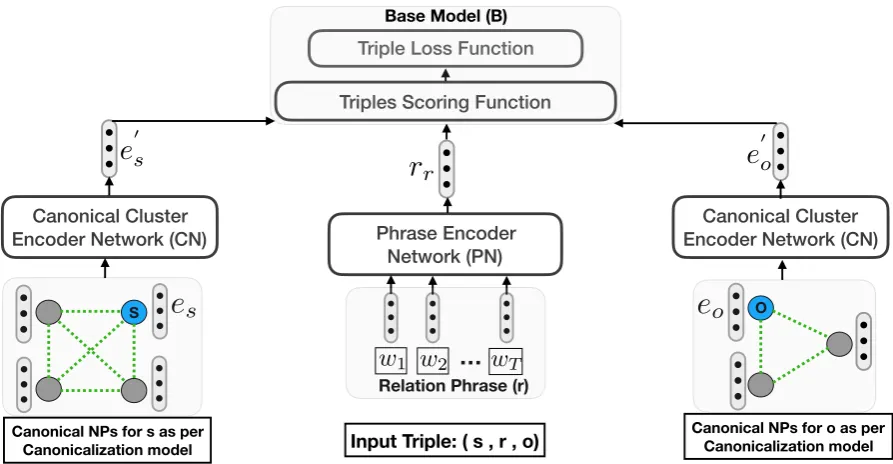
<latexit sha1_base64="VmJPJFkY7hBPN74Ldn84MVnzqoE=">AAAB6nicbVBNS8NAEJ34WetX1aOXxSJ4KokKeix68VixX9CGstlu2qWbTdidKCX0J3jxoIhXf5E3/43bNgdtfTDweG+GmXlBIoVB1/12VlbX1jc2C1vF7Z3dvf3SwWHTxKlmvMFiGet2QA2XQvEGCpS8nWhOo0DyVjC6nfqtR66NiFUdxwn3IzpQIhSMopUennr1XqnsVtwZyDLxclKGHLVe6avbj1kacYVMUmM6npugn1GNgkk+KXZTwxPKRnTAO5YqGnHjZ7NTJ+TUKn0SxtqWQjJTf09kNDJmHAW2M6I4NIveVPzP66QYXvuZUEmKXLH5ojCVBGMy/Zv0heYM5dgSyrSwtxI2pJoytOkUbQje4svLpHle8S4q3v1luXqTx1GAYziBM/DgCqpwBzVoAIMBPMMrvDnSeXHenY9564qTzxzBHzifP0AyjcU=</latexit> TFigure 3: CaRe Step 2:In this step, CaRe learns KG embeddings from the augmented OpenKG (Figure2). Base
model can be any existing KG embedding model (e.g., TransE, ConvE). RP embeddings are parameterized by encoding vector representations of the word sequence composing them. This enables CaRe to capture semantic similarity of RPs. Embeddings of NPs are made more context rich by updating them with the represenations of
canonical NPs (connected with dotted lines). Please see Section3and4for details.
nththe node as follows
el+1n =||Kk=1f
X
i∈N(n)
αk(eln, eli)Wkleli
.
(2)
Here, α(.)denotes attention weights and||
de-notes concatenation.
4 CaRe: Proposed Method
4.1 Overview
CaRe consists of two steps. We first give an
overview of the two steps below and then provide a detailed description of each step.
• Step 1: In this step, the given OpenKG is augmented by adding edges from a canoni-calization model. This step is outlined in
Fig-ure2and described in detail in Section4.2.
• Step 2: In this step, embeddings of nodes and edges present in the augmented OpenKG obtained in Step 1 are learned. This step is
outlined in Figure3. The system consists of
three components: Base Model, Phrase coder Network, and Canonical Cluster En-coder Network. We describe these
compo-nents in Section 4.3, Section 4.4, and
Sec-tion4.5, respectively.
CaRe architecture and its components are
de-picted in Figure3.
4.2 Step 1: Canonicalization Augmented OpenKG
As discussed in Section1, based on the automatic
clusters generated by a canonicalization model, merging NPs with a single ID can lead to the prop-agation of errors in the graph. Hence, we propose a soft integration scheme by adding an unlabeled and undirected edge between any two NPs which are canonical as per the canonicalization model
as shown in Figure 2. More formally, suppose
n1, n2are two NPs that have been identified to be
the same in the canonicalization step. We add an
undirected and unlabelled edge(n1, n2) between
the nodesn1 andn2, and call them
canonicaliza-tion edges. If the canonicalizacanonicaliza-tion step produces
a confidence score forn1 andn2 being the same,
then this score can be incorporated as a weight on the canonicalization edge. If no such score is pro-duced, then the edges are kept unweighted. We then collect all these canonicalization edges into the set C. Finally, these edges are added to the
original OpenKGGto get acanonicalization
4.3 Step 2: Base Model (B)
This component decides the way parameters are
trained in CaRe based on the relational edges T+.
While CaRe is flexible to accommodate any KG embedding model as the base model, for the ex-periments in paper, we used TransE and ConvE
(please see Section3).
4.4 Step 2: Phrase Encoder Network (PN)
We generate embeddings of RPs by encoding the vector representations of the words compos-ing them. Consider an RP as a sequence of T
words (w1, w2, ..., wT) and their corresponding
word vectors as(x1, x2, ..., xT). They are passed
through a Phrase Encoder Network module
(Fig-ure3) for which we use a bidirectional GRU (Cho
et al.,2014) model with last pooling as described
below.
(−→h1,
− →
h2, ...,
−→
hT) =
−−−→
GRU(x1, x2, ..., xT)
(←h−1,
←−
h2, ...,
←−
hT) =
←−−−
GRU(x1, x2, ..., xT).
Finally, rr = [
−→
hT :
←−
h1] is concatenation of
fi-nal hidden states in both the directions. This ap-proach allows parameter sharing across RPs with word overlaps while leveraging the rich semantic information from pre-trained word embeddings.
4.5 Step 2: Canonical Cluster Encoder Network (CN)
The canonicalization information is incorpo-rated in the NP embeddings by utilizing the canonicalization-induced edges C.
Each NPn∈N is assigned a vectoren. As NP
canonicalization is expressed as a clustering step, for each NP, its canonical NPs are a single edge
away in C (see Figure 3). Hence, a single layer
of network aggregation is sufficient. We propose a non-parametric message passing and update net-work which net-works in the following two steps:
Context vector: First for each NP,n ∈ N a
con-text vectorec
nis generated by the following
mes-sage passing scheme from its canonical neighbors.
ecn=
X
i∈N(n)
1
|N(n)|ei
,∀n∈N.
Here,N(n) ={i|i∈N,(n, i)∈C}, is the
canon-ical neighborhood ofn.
Updating NP embeddings: The updated embed-dings for each NP is computed as below:
e0n= en 2 +
ec n
2
which are passed to the decoding stage. For
the case of weighted canonicalization edges, the weights can be used while generating the context vector of an NP, by making the contribution of its canonical NPs proportional to the edge weights joining them. The proposed approach can be
in-terpreted as a local embedding smoothening of
canonical NPs and we call this network as
Lo-cal Averaging Network (LAN). We also
exper-imented with more sophisticated attention-based context vector generation and gating mechanism for embedding update stage, but they resulted in a performance drop.
Note that, our approach to embed NPs is in-spired by the auto-encoder framework used in
R-GCN (Schlichtkrull et al., 2018) but with a key
difference. In R-GCN, the same set of edges are utilized at both the encoding and decoding stages. Whereas in CaRe, the canonicalization edges C are used at the encoder (Canonical Cluster En-coder Network) while the deEn-coder (Base Model)
operates on the relational edges T+.
CaRe nomenclature: We introduce a generic nomenclature for the possible variants of the CaRe framework based on the choice of the Base Model (B), Phrase Encoder Network (PN) and
Canon-ical Cluster Encoder Network (CN) as CaRe(B,
PN, CN). For e.g., CaRe(B=ConvE, PN=Bi-GRU, CN=LAN) corresponds to a CaRe model with ConvE as base model, Bi-GRU network with
last pooling (Section 4.4) as the Phrase Encoder
Network and Local Averaging Network
(Sec-tion 4.5) as the Canonical Cluster Encoder
Net-work. We define Bi-GRU and LAN as default val-ues for the PN and CN arguments respectively. In case, values for these arguments are not explic-itly mentioned, they take the default values. Thus, CaRe(B=ConvE) represents the same network as CaRe(B=ConvE, PN=Bi-GRU, CN=LAN).
5 Experiments
5.1 Datasets
Statistics of the two datasets used in the
experi-ments of this paper are summarized in Table1. In
order to build these datasets, we first obtained the three graph datasets – Base, Ambiguous and Re-Verb45K. While Base and Ambiguous datasets are
Datasets ReVerb45K ReVerb20K
# NPs 27K 11.1K
# RPs 21.6K 11.1K # Gold NP Clusters 18.6K 10.8K # Train Triples 36K 15.5K # Test Triples 5.4K 2.4K # Validation Triples 3.6K 1.6K
Table 1: Details of datasets used. Please see Section5.1
for details.
introduced in (Vashishth et al.,2018). ReVerb20K
is created by combining the two smaller datasets Base and Ambiguous. All the datasets are con-structed through ReVerb Open KB (Fader et al., 2011). We refer the readers to the respective pa-pers for the construction details.
To generate the train, validation and test triples the following procedure is adopted. First, the
en-tire set of triples is divided in 80 : 20 ratio
en-suring that each NP and RP in the triples of the smaller set is at least present once in the triples of the bigger set. This consideration is essential because of the transductive nature of existing KG embedding models. The bigger set is considered as the train dataset and the smaller set is further
randomly divided in 30 : 70 to get the
valida-tion and test datasets respectively. Both datasets contain gold canonicalization clusters for the NPs extracted through the Freebase entity linking
in-formation (Gabrilovich et al.,2013) which enables
automatic evaluation in the canonicalization task.
5.2 Open KG Link Prediction Evaluation
In the typical link prediction evaluation, an unseen
triple(s, r, o) is taken and partial triples (s, r,?)
and(?, r, o)are shown to the model. It ranks all the entities in the graph for their likelihood to be the missing entity and the rank assigned to the true missing entity is considered.
However, while this is suitable for ontological KGs, it is not valid for our setting. In OpenKGs, instead of entities, NPs are present and several of them can refer to the same entity. This means that, even when predicting correct entity, a model will be unfairly penalized if the prediction is a different canonical form of the entity than the one present in the considered triple. We, therefore propose to rank gold NP clusters, available in the dataset, in-stead of ranking each NP. We do this in the follow-ing manner:
• List all the NPs in decreasing order of their
likelihood to be the missing part of the triple.
• Prune this list by keeping the best ranked NPs
for each gold cluster. This gives us the ranked list of gold clusters.
• Consider the rank of the cluster to which the
true missing NP belongs.
We provide results using three commonly used
evaluation metrics: mean rank (MR), mean
re-ciprocal rank (MRR) and Hits@n with n =
{10,30,50}. Filtered setting as introduced in
(Bordes et al.,2013) is followed.
5.3 Experimental Setup
We run CESI on both the datasets to generate the NP canonical clusters. Note that, none of the ex-isting automatic canonicalization models output
edge weights. Hence, for all the experiments,
the canonicalization-induced edges are kept un-weighted. For Phrase Encoder Network, we found single layer in the Bi-GRU model works best. CaRe allows the use of any pre-trained
embed-dings. However, (Vashishth et al., 2018)
demon-strates the effectiveness of pre-trained GloVE
(Pennington et al., 2014) vectors for initializing
representations for the same datasets. Hence, the word vectors are initialized with 300-dimensional pre-trained GloVE embeddings and are kept train-able. We use PyTorch Geometric library (Fey and
Lenssen,2019) for the Canonical Cluster Encoder
Network module.
The choice of optimizer and regularization based hyper-parameters is directly adopted from the ones proposed in the original work of the base models. Both the NP and RP embedding size is kept fixed at 300, while the learning rate is selected
through a grid search over{0.1,0.01,0.001}.
Models like ConvE introduce inverse relations. For our experiments we generate inverse phrase
for an RP by adding a phrase“inverse of”to that
RP. In ComplEx the embeddings have both real and imaginary parts. For this, we use two separate Phrase Encoder Network and Graph Neural Net-work modules for the real and imaginary parts of RP and NP embeddings respectively.
6 Results
Method ReVerb45K ReVerb20K
MR MRR Hits@10 Hits@30 Hits@50 MR MRR Hits@10 Hits@30 Hits@50
TransE 2955.8 .193 .361 .446 .478 1425.8 .126 .299 .411 .468
TransH 2998.2 .194 .362 .442 .478 1464.4 .129 .303 .409 .467
DistMult 8988.8 .051 .051 .052 .065 6260.0 .033 .044 .055 .060
ComlEx 7786.5 .047 .047 .048 .073 5502.2 .037 .058 .075 .085
R-GCN 2866.8 .042 .046 .091 .113 1204.3 .122 .187 .263 .305
ConvE 2650.8 .233 .338 .401 .429 1014.5 .294 .402 .491 .541
[image:7.595.76.525.241.371.2]CaRe(B=ConvE) 1308.0 .324 .456 .543 .579 973.2 .318 .439 .525 .566
Table 2: Link Prediction results. CaRe(B=ConvE) substantially outperforms all the existing KG embedding
models. For all the experiments, evaluation strategy described in Section 5.2is followed. B, CN, PN are the
arguments of CaRe framework (Section4and Figure3). For the reported results: PN=Bi-GRU and CN=LAN.
Method ReVerb45K ReVerb20K
MR MRR Hits@10 Hits@30 Hits@50 MR MRR Hits@10 Hits@30 Hits@50
TransE 2955.8 .193 .361 .446 .478 1425.8 .126 .299 .411 .468 CaRe(B=TransE, CN=φ) 2522.3 .195 .378 .457 .488 978.2 .286 .411 .515 .565
ComplEx 7786.5 .047 .047 .048 .073 5502.2 .037 .058 .075 .085 CaRe(B=ComplEx, CN=φ) 5205.4 .185 .225 .235 .325 3010.0 .216 .288 .345 .376
R-GCN 2866.8 .042 .046 .091 .113 1204.3 .122 .187 .263 .305 CaRe(B=R-GCN, CN=φ) 2508.1 .145 .203 .260 .305 1210.3 .195 .275 .340 .370
ConvE 2650.8 .233 .338 .401 .429 1014.5 .294 .402 .491 .541 CaRe(B=ConvE, CN=φ) 1656.1 .293 .401 .477 .509 966.9 .307 .419 .514 .556
Table 3: Impact of parameterizing RP embeddings. B, CN, PN are the arguments of CaRe framework (Section4
and Figure3). φvalue for CN argument implies that Canonical Cluster Encoder Network module is not used in
these experiments. PN=Bi-GRU in all these experiments. Please refer to Section6.2.
Q1. Is CaRe effective for the link prediction task
in OpenKGs? (Section6.1)
Q2. What is the quantitave and qualitative impact of parameterizing RP embeddings in CaRe?
(Section6.2and Section6.4)
Q3. How does the local embedding smoothening approach adopted in CaRe compare against
other competitive baselines? (Section6.3)
6.1 Overall Performance
As shown in Figure 3, any existing KG
embed-ding model can be used as the base model in the CaRe framework. We experimented with sev-eral KG embedding models and found the CaRe achieved substantial improvements in comparison to standalone use of the KG embedding model in each case. We achieved overall best perfor-mance working with ConvE as the base model, CaRe(B=ConvE). The experimental results are
presented in Table2.
Table 1 shows that in both the datasets, on an
average, the number of train triples for each NP
and RP is less than 2. In contrast, FB15k (Bordes
et al.,2013), an ontological KG, has on an average
32 triples for each entity and 360 triples for each relation. This highlights the extremely sparse and fragmented nature of OpenKGs. Hence, the su-perior performance of CaRe supports the hypoth-esis that the flow of information while learning the representations of canonical NPs and RPs in OpenKGs is beneficial.
Also, a comparison of the number of unique NPs and gold NP clusters for the two datasets
(Ta-ble1) shows that the number of NPs canonical to
each other is more significant in ReVerb45K than in ReVerb20K. Hence, a more prominent improve-ment due to CaRe in ReVerb45K as compared to ReVerb20K proves the effectiveness of CaRe in utilizing the canonicalization information.
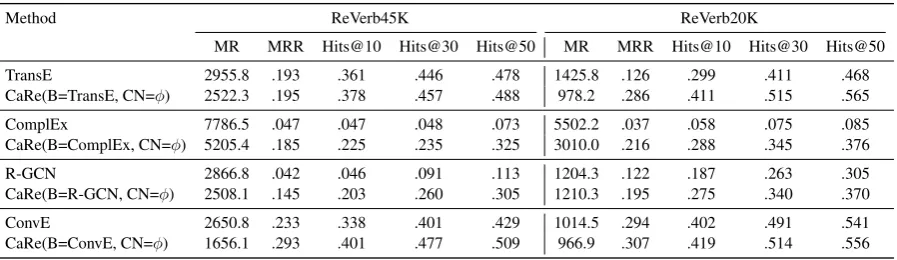
6.2 Impact of parameterizing RP embeddings
As described in Section 4.4, a Phrase Encoder
Network is used to parametrize RP embeddings, which allows parameter sharing while learning
anal-(a) ReVerb45K (b) ReVerb20K
Figure 4: Performance comparison of CaRe framework for differnt values of the CN (as described in Section6.3).
B=ConvE (left group) and B=TransE (right group) in both the plots. PN=Bi-GRU.Mean Reciprocal Rank (MRR)
is plotted on the y axis (higher is better).
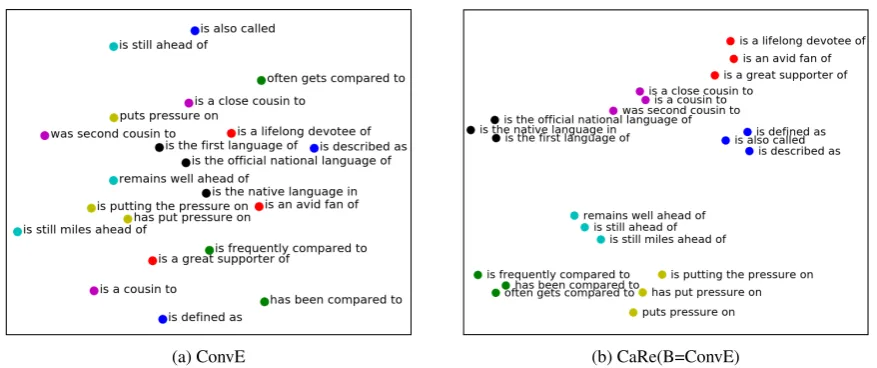
(a) ConvE (b) CaRe(B=ConvE)
Figure 5: t-SNE visualization of RP embeddings. RP embeddings learned by CaRe(B=ConvE) are able to
capture the semantic similarity of the RPs whereas in ConvE this information is lost. Please refer to Section6.4.
ysis of the impact of parameterizing RP embed-dings across several KG embedding models. In these experiments, the CN argument of CaReis
kept φ, which implies no canonicalization
infor-mation is used. The NP embeddings are trained in the same manner as the base KG embedding model.
Comparing the performance of
CaRe(B=ConvE,CN=φ) in Table 3 with the
performance of CaRe(B=ConvE) in Table 2,
it can be noticed that a major part of the per-formance boost of CaRe can be attributed to parameterization of RP embeddings.
6.3 Different ways to utilize Canonicalization edges
There can be several methods through which the canonicalization edges integrated into the graph
(as described in Figure2), can be utilized in the
model. In Section4.5, we described a local
em-bedding smoothening method adopted in CaRe. In this section, we present a comparative analysis with the following competitive baselines:
• CaRe(CN=GCN): A single layer of GCN
(Kipf and Welling, 2016) for the Canonical
Cluster Encoder Network. Refer to
Equa-tion1.
• CaRe(CN=GAT): A single layer of GAT
(Veliˇckovi´c et al., 2018) for the Canonical
Cluster Encoder Network. Refer to
Equa-tion2.
• CaRe(CN=edge): Here the canonicalization
edges in G0 are labelled with a symmetric RP
[image:8.595.81.520.262.446.2]We show these comparisons using both TransE
and ConvE as base models in Figure 4. The
GCN and GAT architectures have an adverse
ef-fect on the performance. We believe this can
be attributed to the complex nature of these ar-chitectures in an already over-parameterized and noisy setting. In CaRe(CN=edge), the model is expected to learn the meaning of two NPs being canonical and encode it in the vector embedding of the new edge type. The local averaging net-work CaRe(CN=LAN) used in CaRe is a GNN
architecture with fixed weights. The choice of
weights follows from the prior belief that canon-ical NP embeddings should be close in the vector space, inducing a useful inductive bias. The above results indicate that this leads to better perfor-mance. Additionally, unlike the GNN based meth-ods, CaRe(CN=edge) has a limitation in its mod-elling capacity as it provides no way to handle the case where canonicalization edges are weighted.
6.4 Qualitative Analysis
Figure 5 demonstrates a qualitative
compari-son of RP embeddings between ConvE and CaRe(B=ConvE). For this experiment, we se-lected seven RPs, and for each RP, through human judgement, we selected two more RPs with similar meaning. Thus, there are seven different clusters. The figure shows t-SNE (van der Maaten and
Hin-ton,2008) visualization of the embeddings learnt
for these RPs by CaRe(B=ConvE) and ConvE. t-SNE is a non-linear transformation which tries to map points in high dimensional space to a lower dimension preserving the local relationships be-tween the points. The figure verifies the hypoth-esis that due to the parameterization of RP embed-dings and utilizing pre-trained word embedembed-dings, CaRe is able to better capture the semantic similar-ity of the RPs in comparison to the base models. Due to the explicit integration of NP canonicaliza-tion in CaRe, we observed a similar desirable im-pact on the embeddings learned for NPs as well.
7 Conclusion
Open Information Extraction (OpenIE) provides an effective way to bootstrap Open Knowledge Graphs (OpenKGs) from text corpus. OpenKGs consist of noun phrases (NPs) as nodes and
re-lations phrases (RPs) as edges. In spite of
this advantage, OpenKGs are often sparse and non-canonicalized, i.e., the same entity could
be expressed using multiple nodes in the graph (and similarly for relations). This renders exist-ing Ontological KG embeddexist-ing methods ineffec-tive in learning embeddings of NPs and RPs in OpenKGs. In spite of this limitation, there has been no prior work which has focused on OpenKG
embedding. We fill this gap in the paper and
propose CaRe. CaRe infuses canonicalization in-formation combined with the neighborhood graph structure to learn rich representations of NPs. Fur-ther, it captures the semantic similarity of RPs by utilizing the word sequence information in these relation phrases to parameterize the RP
embed-dings. Through extensive experiments on
real-world datasets, we demonstrate the effectiveness of embeddings learned by CaRe.
As part of future work, we hope to extend CaRe to also utilize RP canonicalization information. Utilizing OpenKG embeddings in tasks beyond link prediction is another avenue of further work.
Acknowledgments
We thank the anonymous reviewers for their constructive comments. This work is supported by the Ministry of Human Resource Development (MHRD), Government of India. Finally, we thank all the members of MALL Lab, IISc for their invaluable suggestions.
References
Gabor Angeli, Melvin Jose Johnson Premkumar, and
Christopher D. Manning. 2015. Leveraging
linguis-tic structure for open domain information extraction.
In Proceedings of the 53rd Annual Meeting of the
Association for Computational Linguistics and the 7th International Joint Conference on Natural Lan-guage Processing (Volume 1: Long Papers), pages 344–354, Beijing, China. Association for Computa-tional Linguistics.
S¨oren Auer, Christian Bizer, Georgi Kobilarov, Jens Lehmann, Richard Cyganiak, and Zachary Ives. 2007. Dbpedia: A nucleus for a web of open data.
In The Semantic Web, pages 722–735, Berlin,
Hei-delberg. Springer Berlin HeiHei-delberg.
Kurt Bollacker, Colin Evans, Praveen Paritosh, Tim
Sturge, and Jamie Taylor. 2008. Freebase: A
Antoine Bordes, Nicolas Usunier, Alberto Garcia-Dur´an, Jason Weston, and Oksana Yakhnenko.
2013. Translating embeddings for modeling
multi-relational data. InProceedings of the 26th Interna-tional Conference on Neural Information Process-ing Systems - Volume 2, NIPS’13, pages 2787–2795, USA. Curran Associates Inc.
Joan Bruna, Wojciech Zaremba, Arthur Szlam, and
Yann Lecun. 2014. Spectral networks and
lo-cally connected networks on graphs. In
Inter-national Conference on Learning Representations (ICLR2014), CBLS, April 2014.
Kyunghyun Cho, Bart van Merrienboer, Caglar Gul-cehre, Dzmitry Bahdanau, Fethi Bougares, Holger
Schwenk, and Yoshua Bengio. 2014. Learning
phrase representations using RNN encoder–decoder for statistical machine translation. InProceedings of the 2014 Conference on Empirical Methods in Nat-ural Language Processing (EMNLP), pages 1724– 1734, Doha, Qatar. Association for Computational Linguistics.
Janara Christensen, Mausam, Stephen Soderland, and
Oren Etzioni. 2011. An analysis of open
informa-tion extracinforma-tion based on semantic role labeling. In Proceedings of the Sixth International Conference on Knowledge Capture, K-CAP ’11, pages 113–120, New York, NY, USA. ACM.
Luciano Del Corro and Rainer Gemulla. 2013.Clausie:
Clause-based open information extraction. In Pro-ceedings of the 22Nd International Conference on World Wide Web, WWW ’13, pages 355–366, New York, NY, USA. ACM.
Tim Dettmers, Minervini Pasquale, Stenetorp
Pon-tus, and Sebastian Riedel. 2018. Convolutional 2d
knowledge graph embeddings. In Proceedings of the 32th AAAI Conference on Artificial Intelligence, pages 1811–1818.
Anthony Fader, Stephen Soderland, and Oren Etzioni.
2011.Identifying relations for open information
ex-traction. InProceedings of the 2011 Conference on Empirical Methods in Natural Language Process-ing, pages 1535–1545, Edinburgh, Scotland, UK. Association for Computational Linguistics.
Matthias Fey and Jan E. Lenssen. 2019. Fast graph representation learning with PyTorch Geometric.
In ICLR Workshop on Representation Learning on
Graphs and Manifolds.
Evgeniy Gabrilovich, Michael Ringgaard, and
Amar-nag Subramanya. 2013. Facc1: Freebase
an-notation of clueweb corpora, version 1
(re-lease date 2013-06-26, format version 1,
cor-rection level 0). Note: http://lemurproject.
org/clueweb09/FACC1/Cited by, 5.
Luis Gal´arraga, Geremy Heitz, Kevin Murphy, and
Fabian M Suchanek. 2014. Canonicalizing open
knowledge bases. InProceedings of the 23rd acm
international conference on conference on informa-tion and knowledge management, pages 1679–1688. ACM.
Luis Antonio Gal´arraga, Christina Teflioudi, Katja
Hose, and Fabian Suchanek. 2013. Amie:
Associ-ation rule mining under incomplete evidence in on-tological knowledge bases. In Proceedings of the 22Nd International Conference on World Wide Web, WWW ’13, pages 413–422, New York, NY, USA. ACM.
Marco Gori, Gabriele Monfardini, and Franco
Scarselli. 2005. A new model for learning in graph
domains. InProceedings. 2005 IEEE International
Joint Conference on Neural Networks, 2005., vol-ume 2, pages 729–734. IEEE.
Thomas N Kipf and Max Welling. 2016.
Semi-supervised classification with graph convolutional
networks. arXiv preprint arXiv:1609.02907.
Laurens van der Maaten and Geoffrey Hinton. 2008.
Visualizing data using t-SNE. Journal of Machine Learning Research, 9:2579–2605.
Mausam, Michael Schmitz, Stephen Soderland, Robert
Bart, and Oren Etzioni. 2012. Open language
learn-ing for information extraction. In Proceedings of the 2012 Joint Conference on Empirical Methods in Natural Language Processing and Computational Natural Language Learning, pages 523–534, Jeju Island, Korea. Association for Computational Lin-guistics.
Mausam Mausam. 2016. Open information extraction
systems and downstream applications. In
Proceed-ings of the Twenty-Fifth International Joint Con-ference on Artificial Intelligence, pages 4074–4077. AAAI Press.
T. Mitchell, W. Cohen, E. Hruschka, P. Talukdar, B. Yang, J. Betteridge, A. Carlson, B. Dalvi, M. Gardner, B. Kisiel, J. Krishnamurthy, N. Lao, K. Mazaitis, T. Mohamed, N. Nakashole, E. Pla-tanios, A. Ritter, M. Samadi, B. Settles, R. Wang, D. Wijaya, A. Gupta, X. Chen, A. Saparov,
M. Greaves, and J. Welling. 2018. Never-ending
learning.Commun. ACM, 61(5):103–115.
Maximilian Nickel, Lorenzo Rosasco, and Tomaso
Poggio. 2016. Holographic embeddings of
knowl-edge graphs. InProceedings of the Thirtieth AAAI Conference on Artificial Intelligence, AAAI’16, pages 1955–1961. AAAI Press.
Harinder Pal and Mausam. 2016.Demonyms and
com-pound relational nouns in nominal open IE. In Pro-ceedings of the 5th Workshop on Automated Knowl-edge Base Construction, pages 35–39, San Diego, CA. Association for Computational Linguistics.
Jeffrey Pennington, Richard Socher, and Christopher
Manning. 2014. Glove: Global vectors for word
Processing (EMNLP), pages 1532–1543, Doha, Qatar. Association for Computational Linguistics.
Swarnadeep Saha and Mausam. 2018. Open
informa-tion extracinforma-tion from conjunctive sentences. In Pro-ceedings of the 27th International Conference on Computational Linguistics, pages 2288–2299, Santa Fe, New Mexico, USA. Association for Computa-tional Linguistics.
Swarnadeep Saha, Harinder Pal, and Mausam. 2017.
Bootstrapping for numerical open IE. In Proceed-ings of the 55th Annual Meeting of the Association for Computational Linguistics (Volume 2: Short Pa-pers), pages 317–323, Vancouver, Canada. Associa-tion for ComputaAssocia-tional Linguistics.
Franco Scarselli, Marco Gori, Ah Chung Tsoi, Markus Hagenbuchner, and Gabriele Monfardini. 2009. The
graph neural network model. IEEE Transactions on
Neural Networks, 20(1):61–80.
Michael Sejr Schlichtkrull, Thomas N. Kipf, Peter Bloem, Rianne van den Berg, Ivan Titov, and Max Welling. 2018. Modeling relational data with graph
convolutional networks. InESWC, volume 10843 of
Lecture Notes in Computer Science, pages 593–607. Springer.
Fabian M Suchanek, Gjergji Kasneci, and Gerhard Weikum. 2007. Yago: a core of semantic
knowl-edge. InProceedings of the 16th international
con-ference on World Wide Web, pages 697–706. ACM.
Th´eo Trouillon, Johannes Welbl, Sebastian Riedel, ´Eric
Gaussier, and Guillaume Bouchard. 2016.
Com-plex embeddings for simple link prediction. In
In-ternational Conference on Machine Learning, pages 2071–2080.
Shikhar Vashishth, Prince Jain, and Partha Talukdar. 2018. Cesi: Canonicalizing open knowledge bases
using embeddings and side information. In
Pro-ceedings of the 2018 World Wide Web Conference on World Wide Web, pages 1317–1327. International World Wide Web Conferences Steering Committee.
Petar Veliˇckovi´c, Guillem Cucurull, Arantxa Casanova, Adriana Romero, Pietro Li`o, and Yoshua Bengio.
2018. Graph Attention Networks. International
Conference on Learning Representations. Accepted as poster.
Denny Vrandeˇci´c and Markus Kr¨otzsch. 2014.
Wiki-data: A free collaborative knowledgebase. Com-mun. ACM, 57(10):78–85.
Zhen Wang, Jianwen Zhang, Jianlin Feng, and Zheng Chen. 2014. Knowledge graph embedding by
trans-lating on hyperplanes. InTwenty-Eighth AAAI
con-ference on artificial intelligence.
Bishan Yang, Wen-tau Yih, Xiaodong He, Jianfeng Gao, and Li Deng. 2014. Embedding entities and relations for learning and inference in knowledge
bases. arXiv preprint arXiv:1412.6575.
Alexander Yates, Michael Cafarella, Michele Banko, Oren Etzioni, Matthew Broadhead, and Stephen
Soderland. 2007. Textrunner: open information
extraction on the web. In Proceedings of Human