http://dx.doi.org/10.4236/fns.2016.71006
Investigating Transgenic Corn
Hybrids as a Method for
Mycotoxin Control
Hamed K. Abbas
1, Nacer Bellaloui
2, H. Arnold Bruns
31Biological Control of Pests Research Unit, USDA-ARS, Stoneville, USA 2Crop Genetic Research Unit, USDA-ARS, Stoneville, USA
3Crop Production Systems Research Unit, USDA-ARS, Stoneville, USA
Received 11 December 2015; accepted 23 January 2016; published 26 January 2016
Copyright © 2016 by authors and Scientific Research Publishing Inc.
This work is licensed under the Creative Commons Attribution International License (CC BY). http://creativecommons.org/licenses/by/4.0/
Abstract
Transgenic Bt corn hybrids have been available for more than 10 years and are known to control specific insects. More recently, so-called “stacked-gene” hybrids, have been released with multiple insect resistance genes and genes for herbicide resistance, resulting in up to 6 traits per plant. Be-cause insect damage can lead to increased levels of mycotoxins, such as aflatoxins and fumonisin, we designed a study to compare ten commercially available corn hybrids, two non-transgenic, four with both herbicide and insect tolerance (stacked-gene) and four with glyphosate tolerance only to determine if any hybrid class had the advantage of reduced mycotoxin contamination. The ex-periment was carried out in the Mississippi State University Delta Research Extension fields in Stoneville, MS for two years in fine sandy loam and clay soil. Rows were either inoculated at the V10 stage of growth with toxigenic Aspergillus flavus K54 (NRRL 58987, isolated from corn kernels in Mississippi), grown on wheat, and applied at a rate of 22.42 kg/ha or allowed to become natu-rally infected with disease-producing fungi, including various Fusarium and other Aspergillus spp. Mycotoxin production differed according to the soil type with lower levels detected in the hybrids planted in clay soil vs. sandy soil. However, no significant differences in mycotoxin production were found amongst the hybrid classes. More research is needed to identify conditions under which transgenic hybrids might produce higher yields and lower mycotoxin levels. Presently, se-lection of transgenic hybrids will not replace integrated strategies of biocontrol, host plant resis-tance, or good crop management practices for achieving adequate mycotoxin control in corn.
Keywords
1. Introduction
The use of transgenic crops has become increasingly common over the past 10 years in the U.S. and some areas
around the world [1]. Most of these transgenic crops such as corn, soybean, and cotton, were generated to
man-age agricultural pests including insects, weeds, and to some extent diseases. Initially, transgenics started with a
single trait to control a specific pest [2]-[11]. Recently, new technology has emerged and generated crops with
multiple engineered traits which are called “stacked-gene hybrids” enabling them to control more than one
agri-cultural pest [12] [13]. Evaluation of transgenic corn hybrids in regard to mycotoxin management has not been
well established, especially in regard to aflatoxin and fumonisin. While Bt corn has demonstrated some mediat-ing effect on fumonisin, aflatoxin, and trichocenes, no transgenic hybrids have been developed specifically to
lower mycotoxin contamination [1] [14]-[16]. The increased level of mycotoxins, due to insect damage, was
thought to be due to the fact that insect feeding allows fungi to enter the plant and produce mycotoxins [17]-[20].
Research has shown that fumonisin levels are reduced in Bt corn, but no conclusions could be drawn about
possible reductions in aflatoxins [1]. Corn contaminated with mycotoxins may lead to major food safety issues,
production losses and grain waste [21]. Aflatoxins are a group of chemical compounds produced primarily by
Aspergillus flavus, as well as other Aspergillus spp. Aflatoxins and fumonisins can both be serious problems in
the southern U.S., while fumonisins are often more prevalent in more northerly areas of the U.S. [22]-[24].
A number of environmental parameters affect mycotoxin production, including heat, drought, insect
infesta-tion and various plant diseases [25]-[31]. When both toxins are found together, the risk of toxicity increases [24]
[32]-[34]. Theoretically, stacked-gene hybrids should be beneficial to reduce mycotoxins, as they are formulated to deal with factors affecting mycotoxin production. The objective of this study was to investigate the effect of stacked-gene corn hybrids on the accumulation of fumonisins and aflatoxins, compared to single trait glyphosate resistant and non-transgenic hybrids under irrigated field conditions in the Mississippi Delta, and was part of an
experiment previously reporting the yield and economics of three classes of corn hybrids [12].
2. Materials and Methods
2.1. Stacked-Gene Hybrids and Field Conditions
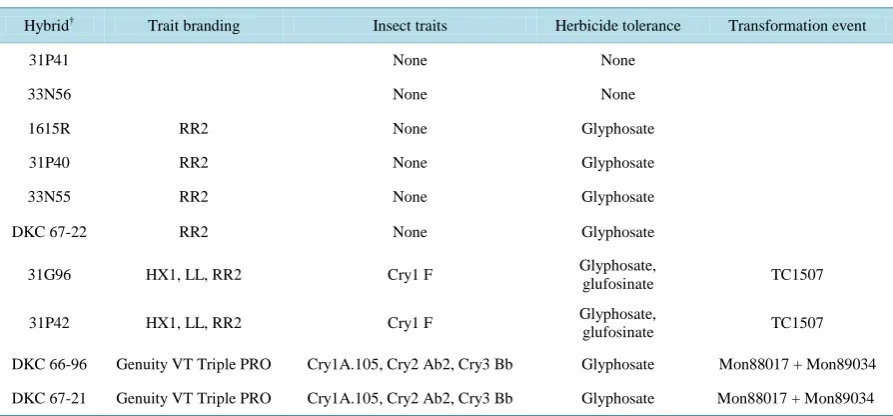
Ten corn hybrids, four stacked-gene, four glyphosate-tolerant and two non-GMO, were purchased commercially
in 2011, and were used in both 2011 and 2012 (Table 1). Between planting seasons, remaining seed were
pre-served in cold storage (4˚C). The research was conducted at two sites, one a Bosket fine sandy loam (fine-loamy,
[image:2.595.90.537.490.698.2]mixed, active, thermic Mollic Hapludalfs), located on the Mississippi State University Delta Branch Research
Table 1. Conventional and transgenic corn hybrids used in 2011 and 2012 study.
Hybrid† Trait branding Insect traits Herbicide tolerance Transformation event
31P41 None None
33N56 None None
1615R RR2 None Glyphosate
31P40 RR2 None Glyphosate
33N55 RR2 None Glyphosate
DKC 67-22 RR2 None Glyphosate
31G96 HX1, LL, RR2 Cry1 F Glyphosate, glufosinate TC1507
31P42 HX1, LL, RR2 Cry1 F Glyphosate,
glufosinate TC1507
DKC 66-96 Genuity VT Triple PRO Cry1A.105, Cry2 Ab2, Cry3 Bb Glyphosate Mon88017 + Mon89034
DKC 67-21 Genuity VT Triple PRO Cry1A.105, Cry2 Ab2, Cry3 Bb Glyphosate Mon88017 + Mon89034
†
and Extension Center, Stoneville, MS, and the other a Tunica clay (clayey over loamy, smectitic, nonacid, ther-mic Vertic Haplaquept) on private property 1.5 k north of Elisabeth, MS, U.S.A. Each hybrid was planted in eight row plots (1.4 meter between rows 12 meter long) with a final stand density of approximately 31,000
ker-nels∙A−1. The experiments were planted 7 April 2011 and 29 March, 2012. All experiments were conducted in
conventional tillage plots, furrow irrigation was performed, and all other agronomic measurements as previously
described by Bruns [12]. Rows 7 and 8 within each plot were inoculated at the V10 stage of growth with
tox-igenic Aspergillus flavus K54 (NRRL 58987, isolated from corn kernels in Mississippi), grown on wheat, and
applied at a rate of 22.42 kg/ha [35]. The remaining 6 rows were allowed to become naturally infected with
dis-ease-producing fungi, including various Fusarium and other Aspergillus spp.
The mature crop was harvested with a two row combine. The non-inoculated rows were harvested first, and then the inoculated rows were harvested. Two different combines were used; one to harvest the inoculated rows (Gleaner K2, AGCO, Duluth, GA) and the other (Kincaid, Haven, KS) to harvest the non-inoculated rows to
prevent cross-contamination. Yield and yield components were determined and previously published [12].
2.2. Mycotoxin Analysis
Sub-samples of 2 kg of kernels from each treatment were pooled, mixed, oven dried at 50˚C for 3 to 5 d, and
ground (20 mesh) using a Romer mill (Union, MO). A representative 50 g sub-sample was taken and extracted
in 250 mL of 70% methanol as previously described [23]. Both aflatoxin and fumonisin levels were determined
by High-Pressure Liquid Chromatography (HPLC) with post-column derivations as described below.
2.3. Aflatoxin Determination
Preparation, cleanup and determination of aflatoxin in samples were performed according to protocols as
de-scribed in detail previously by Abbas et al.[23]. Briefly, aflatoxin levels were analyzed by WATERS HPLC
with post-column photochemical derivation (PHRED) (Aura Industries, New York, NY) and fluorescence detec-tion, containing a WATERS 717 Autosampler. Detection limit of this procedure was 0.1 ng/g, and the standard curve was linear up to 200 ng/g.
2.4. Fumonisin Determination
Fumonison samples extracted in 70% methanol were cleaned up using Bond-Elute SAS columns (Varian,
Har-bor City, CA) [23] [25] [36]. The columns were washed using 2.5 mL each of 100% methanol and 75%
metha-nol. Next, 2.5 mL of the sample extract was applied to the column, and washed again with 75% methanol and 100% methanol applied to the column. The sample was eluted using 2.5 mL of 2% acetic acid in methanol, dried
under nitrogen at 50˚C using a Turbo Vap LV (Biotage, Charlotte, NC), and stored at −20˚C until ready for
analysis. The clean samples were reconstituted in 1 mL acetonitrile: water (30:70) and analyzed by HPLC with
post-column derivatization according to the method described in [37], Joerg Stroke, Institute for Reference
Ma-terials and Measurements, Belgium (Personal communication)] with little modification. Samples to be analyzed for fumonisin were injected onto an Agilent 1200 system consisting of a binary pump, autosampler, and a fluo-rescence detector equipped with a 150 mm × 4.6 mm i.d. 5 µm Zorbax Eclipse XDB-C18 column at a
tempera-ture of 45˚C. A secondary pump (Waters Reagent Manager) was also attached to the system connected in-line
after the column and before the detector. This allowed for mixing of the injected sample and a derivatization so-lution before going to the detector. The detector was set at 335 nm (excitation) and 440 nm (emission). The mo-bile phases for this system were 0.1% formic acid in water (A) and 0.1% formic acid in acetonitrile (B) in a gra-dient at a flow rate of 1.2 mL/min. for 18 minutes beginning at 68% A and 32% B for 8 minutes, switching to 60% A and 40% B for 3 minutes, and then back to 68% A and 32% B for the rest of the injection. The post-column reaction solution was prepared using sodium carbonate, boric acid, potassium sulfate, N-Acetyl-L-Cysteine, and o-phthaldialdehyde (OPA) and run at a constant flow rate of 0.45 mL/min. Standards for this analysis were
pre-pared using fumonisin B1 and B2 (Sigma products F1147 and F3771, respectively) in 30% acetonitrile in water.
The 30% acetonitrile was used as blanks for the analysis. The limit of quantitation was 0.025 ng/µL.
2.5. Experimental Design and Statistical Analysis
va-riance were conducted using Proc mixed of SAS (9.7) (SAS Institute, Cary, NC). Year, soil, cultivar, and genet-ic background were considered fixed effects. Replgenet-icate (Rep) and Rep (Year) were considered random effects.
Residual values shown in Table 5 and Table 6 refer to Restricted Maximum Residual Likelihood (REML),
which reflects the total variance of the random parameters in the model.
3. Results and Discussion
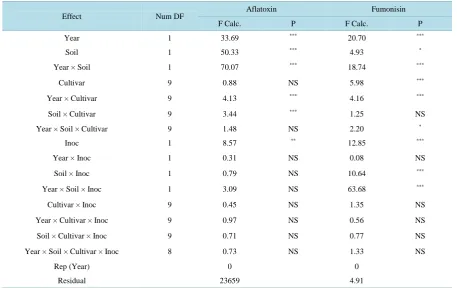
Hybrid had no significant effect on aflatoxin, but interaction with year (hybrid × year) or year × soil × hybrid
was statistically significant (Table 2). Inoculation had significant effects for aflatoxin, but its interactions with
the rest of factors (year, soil, and hybrid) did not show significant effects. Although the response of fumonosin
was similar to aflatoxin for some factors such as the effects of year, soil, and their interactions (Table 2), fumo-
nisin responded differently to other factors in that cultivar, year × soil × cultivar, soil × Inoc, and year × cultivar
× Inoc had significant effects (Table 2). The significant effects of year, soil, and their interactions indicated the
significant of the environmental factors such as heat, drought, and soil on toxins. The weather data [38] revealed
that year 2011 was warmer and drier compared with year 2012 (Figure 1(a) and Figure 1(b)), especially during
the reproductive and seed-fill stages. This could be a source of effects on inoculation. The different response of aflatoxin and fumonisin to some factors and their interactions reflects the different sensitivity of each toxin to these factors. Both toxins were significantly influenced by the inoculation, indicating that the level of these tox-ins in the plant is affected by the disease infection. To further evaluate the effects of the three genetic back-grounds (stacked gene hybrids with multiple Bt genes; Round-up Ready, RR2; and non-transgenic) on aflatoxin and fumonisin levels in seeds, data were analyzed where genetic background was modeled with year, soil, and
inoculation (Table 3). The analysis confirmed that year, soil, and their interactions, and Inoc had significant
[image:4.595.85.543.420.708.2]in-fluences on aflatoxin and fumonisin levels. However, genetic background or its interactions had no significant influences on either aflatoxin or fumonisin levels, indicating that inoculation influenced the levels of aflatoxin and fumonisin, but the inoculation effects did not depend on the genetic background.
Table 2. Analysis of variance (F values and P values) for the effects of year, cultivar, soil, and inoculation (Inoc), and their interactions on aflatoxin (µg/kg) and fumonisin (mg/kg) in corn cultivars (stacked gene hybrids and control) in sandy and clay soils under Mississippi delta condition.
Effect Num DF Aflatoxin Fumonisin
F Calc. P F Calc. P
Year 1 33.69 *** 20.70 ***
Soil 1 50.33 *** 4.93 *
Year × Soil 1 70.07 *** 18.74 ***
Cultivar 9 0.88 NS 5.98 ***
Year × Cultivar 9 4.13 *** 4.16 ***
Soil × Cultivar 9 3.44 *** 1.25 NS
Year × Soil × Cultivar 9 1.48 NS 2.20 *
Inoc 1 8.57 ** 12.85 ***
Year × Inoc 1 0.31 NS 0.08 NS
Soil × Inoc 1 0.79 NS 10.64 ***
Year × Soil × Inoc 1 3.09 NS 63.68 ***
Cultivar × Inoc 9 0.45 NS 1.35 NS
Year × Cultivar × Inoc 9 0.97 NS 0.56 NS
Soil × Cultivar × Inoc 9 0.71 NS 0.77 NS
Year × Soil × Cultivar × Inoc 8 0.73 NS 1.33 NS
Rep (Year) 0 0
Residual 23659 4.91
(a)
[image:5.595.165.461.85.562.2](b)
Figure 1. Weather data for 2011 and 2012 in the Mississippi Delta.
3.1. Levels of Aflatoxin and Fumonisin in Hybrids
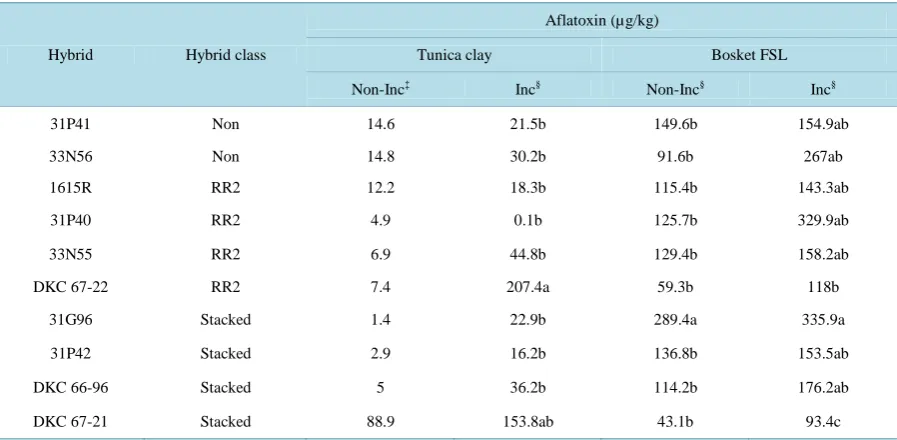
The levels of aflatoxin in samples from the Tunica clay compared to Bosket FSL are shown in Table 4.
Afla-toxin levels observed among samples of the non-inoculated corn of the ten hybrids from the Tunica clay type was variable ranging from 1.4 µg/kg for stacked corn hybrid 31G96 to 88.9 µg/kg for stacked corn hybrid DK67-21. Aflatoxin levels among the inoculated corn of the same ten hybrids were variable as well ranging from 0.1 µg/kg for RR2 corn hybrid 31P40 to 207.4 µg/kg for RR2 corn hybrid DKC67-22. Overall aflatoxin levels in the ten corn hybrids tested were higher from inoculated soils than from non-inoculated soils, and varied
significantly (P ≤ 0.05) among the ten corn hybrids tested in the inoculated fields in comparison to the levels of
aflatoxin among the same hybrids tested in the non-inoculated soil. Levels of aflatoxin were variable and no one hybrid or group of hybrids was consistent in the levels of aflatoxin contamination when grown in Tunica clay under all experimental conditions.
Month
Apr May Jun Jul
Aug Sep Oct
W
aet
her c
om
ponent
0 20 40 60 80 100
Maximum air temperature Minimum air temperature Rainfall (mm)
Year 2011
A
Month
Apr May Jun Jul
Aug Sep Oct
W
eat
her c
om
ponent
0 20 40 60 80 100
Maximum air temperature Minimum air temperature Rainfall
B
Table 3. Analysis of variance (F values and P values) for the effects of year, cultivar, soil, and inoculation (Inoc) on aflatox-in (µg/kg) and fumonisaflatox-in (mg/kg) on corn genetic background [(stacked gene hybrids with multiple Bt genes; Round-up Reddy, RR2; and non-GMO)] in sandy and clay soils under Mississippi delta conditions.
Source effects DF
Aflatoxin Fumonisin
F-Calc. P FCalc. P
Year 1 32.27 *** 12.91 ***
Soil 1 43.4 *** 2.88 *
Year × Soil 1 59.17 *** 9.91 **
Genetic background 2 0.29 NS 1.27 NS
Year × Genetic background 2 2.16 NS 0.73 NS
Soil × Genetic background 2 0.3 NS 0.32 NS
Year × Soil × Genetic background 2 2.38 NS 1.03 NS
Inoc 1 7.03 ** 7.95 **
Year × Inoc 1 0.01 NS 0.07 NS
Soil × Inoc 1 1.06 NS 9.43 **
Year × Soil × Inoc 1 3.83 * 45.3 ***
Genetic background × Inoc 2 0.17 NS 0.14 NS
Year × Genetic background × Inoc 2 1.25 NS 0.61 NS
Soil × Genetic background × Inoc 2 0.2 NS 0.13 NS
Year × Soil × Genetic background × Inoc 2 0.56 NS 0.2 NS
Rep (Year) 1.24E-14 0
Residual 27183 6.4579
*Significance at P ≤ 0.05; **Significance at P ≤ 0.01; ***Significance at P ≤ 0.001.
Table 4. Aflatoxin contamination levels of ten irrigated corn hybrids representing three genotype classes grown on two sites, a Tunica Clay and a Bosket Fine Sandy Loam (FSL) near Stoneville, MS across 2011 and 2012†.
Hybrid Hybrid class
Aflatoxin (µg/kg)
Tunica clay Bosket FSL
Non-Inc‡ Inc§ Non-Inc§ Inc§
31P41 Non 14.6 21.5b 149.6b 154.9ab
33N56 Non 14.8 30.2b 91.6b 267ab
1615R RR2 12.2 18.3b 115.4b 143.3ab
31P40 RR2 4.9 0.1b 125.7b 329.9ab
33N55 RR2 6.9 44.8b 129.4b 158.2ab
DKC 67-22 RR2 7.4 207.4a 59.3b 118b
31G96 Stacked 1.4 22.9b 289.4a 335.9a
31P42 Stacked 2.9 16.2b 136.8b 153.5ab
DKC 66-96 Stacked 5 36.2b 114.2b 176.2ab
DKC 67-21 Stacked 88.9 153.8ab 43.1b 93.4c
†
Means of 4 replications and 2 years. ‡Means are not significantly different. §Means within a column followed by the same letter or letters are not
[image:6.595.89.538.481.701.2]Aflatoxin levels of corn grown in Bosket FSL soil were higher ranging from 43.1 µg/kg for stacked corn hy-brid DKC67-21 to 335.9 µg/kg for the stacked corn hyhy-brid 31G96 under both non-inoculated and inoculated
conditions compared with the overall levels of aflatoxin in Tunica clay soil (Table 4). Although there were
sig-nificant differences (P ≤ 0.05) in aflatoxin levels among hybrids in Bosket FSL soil, all hybrids had aflatoxins
above the regulatory level of 20 µg/kg.
The levels of fumonisin of the combined samples harvested in 2011 and 2012 are shown in Table 5 Fumo-
nisin levels were less variable overall than aflatoxin levels ranging from 0.5 to 16.2 mg/kg. Average fumonisin
levels were about the same in all hybrids in both non-inoculated and inoculated fields both years (Table 5), and
differences were highly significant (P ≤ 0.05) among all hybrids. Fumonisin levels among all hybrids grown in
non-inoculated and inoculated Bosket FSL soil type were not significantly different ranging from 1.2 mg/kg to
5.0 mg/kg (Table 5). Observations of fumonisin levels among the hybrids were similar to observations of
afla-toxin levels among the hybrids. No single hybrid or group of hybrids stood out as resistant or susceptible. Aflatoxin levels were quite different between 2011 and 2012, possibly due to temperature and rainfall condi-tions despite irrigation. Differences in aflatoxin levels were evident between 2011 and 2012 in grain samples from non-inoculated or inoculated treatments in Bosket FSL soil. The aflatoxin levels in the 2011 samples ranged from 237.5 to 339.9 µg/kg for non-inoculated and inoculated Bosket FSL soil, respectively, and were
higher than aflatoxin levels from corn samples from the Tunica Clay soil (Table 6). Likewise, aflatoxin levels in
the 2012 samples were lower than in 2011 samples and ranged from 11.8 µg/ kg to 52.1 µg/kg for the non- inoculated and inoculated field, respectively. The aflatoxin levels in harvested corn samples in 2011 and 2012 were lower in the non-inoculated Tunica Clay field, ranging from 15.2 µg/kg in 2012 to 15.9 µg/kg in 2011.
Fumonisin levels in corn samples harvested from Tunica Clay and Bosket FSL soil types were inconsistent as
far as non-inoculated and inoculated fields in 2011 and 2012 (Table 6). Fumonisin levels in samples from both
non-inoculated and inoculated soils in the Tunica clay field in 2011 were almost identical at 2.3 and 2.2 mg/kg,
respectively. In 2012, the levels were significantly different at 0.3 and 4 mg/kg, respectively (P ≤ 0.05). Samples
harvested from the non-inoculated and inoculated Bosket FSL fields were 2.9 and 6.0 mg/kg in 2011 and 2.6 and 0.6 mg/kg in 2012. Yields of the various corn hybrids used in this study were higher for all hybrids in the Tunica
clay soil [12] compared to the same hybrids in the sandy loam Bosket FSL. During the course of the
[image:7.595.91.535.467.699.2]experi-ments, hybrids in the Tunica clay soil exhibited better plant growth and health (Bruns, Unpublished data).
Table 5. Fumonisin contamination levels of ten irrigated corn hybrids representing three genotype classes grown on two sites, a Tunica Clay and a Bosket Fine Sandy Loam (FSL) near Stoneville, MS across 2011 and 2012†.
Hybrid Class
Fumonisin (mg/kg)
Tunica clay Bosket FSL
Non-Inc§ Inc§ Non-Inc§ Inc‡
31P41 Non 1.1bc 1.4c 2.3 4.4
33N56 Non 2.0b 5.7a 3.6 5
1615R RR2 0.6c 2.1bc 2.3 2.5
31P40 RR2 1.9b 1.6c 2.9 3.2
33N55 RR2 1.2b 3.7b 3.9 4.3
DKC 67-22 RR2 0.5c 2.3bc 1.4 2.4
31G96 Stacked 2.4b 5.9a 3.1 2.4
31P42 Stacked 16.2a 2.4bc 3.7 2.7
DKC 66-96 Stacked 1.8b 5.7a 2.4 1.2
DKC 67-21 Stacked 0.5c 2.4bc 1.8 2.1
†
Means of 4 replications and 2 years; ‡Means are not significantly different; §Means within a column followed by the same letter or letters are not
Table 6. Aflatoxin and Fumonisin contamination levels of irrigated corn hybrids grown on two sites, a Tunica Clay and a Bosket Fine Sandy Loam (FSL) Near Stoneville, MS across 2011 and 2012†.
Aflatoxin (µg/kg)
Tunica clay Bosket FSL
Year Non-Inc‡ Inc§ Non-Inc§ Inc§
2011 15.9 7.6 237.5 339.9
2012 15.2 92.9 11.8 52.1
Fumonisin (mg/kg)
Tunica clay Bosket FSL
Year Non-Inc§ Inc§ Non-Inc‡ Inc§
2011 2.3 2.2 2.9 6.0
2012 0.3 4 2.6 0.6
†
Means of 10 hybrids representing 3 genotypes and 4 replications. ‡Means are not significantly different. §Means within a column are significantly
different P ≤ 0.05.
The theory that reducing plant stress during the kernel-filling time will cause reductions in mycotoxin levels was tested in this research by evaluating if weather data during the 2011 and 2012 growing seasons might
corre-late with aflatoxin and fumonisin levels (Figure 1). Weather comparisons between the 2 years were significantly
different in rainfall. For example, the maximum temperature in June, July, and August 2011 were 34.9, 35.4, and
35.4˚C, respectively, compared to 31.7˚C, 33.7˚C, and 34.1˚C in 2012 (Figure 1). Similar trends for rainfall
were observed where the precipitation was lower during June, July, and August, resulting in a warmer and drier year in 2011 than in 2012, although the precipitation was higher early in the season in 2011 compared to 2012. These conditions may have created additional stress due to warmer and drier season, especially during the ker-nel-filling stage and contributed to much higher aflatoxin contamination in sandy soils. Field water holding ca-pacity of sandy soils is lower than that of clay soils, consequently crops grown in sandy soil are more sensitive to drought stress even when the irrigation is used. Fumonisin levels in the corn samples did not consistently re-late to weather conditions. Recently it was found that these hybrids did not yield as well in sandy soil, possibly due to drought stress even when they received adequate irrigation, (Bruns, unpublished data) compared to the
same hybrids grown in clay soil [12] [25] [39]. In all cases corn grown in sandy loam soil had much higher
le-vels of aflatoxin. None of the hybrids, conventional or stacked-gene, were clearly superior to the others in terms of aflatoxin levels. Some reports of hybrids with a Bt gene showed variable effects on mycotoxin levels. Some
authors reported beneficial effects of hybrids, others did not [1] [40]-[43]. A multifaceted strategy to reduce
mycotoxins appears to be necessary [44].
4. Conclusion
It is not clear at this time whether the benefits of stacked-gene hybrids justify the costs of their development [12].
To reach a conclusive recommendation, more research is required where more hybrids are tested across more years, geographic locations, and under irrigated and non-irrigated conditions.
Acknowledgements
We would like to thank Jeremy Kotowicz, Roderick Patterson, and Terry Johnson for their technical assistance. Mention of trade names or commercial products in this publication is solely for the purpose of providing specific information and does not imply recommendation or endorsement by the U.S. Department of Agriculture.
References
Southern United States. Journal of Agriculture and Food Chemistry, 61, 11759-11770. http://dx.doi.org/10.1021/jf400754g
[2] Alstad, D.N. and Andow, D.A. (1995) Managing the Evolution of Insect Resistance to Transgenic Plants. Science, 268, 894-1896. http://dx.doi.org/10.1126/science.268.5219.1894
[3] Catangui, M.A. and Berg, R.K. (2006) Western Bean Cutworm, Striacosta albicosta (Smith) (Lepidoptera: Noctuidae), as a Potential Pest of Transgenic Cry1Ab Bacillus thuringiensis Corn Hybrids in South Dakota. Environmental Ento-mology, 35, 1439-1452. http://dx.doi.org/10.1093/ee/35.5.1439
[4] Estruch, J.J., Warren, G.W., Mullins, M.A., Nye, G.J., Craig, J.A. and Koziel, M.G. (1996) Vip3A, a Novel Bacillus thuringiensis Vegetative Insecticidal Protein with a Wide Spectrum of Activities against Lepidopteran Insects. Pro-ceedings of the National Academy of Sciences of the United States of America, 93, 5389-5394.
http://dx.doi.org/10.1073/pnas.93.11.5389
[5] George, Z. and Crickmore, N. (2012) Bacillus thuringiensis Applications in Agriculture. In: Sansinenea, E., Ed., Ba-cillus thuringiensis Biotechnology, Chapter 2, Springer Science +Business Media, New York, 19-39.
http://dx.doi.org/10.1007/978-94-007-3021-2_2
[6] Huang, F., Leonard, B.R. and Gable, R.H. (2006) Comparative Susceptibility of European Corn Borer, Southwestern Corn Borer, and Sugarcane Borer (Lepidoptera: Crambidae) to Cry1Ab Protein in a Commercial Bt-Corn Hybrid.
Journal of Economic Entomology, 99, 194-202. http://dx.doi.org/10.1093/jee/99.1.194
[7] Hutchison, W.D., Burkness, E.C., Mitchell, P.D., Moon, R.D., Leslie, T.W., Fleischer, S.J., Abrahamson, M., Hamilton, K.L., Steffey, K.L., Gray, M.E., Hellmich II, R.L., Kaster, V., Hunt, T.E., Wright, R.J., Pecinovsky, K.T., Rabaey, T.L., Flood, B.R. and Raun, E.S. (2010) Areawide Suppression of European Corn Borer with Bt Maize Reaps Savings to Non-Bt Maize Growers. Science, 330, 222-225. http://dx.doi.org/10.1126/science.1190242
[8] Lu, Y., Wu, K., Jiang, Y., Guo, Y. and Desneux, N. (2012) Widespread Adoption of Bt Cotton and Insecticide De-crease Promotes Biocontrol Services. Nature, 487, 362-365. http://dx.doi.org/10.1038/nature11153
[9] Martin, P. and Travers, R. (1989) Worldwide Abundance and Distribution of Bacillus thuringiensis Isolates. Applied and Environmental Entomology, 55, 2437-2442.
[10] Mugo, S.N., Mwimali, M., Taracha, C.O., Songa, J.M., Gichuki, S.T., Tende, R., Karaya, H., Bergvinson, D.J., Pelle-grineschi, A. and Hoisington, D.A. (2011) Testing Public Bt Maize Events for Control of Stem Borers in the First Con-fined Field Trials in Kenya. African Journal of Biotechnology, 10, 4713-4718.
[11] Vaeck, M., Reynaert, A., Hofte, H., Jansens, S., Debeuckeleer, M., Dean, C., Zabeau, M., Vanmontagu, M. and Lee-mans, J. (1987) Transgenic Plants Protected from Insect Attack. Nature, 328, 33-37.
http://dx.doi.org/10.1038/328033a0
[12] Bruns, H.A. (2014) Stacked-Gene Hybrids Were Not Found to Be Superior to Glyphosate Resistant or Non-GMO Corn Hybrids. Crop Management.
[13] Brewer, M. and Odvody, G. (2012) Contributions of Stacked-Trait Bt-Corn, Irrigation, and Hybrid Background on Af-latoxin, Ear Damage, and Yield under Varying Insect Pressure. http://www.corntechconf.org/CUTC/presentations.asp
[14] Abbas, H.K., Accinelli, C., Zablotowicz, R.M., Abel, C.A., Bruns, H.A., Dong, Y. and Shier, W.T. (2012) Dynamics of Mycotoxin and Aspergillus flavus Levels in Aging Bt and Non-Bt Corn Residues under Mississippi No-Till Condi-tions. Journal of Agriculture and Food Chemistry, 56, 7578-7585. http://dx.doi.org/10.1021/jf801771a
[15] Williams, W.P., Windham, G.L., Krakowsky, M.D., Scully, B.T. and Ni, X. (2010) Aflatoxin Accumulation in Bt and Non-Bt Maize Test Crosses. Journal of Crop Improvement, 24, 392-399.
http://dx.doi.org/10.1080/15427528.2010.505111
[16] Wiatrak, P.J., Wright, D.L., Marois, J.J. and Wilson, D. (2005) Influence of Planting Date on Aflatoxin Accumulation in Bt, Non-Bt, and Tropical Non-Bt Hybrids. Agronomy Journal, 97, 440-445.
http://dx.doi.org/10.2134/agronj2005.0440
[17] Dowd, P.F. (2000) Indirect Reduction of Ear Molds and Associated Mycotoxins in Bacillus thuringiensis in Corn un-der Controlled and Open Field Conditions: Utility and Limitations. Journal of Environmental Entomology, 93, 1669- 1679. http://dx.doi.org/10.1603/0022-0493-93.6.1669
[18] Munkvold, G.P., Hellmich, R.L. and Rice, L.G. (1999) Comparison of Fumonisin Concentrations in Kernels of Trans-genic Bt Maize Hybrids and NontransTrans-genic Hybrids. Plant Disease, 83, 130-138.
http://dx.doi.org/10.1094/PDIS.1999.83.2.130
[19] Williams, W.P., Buckley, P.M. and Windham, G.L. (2002) Southwestern Corn Borer (Lepidoptera: Crambidae) Dam-age and Aflatoxin Accumulation in Maize. Journal of Economic Entomololy, 95, 1049-1053.
http://dx.doi.org/10.1093/jee/95.5.1049
[20] Windham, G.L., Williams, W.P. and Davis, F.M. (1999) Effects of the Southwestern Corn Borer on Aspergillus flavus
http://dx.doi.org/10.1094/PDIS.1999.83.6.535
[21] Robens, J. and Cardwell, K. (2003) The Costs of Mycotoxin Management to the USA: Management of Aflatoxins in the United States. Journal of Toxicology: Toxin Reviews, 22, 139-152. http://dx.doi.org/10.1081/TXR-120024089 [22] Abbas, H.K. (Ed.) (2005) Aflatoxin and Food Safety. CRC Press, Boca Raton.
http://dx.doi.org/10.1201/9781420028171
[23] Abbas, H.K., Zablotowicz, R.M., Shier, W.T., Johnson, B.J., Phillips, N.A., Weaver, M.A., Abel, C.A. and Bruns, H.A. (2015) Aflatoxin and Fumonisin in Corn (Zea mays) Infected by Common Smut Ustilago maydis. Plant Disease, 99, 1236-1240. http://dx.doi.org/10.1094/PDIS-03-14-0234-RE
[24] CAST (Council for Agriculture Science and Technology) (2003) Mycotoxins Risks in Plant, Animal, and Human Sys-tems. Task Force Report 139, CAST, Ames.
[25] Abbas, H.K., Shier, W.T. and Cartwright, R.D. (2007) Effect of Temperature, Rain Fall, and Planting Date on Afla-toxin and Fumonisin Contamination in Commercial Bt and Non-Bt Corn Hybrids in Arkansas. Phytoprotection, 88, 41-50. http://dx.doi.org/10.7202/018054ar
[26] Abbas, H.K., Williams, W.P., Windham, G.L., Pringle Jr., J.C., Xie, W. and Shier, W.T. (2002) Aflatoxin and Fumoni-sin Contamination of Commercial Corn (Zea mays) Hybrids in Mississippi. Journal of Agriculture and Food Chemi-stry, 50, 5246-5254. http://dx.doi.org/10.1021/jf020266k
[27] Bruns, H.A. and Abbas, H.K. (2005) Responses of Short-Season Corn Hybrids to a Humid Sub-Tropical Environment.
Agronomy Journal, 97, 446-451. http://dx.doi.org/10.2134/agronj2005.0446
[28] Bruns, H.A. and Abbas, H.K. (2006) Planting Date Effects on Bt and Non-Bt Corn in the Mid South USA. Agronomy Journal, 98, 100-106. http://dx.doi.org/10.2134/agronj2005.0143
[29] De la Campa, R., Hooker, D.C., Miller, J.D., Schaafsma, A.W. and Hammond, B.G. (2005) Modeling Effects of Envi-ronment, Insect Damage, and Bt Genotypes on Fumonisin Accumulation in Maize in Argentina and the Philippines.
Mycopathologia, 159, 539-552. http://dx.doi.org/10.1007/s11046-005-2150-3
[30] Diener, U.L., Cole, R.J., Sanders, T.H., Payne, G.A., Lee, L.S. and Klich, M.A. (1987) Epidemiology of Aflatoxin Formation by Aspergillus flavus. Annual Review of Phytopathology, 25, 249-270.
http://dx.doi.org/10.1146/annurev.py.25.090187.001341
[31] Payne, G.A. (1992) Aflatoxin in Maize. Critical Reviews in Plant Sciences, 10, 423-440. http://dx.doi.org/10.1080/07352689209382320
[32] Abbas, H.K., Wilkinson, J.R., Zablotowicz, R.M., Accinelli, C., Abel, C.A., Bruns, H.A. and Weaver, M.A. (2009) Ecology of Aspergillus flavus, Regulation of Aflatoxin Production and Management Strategies to Reduce Aflatoxin Contamination of Corn. Toxin Reviews, 2-3, 142-152. http://dx.doi.org/10.1080/15569540903081590
[33] King, E.D., Bassi, A.B., Ross, D.C. and Druebbisch, B. (2011) An Industry Perspective on the Use of Atoxigenic Strains of Aspergillus flavus as Biological Control Agents and the Significance of Cyclopiazonic Acid. Toxin Reviews, 30, 33-41. http://dx.doi.org/10.3109/15569543.2011.588818
[34] National Toxicology Program (NTP) (2001) Toxicology and Carcinogenesis Studies of Fumonisin B1 in F344/N Rats and B6C3F1 Mice (Feed Studies). Department of Health & Human Services, Public Health Service, NTP, Central Data Management, Research Triangle Park.
[35] Accinelli, C., Abbas, H.K., Vicari, A. and Shier, W.T. (2014) Aflatoxin Contamination of Corn under Different Agro-Environmental Conditions and Biocontrol Applications. Crop Protection, 63, 9-14.
http://dx.doi.org/10.1016/j.cropro.2014.04.021
[36] Plattner, R.D. (1999) HPLC/MS Analysis of Fusarium Mycotoxins, Fumonisins and Deoxynivalenol. Natural Toxins, 7, 365-370. http://dx.doi.org/10.1002/1522-7189(199911/12)7:6<365::AID-NT85>3.0.CO;2-0
[37] Muscarella, M., Magro, S.L., Nardiello, D., Palermo, C. and Centonze, D. (2008) Development a New Analytical Me-thod for the Determination of Fumonisin B1 and B2 in Food Products Based on High Performance Liquid Chromato-graphy and Fluorimetric Detection with Post-Column Derivatization. Journal of Chromatography A, 1203, 88-93. http://dx.doi.org/10.1016/j.chroma.2008.07.034
[38] MSUcares (2014) http://msucares.com/crops/soybeans/index.html
[39] Kebede, H., Abbas, H.K., Fisher, D.K. and Bellaloui, N. (2012) Relationship between Aflatoxin Contamination and Physiological Responses of Corn Plants under Drought and Heat Stress. Toxins, 4, 1385-1403.
http://dx.doi.org/10.3390/toxins4111385
[40] Hammond, B.G., Campell, K.W., Pilcher, C.D., Degooyer, T.A., Robinson, A.E., McMillen, B.L., Spangler, S.M., Riordan, S.G., Rice, L.G. and Richard, J.L. (2004) Lower Fumonisin Mycotoxin Levels in the Grain of Bt Corn Grown in the United States in 2000-2002. Journal of Agriculture and Food Chemistry, 52, 1390-1397.
[41] Folcher, L., Delus, M., Marenque, E., Jarry, M., Weissenberger, A., Eychenne, N. and Regnault-Roger, C. (2010) Lower Mycotoxin Levels in Bt Maize Grain. Agronomy and Sustainable Development, 30, 711-719.
http://dx.doi.org/10.1051/agro/2010005
[42] Ostry, V., Ovesna, J., Skarkova, J., Pouchova, V. and Ruprich, J. (2010) A Review on Comparative Data Concerning
Fusarium Mycotoxins in Bt Maize and Non-Bt Isogenic Maize. Mycotoxin Research, 26, 141-145. http://dx.doi.org/10.1007/s12550-010-0056-5
[43] Schaafsma, A.W., Hooker, D.C., Baute, T.S. and Illincie-Tamburic, L. (2002) Effect of Bt-Corn Hybrids on Deoxyni-valenol Content in Grain at Harvest. Plant Disease, 86, 1123-1126. http://dx.doi.org/10.1094/PDIS.2002.86.10.1123 [44] Tedford, E. (2012) Development and Refinement of Afla-Guard for Reduction of Aflatoxins in Corn in the US 2012.