This article was downloaded by: [Lancaster University Library] On: 22 April 2013, At: 04:12
Publisher: Taylor & Francis
Informa Ltd Registered in England and Wales Registered Number: 1072954 Registered office: Mortimer House, 37-41 Mortimer Street, London W1T 3JH, UK
International Journal of Production
Research
Publication details, including instructions for authors and subscription information:
http://www.tandfonline.com/loi/tprs20
Theoretical development of a workload
control methodology: evidence from
two case studies
M. Stevenson a & C. Silva b
a
Department of Management Science, Lancaster University Management School, Lancaster University, LA1 4YX, UK b
Mechanical Engineering Department, University of Coimbra, Pòlo II Pinhal de Marrocos 3030, Coimbra, Portugal
Version of record first published: 04 Apr 2008.
To cite this article: M. Stevenson & C. Silva (2008): Theoretical development of a workload control methodology: evidence from two case studies, International Journal of Production Research, 46:11, 3107-3131
To link to this article: http://dx.doi.org/10.1080/00207540601039791
PLEASE SCROLL DOWN FOR ARTICLE
Full terms and conditions of use: http://www.tandfonline.com/page/terms-and-conditions
This article may be used for research, teaching, and private study purposes. Any substantial or systematic reproduction, redistribution, reselling, loan, sub-licensing, systematic supply, or distribution in any form to anyone is expressly forbidden.
The publisher does not give any warranty express or implied or make any representation that the contents will be complete or accurate or up to date. The accuracy of any
Vol. 46, No. 11, 1 June 2008, 3107–3131
Theoretical development of a workload control methodology: evidence
from two case studies
M. STEVENSON*yand C. SILVAz
yDepartment of Management Science, Lancaster University Management School, Lancaster University, LA1 4YX, UK
zMechanical Engineering Department, University of Coimbra, Po`lo II Pinhal de Marrocos 3030, Coimbra, Portugal
(Revision received September 2006)
Workload control (WLC) is a leading production planning and control (PPC) concept for manufacturing environments subjected to high levels of uncertainty, such as in the make-to-order (MTO) industry. Despite the importance of this concept, few case study applications of WLC have been presented in the literature. This paper takes advantage of a rare opportunity to explore two independent longitudinal empirical WLC projects recently undertaken in Portugal and the United Kingdom. Uniquely, the projects were conducted in parallel and both chose to incorporate the exact same influential WLC methodology in the development of a decision support system (DSS), thus providing an ideal platform for cross-case comparison. The paper focuses primarily on theoretical refinements which ultimately had to be made to the WLC methodology applied to the two cases. Reasons for the refinements can be broadly split into two groups: (1) refinements due to the time that has elapsed since the development of the original methodology; and (2) refinements due to company specific characteristics. The paper also reflects upon a number of implementation difficulties common to both case studies, providing insight into how these could be avoided in the future. Finally, eight future research challenges are presented.
Keywords: Production planning and control; Decision support system; Case studies; Workload control; Product customisation
1. Introduction
Workload control (WLC) is a production planning and control (PPC) concept designed for complex environments, such as those encountered by manufacturers of bespoke goods tailored to the needs of individual customers. Despite the importance of this concept, few case study applications of WLC have been presented in the literature (see, for example, Bechte 1988, Hendryet al. 1993, Bechte 1994, Wiendahl 1995, Parket al. 1999). In recent times, a number of authors have called for more empirical research relating to the WLC concept in order to bridge the gap between the extensive literature on theoretical aspects of WLC and the limited empirical body
*Corresponding author. Email: [email protected]
International Journal of Production Research
ISSN 0020–7543 print/ISSN 1366–588X onlineß2008 Taylor & Francis http://www.tandf.co.uk/journals
DOI: 10.1080/00207540601039791
of research (see, for example, Bertrand and Van Ooijen 2002, Kingsman and Hendry 2002, Stevensonet al. 2005).
One of the leading WLC methodologies, designed for customised production environments such as in the make-to-order (MTO) industry, was developed at the Lancaster University Management School (LUMS) during the 1980s and 1990s, and is now commonly referred to as the LUMS approach. Over the past three years, two separate research groups (based at universities in Portugal and the United Kingdom) have conducted case study implementation projects of the LUMS approach. Details of these individual accounts can be found in Silvaet al. (2006) and Stevenson (2006). During this research, both groups have independently developed decision support systems (DSS) based on the LUMS approach for their respective cases and both groups have found it necessary to make theoretical refinements to the LUMS approach that underpins their systems in order to bridge the gap between theory and practice.
This paper presents a comparative case study analysis of the refinements made to the LUMS approach in these two projects. This insight provides a unique paper and a research opportunity unlikely to be repeated in the field of WLC. It describes, in detail, two longitudinal case study research projects which were conducted in parallel, which pursued very similar research agendas and which, uniquely, began with and refined the same WLC concept. This cross-case reflective comparison enables a deeper understanding of the two cases, adds weight to the conclusions that can be drawn from the two projects individually and improves the generality of the findings; hence, it is argued that the comparative analysis presented herein is greater than the sum of the parts. The paper focuses primarily on theoretical aspects of the LUMS approach in order to identify commonalities and divergences between the refinements made in the two cases and in doing so to explain why refinements were necessary. It is anticipated that the outcomes of this research will have implications for establishing a more generic and unified version of the LUMS approach. By focussing on WLC theory, the paper complements that presented by Hendryet al. (2006), which focuses on implementation insights identified through comparative case study analysis.
The remainder of this paper is organized as follows. Section 2 describes the comparative case study methodology applied in this research before section 3 presents a description of the two case study companies. Sections 4 and 5 analyse the refinements made to the LUMS approach during the two case studies, exploring factors that influenced these developments and highlighting a number of ongoing research challenges prominent in the field of WLC. Finally, conclusions are drawn in section 6.
2. Comparative case study methodology
The case study research methodology is widely acknowledged as an ideal approach for refining an established theory and for exploring contextual conditions (see, for example, Meredith 1998, Stuartet al. 2002, Vosset al. 2002). The longitudinal case study approach has a number of advantages over the cross-sectional approach, including an ability to gain an in-depth understanding of a particular context during a period of change; however, this can be very time consuming, making the single case
study a common approach. Through international research collaboration, this paper is able to take a multiple longitudinal approach to case research thus significantly improving the generality of the results. While different WLC methodologies share many of the same characteristics (such as the use of an order pool), they are also different in many ways (such as in their approach to workload accounting over time) and hence are difficult to compare directly; many papers have explored such differences, including Land and Gaalman (1996), Bergamaschi et al. (1997) and Sabuncuoglu and Karapinar (1999). As these two case studies began with an identical theoretical methodology and were refined at the same time, the individual accounts provide an ideal basis for cross-case theoretical comparison. In what follows, the paper seeks to address a number of research questions, these include: How did the application of the LUMS approach have to be refined in the two cases? What are the explanatory factors behind these refinements? What were the commonalities and differences between the two sets of refinements? Are any of these issues likely to re-occur in other settings? In the light of this practical experience, what important future research challenges emerge (or remain outstanding) in the field of WLC ?
2.1 Analytical procedure
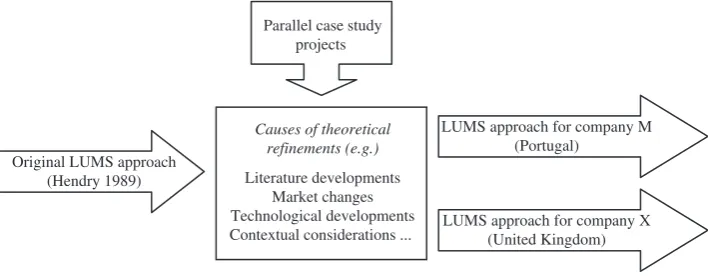
To facilitate collaboration, a meeting was held between the two research groups prior to the case study research and a second meeting was held after the refinements had been made. Minimal contact occurred between the two groups in between these two meetings, hence the refinements made by one group of researchers did not significantly impact the decisions made by the other group of researchers. Figure 1 illustrates the comparative case study methodology applied and described in this paper. While both studies started with the same WLC approach, the projects resulted in varying refinements being made by the two research groups. Figure 1 also highlights some of the reasons why refinements were made to the original methodology.
Tables have proven to be the most notable tool for case study comparison in two respects. Firstly, tables proved useful for comparing characteristics of the two case study companies against a detailed criteria; the criteria makes use of important
Parallel case study projects
Original LUMS approach (Hendry 1989)
LUMS approach for company X (United Kingdom) LUMS approach for company M
(Portugal) Causes of theoretical
refinements (e.g.)
[image:4.493.71.426.66.205.2]Literature developments Market changes Technological developments Contextual considerations ...
Figure 1. Cross-case comparison of refinements to the WLC Methodology.
company characteristics highlighted by Perona and Miragliotta (2000), such as shop configuration and machine characteristics, by Henrich et al. (2004), such as inter-arrival time variability and routing length, and those noted as important during this research. Secondly, and more significantly, tables proved useful for comparing the two methodologies alongside the original LUMS approach (see later tables 1–4); where similar refinements have been made to the two methodologies, a degree of generalisation is possible. Significant differences between the two methodologies have also been explored in detail. The key source of reference for the description of the original methodology is Hendry (1989), an improved version of that previously presented by Tatsiopoulos (1983). Further descriptions of the LUMS approach are also presented by Hendry and Kingsman (1989, 1991, 1993), Hendry et al. (1993), Hendry and Wong (1994), Hendry et al. (1998), Kingsman (2000), Kingsman and Hendry (2002) and Stevenson and Hendry (2006). From Hendry (1989) to Kingsman and Hendry (2002), the theory underpinning the LUMS approach remains relatively unchanged. Theoretical aspects are analysed using five categories:
(1) The three-tiered hierarchy of workloads (see table 1).
(2) The impact of a new job upon the workload length (see table 1). (3) The total and planned workload control infrastructure (see table 2). (4) The released workload control infrastructure (see table 3).
(5) Defining parameters and controls (see table 4).
Hence, the use of tables provides an ideal means for comparative analysis as it allows multiple cases to be presented in a structured and unified format.
3. Case study characteristics
The following subsections compare the two case study companies thus providing an insight into the characteristics of companies for which the LUMS approach is designed to support. To aid comparison, characteristics of the two companies were tabulated and analysed, as described in section 2, under seven main headings (see also the appendix):
(1) Company overview.
(2) Demand data and current shop load.
(3) Planning procedures prior to the implementation of WLC. (4) Shop floor machine details.
(5) Job characteristics.
(6) Capacity management (and output control measures). (7) Technical aspects of the company.
The following subsections are organized around the seven headings above. For anonymity, the case study conducted in Portugal is hereafter referred to as Company M, while the case study conducted in the United Kingdom is hereafter referred to as Company X. Exploring the differing characteristics of the companies may later help to explain the similarities and differences in the refinements made in the two projects; hence the purpose of the section is the identification of potential explanatory factors.
Table 1. Hierarchy of workloads and the impact of a new job upon the workload length. Original Methodology Company M Company X 1.1 Released workload length (RWL) Consists of all jobs that have been released to the shop floor. Original methodology Original methodology 1.2 Planned workload length (PWL) (R1) Consists of the RWL together with jobs awaiting release in the pool, i.e. accepted jobs for which materials are available. Consists of the RWL together with jobs awaiting release in the pool, i.e. accepted jobs for which child components have been concluded. Original methodology 1.3 Total workload length (TWL) (R2) Consists of the PWL together with confirmed jobs awaiting materials and a (strike rate) proportion of potential orders awaiting confirmation. Consists of the PWL together with con-firmed jobs awaiting the completion of child components; the strike rate is not incorporated . Original methodology 1.4 RWL increase The workload contribution of a job is added to the RWL of corresponding work centres at the moment of order release. Original methodology Original methodology 1.5 RWL decrease The workload contribution of a job is sub-tracted from the RWL of a work centre when the operation has been completed and this information is fed-back to the WLC system. Original methodology Original methodology 1.6 PWL increase A job is added to the PWL of all affected work centres upon its earliest release date. Original methodology Original methodology 1.7 PWL decrease A job is subtracted from the PWL of a work centre when the anticipated operation com-pletion date has been exceeded. Original methodology Original methodology 1.8 TWL increase (R2) The whole of a job is added to the TWL if it is accepted by the company (a percentage of job tenders are also incorporated). A job is only added to the TWL if it is accepted by the company; the strike rate is not incorporated . Original methodology 1.9 TWL decrease A job is subtracted from the TWL of a work centre after the operation completion date. A job is subtracted from the TWL of the shop after the anticipated delivery date. Original methodology Original methodology
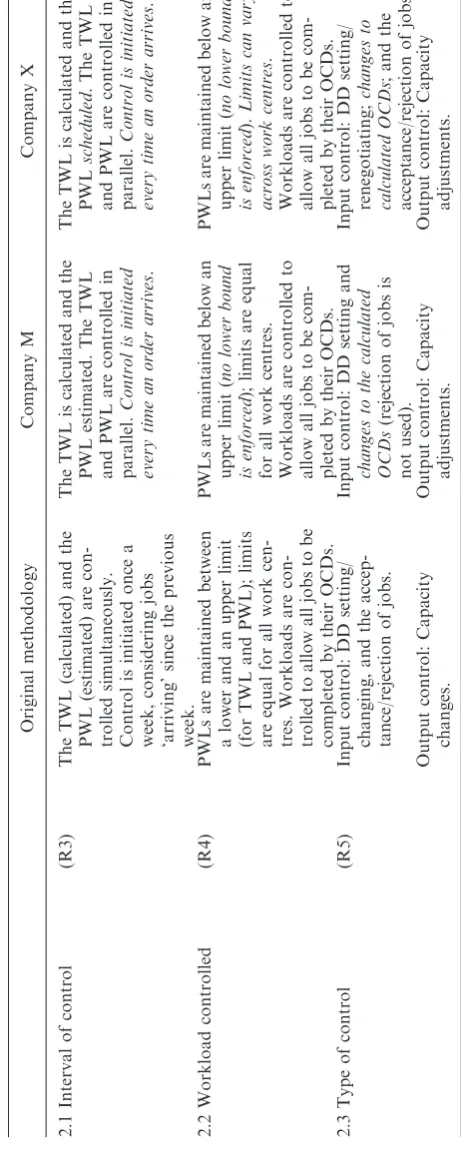
Table 2. Total and planned workload control infrastructure. Original methodology Company M Company X 2.1 Interval of control (R3) The TWL (calculated) and the PWL (estimated) are con-trolled simultaneously. Control is initiated once a week, considering jobs ‘arriving’ since the previous week. The TWL is calculated and the PWL estimated. The TWL and PWL are controlled in parallel. Control is initiated every time an order arrives . The TWL is calculated and the PWL scheduled . The TWL and PWL are controlled in parallel. Control is initiated every time an order arrives . 2.2 Workload controlled (R4) PWLs are maintained between a lower and an upper limit (for TWL and PWL); limits are equal for all work cen-tres. Workloads are con-trolled to allow all jobs to be completed by their OCDs. PWLs are maintained below an upper limit ( no lower bound is enforced ); limits are equal for all work centres. Workloads are controlled to allow all jobs to be com-pleted by their OCDs. PWLs are maintained below an upper limit ( no lower bound is enforced ). Limits can vary across work centres . Workloads are controlled to allow all jobs to be com-pleted by their OCDs. 2.3 Type of control (R5) Input control: DD setting/ changing, and the accep-tance/rejection of jobs. Input control: DD setting and changes to the calculated OCDs (rejection of jobs is not used). Input control: DD setting/ renegotiating; changes to calculated OCDs ; and the acceptance/rejection of jobs. Output control: Capacity changes. Output control: Capacity adjustments. Output control: Capacity adjustments.
[image:7.493.137.368.69.646.2]Table 3. Released workload control infrastructure. Original methodology Company M Company X 3.1 Interval of control (R6) Job release is periodic, typically once a week by considering all jobs in the pool. Job release typically takes place once a day , considering all jobs in the pool. Job release must take place daily (or even once a shift ), considering all jobs in the pool.
3.2 Workload controlled
(R7) RWLs are maintained between a lower and an upper limit; limits are equal for all work centres. RWLs are maintained below an upper limit ( no lower limit ); limits are equal for all work centres RWLs are maintained below an upper limit ( no lower limit ); limits can vary across work centres . 3.3 Type of control (R8) Input control: Push release (normal); intermediate push release (force specific jobs); pull release to spe-cific under load work centres. Input control: Only daily release (choosing the set of jobs to be released). Input control: Push; force; pull; and part-release of jobs. Output control: Capacity changes. Output control: No output control is exercised at the release level. Output control: Capacity adjustments.
Table 4. Defining parameters and controls. Original Methodology Company M Company X 4.1 Delivery date estimation upon customer enquiry (R9) A function of the TWL, enquiry date, customer confirmation time, material lead time, pool delay, total work content and expected shop floor queuing times. Estimated using historical data from similar products and expectations of the customer. Due date setting not fully sup-ported ; the user sets the due date by consulting the TWL. A function of the TWL, enquiry date, customer con-firmation time, material lead time, pool delay and regu-lated work centre throughput times . 4.2 ERD, LRD and OCD parameter estimation (R10) Parameters are a function of the job DD, material arrival date, job routing and processing and setup time. Parameters are a function of the mould due date, mould struc-ture (tree), routing of each mould component and proces-sing plus setup time. OCDs and LRDs are not estimated; discrete back-wards scheduling is used based on routing, work content and daily available capacity. Forwards schedul-ing used if due dates re-negotiated. 4.3 Planning horizon division (R11) Planning horizon split into weekly time periods; jobs enter PWs at the beginning of the week of their ERDs and leave the PWs at the end of the week of their OCDs. Planning horizon split into daily time periods ; jobs enter PWs at the beginning of the day of their ERDs and leave the PWs at the end of the day of their OCDs. Planning horizon split into daily time periods ; jobs enter PWs at the beginning of the day of their ERDs and leave the PWs at the end of the day of their OCDs 4.4 Defining workload limits Defined and adjusted by the manager (using experience/trial and error). Equations also determined to establish a rela-tionship between the maximum values and SFTT, MLT and DLT (in order to help the manager choose limits). Original methodology Original methodology 4.5 Capacity control methods (R12) Assign overtime, reallocate operators, and subcontract. Assign overtime; job re-routing ; subcontracting (anything from one operation to the entire job). Assign overtime; reallocating operators; renegotiating due dates ; and subcontracting.
3.1 Company overviews
Both companies are of a similar size and turnover, but which serve very different markets. Company M has a turnover of E1.2 million and employs 20 people while Company X has a turnover of E1.5 million and employs 30 people. Company M produces one-off aluminium moulds for pre-series production and, as a secondary activity, produces steel mould components for large series production. Every job that Company M undertakes is unique and hence the company can be described as a versatile manufacturing company (VMC), as defined by Amaro et al. (1999). Each aluminium mould is engineered-to-order (ETO), while steel (subcontracted) mould components are essentially make-to-print (MTP) based on designs supplied by the customer. While it operates independently, Company M is in fact one of 16 subsidiaries of a larger mould-producing enterprise. Company X can be described as an independent precision engineering company producing a wide range of small bespoke subcontracted components. Company X is involved in producing one-off jobs as well as the repeat production of bespoke products that a customer repeatedly orders over the length of a contract; hence the company is both a VMC and a repeat business customiser (RBC).
Company M’s customers are in the automotive, electronics, alimentary and electro-domestics industries and are based throughout Europe, the USA and Japan. Company X’s customers are in the aerospace, defence, automotive and construction industries and are almost entirely UK based. Both companies are involved in intensely competitive markets and bidding processes; Company M has a recent strike rate of just 5%, while Company X has a strike rate of 15%. Company M has a much higher delivery date adherence record than Company X, but this is largely due to its ability to subcontract work to other members of the mould producing group, rather than due to the reliability of its in-house processes.
3.2 Current shop load overview
Company X receives an average of five new jobs per day, five days per week. Company M typically receives one aluminium mould order per week; aluminium moulds consist of between five and nine sub-component jobs, while jobs at Company X are normally small single structure components. In addition, Company M also typically receives an average of seven steel mould components per week, subcontracted from other members of the enterprise. Company X is currently heavily overloaded while Company M is under-loaded in its core business area. As a result, Company M accepts a great deal of subcontract work to utilize excess capacity. Approximately 20% of the jobs that Company X receives are considered to be rush orders for important customers; however, the current load of the shop means that all orders can be considered urgent. Jobs given extra attention are those for new customers or for repeat customers that have recently received a poor level of service. Approximately 10% of jobs in Company M are rush orders relating to re-work which is given greater priority over other jobs.
3.3 Current planning procedures
Neither company explicitly considers capacity or the current workload distribution when quoting due dates and does little planning until a job is accepted. Company X quotes lead times that are known to be competitive and acceptable to the customer (between 2 and 4 weeks). Company M tend to quote a standard lead time of 4 weeks for aluminium moulds, while lead times for subcontracted components are imposed on the company. At present, Company X simply write a list of the most urgent jobs next to corresponding machines on a white board for the shop floor supervisor to consult. More planning is performed in Company M using Microsoft Projectßbut it is the operators who ultimately decide the order in which jobs are processed. Once released, little shop floor control or monitoring is performed in Company X, meanwhile in Company M data on the progress of jobs is collected manually.
3.4 Shop floor machine details
The shop floor of Company M consists of 17 machines including CNC milling machines, electro-erosion, assembly presses and turning machines. Company X has 23 machines including CNC milling and turning machines, drilling, grinding and centre lathes. In Company X (semi-)interchangeable machines have been grouped into work centres so that the shop floor consists of 12 work centres varying from one to four machines. This was not considered possible for Company M; creating a single capacity grouping would have distorted the time required to process each job. Both shops can be considered ‘general job shops’, with the material flow in both shops ultimately converging on the final assembly and inspection operations.
3.5 Job characteristics and planning considerations
Company X suffers from highly variable order quantities and set-up times. On the other hand, set up times and quantities in Company M are generally small and stable; while this can make control more manageable, product complexity is much greater in Company M than in Company X. In Company X, almost all jobs are performed sequentially on a single structure while in Company M products are made up of five to nine subcomponents, leading to a more complex and extensive bill of materials. Throughput times in both companies are variable, but while a work centre throughput time of one day may be a reasonable assumption in Company X, in Company M processing time variability means that throughput times can vary from a few hours to 6 or 7 days. For the core work, routing lengths vary greatly in both companies from one to eight operations. In Company M, subcontracted steel mould jobs have a routing length of just one or two operations; hence, there is a clear distinction between the production characteristics of the two types of orders Company M process.
3.6 Capacity management and output control measures
In Company M, each machine runs for 8 hours a day on a single shift, 5 days a week; capacity is essentially machine dependent. For Company X, capacity calculations are more complex; the capacity of the shop is dependent on both machines and
human resources. There are three overlapping shift patterns in the shop, machines run for varying lengths of time and productivity is considered by management to be sensitive to the level of experience of the operator. Thus, management insist on an efficiency rating being incorporated in the determination of capacities. Both companies can manage capacities through overtime, subcontracting and through reallocating operators. However, management at Company X have relatively rigid overtime agreements with operators, limiting the effectiveness of overtime while Company M relies heavily on subcontracting to other subsidiaries of the enterprise. For flexibility, Company X also regularly split large quantity jobs on the shop floor.
3.7 Technological aspects
Company X has been developing an information system that the WLC system based on the LUMS approach described by Stevenson (2006) can ‘plug into’. Company M do not have such a system and hence the WLC system described by Silvaet al. (2006) must operate as a stand-alone package. Both companies have emphasised the importance of web-functionality for furthering their business relationships. In particular, customers of both companies would like to be able to view the progress of jobs prior to delivery, to the extent that it is considered that this will affect the future competitiveness of the companies when bidding for new work. Given the varying locations of customers, this is considered more of an immediate concern for Company M than for Company X. For Company X, face-to-face meetings with clients are common place; however, this is becoming an increasingly important issue to larger customers. The DSS design is thus affected by considerations and advances in technology that were not readily available when the LUMS approach was devised. While web functionality does not have direct implications for the core WLC theory it provides a practical extension to WLC concepts important to improving the widespread use and acceptance of the concept in practice.
4. Refinements made to the WLC methodology
The following subsections compare the original methodology with the refined versions, highlighting where the original methodology remained intact and where changes were made. In doing so the discussion seeks to explain why changes were made, such as due to theoretical developments presented in the literature, current programming capabilities or increasing market competitiveness, and whether the refinements provide relatively generic theoretical changes to the LUMS approach or reflect contextual requirements. The discussion has implications for the development of other WLC methodologies by fellow scholars and for the development of more robust PPC concepts for customized industries.
4.1 Hierarchy of workloads and the impact of a new job upon the workload length
From table 1 it can be seen that most aspects of the original hierarchical structure and the way that a new job impacts the workload lengths remain unchanged. For Company X, no refinements to the original methodology were required, while in
Company M two changes to the original methodology were made to reflect the product complexity in Company M and the competitiveness of the mould industry.
Refinement 1 (R1): The interval during which jobs contribute to the planned workload is increased in sophistication for Company M to accommodate the complex product structure of the mould industry. Jobs still enter the planned workload on their earliest release date, but while in the original methodology the earliest release date is a function of backward scheduling and the material arrival date, in Company M it is a function of backward scheduling and the completion date of any ‘child components’. Hence, the planned workload now reflects the interdependencies between different components in the shop, with the material arrival date being substituted for the completion dates of child components. This refinement makes the LUMS approach more applicable to complex product structures and is likely to be required in many other production environments.
Refinement 2 (R2): The strike rate percentage of unconfirmed jobs was not incorporated into the total workload calculations in Company M for three reasons. Firstly, the strike rate of Company M is extremely low (5%) and hence 5% of the workload of unconfirmed jobs was not considered to be a significant contribution to the total workload of the shop. Secondly, to incorporate the strike rate percentage, details of unconfirmed jobs must be input into the information system; given the low probability of ‘winning’ a tender, extensive planning was not desired at this stage for all jobs. Finally, management were aware that if the shop became overloaded, they had the option of subcontracting components to other members of the enterprise and hence were not as concerned with controlling the total workload as they were with the planned and released workloads. While this change simplifies the original methodology, it has two drawbacks. Firstly, if the strike rate of Company M increases (or if the company want to minimize the quantity of work subcontracted), this refinement can lead to a deterioration in control of the intended workload lengths and thus of due date adherence. Secondly, by removing the strike rate percentage of unconfirmed jobs, an important aspect of the original methodology is not incorporated, meaning due date quotations are not fully supported at the customer enquiry stage. Hence, it is concluded that this does not represent a generic change or improvement to the methodology underpinning the LUMS approach.
4.2 Total and planned workload control infrastructure
As can be seen from table 2, refinements were made to the total and planned workload control infrastructure of the LUMS approach during both case studies; in general these changes can be explained by the passing of time since the methodology was last developed. More specifically, since the 1980s changes to the competitive landscape have occurred in manufacturing while theoretical improve-ments to other WLC concepts, which can be similarly applied to the LUMS approach, have been presented in the literature.
Refinement 3 (R3): The ‘interval of control’ for both the total and planned workload have been reduced in both Company M and Company X. Rather than
control being triggered on a weekly basis, the intensity of the inter-arrival rate observed in both companies meant that workloads have to be updated more regularly. Refining the interval of control is more than just a change in the way the methodology is used; at the planned workload level, daily (rather than weekly) time buckets must also be incorporated. In Company X this also led to the addition of a time-phased total workload chart to illustrate the distribution of due dates and workloads over time. In general, shortening the interval of control is a reflection of the competitiveness of industry and the short lead time expectations of customers and (for many production scenarios) is considered to be a relatively generic change to the methodology underpinning the LUMS approach.
Refinement 4 (R4): In the original methodology there was much greater emphasis on the use of lower bounds to the workloads (whether enforced or simply advised) than in the refined versions developed for Company M and Company X. In Company X, workload limits are also permitted to vary across work centres, creating flexibility and allowing certain work centres to be monitored more closely than others. Recent literature has also highlighted the inferior performance of the combined use of lower and upper bounding compared with the sole use of upper bounding or the use of workload balancing at the release level (see Cigolini and Portioli 2002), impacting the design decisions made by both research teams. Given this support, the refinement is also likely to be a generic change to the methodology underpinning the LUMS approach.
Refinement 5 (R5): At the total and planned workload levels, both case studies led to changes to the input control measures. Management in both case studies were very reluctant to reject jobs and both companies wanted the ability to change operation completion dates without this affecting the due date. This reflects the observation that management favour relatively defined schedules (accompanied by Gantt charts) from which to work and greater discrete shop floor scheduling and control than WLC would normally provide. The refinement made to the methodology in both case studies represents a desire to meet the requests of management in order to improve acceptance of the system and speed up implementation; however, the ability to manually change operation completion dates is not a change that improves the methodology. The need to re-negotiate due dates after the original date had been exceeded in Company X also led to a forwards scheduling function being added to the input control measures to supplement the existing backwards scheduling function. In general, the refinements made to the ‘type of control’ highlight the sorts of requirements found in practice; however they do not provide a comprehensive list of options. Hence, at present future case study implementations will still require input parameters to be tailored to the needs and idiosyncratic characteristics of the individual company.
4.3 Released workload control infrastructure
Table 3 summarizes thereleasedworkload control infrastructure, in the same format as table 2 does for thetotal and planned workload. In general, refinements to the released workload control infrastructure follow a similar pattern to above.
Refinement 6 (R6): In both case studies, job release was found to be necessary on a daily basis or at the start of every shift. Hence, the periodic release policy adopted in the original methodology approaches a more continuous process. In both companies, the released workload length is calculated in days and part days for increased accuracy at this important level of the planning hierarchy. This refinement again reflects the short lead time expectations of customers and the high order-arrival rate. This is considered to be a relatively generic change but is also somewhat dependent on company procedures and product characteristics. For a company that produces low volume–high processing time related items, longer intervals of control may still be required.
Refinement 7 (R7): As with the total and planned workloads, the released workload is maintained below a maximum limit, and the lower limit is ‘relaxed’; this reflects theoretical developments presented in the literature as earlier described. As with the total and planned workloads, the released workloads in Company X can vary across work centres. It should also be noted that interdependencies between jobs affect the release options and decisions made by users (as observed in Company M). While jobs are to be released in both companies according to shortest slack, in practice the importance and tolerance of the individual customer to late delivery also affects the release decision.
Refinement 8 (R8): In Company M, no output control is exercised at the release level; management anticipated that this would lead to high system nervousness. In Company X, output control is exercised through capacity changes while the input control parameters proposed in the original methodology are supplemented by the use of lot splitting. Orders placed with Company X can be very large and the customer may request that deliveries be staggered over a number of months; as a result, the LUMS approach was adapted, allowing the user to ‘part release’ a job onto the shop floor. This provides greater flexibility at the order release stage and means that if a job is behind schedule, the company can take action to deliver at least part of the quantity on time. Splitting a job does not affect due dates or operation completion dates within the system unless part of the delivery has been re-negotiated with the customer. In Company X, users are also able to assess the cumulative impact of jobs before making the choice of which jobs to release; this can be particularly valuable where interdependencies between different sets of jobs occur, as in Company M. Clearly, very different refinements emerged for the two case studies. For Company X, refinements led to the incorporation of additional control measures, tailored to the needs of the individual companies, while for Company M, refinements led to the elimination of all output control measures at the release stage. Similar requirements are envisaged in other companies producing high volume items, but the implications of lot splitting for set-up dependences on the shop floor must be noted.
4.4 Defining parameters and controls
Table 4 summarizes the changes made to the methodology relating to the definition of parameters and controls. Changes occur for both companies in all criteria except in the determination of workload limits; this reflects the fact that research is yet to provide adequate support for this process. Limits must still be determined by
management using trial and error, practical experience and support from the research team.
Refinement 9 (R9): In Company X the due date negotiation process is supported in a comparable way to the original methodology except that instead of basing the time a job spends on the shop floor upon the total work content and the sum of the norm queuing times of work centres in the routing of a job, a single norm throughput time is applied to each work centre. This reduces the complexity of the data required from the user at the enquiry stage. In Company M, no support is provided for the user during this process; this is the responsibility of the estimator, thus eliminating a stage particularly important in highly customised industries. While the simplification made in Company X is more favourable, when making refinements to the due date estimation process, a number of points should be considered:
. The availability of data at the customer enquiry stage is heavily dependent on the estimation process (companies producing low volume items are likely to spend more time producing detailed quotations prior to being introduced to WLC).
. The willingness of the estimator to provide data at the customer enquiry stage is related to the strike rate and culture of the company.
. Product complexity and parts commonality impact other factors important to the calculation of due dates, such as material lead times.
. Throughput norms can only be used if these are relatively stable or are to be gradually ‘brought under control’.
Despite this, the refinement made in Company X is considered to be an improvement to the LUMS approach if it is to be usable on a regular basis in practice, striking a balance between maintaining control at the customer enquiry stage and being applicable in practice.
Refinement 10 (R10): Refinements have been made to the way that release dates and operation completion dates are calculated at the planned workload level during both case studies. For Company M, the refinement in table 4 reflects product complexity in the aluminium mould sector; the potential need to trace problems through several layers of the product tree meant that the WLC system had to provide much more sophisticated user assistance when scheduling a job than was previously provided in the LUMS approach. Similarly, in Company X a discrete backwards scheduling approach is used to assign confirmed workloads to daily time buckets in order to provide greater decision support; this also reduces the reliance on parameters set by management for jobs which have been accepted. The refinements made in both companies emphasise greater scheduling functionality than in the previous LUMS approach where shop floor control (with a reduced workload) was left to the empowered shop floor supervisor to undertake.
Refinement 11 (R11): As earlier described, the daily control of workloads is applied in both companies. This has implications for the intervals in the planning horizon to which workloads are assigned. The size of the planning horizon is also related to the visibility required by the user. In addition, as demand information begins to be shared more openly in supply chains, companies may have greater visibility and wish to look further into the future. In the system developed for
Company X, demand for some repeat items is known many months in advance; these jobs are given a ‘schedule entry date’ and do not impact the total workload until they enter the planning horizon.
Refinement 12 (R12): The capacity control methods used by Company M and Company X vary slightly from those described in the original methodology. In Company M overtime and subcontracting are used but operators are not commonly reallocated between machines. Capacity is also managed through re-routing jobs at the planned workload level. Re-routing is possible because interchangeable machines have not been grouped. As in the original methodology, subcontracting is offered by both companies as a means to manage capacity. The region of Portugal where Company M is located is heavily populated with small family-run job shops and managers of larger companies view these job shops as flexible extensions of their shop floor; hence in this sense the culture and history of the region affect the choice of capacity management options. While Company X has the option of subcontracting, it has a very different culture and only uses this option as a last resort; reallocation is preferred as it results in no extra cost to the company. Unlike in Company M, interchangeable machines have been grouped, where applicable this provides many advantages, for example:
. Fewer parameters have to be set and fewer workloads have to be monitored.
. Jobs do not have to be assigned to specific machines until the last minute.
. Grouping machines provides a more practical means of feeding back information from the shop floor.
Capacity in Company X incorporates the efficiency ratings of operators and is also managed by forward scheduling jobs when re-negotiating due dates. In conclusion, the capacity management options available to the WLC system are heavily dependent on contextual conditions; to improve the robustness of the LUMS approach and accelerate implementation, a comprehensive list of options could be developed and the user could then be permitted to configure the system by choosing the options that best suit their individual requirements.
5. Discussion
The above cross-case analysis has led to the identification of a more comprehensive set of theoretical development considerations than would be possible from a single study; there is also the possibility for further studies to add to this set of factors. This section presents the major findings of the cross-case analysis. In doing so, we reflect upon what has motivated the refinements presented in the previous section, drawing some tentative conclusions regarding which refinements can be considered as generic changes to the theory (and maintained in future implementa-tions), which are company specific (and thus will need to be tailored to specific contextual conditions) and which should be avoided in future implementations. We then discuss some of the implementation issues raised by the two empirical research projects; however, implementation issues are more thoroughly addressed by Hendry et al. (2006). Finally, we outline the implications of this work for future research in the field of WLC, and in particular for the LUMS approach.
5.1 A further note on motivations behind the refinements to the LUMS approach
Refinements made can be broadly split into two groups, or motivations:
(1) Refinements due to the time that has elapsed between the proposal of the original methodology and the recent implementations.
(2) Refinements due to company specific characteristics.
(Note that refinements could alternatively be categorized into those which only affect the setting of parameters and those which reflect more significant methodological changes.)
The first motivation can be further split into three categories:
(A) Refinements motivated by theoretical advances presented in the literature since Hendry (1989) but not formally incorporated into the design of the LUMS approach.
(B) Refinements motivated by changes to the competitive landscape. (C) Refinements motivated by technological advances.
R4 and R7 fall into category A, resulting from simulation research that has highlighted the inferior performance of the combined use of a lower and upper bound to the workload when compared with other alternatives. The similar refinements made in both projects can thus be considered as generic changes that should be maintained in future implementations of the LUMS approach. R3, R6 and R11 fall into category B; these refinements result from market changes since the LUMS approach was conceived. Most notably, it is well documented that customers are demanding shorter lead times and more visibility (through supply chain information sharing) than previously. Such refinements are common to both case studies, reflecting the similarities found by the two research groups in the market pressures put on both companies, as described in section 3. It is also considered that these market pressures are common to a large number of companies and thus R3, R6 and R11 can also be considered to be relatively generic changes that are likely to be required in future implementations. None of the refinements described in section 4 are a direct consequence of technological developments since the 1980s (i.e. Category C), such as the result of increased programming power, information system design and web technology. Nevertheless, it must be noted that technological developments have played a large role in determining the interfaces of the two systems and the underlying infrastructure decisions made during the development of both systems. Hence, in future implementations the availability of new technologies should be taken into account when developing tools to support the WLC concept.
The remaining refinements result from the second motivation, i.e. refinements due to company specific characteristics (encountered directly through field research). For the purposes of this discussion, these can also be further divided into three categories:
(D) Refinements that reflect company specific issues but which, in hindsight, should be avoided in future implementations.
(E) Refinements inspired by company specific issues but which are likely to be used in any future implementation of the LUMS approach (i.e., the needs of the company are considered typical of many others).
(F) Refinements that reflect company specific issues and which must continue to be tailored during future implementations.
R2 falls into Category D; as earlier explained, the decision to omit the strike rate percentage of the unconfirmed workload from the total workload of the shop in the case of Company M was made for simplicity. Nevertheless, this diminished the support provided to users during the negotiation process, and thus the inclusion of the strike rate in the system developed for Company X is considered to be more adequate and should be considered in future implementations. R10 falls into Category E; both studies led to a change in the way in which the parameters required by the LUMS approach are calculated. Despite the different choices made in the two cases, both decisions reflect the insistence by company managers to receive more support during shop floor scheduling activities. Therefore, this type of refinement is likely to occur in future implementations.
Finally, R1, R5, R8, R9 and R12 fall into Category F; refinements in all of these areas were different in both case studies because they are highly dependent on specific company characteristics and thus must continue to be tailored to the contextual conditions of future case studies. R1 was motivated by the differences in product complexity while R9 depended upon the negotiation process followed by the two companies. Other refinements relate to the use of Input-Output control, a principle which underpins all WLC concepts; R5 was influenced by the type of input control available in each company while R8 and R12 depended upon the output control measures available in each company. It should be noted that R12 is also significant for including one of the major differences in the choices made by the two research groups. In Company X, machines were grouped into work centres while in Company M this option was not taken. To conclude, the refinements made, and the motivations behind these refinements, are summarized in table 5.
5.2 Implementation problems
Besides the theoretical refinements made to the LUMS approach during the two case studies, both research groups have also encountered similar implementation difficulties. In general, both studies noted a lack of awareness in practice regarding the Workload Control concept; this is considered a major barrier to increasing the number of case study applications. The concept of WLC is slowly being introduced within undergraduate courses at some universities, but this will take time to filter through to managers in industry. Hence, other means of increasing awareness are also required. Both studies have noted that parameter setting remains a trial and error process reliant on managerial experience. While managerial experience is invaluable, given the lack of awareness in practice regarding WLC, it seems impractical to expect management, with no experience of pool delays and workload lengths, to perform this task effectively.
During the development stage, both studies noted the importance of tailoring the LUMS approach to the needs of the company and of accommodating specific user requirements in order to improve ownership of the resulting systems. The need to refine the methodology is an indication of the level of robustness of existing WLC concepts while specific user requirements can only be accommodated while they do not interfere with the core concept.
Table 5. Summary of refinements to the LUMS approach. Motivations behind refinements Refinements (R1–R12) Refinements due to the time elapsed between the proposal of the original methodology (a) Theoretical advances presented in the literature. R4: Total and planned workload bounding assumptions. (b) Changes to the competitive landscape (in many industrial sectors). R7: Released workload bounding assumptions. (c) Technological advances. R3: Interval of (total and planned) workload control. R6: Periodic release procedure. R11: Assignment of workload over the planning horizon. (No refinements motivated directly) Refinements due to company specific characteristics (d) Company issues (but, in hindsight, refinements to be avoided in future research). R2: Calculation of the total workload (incorporating the strike rate percentage). (e) Company issues (but refinements which are likely to re-occur in future implementations). R10: Job entry scheduling procedures. (f) Company issues (but refinements which must continue to be tailored during future implementations). R1: Interval during which jobs contribute to the planned workload. R5: Type of control measures at the total and planned workload level. R8: Type of control measures at the released workload level. R9: Customer enquiry management/delivery date dete mination process. R12: Overall capacity control parameters.
At the customer enquiry stage, both case studies experienced difficulties in gaining access to sufficient job data due to a reluctance to ‘waste time’ planning jobs until they have been accepted. In Company X, users were only willing to input data for repeat jobs (where the data is likely to be reusable), while in Company M, the complex bill of materials that must be structured for each job causes similar problems. While using the experience of the estimators to quote competitive due dates in both companies can help to win orders, unless the current shop load and capacity availability are also considered, these dates may be unachievable. This is reflected in the extensive due date re-negotiations in Company X and the use of subcontracting in Company M. Both companies also have difficulties in providing up to date feedback information from the shop floor; this is more important than ever given that release decisions are being made on a continuous basis.
5.3 Ongoing WLC research challenges
Another interesting aspect of the cross-case comparison presented in this paper was the identification of a number of outstanding research challenges in the field of WLC, many of which are of particular significance to increasing the use of this concept in practice. Brief details on eight ongoing challenges identified are presented below:
(1) Reducing system nervousness when daily time buckets are required:The use of daily time buckets and intervals within WLC concepts is considered an important contribution made by recent research. Daily time intervals provide greater control and reflect the current competitive manufacturing climate; however, weekly time intervals are able to absorb small schedule deviations between planned and actual job progress. Daily time intervals are thus more sensitive to highly volatile job shop type conditions. Research should explore means to avoid system nervousness when a daily planning approach is utilized.
(2) Grouping machines when processing times are large:The practical advantages of grouping inter-changeable machines have been well documented in recent WLC literature. By grouping machines in Company X, the LUMS approach bases workload lengths and work centre capacities on the cumulative capacity of the individual machines within the work centre. However, if large jobs that cannot be split across multiple machines are being planned, the time required to complete the job can become distorted. In the case of Company M, this meant that machines could not be grouped and hence the system became less manageable, with the user having to monitor seventeen different workload lengths. Overcoming the problem of grouping machines when processing times are large is important to increasing the practical applicability of WLC. (3) Accounting for the released workload when a dominant flow exists: The aggregate load oriented WLC concept underpins the released workload calculation of the LUMS approach. This has led to a number of problems in Company M due to the emergence of a dominant flow on the shop floor at certain times. The methodology suffers because the released workload of a work centre may consist entirely of jobs currently on the shop floor but upstream of a work centre. Hence, while the released workload length may
indicate that a work centre is fully loaded, the machines may in fact be standing idle. In this case, it may be necessary to refine the methodology in line with the ‘adjusted aggregate load’ methodology presented by Land and Gaalman (1996), Oosterman et al. (2000) and Land (2004). Accounting for the release workload under varying shop conditions remains an ongoing research interest in this field.
(4) Planning workloads and pooling with complex product structures:It appears as though the LUMS approach, together with other WLC approaches, has been developed whilst considering relatively simple product structures, as found in Company X. When production complexity increases, and independences occur between jobs, the job entry stage increases in complexity. The effect of complex product structures upon the performance of the WLC concept requires further study. For example, it may be necessary to consider more than one pool of jobs. In the case of Company M, this could be applied in two ways: (1) to distinguish between assembly and subcomponent production (i.e. separate component and final assembly pools); and (2) to distinguish between distinct groups of jobs with differing production requirements (i.e. a pool for aluminium moulds and a pool for steel moulds).
(5) Meeting WLC data requirements in practice:Recent empirical research in the field of WLC has noted difficulties in fulfilling the data requirements of the methodology on a day-to-day basis. In order to provide sufficient control, the concept relies on information being supplied at various levels, such as initial job details at the customer enquiry stage and feedback information regarding the progress of jobs on the shop floor. It is important that WLC concepts are designed in such a way that they are effective but that they also have realistic expectations of the data requirements that can be supplied in practice. Hence, it is important that researchers work closely with companies during the theoretical development stage in order to improve the practical applicability of WLC concepts.
(6) WLC implementation strategies:WLC specific implementation strategies are required in order to address the specific needs of the concept. This remains a research gap in this field as previous case studies tend to focus on the outcomes of the research rather than how the results were achieved (see Hendryet al. 2006).
(7) Increasing awareness of WLC in practice:To popularize the use of WLC in practice it is first necessary to increase industrial awareness, thus making WLC as recognisable as other PPC approaches such as Kanban, Theory of Constraints, and POLCA. Both empirical research projects described in this paper noted a lack of awareness in practice regarding the concept of WLC, and this is considered also likely to be the case in other companies. This is a gradual process and relies on successful case studies and disseminating the results to practitioners, such as through company based training, publications in trade journals and through introducing the topic of WLC into university courses.
(8) The impact of web technology on WLC theory: The availability of web functionality has influenced the way in which the LUMS approach is supported by the decision support systems, rather than having a direct impact on the theory. The use of web technology to share information with
customers and suppliers was highlighted as important in both studies, but expectations regarding this are higher in Company M. It is anticipated that this technology will ultimately be used to access real-time (workload and capacity) information from the job shops of Company M’s suppliers, essentially treating them as an extension of capacity and an additional company work centre. Under such circumstances, the WLC methodology could be adapted to allow decisions to be taken along elements of the wider supply chain; this brings additional challenges and may imply further refinements to the methodology, thus requiring further research.
6. Conclusion
This paper has presented a unique comparative case study analysis of two independent empirical research projects which began with the same WLC methodology and which were refined in parallel. The paper focuses on the refinements made to a particular WLC methodology, known as the LUMS approach. Both projects led to significant refinements to the concept; while ‘what’ is controlled remains relatively unchanged (i.e. the three-tiered hierarchy of workloads), the ‘way’ in which the workloads are controlled has changed dramatically. Despite the differing characteristics and cultures of the two companies, both methodologies have been refined in very similar ways; under the circumstances this is considered to be a reasonable indication of the generality of the refinements. A wide range of factors have influenced the refinements made to the LUMS approach; these include relatively context specific issues such as the flexibility of capacity, the strike rate of the company, the complexity of production, the inter-changeability of machines, the size and variability of processing and set-up times, capacity complexity, user expectations and regional (and cultural) differences. Refinements also reflect broader issues such as increased market competitiveness, increased customer expectations, technological advancements and theoretical developments presented in the literature. Changes to the ‘Workload control infrastructure’ (in tables 2 and 3) largely reflect theoretical developments and the expectations of both users and customers; changes to ‘Parameters and controls’ (see table 4) are more context specific.
The comparison of the two case studies has facilitated the identification of motivations behind the refinements made to the original methodology and allowed the authors to indicate which refinements can be considered relatively generic and which are largely company specific. In general it can be observed that: (1) where refinements are the result of the elapse of time, both projects refined the LUMS approach in very similar (and relatively generic) ways; and (2) where refinements are the result of contextual requirements, the differing company characteristics meant that the two projects refined the LUMS approach in differing directions. The paper also presented a number of implementation difficulties common to both case studies whilst providing insights into possible means of avoiding these complications in the future. Finally, eight important future research challenges have been raised to which the WLC research community must respond in order to facilitate further applications of the WLC concept in practice.
Appendix: tabulated characteristics used to compare the case studies. Issue A: company overview
1 Company size (turnover and number of employees)
2 Typical customers (including industries and types of products) 3 Locations of customers
4 Degree of product customisation 5 Current shop load
6 Current delivery date adherence 7 Strike rate of the company Issue B: demand data (and current shop load)
1 Demand variability/inter-arrival times 2 Number of active jobs at present 3 Number of rush orders
4 Proportion of jobs that include design 5 Delivery lead time and variability Issue C: planning procedures (prior to WLC)
1 Delivery date determination procedure 2 Delivery date (re-)negotiation procedure
3 Due dates at the end of week or on individual days? 4 Due date tightness/slack
5 Amount of planning at the customer enquiry stage 6 Availability of data at the customer enquiry stage 7 Planning horizon required
8 Current production planning procedures 9 Current scheduling procedures
10 Use of prioritising jobs 11 Current ‘release’ procedure 12 Current shop floor control Issue D: shop floor machine details
1 Number of machines
2 Number of different types of machines 3 Interchange-ability of machines
4 Current number of work centres (if machines grouped)
5 Constant bottlenecks/critical resources/convergent machines or routings Issue E: job characteristics
1 Size of setup times 2 Size of processing times
3 Complexity of product structures 4 Throughput times
5 Size of jobs/variability of job sizes
6 Variation in processing times between jobs at a work centre
7 Variation in processing times for an individual job across work centres 8 Routing length and variability
9 Routing diversity
10 Scope for the alternative routing of jobs 11 Job groupings/families
12 Part commonality across jobs and material lead times 13 The size and delivery lead time of the largest anticipated job Issue F: capacity management (and output control measures)
1 Current approach to determining capacities 2 Variation in capacities from day to day
(continued)
References
Amaro, G.M., Hendry, L.C. and Kingsman, B.G., Competitive advantage, customisation and a new taxonomy for non make-to-stock companies.Int. J. Oper. Prod. Manage., 1999,
19(4), 349–371.
Bechte, W., Theory and practice of load oriented manufacturing control.Int. J. Prod. Res., 1988,26(3), 375–395.
Bechte, W., Load oriented manufacturing control just in time production for job shops.
Prod. Plan. & Cont., 1994,5, 292–307.
Bergamaschi, D., Cigolini, R., Perona, M. and Portioli, A., Order review and release strategies in a job shop environment: a review and a classification.Int. J. Prod. Res., 1997,35(2), 399–420.
Bertrand, J.W.M. and Van Ooijen, H.P.G., Workload based order release and productivity: A missing link.Prod. Plan. & Cont., 2002,13(7), 665–678.
Cigolini, R. and Portioli-Staudacher, A., An experimental investigation on workload limiting methods with ORR policies in a job shop environment.Prod. Plan. & Cont., 2002,13(7), 602–613.
Hendry, L.C., A decision support system to manage delivery and manufacturing lead times in make to order companies. PhD thesis, Lancaster University, Lancaster, UK, 1989. Hendry, L.C. and Kingsman, B.G., Production planning systems and their applicability to
make to order companies.Euro. J. Oper. Res., 1989,40, 1–15.
Hendry, L.C. and Kingsman, B.G., A decision support system for job release in make to order companies.Int. J. Oper. Prod. Manage., 1991,11, 6–16.
Hendry, L.C. and Kingsman, B.G., Customer enquiry management: part of a hierarchical system to control lead times in MTO companies.J. Oper. Res. Soc., 1993,44(1), 61–70. Hendry, L.C. and Wong, S.K., Alternative order release mechanisms: a comparison by
simulation.Int. J. Prod. Res., 1994,32(12), 2827–2842.
Hendry, L.C., Land, M.L., Stevenson, M. and Gaalman, G., Investigating implementation issues for workload control: A comparative case study analysis, in14th International Working Seminar on Production Economics, Innsbruck, Conference Proceedings, 2006, Vol. 3, pp. 129–142.
Henrich, P., Land, M.J. and Gaalman, G., Exploring applicability of the workload control concept.Int. J. Prod. Econ., 2004,90, 187–198.
Kingsman, B.G., Modelling input-output workload control for dynamic capacity planning in production planning systems.Int. J. Prod. Econ., 2000,68(1), 73–93.
Kingsman, B.G. and Hendry, L.C., The relative contributions of input and output controls on the performance of a workload control system in make to order companies.Prod. Plan. & Cont., 2002,13(7), 579–590.
Land, M.J., Workload control in job shops: Grasping the tap. PhD thesis, University of Groningen, The Netherlands, Labyrint Publications, Ridderkerk, The Netherlands, 2004.
Land, M.J. and Gaalman, G., Workload control concepts in job shops—a critical assessment.
Int. J. Prod. Econ., 1996,46–47, 535–548.
Meredith, J., Building operations management theory through case and field research.J. Oper. Manage., 1998,16, 441–454.
Appendix: Continued.
3 Capacity flexibility and available output control options
4 Interchange-ability of operators between machines (multi-skilling) Issue G: technical aspects
1 Use of the web within the company 2 Use of the web by customers
3 Software and hardware availability and usage
4 Experience (and current roles and responsibilities) of the proposed end-user
Oosterman, B., Land, M.L. and Gaalman, G., The influence of shop characteristics on workload control.Int. J. Prod. Econ., 2000,68(1), 107–119.
Park, C., Song, J., Kim, J.-G. and Kim, I., Delivery date decision support system for the large scale make-to-order manufacturing companies: a Korean electric motor company case.
Prod. Plan. & Cont., 1999,10(6), 585–597.
Perona, M. and Portioli, A., The impact of parameters setting in load oriented manufacturing control.Int. J. Prod. Econ., 1998,55, 133–142.
Sabuncuoglu, I. and Karapinar, H.Y., Analysis of order review/release problems in production systems.Int. J. Prod. Econ., 1999,62, 259–279.
Silva, C., Roque, L. and Almeida, A., MAPP—A web-based decision support system for the mould industry.Dec. Supp. Syst., 2006,42(2), 999–1014.
Stevenson, M., Refining a workload control (WLC) concept: a case study.Int. J. Prod. Res., 2006,44(4), 767–790.
Stevenson, M. and Hendry, L.C., Aggregate load oriented workload control: A review and a reclassification of a key approach.Int. J. Prod. Econ., 2006,104, 676–693.
Stevenson, M., Hendry, L.C. and Kingsman, B.G., A review of production planning and control: The applicability of key concepts to the make to order industry.Int. J. Prod. Res., 2005,43(5), 869–898.
Tatsiopoulos, I.P., A microcomputer-based interactive system for managing production and marketing in small component manufacturing firms using a hierarchical backlog control and lead time management technology. PhD thesis, Lancaster University, Lancaster, UK, 1983.
Voss, C., Tsikriktsis, N. and Frohlich, M., Case research in operations management.
Int. J. Oper. Prod. Manage., 2002,22(2), 195–219.
Wiendahl, H.P., Load Oriented Manufacturing Control, 1995 (Springer-Verlag: Berlin, Heidelberg, New York).