Open Access
Technical advance
Prospective multi-centre Voxel Based Morphometry study
employing scanner specific segmentations: Procedure development
using CaliBrain structural MRI data
T William J Moorhead*
1,6, Viktoria-Eleni Gountouna
1,6, Dominic E Job
1,6,
Andrew M McIntosh
1,6, Liana Romaniuk
1,6, G Katherine S Lymer
4,6,
Heather C Whalley
1,6, Gordon D Waiter
2,6, David Brennan
3,6,
Trevor S Ahearn
2,6, Jonathan Cavanagh
5,6, Barrie Condon
3,6, J
Douglas Steele
2,6, Joanna M Wardlaw
4,6and Stephen M Lawrie
1,6Address: 1The Division of Psychiatry, Centre for Clinical Brain Sciences (CCBS), School of Molecular and Clinical Medicine, University of
Edinburgh, Edinburgh, UK, 2Aberdeen Biomedical Imaging Centre, Division of Applied Medicine University of Aberdeen, Aberdeen, UK, 3The
Department of Clinical Physics and Bioengineering, NHS Greater Glasgow South University Hospitals Division, Glasgow, UK, 4SFC Brain Imaging
Research Centre, SINAPSE Collaboration http://www.sinapse.ac.uk, Division of Clinical Neurosciences, University of Edinburgh, Western General Hospital, Edinburgh, UK, 5Sackler Institute of Psychological Research, Faculty of Medicine, University of Glasgow, Glasgow, UK and 6Centre for
Neuroscience, Division of Medical Sciences, University of Dundee, Dundee, UK
Email: T William J Moorhead* - [email protected]; Viktoria-Eleni Gountouna - [email protected];
Dominic E Job - [email protected]; Andrew M McIntosh - [email protected]; Liana Romaniuk - [email protected]; G Katherine S Lymer - [email protected]; Heather C Whalley - [email protected]; Gordon D Waiter - [email protected]; David Brennan - [email protected]; Trevor S Ahearn - [email protected]; Jonathan Cavanagh - [email protected]; Barrie Condon - [email protected]; J Douglas Steele - [email protected]; Joanna M Wardlaw - [email protected]; Stephen M Lawrie - [email protected]
* Corresponding author
Abstract
Background: Structural Magnetic Resonance Imaging (sMRI) of the brain is employed in the assessment of a wide range of neuropsychiatric disorders. In order to improve statistical power in such studies it is desirable to pool scanning resources from multiple centres. The CaliBrain project was designed to provide for an assessment of scanner differences at three centres in Scotland, and to assess the practicality of pooling scans from multiple-centres.
Methods: We scanned healthy subjects twice on each of the 3 scanners in the CaliBrain project with T1-weighted sequences. The tissue classifier supplied within the Statistical Parametric Mapping
(SPM5) application was used to map the grey and white tissue for each scan. We were thus able to assess within scanner variability and between scanner differences. We have sought to correct for between scanner differences by adjusting the probability mappings of tissue occupancy (tissue priors) used in SPM5 for tissue classification. The adjustment procedure resulted in separate sets of tissue priors being developed for each scanner and we refer to these as scanner specific priors.
Results: Voxel Based Morphometry (VBM) analyses and metric tests indicated that the use of scanner specific priors reduced tissue classification differences between scanners. However, the Published: 15 May 2009
BMC Medical Imaging 2009, 9:8 doi:10.1186/1471-2342-9-8
Received: 17 November 2008 Accepted: 15 May 2009
This article is available from: http://www.biomedcentral.com/1471-2342/9/8
© 2009 Moorhead et al; licensee BioMed Central Ltd.
metric results also demonstrated that the between scanner differences were not reduced to the level of within scanner variability, the ideal for scanner harmonisation.
Conclusion: Our results indicate the development of scanner specific priors for SPM can assist in pooling of scan resources from different research centres. This can facilitate improvements in the statistical power of quantitative brain imaging studies.
Background
Structural Magnetic Resonance Imaging (sMRI) of the brain is employed in the assessment of a wide range of neuropsychiatric disorders. Voxel Based Morphometry (VBM) has been established as a leading method for ana-lysing large sMRI studies. VBM is a fully automated proc-ess that is used to localise differences in brain parenchyma
[1,2]. The VBM implementation segments T1-weighted
MRI scans into voxel-wise mappings of grey and white tis-sue and Cerebrospinal Fluid (CSF). It provides for statisti-cal comparisons of these mappings within clinistatisti-cal studies. VBM requires good quality co-registration at the voxel level and it is sensitive to differences between MRI scan-ners. Reports of VBM analyses that pool scans from differ-ent sites for analysis have employed validity assessmdiffer-ents [3,4]. In a validity assessment, a VBM contrast of control subjects between the contributing sites is used to map the regions of significant difference between scanners. A masking image that charts these regions is formed. These masked regions are excluded from VBM reporting as results in these regions could be driven by artifactual scan-ner differences [5,6].
In VBM the use of validity masking is undesirable because it limits the analyses to less than whole brain coverage. As VBM draws its inferences from voxel-wise comparisons it is necessary to apply fine grain corrections of the sMRI tis-sue classification in order to avoid validity masking. We investigated making such corrections by scanning the same fourteen healthy subjects, twice, at three scanning sites in Scotland with T1-weighted sequences. These acqui-sitions were implemented as part of the CaliBrain study, and we have complete sets of scans for thirteen subjects. The three scanners in the CaliBrain project were matched on the basis of vendor, field strength and head coil type. In this investigation we used an established sMRI analysis tool Statistical Parametric Mapping (SPM5) [1] to seg-ment the T1 scans into grey and white tissue maps and CSF maps.
Baseline analyses of the Calibrain T1 segmentations
revealed significant differences between the scanners and these differences were of an order that would require validity masking. We investigated the practicality of com-pensating for scanner differences through the adjustments in the SPM5 segmentation procedure. The SPM segmenta-tion protocol employs spatial priors that map the
proba-ble distributions of grey and white tissue and CSF. These priors account for the low frequency variability in tissue presentation across the brain. We adjusted these prior mappings to compensate for the scanner differences. In this process we developed separate sets of priors for each scanner. As above, we refer to these as scanner specific pri-ors. In VBM analyses of the segmentations based upon scanner specific priors, we found that the baseline differ-ences which had indicated a requirement for validity masking were removed.
In addition to VBM analyses we applied metric tests to quantify within scanner variability and between scanner differences. These metrics were applied at baseline and on the adjusted segmentations. The metric results demon-strated that the use scanner specific priors can reduce the tissue classification differences between scanners. How-ever, these reductions were not sufficient to bring the between scanner differences down to the level of within scanner variability.
Methods
Study Design
The CaliBrain project was designed to allow for the assess-ment of differences between scanners and for these differ-ences to be considered in the context of within scanner variability. For this, healthy subjects travelled twice to each of the three scanning centres within a six months period. At each visit the subjects received a T1-weighted structural MRI scan. We used SPM5 [1] to segment the structural scans into baseline grey and white tissue maps and CSF maps. The SPM priors used in these baseline tis-sue classifications were taken from a study of psychosis which employed a scan sequence that was equivalent to that used for the CaliBrain acquisitions [7]. The priors in the psychosis study were drawn from scans of young adults with a family history of schizophrenia and control subjects with no family history of psychosis. All 93 sub-jects in this study were well at time of scanning.
achieve scanner level compensation we implemented an iterative adjustment protocol that employed proportional feedback to develop scanner specific priors for each scan-ner. We illustrate the operation of this protocol by ran-domly selecting six subjects from the CaliBrain project. We used the 1st round scans of these subjects to develop
the scanner specific priors. These priors were then used to segment all the CaliBrain T1 scans and this gave the seg-mentations for our adjusted analyses. VBM contrast anal-yses and metrics were used to assess the scanner differences at baseline and for adjusted segmentations. The seven subjects that were excluded from the scanner specific process formed a test group upon which we could assess the viability of our protocol.
Data Acquisition
The CaliBrain project acquired MRI brain scans from three imaging research centres: The Department of Radiology, University of Aberdeen; The Division of Psychiatry and The SFC Brain Imaging Research Centre within The Centre for Clinical Brain Sciences (CCBS) at The University of Edinburgh; and The Department of Clinical Physics, NHS Greater Glasgow South University Hospitals Division. The three scanners used were manufactured by General Elec-tric (GE Healthcare, Milwaukee, Wisconsin) and had pri-mary field strengths of 1.5T. The scanners are nominated within this report as scanners 'A, B and C'.
Fourteen healthy participants (10 male, mean age 36.3, age range 22–51 years) took part in the study. All partici-pants were native English speakers, right-handed (self reported), met the standard MRI safety criteria and had no history of diagnosed neurological disorder, major psychi-atric disorder or treatment with psychotropic medication, including treatment for substance misuse. The partici-pants were not paid, but they were reimbursed for expenses. All participants provided written informed con-sent and the study was approved by the local research eth-ics committees. The scan records were incomplete for one subject and thus the harmonisation methods in the Cali-Brain project were conducted on the basis of 13 healthy participants.
Three General Electric 1.5T scanners were used in this study, with some inevitable differences in hardware and software versions. In site A scanning was conducted with a General Electrics (GE) 1.5T Signa NVi/CVi scanner (soft-ware version 9.1; gradients with max. amplitude 40 mT/m and max. slew rate 150 T/m/s; standard quadrature head coil). In site B scanning was conducted with a General Electrics (GE) 1.5T Signa LX scanner (software version 9.1M4; Echo-speed gradients with max. amplitude 22 mT/ m and max. slew rate 120 T/m/s; standard quadrature head coil). In site C scanning was conducted with a Gen-eral Electrics (GE) 1.5T Signa scanner (software version
11M3/11M4SP1; gradients with max. amplitude 40 mT/ m and max. slew rate 150 T/m/s; standard quadrature head coil).
All subjects participated in six scanning sessions, two at each of the three sites. The time lapse between scans at each site was nominally two weeks. The scanning param-eters were kept constant across the three scanners, allow-ing for minor deviations arisallow-ing from differences in
scanner hardware and software. A high resolution T1
-weighted scan was acquired using a 3D inversion recov-ery-prepared fast gradient echo volume sequence with the following parameters: orientation coronal; repetition time (TR) of 5.9 ms (sites A and C) or 8.2 ms (site B); echo time (TE) of 1.9 ms (site A) or 3.3 ms (site B) or 1.4 ms (site C); slice thickness = 1.7 mm without a gap; inversion time (TI) 600 ms; matrix = 256 × 256, voxel within slice dimension = 0.86 mm square; field of view (FOV) = 220 mm2; flip angle = 15°; 128 slices.
VBM Preprocessing and Segmentation
Prior to SPM5 segmentation, co-registration and reslicing procedures were applied to ensure that all the scans were aligned to the anterior-posterior commissure axis (AC-PC) in the standard MNI template space. As part of this process the scans were re-sampled to a resolution of 1 × 1 × 1 mm. The SPM5 segmentation at baseline was imple-mented using a study specific priors set that had been pre-viously developed for a study of psychosis [7]. The SPM5 adjusted segmentations were obtained using the scanner specific priors derived in our priors adjustment procedure. The SPM5 segmentations were run using the default set-tings, the 'Number of Gaussians per class' was set to [2 2 2] and the 'Bias regularization' was set to 'medium'. In keeping with the established practice in psychosis research the segmented results were output as unmodulated and normalized to the MNI template. The normalization employed the SPM5 default normalization with the 'Non-linear Frequency Cutoff = 25'. Also, in keeping with estab-lished VBM practice for psychosis in tissue density analyses the SPM5 segmentations were smoothed using an isotropic 12 mm Full Width Half Maximum (FWHM) kernel.
Procedure for creating Scanner Specific Priors
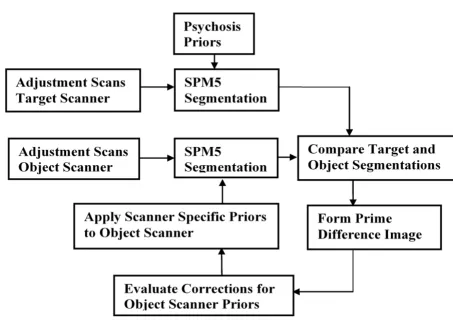
procedure. The object scanner segmentation is also initial-ised with the priors taken from our psychosis study [7]. Then through our iterative procedure these object scanner priors are incrementally adjusted. These adjustments are set to compensate for the segmentation differences between the target and object scanners.
The process illustrated in Figure 1 adjusts the object priors through comparisons based upon grey and white segmen-tations. This dual dependence of the adjusted priors on grey and white tissue is accommodated by allowing the iteration process to alternate the prime comparison between the grey and white tissue types. Thus for every other iteration the prime tissue comparison is applied to the grey segment and this is interspersed with the prime tissue comparison being made on the white segment.
When grey is the prime comparison segment we adjust the grey prior to correct for the voxel level differences found between the target and object scanners and also at the voxel level we apply a balancing adjustment to the white
or CSF prior to ensure that the sum of the priors at the voxel level is maintained at its nominal sum of unity. Sim-ilarly when the prime comparison is made upon the white segment we adjust the white prior to correct for the differ-ences between the target and object scanner and we apply a balancing adjustment to the grey or CSF prior. In VBM assessments of psychosis CSF presentation is not an estab-lished measure of interest, thus we do not assign CSF the prime status within the priors adjustment process.
On a subject by subject basis the prime comparison seg-mentations obtained from the target and object scanners are subtracted. These subtractions were implemented at the voxel-level and the differences were averaged across the subjects included in the priors adjustment process. The averaged voxel-level differences were used to form a difference image that was then smoothed to suppress sam-pling noise and reduce subject bias. Next a proportion of the smoothed difference image is used to adjust the grey, white and CSF priors applied to the object scanner. These adjusted priors are then made available for the next itera-Process Flow diagram
Figure 1
tion of the procedure. This process is repeated until the segmentations given by the object scanner converge with those given by the target scanner. We assess this conver-gence through the use of metrics described below.
The evaluation of the prime difference image Pgdiff for the
grey segment G is given in equation (1). When the prime
comparison segment is white W, the difference image
Pwdiff is given by equation (2). In these calculations of the prime difference images, the processed scans are desig-nated by subscripts (subject, visit, scanner), with N = 6, the number of compared subjects. These comparisons were limited to the 1st round scans. The averaging across the
adjustment subjects suppresses individual differences.
When the primary segment is grey the adjusted prior adjG-prior is given by equation (3). In this voxel-level process the current grey prior curGprior has a proportion beta of
the smoothed prime difference sPgdiff image subtracted.
When the prime comparison segment is grey the
evalua-tions of the adjusted white adjWprior and CSF priors
adjCprior are given by equations (4) and (5). In these the changes applied to the grey prior are balanced by equiva-lent additions to the white or CSF priors. At the voxel level we test the relative occupancy of the white and CSF priors and assign the balancing adjustment to which ever prior exhibits greater occupancy. When the prime comparison segment is white the adjusted priors evaluations are equiv-alent to those given in equations (3), (4) and (5) with the exceptions that the prime difference image is given by
Pwdiff and the grey and white priors are interchanged. This averaged difference images Pgdiff and Pwdiff are smoothed using an isotropic kernel, with a FWHM of 10 mm. Smoothing at this level suppresses sampling noise and limits the subject bias that results from the relatively small
number of subjects that we have used to create the scanner specific priors
The value of beta determines the proportion of the differ-ence image that is used to adjust the priors for the follow-ing iteration of the protocol. The settfollow-ing of beta has an important bearing on this protocol. A high setting for beta
could lead to instability whilst using value that is too low could result in sluggish convergence. As part of the
devel-opment of this method, we experimented with the beta
setting and found that setting beta to 0.33 or greater could lead to instability in the priors adjustment process. We found that a beta setting of 0.15 allowed for stable conver-gence of the segmentations from different scanners. We
found that further reductions of the beta value did not
improve the degree of convergence that was obtained
from the adjustment process. The reductions in beta did
increase the number iterations required to attain conver-gence. We ran a between scanner distance metric to assess the degree of convergence between the target and object scanners. We terminated the adjustment procedure when the incremental change in the between scanner distance was less than 0.1% and held at this level in subsequent iterations.
Testing Scanner Specific Priors Procedure
We tested our priors adjustment procedure by randomly selecting six subjects from the CaliBrain project. We applied the scanner specific priors adjustment to the 1st
round scans of these subjects. We designated the scanners in the CaliBrain project as scanners A, B and C. Scanner A was set as the target scanner and scanner B as the object scanner and we developed a set of scanner specific priors for scanner B. We also developed scanner specific priors for scanner C with scanner A set as the target scanner. Throughout these adjustment procedures the priors set used for scanner A was fixed as the priors drawn from our study of psychosis [7]. The scanner specific priors devel-oped for scanners B and C were initialised with the priors from our psychosis study. The choice of scanner A for as the target scanner was based upon the baseline metric results that indicated that scanner A has a low within scan-ner variability and that it exhibited the lowest overall between scanner differences.
VBM Statistical Analysis
Using the SPM5 application we implemented VBM statis-tical analyses of the grey and white segmentations at base-line and for our adjusted segmentations. In these we treated the visits and scanners as separate grouping com-ponents and thus formed a factorial analysis matrix that was composed of six groups. We designated the Independ-ence variable as 'NO' to account for the fact that we have repeated measures on the same subjects. We reported the overall F-test for main effect of scanner in the CaliBrain
Pgdiff
N Gn, Obje ct Gn, T et
n= N
= 1 visit, . visit, arg 1
( ( )− ( ))
∑
(1)Pwdiff
N Wn, Obje ct Wn, T et
n= N
= 1 visit, . visit, arg 1
( ( )− ( ))
∑
(2)
adjGprior=curGprior −sPgdiff ∗beta (3)
adjWprior= curWprior+(sPgdiff∗beta) if curWprior( >curCprior)
0 iif curCprior( >=curWprior)
⎧ ⎨ ⎩ ⎫ ⎬ ⎭ (4)
adjCprior= curCprior+(sPgdiff∗beta) if curCprio( >=curWprior) 0 iif curWprio( >curCprior)
study. Also, we used this design matrix to report t-test con-trast results for within scanner variability and between scanner differences. The t-tests for between scanner differ-ences were made by combining the two visits at each scan-ner. All t-tests and the F-test were carried out with an uncorrected threshold of 0.001, and we reported Family wise error (FWE) correction for multiple comparisons. All groups were composed of the same subjects and as the scans were all acquired within a six month period there was no requirement to covary for age or gender.
Voxel-wise distance metrics
We employed a percentage distance metric to quantify the within scanner variability and between scanner differ-ences. In SPM, tissue occupancy is assigned at the voxel level for grey, white and CSF as full occupancy or as partial volumes. At full occupancy the voxel is assigned as either grey or white or CSF with occupancy of 1.0. At the inter-face between tissue types partial occupancy is assigned on a continuous scale from 0.0 to 1.0 and the sum of the assigned occupancy for each voxel does not exceed 1.0.
In order to evaluate the distance between two tissue clas-sifications we computed as a percentage the absolute dis-tance. The general form of the absolute percentage distance computation is illustrated in equation (6) where we compare two voxels V1 and V2. This reports the per-centage absolute difference with respect to the average value of the compared voxels. We chose this metric because it accentuates the differences in the compared seg-mentations.
In keeping with established VBM analyses the metrics were applied to the smoothed segmentations and limited to valid-voxels where the compared segments had occu-pancy of greater than 0.05. The summary value reported by the metric is an average of the absolute percentage dif-ference found at the valid voxels in the normalised and
smoothed segmentations. The metrics are applied on a subject basis and for each subject we evaluate the within scanner variability for scanners A, B and C and we evaluate the between scanner differences for the scanner pairs AB, AC and BC. A paired sample t-test is used to compare the baseline and adjusted metric results and to report the mean difference and its significance.
Results
Metric Results
We applied the percentage distance metric to the grey mat-ter segmentations to obtain measures of within scanner variability and between scanner differences. The metric was applied at baseline and after adjustment using the scanner specific priors. Table 1 gives the grey matter metric results averaged across the six subjects used to generate the scanner specific priors. Table 2 gives the grey matter metric results averaged across the seven subjects who were excluded from the process that developed the scanner spe-cific priors. In Tables 1 and 2 we note the mean difference between baseline and adjusted analyses and we give the p_value for the paired sample t-test as measure of signifi-cance in the adjustment process.
VBM Analyses
We ran VBM baseline and adjusted analyses on the nor-malised and smoothed segmentations obtained for the seven subjects who were excluded from the prior's adjust-ment procedure. In these analyses we treat the visits and scanners as separate grouping components and thus form a design matrix composed of six groups. We applied an F-test to consider the main effect of scanner and t-F-tests to investigate within and between scanner differences. All groups are composed of the same seven subjects and as the scans were all conducted within a six month period there is no requirement to co-vary for age or gender.
Baseline VBM Results
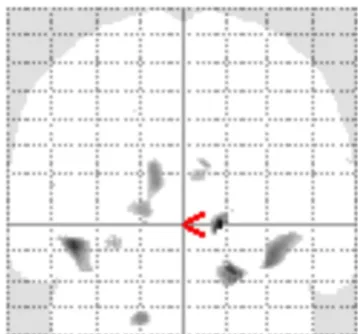
The F-test main effect Maximum Intensity Projection (MIP) for the baseline grey matter analysis is illustrated in Figure 2. The F-test was carried out with an uncorrected
AbsolutePercentageDis ce V1 V2 V1 V2
tan = 200∗ −
+
| |
( ) (6)
Table 1: Grey matter metric results for the subjects used in priors generation
Scanner Comparison Baseline* Adjusted* Mean Difference (paired sample significance)
AA 2.1 (0.5) 2.1 (0.5) 0.00 (p < 1.00)
BB 3.0 (0.5) 3.0 (0.4) 0.02 (p < 0.79)
CC 2.1 (0.6) 2.1 (0.5) 0.02 (p < 0.36)
AB 7.2 (0.8) 3.7 (0.4) 3.5 (p < 0.001)
BC 8.0 (0.8) 4.0 (0.6) 4.0 (p < 0.001)
AC 3.1 (0.4) 2.3 (0.3) 0.8 (p < 0.001)
Grey matter metric results averaged over the six subjects used to generate the scanner specific priors. For the within and between scanner comparison both baseline and adjusted absolute percentage distances are recorded.
threshold of (p < 0.001). This reveals significant scanner effects in the frontal lobes, temporal poles, the thalamus, brain-stem, parietal lobes and occipital lobes. The results of the baseline grey matter F-test are given in Table 3. In this we report the significant maximal voxels giving the MNI coordinate and the anatomical location. We report the Family Wise Error (FWE) corrected p-value of maximal voxel and we also report the extent of the cluster associ-ated with the maximal voxel.
We investigated the source of these baseline grey matter differences by applying t-test contrasts. t-test comparisons of 1st and 2nd round scans of each scanner revealed that
there were no significant within scanner differences. t-test comparisons between the scanners revealed that there were no significant differences between scanners A and C. t-test comparisons between scanners B and C were found to replicate the differences reported in the F-test for main effect of scanner. t-test comparisons between scanners B and A also demonstrated replication of the differences reported in the F-test for main effect of scanner.
The F-test results for the baseline white matter VBM anal-ysis are given in Figure 3 and Table 4. This illustrates the spatial distribution of the between scanner differences
with significant differences in the right middle frontal gyrus and the thalamus. We investigated sources of these baseline white matter differences by applying t-test con-trasts. Comparing 1st and 2nd round scans demonstrated
that there were no within scanner differences. In the between scanner tests we found no significant differences for the A-C contrasts and we found significant differences in the A-B and B-C contrasts. The B-C white matter differ-ences were more extensive that those found in the A-B contrasts.
Adjusted VBM Results
We applied VBM analyses to the adjusted segmentations obtained from the seven subjects who were excluded from the scanner specific priors development process. The VBM analyses applied were a direct replication of the baseline tests. In these F-tests for the main effect of scanner we found that there were no significant differences for either the grey or white matter analyses. We repeated the adjusted VBM analyses with all 13 CaliBrain subjects for whom we had complete records and these analyses con-firmed that no significant differences remained between the pooled scanners.
Table 2: Grey matter metric results for the subjects excluded from priors generation
Scanner Comparison Baseline* Adjusted* Mean Difference (paired sample significance)
AA 2.8 (0.6) 2.8 (0.6) 0.00 (p < 1.00)
BB 3.4 (0.6) 3.4 (0.6) 0.00 (p < 1.00)
CC 2.6 (0.7) 2.5 (0.7) 0.05 (p < 0.078)
AB 7.3 (0.6) 5.1 (0.7) 2.2 (p < 0.001)
BC 8.2 (0.8) 5.5 (0.8) 2.7 (p < 0.001)
AC 4.0 (0.6) 3.6 (0.5) 0.36 (p < 0.003)
Grey matter metric results averaged over the seven subjects excluded from the scanner specific priors adjustment procedure. For the within and between scanner comparisons both baseline and adjusted absolute percentage distances are recorded.
*Absolute Percentage distance % (std dev)
Table 3: Grey Matter Baseline maximal voxel results
F-test Cluster Anatomical location Maximal voxel MNI coordinate FWE p_corrected
Right Temporal Pole 34, 15, -33 0.001
Left Temporal Pole -35, 16, -36 0.001
Left Inferior Parietal lobule -55, -48, 47 0.001
Left Inferior frontal gyrus -42, 45, -11 0.001
Thalamus 13, -10, -1 0.006
Right Inferior Parietal lobule 56, -48, 40 0.009
Left Middle frontal gyrus -43, 20, 46 0.014
Left Middle frontal gyrus -44, 44, 24 0.023
Cingulate gyrus 0, 46, 32 0.040
Brain stem -1, -30, -28 0.045
Right Superior frontal gyrus 15, 40, 49 0.052
Discussion
Combining structural MRI scans from different scanners presents the possibility of increasing the statistical power in VBM analyses of neuropsychiatric disorders. Our aim was to refine the application of SPM segmentation proc-esses and reduce the effects of scanner differences which currently limit multi-centre MRI pooling [3,4]. We have examined the application of the SPM5 priors based seg-mentation to scans sourced from three scanners. The scan-ners were matched by vendor, primary field strength, and
head coil type, and equivalent sequences were used at each scanner. Although these scanners are well matched we found in our baseline analyses significant between scanner differences in the tissue segmentations. We have demonstrated that if we employ scanner specific priors in our application of SPM that these between scanner differ-ences are reduced.
In VBM analyses the harmonisation constraints for the use of multiple scanners are onerous as VBM requires the pro-Grey Matter Baseline Results
Figure 2
Table 4: White Matter Baseline results
F-test Cluster Anatomical location Maximal voxel MNI coordinate FWE p_corrected
Right Middle frontal gyrus 18, 45, -19 0.021
Thalamus 15, -10, 0 0.053
VBM White matter baseline tests for the effect of scanner. Reporting the extent of the F-test cluster for an uncorrected threshold of p < 0.001. Giving the anatomical location of the maximal voxel, the MNI coordinate of this maximal voxel and the p_corrected significance.
White Matter baseline Results
Figure 3
vision of corrections for scanner differences at the voxel level. Previous work has shown that it is possible to pool scans from multiple centres in parcellated volumetric studies. In a volumetric analysis of images from multiple scanners [14], their semi-automated method applied glo-bal corrections for the tissue classification which were computed separately for each scanner. The methods reported summary volumes for grey and white matter in the cerebrum, and cerebellum and lateral ventricle vol-umes [15]. This set-level segmentation method employed global estimates of the intensity values that marked the transitions between tissue types and CSF. These globally applied transitions were adjusted for each scanning site.
A methodology that seeks to minimise the differences between scanners through an integration of scan sequence parameters into the segmentation functions was proposed by [16] and gives global adjustment in the intensity to tis-sue mapping. These global corrections are appropriate in studies where the inferences drawn are limited to lobar tis-sue occupancy. A volumetric method that addresses the localised intensity to tissue mappings has been proposed by [17] and recognises that localised adjustments for the intensity to tissue mapping within the brain are necessary for scan pooling to be valid for parcellation studies. The method that we have proposed is in keeping with this existing work as we have implemented corrections at a scale that is close to the analysis scale for VBM.
Research for the Alzheimer's Disease Neuroimaging Initi-ative (ADNI) project demonstrated that to pool scans from multiple sites, it is important to minimise differ-ences between pooled scanners [18-20]. The ADNI project is a longitudinal analysis of ageing and in this within site MRI reproducibility was tested on a range of scanners and sequences. Based upon this research an MR-RAGE sequence was recommended for multiple site scanning and a scheme of corrections that includes field mapping and geometry correction is applied. ADNI researchers investigated the use of B1 field mapping to correct for within scanner variation in the RF inhomogenity for phased array head coils [20]. The results indicated that this technique has limitations. However, B1 field map-ping can be applied as an addition to the priors adjust-ments protocol that we have developed. It is possible that the inclusion of field mapping would further reduce the between scanner differences in the CaliBrain project. However, the scan time acquisitions necessary for correc-tion of the B1 field are not available in the CaliBrain project.
Recent reports of VBM analyses that sourced scans from multiple scanners employed validation masks to limit the reporting of results to regions where the scanner segmen-tations were equivalent [3,4]. Meda [4] demonstrated in a
VBM study of psychosis at four centres that is possible to limit the effects of scanner differences by validity masking and ensuring that in the pooled analysis that the subjects and controls are drawn equally from all contributing cen-tres [4]. A VBM analysis of scans taken from six scanners [3] reported that through the use of equivalent scan sequences and good quality control, the extent of valida-tion masking required could be limited to a single region in the thalamus.
In the CaliBrain project we consider within scanner varia-bility and between scanner differences and our aim was to reduce the between scanner differences to the level of within scanner variability. In keeping with the ADNI rec-ommendations we have sought to minimise the scanner differences in terms of vendor, field strength, head coil and sequences. However, scanner B in the CaliBrain project does differ from scanners A and C in terms of max-imum gradient amplitude and maxmax-imum slew rate. Our baseline results indicate that scanners A and C are well matched and scans from these two sites could be pooled without further adjustment or compensation. However, our baseline results also demonstrate that scanner B exhibits significant differences with respect to both scan-ners A and C.
In order to reduce the differences between the scanners in the CaliBrain project we have developed a procedure that employs proportional feedback to adjust the priors for each of the scanners. We have scan records for 13 healthy subjects who were scanned twice at three scanners within a six month period. We demonstrate our protocol for cre-ating scanner specific priors using the 1st round scans of six subjects. We test the adequacy of these scanner specific priors through metric and VBM analyses. The tests for ade-quacy are applied to the seven subjects who were excluded from the priors adjustment protocol. These tests are lim-ited by the number of subject scans available and we are unable to evaluate the full effects of subject variation expected in a multi-centre clinical study.
Clinical studies that could benefit from the scanner spe-cific priors method are expected to have subject numbers considerably greater than those available for the CaliBrain project. In a multi-centre clinical study, with the exception of the travelling subjects used to develop the scanner spe-cific priors, the subjects would be recruited and scanned independently at the contributing centres. In such a clini-cal study a test for adequacy of scanner harmonisation could be implemented through comparisons of the healthy control scans recruited from the contributing cen-tres [3,4].
voxel level and are averaged to report an overall distance inclusive of noise and systematic differences. We report in Table 1 on the scans that were used to implement the scanner specific priors procedure. This indicates that the within scanner variability ranges from 3.0% in scanner B to 2.1% in scanners A and C. The adjustment process gives rise to a reduction in the within scanner variability. How-ever, the paired-t tests reveal that these within scanner adjustments do not represent a significant change. In Table 1 the baseline between scanner differences are at a maximum for the BC comparison. Here the adjustment procedure gave rise to significant reductions in all three scanner comparison metrics.
In Table 2 we consider the effects of the scanner specific priors on the scans of seven subjects who were excluded from the priors adjustment process. At baseline the within scanner variability and between scanner distances were equivalent to the baseline results reported in Table 1. Consequently, the use of the scanner specific priors resulted in significant reductions in all three scanner com-parisons. However, for the comparisons that include scan-ner B, the reductions are not sufficient to bring the between scanner difference down to the level of within scanner variability.
The VBM analyses that we applied demonstrated that at baseline there are no significant differences between scan-ners A and C, However, we found that comparisons of scanners A and C with scanner B gave rise to differences that would require validity mapping such as that employed in VBM analyses by [3,4]. After developing scanner specific priors for scanners B and C and re-seg-menting the scans we found that the requirement for validity mapping was removed, because we recorded no significant differences in the grey and white matter F-tests for scanner effect.
Conclusion
Our results indicate the development of scanner specific priors for the SPM application can assist in the pooling of scan resources from different research centres. This devel-opment can facilitate scan pooling and allow for improve-ments in the statistical power of multi-centre brain imaging studies. Our results indicate that six subjects were adequate for the purpose of matching the scanners in the CaliBrain project. In the typical clinical study the range of tissue presentations would be expected to be greater than that seen in our study of healthy controls. Thus it is likely that in a clinical study that more than six travelling sub-jects would be required. The number of travelling subsub-jects required would depend upon the diversity of tissue pres-entation in the study and upon the nature of the differ-ences in the scanners pooled. The method that we have suggested may be limited to multi-site studies in which
there are no major hardware and acquisition protocol dif-ferences across sites. The CaliBrain project uses scanners from the same vendor all with the same field strengths and head coils with matched sequences. This provides an optimal environment for multiple site scan pooling. Dif-ferent field strengths and image acquisition protocols could have very different tissue contrasts that would lead to marked differences in segmentation results. In such cases the differences in tissue classification may well be beyond the scope of our compensatory method.
Competing interests
The authors declare that they have no competing interests.
Authors' contributions
TWJM developed the scanner correction procedure, played a leading role in the design of CaliBrain study and is the principal author of the manuscript; VEG is the main working researcher on the CaliBrain project, they devel-oped the links with the three contributing scanning cen-tres, established the CaliBrain scanning protocols and contributed to the manuscript; DEJ played a major role in the design of the CaliBrain project, assisted in the devel-opment of the scanning protocols at the three centres, and contributed to the final text; AMM assisted in the design of the clinical objects of the CaliBrain project and assisted in the preparation of the manuscript. LR contributed to the statistical analyses and contributed to the final manu-script; GKSL assisted in the development of the multi-cen-tre links, the development of the scanning protocols and contributed to the final manuscript; HCW contributed to the development of the CaliBrain protocols and assisted in the drafting of the manuscript; GDW contributed to the development of the CaliBrain protocols supported the scanning at one of the centres and contributed to the man-uscript; DB contributed to the development of the Cali-Brain protocols, supported the scanning at one of the centres, and contributed to the manuscript; TSA contrib-uted to the development of the CaliBrain protocols and contributed to the manuscript; JC assisted in the design of the clinical objectives of the CaliBrain project and contrib-uted to the manuscript; BC contribcontrib-uted to the develop-ment of the CaliBrain protocols and contributed to the manuscript; JDS assisted in the design of the clinical and methodological objects of the CaliBrain project and con-tributed to the manuscript; JMW assisted in the design of the clinical and methodological objects of the CaliBrain project and contributed to the manuscript; SML is the principal architect of the CaliBrain Project. All authors contributed to the drafting of the manuscript and all authors approved the final version for publication.
Acknowledgements
Publish with BioMed Central and every scientist can read your work free of charge "BioMed Central will be the most significant development for disseminating the results of biomedical researc h in our lifetime."
Sir Paul Nurse, Cancer Research UK
Your research papers will be:
available free of charge to the entire biomedical community
peer reviewed and published immediately upon acceptance
cited in PubMed and archived on PubMed Central
yours — you keep the copyright
Submit your manuscript here:
http://www.biomedcentral.com/info/publishing_adv.asp
BioMedcentral NeuroPsyGrid), AMI is supported by The Health Foundation, GKSL and
SML were supported by the Sir Mortimer and Theresa Sackler Foundation. The Edinburgh imaging was carried out at the SFC Brain Imaging Research Centre http://www.sbirc.ed.ac.uk, Division of Clinical Neurosciences, Uni-versity of Edinburgh, a core area of the Wellcome Trust Clinical Research Facility and part of the SINAPSE (Scottish Imaging Network – A Platform for Scientific Excellence) collaboration http://www.sinapse.ac.uk funded by the Scottish Funding Council and the Chief Scientist Office
References
1. Ashburner J, Friston KJ: Unified segmentation. NeuroImage 2005,
26(3):839-51.
2. Ashburner J, Friston KJ: Voxel-based morphometry – The methods. NeuroImage 2000, 40(4):1429-35.
3. Stonnington CM, Tan G, Klöppel S, Chu C, Draganski B, Jack CR Jr, Chen K, Ashburner J, Frackowiak RS: Interpreting scan data acquired from multiple scanners: a study with Alzheimer's disease. Neuroimage 2008, 39(3):1180-5.
4. Meda SA, Giuliani NR, Calhoun VD, Jagannathan K, Schretlen DJ, Pul-ver A, Cascella N, Keshavan M, Kates W, Buchanan R, Sharma T, Pearlson GD: A large scale (N = 400) investigation of gray mat-ter differences in schizophrenia using optimized voxel-based morphometry. Schizophr Res 2008, 101(1–3):95-105.
5. Tofts PS: Standardisation and optimisation of magnetic reso-nance techniques for multicentre studies. J Neurol Neurosurg Psychiatry 1998, 64(Suppl 1):S37-43. Review.
6. Jovicich J, Czanner S, Greve D, Haley E, Kouwe A van der, Gollub R, Kennedy D, Schmitt F, Brown G, Macfall J, Fischl B, Dale A: Reliabil-ity in multi-site structural MRI studies: effects of gradient non-linearity correction on phantom and human data. Neu-roImage 2006, 30(2):436-43.
7. McIntosh AM, Baig BJ, Hall J, Job D, Whalley HC, Lymer GK, Moor-head TW, Owens DG, Miller P, Porteous D, Lawrie SM, Johnstone EC: Relationship of catechol-O-methyltransferase variants to brain structure and function in a population at high risk of psychosis. Biol Psychiatry 2007, 61(10):1127-34.
8. Wilke M, Schmithorst VJ, Holland SK: Normative pediatric brain data for spatial normalization and segmentation differs from standard adult data. Magn Reson Med 2003, 50(4):749-57. 9. Moorhead TW, Job DE, Whalley HC, Sanderson TL, Johnstone EC,
Lawrie SM: Voxel-based morphometry of comorbid schizo-phrenia and learning disability: analyses in normalized and native spaces using parametric and nonparametric statisti-cal methods. Neuroimage 2004, 22(1):188-202.
10. Job DE, Whalley HC, McIntosh AM, Owens DG, Johnstone EC, Lawrie SM: Grey matter changes can improve the prediction of schizophrenia in subjects at high risk. BMC Med 2006, 4:29. 11. Spencer MD, Moorhead TW, Gibson RJ, McIntosh AM, Sussmann JE, Owens DG, Lawrie SM, Johnstone EC: Low birthweight and pre-term birth in young people with special educational needs: a magnetic resonance imaging analysis. BMC Med 2008, 6:1. 12. Wilke M, Holland SK, Altaye M, Gaser C: Template-O-Matic: a
toolbox for creating customized pediatric templates. Neu-roimage 2008, 41(3):903-13.
13. Shen S, Szameitat AJ, Sterr A: VBM lesion detection depends on the normalization template: a study using simulated atro-phy. Magn Reson Imaging 2007, 25(10):1385-96.
14. VanHaren NEM, Cahn W, Hulshoff Pol HE, Schnack HG, Caspers E, Lemstra A, Sitskoorn MM, Wiersma D, Bosch RJ van den, Dingemans PM, Schene AH, Kahn RS: Brain volumes as predictor of out-come in recent-onset schizophrenia: a multi-center MRI study. Schizophr Res 2003, 64(1):41-52.
15. Schnack HG, van Haren NEM, Hulshoff Pol HE, Picchioni M, Weis-brod M, Sauer H, Cannon T, Huttunen M, Murray R, Kahn RS: Relia-bility of brain volumes from multicenter MRI acquisition: a calibration study. Hum Brain Mapp 2004, 22(4):312-20. 16. Fischl B, Salat DH, Kouwe AJ van der, Makris N, Ségonne F, Quinn BT,
Dale AM: Sequence-independent segmentation of magnetic resonance images. Neuroimage 2004, 23(Suppl 1):S69-84. 17. Han X, Fischl B: Atlas renormalization for improved brain MR
image segmentation across scanner platforms. IEEE Trans Med Imaging 2007, 26(4):479-86.
18. Hua X, Leow AD, Parikshak N, Lee S, Chiang MC, Toga AW, Jack CR Jr, Weiner MW, Thompson PM, The Alzheimer's Disease
Neuroim-aging Initiative: Tensor-based morphometry as a neuroimaging biomarker for Alzheimer's disease: An MRI study of 676 AD, MCI, and normal subjects. Neuroimage 2008, 43(3):458-69. 19. Jack CR Jr, Bernstein MA, Fox NC, Thompson P, Alexander G,
Har-vey D, Borowski B, Britson PJ, L Whitwell J, Ward C, Dale AM, Felm-lee JP, Gunter JL, Hill DL, Killiany R, Schuff N, Fox-Bosetti S, Lin C, Studholme C, DeCarli CS, Krueger G, Ward HA, Metzger GJ, Scott KT, Mallozzi R, Blezek D, Levy J, Debbins JP, Fleisher AS, Albert M, Green R, Bartzokis G, Glover G, Mugler J, Weiner MW: The Alzhe-imer's Disease Neuroimaging Initiative (ADNI): MRI meth-ods. J Magn Reson Imaging 2008, 27(4):685-91.
20. Leow AD, Klunder AD, Jack CR Jr, Toga AW, Dale AM, Bernstein MA, Britson PJ, Gunter JL, Ward CP, Whitwell JL, Borowski BJ, Fleisher AS, Fox NC, Harvey D, Kornak J, Schuff N, Studholme C, Alexander GE, Weiner MW, Thompson PM, ADNI Preparatory Phase Study: Longitudinal stability of MRI for mapping brain change using tensor-based morphometry. Neuroimage 2006,
31(2):627-40.
Pre-publication history
The pre-publication history for this paper can be accessed here: