Interaction Analysis for Fault-Tolerance in
Aspect-Oriented Programming
?Nathan Weston, Francois Taiani, Awais Rashid
Computing Department, InfoLab21, Lancaster University, UK.
{westonn,f.taiani,marash}@comp.lancs.ac.uk
Abstract. The key contribution of Aspect-Oriented Programming (AOP) is the encapsulation of crosscutting concerns in aspects, which facilities modular reasoning. However, common methods of introducing aspects into the system, incorporating features such as implicit control-flow, mean that the ability to discover interactions between aspects can be compromised. This has profound implications for developers working on fault-tolerant systems. We present an analysis for aspects which can re-veal these interactions, thus providing insight into positioning of error detection mechanisms and outlining candidate containment units. We also presentAida, an implementation of this analysis for the AspectJ language.
1
Introduction and Problem Statement
The key contribution of Aspect-Oriented Programming (AOP) is the
encapsu-lation of crosscutting concerns in aspects, which are then introduced into the
system usingadvice - code which applies at a particularjoinpoint in the system,
be that in the base program or within aspect advice. Advice is thenwoven into
the system, either statically at compile-time or dynamically later on. This cru-cial feature of AOP supports modularity and evolvability of otherwise scattered and tangled code, as well as offering the possibility of aspect reuse.
However, it also raises a potential difficulty for developers working with as-pects in a fault-tolerant context. For example, the usual method of implementing aspects - such as the popular AspectJ[1] compiler - allows a developer to code a piece of advice which applies implicitly at multiple points in the code. This can cause problems in determining how faults might propagate through the system, as it is not immediately clear from the code how advice code interacts with the base system, and especially how aspects interact with one another.
To see this, let us consider the example of a version control system which includes the following code:
?This work is supported by European Commission Framework 6 Grant:
voidcommitChanges(String username, String server){ ...
sendFile(username, file , server ); ...
}
The system has two aspects - one which logs all calls to the sendFile()
method, and one which encrypts usernames at calls to the commitChanges()
method:
voidaspectLogFileSends{
after(): call (voidsendFile(String, String , String)) && args(uname, file, serv) { printToFile(”Sent to server, sender is ”+uname);
} }
voidaspectEncrypt{
around(): call(voidcommitChanges(String, String))∧args(uname, serv){ encrypt(uname);
proceed(uname, serv); }
}
Although these two advices apply at different joinpoints in the system, they
have an indirect interaction with one another - the Encrypt aspect modifies
the usernamevariable, which the LogFileSendsaspect reads. Therefore there is a potential coupling between the two advices. Knowing this could impact the
strategy for making this system fault-tolerant - for example, if theLogFileSends
aspect is considered particularly crucial to the system, this might require the
Encryptaspect to be hardened with additional fault-detection mechanisms.
As well as this indirect interaction, we must also consider the possibility
of transitive interactions between aspects. By contrast to indirect interactions,
which are based on shared accesses of a single variable (for example, the uname
variable in the above example), transitive interactions occur when a chain of variable accesses link advices. That is, consider the system in Fig. 1. The system
has an aspect A which modifies a variablex. The variable is then passed to a
methodf, which usesxto define a variabley. Subsequently, the value ofyis used
in aspect B to determine its behaviour. Hence there is a transitive interaction
between the two aspects, even though they do not access a shared variable.
Aspect A x=4
Method f y=x
[image:2.612.133.485.487.541.2]Aspect B if(y>3)...
Fig. 1:Transitive interaction
maximise error detection coverage while minimising overhead. It can also pro-vide insight into error handling by identifying parts of the system which might simultaneously become corrupted, thus outlining candidate containment units.
This kind of interaction analysis also has applications should AO techniques be used to implement fault-tolerance itself. As has been noted, AOP can be an extremely helpful tool to aid developers in building fault-tolerant systems. For example, transaction mechanisms can be implemented as aspects in order to perform rollback in the event of failure[5]; similarly, the mechanisms for switching between versions in N-version programming can be encapsulated in an aspect. Contract enforcement[3] can also be modularised in this way. In this formulation, then, the interactions between fault-tolerance aspects and others can shed light on potential problems which could cause the system to be intolerant to faults - for example, if it can be seen that the presence of another aspect causes a contract enforcement aspect to be bypassed.
In this article we investigate how Data-Flow Analysis can be adapted to be applied to aspect-oriented programs in order to help developers with this
problem. We also presentAida, an implementation of our analysis for use with
the AspectJ language. Section 2 gives some background in Data-Flow Analysis, and we discuss possible modifications with respect to AO programs in Section 3.
Section 4 presentsAida, and Section 5 concludes and looks to potential future
work.
2
Data-Flow Analysis
Data-Flow Analysis (DFA)[6] is an ideal tool in determining this kind of indirect interference between aspects. DFA gives us the ability to see which data aspect advice modifies, and (crucially) trace the effects of that modification throughout the program, including its effect on other aspects. In this section we present the basic tenets of DFA which are necessary in order to understand our approach.
The classical Definition-Use analysis forms the basis of our approach. The
idea behind this analysis is to find Definition-Use chains or du-chains,
associ-ations between an assignment to a variable and all its uses in a program. The def-use analysis is based on a classical data-flow analysis called Reaching Defi-nitions Analysis[6]. Given a program point, the analysis returns the defiDefi-nitions which may have been made and not re-defined when the execution of the pro-gram reaches that point. Comparing these definitions with uses of variables at the program point enables us to determine du-chains, which are candidates for error propagation paths. Our approach to performing this inter-procedural anal-ysis is an extension to the functional approach proposed by Shahir and Pnueli[7], which has an acceptable tradeoff between efficiency and accuracy.
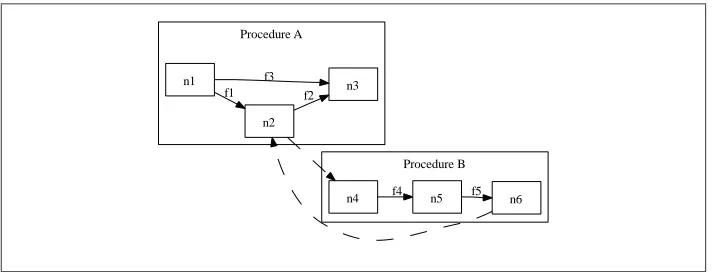
The approach operates on an Inter-procedural Control Flow Graph (ICFG), which contains a control-flow graph (representing code statements as nodes and potential flow as edges) for each of the methods and aspect advices in the
pro-gram. From this, an intra-procedural analysis computes a transfer function for
Reach-ing Definitions Analysis up to that point. As this happens within the method, it models which definitions reach the program point based on abstract initial values at the start of the method. For example, in Fig. 2, the transfer function
at program pointn2 in method A isρ2=f1.
Procedure A
Procedure B n1
n2
f1 n3
f3 f2
[image:4.612.131.487.139.275.2]n4 f4 n5 f5 n6
Fig. 2:Computing transfer functions
In order to model method calls, a special instance of a transfer function is created which defines the summary of calling a method - effectively the con-junction of the transfer functions at the exit points of each method. In Fig. 2,
the summary transfer function φB modelling the effect of calling method B is
φB =ρ6 =f5◦f4. This information is propagated bottom-up using a fixpoint
calculation to determine the transfer functions for each method, taking calls into
account. For example, the final transfer function at noden3 is:
ρ3=f3∧(f2◦φB◦f1) =f3∧(f2◦ρ6◦f1)
=f3∧(f2◦f5◦f4◦f1)
The next step is to propagate real data-flow information in a top-down
fash-ion, starting frommain()methods with an empty set of reaching definitions. At
this stage, information is only propagated to entry points of procedures and to call sites, which is possible because transfer functions based on abstract initial values have already been computed at these points. Again a fixpoint calculation is used to resolve any circular dependencies. In the above example, the real
so-lution S4 at node n4 is S4 = ρ4(ρ2(η)), where η is the data-flow information
present at the beginning of procedure A.
Once this is done, it is trivial to calculate the results of the reaching defi-nitions analysis on-demand, as both the concrete data-flow information at the beginning of each procedure and transfer functions for each program point within
that procedure are available. Therefore, the analysis result at noden5is the
3
Transfer functions for advice
One consideration in applying this technique to AO programs is that of com-puting transfer functions for advice. In languages such as AspectJ, advice which
appliesarounda joinpoint can be difficult to reason about independently of the
base system, mainly due to the inability to discover what aproceed()statement
could refer two. We present two main options:
Advices as methods Perhaps the simplest option is to perform the analysis after the aspect advice has been woven, and treat aspect advices identically
to method calls. An around advice’s proceed()statement would therefore be
transformed to another call back to the advised procedure, and computing the transfer functions would proceed as normal.
Binding functions The disadvantage of the first option is that, as we perform the analysis after the advice has been woven, it is difficult to consider the effect of the advice independently of its binding. Therefore, there could be no partial
analysis results associated with library aspects which include around advice,
as it would be impossible to know the effect of a proceed() statement before
weaving. One solution is to transform thearoundadvice intobef oreandaf ter
advice and treat it as two separate advices - however, real-world advices may well
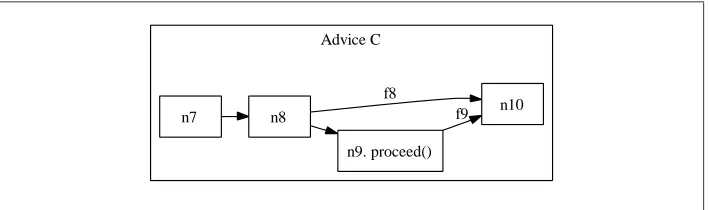
have multipleproceed()statements or have control-flow paths which bypass the
proceed()instruction altogether (see Fig. 3).
Advice C
n7 n8
n9. proceed()
n10 f8
[image:5.612.132.486.377.482.2]f9
Fig. 3:Computing transfer functions for advice
Instead, then, we can compute a partial transfer function based on unknown
bindings using a binding functionψ, which represents the effect of theproceed()
statement. So for the advice in Fig. 3, the summary transfer function for the
whole advice would beφC =ρ10=f9∧(f8◦ψ8).
which is being advised - to the advice such that a summary transfer function can be calculated. The fixpoint calculation is then re-run to propagate the effect of the advice to the rest of the system.
The main advantage of this approach is that partial analysis results can be pre-computed for aspect advice, which means that when an advice is used in a different context as a library advice, for example, or at a different joinpoint -we no longer have to start from scratch in our analysis. As -well as this, -we may be able to infer generic properties of the advice - in the form of a categorisation of its behaviour, for example - which could then inform our later analysis.
[image:6.612.132.487.235.387.2]4
Aida
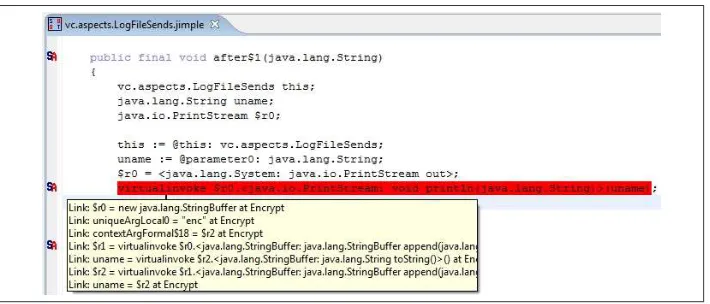
Fig. 4:Aidain Eclipse
We have implemented the simpler version of the algorithm presented above - namely, that which treats advices as method calls - as an extension to the abc
compiler[2] for AspectJ called Aida - Aspect Interference Detection Analysis.
The goal of Aida is to provide developers with a summary and visualisation
of the potential interactions within the system, such that they can develop and evolve a strategy for fault-tolerance.
abc is built on the Soot[8] framework, and so transforms the woven bytecode into an intermediate representation called Jimple, which allows inspection and
analysis of the code. On running the analysis,Aidaproduces annotated Jimple
code which shows the links between advices in terms of which statements are directly affected by other advice being present in the system (see Fig. 4 for how this looks to the user in Eclipse[4]). The analysis also works at any specified depth of transitivity - that is, it can chain any given number of definition-use
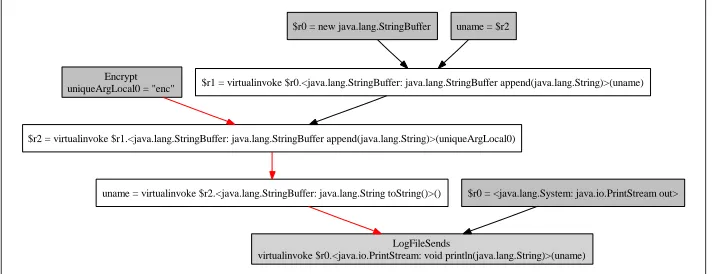
chains together to find even more subtle interactions.Aidaalso produces a visual
Version Control system presented in Section 1, and the interaction between the
EncryptandLogFileSendsaspects is clearly shown by tracing the red arrows.
LogFileSends
virtualinvoke $r0.<java.io.PrintStream: void println(java.lang.String)>(uname) Encrypt
uniqueArgLocal0 = "enc"
$r2 = virtualinvoke $r1.<java.lang.StringBuffer: java.lang.StringBuffer append(java.lang.String)>(uniqueArgLocal0)
uname = virtualinvoke $r2.<java.lang.StringBuffer: java.lang.String toString()>()
$r1 = virtualinvoke $r0.<java.lang.StringBuffer: java.lang.StringBuffer append(java.lang.String)>(uname) $r0 = new java.lang.StringBuffer
[image:7.612.131.487.123.260.2]$r0 = <java.lang.System: java.io.PrintStream out> uname = $r2
Fig. 5: Aida-generated interaction graph
5
Conclusion and future work
In this article we have motivated the adaptation of summary-based DFA for discovery of interactions between aspects. We have motivated the importance of this interaction analysis with respect to its application to fault-tolerant systems - it can reveal error-propagation paths and outline containment units; give hints to the developer on where modules need hardening with assertions and the like; and show how aspects for fault-tolerance can be impacted by other aspects in
the system. We have presentedAida, an implementation of this analysis which
works on AspectJ programs. We are currently extending our implementation to incorporate the more AO-specific algorithm described above, which treats advices differently to methods and is able to pre-compute some analysis results such that they can be reused. We have also developed a categorisation schema which describes the interactions between aspects in a more meaningful way, and we hope to incorporate all of this into an Eclipse plugin.
References
1. AspectJ. Home page of the AspectJ project. http://eclipse.org/aspectj. 2. Pavel Avgustinov, Aske Simon Christensen, Laurie Hendren, Sascha Kuzins,
Jen-nifer Lhot´ak, Ondˇrej Lhot´ak, Oege de Moor, Damien Sereni, Ganesh Sittampalam, and Julian Tibble. abc: an extensible aspectj compiler. InAOSD ’05: Proceedings of the 4th International Conference on Aspect-Oriented Software Development, pages 87–98. ACM Press, 2005.
4. Eclipse. Homepade of the Eclipse project. http://eclipse.org.
5. Jorg Kienzle and Rachid Guerraoui. Aop: Does it make sense? the case of concur-rency and failures. InECOOP ’02: Proceedings of the 16th European Conference on Object-Oriented Programming, pages 37–61, London, UK, 2002. Springer-Verlag. 6. Flemming Nielson, Hanne Riis Nielson, and Chris Hankin. Principles of Program
Analysis, chapter 2, pages 35–135. Springer, 2nd edition, 2005.
7. M. Sharir and A. Pnueli. Two approaches to interprocedural data flow analysis. InProgram Flow Analysis: Theory and Applications, pages 189–234. Prentice-Hall, Englewood Cliffs, NJ, 1981.