Munich Personal RePEc Archive
Dynamic Unawareness and
Rationalizable Behavior
Heifetz, Aviad and Meier, Martin and Schipper, Burkhard C.
The Open University of Israel, Institute for Economic Analysis,
Barcelona, University of California, Davis
29 October 2009
Online at
https://mpra.ub.uni-muenchen.de/18436/
Dynamic Unawareness and
Rationalizable Behavior
∗
Aviad Heifetz
†Martin Meier
‡Burkhard C. Schipper
§October 29, 2009
Abstract
We define generalized extensive-form games which allow for mutual unaware-ness of actions. We extend Pearce’s (1984) notion of extensive-form (correlated) rationalizability to this setting, explore its properties and prove existence. We de-fine also a new variant of this solution concept, prudent rationalizability, which refines the set of outcomes induced by extensive-form rationalizable strategies. We apply prudent rationalizability to the analysis of verifiable communication with unawareness. Finally, we define the normal form of a generalized extensive-form game, and characterize in it extensive-form rationalizability by iterative conditional dominance.
Keywords: Unawareness, extensive-form games, extensive-form rationalizability, prudent rationalizability, iterative conditional dominance.
JEL-Classifications: C70, C72, D80, D82.
∗We are grateful to Pierpaolo Battigalli for numerous insightful comments and suggestions and to
Elchanan Ben Porath for helpful discussions and exchange of ideas. We thank Paulo Barelli, Andy McLennan, Yoram Halevy as well as to seminar participants at Barcelona, Bocconi, Caltech, Maryland, Maastricht, Pittsburgh, USC, UC Davis, Tel Aviv, Stony Brook 2007, LOFT 2008, Games 2008 and NSF/NBER/CEME 2009. Aviad is grateful for financial support from the Open University of Israel’s Research Fund grant no. 46106. Martin was supported by the Spanish Ministerio de Educaci´on y Ciencia via a Ramon y Cajal Fellowship (IAE-CSIC) and a Research Grant (SEJ 2006-02079), and Barcelona Graduate School of Economics. Burkhard is grateful for financial support from the NSF SES-0647811.
†The Economics and Management Department, The Open University of Israel. Email:
‡Instituto de An´alisis Econ´omico - CSIC, Barcelona, and Institut f¨ur H¨ohere Studien, Wien. Email:
1
Introduction
In real-life dynamic interactions, unawareness of players regarding the relevant actions available to them is at least as prevalent as uncertainty regarding other players’ strategies, payoffs or moves of nature. Players frequently become aware of actions they (or other players) could have taken in retrospect, when they can only re-evaluate the past actions
chosen by partners or rivals whowere aware of those actions from the start, and hence
re-assess their likely future behavior. Yet, while uncertainty can be captured within the standard framework of extensive-form games with imperfect information, unawareness and mutual uncertainty regarding awareness require an extension of this framework. Such an extension is the first task of the current paper.
At first, one may wonder why the standard framework would not suffice. After all, if a player is unaware of an action which is actually available to her, then for all practical purposes she cannot choose it. Why wouldn’t it be enough simply to truncate from the tree all the paths starting with such an action?
The reason is that the strategic implications of unawareness of an action are distinct from the unavailability of the same action. To see this, consider the following standard “battle-of-the-sexes”game (where Bach and Stravinsky concerts are the two available choices for each player)
II
B S
B 3 1 0 0
I
B 3, 1 0, 0
S 0 0 1 3
S 0, 0 1, 3
augmented by a dominant Mozart concert for player II:
II II
B S M
B 3, 1 0, 0 0, 4
I S 0, 0 1, 3 0, 4 M 0, 0 0, 0 2, 6
The new game is dominance solvable, and (M,M) is the unique Nash equilibrium.
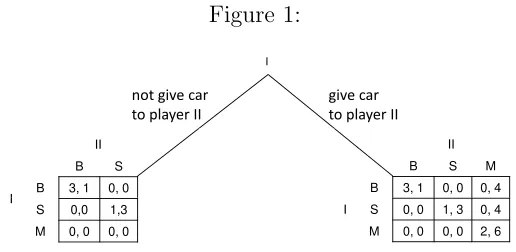
Figure 1:
II
not give car to player II
give car to player II
II
B S M
B 3, 1 0, 0 0, 4 II
B S
I B 3, 1 0, 0
I S 0, 0 1, 3 0, 4 M 0, 0 0, 0 2, 6 I
S 0,0 1,3
M 0, 0 0, 0
with the hope of getting the payoff 3 (because by giving the car to II, player I could have achieved the payoff 2). The best reply of player II is to follow suit and attend the Bach concert as well. Hence, in the unique rationalizable outcome, player I is not to give the
car to player II and to go to the Bach concert.1
But what if, instead, the Mozart concert is in town but player II is initially unaware of the Mozart concert, while player I can enable player II to go to the concert simply by telling him about it? If player II remains unaware of the Mozart concert, then neither does he conceive that player I could have told him about the Mozart concert, and in particular he cannot carry out any forward-induction calculation. For him, the game is a standard battle-of-the-sexes game, where both actions of player I are rationalizable. This strategic situation is depicted in Figure 2.
Figure 2:
II
not tell player II about the Mozart concert
tell player II about the Mozart concert
II
B S M
B 3, 1 0, 0 0, 4 II
B S
I B 3, 1 0, 0
I S 0, 0 1, 3 0, 4 M 0, 0 0, 0 2, 6 I
S 0, 0 1, 3 M 0, 0 0, 0
II
B S
I B 3, 1 0, 0 S 0, 0 1, 3
1
[image:4.612.135.437.449.665.2]The strategic situation is not a standard extensive-form game (more on this in Section 2.6 below). If player I chooses not to tell player II about the Mozart concert, then player II’s information set (depicted in blue) consists of a node in a simpler game –namely the one-shot battle-of-the-sexes with no preceding move by player I.
This is a simple example of the general novel framework that we define in Section 2 for dynamic interaction with possibly mutual unawareness of actions, generalizing standard extensive-form games. The framework will not only allow modeling of situations in which one player is certain that another player is unaware of portions of the game tree, as in the above example, but also of situations in which a player is uncertain regarding the way another player views the game tree, as well as situations in which the player is uncertain regarding the uncertainties of the other player about yet other players’ views of the game tree, and so forth.
In fact, this framework allows not just for unawareness but also for other forms of misconception about the structure of the game. Section 6 specifies further properties obtaining in generalized extensive-form games where the only source of players ‘miscon-ception’ is unawareness and mutual unawareness of available actions and paths in the game. Since we focus on this type of unawareness, most of the examples in the paper
satisfy the further properties specified in Section 6. Nevertheless, modelingawareness of
unawareness does require the general framework in Section 2, as explained at its end.
In this new framework, for each information set of a player her strategy specifies – from the point of view of the modeler – what the player would do if and when that information set of hers is ever reached. In this sense, a player does not necessarily ‘own’ her full strategy at the beginning of the game, because she might not be initially aware of all of her information sets. That’s why a sensible generalization of Pearce’s (1984) notion of extensive-form rationalizability is non-trivial.
In Section 3 we put forward a modified definition, prove existence, and show the sense in which it coincides with form rationalizability in standard extensive-form games.
We chose to focus on extensive-form rationalizability because it embodies forward induction reasoning. If an opponent makes a player aware of some relevant aspect of reality, it is implausible to dismiss the increased level of awareness as an unintended consequence of the opponent’s behavior. Rather, the player should try to rationalize the opponent’s choice, re-interpret the opponent’s past behavior, and try to infer from it the opponent’s future moves. Extensive-form rationalizability indeed captures a ‘best rationalization principle’ (Battigalli, 1997).
With rationalizability, generalized games are necessary for properly modeling un-awareness; trying to model unawareness by having the unaware player assigning prob-ability zero to the contingency of which she is unaware might give rise to a completely different rationalizable behavior, which does not square with unawareness in the proper sense of the word. To see this consider the following example.
A Decision Maker (DM) has to choose between two policies,a0 and a1. Before
choos-ing she gets a recommendation from an expert via a narrow communication channel, through which the expert can recommend either “0” or “1”. The expert makes the
rec-ommendation after observing the state of nature, which may be eitherγ0orγ1, and which
the DM does not see. The interests of the expert and the DM are completely aligned:
They each bear a cost of 1 if a1 is implemented when the state of nature is γ0 or vice
versa. The expert furthermore bears a cost of 10 from “lying”, i.e. from recommending
“0” when the state of nature is γ1 or recommending “1” when the state of nature is γ0.
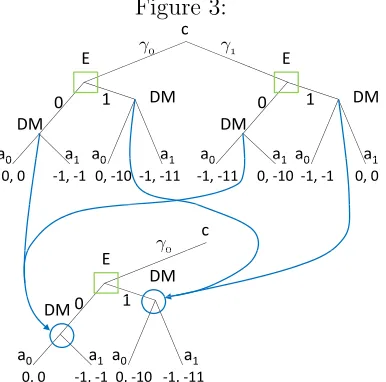
Assume the DM is aware only of the state γ0 and unaware of γ1. The dynamic
[image:6.612.213.406.489.680.2]interaction is hence modeled by the generalized game in Figure 3.
Figure 3:
c
E γ0 γ1 E
DM
0 1 0 1 DM
DM
a0 a1 a0 a1
DM
a0 a1 a0 a1
a0 a1 a0 a1
0, 0 ‐1, ‐1 0, ‐10 ‐1, ‐11
a0 a1 a0 a1
‐1, ‐11 0, ‐10‐1, ‐1 0, 0
c
γ0
E DM 1
γ0
DM 0 1
a0 a1 a0 a1
In this generalized game the only extensive-form rationalizable strategy of the DM is
to always implement the policy a0: she does not conceive of a contingency that would
make the policya1 superior to a0 even if she hears from the expert the recommendation
“1”; in such a case she regrettably concludes that the expert behaved in an irrational way and bore the cost of “lying”.
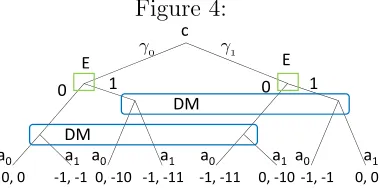
However, if we were to model the DM alternatively as being aware ofγ1 but assigning
[image:7.612.213.403.237.331.2]probability zero to it, the strategic interaction would be modeled by the standard game in Figure 4.
Figure 4: c
E γ0 γ1 E
E
DM
0 1 0 1
DM
a0 a1 a0 a1 a0 a1 a0 a1
a0 a1 a0 a1
0, 0 ‐1, ‐1 0, ‐10 ‐1, ‐11
a0 a1 a0 a1
‐1, ‐11 0, ‐10‐1, ‐1 0, 0
In this game the unique extensive-form rationalizable strategy of the DM is to choose
a0 upon hearing “0” from the expert, but to implement a1 upon hearing the
recommen-dation “1”. Indeed, extensive-form rationalizability requires the DM to base her choice on a system of beliefs about the expert’s strategies with which at every information set of hers she maintains a belief that best rationalizes the choices of the expert which could have led to that information set. In particular, upon hearing the recommendation “1” from the expert, the only way for the DM to rationalize it is to assume that the state of
nature is nevertheless γ1, where recommending “1” is strictly dominant for the expert;
and in γ1 the optimal choice for the DM is a1.
Conceptually, upon hearing the surprising recommendation “1” both choices of the
DM have their internal logic. The former gives priority to “only γ0 is conceivable”,
the latter to the rationality of the expert. But in the latter case, if initially the DM is
genuinely unaware ofγ1, there is no reason why the DM would conceiveprecisely ofγ1and
not of some alternative description γ′
1 of nature that would also rationalize the expert’s
recommendation “1”; some such conceptualizations γ′
1 need not necessarily induce the
DM to adopt the expert’s recommendation. Generalized games lend themselves also to modeling such misconceptions that may arise upon a surprise, as demonstarted in
Figure 5. Here, the DM’s rationalizable strategy is to choose a0 also upon hearing the
Figure 5:
c c
E γ0 γ1 E
E E
DM DM
0 1
DM
0 1
γ0
E E
DM DM
0 1
a0 a1 a0 a1
DM DM
0 1
a0 a1 a0 a1
γ1’
a0 a1 a0 a1 0, 0 ‐1, ‐1 0, ‐10‐1, ‐11
a0 a1 a0 a1 0, ‐11 ‐1, ‐10 0, ‐1 ‐1, 0 c
E DM
γ0
0, 0 ‐1, ‐1 0, ‐10 ‐1, ‐11 ‐1, ‐11 0, ‐10‐1, ‐1 0, 0
DM DM 0 1
a0 a1 a0 a1 0 0 ‐1‐1 0‐10 ‐1 ‐11 0, 0 1, 1 0, 10 1, 11
strictly dominant for the expert but that her interest and those of the expert are now opposed.
In Section 4 we introduce a related solution concept, prudent rationalizability, which is the direct generalization of iterated admissibility to dynamic games with unawareness.
Unlike in normal-form games, this generalization is surprisingly not always a refinement
of extensive-form rationalizability (even for standard extensive-form games). However,
we prove that prudent rationalizable strategies do refine the set of outcomes obtainable
by extensive-form rationalizable strategies. We show how prudent rationalizability is effective in ruling out less plausible rationalizable outcomes in examples due to Pearce (1984) and Ozbay (2007).
Of particular interest is the application of prudent rationalizability to the Milgrom-Roberts (1986) communication game, in which a sender sends a verifiable (and hence correct) piece of information to a receiver who makes a decision on its basis. Milgrom and Roberts (1986) showed that the unique sequential equilibrium in this game features full unraveling of information, and that at equilibrium the receiver interprets each piece of information in the most ‘skeptical’ manner. We show that the complete unraveling
outcome is also the unique outcome in prudent strategies, and hence that it hinges on
rationalizability (or, more precisely, on prudence) considerations and does not require the full power of equilibrium analysis. Nevertheless, we show that if the certified information
has multiple dimensions and the receiver is unaware of some of them, then complete
which unawareness has strategic implications which are genuinely different than those implied by asymmetric information.
In standard game theory, the extensive form has been considered as a more complete description of the strategic situation than the normal form. This has been questioned by Kohlberg and Mertens (1986) who argued that the normal form contains all strategically relevant information. For standard extensive-form games, Shimoji and Watson (1998) showed how extensive-form reasoning embodied in extensive-form rationalizability can be carried out in the normal form. Arguably generalized extensive-form games contain more ”time relevant” structure than standard extensive-form games since they also formalize changes in the awareness of players. It is therefore an intriguing question whether a solution to generalized extensive-form games can be found when the analysis is carried out in the appropriately defined normal form associated to a generalized extensive-form game. In Section 5 we define the normal form associated to general extensive-form games. We extend Shimoji and Watson’ characterization of extensive-form rationalizability by iterated conditional strict dominance to games with unawareness. In some applications, it may be more practical to apply iterated conditional strict dominance in the normal form rather than extensive-form rationalizability.
Our framework for dynamic interaction under unawareness seems to be simpler than the one proposed by Halpern and Rˆego (2006) and Rˆego and Halpern (2007), in which they investigated the notions of Nash and sequential equilibrium, respectively. Feinberg
(2009) defines unawareness by explicit unbounded sequences of mutual “views” of the
game, with analogous properties both for static and for dynamic games. In his dynamic setting, he does not impose perfect recall, which might hamper the extension of known solution concepts such as sequential equilibrium or extensive-form rationalizability that rely on perfect recall; in contrast, extensive-form rationalizability and prudent rational-izability are the focal solution concepts that we extend and define and analyze in our paper, and to this effect we extend the definition of perfect recall to our setting. Li (2006) considered dynamic unawareness with perfect information, while our framework allows for both unawareness and imperfect information.
ambiguity averse insuree. At equilibrium, the insurer does not always reveal all relevant
contingencies to the insuree.2
Our aim is to provide a general framework for modeling misperceptions about the availability of actions in dynamic strategic situations. Different kinds of perception biases among players in games have been a popular topic in the recent literature on behavioral game theory. For instance, in static games Eyster and Rabin (2005) analyze players with correct conjectures about opponents’ actions but misperceptions about how those opponents’ actions are correlated with the opponents’ information. In multi-stage games with moves of nature, Jehiel (2005) studies players that bundle nodes at which other players choose into “analogy classes”, correctly anticipate the average behavior for each analogy class, and thus may have misperceptions about how others’ behavior is related others’ information. Recently there has been a renaissance of non-equilibrium iterative solution concepts in behavioral game theory like level-k thinking and related models (e.g. Stahl and Wilson, 1995, Camerer, Hu and Chong, 2004, Crawford and Iriberri, 2007). Note that our iterative solution concepts, would-be rationalizability and prudent rationalizability, do not only provide behavioral predictions in the limit but also at every finite level of rationalization.
2
Generalized extensive-form games
To define a generalized extensive-form game Γ, consider first, as a building block, a finite
perfect information game with a set of playersI,a set of decision nodesN0,active players
In at node n with finite action sets Ain of player i ∈ In (for n ∈ N0), chance nodes C0,
and terminal nodesZ0 with a payoff vector (pzi)i∈I ∈R
I for the players for every z ∈Z
0.
The nodes ¯N0 =N0∪C0∪Z0 constitute a tree.
2.1
Partially ordered set of trees
Consider now a family T of subtrees of ¯N0, partially ordered () by inclusion. One of
the trees T1 ∈T is meant to represent the modeler’s view of the paths of play that are
objectively feasible; each other tree represents the feasible paths of play as subjectively
viewed by some player at some node at one of the trees.
2
In each treeT ∈Tdenote bynT the copy inT of the noden ∈N0whenever the copy
of n is part of the treeT. However, in what follows we will typically avoid the subscript
T when no confusion may arise.
Denote byNT
i the set of nodes in which player i∈I is active in the tree T ∈T.
We require two properties:
1. All the terminal nodes in each tree T ∈T are copies of nodes in Z0.
2. If for two decision nodesn,n′ ∈NT
i (i.e. i∈In∩In′) it is the case thatAin∩Ain′ 6=∅,
then Ai
n=Ain′.3
Property 1 is needed to ensure that each terminal node of each treeT ∈Tis associated
with well defined payoffs to the players. Property 2 means that i’s active nodes NT
i are
partitioned into equivalence classes, such that the actions available to playeriare identical
within each equivalence class and disjoint in distinct equivalence classes. It will be needed for the definition of information sets which follows shortly.
Denote byN the union of all decision nodes in all trees T ∈T, byC the union of all
chance nodes, by Z the union of terminal nodes, and by ¯N = N ∪C ∪Z. For a node
n ∈N¯ we denote by Tn the tree containing n.
2.2
Information sets
Next, in each decision node n ∈ N, define for each active player i ∈ In an information
set πi(n) with the following properties:
I0 Confinement: πi(n)⊆T for some tree T.
I1 No delusion: Ifπi(n)⊆Tn then n∈πi(n).
I2 Introspection: If n′ ∈π
i(n) thenπi(n′) =πi(n).
I3 No divining of currently unimaginable paths, no expectation to forget currently
conceivable paths: If n′ ∈π
i(n)⊆T′ (where T′ ∈ T is a tree) and there is a path
n′, . . . , n′′ ∈T′ such that i∈I
n′ ∩In′′ then πi(n′′)⊆T′. 3
Sometimes the modeler may want to impose an additional property: If in the original tree the probabilities of reaching ¯n1, . . .n¯k ∈N¯ from the chance nodec∈C arepnc¯1 >0, . . . , p
¯
nk
c >0 but some
I4 No imaginary actions: If n′ ∈π
i(n) thenAin′ ⊆Ain.
I5 Distinct action names in disjoint information sets: For a subtreeT, ifn, n′ ∈T and
Ai
n=Ain′ then πi(n′) =πi(n).
I6 Perfect recall: Suppose that playeri is active in two distinct nodesn1 andnk, and
there is a path n1, n2, ..., nk such that at n1 player i takes the action ai. If n′ ∈
πi(nk), then there exists a node n′1 6= n′ and a path n′1, n′2, ..., n′ℓ = n′ such that
πi(n′1) =πi(n1) and at n′1 player itakes the action ai.
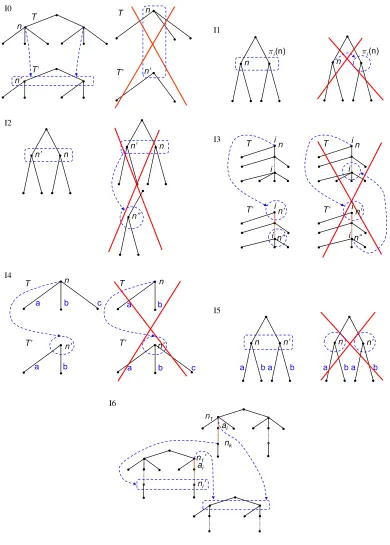
The following figures (Figure 6) illustrate properties I0 to I6.
Properties (I1), (I2), (I4), and (I5) are standard for extensive-form games, and prop-erties (I0) and (I6) generalize other standard propprop-erties of extensive-form games to our generalized setting. The essentially new property is (I3). At each information set of a
player, property (I3) confines the player’santicipation of her future view of the game to
the view she currently holds (even if, as a matter of fact, this anticipation is about to be shuttered as the game evolves).
We denote by Hi the set of i’s information sets in all trees. For an information set
hi ∈ Hi, we denote by Thi the tree containing hi. For two information sets hi, h
′
i in a
given treeT,we say thathi precedesh′i (or thathi′ succeedshi) if for everyn′ ∈h′i there
is a path n, ..., n′ such that n∈h
i. We denote hi h′i.
Remark 1 The following property is implied by I2 and I4: Ifn′, n′′ ∈h
i wherehi =πi(n)
is an information set, then Ai
n′ =Ain′′.
Proof. If n′, n′′ ∈ h
i where hi = πi(n) is some information set, then by introspection
(I3) we must haveπi(n′) =πi(n′′) =πi(n). Hence by (I4)Ain′ ⊆Ain′′ and Ain′′ ⊆Ain′.
Remark 2 Properties I0, I1, I2 and I6 imply no absent-mindedness: No information
set hi contains two distinct nodes n, n′ on some path in some tree.
Proof. Suppose by contradiction that there exists an information set hi with a node
n∈hi such that some other node inhi precedes n in the tree Tn. Denote byn′ the first
node on the path from the root ton that is also inhi.Now applyI6 withn′l :=n′ to get
a path n′′ =n′
1, ..., n′l =n′, with πi(n′′) = πi(n1) =πi(n′) = hi. By I1, we have n′′ ∈hi
Figure 6: Properties I0 to I6
T ● T
n● I0 n● ● ● ● ● ● ● ● ● ● ● ● ● ● T’ ● ● ● T’
n’ ● ●
● T’ n’●
●
● ● ● ● ●
● ●
I1
●n ● ●n ●
πi(n) πi(n)
● ● ● ● ● ● ● ● ● ● I2
●n’ ●n ●
n’ ●n
● ● ● ● ● ● ● ● ● ●n’’ ● ●
●in
T T ●in
I3 ● ● ● ● ● i ● ● ● ● ● i ● ● ● ● ● ● ● ● i
T’ ●n’ T’ ●in’
● ● ● ● i ●n” ● ● ● ● i ●n” ● ● ● ● ● ● ●n
T T ●n
I4
● ●
● a ●b c ● a ●●b
●
T’ n’ T’ ●n’
●
● a b ● a ●b ●c
● ●
I5
●n ●n’ ●n ●n’
a b a b a b a b
● ● ● ●
a b a b
● ● ● ●
a b a b
n ●
I6
● ●
● ●
n1 ● ● ai
● ●
● ●
●n1’
● nk
● ●
●
● ●
● ●
1
● ●nl’
ai
●
●
● ●
●nl
The perfect recall property I6 and Remark 2 guarantee that with the precedence
relation player i’s information sets Hi form an arborescence: For every information
seth′
i ∈Hi, the information sets preceding it {hi ∈Hi :hi h′i} are totally ordered by
.
For treesT, T′ ∈T we denoteT T′ whenever for some noden∈T and some player
i∈In it is the case thatπi(n)⊆T′. Denote by֒→the transitive closure of.That is,
T ֒→T′′iff there is a sequence of treesT, T′, . . . , T′′ ∈TsatisfyingT T′ · · ·T′′.
2.3
Generalized games
A generalized extensive-form game Γ consists of a partially ordered set T of subtrees of
a tree ¯N0 satisfying properties 1-2 above, along with information sets πi(n) for every
n∈T, T ∈T and i∈In, satisfying properties I0-I6 above.
For every treeT ∈T, theT-partial game is the partially ordered set of trees including
T and all trees T′ in Γ satisfying T ֒→ T′, with information sets as defined in Γ. A T
-partial game is a generalized game, i.e. it satisfies all properties 1-2 and I0-I6.
We denote by HT
i the set ofi’s information sets in the T-partial game.
2.4
Strategies
A (pure) strategy
si ∈Si ≡
Y
hi∈Hi Ahi
for playerispecifies an action of playeriat each of her information setshi ∈Hi.Denote
by
S=Y
j∈I
Sj
the set of strategy profiles in the generalized extensive-form game.
Ifsi = (ahi)hi∈Hi ∈Si, we denote by
si(hi) =ahi
the player’s action at the information set hi. If player i is active at node n, we say that
at noden the strategy prescribes to her the actionsi(πi(n)).
plan of action. If hi ⊆ T but T 6֒→ T′, then at hi player i may be interpreted as being
unaware of her information sets inHT′
i \HiT.
Thus, a strategy of player i should rather be viewed as a list of answers to the
hypothetical questions “what would the player do ifhiwere the set of nodes she considered
as possible?”, for hi ∈ Hi. However, there is no guarantee that such a question about
the information set h′
i ∈ HT
′
i would even be meaningful to the player if it were asked
at a different information set hi ∈ HiT when T 6֒→ T′. The answer should therefore be
interpreted as given by the modeler, as part of the description of the situation.
For a strategysi ∈Si and a treeT ∈T,we denote bysTi the strategy in theT-partial
game induced by si. If Ri ⊆Si is a set of strategies of playeri, denote by RTi the set of
strategies induced by Ri in the T-partial game, The set ofi’s strategies in the T-partial
game is thus denoted byST
i . Denote byST =
Q
j∈IS T
j the set of strategy profiles in the
T-partial game.
We say that a strategy profiles∈Sreaches the information sethi ∈Hiif the players’
actions and nature’s moves (if there are any) inThi lead tohi with a positive probability.
(Notice that unlike in standard games, an information setπi(n) may be contained in tree
T′ 6= T
n. In such a case, by definition si(πi(n)) induces an action to player i also in n
and not only in the nodes ofπi(n).)
We say that the strategy si ∈Si reaches the information set hi if there is a strategy
profile s−i ∈ S−i of the other players such that the strategy profile (si, s−i) reaches hi.
Otherwise, we say that the information sethi is excluded by the strategy si.
Similarly, we say that the strategy profile s−i ∈S−i reaches the information set hi if
there exists a strategysi ∈Si such that the strategy profile (si, s−i) reaches hi.
A strategy profile (sj)j∈I reaches a node n ∈ T if the players’ actions sj(πj(n′))j∈I
and nature’s moves in the nodes n′ ∈ T lead to n with a positive probability. Since we
consider only finite trees, (sj)j∈I reaches an information set hi ∈ Hi if and if there is a
noden∈hi such that (sj)j∈I reaches n.
As is the case also in standard games, for every given node, a given strategy profile of the players induces a distribution over terminal nodes in each tree, and hence an expected payoff for each player in the tree.
For an information set hi, let sis˜hii denote the strategy that is obtained by replacing
actions prescribed bysi at the information sethi and its successors by actions prescribed
The set ofbehavioral strategies is
Y
hi∈Hi
∆ (Ahi).
2.5
Awareness of unawareness
In some strategic situations a player may be aware of her unawareness in the sense
that she is suspicious that something is amiss without being able to conceptualize this
‘something’. Such a suspicion may affect her payoff evaluations for actions that she knows are available to her. More importantly, she may take actions to investigate her suspicion if such actions are physically available.
To model awareness of unawareness some of the trees may includeimaginary actions
as placeholders for actions that a player may be unaware of and terminal nodes/evaluations of payoffs that reflect her awareness of unawareness. (The approach of modeling aware-ness of unawareaware-ness by “imaginary moves” was proposed by Halpern and Rˆego, 2006.)
[image:16.612.175.439.415.566.2]Consider the example in Figure 7.
Figure 7: Game form with awareness of unawareness
raise 2’s raise 2’s
1 1
suspicion suspicion
i ti t i ti t
2 2
2 2
a b a b
’ b’
investigate
’ b’
investigate
” b”
2 2
2 2
a’ b’ a’ b’ a” someb”
thing
A B C D
2
a b 2
that player 1 raised her suspicion (and could have refrained from doing so); and that she could have chosen to investigate, in which case she may have had ‘something’ else to do, that she cannot conceptualize in advance. Once she investigates, she becomes aware of two more actions and her information set is in the right tree. She also realizes that player 1 initially raised her suspicion without being explicitly aware of those actions of hers by himself. Note that before she decides whether or not to investigate, she is not modeled as anticipating to be in the right tree, because she cannot conceptualize the nature of the actions she reveals if and when she investigates.
2.6
The connection to standard extensive-form games
Harsanyi (1967) showed how to transform games with asymmetric information into games with imperfect information about a move of nature. Can a similar idea be used to transform any generalized extensive-form game into a standard extensive-form game?
Given a generalized extensive-form game Γ with a partially ordered set of trees T, one
could define the transformation of Γ to be the extensive-form game with an initial move
of nature, in which nature chooses one of the trees in T.
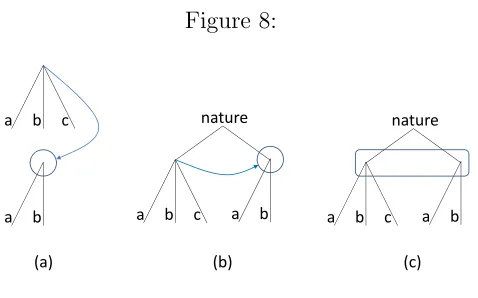
Notice, however, that the resulting structure would not be a standard extensive-form game. To see this, notice that every standard extensive-form game has the following property (E): the equivalence class of nodes in which a player considers as possible a
given possibility set of nodes is identical with that possibility set; this set is called an
information set of the player, and in all of its nodes the player has the same set of available actions. In contrast, in the transformation considered above for games with
misperceptions, this equivalence class may be a strict super-set of the possibility set. For
example, when the generalized game in Figure 8(a) is transformed so as to have an initial move of nature, the possibility set for the (unique) player is the right node, while the equivalence class contains both the right and left node.
Thus, if after adding the initial move of nature the information sets are defined to be synonymous with the possibility sets, the resulting game would be non-standard, because
for some information set there may be additional nodes outside it in which the player
Figure 8:
t
a b c nature nature
a b a b c a b a b c a b
(a) (b) (c)
the player has more available actions than in the right node, even though both are within the same information set).
There is also another aspect that prevents the above transformation from yielding a standard extensive-form game. In a standard extensive-form game each player has
a full-support prior on the moves of nature.4 Using Bayes rule, the player therefore
has a well-defined belief about nature at each stage of the game. In contrast, in the above transformation each player ascribes probability 1 only to one of the initial moves of nature; moreover, along the path of play the player may switch completely the move of nature in which she confides even if nothing in the path of play itself imposed such a switch. Such a switch corresponds to a node in the generalized game in which the player is
def inedasbecoming aware of new aspects of the dynamic interaction; such an increase
of awareness may occur even when the physical path of play per se did not imply a
surprise, and may have also been compatible with the player’s previous conception of the game. Thus, if we do add an initial move of nature to connect the trees of the generalized game, the player’s (evolving) belief about nature cannot be encapsulated within an initial
probabilistic belief about nature, and must be represented explicitly by a belief system
as part of the definition of the game.5
Adding an initial move of nature has a further conceptual drawback. In classical extensive-form games the implicit assumption is that the players understand the entire
structure of the dynamic interaction as embodied in the game tree.6 Assigning probability
4
Moreover, in the classical definition of an extensive-form game the priors of the different players about nature are actually identical, i.e. the players have a common prior about nature.
5
Recall that in standard extensive-form games belief systems appear as components of solution con-cepts (like sequential equilibrium or extensive-form rationalizability), but not as part of the definition of the game itself.
6
For instance, Myerson (1991, p. 4) puts forward explicitly the tenet that game theory deals with
zero to some move of nature is still compatible with realizing what could have happened if this zero-probability move were nevertheless to materialize. This is conceptually distinct
from being completely unaware of a subset of paths in the game, and it is the latter
concept that we want to model here. Moreover, as we have seen in the example of the introduction (Figures 3 and 4), it may lead to behavioral predictions different from unawareness.
Thus, standard extensive-form games are neither technically fit (without further gen-eralization) for modeling behavior under dynamic misperceptions and unawareness, nor do they convey the appropriate conceptual apparatus for modeling such interactions,
hence the need for our definition of generalized games.7
3
Extensive-form rationalizability
Pearce (1984) defined extensive-form (correlated) rationalizable strategies by a procedure of an iterative elimination of strategies. The idea behind the definition involves a notion of forward induction. In generic perfect-information games, rationalizable strategy pro-files yield the backward induction outcome, though they need not be subgame-perfect equilibrium strategies (Reny 1992, Battigalli 1997).
In what follows we extend this definition to generalized extensive-form games.
A belief system of player i
bi = (bi(hi))hi∈Hi ∈
Y
hi∈Hi
∆SThi
−i
is a profile of beliefs - a belief bi(hi) ∈ ∆
SThi
−i
about the other players’ strategies in
the Thi-partial game, for each information set hi ∈Hi,with the following properties
• bi(hi) reaches hi, i.e. bi(hi) assigns probability 1 to the set of strategy profiles of
the other players that reach hi.
• Ifhiprecedesh′i (hi h′i) thenbi(h′i) is derived frombi(hi) by Bayes rule whenever
possible.
7
Denote byBi the set of player i’s belief systems.
For a belief system bi ∈Bi, a strategy si ∈Si and an information set hi ∈Hi, define
player i’s expected payoff athi to be the expected payoff for player iinThi givenbi(hi),
the actions prescribed by si athi and its successors, and conditional on the fact thathi
has been reached.8
We say that with the belief system bi and the strategy si player i is rational at the
information set hi ∈ Hi if either si doesn’t reach hi in the tree Thi, or if si does reach
hi in the tree Thi then there exists no hi-replacement ofsi which yields player ia higher
expected payoff in Thi given the belief bi(hi) on the other players’ strategiesS
Thi
−i .
We say that with the belief systembi and the strategysi player iwould be rational at
the information sethi ∈Hi if there exists no actiona′hi ∈Ahi such that only replacing the
action si(hi) by a′hi results in a new strategy s
′
i which yields player i a higher expected
payoff at hi given the belief bi(hi) on the other players’ strategiesS
Thi
−i .
The difference between these two definitions is as follows. The definition ofrationality
of a strategy si at an information set hi takes a global perspective. It is mute regarding
information sets which the strategy si itself rules out. Also, at an information set hi
which si does reach, it considers hi-replacements, which may alter si not only at hi, but
also simultaneously at hi and/or at some of the succeeding information sets of player i.
In contrast, the second definition takes a local perspective. It takes seriously the
reasoning about rationality assuming thathi has been reached, whether this assumption
is realistic (when hi can in fact be reached with a positive probability given the actions
prescribed by si at preceding information sets) orcounterfactual (whenhi is ruled out by
i’s own actions with the strategysi at preceding information sets). Moreover, it considers
alternative actions a′
hi only athi itself. This is motivated by the implicit assumption that
athi,playeriis certain that at future information sets she will be acting according to the
strategy si, but at the same time she also realizes that at each such future information
set she will have the opportunity to re-consider her action, and that at hi she has no way
to commit herself to the action she will be taking at such a future information set.
We find the second definition more appealing in the context of unawareness. With unawareness, a player does not necessarily conceive of her entire strategy. Rather, she might be aware only of a subset of her information sets. She may plan what to do if
8
Even if this condition is counterfactual due to the fact that the strategy si does not reach hi. The
conditioning is thus on the event that nature’s moves, if there are any, have led to the information set hi, and assuming that playeri’s past actions (in the information sets precedinghi) have led tohi even
and when such an information set is reached. However, once her level of awareness gets increased along the path of play, she may suspect that a similar revelation can happen again. She may then realize that whatever she plans to do, with her current level of awareness, is in fact subject to reconsideration. That’s why with unawareness, what a strategy specifies for future information sets should better be conceptualized as expressing current beliefs about one’s future actions rather than as a rigid plan to which the player is bound to conform.
The following lemma describes the close connection between the two definitions when
all of the information sets hi are considered. The lemma follows from the principle of
optimality in dynamic programming. The explicit proof appears in the appendix.
Lemma 1 With a belief system bi of player i,
(i) if a strategy si of player i would be rational at all information sets hi ∈Hi then it
is rational at all information sets hi ∈Hi; and
(ii) if a strategy si of player i is rational at all information sets hi ∈ Hi, then there
exists a strategy sˆi which coincides with si at all information sets reached by si,
such that sˆi would be rational at all information sets hi ∈Hi.
The connection between the two definitions described in Lemma 1 is related to the
notion of aplan of action (Rubinstein 1991, Reny 1992). A plan of player ispecifies her
action when she is called to play, and does not specify what she would do at information
sets which are ruled out by that plan. Formally, a plan of action for player i is an
equivalence class of strategiesPi ⊂Si such that two strategiessi,ˆsi are inPi if and only
if for every strategy profiles−i of the other players, (si, s−i) and (ˆsi, s−i) induce the same
distribution over terminal nodes in each of the trees of the game Γ. If si ∈ Pi we say
that the strategy si induces the plan of action Pi.
With this terminology, Lemma 1 implies:
Lemma 2 For a given belief system bi of player i, there exists a strategy si which is
rational at all information sets hi ∈ Hi and induces the plan of action Pi if and only
if there exists a strategy ˆsi which would be rational at all information sets hi ∈Hi and
induces the plan of actionPi.
Definition 1 (Would-be rationalizable strategies) Define, inductively, the
follow-ing sequence of belief systems and strategies of player i.
B1
i =Bi
S1
i ={si ∈Si: there exists a belief system bi ∈B1i
with which for every information set hi ∈Hi player i is rational at hi}
...
Bk
i = {bi ∈ Bik−1 : for every information set hi, if there exists some profile of the other
players’ strategies s−i ∈S−k−i1 =
Q
j6=iS k−1
j such that s−i reaches hi in the tree Thi, then
bi(hi) assigns probability 1 to S
k−1,Thi
−i }
Sk
i ={si ∈Si: there exists a belief system bi ∈Bik with which for every information set
hi ∈Hi player i would be rational at hi}
The set of player i’s would-be rationalizable strategies is
Si∞ =
∞
\
k=1 Sik.
Remark 3 Sk i ⊆S
k−1
i for every k >1.
Proof. Consider si ∈ Sik. By definition, si would-be rational at each of player i’s
information sets given some belief system bi ∈ Bik. Since Bik ⊆ B
k−1
i , si would also be
rational at each of playeri’s information sets given a belief system inBik−1,namely given
bi. Hence si ∈Sik−1.
The generalization of Pearce’s (1984) notion of extensive-form correlated rationaliz-able strategies is introduced next. The inductive definition below generalizes Definition 2 in Battigalli (1997), which he proved to be equivalent to Pearce’s original definition.
Definition 2 (Extensive-form correlated rationalizable strategies) Fork ≥1let ˆ
Bk
i,Sˆik be defined inductively asBik, Sik above, respectively, the only change being that the
phrase “for every information set hi ∈ Hi player i would be rational at hi ” in the
definition of Sk
i is changed to “for every information set hi ∈ Hi player i is
ratio-nal at hi” in the definition of Sˆik. The set of player i’s extensive-form correlated
rationalizable strategies is
ˆ
Si∞ =
∞
\
k=1
ˆ
Remark 4 Sˆk i ⊆Sˆ
k−1
i for every k >1.
Proof. Analogous to the proof of Remark 3 above.
Lemma 2 above implies the following proposition.
Proposition 1 The set of strategies Sk
i is contained in Sˆik, but Sik induces a set of plans
of action identical to the set of plans of action induced by Sˆk
i. Consequently, the set
of would-be rationalizable strategies is contained in the set of extensive-form correlated rationalizable strategies,
Si∞ =
∞
\
k=1 Sk
i ⊆Sˆ
∞
i =
∞
\
k=1
ˆ
Sk i
but both sets induce the same set of plans of actions.
The inclusion mentioned in the proposition may be strict. For instance, in our first example in the introduction (Figure 1), it is rationalizable for player 1 not to give the car to player 2 and to subsequently go to the Bach concert, but to have gone to the
Stravinsky concert (or to the Bach concert, or to the Mozart concert) had he given the
car to 2. In contrast, the only would-be rationalizable strategy of player 1 is not to give
the car to player 2 and subsequently attend the Bach concert, but to have gone to the Mozart concert had he given the car to player 2. As the proposition asserts, no difference arises between rationality and would-be rationality along the unique realized path.
Proposition 2 The set of would-be rationalizable strategies is non-empty. Consequently, the set of extensive-form correlated rationalizable strategies is non-empty.
The proof is in the appendix.
What are the would-be rationalizable strategies in our battle-of-the-sexes example from the introduction (Figure 2)?
Remark 5 In the Bach-Stravinsky-Mozart example with unawareness from the introduc-tion (Figure 2), no player has a unique would-be raintroduc-tionalizable strategy.
concert. If he is aware of the Mozart concert, then only this concert is rational since it
is a dominant action. Thus, S1
II = {(B, M),(S, M)}. Not telling player II about the
Mozart concert and going to the Bach concert would-be rational for player I assuming
that she believes with probability at least 12 that player II will go to the Bach concert
under such circumstances. Telling player II about the Mozart concert and going to the
Mozart concert would-be rational for player I if she believes with probability at least 12
that player II would go to the Stravinsky concert if not told about the Mozart concert.
To summarize,
SI2 =
(
(“don’t tell”, B, M, B),(“don’t tell”, B, M, S),
(“tell”, B, M, B),(“tell”, B, M, S),(“tell”, S, M, B),(“tell”, S, M, S) )
where the second (resp. third) component of the strategy vector refers to playerI’s choice
after history “don’t tell” (resp. “tell”), and the last component denotes the action in the
lower subtree. Finally, note that Sk
II =SII1 for k ≥1 and SIk =SI2 for k ≥2.
When we compare this example to the game in which both players are aware of the
Mozart concert but player I has the option of not providing her car for going to this
concert (Figure 1), we note that the strategic implications of unawareness of actions are distinct from a situation in which both players are aware of the actions but some action
may not always be available. The reason is that if player I keeps player II unaware
of the Mozart concert, then player II can not infer the intention of player II to go to
the Bach concert. In other words, awareness of an available action (providing the car for going to the Mozart concert) and certainty that it hasn’t been taken has stronger strategic implications than unawareness of the very same action.
4
Prudent rationalizability
In normal-form games, iterated admissibility (i.e. iterative elimination of weakly domi-nated strategies) is a refinement of rationalizability. Van Damme (1989) and more gener-ally Ben-Porath and Dekel (1992) showed that iterated elimination of weakly dominated
strategies singles out the forward induction outcome in money-burning games.9 One
in-terpretation of iterated admissibility is that in every round of elimination, each player is prudent and hence does not exclude completely any strategy profile of the other players which has not been thus far eliminated. In this section, we use the idea of prudence to define an analogous notion of rationalizability for dynamic games:
Definition 3 (Prudent rationalizability) Let
¯
Si0 =Si
For k ≥1 define inductively
¯ Bk i =
bi ∈Bi :
for every information set hi, if there exists some profile
s−i ∈S¯−k−i1 =
Q
j6=iS¯ k−1
j of the other players’ strategies
such that s−i reaches hi in the tree Thi, then the support
of bi(hi) is the set of strategy profiles s−i ∈S¯
k−1,Thi
−i that reach hi
¯ Sk i = (
si ∈S¯ik−1 :
there exists bi ∈B¯ik such that for all hi ∈Hi player i
would be rational at hi
)
The set of prudent rationalizable strategies of player i is
¯
Si∞=
∞ \ k=1 ¯ Sk i
Proposition 3 The set of player i’s prudent rationalizable strategies is non-empty.
Proof. First, observe that ¯Bk
i 6= ∅ for every k ≥ 1, because if an information set
hi ∈ Hi is reached by some s−i ∈ S¯−k−i1, then s−i reaches also all of i’s information sets
that precede hi in the tree Thi.
9
We proceed by induction. ¯S0
i = Si and hence non-empty. Notice also that for every
bi ∈ B¯i1, a standard backward induction procedure on the arborescence of information
sets Hi yields a strategysi ∈S¯i1 with which player i would be rational ∀hi ∈Hi given bi.
Suppose, inductively, we have already shown that∀i∈I S¯k−1
i 6= 0 (and hence that
¯
Sk−1
−i 6= 0), and also that for every bi ∈B¯ik−1 there exists a strategysi ∈S¯ik−1 with which
player i would be rational∀hi ∈Hi givenbi.
Letbi ∈B¯ik. Let ˙Hi ⊆Hi be the set ofi’s information sets not reached by any profile
s−i ∈S¯−k−i1 but reached by some profile s−i ∈S¯−k−i2. If ˙Hi 6=∅, for every hi ∈H˙i with no
predecessor in ˙Hi, modify (if necessary)bi(hi) so as to have full support on the profiles in
¯
S−k−i2 that reachhi, and in succeeding information sets modify bi by Bayes rule whenever
possible. Denote the modified belief system by ˙bi.Then by construction also ˙bi ∈B¯ik.
Consider a sequence of belief systemsbi,n∈B¯ki−1 such that
˙
bi =
˙
bi(h′i)
h′
i∈Hi
≡lim
n→∞bi,n(h ′
i)
h′
i∈Hi
and given this sequence10 b
i,n ∈ B¯ik−1 let si,n ∈ S¯ik−1 be a corresponding sequence of
strategies with the property that given bi,n, it is the case that with the strategy si,n
player i would be rational at every hi ∈ Hi. Since player i has finitely many strategies,
some strategy si appears infinitely often in the sequence si,n. Since expected utility is
linear in beliefs and hence continuous, also given ˙bi it is the case that with the strategy
si player i would be rational at every hi ∈Hi.Hence si ∈S¯ik as well.
Now, since player i’s set of strategies Si is finite and by definition ¯Sik+1 ⊆ S¯ik for
every k ≥ 1, for some ℓ we eventually get ¯Sℓ
i = ¯S ℓ+1
i ∀i ∈ I and hence ¯B
ℓ+1
i = ¯B ℓ+2
i
∀i∈I. Inductively,
∅ 6= ¯Sℓ i = ¯S
ℓ+1
i = ¯S ℓ+2
i =...
and therefore
¯
Si∞=
∞
\
k=1
¯
Sik= ¯S ℓ i 6=∅
as required.
10
To construct such a sequence bi,n ∈ B¯k−
1
i , for every information seth′i ∈ Hi not reached by any
s−i ∈S¯k−
1
−i definebi,n(h′i) = ˙bi(h′i) for everyn ≥1; and for everyh′i ∈Hi with no predecessors but
reached by some profile s−i ∈S¯k−
1
−i define bi,n(h′i)∈∆ ¯S k−1
−i
to be any converging sequence of beliefs such that for every n≥1 the support of bi,n(h′i) is the subset of profiles in ¯S
k−2
−i that reach h′i,while
limn→∞bi,n(h′i) = ˙bi(h′i). In succeeding information sets reached by somesi ∈S¯k−
1
−i define bi,n(h′i) by
4.1
A first tension between rationalization and prudence:
Divining the opponent’s past behavior
In normal-form games, iterated admissibility is a refinement of rationalizability.
Some-what surprisingly, in extensive-form games prudent rationalizability isnot a refinement
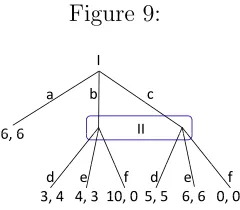
[image:27.612.246.366.195.300.2]of would-be rationalizability, as the following example (Figure 9) demonstrates.
Figure 9:
I
a b c
II
6 6 II
6, 6
d e f d e f 0 0 5 5 6 6 10 0
3 4 4 3 10, 05, 5 6, 6 0, 0 3, 4 4, 3
In this example, player 1 can guarantee herself the payoff 6 by choosingaand ending
the game. If player 2 is called to play, should he believe that player 1 chose b or c? If
player 1 is certain that player 2 is rational, she is certain that player 2 will not choose f.
Hence, if player 2 is certain that player 1 is certain that he (player 2) is rational, then
at his information set player 2 is certain that player 1 chosec. The reason is that among
player 1’s actions leading to 2’s information set, c is the only action which, assuming
2 believes c was chosen and that 2 is rational and will hence choose e, yields player 1
the payoff 6, which is just as high as the payoff she could guarantee herself with the
outside option a. Hence (a, e) and (c, e) are the profiles of extensive-form (correlated)
rationalizable strategies (as well as would-be rationalizable strategies) in this game.
The notion of prudence, in contrast, embodies the idea that being prudently rational,
player 1 shouldn’t rule out completely any of 2’s possible choices, and hence that c is
strictly inferior for player 1 relative to her outside optiona. Hence, if 2’s information set
is ever reached, the only way for 2 to rationalize this is to believe that 1 choseb,based on
a belief ascribing a high probability to the event that 2 will foolishly choosef. Player 2’s
best reply tob is d; and player 1’s best reply to d is a. Thus, the only profile of prudent
rationalizable strategies in this game is (a, d).
This example demonstrates that in dynamic interactions the notions of rationalization
and prudence might involve atension. Extensive-form rationalizability embodies a
future behavior by attributing to them the ‘highest’ level of rationality and mutual cer-tainty of rationality consistent with the fact that the information set has indeed been reached. But, with the additional criterion of ‘prudence’, what should a player believe about the behavior of his opponent if, as in the example, the opponent’s only action which is compatible with common certainty of rationality is imprudent on the part of the opponent?
The definition of prudent rationalizability resolves this tension unequivocally in fa-vor of the prudence consideration. It remains open whether and how a more balanced and elaborate definition could resolve the tension in less an extreme fashion. We plan to address this challenge in future work. However, any definition would have to cut
the Gordian knot in the above example in one particular way, choosing either d or e,
and indeed both potential resolutions are backed by sensible intuitions. This suggests that for dynamic interactions we need not necessarily expect one ultimate definition of rationalizability taking into account both rationalization and prudence.
Remark 6 The definition of prudent rationalizability employs would-be rationality. For standard extensive-form games, Brandenburger and Friedenberg (2007) studied the con-nection between extensive-form iteratively admissible strategies (defined on the basis of rationality rather than would-be rationality) and extensive-form rationalizability. They showed that under a “no relevant convexities” condition, extensive-form rationalizability and extensive-form iterated admissibility coincide. However, the example in Figure 9 does
notsatisfy this condition, and hence demonstrates that in general extensive-form iterated
admissibility is not a refinement of extensive-form rationalizability.
Nevertheless, as far as paths of play are concerned, in the above example the set of
paths induced by prudent rationalizability (the patha)is a subset of the paths induced
by (would-be) rationalizability (the pathsa and (c, e) ). This is an instance of a general
phenomenon:
Proposition 4 (Prudent rationalizability refines would-be rationalizable paths)
The set of paths induced by profiles of prudent rationalizable strategies is a subset of the paths induced by profiles of would-be rationalizable strategies (or, equivalently, the paths induced by profiles of extensive-form correlated rationalizable strategies).
4.2
The refining power of prudent rationalizability
We now bring two examples demonstrating the refining power of prudent rationalizability. The first example was originally analyzed (for the full awareness case) by Milgrom and Roberts (1986) using sequential equilibrium. A second example is due to Ozbay (2007).
4.2.1 Milgrom-Roberts (1986) verifiable communication
Consider a merchandize whose quality qi ∈ {q1, . . . , qn} is known to its seller, while a
buyer knows only the prior probability distribution (p1, . . . , pn) of the qualities, where
pi >0 for all i= 1, . . . , n. For each quality level qi the seller is better off the larger the
quantity that she sells, while the utility of the buyer from the merchandize is strictly
concave in the quantity purchases with a single peak at β(qi). Furthermore,
β(q1)<· · ·< β(qn).
Before sale takes place, the seller has the option of providing the buyer with a certified signal about the quality of her merchandize, proving to the seller that the quality is within some range {qmin, . . . , qmax} containing the actual quality qi.
Milgrom and Roberts (1986) proved that if the buyer’s utility is strictly concave then
there is a unique sequential equilibrium, in which when the quality isqi the seller certifies
to the buyer a range (possibly a singleton) {qmin, . . . , qmax} in whichqmin =qi, while the
buyer is skeptical and always buys β(qmin). Thus, in this unique sequential equilibrium
the qualityqi is fully revealed to the seller, who buys the optimal quantity β(qi) for him.
We proceed with the caveat that the quantities which can be demanded by the buyer belong to a finite, fine grid (recall that, formally, in our formulation each player has finitely many available actions in each information set). For simplicity, we assume further that
the quantities β(qi), i = 1, . . . , n belong to this grid. For 1 ≤ m < n we denote by
[β(qm), β(qn)] the set of quantities in this grid at least as large asβ(qm) and no larger
thanβ(qn).
Proposition 5 The strategy to buy β(qmin) when confronted with the certification that
the quality is in the range {qmin, . . . , qmax} is also the unique prudent rationalizable
strat-egy for the buyer, and certifying some range{qmin, . . . , qmax} in whichqmin =qi constitute
the prudent rationalizable strategies of the seller.
rev-elation outcome indicated by Milgrom and Roberts (1986).
Proof of Proposition 5. When the buyer is confronted with the certificate {qn}, his
unique level-1 (prudent) rationalizable action is to buyβ(qn), while when he is confronted
with some range {qm, . . . , qn} all the quantities in the interval [β(qm), β(qn)] are
level-1 (prudent) rationalizable (because any posterior belief of the buyer about the qualities
with support{qm, . . . , qn}can be derived from a belief of the buyer that the seller provides
the certificate{qm, . . . , qn}with an appropriate probabilityri when the seller knows that
the quality is qi ∈ {qm, . . . , qn}.) Consequently, the only level-2 prudent rationalizable
strategies of the seller are those in which she provides the certificate{qn}when the quality
isqn(because any other certificate that she can provide{qm, . . . , qn}will yield an expected
sale strictly smaller than β(qn) with a full support belief about the level-1 prudent
rationalizable strategies of the buyer, that have actions in the range [β(qm), β(qn)]).
Assume, inductively, that we have already proved that in all the level-(2k−1) prudent
rationalizable strategies of the buyer, for every i = 0, . . . , k − 1 he buys the quantity
β(qn−i) when confronted with a certificate of the form {qn−i, . . . , qℓ}, and that in all
the level-2k prudent rationalizable strategies of the seller she indeed provides such a
certificate when the quality isqn−i. Then in all the level-(2k+ 1) (prudent) rationalizable
strategies of the buyer he buys the quantityβ(qn−k) when confronted with a certificate
of the form {qn−k, . . . , qℓ} (because he believes that such a certificate could only be
presented to him with the qualityqn−k, as by the induction hypothesis with each higher
quality all the level-2k prudent rationalizable strategies of the seller present a certificate
where that higher value is the minimal value). Furthermore, when confronted with some range {qm, . . . , qn−k, . . . , qℓ} all the quantities in the interval [β(qm), β(qn−k)] are
level-(2k+ 1) (prudent) rationalizable (because any posterior belief of the buyer about the
qualities with support {qm, . . . , qn−k} can be derived from a belief of the buyer on the
level-2k prudent rationalizable strategies of the seller in which the seller provides the
certificate{qm, . . . , qℓ}with an appropriate probability ri when the seller knows that the
quality isqi ∈ {qm, . . . , qn−k}.)
Consequently, in all the level-(2k+ 2) prudent rationalizable strategies of the seller
she provides the certificate {qn−k, ..., qℓ} when the quality is qn−k (because any other
certificate that she can provide {qm, . . . , qn−k, . . . , qℓ} will yield an expected sale strictly
smaller than β(qn−k) with a full support belief about the level-(2k+ 1) prudent
ratio-nalizable strategies of the buyer, that have actions in the range [β(qm), β(qn−k)]).
wanted to prove.
In fact, it is not difficult to see that the above argument does not depend on the assumption that the available certificates consist of ranges of qualities (containing the true quality). For the argument to hold it is enough to assume that for each quality level
qi one of the available certificates is the fully revealing certificate {qi}.
Multi-dimensional certificates and unawareness. Assume now that there are sev-eral dimensions of quality along which such certifications could be provided. To fix ideas, consider two dimensions with two values in each:
L0, H0, L∗, H∗
so, for instance, in the state L0 the available certificates are{L, H} × {0,∗},{L} × {0,∗}, {L, H} × {0} and {L} × {0}.
Assume further that
β(L∗)< β L0
< β H0
< β(H∗)
Since the singleton certificates
{L} × {∗},{L} ×0
,{H} ×0
,{H} × {∗}
are available, the above argument obtains and full revelation takes place in any profile of prudent rationalizable strategies of the players.
Assume, however, that the buyer is initially aware only of the{L, H}dimension and
is unaware of the {0,∗} dimension; he evaluates the merchandize as having the default
quality L0 when confronted with the certificate {L}, and similarly, with the certificate
{H}he evaluates the merchandize as having the default qualityH0. Assume further that
the seller knows this, and that by presenting the certificates{∗}, {0} or {0,∗} the seller
inter alia makes the buyer aware of the{0,∗} dimension.
Intuitively, it is clear that the seller will want to make the buyer aware of this extra
dimension when the quality is H∗, because this will lead the buyer to demand the high
quantity β(H∗). In contrast, when the actual quality is L∗, the seller will prefer not
to present any certificate at all along the dimension {0,∗}: This way the buyer will
unraveling and full revelation will occur only along the {L, H} dimension); if the seller were to make the buyer aware of this extra dimension, the buyer would have demanded only β(L∗)< β(L0).
This strategic interaction is represented in the following generalized game form
(Fig-ure 10). Initially, nat(Fig-ure, c, selects a state out of {L0, L∗, H0, H∗}. The seller observes
the state of nature and chooses a certificate. Unless the seller presents a certificate
in-volving the dimension {0,∗}, the buyer remains unaware of it. This is indicated by the
intermitted arrows from nodes in the upper tree to nodes in the lower tree. E.g., if the
seller selects the certificate {L}, then the buyer remains unaware of the {0,∗}dimension
and views the game as represented by the lower tree. In particular, his information set
is a singleton containing the node after nature selects L and the seller reports {L} in
the lower tree. If the seller presents a certificate involving the {0,∗}-dimension, then the
buyer becomes aware of it and he conceives of the entire generalized game. For instance,
if the seller selects the certificate{L, H}×{0,∗}, then the buyer’s information set is given
by the upmost information set drawn as an intermitted line connecting four nodes.
4.2.2 An example by Ozbay (2007)
To demonstrate the extra power of prudent rationalizability, consider the following ex-ample of dynamic interaction with unawareness, which is a variant of exex-ample 3 in Ozbay
(2007). There are 3 states of nature, ω1, ω2, ω3. A chance move chooses one out of four
potential distributions over the states of nature:
δ1 = (1,0,0)
δ2 = (0,1,0)
δ3 = (0,0,1)
δ4 =
1 3,
1 3,
1 3
An Announcer gets to know the distribution (but not the realization of the state of
nature). A Decision Maker (DM) is initially aware only of the state ω1 (and hence the
DM is certain that ω1 will be realized with certainty). However, before the DM chooses
what to do, the Announcer can choose to make the DM aware of eitherω2, ω3, none of
them or both of them. Increased awareness makes the DM aware of the relevant marginals
Figure
10:
Seller Seller Seller Seller
c
L0 L* H0 H*
Seller Seller Seller Seller
{L}×{0 *}
{L,H}×{0}
{L,H}×{0, *}
{L}×{0 *}
{L,H}×{*} {L,H}×{0, *}
{H}×{0 *}
{L,H}×{0}
{L,H}×{0, *}
{H}×{0 *}
{L,H}×{*} {L,H}×{0, *}
●
●
●
●
●
●
{L}×{0}
{L}×{ , }
{L}×{*} {L}×{0, }
{H}×{0}
{H}×{0, }
{H}×{*} {H}×{0, *}
{L, H} {L, H} {L, H} {L, H}
●
●
●
●
●
…
●
…
…
{L}
…
{L} {H}…
{H}…
…
…
…
…
…
…
…
H L
…
…
…
…
c
Seller Seller
{L,H} {L}