Munich Personal RePEc Archive
Long term financing decision at the level
of companies.
Dobrota, Gabriela and Chirculescu, Felicia Maria
Constantin Brancusi University of Targu-Jiu, Romania
2009
Online at
https://mpra.ub.uni-muenchen.de/17527/
LONG TERM FINANCING DECISION AT THE LEVEL OF COMPANIES
Prof. PhD Dobrotă Gabriela, Asist. Chirculescu Maria Felicia
“Constantin Brancusi“ University of Targu-Jiu
Abstract: Debates on the financing needs registered a firm levels were a constant concern of specialists but especially managers. Majority opinion is that the financing of investment must be made by sources having character of permanence. However, a problem whose answer is not easily determined is the degree to which it may use its own sources, borrowed or rented, to record the lowest financing cost. Since the shareholders require a higher remuneration of capital investments superior to those on the financial market, managers must seek to reduce the cost of borrowed capital and the growth rate of financial return. In this paper are presented issues relating to the structure and potential sources and funding the decision on cost related to each funding opportunities.
Key words: financing, firms, management, investments, reduction of the cost of borrowed capital.
1. Introduction
Conducting business at a company generates significant funding necessities for the cycle of exploitation and development activities, restructuring and modernization. For funding these there can be used internal resources and external resources. Typically, the most important investment is the external resources “consumer”. Given that the company has several options for financing the business, the question is to choose those which suites its needs. This selection is done taking into account the specific conditions which limit the scope of opportunities to purchase resources.
Cover the deficit of resources in the long term can be achieved through the banking system, capital markets, specialized companies or state. Since these resources fall within the permanent capital, is imposed a background relevant to the financing decision. In this respect, the ratio of debt financing and equity must ensure lowest financing cost, the financing decision is based on optimizing the proportion of funding source, allocation and use of funds and obtaining financial future surpluses will allow reimbursement lending and development activities.
Establish a financial structure is an important decision that fall within the financial company. Thus, should decide the allocation of funding between short-term debts and use the permanent capital. Also, analysis should be steeped on the structure of permanent capital structure, imposing the choice of the proportion of equity and borrowed the medium and long.
Decident parties must adopt the financing decision from the ability of indebtedness, the financial profitability, the type of funding needs, the cash flow's future. Should not be missed the fact that the decision is subject to funding and influence the evolution of macro-indicators economic: inflation, interest rates, exchange rates, GDP and by the fiscal and legislative component. Based on these clarifications, we will try to highlight a possible background of the decision of long-term financing by Opt in the existing analysis to a firm.
2. Bank loan financing
and bank fees to be paid monthly, annually, at the end of the period and at the time of contracting (bank charges and commissions). Credit conditions respectively interest rate, term of repayment, any grace period, penalties for breach of contract clauses, etc., are negotiated between banks and borrowers. Level of interest in bank loans is higher than that used by the financial specialist. Cost of bank loan size and interest rate is determined by three factors: the credit volume, interest rate and the lending. Repayment of loans is done in accordance with the situation regarding the staggering rates and annual interest, half, quarter or month, with constant or variable annuities or once at final maturity, with or without a grace period. Based on this the financial section of the company determines the financial flows generated by the decision of credit that can be included in budget revenue and expenditure. The cost of bank credit and long-term size of C and to be repaid in annuities . Sai, i = 1,2, …., n, can be measured by the cost
update. This is given by the same updated rate "a" that allows equal amount of debt contracted and annuities (the rate of repayment plus interest) updated the rate of:
(
)
∑
= +
= n
i
i i
a Sa C
1 1
[1]
Annuities can be broken down with or without consideration of tax incidence and the methods of reimbursement.
For example, consider the establishment of funding sources needs to carry out an investment project, a firm called a bank loan amounting to 18,912 euro, with an interest rate of 10% / year. Also, when contacting the credit, the bank receives a management fee of 0.3% for credit insurance and charge 1% of the amount borrowed by the company. Loan repayment is done annually, through constant annuities. In this context, the total cost per year is determined by: Interest-1024.36 euro management fee 56.74 euro credit insurance 189.12 Euros, resulting in a total of 1270.22 euro. If the loan is repaid in a higher cost of financing can be determined according to the relationship outlined above.
As noted, bank loans can be repaid in other ways too, the cost of financing being determined by them. But whatever the mode of repayment is, it can be concluded that they are costs generators that could significantly influence the company's treasury (especially that perceive and various administrative fees, insurance reimbursement, etc.) and require charging equity guarantees needed by the bank (sometimes guarantees required by banks may not be offered to companies demanding, which requires a shift towards other ways of financing, which may be more expensive). However, bank loans and long-term began to be Romanian and an option selected to ensure the needs of registered investment processes.
3.Mortgage bond
advertising, banking commissions, bonus issue, etc. They are determined from the beginning in the percentage to be deducted from the total amount of the loan.
Operation of the mortgage bond repayment is made in accordance with the deadlines included in the contract, such:
• Through constant annuities;
• Though equal series;
• Through single depreciation at the end of the term;
• Through zero coupon.
If we consider a loan worth 200,000 lei, contracted for a period of 4 years with interest at 10%, the nominal value of bonds is 100 lei, it can be seen that while delaying payments implies a higher cost for issuer of the bonds due to erosion over time of capital (tab. nr. 1 and 2).
Table no. 1. Mortgage bond repayment through equal series and constant annuities
Depreciation through equal series Depreciation through constant annuities
Elements
1 2 3 4 1 2 3 4
Or 500 500 500 500 431 474 522 573
Yearly depreciation
5000 50000 50000 50000 43100 47400 52200 57300
Interest 2000 15000 10000 5000 20000 15690 10950 5730 Yearly amount 7000 65000 60000 55000 63100 63090 63150 63030
Remaining amount to be refunded
150000 100000 50000 0 156900 109500 57300 0
Table no. 2. Refund of mortgage bonds through unique depreciation and zero coupon Unique depreciation Zero coupon depreciation
Elements
1 2 3 4 1 2 3 4
Or 0 0 0 2000 0 0 0 2000
Yearly depreciation
0 0 0 200000 0 0 0 200000
Interest 20000 20000 20000 20000 0 0 0 0 Yearly
amount
20000 20000 20000 220000 0 0 0 200000
Remaining amount to be refunded
200000 200000 200000 0 200000 200000 200000 0
- In the last way, the issuing company made a profit from the difference between issue price and the redemption. The cost of such financing arrangements shall be subject to the influence of several factors, including fall:
- Credit period; - Refund modality;
- Requested guaranties, number of involved participants, etc.
the corresponding current flow annuities (Sai):
(
)
∑
= +
−
= n
i
i i
a Sa VAN
1 0
1 C
[2] where a- actualization rate.
The second mentioned indicator is actually the actualisation rate for which VAN is zero:
(
)
∑
= +
= n
i
i a i
r Sa
1 0
1 C
[3]
Where there is a negative indicator that results in real terms, the issuer has incurred a higher amount (expressed in purchasing power since issue) and vice versa. If calculations are carried out for more funding alternatives, the choice should be that which generates the highest net present value. In the selection of financing alternatives will be taken into consideration the record with the lowest level. This indicator cannot be determined always through calculations, being imposed the fundament financing decision, especially through VAN determination.
In our country, financing through this modality constituted the privilege of public administrations and not of public firms, because of the investors’ lack of confidence in their capacity to gain profit. If the economic context, however, and current world financial difficulties in the contracting bank loans faced economic, predictability they offer financial instruments with fixed income in periods of increased volatility can be considered that the alternative funding could become attractive for them.
Public offer for the sale of bonds is based on the same principles as that for the sale of shares, taking place usually through an intermediary that coordinates all operations generated by financing through the issue of bonds. Possibility of obtaining a mortgage bond is significant determined to a profile of activity and industry which operates in.
Financing through bond behaves both advantages and disadvantages. Thus the use of the advantages mentioned ways: determining the mobilization of resources for financing; avoid banks and banking expenses in procuring resources necessary to obtain a better return on reinvested only if financing by issuing shares, gives the anticipated reimbursement Depending on the evolution rate, does not alter the structure of shareholders, confer rights in the decisions. At the same time, however, the issue of bonds presents disadvantages, as involving the making of financial charges, regardless of the results recorded by the company, determines the reduction of liquidity as a result of issuing compulsory repayment of the loan, there is a risk that the subscription is not successful.
4. Leasing
that normal remuneration of capital brought by the leasing company (interest, commission and a risk bonus)
To establish the cost of the contract it can be used the following equality (explicit cost of leasing is given by the actualisation rate “a”):
(
)
(
)
1 1 1 1
n n ini i i i i F Fei a a = = = + +
∑
∑
[4]where:
Fi n i – entrance fluxes in the year „i”;
Fei – exit fluxes in the year „i”;
The relationship presented is applied in different ways for both parties (user and financier), whereas flows to the lessor are input output flows tenant and vice versa. Basically, the cost of leasing is an inmate to return to profitability rate tenant. For example, a leasing company buys a machine worth 250 thousand lei, with a normal duration of use chosen by 5 years. By leasing contract with a tenant, annual rent is set at 75 thousand lei. And the residual value is zero. Rate of tax is 16%.
Leasing cost borne by the lessor, when using the linear depreciation is fixed as it follows:
(
)
1
1
(1 ) (1 )
n
i p p i r
I
i n
i
C I I A V
V a a = − + × + = + +
∑
[5] 5 5 175 0,84 0,16 50
0 250
(1 )
i= a
× + × + = +
∑
5 5 1 63 8 250 (1 )i= a
+ = +
∑
5 5 1 1 3,5211 (1 )i= a
= +
∑
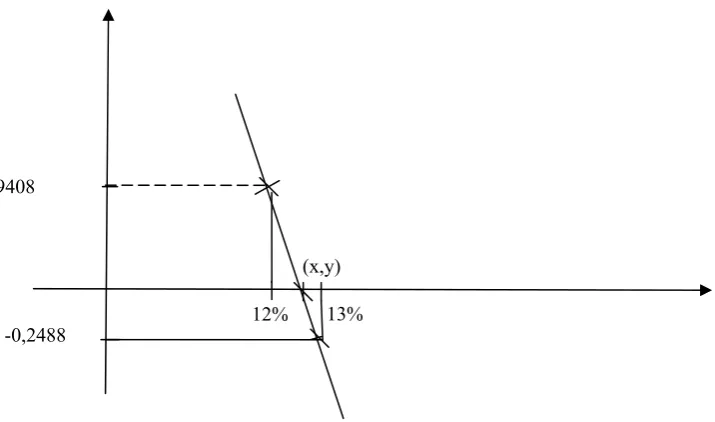
(12,13) a ⇒ ∈For a = 12%: 71 x 3,6048 – 250 = 5,9408
For a= 13%: 71 x 3,5172 – 250 = - 0,2488
From the equation of the right line that goes through two points results:
1 1
2 1 2 1
x x y y
x x y y
− −
=
− −
12 0 5, 9408
13 12 0.2488 5, 9408
x− −
=
− − −
12 5, 9408
1 6,1896
x−
=
12,905%
Graphic no.1 Coordinates determination of the actualisation cost point that determines the quality between the entrance and exit fluxes
[image:7.595.88.446.67.278.2]If the contract is concluded for shorter period shall not apply to the relationship based on updating elements specified. We believe that a company wants to buy a car on lease, with a value of 18912 Euro (price without VAT), in the following conditions: advance-50% management fee 2% interest rate financing-10% rate number-12; residual value-0. In this case, the company will incur a cost of 970.1 Euros financing (interest and management fee), as shown in table. 3):
Table no. 3. Leading financing cost
Element % Without VAT With VAT
Acquisition price 18912 22505,28 Client advance 50% 9456 11252,64 Financing value 9456 11252,64 Commission management 2% 378,24 450,11 Financing interest 10% 519,99 519,99 Rates number 12
Total contract 19810,20 23475,34
The cost of funding increases as it extends the period for payment of rates and the advance paid by the applicant firm is lower. Financing lease involving certain advantages:
• business user can channel their resources for other purposes, avoiding immobilization in active use and access to new technologies in the field, whereas at the end of the period fixed by the lease, return the property leasing company and may end a new leasing contract for a good technical parameters with high functional;
• the good obtained constitutes also a guaranty, the firm’s capital remaining legally not-engaged;
• tenant may perform the duty to end the contract in the case of imported goods, to the residual value;
5,9408
12% 13%
(x,y)
• recorded tax (if the contract of finance lease assets which are subject to it shall be recorded as fixed assets in the accounts of the user deducting depreciation costs, and the leasing costs of interest, in the case of the operational leasing, the asset is recorded as fixed asset accounting in the leasing company and the lease rate is fully deductible expense to the user);
• the procedure for obtaining a lease in the funding and conduct of such a contract are more facile than for the lending bank;
• the leasing company can provide certain services performed related to the installation, putting into service, etc.
This way of funding determines also disadvantages, primarily related to high cost of financing (which requires obtaining a yield at least cover) and that affect future self because of periodic and non-payment of instalments shall entail the loss asset and obligation to pay all outstanding rates (in many companies today are unable to pay rates on goods purchased in lease). Also, unlike bank credit, when leasing, transfer of ownership is achieved after the last payment rate.
Last legislative measures adopted in the fiscal area affect this mode of financing for purchases of cars. Thus, is not given tax deduction granted to the purchase of new machines by legal and leasing companies, which will cause them many economic agents to shift to other ways of financing.
5. Determining the marginal cost of capital used - foundation element of the financing decision
Option for another way of funding should be base on sizing and marginal cost of capital used. In other words, is not sufficient to compare the cost of specific sources of funding but also an analysis of the cost of each additional unit of capital allocated so as to make a comparison between the effects generated by the process of financing through various.
For example we can consider the following situation: an economic agent has capital of 200 m.u and the borrowed capital is 50 m.u in the profits of the year has expired dividends in providing a figure of 10% and the capital lent support for a total cost of 25%.
To fund a record investment needs more than 50 um can be covered either by a bank credit or by issue of new shares being determined and the rate of dividend increase to 12%. In this case, the section may calculate the corresponding marginal cost of each option (table no. 4):
Table nr. 4 Determination of marginal cost by type of funding
Initial situation Bank loan Issuance of shares Elements
Kpr Kî Kt Kpr Kî Kt Kpr Kî Kt Capital structure 200 50 250 200 100 300 250 50 300 Share component
(%)
80 20 100 68,67 33,3 3
100 83,33 16,6 7
100
Cost components (%)
10 25 - 12 25 - 12 25 -
Ponder x cost/100
8 5 - 8,24 8,33 - 9,99 4,17
Data analysis may find that the second option generates an additional cost of capital lower than the first. However, the analysis should not remain at this level and the results should be interpreted as singular. Thus, marginal cost must be compared with the rate of return and marginal cost of capital, should be set in relation to financial rate of return required by shareholders. Maybe, a trader who has not paid regularly the shareholders may face difficulties in the conviction of the shareholders or foreign investors to allocate capital investment or additional.
6. Conclusions
Financial structure and option for a given structure is an important decision for the policy of funding since the financial equilibrium of the firm's independence in management is conditioned by these. Option for the equity / borrowed capital should be determined only by the desire of obtaining a higher yield but also the risk that the manager wants to take. In substantiation of the decision is necessary to optimize the funding interests of shareholders, creditors, and analyze the influence of financial factors and macroeconomic indicators.
Operators in our country have been targeted mainly to finance through bank debt and leasing rather than to issue shares or bonds. However, due to the emergence on the market a variety of financing instruments and risk reduction has been a trend-oriented diversified financial structure, which permits the best possible combination of profitability driven by inputs and risk generated by their use.
If we consider the results of the previous examples, we can conclude that the decision to opt for leasing or purchasing a good credit through the banking needs basis by comparing the cost of financing of the two alternatives and that choice of funding sources with the lowest cost. Registration of more difficult schedules in the use of actions and access to bank loans increased interest of investors for bonds, because that is revenue generating reliable, unaffected by the trend of economic and financial situation of the issuing company. Also, it is imposed a review of the effect of indebtedness and the impact on the profitability of financial indebtedness, so that the final result should be the maximization of the enterprise value.
Bibliography:
Dobrotă G.,Financial management of the enterprise, Spirit Românesc Publishing house ,Craiova, 2003;
Sichigea, N., Giurcă Vasilescu L.,Financial management of the enterprise. Theory and applications , Universitaria Publishing house, Craiova, 2007;
Stancu, I., Financial management of the enterprise , Economic Publishing house, Bucharest, 2003;