ISOTHERMAL IONIC MIGRATION IN MELTS
m
PM
ι Ι Π Η · « ! · , : ' ·
;> utile1 :;
LEGAL NOTICE
m
3K
I'M
.Ρ
document was prepared under the sponsorship of the Commission of the European Atomic Energy Community
(EURATOM).
r M|l''i51*í5i*!,fir «wPl '■ ¡TJo" HiavWrTi'ii'.i.i.'· ' » ■ Iah Íffi<Ír^«HroiílBHMMlftÍ^HM'*M'<'i' Neither the EURATOM Commission, its contractors nor any
person acting on their behalf :
Make any warranty or representation, express or implied, with respect to the accuracy, completeness, or usefulness of the information contained in this document, or that the use of any information, apparatus, method, or process disclosed in this document may not infringe privately owned rights ; or
Assume any liability with respect to the use of, or for damages resulting from the use of any information, apparatus, method or process disclosed in this document.
iililil
^MmkMUí»
at the price of F F 5.— FB 50. DM 4.
When ordering, please quote the EUR number and the title, '"PK«!P which are indicated on the cover of each report.
aiJáfâijJl&t" '
Lit. 620 Fl. 3.60
This document was reproduced on the basis of the best available cop
mitLúÉti
The application of the thin layer electrophoresis and diffusion on ceramic oxides (A1203, MgO or Zr02) using radioisotopes to the deter
mination of isothermal transport quantities in molten salts is described. This technique utilizes two different types of support layer for the electrolyte : powder deposited on fritted impermeable ceramic strips (A1203 or Zr02) or fritted porous ceramic material fixed on similar
impermeable strips.
EUR 3160.e
ISOTHERMAL IONIC MIGRATION IN MELTS by S. FORCHERI and A. BERLIN
European Atomic Energy Community — EURATOM Joint Nuclear Research Center
Petten Establishment (Netherlands) Materials Department — Electrochemistry
Brussels, October 1966 — 28 Pages ■— 5 Figures — FB 50
The application of the thin layer electrophoresis and diffusion on ceramic oxides (Al2Os, MgO or Zr02) using radioisotopes to the deter
mination of isothermal transport quantities in molten salts is described. This technique utilizes two different types of support layer for the electrolyte : powder deposited on fritted impermeable ceramic strips (A1203 or Zr02) or fritted porous ceramic material fixed on similar
Some applications of this method to the investigation of molten nitrates are presented. The characteristics of methods of this kind as applied to the study of the molten systems are critically discussed.
The ionic mobilities and transport numbers are calculated by deter-mining the displacement of the labelled zone and the weight of the salt system on the strip, and coulometrically the quantity of electricity.
The self-diffusi on coefficients (tracer-diffusion) are measured from the widening of the labelled zone and from the conductivity of the molten salt system on the strip.
The measurement of the ionic mobilities and transport numbers requires also the knowledge of specific conductivities and densities of the electrolyte.
EUROPEAN ATOMIC ENERGY COMMUNITY - EURATOM
ISOTHERMAL IONIC MIGRATION IN MELTS
by
S. FORCHERI and A. BERLIN
1966
Joint Nuclear Research Center Petten Establishment - Netherlands
The ionic mobilities and transport numbers are calculated by deter-mining the displacement of the labelled zone and the weight of the salt system on the strip, and coulometrically the quantity of electricity.
The self-diffusion coefficients (tracer-diffusion) are measured from the widening of the labelled zone and from the conductivity of the molten salt system on the strip.
The measurement of the ionic mobilities and transport numbers requires also the knowledge of specific conductivities and densities of the electrolyte.
recent years (x).
The porous plug methods (3,4,5,6,7,8,9,10) used in the determination of transport numbers in fused salt mixtures present the disadvantage that the precision of the measurement for a given species is a function of its concentration in the melt. Thus the determination of the mobility of an extraneous ion in a molten salt in which
its concentration is vanishingly small is impossible.
The electrophoretic method coupled with the use of radio active isotopes overcomes this difficulty, the precision of the measurement being principally a function of the precision with which the displacement of the labelled zone is measured.
Ionophoretic techniques have been used by several authors for these determinations. As supporting media for the molten salt in the electromigration experiments, use has been made of asbestos (ll) and of borosilicate glass fiber (12,13,14,15,16).
We have used thin layers of fired ceramic oxides powders or of fritted porous ceramic oxides (AlgO«, MgO, ZrO«) fixed on impermeable (zero opened porosity) fritted ceramic oxide strips (ΑΙ,,Ο-, Zr0„ ).
(x) For a review relative to the techniques utilized for the determination of transport quantities, and for the significance of these transport quantities see references (l) and (2).
These supporting media for ionophoretic experiments have the following characteristics:
• Possibility to vary the thickness of the oxide layer. The quantity of salt por unit of area can thus be varied and the optimum working conditions for the system under inve-stigation choson.
• The refractory characteristics and chemical inertness of those strips permit their use with corrosive salts and at high temperature.
The high temperature of the preparation procedure leads to a small specific area and to. an inactive state of the sup-port surface. Exchange reactions or chemisorption with the molten system cannot take place.
The present work deals with the application of this ionophoretic technique to the determination of ionic mobilities and transport
numbers in molten salts. The determination of self-diffusion (tracer-diffusion) coefficients with the zone diffusion
method is also described.
Besides the characteristics of electrophoretic methods as applied to the investigation of molten salts are critical-ly discussed.
EXPERIMENTAL
Preparation of the support
Ceramic oxide (A1„0 , ZrO«) sintered strips (10 to 30 cm long, 0,5 to 2.0 cm wide and 0.2 cm thick) especially
prepared by Degussa A.G.(x), are used« These sintered
strips have a zero opened porosity as determined with a mercury porosimeter.
Two different types of porous ceramic oxide layers are used: powdered and sintered.
a) Powdered thin layers
A water suspension made of calcinated ceramic oxides
(AloO , Zr03, MgO; size of some tenths of microns) is
sprayed on the strips by means of a spray gun. Homogeneous 2
layers of 5 to 20 mg/cm are obtained when the spray gun is placed at 1-2 m from the strip. The prepared strips
are dried for several hours at 500°C.
b) Sintered thin layers
The fritted layers are obtained by means of a flame spraying technique. The strips are sanded on one side and then exposed to a flux of molten ceramic particles. In the case of alumina a Meteo Flame Spray apparatus is used, while with zirconia and magnesia a Meteo Plasma Jet is
employed for spraying the molten particles on zirconia strips. The flame spray gun is driven automatically to obtain a homogeneous distribution of the sintered ceramic material. The characteristics of the thin layer can be varied greatly depending on the procedure. The porosity depends particular-ly on the spraying distance, while the thickness of the layer on the number of passages (x).
With both methods it is possible to obtain layers from few milligrams per square centimeter to several tenths.
(x) For example, if a scanning speed of 1,3*1.4 cm/sec is used, with a spray distance of 16 cm, alumina porous
Apparatus
The strip is connected via quartz fiber, "alumina paper" (x) or small ceramic strip bridges to two reser-voirs (3-10 cc in volume) containing the ionic melt.
Working electrodes (Pt, W, etc) are fixed in the reservoirs. In some cases (for homogeneity control) auxiliary Pt wire electrodes are fixed on the strip.
The assembly is introduced into a tubular furnace (100 cm long ) whose temperature is maintained constant over 30 cm (+ 2°C below 500°C). The temperature of the strip under working conditions is measured by means of a thermocouple placed near the strip. The furnace has been equipped for controlled atmosphere operation, as many molten salts are sensitive to water vapour and oxygen (xx).
Impregnation of the strip
The impregnation is done by capillary action: it proceeds at a variable rate (normally 2-5 cm per hour) depending on the salt, the temperature and the characte-ristics of the strip. Usually, in order to reach equili-brium conditions ,the strip is left for conditioning over-night.
(x) The "alumina paper" is prepared by fritting a poorly sanded alumina strip. The porous layer formed on the strip does not adhere .
This method of impregnation is used both for pure
salts and for mixtures. The specific surface of the ceramic materials used on the strip was measured with a BET-ograph
(Atlas Werke). It was found to be below the limits of
sensitivity of the instrument and therefore certainly smal-2
1er than the values of surface active areas (>6 m /gr) necessary to achieve chromatographic separations (18).Selec-tive chromatographic effects when the impregnation is done with molten mixtures, or during a transport experiment are not expected: nevertheless the absence of such effects can be tested by classical adsorption-chromatography experiment
(19).
When the rate of impregnation is fast, it can lead to hydrodynamic flow during the electromigration experiment and consequently to an erroneous displacement of the label-led zone. This hydrodynamic flow during the transport
experiment, which depends on the viscosity of the melt and on the interfacial surface tension of the system, can in some cases influence appreciably the measurement (20). These effects can be minimized if care is taken to equalize the salt levels in the reservoir or if the eleo-tromigration is performed after the equilibrium conditions have been achieved.
The equilibrium quantity of salt on the strip is / 2
usually between 5 and 30 mg/cm . This corresponds to a
Homogeneity control
The homogeneity of the layer is checked by measuring the resistance (x) between auxiliary electrodes (platinum
wires, 0 - 0.2 mm) placed on the impregnated strip: the
linearity of the plot resistance vs. strip length can be verified. The fritted thin layers as prepared by the
method described above are very homogeneous if the sanding of the strip has been done properly.
Maximum permissible power during electrophoresis
The maximum power under which electrophoretic experi-ment can be performed, without an appreciable heating of the strip by Joule effect, depends on the characteristics of the molten salt system under study: electric and thermal conductivity as well as vapour pressure of the salt, tempe-rature of the experiment and thermal characteristics of the apparatus.
The heating of the strip is non-homogeneous: it is apparent that the central region of the strip is hotter
than the other parts as it is more distant from the liquid of the reservoirs which acts as cooling media.If this non-homoge-neous heating causes an appreciable differential vaporization of the liquid on the strip more serious limitations are
involved (21),
(x) These determinations were oarried out by applying a potential difference of about 30V between the working
electrodes in the reservoirs, measuring the potential drop between the auxiliary electrodes with an electro-meter (Keithley 610 A ) , and recording the current
The determination of the maximum power allowable can be done, either by placing a thermocouple directly in contact with the strip, or by checking the linearity of the.current tension curve.
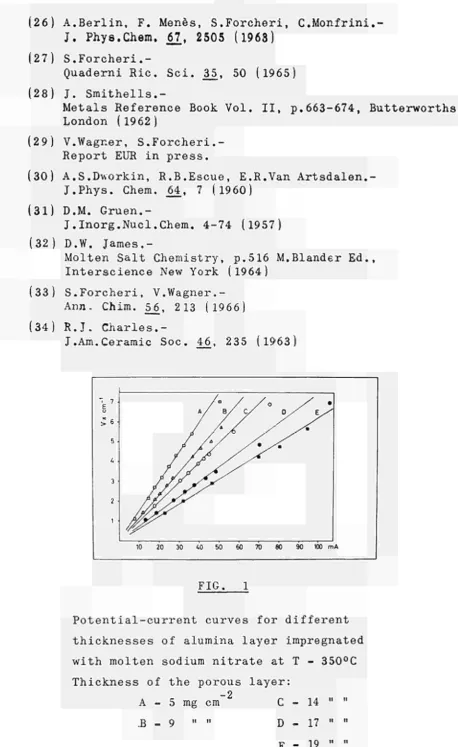
In Fig. 1 a series of V-I curves for NaNO- on layer
of different thickness is shown: . one can observe that at the same temperature the maximum power that can be dissipated is almost independent from the quantity of salt on the strip.
Thus it is possible to give some guide limits of
power dissipated for several salts without increasing the
temperature more than 2°C (Table l ) .
T A B L E 1
Salt
NaN03
KN03
CsN03
TINO g
AgNOg
Temperature
ÌCO)
350 350 450 300
2 50
Dissipation
W/cm2
0.1 0.3 0.3
0.05
0.05
Above these limits it was verified that the tempera-ture of the central zone becomes higher than the ends of
the strip. These limits are in general much smaller
than the power usually dissipated in experiments of this
than one mg) placed on the strip. The temperature is brought again to .the initial value.
For a migration experiment the strip is left at this 13mperature only for a few minutes and then scanned radiomotrically to determine precisly the position of the starting point.
The strip is now ready for the experiment. For the migration a stable potential difference of up to 10 V/cm
is applied to the working electrodes for 0.5 to 4 hours. This produces a displacement of the marked zone of several cm.
For the diffusion after placing the tracer the strip is disconnected from the reservoirs and left at the tempe-rature of the experiment up to 10 hours (x). The diffusion zone isofseveral cm. After the experiment the strip is again scanned. In Table 2 usual experimental conditions are
compared with those relative to other molten salts iono-phoretic techniques.
Asbestos Borosilicate glass fiber Silica Fiber Ceramic Powders Sintered Supports Arnikar and Chemla
Alberti et al
Ketelaar and Honig Bailey and Steger Ketelaar and Kwak Forcheri and Berlin 400°C 500°C 800 30 120 60 10-30 5-30 10 1-3 0.3-2 10 2 2-8 10 400 40-160 10 10-30 5-30 Salt sprinkl-ed on support not saturated
Salt sprinkl-ed on support dipped in molten salt
Determination of the labelled zone of the electromigration and diffusion experiments
The position of the maximum of the activity curve after an electromigration experiment is determined by scanning the strip placed under a G.M. counter with a narrow window. The determination of the diffusion coefficients requires not
only the knowledge of the position of the maximum but also that oí the form of activity distribution curve. After a diffusion
experiment a more precise method is used: the strip is scanned with a G.M. counter adapted with a high density material collimator in direct contact with the strip having a window from 0.5 to 1 mm. The collimator having a thickness of only 1 mm has generally a partial transparency and this is corrected for by scanning the strip with a windowless collimator (x).
Calculation of the transport parameters from the experiment
a) Mobility and transport number
In an electrophoretic experiment the displacement of a labelled zone, 1^, is related to the absolute mobility of the ion i (Ni) by the relation:
in which "V0 is the applied potential gradient and t the
duration of the experiment. K is a factor defined operational
ly as Rp/R, the inverse of the obstructive factor as defined
by Crawford and Edward (22) for paper electrophoresis (Rp is
the electrical resistance of the strip and R the calculated
resistance from the dimensions of the strip and the quantity
of the molten system ,and the specific resistance of the salti
where :
X is the specific conductance of the electrolyte;
d the density of the electrolyte;
ρ the weight of ionic melt per unit of length of support;
i the intensity of the current.
From equation (l) and (2) it follows that the expression
for the ionic mobility of species i in a molten ionic mixture
of m salts is:
« i - I · ^
<
3
>
where q is the quantity of electricity passed through the
cellt Gomìining aquation (3) with the following relations;
(4) A
and
(5)
where t. is the transport number of the species i, f¿ the
equivalent ionic fraction of the ion i and Meo the average
equivalent weight of the system, one obtains:
p.l .F f
t. i — . rr^ (6)
i q M ea
By expliciting f. and M ea this expression becomes:
ι
H
Λ
-f
i. F . N i
Χ
d
Λ
where:
Ρ t. —
1
ν . the 1
1.
1
ζ
val
v. . r.
1 1
m
Jl
enee of ion i
(7)
r. number of gram ions of the specie ¿
η. number of moles of the salt i 3
M, the molecular weight of the salt j
ζ the number of Faraday passed through the cell.
The radiometric determination of the displacement of
the labelled zone and the coulometric determination of the
quantity of electricity passed in the cell enables the
evaluation of the ionic mobility of the labelled species,
provided that the conductivity and density of the system
are known.
For determining the transport number the knowledge
of the latter parameters is not necessary.
b) Diffusion
The solution of the diffusion equation corresponding
to our experimental conditions of a line source at the time
t 0, is the solution of the equation corresponding to the
onedimensional infinite diffusion case (23).
Experimentally, the slop of log activity from the
radiometric scanning versus the square of the linear distance
from the centre of the Gaussian curve (x XQ ) , Fig. 3)1, is
equal to . ·=τγτ (see Fig. 4 ) , where D' is an apparent dif
fusion coefficient, t the duration of the experiment (x)
If the Edward' (24) relation between the K factor defined
in equation (2) and the ratio of the real ionic path, 1 in
the porous support to the linear one, 1', is used:
R ll«'
then:
D. K Dì
ι ι
where D. is the selfdiffusion coefficient of the i species, ι
Thus the ionic mobilities and the transport numbers can
be determined without the explicit knowledge of K (the
measurement of 0 during the experiment using auxiliary
electrodes is not necessary), while for the determination
of the diffusion coefficient K must be measured.
Some applications (x)
Some typical experiments relative to the determination
of an ionic mobility, of a.diffusion
coefficient in molten nitrates and some results relative
to the investigation of the mobility of transition metals
in molten nitrate chloride systems are presented. 137
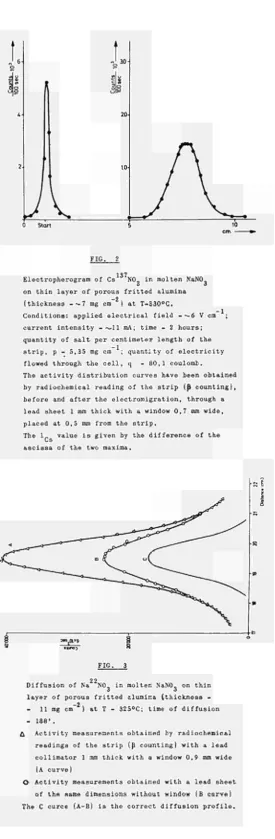
Fig. 2 represents an electropherogram of Cs NO« in
sodium nitrate at 350°C, The two curvee are the result oí
the readings before and after the electromigration.
The distribution of the activity after the experiment
(curve B) does not present tailings or asymmetries: this
(x) Some results using this electromigration technique as applied to the study of some molten systems were previous ly reported (25,26,27). Recently the binary systems
permits to exclude the existence of chemical phenomena between the porous support and the migrating species
(chemical reaction, chemisorption, or decomposition of CsN0Q with formation of Cs90). The mobility value
calcu--4 2 - 1 - 1 lated from the formula (3), is 2,72.10 cm V sec (x).
In Fig. 3 are reported the readings of the activity 22
after a diffusion experiment: Na " N0„ in sodium nitrate at T-32 5°C. The curve A is obtained with a collimator of Pb thick 1 mm. with a window of 0.5 mm. The Β curve is obtained through a Pb sheet with the same dimensions but without window. The correct diffusion profile is given by curve C (xx). In Fig. 4 the function log activity vs.
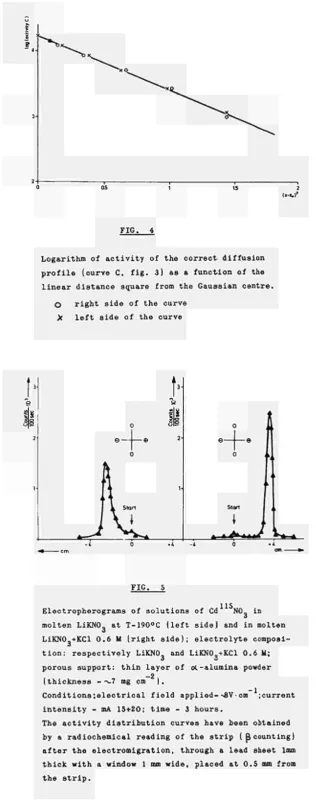
the square of the linear distance from the Gaussian centre is plotted.
-5 2 -1
From the slope a value of D -2.2 10 cm sec is obtained(with a measured K value of 1,9). It can be compared with the
—5 2 —1
value of 1.94.10 cm sec of Dworkin et al.(30)) at Τ - 320°C.
The results relative to the investigation of the mobi lity of traces of transition metals in nitrate-chloride environnement indicate that ionic mobilities can vary ap preciably with melt composition. The formation of a metal halogenide aeeooiation is often pointed out by a change in the sign of the mobility of the metal (starting from pure nitrate melt).
(x) Specific conductivity and density interpolated from data of reference (28).
In Fig. 5 is presented an electropherogram of a solution of Cd(NO.)« in LiKNO. eutectic; in the same figure is reported an electropherogram of a solution of Cd(NO_) in the same eutectic in which a quantity
of KCl was dissolved, (ratio Cl/Cd - 5). The asymmetry of the cadmium zone is due to the slight decomposition of the cadmium species with formation of CdO during the electromigration. This phenomenon is unavoidable also by working in atmosphere of inert eas and it increases with an increase in temperature. The cadmium zone after migration in the solution LiKNO.+KCl is symmetric: the cadmium chloride association is more stable than cadmium.
The behaviour of zinc in such melts has been found to be rather similar to that of cadmium.
It seems that most transition metals have a tendency toward the formation of halogenides associations in molten systems. It is worth to note that these electrophoretic observations are in accord to the spectroscopic studies on the formation of this kind of association in melts (31, 32).
DISCUSSION
In the ionophoretic experiments just described, while the contact surface between the molten system and the porous wall is normally smaller than in the case
This large ratio of gas to molten salt contact surface
presents a major drawback. Work at temperatures at which
the vapour pressure is higher than 12 mm of Hg is very
difficult.
The loss of salt by evaporation leads to a continuous
pumping of the salt from the reservoirs to maintain steady
conditions on the strip: this can affect the measurement
of the displacement of the labelled zone. The presence of
an appreciable vapour phase above the strip can produce
also a nonnegligible isotopie exchange between the gas
phase and the liquid; in favorable cases one observes a
widening of marked zone (and in less favorable cases the
whole strip can become active).
The slight decomposition or hydrolysis of the melt
which occurs often at the surface is also to be avoided.
It is often necessary to maintain an inert and dry atmo
sphere at all times while the salt is in the molten state.
For example the determination of the transport para
meters of AgNOq while realizable with porous plug techniques
(4) presents some difficulties when using ionophoretic
methods. A dry inert atmosphere is necessary to prevent
the decomposition of the AgNO_ with formation of silver
oxide (also at temperature below 250°C)(x).
The investigation of mobilities of transition
metals in molten systems can be performed only in inert
dry atmosphères.
(χ) Ceramic oxides supports do not show reaction with this salt. Chemisorption occurs with glass fibers support (20). It is also probable that asbestos,due to its ion
exchange properties, "is not , inert to. the silver
The K values, in absence of specific interactions of the support with the melt, are a measure of the geometry of the salt on the support. These values for molten
nitrates are usually 1,3*1,5 (powder) and 1,5+1,9 (frit-ted) depending on the quantity of the molten system with respect to the porous thin layers. These values are
slightly smaller than the corresponding value of acqueous electrolyte solutions absorbed on paper (22).
The applicability of the equation (3) and (7) to the electromigration experiments for the calculation of the ionic mobilities and transport numbers of the species of the salt system absorbed on the porous support is limited to the cases in which selective interactions between the porous support and the ionic species do not exist, and when the geometry of the salt on the porous support is
such that all the system fully participates,in.the ionic transport.
In the first case the.K/factor can no longer be expressed as Rp/R for all the ionic species: the quantities calculted with the equation (3) and (7) will be also a measure of an electroosmotic effect due to selective wall interactions
(27,33).
A chemical reaction of the support with an ionic component of the salt or chemisorption can cause such an effect. Fired or fritted ceramic oxides do not show
chemical interaction with molten nitrates, Exohange proper-ties of the pyrex glass, can render
electromi-gration experiments (χ) (16).
In the second case the non applicability of the formulas(3) and (7) arises from the lack of knowledge of the factor ρ (weight of the salt which effectively participates on the electrical transport per unit length of the strip). If ρ is taken as the total salt weight for unit length of the strip, the quantities measured are too large (xx). This point should be verified, for instance, when in the support some pore diameters are
very small: part of the salt can be placed in cavities with small openings so that the ion exchange between the bulk might be slower than the electrical transport .
In general, it is likely to suppose that the trans port processes of molten salts absorbed ona porous support are influenced by the pores size (or by the extension of the surface) of the support below a critical size value.
_2 The critical value lies probably in the range 1-10 yU.
(x) In some electromigration experiments in molten sodium nitrate carried out on alumina powder deposited on
pyrex strips an unusual variation of the cationic trans port number with temperature wag observed (from 0,7 to 0,5 passing from 370°C to 420°C). After the experiments radioactive sodium was observed in the pyrex strip with out any changein weight of this latter.
(xx) Experimentally this point has been verified with cera-· mie sintered support (AI2O3 and Zr02) presenting a large
spectrum of pore diameters (from 1 micron to 100 At f).
These supports were prepared by a prolonged but not com plete sintering. In a series of determinations of the cationic transport numbers of molten sodium nitrate, values larger than one were obtained. The Κ values were unusually large (-v.4).A difference between a.c. (2 Kc/sec) and d.c. conductivity (a.c. larger than d.c. conductivity)
The ceramic support presented (either powdered, either fritted) have an average pores «size of the order of ten microns or more. This fact* and the absence of chemical interactions with molten nitrates give a posi-tive indication on the validity of the method as a tool for determining the isothermal transport quantities of these systems.
ACKNOWLEDGEMENT
We are greatly endebted to B. Langevin and to V.Wagner who participated in the last part of this work.
We wish to-thank G. Marengo of the Physical Chemistry Service of Ispra Centre for the determination of specific surface and porosity.
We are also endebted to E. Franzetti of the Metallurgy Service for his kind assistence in the utilisation of the Flame Spraying Technique.
BIBLIOGRAPHY
(1
(2
(3
(4
(5
(6
(7
(8
B.R.Sundheim.-Fused Salts p. 165, Sundheim Ed., McGraw Hill Book Co. New York (1964).
A.
Klemm.-Molten Salt Chemistry, p.535, Blander Ed., Interscience New York (1964)
F.R. Duke, R.W. Laity.-J.Phys.Chem. 59, 6 (1955) R.A.Laity,
F.R.Duke.-J. Electrochem.Soc. 105, 197 (1958) I.G.Murgulescu,
D.Topor.-Z.Phys.Chem. (Leipzig) 22_1> 139 (1962)
A.Lunden.-J. Electrochem.Soc. ¿09, 260 (1962)
F.R.Duke,.G.Victor.-J.Electrochem.Soc. 110, 91 (1963) R.J.Labrie,
(10) F.Lantelme, xM.Chemla.
Electrochem. Acta JLO, 665 (1965)
(il) H.J.Arnikar, M.Chemla.
Radioisotopes in scientific research Vol. II p.421 Pergamon Press, London (19 58)
(12) G.Alberti, G.Grassini, R.Trucco. J.Electroan. Chem. 3, 283 (1962)
(13) R.A.Bailey, A.Steger.
J. Chromatogr. Π., 122 (1963)
(14) G.Alberti, S.Allulli, G.Modugno. J. Chromatogr. JL5, 420 (1964)
(15) J.A.A. Ketelaar, Ε.P. Honig. J.Phys. Chem. 6_8, 1956 (1964)
(16) E.P.Honig, J.A.A. Ketelaar. Trans.Far.Soc. 62, 190 (1966).
(17) C.F. Morel.
Private Communication.
(18) E.Lederer, M.Lederer.
Chromatography p. 20, Elsevier Pubi. Amsterdam (1957)
(19) A.Berlin, S.Forcheri, B.Langevin, V.Wagner.
Paper presented to the 16th CITCE Meeting (1965) Report EUR in press
(20) E.P.Honig.
Thesis Amsterdam (1964)
(21) L.P.Ribeiro, E.Mitidieri, O.R.Affonso.
Paper Electrophoresis, p.26, Elsevier Pubi. Amsterdam (1961)
(22) R. Crawford, J.T. Edward. Anal. Chem. 29, 1543 (1957)
(23) W. Jost.
Diffusion in Solids, Liquids Gases, p.17 Academic Press, New York (i960)
(24) J.T. Edward.
J. Chromat. 1, 446 (1958)
(25) S.Forcheri, C.Monfrini.
Quaderni Rie. Sci. 35_, 50 (1965)
(28) J. Smithelis.
Metals Reference Book Vol. II, p.663674, Butterworths, London (1962)
(29) V.Wagner, S.Forcheri. Report EUR in press.
(30) A.S.Dworkin, R.B.Escue, E.R.Van Artsdalen. J.Phys. Chem. 64, 7 (i960)
(31) D.M. Gruen.
J.Inorg.Nucí.Chem. 474 (1957)
(32) D.W. James.
Molten Salt Chemistry, p.516 M.Blander Ed., Interscience New York (1964)
(33) S.Forcheri, V.Wagner. Ann. Chim. 5_6, 213 (1966)
(34) R.J. Charles.
J.Am.Ceramic Soc. 46, 235 (1963)
v-υ
Í 6
-5 ·
U ■
3 ■
2 · 1
/
/ /'°
/
*
A / Β / Ζ/ ν / Z/
10 20 30 40 50 60 70 80 90 K» m A
FIG.
Potentialcurrent curves for different
thicknesses of alumina layer impregnated
with molten sodium nitrate at Τ 350°C
Thickness of the porous layer:
A 5 mg cm"2 C 14 " "
.Β 9 D 17 " "
[image:28.595.31.490.58.806.2]s t r i p , ρ 5,35 mg cm ; q u a n t i t y of e l e c t r i c i t y
flowed through the cell, q 80,1 coulomb. The activity distribution curves have been obtained by radiochemical reading of the strip (p counting), before and after the electromigration, through a
lead sheet 1 mm thick with a window 0,7 mm wide, placed at 0,5 mm from the strip.
The 1„ value is given by the difference of the ascissa of the two maxima.
■ S
FIG. 22
Diffusion of Na NO in molten NaNO, on thin layer of porous fritted alumina (thickness
_2
11 mg cm ) at T 325°C; time of diffusion 188'.
Û Activity measurements obtained by radiochemical readings of the strip (B counting) with a lead collimator 1 mm thick with a window 0,9 mm wide (A curve)
[image:29.595.155.431.0.842.2]linear distance square from the Gaussian centre.
O right side of the curve
λ left side of the curve
0 0
, l l V Start
's als
2ι
1-0 ° <D I 0
, >
Start 1
I
FIG.
E l e c t r o p h e r o g r a m s of s o l u t i o n s of Cd NO. in molten LiKNO a t T190°C ( l e f t s i d e ) and i n molten LiKNO.+KCl 0 . 6 M ( r i g h t s i d e ) ; e l e c t r o l y t e composi t i o n : r e s p e c t i v e l y LiKNO and LiKN0,+KCl 0.6 M; p o r o u s s u p p o r t : t h i n l a y e r of ocalumina powder
2
(thickness ^ 7 mg cm ).
Conditions;electrical field applied>flV·cm ¡current
intensity mA 15*20; time 3 hours.
The activity distribution curves have heen obtained
by a radiochemical reading of the strip ( Β counting)
after the electromigration, through a lead sheet 1mm
thick with a window 1 mm wide, placed at 0.5 mm from
[image:30.595.89.406.28.835.2]specimen copies please write to :
fía Handelsblatt GmbH
"Euratom Information" Postfach 1102
D-4 Düsseldorf (Germany)
or
Office central de vente des publications des Communautés européennes 2, Place de Metz Luxembourg
;!ή·1«?Ι
.;:::Π;:;;:::::::
; To disseminate knowledge is to disseminate prosperity — I mean ! general prosperity and not individual riches — and with prosperity | disappears the greater part of the evil which is our heritage from ! darker times.
Alfred Nobel ' · · . ; ; : : : ; : : : : : : ; : : : : : : : ■
ïSfCf
AU Euratom reports are o n sale at
cai,!
es given on the back of the front cover (when ordering, specify clearly the EUR number and the title of the report, which are s h o w n on the front cover)
¡"Uil· ψ
m
«fóri
ï
■'•■ΧΛ&ΚΑ
PRESSES ACADEMIQUES EUROPEENNES 98, Chaussée de Charleroi, Bruxelles 6
Banque de la Société Générale Bruxelles
compte N° 964.558, t | j J |
Banque Belgo Congolaise Bruxelles compte N° 2444.141,
Sai.'rttíiiíjÍíJínffiíí^uil
tm
Compte chèque postal Bruxelles N° 167.37,
Belgian American Bank and Trust Company New York compte No. 22.186,
Lloyds Bank (Europe) Ltd. 10 Moorgate, London E.C.2, Postscheckkonto Köln Nr. 160.861.
frifcJT3'i'L''(f" 'îi.' »."vi
iiiaiÉïf'
mfàn
¿wBfSLM
OFFICE CENTRAL D E VENTE DES PUBLICATIONS D E S C O M M U N A U T E S E U R O P E E N N E S
2, place de Metz, Luxembourg (Compte chèque postal N° 19190)
B E L G I Q U E — B E L G I Ë
M O N I T E U R B E L G E
4042, r u e de Louvain Bruxelles B E L G I S C H STAATSBLAD Leuvenseweg 4042 Brussel
(ë.
D E U T S C H L A N D
B U N D E S A N Z E I G E R Postfach Köln 1
F R A N C E
S E R V I C E D E V E N T E E N F R A N C E D E S P U B L I C A T I O N S D E S
C O M M U N A U T E S E U R O P E E N N E S 26, r u e Desaix Paris 15e
I T A L I A
L I B R E R I A D E L L O STA Piazza G. Verdi, 10 R o m a
L U X E M B O U R G
O F F I C E C E N T R A L D E V E N T E D E S P U B L I C A T I O N S D E S COMMUNAUTES E U R O P E E N N E S 9, r u e Goethe Luxembourg
tffi&fil
N E D E R L A N D
S T A A T S D R U K K E R I J
Christoffel P i a n t i j n s t r a a t Den H a a g
ü
U N I T E D K I N G D O MC D N A 0 3 1 6 0 E N C
ΠΒΒΤ F ,% MMUHm *
H. M. S T A T I O N E R Y O F F I C E P . O . Box 569 London S.E.l
...ft?« CM·! '
EURATOM — C.I.D.